


Diagnosing short and open circuits starts with one practical idea: a short circuit creates an unintended path for current, while an open circuit breaks the intended path and stops current from reaching the load. For beginners, that difference matters because it shapes every next step, from symptom recognition to safe testing with a meter.
The first part of diagnosis is learning what each fault looks like in real life. A short often blows a fuse, trips protection, or overheats wiring, while an open often makes a component stop working completely or work only intermittently. That symptom pattern gives you your first clue before any testing begins.
The next part is learning how to test logically instead of guessing. Using a multimeter for wiring diagnosis helps you check voltage, continuity, and resistance in the right order, so you can confirm whether the circuit is overloaded, disconnected, or simply losing power at one point in the path.
The final part is knowing what causes these faults, what mistakes beginners should avoid, and when wiring repair becomes urgent. Introduce a new idea: below, the guide moves from definition to symptoms, then to tools, diagnosis steps, common causes, safety, and broader troubleshooting scenarios.
What are short circuits and open circuits?
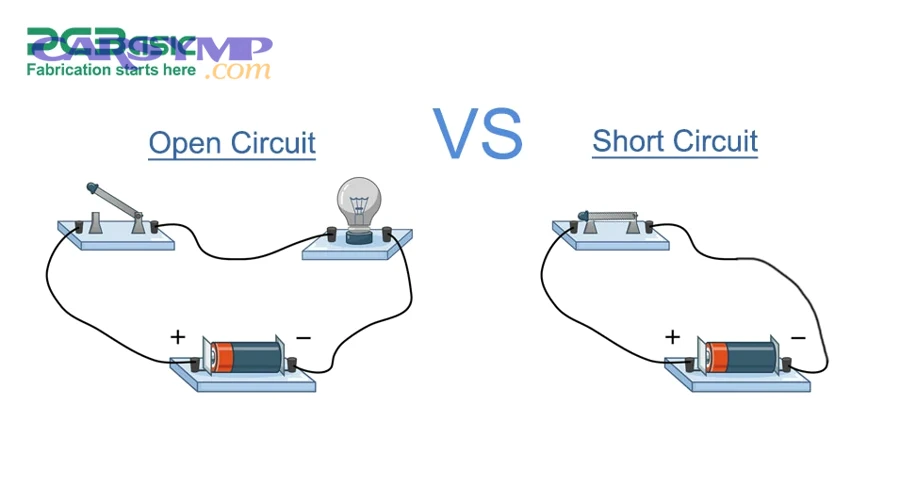
Short circuits and open circuits are two basic electrical faults: a short creates an unintended low-resistance path, while an open breaks the circuit path and stops normal current flow. To better understand that difference, it helps to define each fault separately before comparing how they behave in real troubleshooting.

What is a short circuit?
A short circuit is an electrical fault in which current leaves its intended route and follows an unintended path with lower resistance. In normal operation, current travels through a complete path that includes the source, wiring, switch or control, load, and return path. In a short, insulation damage, melted wiring, moisture, or internal component failure lets current bypass some or all of that intended route.
That is why short circuits often create strong symptoms quickly. A fuse may blow the moment the circuit is energized. A breaker may trip repeatedly. A wire may become hot because too much current flows through a path that was never meant to carry it that way. In severe cases, the short creates sparks, smoke, or a burning smell.
A short is not always dramatic, though. Some faults are partial shorts. In those cases, the circuit may still operate, but it may behave erratically, dim lights, reset modules, or blow a fuse only under vibration or load. That is why beginners should not limit their understanding of a short to the image of a dead battery cable touching metal. Many real-world shorts are smaller, intermittent, and hidden inside connectors or under damaged insulation.
In practical terms, diagnosing a short means finding where the unwanted path exists. That path may be between a power wire and ground, between two adjacent conductors, or inside a component whose internal insulation has failed. Once the short location is isolated, wiring repair usually involves replacing damaged insulation, repairing the wire section, correcting routing, or replacing the failed component.
What is an open circuit?
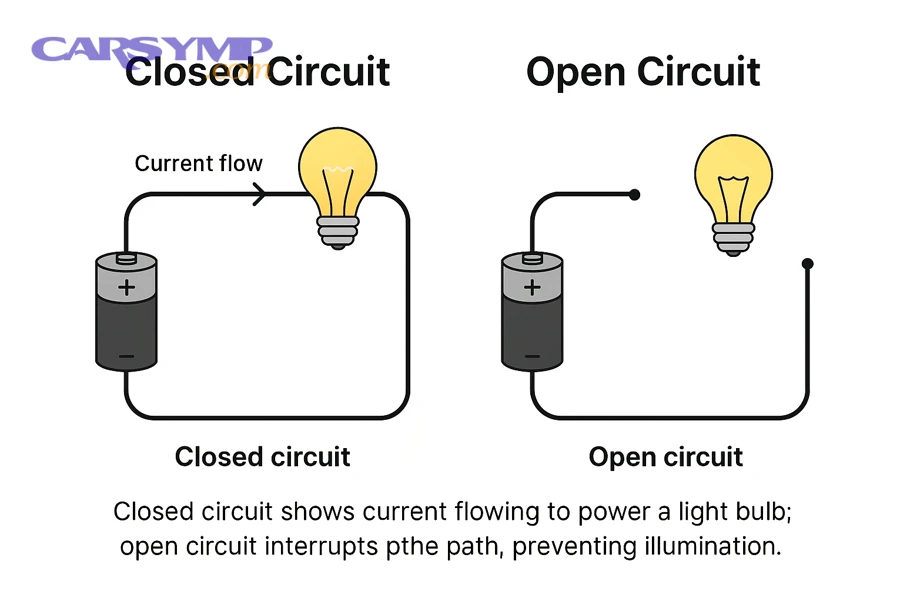
An open circuit is an electrical fault in which the intended current path is broken, so electricity cannot complete the circuit through the load. More specifically, the break may be obvious, such as a disconnected plug or blown fuse, or it may be hidden, such as a broken conductor inside intact insulation or a corroded terminal that has separated electrically.
Because the path is broken, the usual symptom is loss of function. A motor will not run, a lamp will not illuminate, or a sensor circuit will not transmit a usable signal. Sometimes the failure is complete. Sometimes it is intermittent because the broken section touches only when vibration, heat, or movement changes the connection.
Open circuits are common in aging wiring because conductors fatigue, connectors loosen, terminals corrode, and switches wear internally. In a beginner diagnostic process, an open often shows up as “power here, no power there” when you trace the circuit with a meter. That simple logic makes open-circuit diagnosis one of the best entry points for learning electrical troubleshooting.
When people think about wiring repair, they often imagine replacing burned wires after a short. However, many real repair jobs involve open circuits: fixing a broken wire inside a harness, restoring a poor crimp, cleaning a corroded terminal, or replacing a switch contact that no longer closes.
How is a short circuit different from an open circuit?
A short circuit and an open circuit differ in current behavior, symptom pattern, and risk. Specifically, a short allows unintended current flow, while an open prevents intended current flow.
This difference explains why symptoms often look opposite. A short tends to overload the circuit. It may blow a fuse, trip a breaker, heat a wire, or drain a battery. An open tends to starve the load. It often causes a device to stop working, operate intermittently, or show no response at all even though the rest of the system appears normal.
The risk profile also differs. Shorts are often more urgent because excessive current can damage wiring and create heat. Opens are often less dramatic, but they can still be serious when they disable lighting, fuel delivery, cooling fans, brakes, steering assist, or safety-related electronics.
Test results differ too. A short may show unexpected continuity to ground or very low resistance where it should not exist. An open may show infinite resistance across a section that should conduct or reveal a voltage drop that disappears after a break point. Understanding that contrast is the foundation of Using a multimeter for wiring diagnosis correctly.
What signs tell you a circuit may be shorted or open?
A circuit may be shorted or open if it shows recognizable patterns such as blown protection, overheating, total loss of function, or intermittent operation. Next, those symptom patterns help you choose the right test before you touch the meter.

What symptoms usually indicate a short circuit?
Short circuits usually show at least three classic signs: blown fuses or tripped breakers, heat or burning smell, and abnormal current-related behavior such as sparks or battery drain. More specifically, these symptoms appear because the fault gives current an easier path than the designed load path.
A fuse that blows immediately after replacement is one of the clearest warning signs. If the protection fails the instant the circuit is energized, current is likely rushing through a low-resistance fault path. Repeated fuse failure under the same condition is not random bad luck; it is a diagnostic clue that points toward a short or near-short.
Heat is another strong sign. Shorted wires, connectors, or components may become warm or hot to the touch. Plastic insulation may soften, discolor, or emit an acrid smell. A short near metal edges or moving parts may create visible abrasion or chafing marks. In vehicle harnesses and industrial machinery, that visual evidence often leads directly to the fault.
Some shorts are intermittent. A trunk harness may short only when flexed. A fan motor lead may touch ground only when vibration moves it. A component may short internally only when hot. That is why symptoms can appear random unless you link them to movement, temperature, or load.
What symptoms usually indicate an open circuit?
Open circuits usually show three different signs: the load stops working, operation becomes intermittent, or power is present only up to one point in the circuit. Then, once the path breaks, the component cannot receive or return current as intended.
A dead load is the most familiar symptom. A bulb does not light. A pump does not run. A relay does not energize. In many cases, the supply side still has voltage, but the circuit cannot complete the path through the device and back to the source or ground.
Intermittent behavior also points to an open. For example, a wire may be internally broken but still touch enough to work when cold. A corroded connector may pass current until vibration shakes it loose. A worn switch contact may connect only when pressed in a certain way. These symptoms often mislead beginners into replacing the load when the real problem is upstream or downstream in the path.
An open may also show as normal voltage at the source but missing voltage at the load. That pattern is why voltage tracing is so effective. It turns a “nothing works” complaint into a structured search for the last point where the circuit was still intact.
Can a circuit have symptoms of both a short and an open?
Yes, a circuit can show symptoms of both a short and an open because damage, corrosion, or connector failure can change the fault pattern as conditions change. However, that mixed behavior still follows electrical logic once you isolate the path.
A partially melted connector is a good example. At one moment, heat-damaged terminals may touch and create a short or high-current event. At another moment, the same terminals may separate enough to act like an open and stop current flow altogether. The user experiences both fuse failures and no-operation complaints, but the root cause is the same damaged connection.
Corrosion can do the same thing. Moisture may create a conductive bridge between adjacent pins, especially in low-voltage circuits. Later, corrosion buildup increases resistance or separates the contact, producing an open-circuit symptom instead. This is why a single connector can create confusing behavior until it is inspected closely.
Mixed symptoms do not mean diagnosis is impossible. They mean the fault is unstable, and the best response is to test the circuit in sections, inspect physical connection points, and reproduce the condition if possible.
What tools do beginners need to diagnose short and open circuits?
Beginners need only a few core tools to diagnose short and open circuits: a digital multimeter, a wiring diagram, visual inspection light, and basic hand tools. To better understand fault patterns, the right tool matters less than using it in the right order.

Is a digital multimeter enough for basic diagnosis?
Yes, a digital multimeter is enough for basic diagnosis because it checks voltage, continuity, and resistance, which are the three measurements beginners use most often. Specifically, those three functions help confirm whether power is present, whether the path is continuous, and whether a section behaves abnormally.
Voltage testing tells you whether the circuit is energized at a given point. That is useful when a device does not operate and you need to find where power disappears. Continuity testing, done with power removed, tells you whether a section of wire or a switch path is electrically connected. Resistance testing helps reveal unwanted low-resistance paths, open sections, or abnormal values across some components.
A multimeter does not solve everything alone. A test light can be useful in simple load circuits, and a clamp meter can help on current-heavy systems. Still, for beginner learning, the multimeter covers the essential logic of diagnosis. It teaches you to stop guessing and start verifying.
That is why Using a multimeter for wiring diagnosis is one of the most valuable skills a DIY beginner can learn. It turns the circuit into measurable checkpoints instead of mysterious behavior.
What should you inspect before using a meter?
Before using a meter, inspect the circuit visually for at least four things: damaged insulation, loose or corroded connectors, blown fuses, and signs of heat or rubbing. More importantly, visual inspection often identifies the fault faster than meter testing.
A wire routed against a sharp bracket may show clear chafing. A connector may have green corrosion on the terminals. A fuse may be open, and the pattern around the fuse box may show moisture or heat. A harness near an engine or motor may show hard, brittle insulation caused by long-term heat exposure.
Visual inspection also helps you plan your meter work. If you already see likely damage near a hinge, hot component, or moving linkage, you can begin testing at the most probable fault area instead of measuring random points.
Beginners often underestimate this step because it looks too simple. In reality, it is one of the most professional habits in troubleshooting. Many effective wiring repair jobs begin not with a probe but with careful observation.
What safety steps should you follow before testing a circuit?
Before testing a circuit, follow three safety steps: identify whether the circuit is live, disconnect power before continuity or resistance tests, and protect yourself from heat, sparks, or unintended activation. In addition, safe testing prevents meter damage and personal injury.
Never measure resistance or continuity on a live circuit. That is one of the most common beginner mistakes. Resistance mode sends a small internal signal from the meter, and external voltage can damage the tool or distort the reading. If the circuit powers motors, relays, or other moving components, live probing can also trigger unexpected movement.
Use insulated probes, keep fingers behind the probe guards, and avoid bridging adjacent terminals accidentally. When testing near batteries, power supplies, or high-current components, remove jewelry and keep metal tools under control. If the system includes control modules, review whether disconnecting power could affect memory or settings before you proceed.
Safety also includes knowing when not to test further. If insulation is melted, smoke is present, or a circuit continues to overheat, stop energizing it until you isolate the fault. No reading is worth worsening the damage.
How do you diagnose a short circuit step by step?
Diagnosing a short circuit follows four steps: confirm the overload pattern, isolate the affected branch, test sections with the meter, and verify the exact fault location. Let’s explore each step so the logic becomes repeatable instead of intimidating.

How do you confirm that a short circuit is present?
You confirm a short circuit by verifying repeated overcurrent symptoms and finding an unintended low-resistance path where it should not exist. To begin, look for the pattern: a fuse blows repeatedly, a breaker trips, or a wire heats up whenever the circuit is energized.
Then compare that symptom to the circuit design. If the circuit should power a lamp, motor, or sensor but instead kills the fuse immediately, current is likely bypassing the intended load or entering ground too easily. At that point, disconnect power and test the suspected branch for continuity to ground or abnormal resistance.
Context matters here. Some loads normally have low resistance, so beginners should not interpret every low reading as a short. The better question is whether the reading makes sense for the circuit state. If the load is unplugged and the wire still shows unintended continuity to ground, the fault is more likely in the harness than in the device.
How do you isolate where the short is located?
You isolate a short by dividing the circuit into smaller sections and retesting each section until the unwanted path disappears. Specifically, this “divide and isolate” method prevents random guessing.
Start at the branch protected by the failed fuse or breaker. Disconnect the load if possible. Then disconnect connectors that split the circuit into sections. After each disconnection, test again. If the short disappears after unplugging one branch, that branch likely contains the fault. If it remains, the fault is upstream.
This method works because electrical faults become easier when the circuit becomes smaller. Instead of asking, “Where is the short in this whole system?” you ask, “Is the short before or after this connector?” Then you ask the same question at the next point. That step-by-step narrowing process is how professionals find hidden faults efficiently.
In wiring repair, isolation also helps you decide what to repair. You may find that the short exists in a short exposed harness segment, a crushed connector area, or inside a failed device. That difference changes the repair cost, parts, and time required.
How do multimeter readings help you find a short?
Multimeter readings help you find a short by showing abnormal continuity, very low resistance, or incorrect voltage behavior along the circuit path. More specifically, the meter turns a suspected short into a measurable condition.
With power removed, continuity between a power wire and ground may reveal the short path. With the load disconnected, a low-resistance reading that remains suggests wire damage or a shorted internal circuit elsewhere. With power applied carefully, voltage may disappear as the fuse fails or show abnormal distribution when the fault drags the circuit down.
The reading becomes most useful when you compare sections. A damaged branch may show continuity to ground, while a healthy branch does not. A connector pin may read normal on one side and faulty on the other. Those comparisons convert the meter from a guessing tool into a logic tool.
In practice, beginners improve fastest when they record readings. Write down where voltage was present, where it disappeared, and where continuity changed. That small habit creates a troubleshooting map and makes repeat tests easier.
How do you diagnose an open circuit step by step?
Diagnosing an open circuit follows four steps: confirm the loss of function, trace voltage from the source, check continuity with power off, and locate the exact break. Then, once the path is broken, each test narrows the search to one failed section.
How do you confirm that a circuit is open?
You confirm that a circuit is open by proving the load cannot complete its normal electrical path even though the system should be operating. To better understand that proof, begin with the simplest question: does the load receive power and have a return path?
If the device does not work, check for supply voltage at the feed side. If voltage is present at the source but absent at the load, the fault lies somewhere between those points. If voltage reaches the load but the return path is missing, the open may be on the ground side or through a switch, relay, or control module.
An open may also appear after a fuse, connector, splice, or flexible section of harness. That is why diagnosis should follow the path in order rather than jumping around. Every measurement should answer, “Is the path intact up to here?”
How do you find where the circuit opens?
You find where a circuit opens by locating the last point that still works electrically and the first point that does not. Specifically, that “last good, first bad” method is the fastest way to locate a break.
Begin at the power source and trace the circuit forward. Check voltage before and after the fuse. Check before and after the switch. Check at the connector entering the load. If voltage disappears between two test points, the open lies between them. With power removed, you can then test continuity across that isolated section to confirm the break.
Do the same on the return side when needed. Many open-circuit problems are not missing power but missing ground. That is especially common in corroded connectors, body grounds, and equipment exposed to moisture.
This process also supports accurate Wiring repair cost estimate decisions. A broken terminal at an exposed connector is usually inexpensive to repair. A break buried in a long harness or under interior trim takes more labor and costs more even if the damaged conductor itself is simple.
How do continuity and voltage tests reveal an open circuit?
Continuity and voltage tests reveal an open circuit in different but complementary ways: continuity checks the path with power off, while voltage tracing shows where power stops under operating conditions. In addition, using both methods reduces false conclusions.
Continuity is useful when you can isolate a section completely. If a wire should connect two points but shows infinite resistance or no continuity, the section is open. This is ideal for checking disconnected harness sections, switches, and known wire runs.
Voltage tracing is useful when the system is assembled and energized. It shows where electricity still reaches and where it no longer does. In a working path, supply voltage appears where expected. In an open path, voltage may vanish after the break or appear only on one side of a component or connector.
The strongest diagnosis usually combines both. First, voltage tracing identifies the suspect zone. Then continuity confirms the exact broken section with power removed.
What are the most common causes of short and open circuits?
The most common causes of short and open circuits fall into a few groups: physical wire damage, connector failure, heat, corrosion, movement, and internal component failure. Below, each cause group explains why faults appear repeatedly in the same places.
What commonly causes short circuits?
There are five main causes of short circuits: insulation damage, pinched wiring, moisture intrusion, melted conductors, and internal component failure. Specifically, all five create an unintended path that lets current flow where it should not.
Insulation damage is the most common. Wires rubbing against metal brackets, engine parts, moving hinges, or sharp edges eventually wear through. Once copper contacts ground or another conductor, the short begins. Pinched wiring does similar damage when clips, panels, or fasteners crush a harness.
Moisture intrusion causes shorts by bridging contacts or reducing insulation quality. This is common in outdoor equipment, vehicles, marine systems, and poorly sealed connectors. Heat can melt insulation until adjacent wires contact one another. Internal component failure can also create a short when a motor, relay, sensor, or module fails inside its housing.
These causes matter because they influence repair strategy. A short caused by routing can return if you only tape the wire and ignore the rubbing point. Effective wiring repair solves both the electrical damage and the mechanical cause.
What commonly causes open circuits?
There are five main causes of open circuits: broken conductors, loose terminals, corroded connectors, blown fuses, and failed switches or relays. Then, each cause interrupts the path and prevents normal current flow.
Broken conductors often occur where wiring flexes repeatedly, such as door harnesses, tailgate harnesses, articulated machines, and tools with moving cables. Loose terminals create intermittent opens because the physical connection no longer holds tightly enough for reliable contact. Corrosion separates metal surfaces or increases resistance until the connection fails.
Blown fuses are technically an intentional open, and they should always prompt a search for the cause rather than simple replacement. Switches and relays also fail internally when contacts wear, burn, or stick. In those cases, the wire may be perfect while the switching device interrupts the path.
Open-circuit causes often look less dramatic than short-circuit causes, but they are just as important for reliable system operation.
Are corrosion, heat, and vibration major causes of both faults?
Yes, corrosion, heat, and vibration are major causes of both faults because they damage conductors, insulation, terminals, and contact surfaces in different ways. More importantly, these three conditions often work together over time.
Corrosion can reduce contact pressure, create conductive contamination, and weaken terminals. Heat can harden insulation, loosen crimps, and accelerate material breakdown. Vibration can rub wires through insulation, fatigue conductors, and separate weak terminals.
That overlap is why the same environment can create both a short and an open at different stages of failure. A connector may start with rising resistance, progress to intermittent open behavior, and later develop conductive contamination between terminals. Understanding those stages helps beginners think beyond a single fixed fault label.
What mistakes do beginners make when diagnosing shorts and open circuits?
Beginners make a few consistent mistakes when diagnosing shorts and open circuits: they replace parts too early, skip visual inspection, misuse the meter, and ignore grounds and connectors. However, these mistakes are easy to fix once you follow a repeatable process.

Why is replacing parts before testing a mistake?
Replacing parts before testing is a mistake because symptoms do not prove the failed part, parts swapping hides the real fault, and unnecessary replacements increase time and cost. To illustrate, a dead motor may not be bad at all; it may simply be on the far side of an open wire.
Guess-based replacement also creates confusion when multiple changes happen at once. If you replace a relay, a switch, and a component before testing, you may never learn which change mattered. That weakens future troubleshooting skill and makes repeat faults harder to solve.
A better method is simple: inspect first, test second, repair third, replace fourth if needed. That order supports accurate decisions and prevents waste. It also improves any Wiring repair cost estimate because you are paying for confirmed failure, not speculation.
Why is testing resistance on a live circuit dangerous and misleading?
Testing resistance on a live circuit is dangerous and misleading because external voltage interferes with the meter, can damage the meter, and may expose the user to unexpected electrical behavior. More specifically, ohms and continuity modes are designed for de-energized circuits only.
When a circuit remains live, the meter’s internal measurement signal competes with external voltage. The reading becomes unreliable, and some meters can be damaged. If the circuit includes motors or relays, probing in the wrong condition can also activate parts unexpectedly.
The correct practice is to remove power, confirm the circuit is de-energized, isolate the section if possible, and then measure resistance or continuity. Live circuits are for voltage testing, not resistance testing. That single distinction prevents many beginner errors.
Can a bad ground look like a short or an open circuit?
Yes, a bad ground can look like a short or an open circuit because it disrupts current return, creates unstable voltage behavior, and can mimic both loss-of-function and overload-related symptoms. In addition, poor grounds are common and often overlooked.
A weak or corroded ground can act like an open by preventing the load from completing the circuit. The component may not run, may run weakly, or may work intermittently. At the same time, unstable grounding can cause strange current paths, feedback through other circuits, dim lights, false sensor readings, or unexpected module behavior that looks like a short.
That is why grounds deserve early testing. Check for voltage drop across the ground path under load, inspect attachment points, and clean or repair poor connections. Many stubborn problems disappear when the return path is restored properly.
When is a short or open circuit unsafe to keep using?
A short or open circuit becomes unsafe when it creates heat, disables critical functions, or behaves unpredictably under load or motion. In short, some faults are minor inconveniences, but others demand immediate shutdown and repair.

Is a short circuit always urgent?
Yes, a short circuit is usually urgent because it can overheat wiring, damage components, and create fire risk if the protective device does not act as intended. More importantly, repeated energizing of a short can enlarge the damage each time.
A small short may begin as a blown fuse complaint, but repeated fuse replacement without diagnosis can melt more insulation, damage connectors, or hide the original contact point. If smoke, heat, or burning odor appears, the circuit should not be re-energized until the fault is isolated.
Urgency also depends on circuit function. A short in a convenience accessory may be less critical than a short affecting steering assist, battery cables, fuel delivery, cooling systems, or lighting. Still, in all cases, the presence of excessive current makes a short a high-priority fault.
Is an open circuit always harmless?
No, an open circuit is not always harmless because it can disable safety systems, stop cooling or fuel delivery, remove lighting, or interrupt controls that the equipment depends on. However, the danger is usually functional rather than thermal.
An open in a cabin light circuit may be inconvenient. An open in a cooling fan circuit can allow overheating. An open in brake-light wiring can create a road hazard. An open in a sensor circuit can trigger limp mode or incorrect control behavior. The seriousness depends on what the open disables.
That is why open circuits should be judged by consequence, not by how dramatic they look. Silent failures can still have major operational effects.
When should a beginner stop diagnosing and call a professional?
A beginner should stop diagnosing and call a professional when the fault is hidden deep in a harness, affects control modules, repeats after basic repair, or involves heavy-current or safety-critical systems. Thus, the limit is not curiosity but risk and complexity.
If the circuit continues to blow protection after obvious damage is repaired, the fault may extend farther than expected. If the system involves airbag circuits, advanced engine controls, industrial automation, or high-current battery connections, specialized procedures matter. If access requires major disassembly, a repair that is simple in theory may become expensive if attempted incorrectly.
A professional can also help when the needed equipment goes beyond a beginner meter, such as scope testing, load simulation, or advanced diagram interpretation. Stopping early is not failure; it is part of safe troubleshooting.
What related circuit faults and advanced scenarios should beginners know about?
Beginners should also know about intermittent opens, high-resistance faults, automotive wiring differences, and connector-related mixed symptoms because these scenarios expand basic diagnosis into real-world troubleshooting. Next, these related faults deepen understanding without changing the core logic.

What is the difference between an intermittent open circuit and a constant open circuit?
An intermittent open circuit loses connection only under certain conditions, while a constant open circuit remains broken all the time. Specifically, the difference matters because intermittent faults are harder to reproduce and easier to misdiagnose.
A constant open is straightforward. The load never works, and your tests repeatedly show the same missing path. An intermittent open behaves differently. The circuit may fail only when hot, cold, vibrating, flexed, or under a certain load. Door harnesses, trunk harnesses, rotating tools, and machines with vibration commonly produce intermittent opens.
Diagnosis often requires changing the condition while testing. You may gently flex the harness, move the connector, or repeat the test when the equipment is hot. The key is not random movement but controlled change while watching the reading.
What is a high-resistance fault, and how is it different from a true open circuit?
A high-resistance fault restricts current enough to weaken performance, while a true open circuit stops current flow almost completely. More specifically, a high-resistance fault may pass basic continuity yet still fail under load.
This makes it one of the most misunderstood faults for beginners. A corroded connector can still show continuity on a meter because a tiny measurement current passes through. But when the real load tries to draw current, voltage drops across the corroded point, and the component underperforms or shuts down.
That is why voltage-drop testing under load is so valuable. A true open usually shows no completed path. A high-resistance fault shows a completed but unhealthy path. The symptom difference may be the difference between “does not work” and “works weakly, slowly, dimly, or inconsistently.”
How is diagnosing automotive wiring different from diagnosing simple electronics circuits?
Diagnosing automotive wiring differs from diagnosing simple electronics circuits because vehicles add vibration, heat, moisture, long harness runs, shared grounds, and moving sections that change how faults appear. In addition, automotive systems often mix mechanical wear with electrical symptoms.
A simple bench circuit usually stays still, dry, and visible. Automotive or equipment wiring moves through doors, hinges, engine bays, underbody areas, and weather-exposed connectors. That environment makes physical damage a much larger factor. Shorts may come from abrasion, and opens may come from repeated flexing.
Automotive diagnosis also depends heavily on wiring diagrams, connector views, splice locations, and grounding points. A beginner can still follow the same logic—source, path, load, return—but must pay more attention to routing and environment. That is why wiring repair in vehicles is often as much about secure routing, sealing, and strain relief as it is about restoring conductivity.
Can damaged connectors and grounds create symptoms that mimic both shorts and opens?
Yes, damaged connectors and grounds can mimic both shorts and opens because they can bridge adjacent terminals, interrupt contact, increase resistance, and destabilize voltage references at the same time. To sum up, connection quality can imitate many different faults.
A melted connector may let two circuits touch. A corroded connector may partially bridge low-voltage pins. A loose ground may act like an open under load but create strange feedback paths that resemble a short elsewhere. That is why connector and ground inspection belongs near the top of any diagnostic routine.
When the repair is complete, the best final check is functional, visual, and electrical. Confirm that the circuit operates normally, confirm that the wire is routed and protected correctly, and confirm with the meter that voltage, continuity, or resistance now matches expected behavior. That combination turns a temporary fix into a durable repair.