


Most post-service leaks are preventable, and you can confirm a clean, dry result by checking the two highest-risk points—the oil filter seal and the drain plug seal—using a simple, repeatable checklist right after service and again after a short drive. Next, if you do see fresh oil, you’ll need a quick “trace-to-the-highest-wet-point” method so you can tell whether the source is the filter area, the drain plug/washer, or oil that was spilled during the oil change and is now dripping later. Then, you’ll want a practical prevention playbook—clean sealing surfaces, correct gasket/washer use, and proper tightening—so the same leak doesn’t come back at your next oil change. Introduce a new idea: once you’ve completed the core checklist and source-tracing steps, you can expand into confirming fluid type and catching hard-to-find seepage that looks “dry” at first glance.
What does “post-service leak” mean, and how is it different from seepage or leftover residue?
A post-service leak is fresh fluid escaping from a sealed joint (often the oil filter or drain plug) after service, while seepage is a slow weep that leaves a damp film, and leftover residue is spilled oil that drips later even though no seal is failing.
Next, to avoid chasing the wrong problem, you need a fast way to separate “new and active” from “old and harmless.”

When people say, “My car is leaking after service,” they often mean one of three things:
- Leak (active failure): oil visibly wet at a sealing point, with drops forming or a growing spot.
- Seepage (slow weep): dampness or shine around a joint, usually not dripping immediately.
- Residue (spilled oil): oil drips from a splash shield, crossmember, or pan lip because someone spilled oil during the oil change and didn’t fully wipe it.
The reason this matters is simple: a leak gets worse under pressure and heat, while residue typically fades after one or two heat cycles and a good wipe-down.
What does a “new wet spot” vs “old oily grime” usually indicate after service?
A new wet spot usually indicates an active leak or fresh spill, while old oily grime usually indicates a long-term seep that was already there (or slow accumulation that looks dramatic once you start inspecting).
Specifically, you can confirm which one you’re dealing with using a “clean → run → recheck” approach.
Use the wipe-test logic:
- Pick the suspected area (oil filter base, drain plug, oil pan seam).
- Wipe it clean with a paper towel or clean rag until it looks dry.
- Run the engine 2–5 minutes (or take a short loop around the block if safe).
- Recheck the same exact spot with a flashlight.
- If the area becomes wet again quickly, you’re seeing an active leak.
- If the area stays dry, but drips still appear from somewhere else, you’re probably seeing residue traveling along underbody surfaces.
Why undertrays confuse people: modern cars often have splash shields that catch spilled oil and release it later in slow drips, making it look like a new failure. That’s why you always want to find the highest wet point, not the lowest drip point.
Can a small amount of seepage be normal right after service?
Yes, small seepage can appear normal right after service if it comes from residual oil and it steadily decreases, because (1) spilled oil can hide on shields and brackets, (2) heat thins oil and makes residue run, and (3) airflow while driving can spread oil into new-looking trails.
However, a true sealing problem does not “self-heal,” so you still need to verify the seal points.
Treat seepage as acceptable only when all three are true:
- You can wipe the suspected area dry, run the engine, and it stays dry.
- The drip rate slows each time you check over 24–48 hours.
- The oil level does not drop on the dipstick.
If any of those fail—especially if the spot grows or the level drops—assume it’s an active leak and move to the checklist and tracing steps.
What should you check for leaks immediately after the service (before you drive away)?
There are 4 critical checks to do before you drive away: oil filter seal, drain plug seal, oil level, and fill cap/dipstick seating, because these points account for most “right after service” problems.
Then, once you confirm these basics, you can drive with confidence and recheck after the engine warms.
Here’s the “parking lot” version of the checklist—fast, high impact, and focused.
Is the oil filter gasket seated correctly (and is there any chance of a double gasket)?
Yes, you should confirm the oil filter gasket is seated correctly, because (1) a mis-seated gasket leaks under pressure, (2) a double gasket can blow out suddenly, and (3) an under-tightened filter can drip steadily after an oil change.
Next, the key is to inspect the filter base and confirm you have one—and only one—gasket.
What to look for (spin-on filters):
- Dry ring of oil around the filter baseplate (a sign oil is escaping past the seal).
- Fresh wetness where the filter meets the engine.
- Filter not fully seated (you can often turn it more by hand without resistance—warning sign).
How double-gasketing happens: the old filter’s rubber gasket sticks to the engine; the new filter’s gasket stacks on top; it seals poorly and can fail when oil pressure rises. This failure mode is common enough that many professional installation guides explicitly tell installers to clean the sealing surface and verify gasket seating. (static.nhtsa.gov)
Quick confirmation steps:
- Look at the old filter (if you have it): is its gasket still attached? It should be.
- Shine a light at the engine’s filter mounting pad: it should be clean metal, not rubber-on-metal.
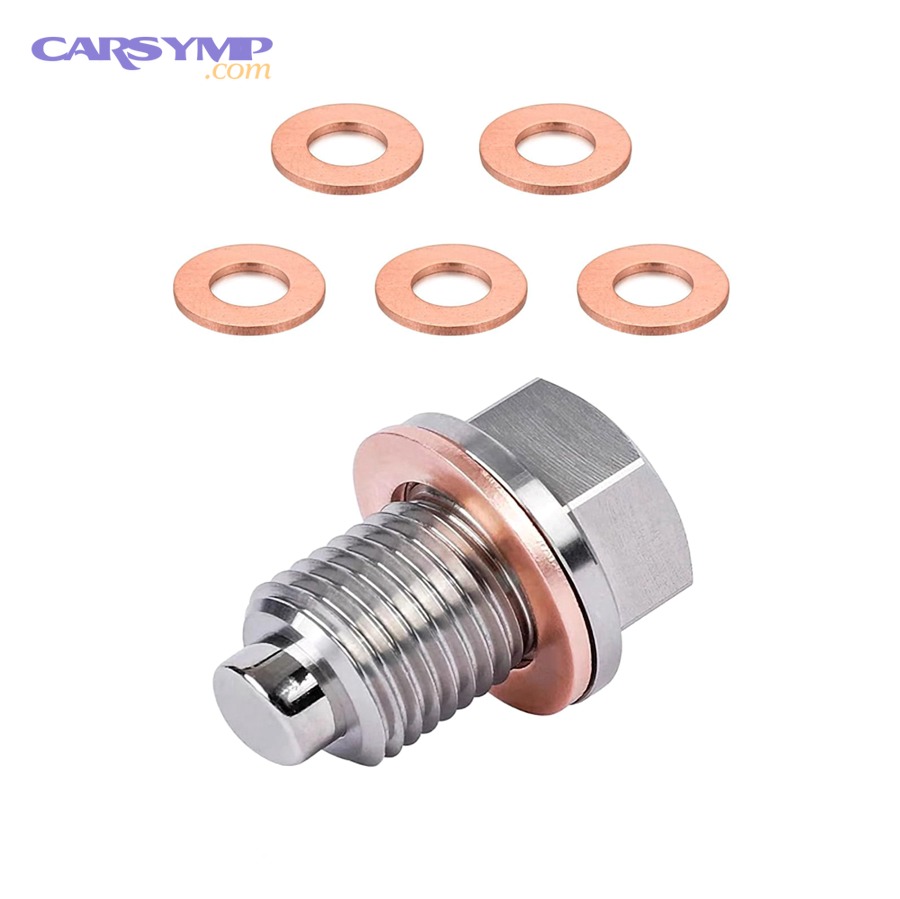
Is the drain plug sealed (crush washer/gasket present) and is there fresh oil at the plug?
Yes, the drain plug should be sealed by a proper washer or gasket, because (1) the washer forms the seal, (2) reusing a crushed washer can reduce sealing ability, and (3) overtightening can damage threads and cause chronic leaks.
Then, you confirm it visually and by touch—without trying to “crank it tighter.”
What you’re checking:
- Is there a fresh wet halo around the plug head?
- Is oil collecting on the lowest edge of the pan right below the plug?
- Can you see evidence of a washer between the plug head and pan (varies by design)?
Common drain plug failure patterns:
- Missing washer / wrong washer size: leaks immediately.
- Reused crush washer: may seal, may seep—depends on design and condition.
- Overtightened plug: threads deform; plug may feel “tight” yet seal poorly later.
As a practical reference point, many drain plugs are spec’d in a relatively low torque range, and overtightening is a known cause of stuck plugs and thread damage. (carparts.com)
Is the oil level correct and could overfill be causing push-out seepage?
Yes, you should confirm the oil level is correct, because (1) overfill can increase crankcase windage and oil aeration, (2) oil can be pushed into places it normally wouldn’t go, and (3) an inaccurate level check can hide a leak until the warning light appears.
Next, a proper dipstick check prevents “false alarms” and real engine risk.
Dipstick method that actually works:
- Park on level ground.
- Turn engine off and wait 5–10 minutes so oil drains back.
- Pull dipstick, wipe, reinsert fully, then read.
- Level should be between MIN and MAX (or within the marked crosshatch).
If it’s above MAX: do not assume “more is better.” Overfilled oil can foam and reduce lubrication quality, and it can worsen seepage at marginal seals. If you suspect overfill, correct it before doing more diagnosis.
What is the best 10-minute leak check routine once the engine has run and reached operating temperature?
The best 10-minute routine is run → park → wait → inspect → wipe → recheck, because heat and oil pressure reveal sealing problems that a cold engine can hide.
To better understand where leaks start, you’ll check the two main sealing points first, then scan for trails and drips.
10-minute checklist (do it safely):
- Minute 1–3: idle the engine; watch for warning lights; listen for odd noises.
- Minute 4: shut off and wait 2–3 minutes (hot oil settles).
- Minute 5–8: inspect with a flashlight:
- Oil filter base / filter housing
- Drain plug area
- Oil pan perimeter seam
- Any undertray edges where oil might drip
- Minute 9–10: wipe suspicious wetness, then recheck quickly.
Where are the top 5 leak points to inspect after an oil change (ranked by likelihood)?
There are 5 main leak points to inspect after an oil change: oil filter seal, drain plug/washer, oil filter housing/cap O-ring, oil pan seam, and spilled-oil drip points, based on how often these parts are touched during service and how seals fail under heat.
Next, you’ll inspect them in the order that finds the problem fastest.
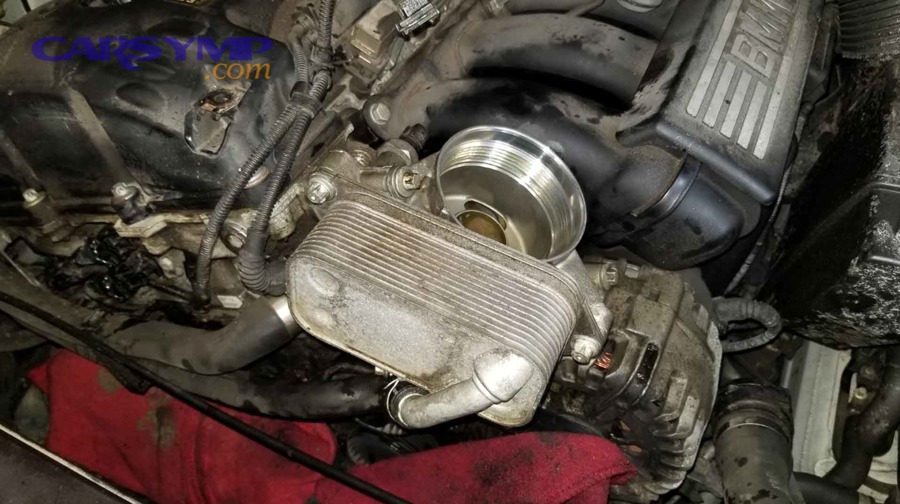
- Oil filter seal at the engine pad
- Most frequently disturbed part of the oil change.
- Leaks show as a wet ring at the filter base.
- Drain plug and washer area
- Second-most disturbed part.
- Leaks show as fresh wetness around the plug.
- Filter housing/cap (cartridge systems)
- O-ring pinched, twisted, or wrong size.
- Leaks show as wetness down the housing.
- Oil pan seam / gasket area (edge cases)
- Usually not “caused” by service, but can be revealed by cleaning/inspection.
- Spill trails and undertray drips
- Not a seal failure, but a common reason for “it’s leaking after my oil change.”
If you want installation guidance for spin-on filter sealing behavior, some technical service instructions specify cleaning the base surface, lubricating the gasket, tightening until contact, then tightening about 3/4 to 1 turn after contact. (static.nhtsa.gov)
Should you tighten the filter or drain plug again if you see a drip?
No, you should not automatically tighten the filter or drain plug again, because (1) overtightening can damage threads or crush seals incorrectly, (2) the real issue might be a missing gasket/washer, and (3) tightening without confirming the source can make diagnosis harder.
However, if you confirm the source and the part is clearly loose, you can take a cautious, limited action.
Safe rule for DIY drivers:
- If the oil filter is hand-loose (you can rotate it easily), tightening to the correct method can stop a leak.
- If the drain plug appears to leak, do not “gorilla-tighten.” A damaged pan thread is far worse than a recheck.
What to do instead (better):
- Wipe the area clean.
- Run engine briefly.
- Confirm exact source.
- If the source is confirmed and the fastener is loose, tighten to the proper spec/method.
- Recheck.
For drain plugs, published guidance emphasizes torque ranges and warns that overtightening can cause removal problems and thread damage. (carparts.com)
How do you identify the exact source when you see oil under the car after service?
To identify the exact source, follow the oil upward to the highest wet point, because drips fall and oil runs along edges, making the puddle location misleading.
Then, once you find the highest wet point, you can decide whether it’s the filter area, the drain plug area, or residue.
Start with the puddle—but don’t end there.
- Place a piece of cardboard under the car overnight to map drip location.
- In the morning, look above that spot for the nearest wet surface.
- Follow the trail back toward the front/rear depending on airflow patterns.
Is the oil coming from the filter area or the drain plug area?
The filter area is more likely if the wetness starts higher on the engine block and runs down, while the drain plug area is more likely if the wetness is concentrated at the lowest point of the pan around the plug.
However, spilled oil can mimic both, so you still confirm with a wipe-and-recheck.
Patterns that suggest oil filter area:
- Oil is wet above the pan on engine surfaces.
- Oil appears on brackets or hoses near the filter.
- Drip forms after a short drive when pressure/heat increase.
Patterns that suggest drain plug area:
- Wet halo around plug head or washer area.
- Oil collects at the pan’s lowest edge and drops straight down.
- Drips appear even after short idle without driving.
A helpful mental model:
- Filter leaks often start higher and spread.
- Drain plug leaks often start low and drip straight down.
What quick tests confirm the source without special tools?
There are 4 quick tests that confirm the source: wipe-and-recheck, paper towel dab, cardboard mapping, and short idle recheck, based on how fresh oil behaves compared to residue.
Next, use the tests in this order so you don’t waste time.
- Wipe-and-recheck test (best overall)
- Clean suspected area thoroughly.
- Run engine 2–5 minutes.
- Fresh oil reappears at the source.
- Paper towel dab test
- Dab the wet point and note:
- fresh oil = slick, amber to dark brown/black
- residue = often mixed with dust and grime, less “fresh”
- Dab the wet point and note:
- Cardboard mapping test
- Shows drip location and rate overnight.
- Helps distinguish “one drip” from “active leak.”
- Short idle recheck
- If a leak shows at idle (not driving), it’s usually a seal issue, not just airflow spread.
What should you do if you find a leak after service?
If you find a leak after service, stop the leak source identification first, then control risk, because driving with an active oil leak can drop oil level quickly and cause serious engine damage.
Next, you’ll use a simple severity triage so you know when to monitor and when to shut down immediately.
Should you keep driving if the leak is only a few drops?
Yes, you can keep driving cautiously in some cases if the leak is truly only a few drops, because (1) it may be spilled residue, (2) seepage may not lower the oil level quickly, and (3) you can verify safely with short rechecks and dipstick monitoring.
However, you should only do this if you can confirm the oil level is stable and there are no warning lights.
Use this “few drops” decision rule:
- Safe to monitor (short term):
- No oil pressure warning
- No smoke or burning smell
- Dipstick level stable
- Drip rate not increasing (cardboard test shows same or less)
- Not safe to keep driving:
- Drip rate increasing
- Spot grows quickly after each drive
- Oil level drops noticeably
Practical monitoring cadence:
- Recheck after 5–10 minutes of driving.
- Recheck again after your next parking event.
- Confirm dipstick level at least daily until resolved.
A separate but related reliability issue: many drivers follow the wrong schedule for “severe” driving, which can add stress to the engine over time and complicate oil-related problems. (news.aaa-calif.com)
When is it unsafe to drive and you should shut the engine off immediately?
Yes, it is unsafe to drive and you should shut the engine off immediately if you see any of these red flags, because (1) rapid oil loss can starve bearings, (2) oil on hot components can smoke or ignite, and (3) low oil pressure can cause immediate internal damage.
Then, you protect the engine first and deal with repairs second.
Shut down now if:
- The oil pressure warning light comes on.
- You see a steady stream or fast dripping (not occasional drops).
- You smell burning oil or see smoke from the engine bay.
- A puddle forms quickly (minutes, not hours).
Immediate actions:
- Turn off engine.
- Check oil level (if safe and not dangerously hot).
- Arrange a tow or return to the shop—don’t “limp it” if the leak is active.
Technical literature consistently treats oil pressure as critical to engine function; low oil pressure conditions are associated with increased risk of damage. (researchgate.net)
Quick triage table (what it means): This table helps you translate what you see on the ground into an action.
| What you see | Likely meaning | What to do |
|---|---|---|
| 1–3 small drops overnight | Residue or minor seepage | Wipe clean, monitor, recheck dipstick |
| Small spot that grows after every drive | Active leak | Find highest wet point; fix source |
| Drips every few seconds at idle | Seal failure | Shut off, repair before driving |
| Oil pressure light | Immediate risk | Shut off; do not drive |
How can DIY drivers prevent post-service leaks next time?
You can prevent most post-service leaks by controlling three variables—clean sealing surfaces, correct sealing parts (gasket/washer/O-ring), and correct tightening method—because these are the root causes of leaks after an oil change.
Next, you’ll apply prevention as a repeatable system, not “best guesses.”
Which sealing parts should be replaced every time (and which can be reused safely)?
A crush washer is best treated as replace-every-time, while some reusable gasket designs can be reused if the manufacturer allows it, and O-rings on cartridge caps should be replaced whenever they show flattening, nicks, or swelling.
However, the safest general rule for DIY drivers is: replace the cheap seal parts that routinely fail.
Replace every time (common best practice):
- Crush washer (soft metal that deforms to seal)
- Disposable drain plug gasket (if specified)
- Cartridge filter O-ring (if you’re already opening the cap and the kit includes it)
Usually safe if done correctly:
- Spin-on filter gasket is replaced automatically because it comes with the new filter.
- Drain plug itself can be reused unless damaged (rounded head, worn threads).
Why this matters: a seal that has already been crushed or heat-cycled often seals less reliably on the next install, increasing seepage risk.
What tightening method is safer: torque spec or “hand tight + turns”?
Torque spec wins in precision, “hand tight + turns” is best for simplicity, and manufacturer-specific guidance is optimal when you’re dealing with different gasket styles and housings.
Meanwhile, the safest path is to follow the method intended for the part you’re tightening.
Oil filter tightening (spin-on):
- Many service instructions recommend: tighten until gasket contacts the base, then tighten about 3/4 to 1 turn after full contact. (static.nhtsa.gov)
- Technical guidance for molded gaskets also warns not to back off after contact because it can create a poor seal. (ecogard.com)
Drain plug tightening:
- Use the manufacturer torque spec when possible.
- As a general reference, common drain plug torque values are often in a relatively modest range, and overtightening can cause removal and thread issues. (carparts.com)
The big mistake to avoid: overtightening to “feel safe” can damage threads or distort sealing surfaces, creating a leak that’s harder to fix than the original problem.
Do skid plates/undertrays change how you should check for leaks?
Yes, skid plates and undertrays change how you should check for leaks, because (1) they can trap spilled oil and drip later, (2) they spread oil into trails that hide the true source, and (3) they can prevent you from seeing the highest wet point.
Next, adapt your inspection so you’re not fooled by delayed drips.
Best practice with undertrays:
- If you suspect residue, consider removing the undertray once to:
- wipe it clean
- confirm the actual source area
- After cleaning, repeat the wipe-and-recheck test so any new oil is clearly from an active source.
Bonus prevention: after every oil change, wipe:
- the filter area
- the drain plug area
- any surfaces that could catch spilled oil (crossmember lip, splash shield edge)
This one habit prevents a large share of false “it’s leaking” scares after an oil change.
Evidence (why routine oil practices matter): Purdue University Extension summarizes research where taxi fleets were driven for 100,000 miles and researchers found no wear differences between engines using synthetic vs conventional oils as long as the vehicles received routine oil changes. (ag.purdue.edu)
By this point you’ve completed the core checklist to confirm whether a post-service leak is present, identified the most likely source (filter vs drain plug), and learned what to do immediately if a leak appears. Next, we’ll expand into related but secondary topics—like telling oil from other fluids and catching hard-to-find seepage—so you can diagnose edge cases and prevent repeat issues.
How can you confirm the fluid type and catch hard-to-find seepage after service?
You can confirm fluid type and catch hard-to-find seepage by using sensory cues + location logic + one confirmation method (clean-and-recheck or UV dye), because many “oil leaks” after service are actually residue or even a different fluid.
Next, you’ll use practical comparisons so you don’t solve the wrong problem.
Is the puddle actually engine oil, or could it be ATF, coolant, or power steering fluid?
Engine oil looks and smells different from other fluids, ATF is usually thinner and often red/brown, and coolant is watery with a distinct sweet smell and bright color—so you can often tell them apart quickly using appearance, feel, and where the drip forms.
However, you still confirm by tracing the highest wet point because airflow and undertrays can move any fluid.
Fast comparison guide:
- Engine oil: amber to dark brown/black, slick, oily smell; often near oil pan, filter, or front/rear of engine.
- ATF (automatic transmission fluid): red/pink when fresh, brown when old; often near transmission pan or cooler lines.
- Coolant: green/orange/pink depending on type; watery feel; often near radiator, hoses, water pump area.
- Power steering fluid (if hydraulic): similar to ATF in many vehicles; leak near steering rack or pump.
Location clue (high value): A drip directly beneath the engine oil pan after an oil change strongly points to the drain plug area, but it can still be spilled oil caught on a shield—so you always recheck after wiping.
Do UV dye and a blacklight help confirm seepage when everything looks dry?
Yes, UV dye and a blacklight can help confirm seepage when everything looks dry, because (1) the dye highlights tiny fresh leaks, (2) it separates new oil from old grime, and (3) it makes the “highest wet point” easier to spot under the car.
Then, you use it as a confirmation tool—not a substitute for basic checks.
When UV dye is worth it:
- You have repeated oil spots but can’t find a wet source.
- The engine is grimy and you need to confirm whether seepage is active.
- Undertrays and airflow create confusing trails.
When it’s not necessary:
- You can already see fresh wetness at the oil filter base or drain plug.
- The drip disappears after cleaning (classic residue).
What rare causes can mimic an “oil change leak” (double gasket, cartridge cap O-ring, oil cooler/sandwich adapter)?
There are 3 common rare causes that mimic an oil change leak: double gasket at a spin-on filter, pinched/misplaced cartridge cap O-ring, and seepage at an adapter/cooler connection near the filter area, based on how these seals fail and where oil collects.
More importantly, recognizing these saves you from repeatedly tightening parts that aren’t the true cause.
- Double gasket (spin-on filter)
- Symptom: sudden heavy leak shortly after start/drive.
- Confirmation: inspect mounting pad; verify only one gasket.
- Cartridge cap O-ring issue
- Symptom: oil wetness around housing cap area, often after warm-up.
- Confirmation: correct O-ring position; no twisting; correct size.
- Oil cooler / adapter seep (near filter area)
- Symptom: oil appears to come from “above” the filter area.
- Confirmation: highest wet point is above the filter; may require deeper inspection.
If your leak is fast or you can’t confirm the source safely, stop driving and get professional help—rare causes often involve seals and housings that are easy to worsen with guesswork.
What are the antonym signals of a healthy service (clean, dry, stable oil level) over the next 7 days?
There are 4 “healthy service” signals : clean/dry seal points, no new spots on cardboard, stable dipstick level, and no burning smell, based on how oil behaves when seals are correct.
In short, if these signals hold for a week, you can stop monitoring.
7-day confidence checklist:
- Day 1–2: inspect oil filter and drain plug area after first drive and first overnight park.
- Day 3–4: quick look under car; confirm no fresh wetness.
- Day 7: final dipstick check; confirm stable level.
Tie-in to oil maintenance habits: If you drive short trips, tow, idle a lot, or see extreme heat/cold, you’re more likely to fall under “severe” conditions—so your Oil change interval by driving conditions matters for long-term engine cleanliness and seal health. (autocare.org)
Where “High-mileage oil: when it helps” fits: If your engine has higher mileage and you notice minor seepage between changes, high-mileage formulations may help condition aging seals in some cases—but they won’t fix a missing washer, a double gasket, or a loose filter after an oil change. (ag.purdue.edu)