


If you’re hearing a harsh grind, it is not safe to keep driving with grinding brakes because the sound often means braking force is compromised and metal parts may be contacting each other. Your safest move is to reduce speed, avoid hard stops, and get the car inspected immediately—towing is often the best option when the noise is loud or stopping power feels reduced.
Next, you’ll learn what to do right now to protect your safety first and your brake system second, including when it’s reasonable to creep to a nearby shop versus when it’s smarter to stop and tow.
Then, you’ll get a clear explanation of what grinding usually means inside the brake system—especially how worn pads and damaged rotors create the noise—so you can recognize severity signs without guessing.
Introduce a new idea: once you understand the safety decision and immediate steps, the main sections below walk you from diagnosis-by-symptom to damage prevention, using a simple chain of “sound → cause → risk → action” so you always know what to do next.
Is it safe to drive with grinding brakes right now? (Yes/No)
No—driving with grinding brakes is not safe because (1) grinding often signals metal-on-metal contact that reduces braking performance, (2) it can increase stopping distance and loss-of-control risk, and (3) every mile can multiply damage to rotors, calipers, and brake hardware.
More importantly, the decision is not about “Can the car still move?”—it’s about whether the car can stop predictably in traffic, in rain, or during a surprise stop. Brake problems also show up in crash investigations: in the National Motor Vehicle Crash Causation Survey (NMVCCS), brake-related problems were identified as a critical reason in a substantial portion of vehicle-related cases. (crashstats.nhtsa.dot.gov)

Should you stop driving immediately when you hear grinding while braking? (Yes/No)
Yes—you should stop driving as soon as it’s safe because (1) the grinding noise when braking commonly means the friction material is gone, (2) stopping power can drop unpredictably from one stop to the next, and (3) heat and metal wear can escalate quickly during repeated braking.
Specifically, treat grinding as an “end-of-life” warning for the braking surface until proven otherwise. When pads wear through, the backing plate can contact the rotor and act like a cutting tool. The rotor surface can become deeply grooved, the caliper piston can overextend, and the brake system may begin to pull to one side when you stop. Even if the pedal still feels “okay” right now, the next stop could feel very different.
Use this immediate, safety-first sequence:
- Ease off the accelerator and increase following distance.
- Signal and move to a safe spot (parking lot shoulder, wide turnout).
- Avoid hard braking unless needed to prevent a collision.
- Set hazards and let brakes cool if you smell burning.
- Call for assistance if the car does not feel safe to stop repeatedly.
If you are on a hill or in heavy traffic, don’t gamble. A controlled stop now beats an emergency stop later.
Can you drive a short distance to a mechanic if the brakes are grinding? (Yes/No)
No in general—but yes only in a narrow emergency window because (1) your margin for safe stops is unknown, (2) the system may fail under heat, and (3) “just a short drive” can turn a pad job into rotor-and-caliper replacement.
However, real life sometimes forces a decision. If you must move the car a very short distance (for example, to exit a dangerous roadway), minimize risk using a strict “lowest exposure” plan:
- Choose the shortest route with the fewest intersections.
- Stay under city speeds and avoid highways.
- Brake early and gently to reduce heat.
- Leave huge following distance so you never need panic braking.
- Avoid downhill routes where braking loads are higher.
- Stop if the noise gets louder, the car pulls, the pedal sinks, or warning lights appear.
This is not “normal driving.” It is an emergency repositioning step to get to safety or professional help.
When is it unsafe enough that you should tow instead of drive?
There are 7 common red flags that mean you should tow instead of drive, based on severity signals you can observe quickly:
- Pedal goes unusually low or feels spongy (possible fluid/pressure issue).
- Car takes longer to stop or you need more pedal force than usual.
- Hard pull left/right when braking (uneven braking or seized caliper).
- Burning smell, smoke, or extreme wheel heat after a short drive.
- Grinding becomes constant (even when not braking) or turns into loud scraping.
- Brake warning light plus any change in pedal feel or stopping performance.
- Vibration + grinding together (possible rotor damage or severe uneven contact).
A simple way to frame it: if your brakes are not “boringly predictable,” your safest choice is a tow.
Evidence: According to a report by the U.S. Department of Transportation’s National Highway Traffic Safety Administration, in 2015 (NMVCCS data publication), brake-related problems were identified as a critical reason in about 22% of vehicle-related critical-reason crashes. (crashstats.nhtsa.dot.gov)
What does “grinding brakes” usually mean?
Grinding brakes is a high-friction, harsh noise created when brake components rub abnormally, most often when brake pad friction material is worn away and metal parts contact the rotor, producing a rough grinding noise and accelerated wear.
To better understand why this matters, focus on how disc brakes work: the pad’s friction layer is designed to wear gradually while providing consistent grip. Grinding usually appears when that friction layer is gone, contaminated, or no longer contacting the rotor correctly. Once you are in grinding territory, you are typically beyond routine “monitor it” advice and into “act now” territory.
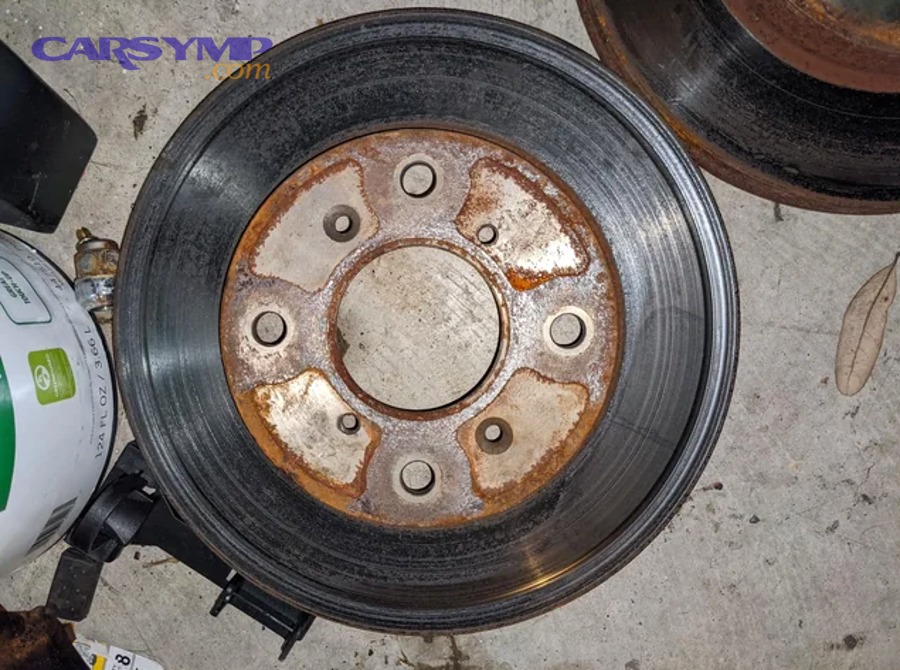
Is brake grinding typically metal-on-metal from worn brake pads? (Yes/No)
Yes—most brake grinding is metal-on-metal because (1) pads can wear down until the backing plate touches the rotor, (2) the rotor face can become grooved and uneven, and (3) a stuck caliper can force constant contact that chews metal.
This is why grinding sounds different from squealing. Squeal is often a warning (sometimes from a wear indicator tab). Grinding is more like the warning you hear after the protective friction layer is gone. Once the rotor is being cut or scored, braking can become inconsistent because the pad no longer presses against a smooth, uniform surface.
Key “metal-on-metal” clues:
- The noise is low and harsh, not high-pitched.
- It tends to get worse with braking pressure.
- It may come with vibration, steering shake, or a pulsing pedal.
When friction material is gone, braking heat rises faster. The system can feel okay at first but degrade quickly in stop-and-go traffic.
Can rust, debris, or a bent dust shield cause grinding-like noise? (Yes/No)
Yes—sometimes grinding-like noise comes from non-wear causes because (1) surface rust after rain can sound rough at first, (2) a small stone can lodge between rotor and shield, and (3) a bent dust shield can rub the rotor and mimic grinding.
However, these “less severe” causes usually have a pattern:
- Rust pattern: rough noise for the first few stops after the car sits in moisture, then it fades.
- Debris pattern: noise may change with wheel speed or disappear temporarily after reversing.
- Dust shield pattern: a light scraping that may occur even when you are not braking, and can change when turning.
The risk is that drivers assume “it’s just rust” when it is actually worn pads. If the noise is persistent and harsh, treat it as serious until inspected.
What symptoms help confirm grinding is coming from the brakes and not something else?
There are 4 symptom groups that help confirm the brakes are the source, based on when the noise happens and what you feel:
- Timing pattern
- Noise happens only when braking → likely brake pads/rotor contact.
- Noise happens all the time → could be dust shield rub, wheel bearing, or dragging caliper.
- Location pattern
- Noise seems to come from one corner → a single pad set, rotor, or caliper issue.
- Noise seems to come from both front wheels → common if both pads are worn or both calipers are sticking.
- Feel pattern
- Pedal pulsation → rotor surface variation or uneven pad transfer.
- Steering wheel shake → front rotor issues or severe uneven contact.
- Heat/smell pattern
- A wheel that is much hotter than the others after a short drive → dragging caliper or severe friction.
- Burning odor during routine stops → overheating and possible fade.
These checks do not replace a shop diagnosis, but they help you decide whether to stop immediately.
How do you do “stop-driving guidance” safely when grinding starts?
Follow a 6-step safety method—slow down smoothly, pull over safely, minimize braking load, let the system cool, do quick checks, and choose tow or shop travel—so you reduce crash risk and prevent additional brake damage.
Next, treat this as triage: your goal is to protect the people in the car and around you, then prevent the brake system from being forced into repeated high-heat stops.

What are the safest immediate steps when brakes grind on the road?
Here are 8 immediate steps that keep the situation controlled:
- Lift off the throttle early and avoid late braking.
- Increase following distance dramatically.
- Signal and move to the right (or safest shoulder/exit) as soon as traffic allows.
- Use gentle, steady braking instead of repeated hard taps.
- Avoid downhill braking; coast when safe.
- Turn on hazard lights if you cannot maintain normal traffic speed.
- Park in a safe area and set the parking brake only if it feels normal (if unsure, use Park/gear and wheel chocks if available).
- Let brakes cool before touching wheels; heat can be extreme.
This is where “stop-driving guidance” matters: the situation changes from “diagnose later” to “reduce exposure right now.”
What quick checks can you do at home without tools to assess severity?
Use this DIY inspection for grinding noises that takes five minutes and avoids risky actions:
- Look through the wheel spokes: can you see pad material thickness at the caliper? If you only see a thin sliver or nothing obvious, assume severe wear.
- Check for rotor scoring: deep grooves or a shiny ring can suggest metal contact.
- Compare wheel heat carefully: after a short, gentle roll, hover your hand near (not on) each wheel. A dramatically hotter wheel can indicate dragging brakes.
- Check the brake fluid level (without opening the system): low fluid can accompany pad wear, but sudden drops can indicate a leak.
- Listen for changes: grinding that is louder with light braking is often rotor/pad surface; grinding that continues without braking may be shield or bearing-related.
If you are not experienced, don’t remove wheels at roadside. The point is quick severity detection, not full repair.
What should you avoid doing to prevent making the problem worse?
Avoid these 7 common mistakes because they amplify heat, damage, and risk:
- Do not test “one more hard stop” to see if it goes away.
- Do not drive highway speeds where stopping distances must be longer and failures are less manageable.
- Do not ride the brakes downhill; use lower gear and engine braking when possible.
- Do not spray water on hot rotors; rapid cooling can stress components.
- Do not assume ABS will save you if friction surfaces are compromised.
- Do not ignore warning lights paired with noise or pedal changes.
- Do not keep driving to “save money”; it often increases total repair cost.
Evidence: According to a study by Kirkuk University from the College of Engineering (Mechanical Department), in 2017, increased brake disc temperature was shown to reduce braking performance and increase stopping distance in light-vehicle brake testing. (erpublications.com)
What happens if you keep driving with grinding brakes vs stopping now?
Stopping now wins on safety, cost, and predictability, while continuing to drive is most likely to increase damage and decrease braking confidence as heat and metal wear compound with every stop.
More specifically, think of it as two timelines: the “stop now” timeline usually limits repairs to the wear parts you expected (pads, maybe rotors), while the “keep driving” timeline increases the chance that multiple components will need replacement.
Does continuing to drive increase repair cost and damage to rotors/calipers? (Yes/No)
Yes—continuing to drive increases cost and damage because (1) metal backing plates can carve rotors deeply, (2) caliper pistons can overextend or seals can be stressed, and (3) heat can damage hardware and accelerate uneven wear.
A practical way to visualize the escalation:
- Early stage (warning squeal): often pads only, sometimes rotor resurfacing if needed.
- Grinding stage: commonly pads + rotors, and the odds of caliper issues rise if the caliper has been dragging or the piston has extended too far.
- Severe stage (smoke/odor/pull): pads + rotors + possibly caliper, brake hose, or fluid service.
Drivers often underestimate how quickly “one commute” becomes “multiple high-energy stops.” In stop-and-go traffic, you generate repeated heat cycles that can worsen fade and friction inconsistency.
How does braking distance and control compare before vs after grinding starts?
Grinding brakes change control in three key ways:
- Stopping distance becomes less predictable because the contact surfaces are no longer designed to grip consistently.
- Steering stability can degrade because one wheel may brake harder than the other (pulling).
- Pedal feel can change with heat as components expand and friction characteristics vary.
Heat matters because it changes friction behavior. Research on braking performance consistently shows that higher brake temperatures can lengthen braking time and distance when friction becomes unstable. (sciencedirect.com) This is one reason grinding is not just a “noise problem”—it can become a “stopping problem.”
How can you tell grinding brakes from other noises like squealing, clicking, or humming?
Grinding is most consistent with severe friction contact, squealing is often an early wear warning, clicking can be loose hardware, and humming is frequently rotational (like a bearing). Each noise has a “when it happens” signature that helps you separate brake wear from other issues.
Next, use comparisons that are simple enough to do without tools: listen for whether the noise appears only during braking, only while turning, or only at certain speeds.

Is squealing the same as grinding? (Yes/No)
No—squealing is not the same as grinding because (1) squeal is often produced by a wear indicator tab or vibration, (2) squeal can occur while pads still have usable friction material, and (3) grinding usually indicates the friction layer is gone or the rotor surface is severely damaged.
However, squeal can be a progression point: ignoring squeal can lead to grinding later. If you want “Preventing grinding with regular inspections,” squeal is the moment to act. Replace pads before you hear harsh grinding, and you protect rotors and keep braking consistent.
Can a wheel bearing or CV joint be mistaken for grinding brakes? (Yes/No)
Yes—bearing or CV noises can be mistaken for brake grinding because (1) they can sound like rough metal friction, (2) they change with speed, and (3) they may become louder under load shifts.
The difference is pattern:
- Wheel bearing: often a hum or growl that rises with speed and can change when you turn left/right.
- CV joint: often clicks during turning under acceleration, especially at low speed.
- Brakes: grinding noise when braking tends to appear most strongly when you press the pedal.
If you hear the sound while coasting with no brake input, investigate non-brake sources too—but do not ignore grinding that appears with braking pressure.
What quick “when-it-happens” test helps differentiate noises?
There are 5 quick pattern tests you can do safely in a low-traffic area:
- Brake-only test: noise appears only when you press the brake pedal → brake-related likely.
- Coast-only test: noise continues while coasting with no brake input → suspect bearing/shield/dragging caliper.
- Turn test: noise changes significantly during left/right turns → suspect bearing or CV joint.
- First-stop-after-rain test: noise is rough at first and then fades → surface rust is possible.
- Reverse/forward test: noise appears only in one direction → debris or hardware can be involved.
If the result points back to braking, prioritize safety and inspection over further testing.
Why might brakes grind even with “new” pads, and what rare edge cases should drivers know?
Brakes can grind even with new pads because installation fit, hardware alignment, rotor condition, or uncommon system behaviors can create abnormal contact, producing grinding or scraping that mimics severe wear.
In addition, modern brake systems are more complex than “pad + rotor.” Caliper slides, anti-rattle hardware, backing plates, shields, and even vehicle design choices can create noises that feel like grinding. This is where micro-level diagnosis matters, especially if you already replaced pads and still hear a grinding noise when braking.

Can new brake pads still cause grinding due to incorrect installation or missing hardware? (Yes/No)
Yes—new pads can grind if installation or hardware is wrong because (1) missing anti-rattle clips can let pads sit crooked, (2) seized slide pins can force uneven pad contact, and (3) pads can bind in the bracket and drag on the rotor.
Common “new pads, still grinding” causes:
- Old rotor left in place with deep grooves; the new pad rides the ridge and creates noise.
- Incorrect pad type (wrong thickness or shape), causing constant contact.
- No lubrication on slide points (where allowed) leading to sticking and uneven wear.
- Caliper piston not retracting properly, producing drag and heat.
If the grinding began immediately after a brake job, suspect fitment or hardware first. A qualified inspection can often identify shiny rub points quickly.
Can regenerative braking (EV/hybrid) make rust or glazing more likely and lead to grinding later? (Yes/No)
Yes—regenerative braking can contribute indirectly because (1) friction brakes may be used less often, allowing surface rust to build, (2) rust can create rough initial contact when friction brakes engage, and (3) intermittent friction use can contribute to uneven pad transfer or glazing.
This does not mean EVs “have worse brakes.” It means the friction brakes can experience different usage patterns. Drivers may not notice gradual friction pad wear because regen handles a lot of routine slowing—until the day the friction system is suddenly needed harder and the noise appears. If you drive a hybrid/EV, occasional controlled friction braking (where safe) and regular inspections help keep surfaces clean.
Can heavy towing, mountain driving, or repeated hard stops trigger rotor heat damage that sounds like grinding? (Yes/No)
Yes—high-load driving can create grinding-like symptoms because (1) repeated high-energy stops raise rotor temperature, (2) friction coefficient can become unstable under heat, and (3) the rotor surface can develop uneven transfer layers that feel rough.
This is one reason performance and towing setups often emphasize proper pad compounds and rotor condition. If your grinding appears after a mountain descent, it may involve heat effects like glazing or uneven deposits rather than “pads worn to nothing.” Even then, you still treat it urgently because heat-related fade can reduce braking confidence. (sciencedirect.com)
What are the most common “not actually brakes” rubbing sources that mimic grinding?
There are 6 frequent non-brake rubbing sources that can mimic grinding:
- Bent dust shield lightly contacting the rotor (often changes with turning).
- Small stone trapped between shield and rotor (can be intermittent).
- Backing plate contact after a prior repair or impact.
- Wheel bearing growl that’s speed-dependent and changes with steering load.
- Tire rub on a liner after suspension issues (more of a scrape).
- Brake hardware clip interference if installed incorrectly.
If you want a simple way to keep this organized, create a short notes list for your mechanic: when the noise happens, which wheel area it seems to come from, and whether it changes with braking pressure or turning. Some drivers also look for symptom checklists on carsymp.com, but treat any checklist as a starting point—not a substitute for inspection.
Evidence: According to a study by Kirkuk University from the College of Engineering (Mechanical Department), in 2017, braking tests showed that higher brake disc temperature can reduce braking performance and increase stopping distance, reinforcing why prolonged driving under severe brake noise is a safety risk. (erpublications.com)