


A coolant leak while driving is serious because it can quietly drain your cooling system, spike engine temperature, and turn a “small drip” into rapid overheating within minutes—so your first job is to recognize the warning signs early and treat them as a safety decision, not just a maintenance issue.
Next, you’ll want to decide whether you can limp to a safe spot or whether you should shut the engine down right away, because the “right” move depends on how fast the temperature is rising, how much coolant is escaping, and whether you’re seeing signs of internal engine trouble.
Then, if you’re already on the shoulder or in a parking lot, there are a few low-risk checks you can do without burning yourself—mainly observation, waiting for cooldown, and looking for obvious external leak patterns—while avoiding the most dangerous mistake: opening a hot pressurized cap.
Introduce a new idea: once you can recognize the symptoms, make the stop/drive call, and do safe checks, you’ll be able to pinpoint likely leak sources and confirm the diagnosis so the repair is targeted—not guesswork.
What are the most common warning signs of a coolant leak while driving?
A coolant leak while driving usually shows up as a rising temperature gauge, a sweet odor, visible steam, or sudden cabin-heater changes—because the cooling system is losing fluid and pressure faster than it can stabilize.
To better understand what you’re seeing, it helps to separate “heat warnings,” “smell/steam warnings,” and “behavior changes” that point to specific leak paths.
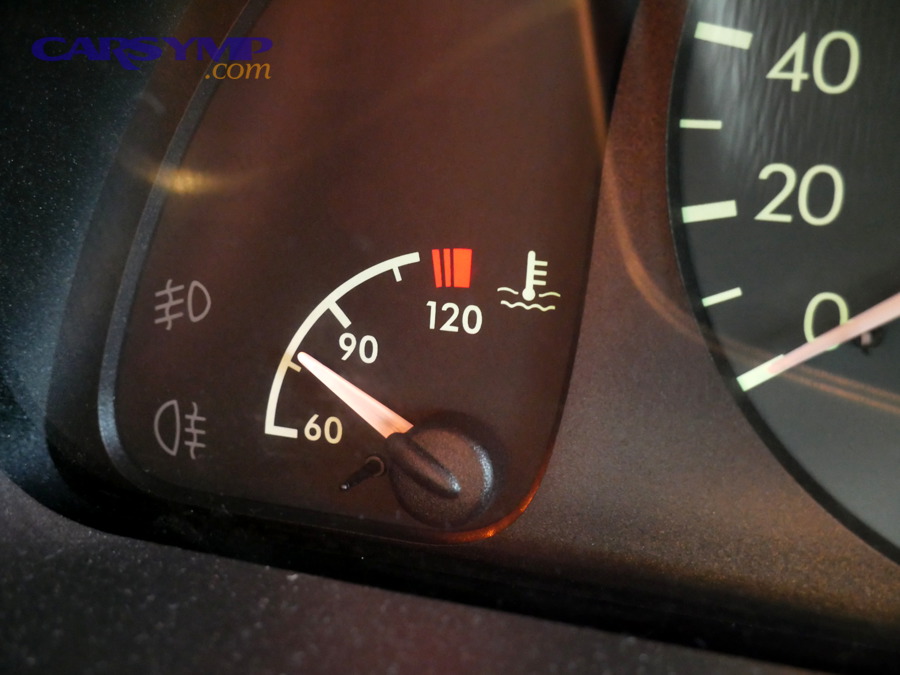
What does the temperature gauge or warning light tell you?
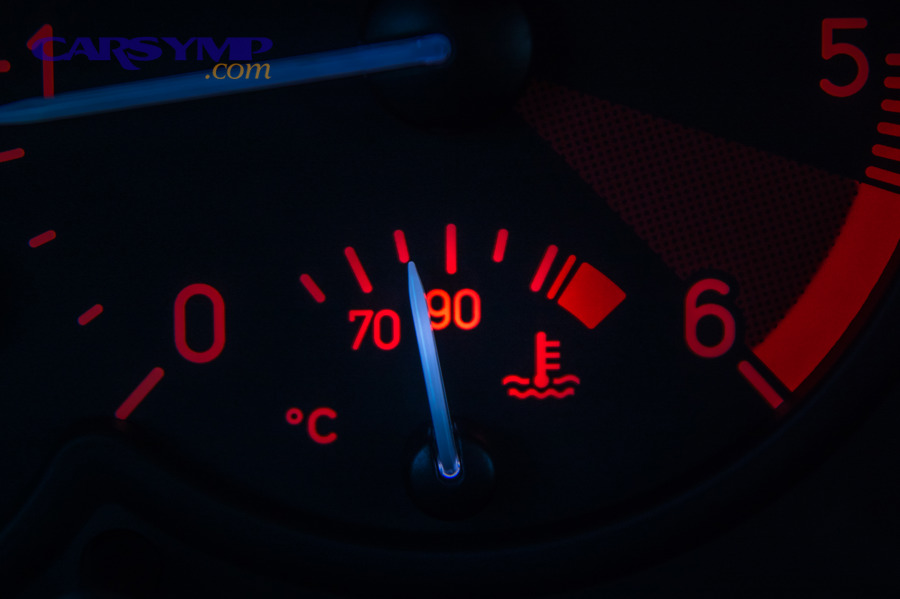
A temperature gauge that climbs above normal (or an engine temperature warning light) is often the earliest high-stakes clue that coolant is low, trapped air is forming, or circulation is compromised—any of which can happen after a leak starts.
Most cars sit near the middle of the gauge at normal operating temperature; when the needle moves noticeably above that baseline, it’s not “just hot outside,” it’s a cooling system that’s losing control. The key is the trend: a steady creep upward during driving, a spike during idling, or repeated climbs after briefly cooling down often means the system can’t hold pressure or volume.
Watch for patterns that strongly suggest a leak rather than a one-time anomaly:
- Needle rises at idle, improves at speed: airflow helps the radiator, but low coolant/air pockets still cause heat soak at stops.
- Needle rises on hills or acceleration: load increases combustion heat; a low-coolant system can’t buffer the extra heat.
- Gauge suddenly pegs hot: this can occur when coolant drops below the sensor or steam/air surrounds it—sometimes you’ll see a sudden jump that doesn’t “feel gradual.”
If your car has a “Low Coolant” message, treat it as a direct warning that the system level is already compromised. Even if the engine isn’t overheating yet, the situation can change quickly because small leaks often worsen when the engine bay heats up and system pressure increases.
What does a sweet smell, steam, or visible coolant spray mean?
A sweet smell is a classic sign of ethylene glycol-based coolant vaporizing on hot metal surfaces—especially near the radiator, hoses, thermostat housing, or coolant reservoir area.
Here’s how to read these “sensory” clues without guessing:
- Sweet smell after stopping: coolant may be dripping onto the exhaust manifold, downpipe, or other hot components and burning off.
- Steam from the hood/engine bay: coolant is boiling off after contacting a hot surface or after escaping into an area with high heat. Steam is not always “engine boiling over,” but it is a sign coolant is leaving the system.
- Visible spray or mist: this often points to a pressurized leak (hose split, clamp failure, radiator seam crack). Under load, pressure increases and the leak can turn into a fine mist that leaves residue.
If you open the hood (only when safe) and see a wet sheen or colored crusty residue near hose junctions, that’s a strong “external leak” signature. Coolant often dries into a chalky, colored deposit (green/orange/pink depending on type), which helps you identify the general area.
Also note puddle clues—coolant can collect on engine covers or undertrays and then drip elsewhere, so the puddle may not be directly under the failed part. A puddle near the front center often points toward radiator/water pump/upper hose area; a puddle more toward the firewall can suggest heater hoses or heater core lines.
What driving or cabin symptoms point to a heater-core or pressure leak?
Cabin behavior can be one of the most useful coolant leak symptoms because the heater is essentially a small radiator that depends on coolant volume and circulation.
Pay attention to these signals:
- Heater suddenly blows cold at idle (then warm again while driving): low coolant or air pockets reduce flow through the heater core at low pump speed.
- Sweet smell inside the cabin or foggy film on windows: can indicate a heater core leak or heater-hose seepage near the firewall, where vapors enter the cabin airflow.
- Wet passenger-side carpet: a strong heater core leak indicator in many vehicles.
Pressure-related leaks can “act weird” while driving:
- Leak appears only when moving: higher RPM raises pump flow and pressure, exposing weak hose sections.
- Leak appears only when stopped: heat soak increases pressure and expansion, pushing coolant through a crack that stays sealed while cooler.
When you combine a heat warning (gauge trending up) with a heater change (warmth disappears) and a sweet smell, assume you’re not dealing with a minor inconvenience—you’re dealing with a system that may lose control suddenly.
What do exhaust and tailpipe clues mean for internal coolant loss?
White exhaust can be normal condensation on a cold morning, but persistent white smoke with coolant loss is a different story: it can indicate coolant entering the combustion chamber through a head gasket, cracked head, or intake gasket (engine-dependent).
Use “pattern + context” to avoid false alarms:
- Normal condensation: appears on cold starts, disappears as the exhaust warms, no coolant loss, no overheating trend.
- Suspicious white smoke: continues after warm-up, may smell slightly sweet, and often accompanies coolant loss and/or overheating.
This is where White exhaust smoke vs coolant leak clues matters: external leaks usually leave visible wetness or drips; internal leaks often show consumption without obvious puddles, plus tailpipe symptoms and sometimes rough running.
If you also see “milkshake” oil (oil cap residue, dipstick discoloration) or repeated misfires on startup, treat that as a high-risk internal leak scenario and avoid extended driving.
Should you keep driving if you suspect a coolant leak?
No—you generally should not keep driving with suspected coolant leak symptoms because the leak can accelerate under heat and pressure, and overheating can cause rapid engine damage; the safe exception is a short, controlled move to a safer stopping location when temperatures are stable.
With that in mind, the decision comes down to severity signals, not wishful thinking.
Below is a quick decision table showing common scenarios and what they typically mean.
| What you observe while driving | What it usually indicates | Best immediate action |
|---|---|---|
| Temperature needle rising above normal and still climbing | Cooling system losing control | Pull over ASAP, shut down |
| Steam from hood + hot smell | Coolant contacting hot components or boiling | Pull over ASAP, shut down |
| Low coolant warning but temperature still normal | Early leak or low reserve volume | Drive only to safe stop; inspect soon |
| Heater turns cold + gauge rising | Low coolant / air pocket, circulation compromised | Pull over ASAP, shut down |
| White smoke persists after warm-up + coolant loss | Possible internal leak | Stop driving; tow recommended |
When should you stop driving immediately?
You should treat these as When to stop driving immediately triggers:
- Temperature gauge enters the hot zone or climbs quickly and doesn’t stabilize
- Steam is actively coming from the hood/engine bay
- Warning messages for overheating + reduced power/limp mode
- You hear knocking/pinging, or the engine feels unusually weak while the gauge is rising
- You suspect an internal leak (persistent white smoke after warm-up + coolant loss)
The logic is simple: overheating is not “gradual wear,” it’s a fast path to warped heads, blown head gaskets, damaged catalytic converters (from misfires), and seized engines. Once metal temperatures exceed design limits, you can permanently change clearances and sealing surfaces.
AAA specifically advises watching the temperature gauge and treating high readings and steam as signs of overheating that require pulling over safely.
Can you ever drive a short distance, and how do you do it safely?
Yes—sometimes you can drive a short distance only to reach a safer stopping point, but only if the temperature is stable and you are not seeing active steam or rapid coolant loss.
If you must move:
- Turn off A/C, turn heater to max heat and fan high (the heater can act as a secondary radiator).
- Reduce load: gentle throttle, avoid hills, avoid stop-and-go.
- Watch the gauge continuously: if it rises again, stop immediately.
This is not a “get home” plan; it’s a “get out of danger” plan. The longer you drive, the more likely the leak becomes a burst, especially if it’s a weakened hose or plastic fitting.
How fast can a “small leak” become an overheating event?
A small leak can become big quickly because cooling systems operate under pressure; pressure raises boiling point, but it also pushes coolant through weak points. As temperature rises, pressure rises; as pressure rises, leak rate can increase. That feedback loop is why minor seepage can turn into a stream.
Also, coolant doesn’t have to reach “empty” for overheating to happen. Air pockets and low system pressure can reduce heat transfer and trigger localized boiling even when some coolant remains.
From a diagnostics perspective, even relatively small deviations in measured variables can matter: a Vanderbilt University engineering study on cooling-system fault detection notes that tighter sensor error tolerances (commonly in the 2%–5% range of nominal values) help detect deviations that might otherwise go unnoticed.
What can happen if you ignore it and keep driving?
Ignoring a coolant leak can escalate from inconvenience to catastrophic repair because the cooling system protects multiple temperature-sensitive components.
Common failure outcomes include:
- Warped cylinder head (aluminum heads are especially vulnerable)
- Blown head gasket (combustion pressure enters cooling system; coolant enters cylinders)
- Cracked plastic housings (thermostat housings, quick-connects) from repeated overheating cycles
- Heater core damage if air pockets and corrosion increase
- Engine seizure in extreme cases if oil film fails under heat
Even if the engine “seems fine” after cooling down, repeated overheating events often accumulate damage. That’s why your safest assumption is: if it overheated, it needs inspection.
What safety checks can you do on the roadside without getting burned?
You can do a safe roadside check by using a “cool down + observe + confirm” sequence—waiting for temperature to drop, looking for leak evidence, and checking levels only when the system is no longer hot and pressurized.
Next, follow a method that minimizes contact with hot parts and avoids opening any pressurized cap.
How do you pull over, cool down, and avoid the most dangerous mistake?
The most dangerous mistake is opening the radiator cap or reservoir cap while the engine is hot. A pressurized system can spray near-boiling coolant instantly.
Do this instead:
- Signal and pull over safely, away from traffic.
- Turn the engine off if the gauge is high or rising.
- Pop the hood (if safe) to vent heat, but keep your face and hands back.
- Wait—often 20–45 minutes depending on conditions—until the radiator area is no longer radiating intense heat.
While waiting, look without touching:
- Is there active dripping under the car?
- Is steam continuing after shutdown?
- Do you see wet streaks or splatter on the underside of the hood or around the radiator fan shroud?
How can you check coolant level safely?
Only check levels once the engine has cooled significantly.
- Use the overflow/expansion tank markings if your vehicle has them. Many cars allow a level check without opening the pressurized side.
- If you must open a cap, confirm it is cool to the touch first, then use a thick cloth and open slowly to release any remaining pressure.
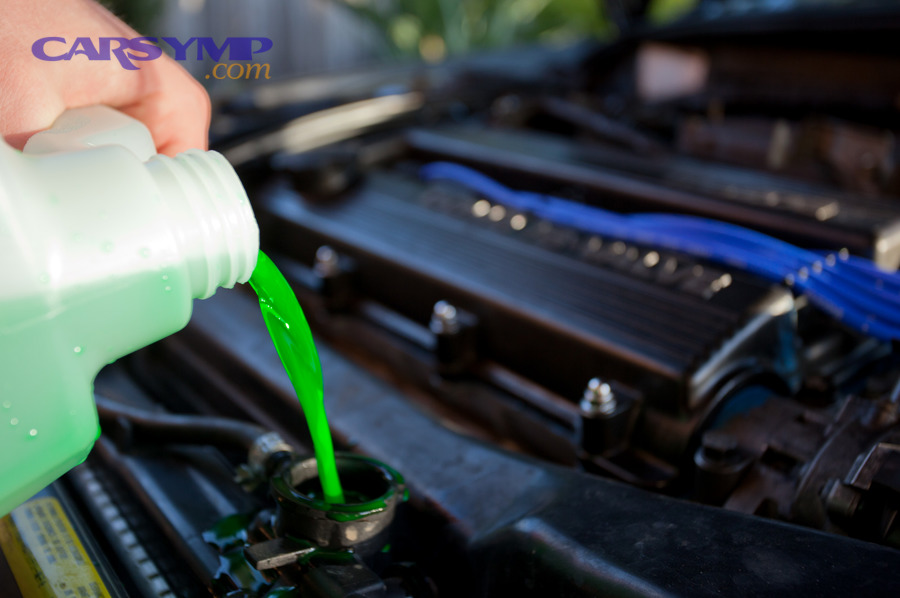
If the reservoir is below minimum or empty, you have confirmation of loss—but refilling on the roadside is not always the right move. If the leak is large, you’ll just dump coolant onto the ground, and you may still overheat quickly.
If you add coolant or water in an emergency, use it only as a short-term measure to move to a safe location or a shop, and never assume the problem is “fixed.”
What should you look for under the hood and under the car?
Look for evidence patterns that match common leak locations:
- Front of engine / belt area: wetness near water pump or weep hole, spray on belts
- Radiator corners and seams: damp fins, crusty deposits, wet undertray near front bumper
- Hose junctions: wet clamps, bulges, splits, residue lines along hose length
- Firewall area: heater hoses, quick-connect fittings, signs of seepage
Under the car:
- Coolant puddles often appear after you stop, because airflow while driving can disperse droplets and delay dripping.
- Use the puddle location as a clue, but remember fluid can travel along splash shields and subframes.
What should you do if coolant is leaking onto the ground?
Treat spilled coolant seriously: many coolants are toxic and attractive to pets due to taste/smell.
- Keep children and animals away from the spill.
- Avoid letting coolant drain into storm drains if you can prevent it.
- If the leak is significant, do not keep running the engine “to see what happens.”
At this point, calling roadside assistance or arranging a tow is often the lowest-cost decision compared with gambling on overheating damage.
Where do most coolant leaks come from in the cooling system?
Most coolant leaks come from hoses, clamps, radiators, water pumps, and plastic housings because these parts experience constant heat cycles, pressure, vibration, and chemical exposure over time.
To narrow it down, match the symptom pattern (spray vs drip vs no puddle) to the component group most likely to fail.
Are hoses and clamps the most common external leak points?
Yes—hoses and clamps are among the most common external leak points because rubber ages, clamps loosen, and quick-connect fittings can deform from heat cycling.
Typical hose/clamp leak signs:
- Wetness concentrated at the clamp edge
- A “track line” of dried residue along the hose path
- Leak worsens under throttle (pressure increases)
Pay special attention to:
- Upper radiator hose (hot-side pressure)
- Lower radiator hose (suction + collapse risk)
- Small diameter bypass and heater hoses (often overlooked)
Can the radiator or reservoir crack and leak only when hot?
Yes—radiators and reservoirs can develop hairline cracks that open when hot and close when cool, making the leak seem “intermittent.”
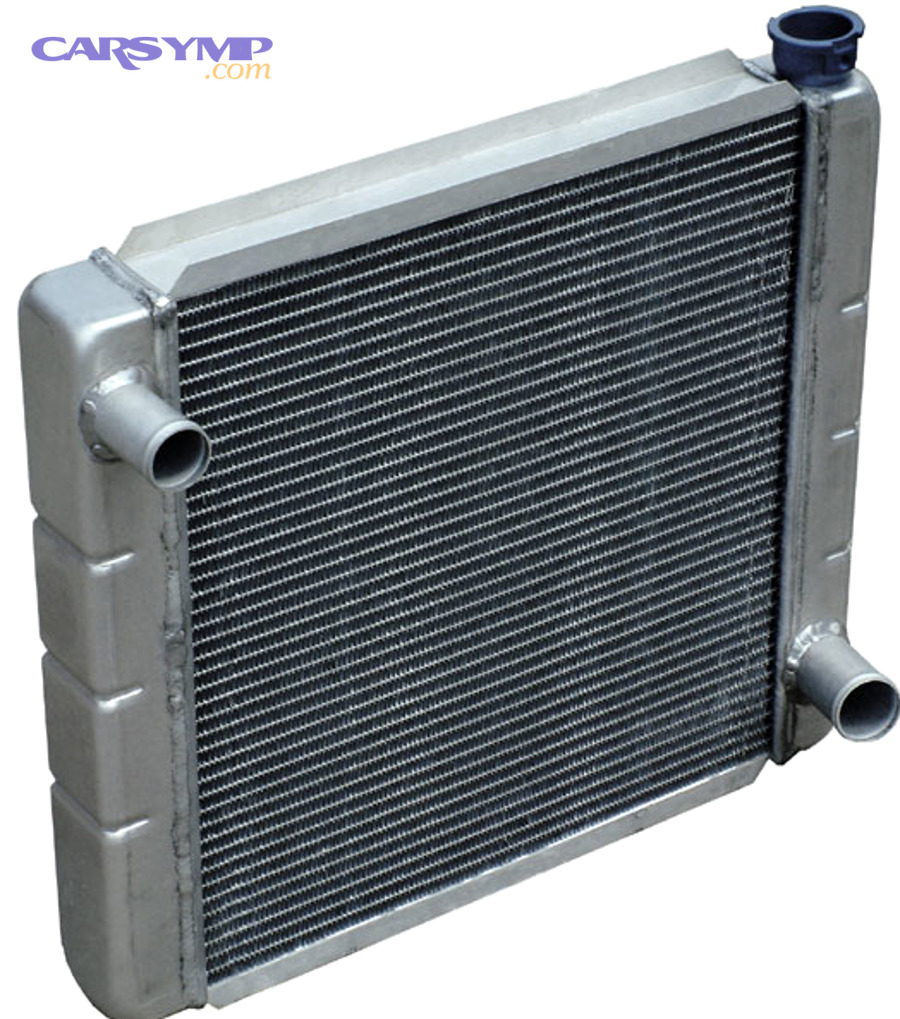
Radiator leak patterns often include:
- Dampness at plastic end tanks (common in aluminum-core/plastic-tank radiators)
- Seepage at seams or drain plug area
- Coolant smell after driving, with little visible dripping until parked
Reservoir issues include:
- Cracked tank seams
- Bad cap that fails to hold pressure (which can promote boiling and overflow)
A pressure test at a shop often reveals these “only when hot” failures.
Is the water pump a common culprit, and how does it show up?
Yes—the water pump is a frequent source of leaks, especially as seals wear. Many pumps have a weep hole designed to vent when the internal seal begins failing.
Water pump clues:
- Coolant traces on the pump housing
- Drips behind the crank pulley area
- Wet belt or sprayed residue around the front of the engine
- Chirping or bearing noise (sometimes accompanies leakage)
If the pump is leaking, continuing to drive is risky because leakage can worsen suddenly, and pump bearing failure can cause belt issues.
What about heater core, heater hoses, and cabin-side leaks?
Heater cores and heater hoses are common “hidden” leak points because they sit near the firewall and can leak into the cabin.
Clues that point to heater-side leaks:
- Sweet odor inside the cabin
- Foggy windows with an oily film
- Damp carpet (often passenger side)
- Heater performance becomes inconsistent
Because heater core replacement can be labor-intensive, accurate confirmation matters—don’t guess. Combine cabin symptoms with coolant loss and visible seepage around firewall hose connections.
How do internal leaks like head gaskets differ from external leaks?
Internal leaks differ because coolant disappears without a clear external trail, and you often see combustion/exhaust or oil-contamination clues.
Strong internal-leak indicators:
- Persistent white exhaust smoke after warm-up (White exhaust smoke vs coolant leak clues)
- Unexplained coolant loss with no puddle
- Bubbling in the reservoir while revving (combustion gases entering coolant)
- Oil/coolant mixing signs (milky residue)
Because internal leaks can quickly progress, towing is usually smarter than “testing it” by driving.
Here’s one helpful visual walkthrough for basic head-gasket checks:
How can you confirm a coolant leak and prevent it from happening again?
You can confirm a coolant leak by combining a pressure test, visual tracing (including UV dye if needed), and symptom correlation—then prevent repeat failures by repairing the root component, restoring correct coolant mixture, and maintaining hoses/caps before they fail.
Next, use a confirmation-first mindset so you don’t replace parts blindly.
How does a pressure test or UV dye test confirm the leak location?
A cooling-system pressure test is one of the fastest ways to turn “suspected leak” into “proven leak.” A technician pressurizes the system (engine off) and checks for pressure drop and external seepage.
UV dye adds another layer: dye circulates with coolant and glows under UV light, making small leaks visible around seams, fittings, and hose ends.
This approach is especially valuable for:
- Slow leaks that evaporate on hot surfaces
- Leaks that only appear under pressure
- Multiple small seep points
The goal is to identify the exact leak origin so the repair is precise (hose vs radiator seam vs pump weep hole vs housing crack).
How do you refill correctly and avoid air pockets after repair?
Refilling correctly matters because trapped air can mimic leak symptoms (rising temps, heater issues) even after the leak is fixed.
Best-practice refill concepts:
- Use the correct coolant type and a proper water/coolant ratio per manufacturer spec (often premixed or 50/50 where appropriate).
- Bleed air using the vehicle’s designed method (bleeder screws, vacuum fill, or specific fill sequence).
- Confirm heater output returns to normal (a practical sign of restored circulation).
- Recheck level after a complete heat cycle and cooldown.
If you refill incorrectly, you can get false “overheating” behavior that looks like the leak is still present.
What maintenance habits actually prevent future coolant leaks?
Prevention is mostly about catching aging rubber and weak plastic before pressure finds the weakest point.
High-value habits:
- Inspect hoses for soft spots, swelling, cracks, and oil contamination at every oil change.
- Replace caps (radiator/reservoir) when they can’t hold pressure or seals harden.
- Flush/replace coolant on schedule to reduce corrosion and seal wear.
- Address small seepage early—minor residue today can be a burst tomorrow.
If the vehicle has known weak points (certain plastic thermostat housings, specific quick-connect designs), proactive replacement can prevent roadside failures.
What temporary actions are acceptable, and what should you avoid?
Temporary actions can help you reach safety, but they are not repairs.
Acceptable “get-safe” actions:
- Add water/coolant in an emergency to move a short distance if temperature is stable
- Run the heater to reduce engine heat while moving to a safe stop
- Arrange towing if overheating or internal-leak signs appear
Actions to avoid:
- Opening a hot cap
- Driving with the gauge in the hot zone
- Using stop-leak products as a first choice (they can clog heater cores/radiators and complicate repairs)
If you’re seeing recurring temperature spikes, steam, or white smoke after warm-up, treat it as a tow situation—because the cost of overheating damage is usually far higher than a tow.
Evidence: According to a study by Vanderbilt University from the Department of Electrical Engineering and Computer Science and the Department of Mechanical Engineering, in an experimental cooling-system fault-detection setup, researchers highlighted that measurement precision (often within about 2%–5% of nominal values) can be critical for detecting small deviations and isolating faults like leaks.