


If you want a reliable way to compare car fluid service costs, start by separating what fluid you’re servicing from how the shop services it—because a “flush” and a “change” can be entirely different jobs with very different totals. This guide breaks down typical price ranges for transmission, brake, coolant, and power steering services, plus what’s usually included so you can judge a quote quickly.
Next, you’ll see how flush vs change/exchange affects price and risk—especially for transmissions—so you can match the service method to your car’s condition instead of buying the most expensive option by default.
Then, we’ll explain why two shops can quote wildly different totals for the “same” service, including labor rate per hour, fluid specifications, vehicle design, and the line items that turn a simple service into a bigger ticket.
Introduce a new idea: once you understand the cost drivers, you can build a repeatable maintenance cost estimate using your own car’s mileage and records—so you’re not guessing the next bill, you’re predicting it.
What does “car fluid service cost” mean, and what’s typically included in the price?
A car fluid service cost is the total you pay for replacing or conditioning a vehicle fluid using a specific procedure (change, exchange, flush/bleed), usually including labor, the correct fluid, and any required seals, gaskets, or disposal fees. More importantly, the words on the invoice matter—because “service” can mean anything from a simple drain-and-fill to a multi-step flush with testing.
What parts and labor items are included in a fluid service estimate?
A typical estimate includes fluid + labor + any required parts, but the exact mix changes by system. Specifically, you should expect the quote to describe what is being replaced, how it’s being replaced, and what components are removed or tested to do it safely.
Here are the most common line items you’ll see (and what they usually mean):
- Fluid (type + quantity): The shop should list the specification (e.g., ATF type, coolant chemistry, DOT rating) and the amount used.
- Labor time (or flat-rate labor): Even if the shop charges flat-rate, it should still be based on a time standard.
- Consumables and required parts (when applicable):
- Transmission: pan gasket, filter/strainer, crush washer, RTV sealant (some designs), sometimes new bolts.
- Coolant: radiator cap (sometimes recommended), drain plug gasket, hose clamps (if disturbed).
- Brake fluid: bleeder screws rarely replaced, but sometimes caps, bleeder fittings, or ABS bleed steps add labor.
- Power steering: return line clamp or sealing washer (occasionally), reservoir screen cleaning (model-dependent).
- Inspection steps: Leaks, condition checks, test drive, pressure test (cooling system), or scan tool verification.
A simple way to sanity-check a quote: if the shop can’t tell you fluid spec + service method + what’s included, you don’t have enough information to compare prices.
Are “shop supplies,” disposal, and environmental fees normal—and how much do they add?
Yes, shop supplies and disposal fees are common for fluid services because fluids are regulated waste and shops pay to handle them, but the charge should be reasonable, itemized, and consistent with the shop’s policy. In addition, the best way to keep those fees fair is to ask what they cover (absorbent pads, cleaners, hazardous waste handling) and whether they’re flat or percentage-based.
Practical red flags to watch for:
- A disposal fee that appears multiple times for the same service.
- “Shop supplies” as a large percentage without explanation.
- A quote that lists a “flush chemical” without stating why it’s needed.
If you’re comparing two quotes, compare total out-the-door price and compare the method. A higher price can be legitimate if it includes a filter, gasket, pressure test, or an ABS bleed procedure that the cheaper quote omits.
What is the average cost of each major fluid service (transmission, brake, coolant, power steering)?
There are four major fluid services most drivers compare—transmission, brake, coolant, and power steering—and their costs vary based on fluid type, capacity, and procedure (change vs exchange vs flush). To make the comparison useful, you need ranges that reflect “simple service” vs “more complete service,” not just one number.
The table below summarizes typical price bands by service type, so you can see what you’re being sold before you focus on the exact dollar amount.
What this table contains: an at-a-glance comparison of common service methods and why the price changes.
| Fluid system | Lower-cost method (what it usually is) | Higher-cost method (what it usually is) | Why the higher method costs more |
|---|---|---|---|
| Transmission | Drain-and-fill | Fluid exchange + possible filter/pan service | More fluid, more time, more parts (filter/gasket) |
| Brake | Bleed / partial exchange | Full flush/bleed (sometimes ABS procedure) | More labor steps, sometimes scan tool cycle |
| Coolant | Drain-and-fill | Full flush + pressure test + proper refill/bleed | More labor, more steps, air-pocket prevention |
| Power steering | Simple exchange (turkey baster/reservoir) | Full exchange/flush (line method) | More time, more fluid, more access steps |
How much does a transmission fluid change or exchange cost, and what changes the price?
A transmission service price depends primarily on service method (change vs exchange), transmission type (automatic vs CVT), and whether a filter/pan gasket is replaced. To better understand the bill, treat “transmission fluid change” as a baseline, and “filter + pan service” as a bigger job category.
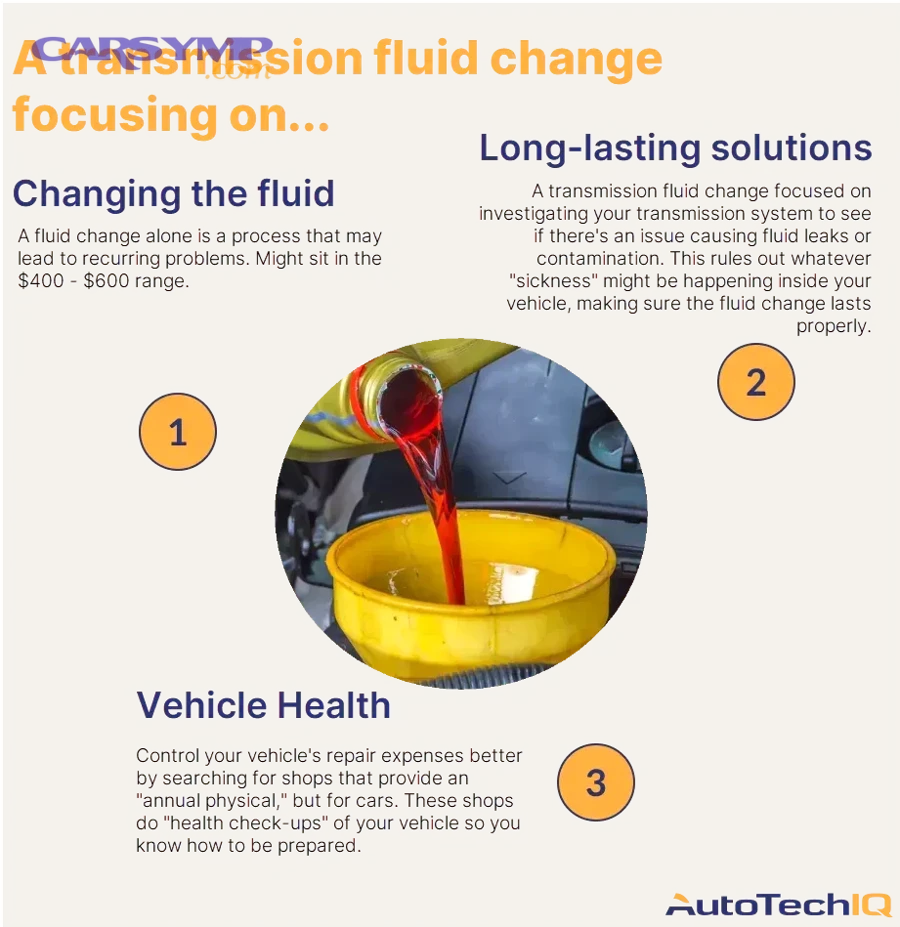
A commonly cited baseline estimate for a transmission fluid change is in the low-to-mid hundreds, and RepairPal’s estimator lists an average range of $232–$290 for a transmission fluid change (labor + parts), before taxes/fees and location adjustments. (repairpal.com) If the service includes a filter and pan gasket, RepairPal’s estimate category for transmission filter and fluid change is substantially higher, with an average range of $562–$727. (repairpal.com)
What pushes the price up (fast):
- CVT fluid and specialized fluids (higher cost per quart).
- “Sealed” or temperature-dependent fill procedures that require scan tool verification.
- Removing undertrays, braces, or components to access the fill/check port.
- Adding filter/pan gasket parts and the labor to remove and reseal the pan.
What keeps the price closer to the baseline:
- Simple drain-and-fill designs with easy access.
- Lower fluid capacity and common ATF types.
- No filter replacement required (design-dependent).
How much does a brake fluid flush cost, and when is it truly needed?
Brake fluid service costs usually track labor complexity because the fluid itself is relatively inexpensive compared to the risk and procedure. More specifically, the biggest price driver is whether the shop performs a straightforward bleed or a full flush/bleed—and whether it runs an ABS cycle procedure.
A brake fluid flush is most “truly needed” when:
- Brake fluid is old (time-based intervals matter because brake fluid absorbs moisture).
- The system has been opened (caliper, hose, master cylinder replacement).
- The pedal feel is inconsistent and the shop confirms fluid degradation.
- The vehicle is used for towing, mountainous driving, or heavy braking.
Why moisture matters: brake fluid is hygroscopic, so water contamination can lower boiling point and affect performance under heat.
Evidence: According to a study by National Taipei University of Technology from the Department of Mechanical Engineering, in 2006, researchers reported experimental findings showing brake fluid’s hygroscopic behavior and noted that moisture in brake fluid reduces boiling point and can deteriorate brake system functionality. (ntut.elsevierpure.com)
How much does a coolant flush cost, and what’s different from a coolant drain-and-fill?
A coolant drain-and-fill is usually cheaper than a full coolant flush because a flush often adds extra steps like thorough system cleaning, controlled bleeding, and sometimes pressure testing. However, the right choice depends less on price and more on whether the system is contaminated, mixed with the wrong coolant, or overdue.
A drain-and-fill typically focuses on:
- Draining coolant from a drain point (radiator and sometimes engine block).
- Refilling with the correct coolant mix.
- Bleeding air from the system as required.
A flush often adds:
- Additional draining cycles (sometimes with a flushing agent, depending on shop practice).
- More comprehensive bleeding to reduce air pockets.
- Potential pressure test recommendations if overheating or leaks are suspected.
Coolant pricing jumps when:
- The vehicle uses OEM-specific coolant chemistry that costs more.
- The system holds a large coolant volume (trucks, some SUVs).
- Access is complex (buried thermostats, bleed screws, or multiple cooling loops).
Evidence: According to a study by McGill University from the Department/Program of Mechanical Engineering (MSc thesis), in 2016, research on corrosion inhibitors highlighted how inhibitor selection affects corrosion behavior in water-based cooling systems, supporting why coolant type and additive package matter for long-term radiator protection. (combustion-engines.eu)
How much does a power steering fluid flush/exchange cost, and when is there no fluid at all?
Power steering fluid service cost depends on whether the car uses hydraulic power steering (fluid-based) or electric power steering (no fluid). In other words, some modern vehicles have no power steering fluid to service, and any quote for “power steering flush” should start with confirming the system type.
For hydraulic systems, price varies by:
- Whether the shop does a quick reservoir exchange or a full line exchange.
- Hose access (some return lines are easy; others are buried).
- Whether there’s a known leak (in which case fluid service alone may not solve the issue).
A fluid exchange makes sense when:
- Fluid is dark/burnt and steering feels noisy or groany.
- A component was replaced (pump, rack, hose).
- The manufacturer recommends periodic replacement (varies).
If steering is electric, focus your maintenance budget elsewhere—because “fluid service” is not applicable.
Flush vs change: what’s the difference, and which one should you choose?
A flush is not automatically better than a change—the best method depends on the system, its condition, and service history. To sum it up: a change/drain-and-fill is the conservative baseline, while a full exchange/flush is a more comprehensive method that can cost more and may not be ideal for every situation.
Is a “flush” the same as an “exchange,” and why do shops use different terms?
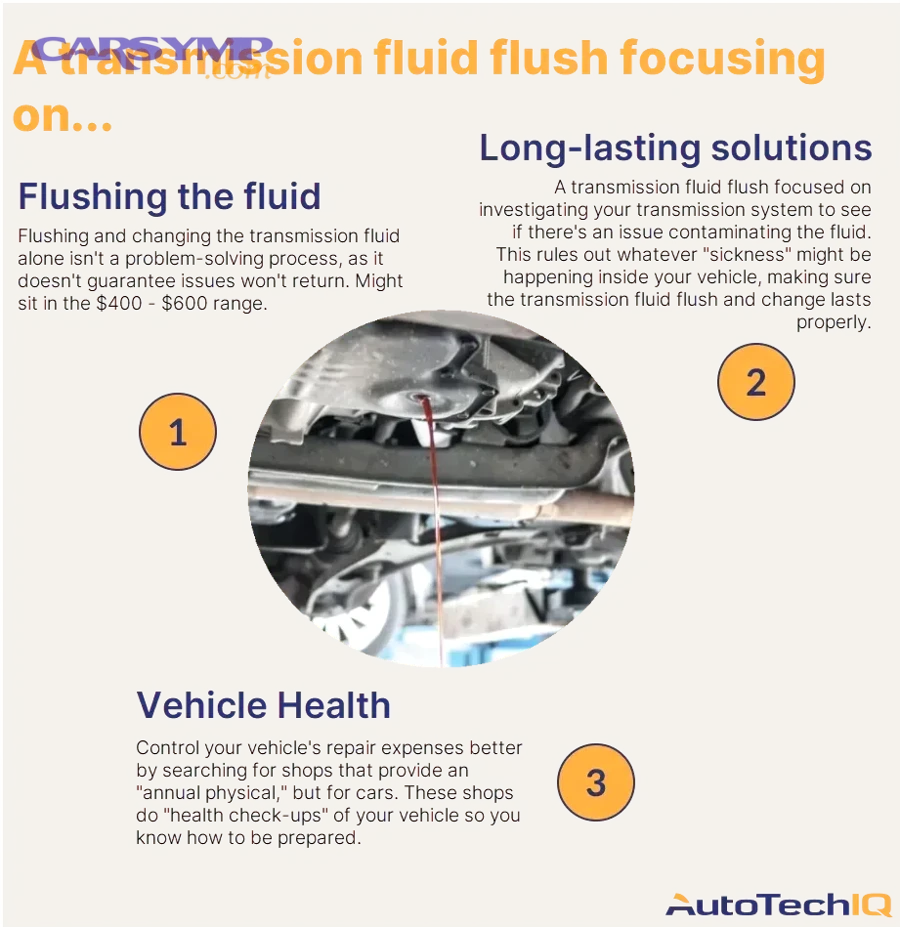
A “flush” and an “exchange” can overlap, but they’re not always identical because shops use the terms differently: some say “flush” for any full replacement, while others reserve “flush” for services that use a machine or add a cleaning step. Next, the only safe approach is to confirm the procedure rather than relying on the label.
Ask these questions to lock down meaning:
- “Are you doing a drain-and-fill or a full exchange?”
- “How many quarts are you replacing?”
- “Are you dropping the pan and replacing a filter/gasket (if applicable)?”
- “Are you using a machine, and does it add any chemicals?”
When you ask those, you’re no longer comparing marketing terms—you’re comparing real work.
When is a simple drain-and-fill better than a full exchange or flush?
Yes, a drain-and-fill is often the better choice for many drivers because it is (1) lower risk for unknown service history, (2) cheaper, and (3) still meaningfully refreshes the fluid and additive package. However, the decision becomes clearer when you connect it to your Maintenance cost by mileage intervals and your car’s history.
Drain-and-fill tends to be the best fit when:
- You bought the car used and you’re not sure about prior transmission services.
- The vehicle is higher mileage and you want a gradual approach.
- You’re building a predictable maintenance plan and repeating it at consistent intervals.
This is where Using service records to predict costs becomes powerful: if your records show regular fluid services, you can step up to more comprehensive methods with more confidence. If your records are unknown, start conservative and monitor results.
When does a flush make sense—and when can it be risky?
Yes, a flush (or full exchange) can make sense, but it’s risky when the system shows symptoms that indicate internal wear or when service history is unknown and the fluid is severely degraded. More importantly, a flush is best treated as a tool—not a default upgrade.
A flush/exchange is most justified when:
- The fluid is overdue but the system is operating normally.
- The manufacturer recommends a full exchange method for that system.
- You’re correcting a known issue like mixed coolant types (coolant) or heavily contaminated brake fluid.
A flush can be risky (especially for transmissions) when:
- The transmission is already slipping or has delayed engagement.
- The fluid is burned and the system is showing signs of internal wear.
- The shop cannot explain the method or wants to add chemicals without reason.
If you’re unsure, choose the method that preserves options: start with inspection + drain-and-fill, then reassess.
Why do fluid service prices vary so much by vehicle and shop?
Fluid service prices vary because the “same service name” can hide different procedures, different fluid specifications, different labor times, and different labor rates per hour. In addition, the vehicle itself can turn a straightforward job into a time-consuming one due to access, fill procedures, and required tools.
How do labor rates, region, and shop type (dealer vs independent) change the total?
Dealer quotes tend to run higher when labor rates are higher and OEM procedures are followed strictly, while independent shops can be more price-competitive, especially for straightforward drain-and-fill services. Meanwhile, region can shift the baseline because local labor markets move the labor rate per hour up or down.
Where the difference usually shows up:
- Labor rate per hour: A higher rate multiplies any procedure that takes longer.
- Parts and fluid pricing: Dealers may use OEM-only fluids; independents may offer OEM-equivalent or approved alternatives.
- Warranty on work: Some shops include longer service guarantees, which can add cost but reduce risk.
The key is not “dealer vs independent” as a slogan—it’s whether the quote clearly matches the procedure your car needs.
How do vehicle design and fluid specs affect cost (capacity, “sealed” transmissions, special coolant)?
Vehicle design affects cost because access, fill verification, and fluid capacity directly change labor time and parts/fluid volume. For example, a transmission that requires temperature-based level checks can add time and tool requirements, while a large cooling system raises the coolant volume and refill complexity.
Watch for these design-driven cost multipliers:
- High fluid capacity (more fluid = higher parts cost).
- Specialty fluids (CVT fluids, OEM-specific coolants).
- Complex access (undertrays, braces, buried fill ports).
- Procedure requirements (scan tool steps, bleed sequences, vacuum fill).
If you want quotes that are comparable, insist on one thing: the shop lists the exact fluid spec and the exact method.
How can you estimate your total cost and avoid overpaying?
Yes, you can estimate your total cost and avoid overpaying by (1) turning your car’s mileage into a service schedule, (2) matching each service to the correct method (change vs flush), and (3) comparing itemized quotes—not headlines. To better understand your next bill, think in terms of a repeatable plan instead of random one-off repairs.
What should you ask for in a quote (itemized line-by-line) before approving service?
Before approving service, ask for a line-by-line estimate that names the fluid spec, quantity, method, labor, and included parts, so you can compare apples to apples. Specifically, your goal is to remove ambiguity—because ambiguity is where overpaying hides.
Use this checklist:
- What is the exact fluid specification (brand/spec, not just “ATF” or “coolant”)?
- How much fluid will you use (quarts/gallons)?
- What is the service method (drain-and-fill, exchange, flush/bleed)?
- Does it include a filter, gasket, crush washer, or seals (if applicable)?
- Are there diagnostic or test steps included (pressure test, ABS cycle, scan tool verification)?
- What fees are added (shop supplies, disposal), and are they flat or percentage-based?
This is how a quote becomes a decision tool instead of a surprise invoice.
What are common “hidden fees to watch for,” and which upsells are worth it?
Common hidden fees include vague shop supplies, redundant disposal charges, and “conditioning” additives that aren’t tied to a specific problem or procedure. However, some upsells are worth it when they directly support the service quality and longevity.
Fees to question:
- “Flush chemical” without stated reason.
- Multiple disposal charges for the same job.
- A large “miscellaneous” line with no breakdown.
Upsells that can be worth it (when justified):
- Transmission pan gasket + filter service if the design supports it and the service interval calls for it.
- Cooling system pressure test when there’s overheating history or coolant loss.
- Brake fluid test and a full bleed when moisture/boiling point concerns are documented.
A useful rule: if the upsell changes the system’s reliability outcome, it may be worth it; if it’s just a vague add-on, it’s negotiable.
Can you DIY fluid changes to save money, or is it better to pay a shop?
DIY can win on cost, while a reputable shop wins on procedure control, tool access, and risk reduction—so the best answer depends on the fluid system and your tools. More specifically, DIY savings are strongest on simple drain-and-fill jobs and weakest on procedures that require bleeding sequences, temperature checks, or safe disposal.
DIY is often reasonable when:
- You’re doing a simple engine-related drain-and-fill and you can dispose of fluid correctly.
- The procedure is well-documented and doesn’t require scan tools.
A shop is often better when:
- The job needs ABS bleeding, scan tool steps, or temperature-based fill verification.
- Access is difficult or safety risk is high.
This is also where your broader maintenance plan matters: if you’re budgeting for reliability, a well-documented shop service can make your long-term maintenance cost estimate more accurate.
What rare or vehicle-specific factors can make fluid service costs unusually high or low?
Rare vehicle-specific factors can raise or lower your quote because they change fluid type, procedure complexity, required tools, and time, even when the service name looks the same. Besides the basics, this is where micro-details—like temperature-based fill procedures or multiple cooling loops—explain why your estimate doesn’t match a generic average.
How do CVT, DSG/DCT, and temperature-based fill procedures change transmission service pricing?
CVT and DSG/DCT transmissions often cost more to service because they use specialized fluids and can require stricter fill verification procedures, sometimes involving temperature checks and scan tools. Next, that extra procedure time and higher-cost fluid show up directly in your quote.
What changes in the real world:
- Fluid cost per unit increases (specialized fluids).
- Verification steps increase (temperature windows, scan tool monitoring).
- Access complexity increases (fill/check ports, undertrays).
- Procedure sensitivity increases (overfill/underfill risk).
If a shop quotes a bargain price but can’t explain the fill verification method, treat that as a quality risk—not a deal.
How do hybrids/EVs change coolant service costs (multiple cooling loops, specialty coolant)?
Hybrids and EVs can increase coolant service complexity because they may have multiple thermal management loops and sometimes use specialty coolant requirements for different components. More importantly, additional loops can mean additional bleeding steps and more time to refill correctly.
Why this affects your bill:
- More circuits can mean more points to bleed and verify.
- The shop may need specific procedures to avoid air pockets.
- The coolant spec may be more specific and less “universal.”
If you’re planning maintenance spending, this is one reason newer powertrains can shift long-term totals even if they reduce other service categories.
Does brake fluid testing (moisture/boiling point) reduce unnecessary flushes?
Yes, brake fluid testing can reduce unnecessary flushes because it provides evidence that the fluid’s condition has degraded, rather than relying only on time or mileage. However, the test is most useful when it’s paired with a clear recommendation: “here’s the measured result and here’s why it matters for safety.”
What good testing changes:
- It turns a recommendation into documentation.
- It helps you time service more precisely rather than guessing.
Evidence: According to a study by National Taipei University of Technology from the Department of Mechanical Engineering, in 2006, experimental results reinforced that brake fluid’s hygroscopic nature allows water absorption that can reduce boiling point—supporting why moisture-based condition checks are relevant. (ntut.elsevierpure.com)
What’s the real difference between OEM-specific vs “universal” fluids—and how does it affect total cost?
OEM-specific fluids prioritize compatibility and long-term protection for a particular system, while “universal” fluids prioritize broad coverage—so OEM-specific wins on certainty, universal wins on availability and sometimes price. Meanwhile, the cost impact comes from both the price per quart and the risk of mismatch.
How this changes your total:
- OEM-specific fluids can raise parts cost but reduce compatibility uncertainty.
- Universal fluids can lower parts cost but require careful verification of approval and chemistry.
For cooling systems in particular, coolant chemistry matters because corrosion protection depends on inhibitor packages.
Evidence: According to a study by McGill University from the Department/Program of Mechanical Engineering, in 2016, research discussing corrosion inhibitors in water-based cooling systems supports why inhibitor selection and coolant chemistry influence long-term corrosion behavior—making “universal vs OEM-specific” a real maintenance decision, not just a price choice. (combustion-engines.eu)
Evidence (cost anchors you can cross-check quickly)
- RepairPal’s estimator lists an average transmission fluid change range of $232–$290 (labor + parts), before taxes/fees and location adjustments. (repairpal.com)
- RepairPal’s estimator category for transmission filter + fluid change lists an average range of $562–$727. (repairpal.com)
If you want, I can turn this into a reusable maintenance cost estimate template (by mileage intervals + expected fluid services), and include a section that ties in other predictable costs like tires over a year so your annual plan is complete.