


Regional mechanic labor rates drive maintenance costs because labor is the one part of your bill that changes dramatically by ZIP code, even when the car and the repair are identical. If you understand the labor rate per hour, the billed hours, and the fee structure, you can predict what you’ll pay before you book—and you can spot an estimate that looks “cheap” but becomes expensive at checkout.
Next, you’ll see how labor rates vary by location in practical, quote-ready terms, so you can compare a state-by-state range to what shops in your area are actually charging. That comparison matters most when you’re paying for labor-heavy jobs like brakes, suspension, and complex diagnostics where hourly differences compound quickly.
Then, you’ll learn why rates swing so widely—cost of living, technician supply, shop overhead, and the type of business model (dealer, independent, franchise, specialist). Those drivers explain why a higher labor rate per hour can sometimes signal better tools, faster diagnosis, and stronger warranty, but can also be just “rent and demand” with no added value.
Introduce a new idea: once you understand how regional labor pricing works, you can actively control your maintenance spending with a repeatable playbook—choosing the right shop type, comparing out-the-door totals, and using a simple maintenance cost estimate framework to plan routine service instead of reacting to surprises.
What does “regional mechanic labor rate per hour” mean, and how does it show up in your bill?
A regional mechanic labor rate per hour is the local price a shop charges for one hour of technician labor, shaped by area wages and overhead, and it appears on your estimate as a labor line item that multiplies the hourly rate by billed time.
Then, because that single line can hide the biggest location-based price difference, it helps to understand exactly what you’re paying for—and what you’re not.
Is the labor rate per hour the same thing as the total labor charge?
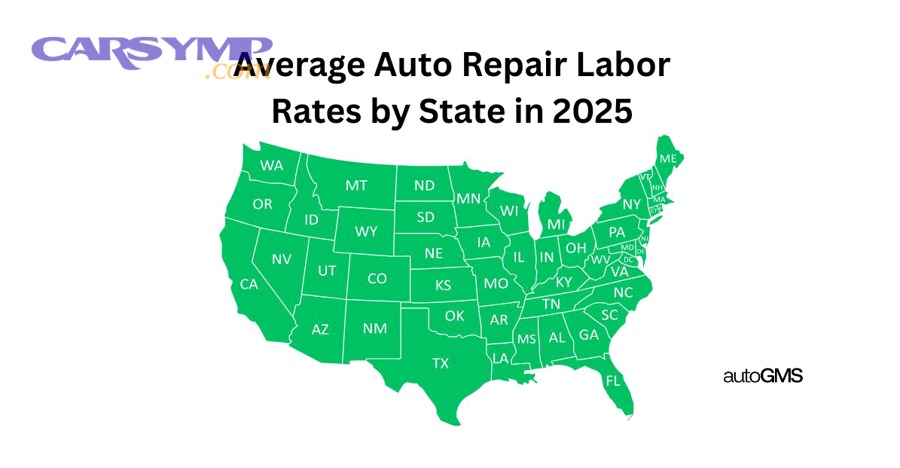
No—the labor rate per hour is only the price per unit of time, while the total labor charge is the rate multiplied by the billed hours (plus, in many invoices, related labor-adjacent fees).
Next, this difference is where most quote confusion starts, because two estimates can show the same hourly rate but different billed time—or show different rates but converge once fees and flat-rate time are applied.
Here’s the simplest way to read the labor portion of a bill:
- Labor rate per hour: the shop’s posted “door rate” (example: $125/hr).
- Billed labor hours: the time the shop charges you for (example: 2.0 hours).
- Total labor: rate × hours (example: $125 × 2.0 = $250).
Where it gets tricky is that some labor time is bundled into packages. For example, a “brake service” price might not list an hourly rate at all, but the shop is still using an internal rate to price the package. In that case, the best comparison tool is not “hourly rate,” but the out-the-door number paired with what the service includes (parts grade, warranty, and whether the quote includes shop supply fees).
A practical habit that saves money is to ask every shop the same three questions:
- What is your labor rate per hour for customer-pay work?
- How many labor hours are you billing for this job (and is diagnosis included)?
- What fees are added on top of labor and parts (shop supplies, disposal, environmental)?
When you collect those three answers, you can turn any estimate into a transparent breakdown—and you stop shopping “headline prices” that ignore the real structure of the invoice.
What is “book time,” and why can two shops quote different labor hours for the same job?
Book time is a standardized labor-time guideline used to price common repairs, and two shops can quote different labor hours because they apply different guides, diagnostic policies, and minimum billing rules—even when the repair procedure is the same.
Specifically, book time is the bridge between “what the job takes” and “what the job costs,” so it’s the key to understanding regional differences that go beyond the posted labor rate per hour.
Think of book time as a pricing language:
- A repair guide lists a job at X hours under typical conditions.
- The shop charges its local labor rate per hour for those hours.
- The customer pays rate × hours, regardless of whether the work is finished faster or takes longer.
Two shops can differ on labor hours for several common reasons:
- Different estimating systems: one shop uses one guide; another uses a different one.
- Condition and corrosion: a car in a rust-prone region may require extra time for seized fasteners, broken bolts, or additional steps.
- Diagnostic policy: some shops bill diagnosis separately; others roll it into the repair if you approve the work.
- Minimum labor charges: a shop may have a one-hour minimum even for a 0.5-hour procedure.
- Sublet work: alignments, programming, or specialized machining may be billed differently than in-house labor.
To compare fairly, ask for the labor hours in writing and identify whether the shop is using flat-rate guide time, custom time, or a “package” price. If two quotes differ, the first thing to check is not who is “cheaper,” but whether both quotes assume the same time and the same scope.
What hidden fees to watch for can change your final maintenance cost by region?
There are 5 common “hidden” fee categories that can change your final maintenance cost by region: shop supplies, environmental/disposal, diagnostic charges, minimum labor increments, and taxes/municipal fees, and they often vary more by location than parts pricing does.
Moreover, these fees are where a quote that looks competitive can quietly drift upward, especially in high-cost metros with higher compliance and overhead expenses.
Here are the fee types to watch for—and how to evaluate them:
- Shop supplies fee (or “shop materials”)
Covers consumables like rags, cleaners, lubricants, and small hardware. It may be a flat amount or a percentage of labor. - Environmental/disposal fee
Common for oil, coolant, tires, and hazardous materials. The amount can vary by local disposal costs and regulations. - Diagnostic fee
Often charged for troubleshooting “check engine” lights, intermittent issues, or electrical problems. In some shops, it’s credited toward the repair if you proceed. - Minimum labor increments
Many shops bill in increments (e.g., 0.5 hour) or have a minimum (e.g., 1 hour), which affects small jobs. - Taxes and local add-ons
Labor taxability varies by jurisdiction. Even when the shop does not control it, it changes the out-the-door total.
A smart rule for apples-to-apples comparisons is: compare out-the-door totals with the same scope, and make sure both estimates show fees clearly. If a shop can’t or won’t itemize fees, that’s a pricing risk—because you can’t build a reliable maintenance cost estimate without knowing what gets added at the end.
How do regional labor rates drive maintenance costs (repair costs) in real numbers?
Regional labor rates drive maintenance costs by multiplying every billed hour, so a difference of $40–$80 per hour can swing labor-heavy repairs by hundreds of dollars even before parts and fees are added.
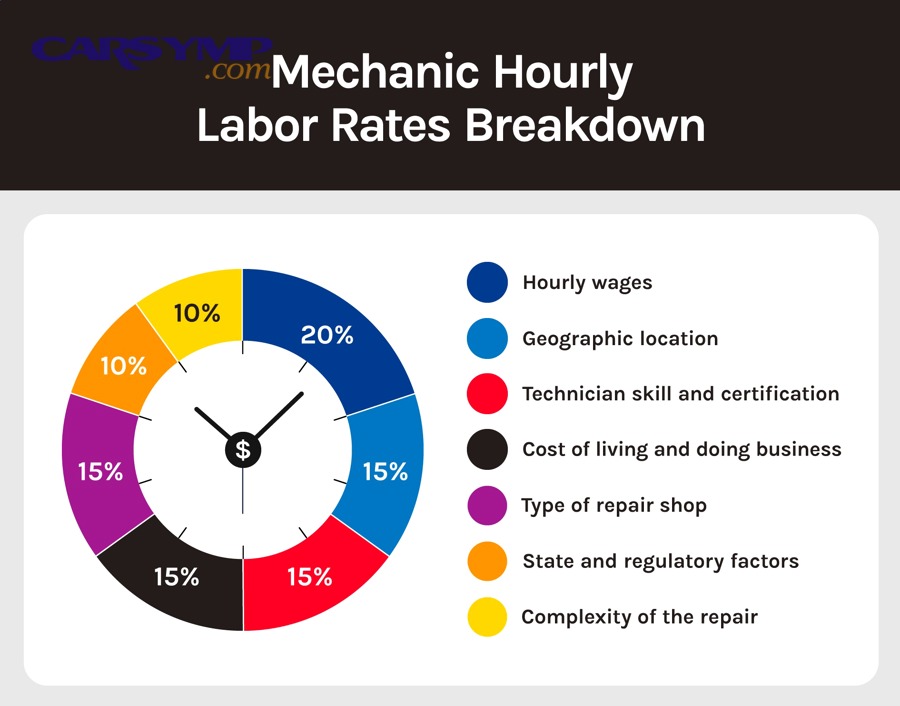
To illustrate, once you apply the same job hours across different locations, the math reveals exactly why some regions feel “expensive” even for routine service.
Here’s a simple framework you can reuse for any job:
Total cost ≈ (labor rate per hour × billed hours) + parts + fees + tax
To make that concrete, imagine a repair that bills 2.5 hours of labor:
- Region A labor rate: $100/hr → labor = $250
- Region B labor rate: $160/hr → labor = $400
- Difference in labor alone: $150
Now add typical fees (shop supplies and disposal) and tax, and the out-the-door gap widens. That’s why you should treat labor rate as the “multiplier” of your entire maintenance life: every time a shop touches your car, the local hourly rate shapes the baseline.
Does living in a high-cost state always mean higher maintenance costs?
No—living in a high-cost state often increases maintenance costs because labor rates trend higher, but the final bill can be lower when competition is strong, promotions are common, or the job is parts-heavy rather than labor-heavy.
However, the key is to predict when labor dominates the invoice, because that’s when region matters most.
High-cost areas tend to push labor upward for reasons like wages, rent, and insurance. But you can still see exceptions:
- A dense metro may have many shops competing, which can compress margins and reduce fees.
- A low-cost area may have fewer shops, longer lead times, and less competition, which can raise effective prices.
- Some services are largely parts-driven (like a battery replacement), so the labor difference is small.
- A high-cost area may offer transparent flat pricing that reduces surprise add-ons.
Instead of assuming “high-cost state = high repair bill,” use this decision shortcut:
- If the job is over 2 hours, regional labor rates are likely to matter a lot.
- If the job is under 1 hour and parts dominate, regional impact may be limited.
This approach helps you focus your comparison effort where it pays off.
Which maintenance jobs are most sensitive to labor rates (labor-heavy vs parts-heavy)?
There are 2 main groups of maintenance jobs—labor-heavy and parts-heavy—based on whether billed hours or parts cost makes up the larger share of the total.
Next, once you classify a service into one of these two groups, you can predict how strongly location will affect your out-the-door total.
Labor-heavy (high sensitivity to labor rate per hour):
- Brake rotor and pad replacement (especially multiple axles)
- Suspension work (control arms, struts, ball joints)
- Timing belt and water pump jobs
- Diagnostic-heavy electrical issues
- Cooling system repairs and leak tracing
Parts-heavy (lower sensitivity to labor rate per hour):
- Battery replacement
- Tires (especially if price includes mount/balance)
- Wiper blades, cabin/engine air filters (when priced as parts packages)
- Some fluid services offered as specials
Even inside these groups, your car type changes the sensitivity. For example, on some vehicles, brakes are straightforward; on others, they involve electronic parking brakes, scanning tools, and extra calibration, which increases labor time and makes regional labor rates matter more.
To keep your planning realistic, build your annual routine maintenance around jobs you know are coming (fluids, brakes, tires), then add a buffer for labor-heavy surprises (diagnostics, suspension, cooling). That structure gives you a maintenance cost estimate you can actually live by.
How much can a 20–40% labor-rate gap change the annual maintenance budget for a typical car owner?
A 20–40% labor-rate gap can change a typical annual maintenance budget by a meaningful margin—often from “a few hundred dollars” to “over a thousand”—because it compounds across multiple labor-billed services throughout the year.
More specifically, the larger your year’s labor hours, the more your location amplifies the total.
A practical way to estimate the impact is to count your expected labor hours for the year:
- Oil service packages and inspections: 0.5–1.5 hours total (varies by pricing model)
- Tire rotation/balance: 0.5–1.0 hours total
- Brake service (if due): 2–4 hours
- Alignment (if needed): 0.5–1.0 hours
- Diagnostic event (if a light appears): 1–2 hours
If you total 6–10 billed hours in a year, a $50/hr regional difference creates a $300–$500 swing in labor alone. If your year includes labor-heavy repairs (suspension, cooling, major service), those hours can double—and so can the location-driven difference.
That’s why “How to estimate routine maintenance costs” starts with labor-hours thinking, not just parts prices. Once you understand your likely billed hours, you can translate any regional labor rate into a predictable budget.
How do labor rates vary by state and region, and what benchmarks should car owners use?
Labor rates vary by state and region because local wages, rent, and market competition set different price floors, so car owners should use benchmarks as “ranges” for their ZIP code and compare them to out-the-door totals rather than relying on a single national average.
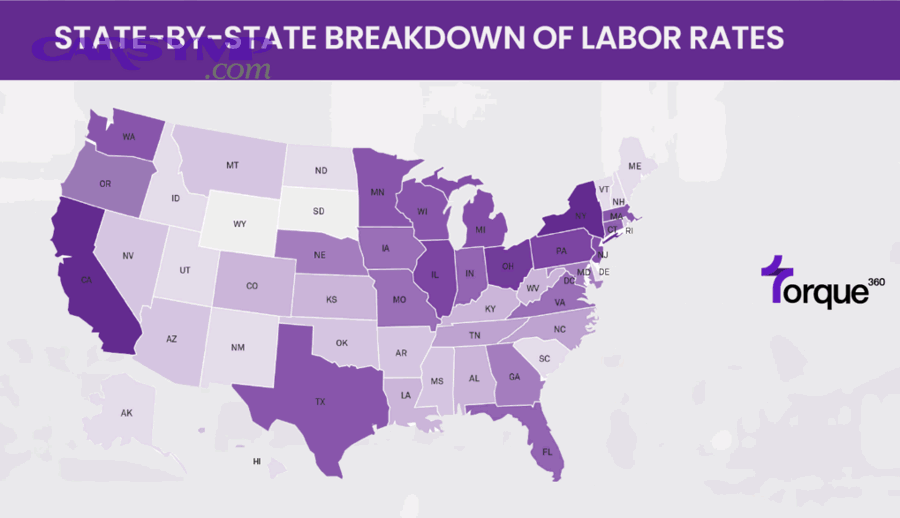
Then, because state lines rarely reflect true pricing boundaries, the most accurate comparison is state-level context plus metro-vs-rural reality.
A “benchmark” should help you answer two questions:
- Is this quote normal for my area?
- If it’s higher, am I getting extra value (diagnosis skill, warranty, OEM tooling, speed)?
Instead of chasing one perfect number, aim for a practical benchmark range:
- Low-rate range: often rural or lower-overhead areas
- Mid-rate range: many suburbs and mid-size cities
- High-rate range: dense metros, high cost-of-living regions, specialty-heavy markets
That range-based approach keeps you from misreading a fair quote as “too high” just because you saw a national average that doesn’t match your ZIP code.
Which regions typically have the highest and lowest mechanic labor rates?
Higher labor rates are typically found in high-cost metro regions, while lower labor rates are more common in lower-cost, lower-density regions, but the final price can invert when competition, minimum charges, and fee structures differ.
Meanwhile, this is exactly why the title’s “state-by-state guide” framing matters: it helps you understand the direction of pricing, not pretend every city in a state shares one rate.
A realistic way to interpret “highest vs lowest” without being misled:
- High-rate patterns often align with:
- Dense metro areas
- Higher wages and commercial rent
- Greater specialization (European, diesel, hybrid/EV)
- Higher insurance and compliance costs
- Low-rate patterns often align with:
- Smaller cities and rural zones
- Lower wages and operating costs
- More generalist service mixes
But the “lowest rate” region is not always the cheapest out the door. A shop with a lower posted rate can still be expensive if it relies on minimum labor increments, higher parts markups, or stacked fees.
So your actionable takeaway is: treat “region ranking” as a starting clue, not a final judgment, and verify with out-the-door quotes.
How can you quickly estimate a “fair” labor rate in your area before you book service?
You can estimate a fair labor rate in your area by collecting 3 local quotes, normalizing the labor hours and fees, and calculating an apples-to-apples effective rate, which gives you a reliable baseline in under an hour of calls or online requests.
Next, once you’ve built that baseline, you can use it repeatedly for future bookings—turning regional variation into a predictable planning tool.
Use this fast method:
- Pick 3 comparable shops
Include at least one independent and one dealership or franchise, if available. - Ask for the same job scope
Example: “front brake pads and rotors, including hardware, and an inspection.” - Request the same fields
- Labor rate per hour
- Billed labor hours
- Parts grade (OEM/OE equivalent/aftermarket)
- Fees and tax estimate
- Warranty terms
- Build a simple comparison grid
Your goal is not just the cheapest number, but the most transparent and consistent price structure.
This is also where you create a personal “maintenance cost estimate” workflow: once you know your local labor range and your car’s typical service cadence, you can budget routine work without guesswork.
Should you compare quotes by the labor rate per hour or by the out-the-door total?
Out-the-door total wins for fairness, labor rate per hour is best for diagnosing why quotes differ, and a blended approach is optimal when you want both price accuracy and insight into fee padding or time inflation.
However, because regional differences often hide in fees and billed hours, comparing only the hourly rate can mislead you into choosing the wrong shop.
Use this comparison rule:
- Compare out-the-door totals to decide affordability.
- Compare rate × hours to identify pricing behavior.
- Compare fees to detect “cheap headline, expensive checkout” patterns.
If you’re deciding between two estimates that are close, prioritize transparency and scope clarity:
- Does the quote specify labor hours?
- Does it list fees?
- Does it name the parts grade?
- Does it include a warranty?
Those are the factors that make a quote predictable—and predictability is what keeps maintenance affordable over time.
Why do mechanic labor rates vary so much by location?
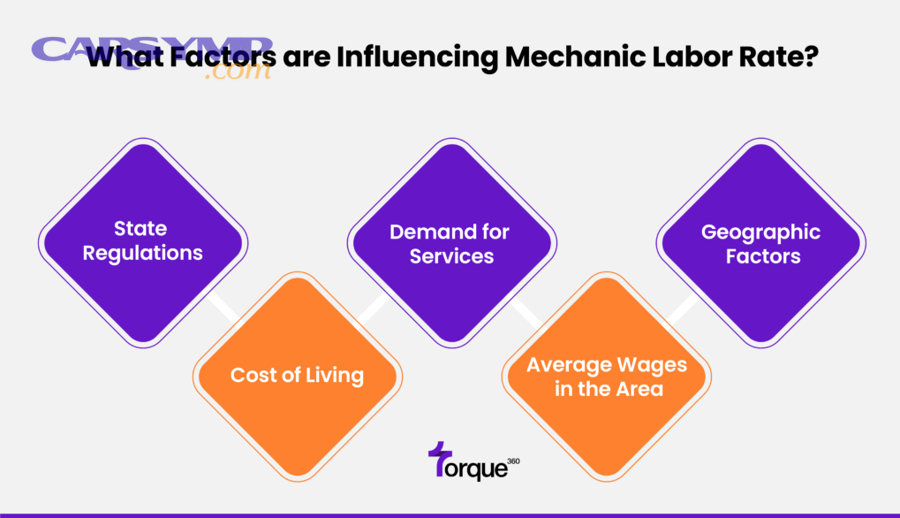
Mechanic labor rates vary by location because wages, rent, insurance, demand, technician supply, and specialization costs differ across regions, so shops must price labor to cover local overhead and maintain staffing.
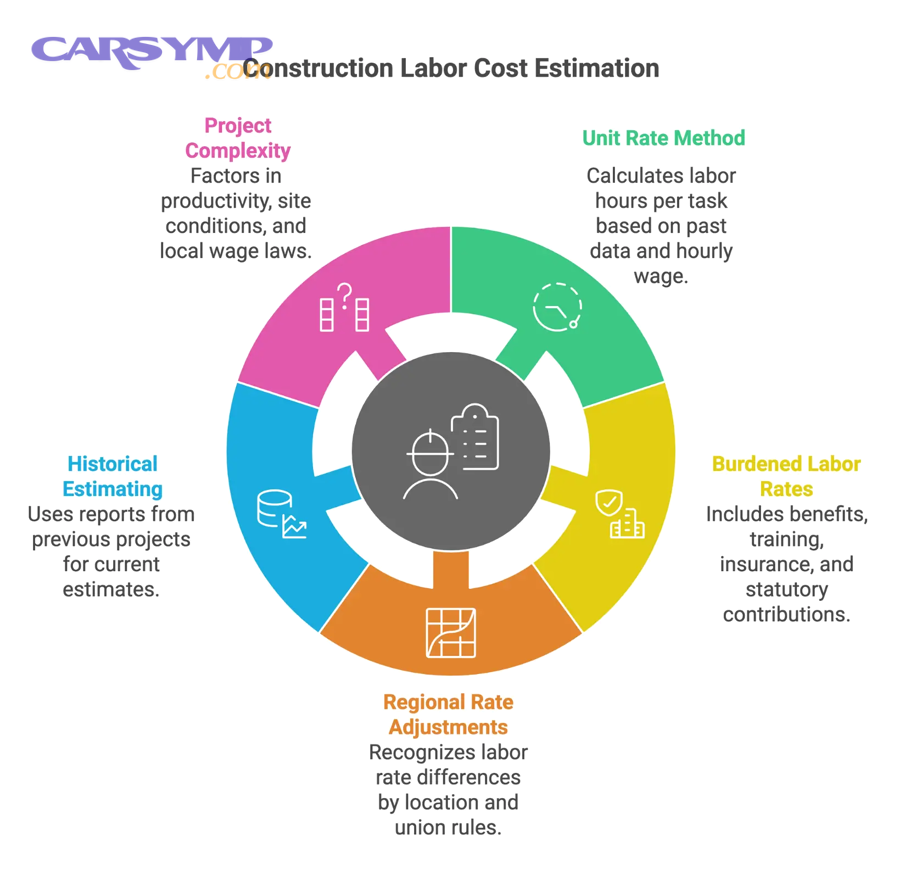
Besides, regional pricing is not just “shop greed”—it is usually the economic result of running a service business where skilled labor and facility costs are the largest inputs.
The biggest drivers of regional variation include:
- Technician wages and labor market tightness
Shops in high-demand markets pay more to hire and retain talent. - Facility costs
Commercial rent, utilities, and property costs scale dramatically by metro area. - Insurance and compliance
Liability coverage, worker’s comp, and local compliance costs vary. - Demand patterns
Commuter-heavy regions, harsh climates, and high vehicle density increase repair demand. - Specialization and tools
Modern vehicles require scan tools, software subscriptions, and training—costs that can be passed into labor.
This section matters because it helps you interpret rate differences intelligently: sometimes a higher labor rate is a value signal, and sometimes it is just a cost-of-doing-business signal.
Is a higher labor rate per hour always worth it?
No—a higher labor rate per hour is not always worth it, because value depends on diagnostic accuracy, workmanship standards, and warranty coverage; the best choice is the shop that delivers the right fix, the first time, with clear scope and fewer repeat visits.
More importantly, you can test “worth it” by looking for proof of capability rather than assuming price equals quality.
Here are three reasons a higher rate can be worth it:
- Faster, more accurate diagnosis
The right diagnosis prevents repeated parts swapping and repeat labor charges. - Better warranty and documentation
A strong warranty lowers the financial risk of a complex repair. - Specialized tools and training
Advanced vehicles and systems require equipment that improves outcomes.
Here are three reasons a higher rate might not be worth it:
- The job is routine and low-risk
Simple services don’t always need premium pricing. - The quote lacks transparency
High rate plus vague hours and vague fees is a red flag. - No evidence of added value
If the shop can’t explain parts grade, test process, or warranty, higher pricing may be unsupported.
This is where car owners often overpay: they buy “high rate” expecting quality, but they don’t verify the shop’s process. A better strategy is to pay for proven capability when the job is complex, and shop competitively when the job is routine.
What factors explain the biggest labor-rate differences between metro and rural areas?
The biggest labor-rate differences between metro and rural areas come from facility overhead, wage levels, competition density, and service mix, with metros usually charging more due to higher fixed costs and higher customer demand for convenience and specialization.
To better understand, think of metro pricing as “cost + access,” while rural pricing can be “cost + scarcity,” depending on how many shops serve the area.
Metro areas often have:
- Higher rent and utilities
- Higher wages
- More specialization demand
- More customers willing to pay for speed and amenities
Rural areas can have:
- Lower rent and wages
- Fewer shops, which can reduce competition
- Longer wait times
- Higher travel/logistics burdens for certain services
This is why two rural towns can price differently: one has three good shops competing; the other has one shop with a full calendar and no nearby alternatives.
Do specialty vehicles (European, diesel, hybrids/EVs) face higher labor rates everywhere?
Yes, specialty vehicles often face higher labor rates in many regions because they require specialized tools, training, and diagnostic procedures, but the premium varies widely and can shrink in markets where many shops compete for that niche.
Especially, specialty pricing becomes most visible when the job includes programming, calibration, or complex diagnosis rather than mechanical replacement.
What commonly raises labor costs for specialty vehicles:
- Brand-specific diagnostics and scan tools
- Software subscriptions and programming capability
- Technician training and certification
- Longer procedures and tighter access packaging
If you own a specialty vehicle, the best cost-control move is not automatically “find the cheapest shop,” but “find the most competent shop with transparent pricing.” One wrong diagnosis can erase the savings of a lower hourly rate through repeat labor and repeated parts.
How can car owners lower maintenance costs even in high labor-rate regions?
Car owners can lower maintenance costs in high labor-rate regions by using a repeatable strategy that reduces billed hours, prevents labor-heavy failures, and compares quotes by scope, which typically saves more than chasing the lowest posted hourly rate.
In addition, the key is to act early—because neglected maintenance turns into labor-intensive repairs that amplify regional labor pricing.
A practical cost-control plan includes:
- Preventive scheduling (reduce surprise failures)
- Quote normalization (compare same scope, same parts grade)
- Shop-type matching (dealer vs independent vs specialist based on job complexity)
- Fee awareness (avoid stacked charges)
- Routine budgeting (so you don’t skip essentials that trigger expensive repairs)
This is also where drivers get tripped up by the question: What maintenance items are often skipped? The skipped items are usually the ones that later create labor-heavy problems—because neglect multiplies labor hours, and labor is the part of the invoice most sensitive to region.
Commonly skipped items that later increase labor-heavy repair risk include:
- Coolant service and leak checks
- Brake fluid service
- Transmission fluid service (when applicable)
- Serpentine belt inspection/replacement
- Suspension and steering inspections (bushings, ball joints)
Skipping them doesn’t just risk parts failure—it risks a bigger labor event later.
Can choosing an independent shop instead of a dealership reduce labor costs without sacrificing quality?
Yes—choosing an independent shop can reduce labor costs without sacrificing quality when the shop has strong diagnostic capability, clear estimate practices, and a solid warranty, because many independents operate with lower overhead than dealerships while still employing highly skilled technicians.
However, the tradeoff depends on the job type, which is why the most useful lens is Dealer vs independent maintenance pricing by service category.
Three reasons independents can be a better value:
- Lower overhead and more flexible pricing
Many independents keep facility and administrative layers lean. - Parts choice flexibility
Independents often offer OEM/OE equivalent/aftermarket options, which can optimize cost. - Personalized service and communication
Better explanation can prevent unnecessary add-ons and repeat visits.
Three reasons a dealership can be the right choice:
- Warranty and recall work
Dealers are often required for manufacturer warranty repairs and certain updates. - Brand-specific programming and calibration
Some tasks are easier and cleaner at a dealer with full OEM tooling. - Complex model-specific issues
Technical service bulletins and brand experience can shorten diagnostic time.
The best approach is to decide based on the job:
- Routine maintenance (fluids, brakes, filters): often strong independent value
- Advanced diagnostics, programming, warranty issues: dealer may be worth it
That’s the practical meaning of Dealer vs independent maintenance pricing: you’re not choosing a “winner,” you’re matching the shop type to the job’s risk and complexity.
How does flat-rate vs hourly billing explained help you avoid overpaying?
Flat-rate vs hourly billing explained helps you avoid overpaying by showing when you should focus on billed hours and scope (flat-rate) versus when you should focus on time transparency and diagnostic boundaries (hourly), so you can prevent inflated labor and surprise charges.
Then, once you know which billing model a shop is using, you can ask the right questions and compare quotes correctly.
Flat-rate (guide-time) pricing:
- Pros: predictable, easier to estimate, standardized for common jobs
- Cons: can feel unfair when a job is quick; may hide minimum charges
Hourly (time-based) pricing:
- Pros: can be fair for custom work; aligns to actual time
- Cons: can drift if scope changes; needs clear caps and approvals
To avoid overpaying under either model, use these controls:
- Ask for labor hours in writing (even for flat-rate jobs).
- Ask whether diagnosis is separate and whether it is credited if you approve repair.
- Request a call-before-exceeding policy: “Contact me if labor exceeds X hours.”
- Confirm the scope: what exactly is included, and what is not.
These small questions protect your budget more than hunting a slightly lower labor rate per hour.
What questions should you ask to compare repair quotes line-by-line?
There are 8 core questions you should ask to compare repair quotes line-by-line: labor rate, billed hours, diagnostic policy, parts grade, fees, tax estimate, warranty, and optional recommendations, because each one can change the out-the-door total even when the main repair sounds identical.
To sum up, these questions turn a confusing estimate into a decision you can defend.
Ask these questions in order:
- What is the labor rate per hour for customer-pay work?
- How many labor hours are you billing—and is that book time or custom time?
- Is diagnosis included, separate, or credited if I approve the repair?
- What parts grade are you quoting (OEM, OE equivalent, aftermarket)?
- What fees are added (shop supplies, disposal, environmental, sublet)?
- What is the estimated tax and what items are taxable here?
- What warranty do you provide on parts and labor (duration and mileage)?
- What other items do you recommend now, and which can wait?
That last question is where you control scope creep. Shops often identify real needs during inspection, but not everything is urgent. If you’re building a maintenance cost estimate, you need the ability to schedule work in priority order instead of approving a long list under pressure.
What other pricing mechanics can change your effective labor rate beyond the posted door rate?
Other pricing mechanics can change your effective labor rate beyond the posted door rate by altering billed time, bundling services, discounting labor while marking up parts, or adding fees, so the “real” hourly cost you pay can be higher or lower than what the shop advertises.
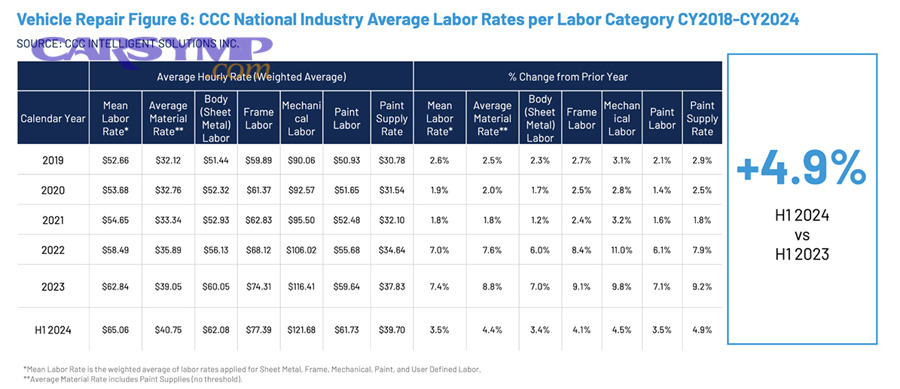
Thus, if you want to compare regions accurately, you must compare the full invoice logic—not just the number on the wall.
This is the micro-level layer of the topic: two shops can post the same labor rate per hour, yet produce different totals because their pricing system is built differently.
What is the “effective labor rate,” and why can it be higher or lower than the posted rate?
The effective labor rate is the labor cost you effectively pay after bundles, minimum charges, discounts, and fee structures are applied, and it can be higher or lower than the posted rate depending on how the shop packages jobs and allocates charges across labor and parts.
Next, once you calculate effective rate a couple times, you’ll immediately spot which quotes are transparent and which are engineered to look cheaper upfront.
You can estimate effective labor rate with this quick calculation:
Effective labor rate ≈ (total labor line items + labor-linked fees) ÷ billed hours
Why it can be higher than posted:
- Minimum labor charges inflate hours for small jobs
- Fees are percentage-based on labor
- Diagnostic time is billed separately
- Labor hours are padded or rounded up
Why it can be lower than posted:
- Labor is discounted for specials
- Bundles include multiple tasks at a package price
- Loyalty/membership programs reduce labor charges
Effective rate is especially useful for routine service planning, because it helps you see what you’ll really pay in your region—not what the shop claims you’ll pay.
How do fleet or membership programs change regional maintenance costs compared with walk-in pricing?
Fleet or membership programs change regional maintenance costs by reducing the effective labor rate through negotiated pricing, bundled services, and predictable fee structures, which can shrink regional price gaps that are large for walk-in customers.
However, the tradeoff is that these programs may limit parts options, require specific service intervals, or steer you to certain locations.
Fleet-style advantages often include:
- Consistent labor pricing
- Lower or waived shop supplies fees
- Bundled inspections and rotations
- Priority scheduling
But you still need to compare scope:
- Does the bundle include the parts you want?
- Is the warranty equivalent?
- Are there limits on diagnostics or “extra time” approvals?
If you’re managing multiple vehicles or driving high mileage, programs can stabilize cost volatility—turning a region-driven problem into a predictable budget.
Do EVs and advanced diagnostics change labor pricing differently than gas cars across regions?
Yes—EVs and advanced diagnostics can change labor pricing differently than gas cars because they increase the need for specialized tools, software access, and diagnostic time, but regional factors still dominate the baseline because technician wages and shop overhead remain location-driven.
Meanwhile, this means an EV owner should expect two layers of cost: a regional labor layer and a specialization layer.
EV and advanced-diagnostic pricing often rises due to:
- High-voltage safety training requirements
- Specialized scan tools and subscriptions
- Calibration procedures (ADAS sensors, cameras)
- More time spent validating software states and fault history
Even so, the best cost control remains the same: verify scope, compare out-the-door totals, and choose the shop type that matches the job.
Which invoice line items most often flip a “cheap rate” shop into a higher total cost shop?
There are 6 invoice line items that most often flip a “cheap rate” shop into a higher total cost shop: shop supplies, disposal fees, diagnostic charges, minimum labor increments, parts markups, and sublet services, because each one can add meaningful cost without changing the posted labor rate per hour.
In short, these items are why you should never choose a shop based solely on a headline hourly rate.
Here’s what to scan for on any estimate:
- Supplies as a percentage (rises with labor)
- Environmental/disposal stacked across multiple items
- Diagnosis billed separately without credit
- Minimum labor charged on small tasks
- Parts markups without parts grade clarity
- Sublet line items (alignment, programming, machining) with unclear pricing
If you want a repeatable budgeting method, build your routine plan around a “known services + buffer” model. Start with “How to estimate routine maintenance costs” using your car’s schedule, add your region’s typical labor rate per hour range, and include a buffer category for diagnostics and wear items. That’s how you turn regional variation from a surprise into a manageable variable—without skipping essentials and without overpaying for lack of clarity.