


If you want a reliable DPF cleaning cost estimate, you need to price the whole job—not just the cleaning machine time—by combining service type, labor time, testing, and the condition of the filter. This guide walks you through a practical estimating method you can use before you call a shop.
Next, because “estimate” only matters if it supports a decision, you’ll also learn how to compare cleaning versus replacement using cost-per-mile thinking and clear “replace instead” triggers—so you can avoid paying twice for the same underlying problem.
Then, since the biggest price swings usually come from avoidable factors (repeat clogging, rushed turnaround, missing test documentation), you’ll see the specific variables that raise or lower the final invoice and how to spot a fair quote.
Introduce a new idea: once you understand what drives the estimate, you can use a simple checklist to control costs, validate the scope, and prevent repeat downtime across one truck or an entire fleet.
What is a DPF cleaning cost estimate, and what does it include?
A DPF cleaning cost estimate is a preliminary price range for restoring a diesel particulate filter’s flow and backpressure using a specific cleaning method, including removal/installation labor, testing, and basic replacement hardware, before any extra repairs are authorized.
To better understand why estimates vary, you need to see the line items that quietly move the total from “reasonable” to “surprising.”

What line items typically appear on a DPF cleaning estimate?
There are 8 main line items that show up on most DPF cleaning estimates, based on whether the shop must remove the filter and whether they verify results with before/after testing:
- Initial inspection / intake check
The shop confirms the complaint (restriction, limp mode, regen frequency) and checks for obvious physical damage (cracks, melted substrate, oil contamination). - Diagnostic scan (sometimes separate)
A scan can confirm soot load calculations, regen history, and aftertreatment-related codes. Some shops bundle it; others price it separately because it consumes technician time and tooling. - Removal and installation labor
This is often the biggest swing factor. On some vehicles, access is straightforward; on others, heat shields, sensors, clamps, and tight packaging add labor time. - Cleaning service (the actual DPF cleaning)
The estimate should specify the method (off-vehicle thermal + pneumatic, aqueous/wet, ultrasonic, exchange unit, etc.) and whether it targets soot, ash, or both. - Testing and documentation
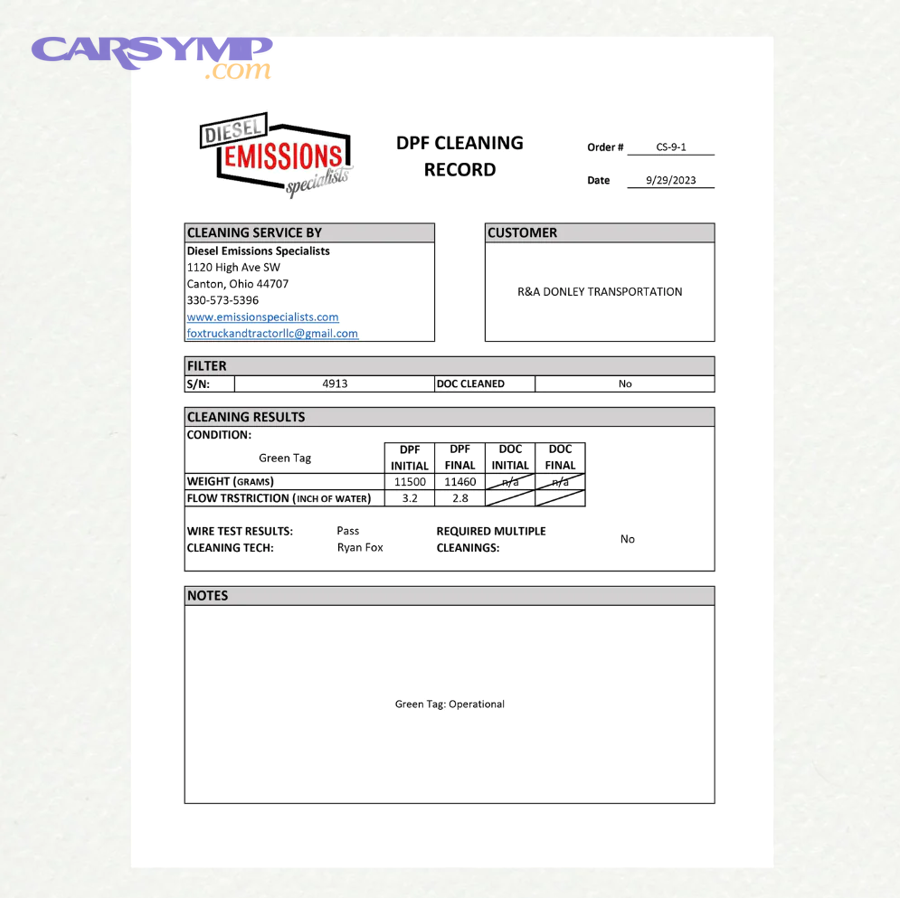
Strong estimates include before/after restriction or flow test results, sometimes plus ash mass or weight comparison. This is your proof the cleaning delivered measurable improvement. - Consumables and hardware
Common items include gaskets, clamps, band couplers, mounting hardware, sensor sealing rings, and anti-seize. They’re small individually, but they add up. - Shop supplies and environmental fees
Some regions and shops include “shop supplies,” disposal, or environmental handling charges, especially with wet cleaning. - Taxes and surcharges
Taxes vary by location; some estimates include them, others don’t. A fair comparison requires “out-the-door” totals.
To keep your estimate realistic, ask the shop to separate fixed costs (cleaning + testing) from variable costs (labor hours and add-ons), because that’s where scope creep happens.
Does a DPF cleaning estimate include diagnosing the root cause of clogging?
No—most DPF cleaning cost estimates do not fully include diagnosing the root cause of clogging, and that’s actually logical for three reasons:
- Cleaning and diagnosis are different jobs
Cleaning restores the filter’s capacity; diagnosis explains why the filter filled too fast. They require different tools, time, and sometimes different specialists. - The shop cannot confirm the real cause until flow is restored
A severely restricted DPF can distort sensor readings and operating behavior. After cleaning, the technician can verify whether the system returns to normal regen intervals and backpressure levels. - Root-cause diagnosis can expand quickly
A clogged DPF may be a symptom of upstream issues like EGR faults, injector problems, turbo oil leaks, failed sensors, or repeated short-trip operation. That investigation often requires stepwise testing and authorization.
However, you can still protect yourself: treat diagnosis as a conditional line item. You want the estimate to say, in plain language, “DPF cleaning + verified results,” and then list “diagnosis if codes return / if soot load rises abnormally” as a separate step you can approve later.
How much does DPF cleaning cost in typical scenarios?
DPF cleaning cost typically falls into predictable ranges once you separate the service method from labor and downtime, because the method sets a base price and access difficulty sets the final number.
Next, you’ll get useful price bands by service type and vehicle class so your “estimate” isn’t just a guess.

What are typical DPF cleaning price ranges by service type (on-vehicle vs off-vehicle vs exchange)?
There are 3 main types of DPF service pricing, based on where the work happens and whether you keep your original filter:
- On-vehicle service / forced regeneration support (lowest base cost, limited ash removal)
Best described as: “get it running again” rather than “restore like-new flow.”
Typical costs are driven by diagnostic time and whether the vehicle can complete a regeneration safely.
This approach can be appropriate when soot loading is high but the DPF is not ash-saturated. - Off-vehicle professional cleaning (most common for a true reset)
The DPF is removed and cleaned using thermal + air, wet/aqueous, ultrasonic, or a multi-step process.
You should expect the estimate to include cleaning + a measured before/after result (flow or restriction).
Pricing increases if the shop includes detailed reporting and fast turnaround. - Exchange / swap program (fastest turnaround, often higher parts-style pricing)
You receive a cleaned unit (sometimes remanufactured) and return your used core.
This reduces downtime, which can be more valuable than saving a smaller amount on the cleaning line item.
The estimate should clarify core charges, warranty terms, and what happens if your core is rejected.
How to use these ranges in real life:
If your priority is to minimize downtime, exchange programs often “win” on operational cost even if the invoice is higher. If your priority is lowest cash outlay, off-vehicle cleaning typically gives the best balance—especially when your own DPF housing and sensors are still in good condition.
How do costs differ for light-duty diesels vs medium/heavy-duty trucks?
DPF cleaning estimates differ most by physical access and filter size, so the same “cleaning method” can produce very different totals:
- Light-duty diesels (pickups, vans, smaller commercial vehicles)
The filter may be integrated tightly with DOC/SCR components, which increases labor.
Some setups have more sensors and heat shielding relative to size, also adding time.
Turnaround is often fast, but repeat clogging is common if the vehicle is used for short trips. - Medium/heavy-duty trucks (delivery, vocational, Class 8)
The DPF is physically larger and may require more handling equipment.
Fleet schedules often create “batch pricing” or volume discounts, but downtime costs can dominate.
Exchange programs are more common because every day off-road has measurable revenue impact.
A practical takeaway:
For light-duty vehicles, labor and packaging often drive the estimate. For heavy-duty, downtime and logistics (remove, transport, test, reinstall) can be the hidden cost center.
Which factors increase or decrease your DPF cleaning estimate the most?
There are 6 major factors that raise or lower a DPF cleaning estimate—filter condition, soot/ash level, access labor, location/shop rate, turnaround urgency, and add-on repairs—because each factor changes either time-on-task or the likelihood the shop must do more than “just clean.”
More importantly, once you can name these factors, you can control them: you either reduce them (prevention) or you plan for them (contingency).

Does soot/ash load (restriction level) change the cleaning price?
Yes—soot/ash load changes the DPF cleaning price, and it does so for at least three reasons:
- Heavier loading requires longer and more careful processing
A lightly loaded filter may respond quickly to a standard cycle, while an ash-saturated unit often needs extended steps to restore flow. - Severe restriction increases the risk of damage during regeneration attempts
Shops may avoid aggressive on-vehicle regeneration when restriction is high, because overheating a compromised substrate can crack or melt the internal structure. - High ash load often signals “end-of-life” or upstream problems
When ash accumulation is excessive, cleaning may restore function only temporarily if the underlying cause remains. Shops account for this risk by recommending more testing or setting expectations clearly.
A useful way to interpret this is: restriction level isn’t just a “how clogged” number—it’s a pricing signal. The more restricted the unit, the more likely the estimate includes testing, extra labor, and a contingency for sensor or hardware issues during reassembly.
How do labor time, shop rate, and location affect the estimate?
Labor time and shop rate shape the estimate because they control the cost of everything that is not the cleaning machine cycle. Specifically, three patterns appear again and again:
- Access complexity multiplies labor hours
Two trucks can use the same filter technology but take very different time to remove due to packaging, rust, clamp location, and sensor harness routing. That difference can exceed the cleaning price. - Regional shop rates change the baseline
A high-cost metro area with higher labor rates will naturally price higher than a rural region. You should compare estimates using labor hours and scope, not just the final number. - Turnaround urgency increases cost
“Same-day” or “rush” service often includes scheduling disruptions or overtime. For fleets, paying extra can still be rational if it prevents a missed load or an idle driver.
A practical trick: ask for the estimate in two versions—standard turnaround and rush turnaround—so you can see the true cost of speed and decide if it’s worth it.
What add-on repairs commonly raise the total bill after a DPF service?
There are 7 common add-ons that frequently appear once the DPF is removed and the tech can see the full system condition:
- Gaskets, clamps, and couplers (often needed due to heat cycling and corrosion)
- Exhaust leaks and flange repairs (leaks can skew sensor readings and regen performance)
- Temperature or pressure sensors (failed sensors cause false loading or regen errors)
- NOx sensors / aftertreatment sensors (varies by system design)
- DOC or SCR-related issues that show up once the DPF is flowing again
- EGR system faults (a common root cause of high soot production)
- Turbo or injector problems (oil contamination or poor combustion increases particulate load)
This is why a good estimate clearly states what’s included and includes a note like: “Additional repairs only with authorization.” Without that clarity, the invoice can balloon and still look “normal” because it’s spread across many small parts and labor lines.
How can you calculate a realistic DPF cleaning cost estimate for your truck or fleet?
You can calculate a realistic DPF cleaning cost estimate in 5 steps—choose the service type, estimate removal/install labor, add cleaning + verification testing, add consumables, and add a contingency/downtime factor—so you get an “all-in” number that matches how shops actually bill.
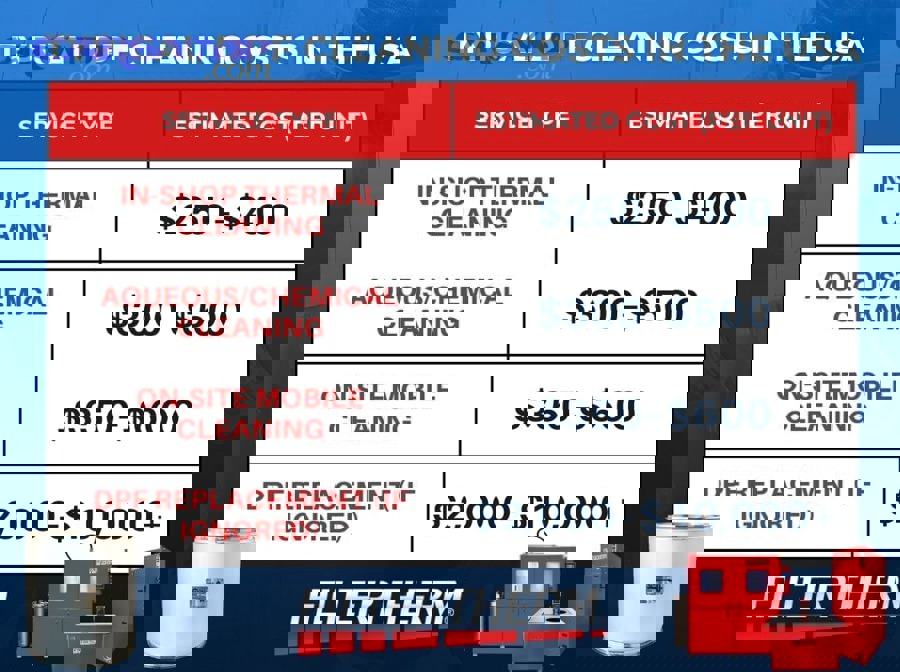
Then, once you can calculate it yourself, you can compare quotes faster and negotiate scope instead of arguing over a final price.
What inputs do you need to estimate DPF cleaning cost before calling a shop?
There are 10 inputs that make your estimate accurate without needing insider shop data:
- Vehicle class and configuration (light-duty vs heavy-duty; chassis packaging matters)
- Current symptoms (limp mode, regen frequency, loss of power, warning lights)
- Any stored codes (aftertreatment, sensor, or fuel/air-related)
- Recent driving pattern (city stop-and-go vs long highway runs)
- Last time the DPF was cleaned or replaced (if known)
- Whether you want on-vehicle or off-vehicle service
- Local labor rate range (ask two shops, or use past invoices)
- Estimated labor hours for removal/install (shop can often provide a range by model)
- Whether you require test documentation (before/after restriction or flow)
- Turnaround requirements (standard vs rush)
Once you have those inputs, you can build a fast estimate using a simple structure:
Total estimate = (Labor hours × shop rate) + cleaning price + testing/reporting + consumables + contingency
To make this more concrete, the table below shows a sample estimate structure so you can see how each component contributes to the total.
Example table: what a DPF cleaning estimate can look like (line-item structure)
| Cost component | What it covers | Why it matters |
|---|---|---|
| Removal/installation labor | Access, sensors, clamps, reassembly | Often the biggest variable |
| Cleaning service | Off-vehicle or exchange cleaning process | Sets baseline restoration cost |
| Verification testing/report | Before/after restriction or flow | Proves the result, reduces repeat spend |
| Consumables/hardware | Gaskets, clamps, seals, shop supplies | Prevents leaks and rework |
| Contingency | Unexpected sensor issues, damaged hardware | Keeps your “estimate” realistic |
A realistic estimate is not the cheapest number—it’s the one that includes the costs you almost always end up paying anyway.
How do you estimate downtime cost and “true cost” per day for fleets?
Downtime cost is the difference between “invoice cost” and “business cost,” and fleets feel it first because a truck not running is still consuming overhead. To estimate true cost per day, focus on three categories:
- Revenue loss or substitution cost
Lost load revenue if no substitute truck exists
Rental truck cost if you can substitute
Dispatch disruption and service failures - Labor and utilization loss
Driver hours paid but underutilized
Yard time, rescheduling, and overtime to catch up - Knock-on costs
Missed delivery penalties
Customer impact
Increased risk of breakdown if you delay the repair
A simple operational formula many fleets use is:
True downtime cost/day = (net revenue/day at risk) + (substitution/rental cost) + (labor inefficiency cost)
Even a conservative downtime estimate can change your decision. If an exchange program costs more on paper but saves 1–2 days of downtime, the real cost may be lower than a cheaper cleaning method that takes longer.
Is DPF cleaning cheaper than DPF replacement, and when should you replace instead?
DPF cleaning wins in upfront cost, DPF replacement is best for irreversible physical damage, and exchange/reman options can be optimal for fast uptime, because each option optimizes a different decision criterion.

More importantly, a “cheaper” cleaning is not a win if the DPF is structurally compromised or if the root cause will immediately re-clog it.
Should you clean or replace when the DPF is cracked, melted, or oil-soaked?
No—you generally should not clean and reinstall a DPF that is cracked, melted, or oil-soaked, because three failure mechanisms make cleaning unreliable:
- Cracks and melted substrate reduce filtration integrity
The filter may no longer trap particulate properly, and flow may be inconsistent even if restriction improves. - Oil contamination can permanently alter the internal structure
Oil ash and residues can embed and reduce effective cleaning results, leading to rapid return of restriction. - Thermal damage increases the risk of repeat failure
A previously overheated DPF is more likely to fail again under normal regeneration cycles.
This is the practical rule behind the phrase “When DPF replacement is necessary”: replacement becomes the smarter spend when the filter’s structure cannot be restored to safe, predictable performance. In those situations, cleaning can become a “false economy” that leads to repeat downtime and a second invoice.
Evidence sentence: According to a study by the University of California, Riverside from the Center for Environmental Research and Technology (CE-CERT), Bourns College of Engineering, in 2025, particle number emissions during DPF regeneration were reported to be about 3 to 246 times higher than normal operation—highlighting how stressed aftertreatment events can amplify risk when components are already compromised. (pubmed.ncbi.nlm.nih.gov)
How does DPF replacement cost compare to cleaning cost over time (cost per mile)?
DPF replacement versus cleaning becomes clearer when you compare them using cost per mile (or cost per operating hour), because it forces you to account for interval and downtime rather than a single invoice.
Use this simple comparison framework:
- Cleaning cost per mile = (cleaning invoice + related downtime cost) ÷ miles until next cleaning
- Replacement cost per mile = (replacement invoice + related downtime cost) ÷ miles until end-of-life
Cleaning typically wins when:
- The DPF is structurally sound
- The system returns to normal regen intervals after cleaning
- The truck’s duty cycle supports healthy exhaust temperatures (or the system can manage active regen properly)
Replacement (new or reman) typically wins when:
- The DPF is physically damaged
- Repeat restriction returns quickly after cleaning
- The system is repeatedly forced into high-stress regen conditions due to unresolved upstream issues
Evidence sentence: According to a study by California Air Resources Board researchers published in 2018, real-world active regeneration frequency averaged 28.0 hours and 599 miles between events (with wide variation), reinforcing why duty cycle can dominate long-term cost calculations. (pubmed.ncbi.nlm.nih.gov)
What questions should truck owners and fleet managers ask to confirm the estimate is fair?
There are 7 questions you should ask to confirm a DPF estimate is fair—about scope, test proof, method, inclusions, exclusions, turnaround, and warranty—because fair pricing is less about “cheap” and more about “measurable results with controlled risk.”
Next, you’ll use these questions to validate whether you’re paying for outcomes (restored flow and predictable operation) or paying for vague promises.
Will the shop provide before/after test results (restriction/flow/ash report)?
Yes—you should expect before/after test results from a quality DPF service, for at least three reasons:
- It proves the cleaning worked
A measured reduction in restriction or an improvement in flow separates real restoration from “we ran a cycle.” - It protects you from repeat spending
If the vehicle re-clogs quickly, your documentation helps determine whether the cause is upstream or whether the cleaning was incomplete. - It makes quotes comparable
Two estimates might look similar, but the one with verified testing is often higher-value because it reduces uncertainty.
If a shop cannot provide any measurable before/after documentation, ask what they do provide: photos, weight change, or a standardized report. If the answer is vague, treat the estimate as incomplete.
What warranty or guarantee should you expect on a cleaned DPF?
A reasonable warranty on a cleaned DPF is usually a limited guarantee on workmanship and measured performance, not a promise that your aftertreatment system will never clog again. That distinction matters because a shop can control cleaning quality, but it cannot fully control your duty cycle and upstream engine health.
To evaluate a warranty, look for:
- What is covered
- Cleaning process quality
- Documented test result (e.g., passing a flow benchmark)
- What is not covered (common exclusions)
- New upstream faults (injectors, EGR, turbo)
- Physical damage discovered after the fact
- Misuse or operating conditions that cause rapid soot accumulation
- What you must do to keep coverage valid
- Provide codes and symptoms if issues return
- Avoid ignoring warning lights
- Follow recommended maintenance intervals
A strong estimate pairs warranty language with a clear scope statement like: “If the DPF fails our post-cleaning flow test, we will re-clean or advise replacement.” That is the kind of clarity that prevents disputes later.
Evidence sentence: According to a report involving testing at West Virginia University from the Center for Alternative Fuels, Engines and Emissions (CAFEE), in 2014, researchers analyzed engine energy losses and emphasized reducing pumping losses through low-pressure-drop aftertreatment systems—supporting the idea that verified flow/backpressure outcomes are central to performance and operating cost. (theicct.org)
Contextual Border: Now that you can estimate DPF service costs and make the cleaning-versus-replacement decision, the next section shifts to secondary—but money-saving—topics: how to reduce repeat clogging, choose providers by quality signals, and avoid practices that create long-term risk.
How can you reduce future DPF costs and avoid repeat cleanings?
You can reduce future DPF costs by combining 4 prevention levers—heat-friendly operation, early intervention, upstream fault control, and provider quality checks—so you stretch cleaning intervals and avoid emergency downtime.
Below, the focus moves from “what will this cost today?” to “how do we keep this from happening again?”
What driving patterns (duty cycles) make DPF clogging more likely, and how can you offset them?
Short, cold, stop-and-go duty cycles clog filters faster because the exhaust often fails to reach temperatures that support efficient passive regeneration. This is where Driving habits that clog DPF quickly show up in real life:
- Frequent short trips that end before the exhaust warms fully
- Extended idling (especially in cold weather)
- Low-speed urban routes with constant stops
- Interrupted regenerations (shutting down mid-regeneration)
To offset these patterns:
- Plan periodic longer highway runs when possible
- Avoid unnecessary idling and use operational alternatives (route staging, optimized dispatch)
- Respond early to warning signs instead of “driving through it”
- For fleets, align maintenance schedules with duty cycles (urban units often need different intervals than highway units)
This is the practical core of Preventing future DPF blockages: you are not just maintaining a part—you are managing a heat-and-load system that depends on how the vehicle is used.
Which upstream issues (EGR, turbo, injectors, sensors) most often cause repeat DPF problems?
There are 5 upstream issue groups that repeatedly cause “clean it, then it clogs again” outcomes:
- EGR faults that increase soot production
- Injector issues that worsen combustion quality
- Turbo problems (including oil leaks) that contaminate the system
- Sensor failures (pressure/temperature/NOx) that trigger incorrect regeneration behavior
- Exhaust leaks that distort readings and reduce aftertreatment efficiency
If you keep paying for DPF service without checking these, you often end up paying for symptoms. A better strategy is to treat repeated clogging as a diagnostic signal: something upstream is driving abnormal soot or preventing successful regeneration.
How do you compare DPF cleaning providers using quality signals (testing, process, warranty)?
Provider comparison becomes simple when you grade three things: proof, process, and protection.
- Proof (documentation)
- Before/after results (flow, restriction, or standardized pass/fail)
- Clear reporting that matches the estimate scope
- Process (method clarity)
- The shop can explain what method they use and why it fits your condition
- The shop can state whether they’re removing soot only or addressing ash load as well
- Protection (warranty and boundaries)
- Reasonable workmanship guarantee
- Clear exclusions tied to upstream faults
- A policy for “if it doesn’t test out”
This is also where DPF cleaning stops being a commodity and becomes a measurable service: you’re buying restored performance with documented verification, not just time on a machine.
Is a DPF delete a valid “cost-saving” option?
No—a DPF delete is not a valid cost-saving option, for three reasons that outweigh any short-term invoice avoidance:
- Legal and compliance risk
Tampering with emissions equipment can create severe penalties and inspection failures, and it can jeopardize fleet compliance. - Operational risk
Modifications can create drivability issues, unexpected engine behavior, or warranty complications. - Business risk
For fleets, non-compliance can damage contracts, insurance posture, and customer trust.
The safer “cost-saving” approach is the opposite of delete thinking: reduce repeat clogging through duty-cycle management, fix upstream causes, and require verified cleaning results so you don’t pay twice.
Evidence sentence: According to a study by the University of California, Riverside from the Department of Chemical and Environmental Engineering (Bourns College of Engineering), in 2025, researchers observed substantially higher particle number emissions during DPF regeneration than normal driving—underscoring why maintaining compliant, functioning aftertreatment is central to public exposure and operational responsibility. (pubmed.ncbi.nlm.nih.gov)