


Wheel alignment is required after tie rod replacement because the tie rod directly controls the toe angle of each wheel, and any change to its length or thread position — even a fraction of a turn — shifts that angle out of specification. This is not a precautionary suggestion; it is a mechanical necessity. The moment a technician removes an old tie rod and threads in a new one, the precise geometry that kept your wheels tracking straight no longer exists in its original form. Restoring it requires a calibrated alignment machine, not guesswork.
Understanding why this matters starts with understanding what tie rods actually do inside the steering system. They are the physical link between the steering rack and each wheel’s steering knuckle, and their effective length is what determines whether your front wheels point inward, outward, or perfectly straight. When that length changes — as it always does during tie rod replacement — the toe angle changes with it, and the entire steering geometry is thrown off balance.
The consequences of skipping alignment after this repair are progressive and costly. In the short term, you will notice your car pulling to one side or your steering wheel sitting off-center. Over weeks and months, your tires will develop uneven wear patterns — feathering on the inner or outer edges — that can destroy a set of tires far ahead of their rated lifespan. On modern vehicles equipped with Advanced Driver Assistance Systems (ADAS), the risks extend even further: a misaligned steering angle sensor can compromise lane keep assist, automatic emergency braking, and stability control.
Knowing whether the alignment process differs based on which tie rod was replaced — inner versus outer — or whether your vehicle has ADAS, or whether you installed an OEM versus an aftermarket part, shapes how urgently and carefully you need to approach the post-replacement alignment. This article walks through all of it, from the mechanical fundamentals to the edge cases that most guides overlook.
What Is the Role of Tie Rods in Wheel Alignment?
Tie rods are the steering system components that connect the steering rack to the wheel’s steering knuckle, and their length directly determines the toe angle setting of each front wheel. Even a small change in that length — caused by replacement — shifts the entire alignment baseline.
To better understand why alignment cannot be skipped, it helps to see exactly how the tie rod and wheel geometry are mechanically inseparable.

What Is Toe Angle and Why Does It Depend on Tie Rod Position?
Toe angle is the measurement of whether the front edges of a vehicle’s tires point inward toward each other (toe-in) or outward away from each other (toe-out) when viewed from above. It is one of the three primary alignment parameters — alongside camber and caster — but it is the only one directly and immediately controlled by tie rod position.
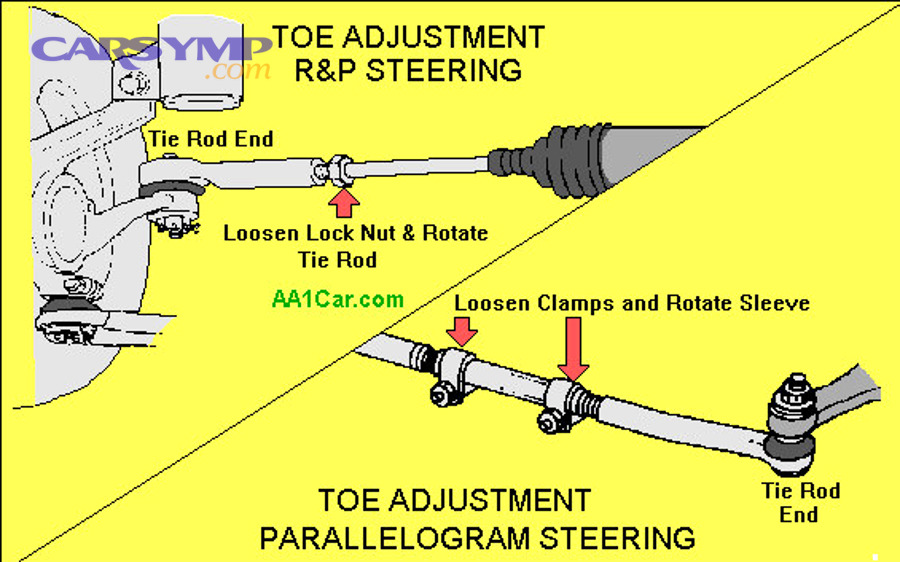
The relationship works like this: the tie rod threads into an adjustment sleeve or collar that changes how far the rod extends. As the tie rod gets longer, it pushes the wheel outward, creating toe-out. As it shortens, it pulls the wheel inward, creating toe-in. The difference between a correctly aligned vehicle and a dangerously misaligned one can be as small as a quarter-turn on the tie rod thread. According to alignment technicians and steering system manufacturers, a quarter-turn difference in thread engagement on a typical tie rod can translate to roughly 1/16 inch of toe change per side — enough to cause measurable tire wear deviation within a few thousand miles.
How Does Replacing a Tie Rod Disturb the Existing Alignment Settings?
Replacing a tie rod disturbs alignment settings because no two installation sessions produce an identical thread engagement depth, even when the technician carefully counts the turns it takes to remove the old part and mirrors that count on the new one. The “count the turns” method — a commonly practiced shortcut — is an approximation, not a precision restoration.
Several factors explain why counting turns falls short. First, the thread pitch on tie rods is coarse by design, which means small positional differences translate into large angular changes at the wheel. Second, aftermarket tie rods frequently differ from OEM specifications by small but meaningful amounts in their effective shaft length, meaning even a perfectly mirrored thread count produces a different toe angle than the original. Third, the jam nut — the locking nut that secures the tie rod adjustment — can shift the final position slightly as it is torqued down, introducing additional deviation. For all of these reasons, Bad tie rod symptoms such as steering wander, pulling, and abnormal tire wear often persist or worsen when alignment is skipped after replacement, even when the technician believed the setup was close enough.
Is Wheel Alignment Always Required After Tie Rod Replacement?
Yes, wheel alignment is required after tie rod replacement in virtually all cases, for three primary reasons: the replacement process disrupts toe angle geometry, the “count the turns” approximation method is not sufficiently precise, and modern vehicles with ADAS cannot function safely with even minor alignment deviations.

That said, the urgency and scope of the alignment requirement vary depending on which specific tie rod was replaced. Next, let’s examine both scenarios in detail.
Does Replacing Only One Outer Tie Rod Still Require Alignment?
Yes, replacing only one outer tie rod still requires alignment, and one of the least-understood reasons is how toe deviation on one side propagates to the other as the vehicle is driven.
When a single outer tie rod is replaced and the toe is even slightly off on that side, the vehicle will naturally try to compensate as it travels down the road. This dynamic “toe equalization” — caused by the steering system seeking mechanical equilibrium — means both front wheels end up running at incorrect angles, not just the one that was serviced. The result is accelerated wear on both front tires, not just the one nearest the replaced tie rod. Additionally, Tie rod replacement labor time spent on a single outer tie rod is typically 30 to 60 minutes, and adding a four-wheel alignment to that service costs a fraction of what a premature set of tires would. The math consistently favors alignment.
Does Replacing an Inner Tie Rod Require Alignment?
Yes, replacing an inner tie rod requires alignment even more urgently than replacing an outer tie rod, because the inner tie rod sits closer to the steering rack and its position has a compounding effect on the entire front steering geometry.
The inner tie rod is the pivot point of the entire tie rod assembly. When it is removed and reinstalled, the reference position for both the inner and outer tie rod angles shifts. Unlike outer tie rod replacement — where only one end of the assembly is disturbed — inner tie rod replacement affects the base geometry from which all toe adjustments are measured. Clunking and uneven tire wear diagnosis after inner tie rod replacement almost always reveals that multiple alignment parameters have shifted simultaneously, not just toe. For this reason, a full four-wheel alignment check is not optional after inner tie rod work; it is the only reliable way to confirm that all geometric parameters have returned to specification.
What Exactly Changes in Alignment After Tie Rod Replacement?
There are three main alignment-related changes that occur after tie rod replacement: toe angle deviation, steering wheel centering offset, and — in some cases — secondary effects on camber, all of which stem from the repositioning of the tie rod assembly.

Specifically, the most immediate and impactful change is toe angle, but the others deserve careful attention too.
How Does Tie Rod Replacement Affect the Toe Angle Setting?
Toe angle deviation is the primary alignment consequence of tie rod replacement, and it manifests in two distinct phases: a static toe error immediately after installation and a dynamic equalization effect as the vehicle is driven.
Immediately after installation, if the tie rod has been set to a slightly different length than the original, one or both front wheels will point at an incorrect angle relative to the vehicle’s centerline. This is the static phase — measurable on an alignment rack. Once the car is driven, steering inputs and road forces cause the toe to shift further as the steering system seeks a natural balance point, and this dynamic phase often makes the problem worse, not better. Car Symptoms that indicate toe deviation include: a steering wheel that doesn’t return cleanly to center, a sense of the car “darting” or requiring constant small corrections at highway speeds, and the classic symptom of feathered tire wear — where the tire tread blocks develop a saw-tooth edge pattern caused by the tire scrubbing sideways across the road surface rather than rolling cleanly.
How Does Tie Rod Replacement Affect Steering Wheel Centering?
Tie rod replacement affects steering wheel centering because the steering wheel’s centered position is calibrated to correspond with the wheels pointing precisely straight ahead, and a change in tie rod length breaks that correspondence.
After tie rod replacement without alignment, a very common car symptom is a steering wheel that sits visibly off-center — rotated several degrees to the left or right — while the vehicle appears to be tracking straight. This is because the driver is unconsciously compensating for the toe imbalance by holding the steering wheel at a slight angle. Beyond the comfort issue, an off-center steering wheel is a safety concern: it indicates that the steering angle sensor — which many ADAS functions rely on — is reading an incorrect “zero” position. When the sensor believes the wheel is centered but the geometry says otherwise, systems like lane keep assist and electronic stability control make incorrect decisions during active interventions.
Does Tie Rod Replacement Affect Camber or Caster?
Tie rod replacement primarily affects toe and does not directly alter camber or caster under normal circumstances, because those parameters are controlled by different suspension components — strut position, control arm geometry, and eccentric bolts — rather than by tie rod length.
However, there is an important exception worth noting. If the tie rod replacement process disturbs the steering knuckle position — which can happen when a stuck tie rod end requires significant force to remove — secondary effects on camber can appear. A knocked or shifted knuckle changes the wheel’s vertical angle relative to the road, which is camber. For this reason, a comprehensive post-replacement alignment check should measure all three parameters — toe, camber, and caster — even if only toe adjustment is expected to be needed. This full-parameter check is standard practice on professional alignment racks and adds no significant time to the process.
What Are the Consequences of Skipping Alignment After Tie Rod Replacement?
Skipping alignment after tie rod replacement leads to four categories of consequences: accelerated and uneven tire wear, degraded steering feel and vehicle safety, ADAS system malfunction, and long-term stress damage to surrounding suspension components.
More importantly, each of these consequences compounds the others over time, turning a single skipped service into a cascade of escalating repair costs.
How Does Misalignment After Tie Rod Replacement Cause Uneven Tire Wear?
Misalignment after tie rod replacement causes uneven tire wear because a toe angle that is even slightly off-specification forces the tire to scrub sideways across the road surface on every rotation, wearing the tread unevenly instead of consuming it evenly across the full contact patch.
The specific wear patterns that result from toe misalignment include:
- Feathered wear: Tread blocks develop a saw-tooth pattern when the tire is consistently running at a toe-out or toe-in angle. This is the most diagnostic indicator of toe deviation.
- Inner-edge wear: Excessive toe-in causes the inner edge of the tire to carry disproportionate load, stripping it faster than the outer edge.
- Outer-edge wear: Excessive toe-out concentrates wear on the outer edge in the same manner.
The financial stakes are significant. A professional wheel alignment costs between $75 and $150 at most service centers. A single replacement tire on a standard passenger vehicle typically costs $150 to $300, with premium or performance tires ranging considerably higher. For all-wheel-drive vehicles, where uneven wear on one tire often requires replacing all four to maintain drivetrain balance, skipping a $100 alignment can trigger a $600 to $1,200 tire replacement. This is the core reason why tie rod replacement labor time should always be quoted together with alignment cost — separating the two services creates a false economy.
How Does Skipping Alignment Affect Steering and Vehicle Safety?
Skipping alignment after tie rod replacement degrades steering precision and vehicle safety by forcing the driver to constantly compensate for a car that pulls, darts, or tracks imprecisely — increasing both driver fatigue and the margin for error in emergency situations.
The handling effects of post-replacement misalignment are progressive. Initially, the driver notices a mild pull to one side and a slight off-center steering wheel position. These are nuisances. Over time, as the tires wear unevenly, the pull intensifies and the vehicle’s response to steering inputs becomes vague and inconsistent. In an emergency — a sudden lane change or obstacle avoidance maneuver — a misaligned vehicle does not respond the way the driver expects, and that gap between expectation and response is where accidents happen. Beyond driver experience, the constant lateral scrub force on misaligned tires transfers stress into the wheel bearings, ball joints, and control arm bushings. These components are not designed to absorb continuous lateral loading, and premature failure of any one of them can result in steering loss — the most serious possible suspension failure mode.
What Happens to ADAS Systems If Alignment Is Skipped After Tie Rod Replacement?
If alignment is skipped after tie rod replacement on a vehicle equipped with ADAS, the steering angle sensor retains its previous calibration — which no longer corresponds to the vehicle’s actual straight-ahead direction — causing ADAS functions to operate on incorrect data.
The following table summarizes how each major ADAS function is compromised when the steering angle sensor is operating from a misaligned baseline:
| ADAS Feature | How Misalignment Affects It |
|---|---|
| Lane Keep Assist | Applies incorrect steering corrections, may fight the driver |
| Automatic Emergency Braking | Miscalculates vehicle path during pre-brake targeting |
| Electronic Stability Control | Applies wrong corrective torque when detecting oversteer/understeer |
| Adaptive Cruise Control | Misjudges lane center, causing unnecessary speed adjustments |
According to technical service bulletins published by MOOG Parts, an outer tie rod installation is not considered complete on ADAS-equipped vehicles until both the alignment and the steering angle sensor recalibration have been performed. Treating them as optional is a safety liability, not just a maintenance oversight.
What Does the Wheel Alignment Process Look Like After Tie Rod Replacement?
The wheel alignment process after tie rod replacement follows four main steps — pre-alignment inspection, parameter measurement, adjustment, and road test verification — and takes approximately 45 to 90 minutes at a properly equipped service facility.

To better understand what you are paying for and why each step matters, let’s walk through the process from start to finish.
What Tools and Equipment Are Used for Post-Tie Rod Alignment?
Post-tie rod alignment is performed using three primary categories of equipment: a precision alignment rack (laser or 3D camera-based), a steering angle sensor reset tool or scan tool, and calibrated torque wrenches for final tie rod jam nut tightening.
The alignment rack itself is the core of the process. Modern 3D alignment systems use cameras and reflective targets mounted on each wheel to measure toe, camber, and caster simultaneously with sub-millimeter accuracy. This is categorically more precise than any DIY method. The following table illustrates how professional and DIY approaches differ in accuracy and reliability:
| Method | Accuracy | Suitable For |
|---|---|---|
| 3D Alignment Rack | ±0.01° | Professional post-replacement service |
| Laser Alignment System | ±0.05° | Professional service |
| String Method (DIY) | ±0.25° | Temporary check only |
| Tape Measure Method (DIY) | ±0.5° | Emergency approximation only |
| Count the Turns (DIY) | ±1.0°+ | Not recommended as a standalone method |
The accuracy gap between professional and DIY alignment methods is not a matter of preference — it is a matter of measurable mechanical precision. A ±1.0° error from counting turns is ten times less accurate than a professional 3D system, and that difference has real-world consequences for tire wear and ADAS performance.
How Is the Steering Angle Sensor Recalibrated After Alignment?
The steering angle sensor is recalibrated after alignment by resetting its stored “zero position” — the data point it uses to define straight-ahead — to match the new, corrected alignment geometry established by the alignment rack.
There are two standard methods for performing this recalibration:
Method 1 — Alignment rack software reset: Most modern 3D alignment systems include integrated scan tool functionality that can communicate directly with the vehicle’s ECU and reset the steering angle sensor as part of the alignment workflow. This is the preferred method because it is performed while the vehicle is still on the rack with the wheels confirmed to be in the correct position.
Method 2 — Standalone scan tool reset: A technician uses a diagnostic scan tool to access the vehicle’s steering angle sensor module and command a reset. The vehicle must be on a flat surface with the steering wheel in the confirmed straight-ahead position before the reset is executed. Some vehicles also require a “lock-to-lock” steering sweep after the reset to complete the calibration cycle.
Skipping steering angle sensor recalibration after alignment is the equivalent of adjusting your car’s compass but forgetting to reset its reference point — every direction it reports afterward will be offset by the uncorrected error.
Can You Drive Without Alignment Immediately After Tie Rod Replacement?
You can drive a short distance at low speed after tie rod replacement without a professional alignment, provided the toe has been set approximately straight using the tie rod measurement method, but this should be treated as a temporary measure only — not a substitute for proper alignment.

Below is a practical guide for managing the window between tie rod replacement and your alignment appointment.
How Can You Temporarily Check Toe by Eye Before Getting a Professional Alignment?
You can temporarily check toe by eye after tie rod replacement using a combination of the steering wheel centering method and a visual tire comparison — a process that takes about 10 minutes and provides a rough but usable approximation for low-speed driving.
Here is the step-by-step process:
- Lift all four wheels off the ground if possible, or at minimum the two front wheels, to allow them to hang freely in their natural position.
- Center and secure the steering wheel by positioning it straight ahead and locking it in place using the seatbelt looped through the steering wheel spokes.
- Stand at the front of the vehicle and visually sight down each front tire, comparing the front edge of the tire to the rear edge. The front edge should be slightly closer to the vehicle centerline than the rear (slight toe-in) or perfectly parallel — not toe-out.
- Compare each front tire to the corresponding rear tire by looking down the side of the vehicle. The front and rear tires should appear to be in line with each other.
- Use a tape measure to check the distance between the front edges of both front tires at axle height and compare it to the distance between the rear edges of both front tires at the same height. Equal measurements indicate roughly parallel (zero toe); a slightly smaller front measurement indicates slight toe-in.
- Adjust the tie rod if necessary by loosening the jam nut, turning the tie rod adjustment sleeve a small amount, re-tightening the jam nut, and re-measuring.
This method is adequate for moving the vehicle to an alignment shop safely. It is not adequate for highway driving, extended use, or any vehicle equipped with ADAS. The moment proper alignment is available, it should replace this temporary approximation.
Are There Cases Where Alignment Requirements Differ After Tie Rod Replacement?
Yes, alignment requirements after tie rod replacement differ meaningfully across four scenarios: ADAS-equipped modern vehicles versus older cars, OEM versus aftermarket tie rod installations, lowered or performance-modified vehicles, and electric vehicles with advanced suspension systems.

In addition, understanding these distinctions helps owners and technicians prioritize correctly — because not all tie rod replacements carry the same alignment urgency or the same procedural requirements.
Is Alignment After Tie Rod Replacement Different on ADAS-Equipped Modern Vehicles vs. Older Cars?
Alignment after tie rod replacement is significantly more demanding on ADAS-equipped modern vehicles than on older cars, because modern vehicles require both a precision alignment and a steering angle sensor recalibration — two steps that older vehicles do not need.
On pre-ADAS vehicles (generally those manufactured before 2010–2012), the primary concern after tie rod replacement is mechanical: restoring toe angle to prevent tire wear and maintain straight-line tracking. A small residual error is uncomfortable but not dangerous in a systemic way. On modern vehicles with ADAS, even a small alignment deviation — well within the range that a driver might not consciously notice — can cause lane keep assist to apply unwanted steering inputs, or cause automatic emergency braking to miscalculate vehicle path during an intervention. This is a fundamentally different risk profile, and it is why ADAS-equipped vehicles require dealer-level or professional-grade alignment tools, not approximation methods.
Does It Matter Whether You Use OEM or Aftermarket Tie Rods When It Comes to Alignment?
Yes, it matters whether OEM or aftermarket tie rods are used, because aftermarket tie rods can differ from OEM specifications in effective shaft length, thread pitch, or joint geometry — differences that shift the alignment baseline further than an OEM replacement would.
When an OEM tie rod is replaced with another OEM part, the design dimensions are nominally identical, meaning that a careful measurement of the original thread engagement length provides a reliable starting point for the new installation. With aftermarket parts, this assumption does not hold. Even a reputable aftermarket tie rod may have a shaft that is a few millimeters shorter or longer than OEM spec, and that difference changes the toe angle even when the thread count matches exactly. The practical implication is straightforward: always measure the effective length of the old tie rod from the inner pivot to the outer ball joint center before removal, and verify that the new part matches that measurement before installation. Then proceed to alignment regardless — because the measurement gives you a safe starting position, not a final one.
How Does Tie Rod Replacement Affect Alignment on Lowered or Performance Vehicles?
Tie rod replacement on lowered or performance-modified vehicles requires more precise post-replacement alignment work than on stock vehicles, because the modified suspension geometry means the vehicle is already operating outside OEM alignment specifications — and any further deviation from its tuned baseline has an amplified effect.
A performance vehicle set up with negative camber and adjusted toe-in for handling purposes has a tight, intentional alignment specification. When a tie rod is replaced on such a vehicle, the technician must restore not the OEM factory spec but the custom performance spec that was dialed in for that specific application. This requires the owner or tuner to have documented alignment records prior to the repair. Without those records, the technician defaults to OEM spec, which may result in handling characteristics the driver considers incorrect. Additionally, lowered vehicles often have reduced suspension travel and more sensitive geometry relationships, meaning small toe deviations produce proportionally larger handling effects compared to a stock-height vehicle. For performance applications, a post-tie rod alignment should always be performed by a shop with experience in modified vehicle geometry.
Does Tie Rod Replacement on an Electric Vehicle Require Any Special Alignment Considerations?
Yes, tie rod replacement on electric vehicles requires additional alignment considerations beyond those for conventional cars, primarily because EVs often integrate torque vectoring, rear-wheel steering, or regenerative braking systems that interact with steering geometry in ways that combustion-engine vehicles do not.
On EVs with torque vectoring — where individual wheel motors apply different drive forces to steer the vehicle — the alignment specification affects how the torque vectoring algorithm distributes power. A toe deviation that causes one front wheel to carry more lateral load than the other creates an asymmetric input that the torque vectoring system must constantly correct for, reducing efficiency and range. On EVs with rear-wheel steering systems, alignment on both axles must be verified after any front steering component replacement, because the rear steering angle is calculated relative to the front alignment baseline. In both cases, the steering angle sensor recalibration process on EVs often requires manufacturer-specific diagnostic software — not just a generic scan tool reset — making a dealer visit or a shop equipped with EV-specific tooling the appropriate choice for post-tie rod alignment on these vehicles.
Wheel alignment after tie rod replacement is not a discretionary add-on service — it is the completion of the repair. The tie rod controls toe angle, and toe angle controls tire wear, steering feel, and ADAS accuracy. Every tie rod replacement disturbs that geometry to some degree, and the only reliable way to restore it is with calibrated alignment equipment. Whether you have replaced an inner or outer tie rod, used an OEM or aftermarket part, or drive a modern ADAS-equipped car or a modified performance vehicle, the conclusion is the same: the alignment must follow the replacement. The cost of skipping it — in tires, safety systems, and suspension wear — will always exceed the cost of getting it done right.