


The Cabin filter impact on blower performance is real: a restricted filter raises airflow resistance, so the fan has to work harder while you feel less air at the vents—especially at lower speeds.
Beyond comfort, the same restriction can change how evenly air distributes across vents, how fast the cabin cools or heats, and how effective defogging feels on humid days.
Drivers often misread weak airflow as “the A/C is bad,” but the root issue can be simple: the system can’t move enough air, even if the refrigerant side is fine.
To connect the dots, Giới thiệu ý mới: we’ll break down what the filter does, how restriction shows up, how to test it quickly, and what to do when airflow stays weak even after you change it.
What does a cabin air filter do to airflow and fan load?
A cabin air filter is a ventilation barrier that traps dust and debris before air enters the HVAC box, but every barrier adds resistance, so cleanliness directly affects airflow and the effort your fan must produce.
To keep the flow logical, Tiếp theo we’ll connect “filter condition” to what you actually feel at the vents.
Airflow basics: restriction, pressure drop, and why vents feel weak
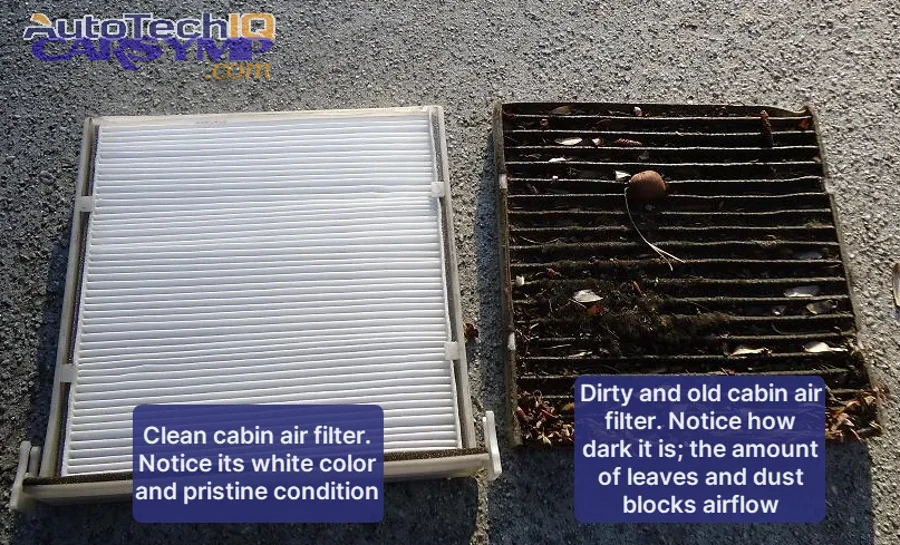
Air doesn’t “disappear”—it gets throttled. When the filter media fills with dust, leaf fragments, and lint, air must squeeze through fewer open paths. That creates more resistance, which means less total air volume can move at the same fan speed. In practical terms, the air that used to feel like a steady stream becomes a softer push, and you may find yourself turning the fan higher than you used to.
Cụ thể, this is the same principle as breathing through a thick cloth: you can still breathe, but you work harder for less air.
Why the system can sound “busier” even when airflow drops
Restriction changes the way air loads the fan blades. A fan under higher resistance can create different turbulence patterns, and your ear may interpret that as more “hiss,” “whoosh,” or a strained tone. You might also notice the fan pitch changes more abruptly between speed steps than it used to. This is a clue that the fan is fighting resistance upstream.
Quan trọng hơn, the sound alone isn’t a diagnosis—pair it with vent airflow and filter inspection to avoid chasing the wrong part.
Micro-entities that matter inside the HVAC box
When you think about airflow, imagine a chain of parts: the intake opening → the filter frame and seal → the fan wheel → doors (fresh/recirc, blend, mode) → ductwork → vent registers. The filter is only one link, but it is a common “bottleneck” because it is designed to catch debris.
Để hiểu rõ hơn, the next section answers the key yes/no question most drivers type into search.
Can a clogged cabin filter actually make the blower feel weak?
Yes—a clogged filter can make the fan feel weak because it reduces available airflow, forces you to use higher speeds for the same comfort, and can exaggerate uneven airflow between vents.
Tuy nhiên, weak airflow can also come from doors, ducts, or electrical control issues, so you’ll want quick “separation tests.”
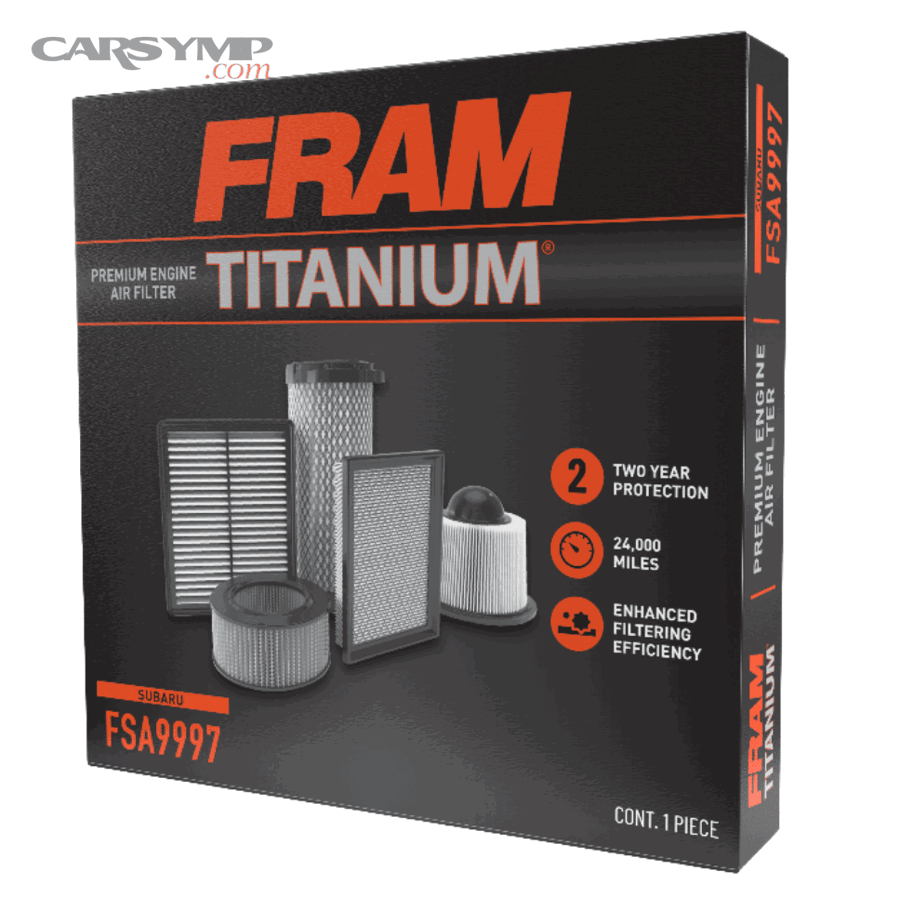
Three “driver-level” signs that point to filter restriction first
- Fan speed increases but airflow doesn’t scale: you hear the fan get louder, yet the vent stream stays disappointing.
- Defogging feels slower: windows clear, but it takes longer and you need higher fan settings to get results.
- Airflow feels inconsistent: center vents feel okay while side vents feel lazy, or airflow changes when you switch fresh/recirc.
Ví dụ, if you switch to recirculation and airflow improves noticeably, the system may be struggling to pull enough fresh air through a restricted intake/filter path.
Why “weak airflow” can masquerade as poor cooling or heating
Cooling and heating are heat transfer problems, but heat transfer depends heavily on air volume moving across the evaporator/heater core and then into the cabin. If airflow is low, your cabin may cool slowly even if the A/C is producing cold air. You might feel “cold but weak” at the vents: the temperature is right, but the volume is not.
Ngược lại, if air volume is strong but temperature is wrong, you’re likely dealing with a different subsystem than the filter.
When a clogged filter affects comfort in subtle ways
Some drivers don’t notice airflow loss until they drive with passengers or load the car. More bodies and more humidity increase the need for ventilation. A marginal airflow system can feel “fine” on mild days but disappointing in heavy rain, after gym bags and wet coats enter the cabin, or during smoky/pollen-heavy seasons.
Sau đây, we’ll build a fast diagnosis path to tell “filter restriction” from other airflow blockers.
How do you separate cabin filter restriction from duct or vent problems?
Use a simple three-step test: compare airflow at different vents, compare fresh vs recirculation behavior, and inspect the filter and its door/seal; together these quickly narrow the cause without tools.
Để bắt đầu, think of airflow as a route—find where it narrows.
Step 1: Compare center vents vs outer vents
If center vents are strong but outer vents are weak, that can be normal on some cars, but a big difference can hint at duct leakage, a mode-door position issue, or a partially blocked duct. If all vents feel weak and the fan sounds loaded, restriction near the intake/filter is more likely.
Cụ thể hơn, run this test at the same fan speed and the same temperature setting to avoid confusing variables.
Step 2: Toggle fresh air vs recirculation and watch what changes
Recirculation typically draws air from inside the cabin and can be easier to pull than fresh air through a restricted intake. If airflow improves strongly on recirculation, that suggests the fresh-air path (often near the filter or intake screen) is adding resistance. If nothing changes, look downstream (doors/ducts) or at fan output itself.
Ngoài ra, do the toggle while driving and while parked; some vehicles change door position slightly with speed and pressure at the cowl.
Step 3: Inspect the filter frame, seal, and access door fit
A filter can be new yet still restrictive if it is installed backward, crushed, or not seated in the frame. A missing seal can also allow bypass in some designs, pulling debris into the HVAC box and creating future airflow issues. When the access door doesn’t close properly, the filter may not sit square, causing the fan to draw air unevenly across the media.
Hơn nữa, a quick flashlight look often reveals leaves stuck at the entry, not just on the filter face.
Fast “bypass check” without driving unsafe
If your filter is easy to reach, you can do a short stationary test: remove the filter, close the housing as best as possible, and run the fan briefly. If airflow jumps noticeably, you’ve found a restriction at the filter. Keep the test short to avoid pulling debris into the HVAC box.
Tóm lại, you’re not trying to run permanently without a filter—just to compare airflow response.
How to inspect and replace the cabin filter safely in minutes?
The safest approach is a quick access routine: locate the filter housing, protect the cabin from debris, remove the old filter without shaking it, clean the tray, and install the new filter with correct airflow direction.
Tiếp theo, we’ll turn this into a repeatable checklist that avoids common mistakes.

Locate the housing and prepare the area
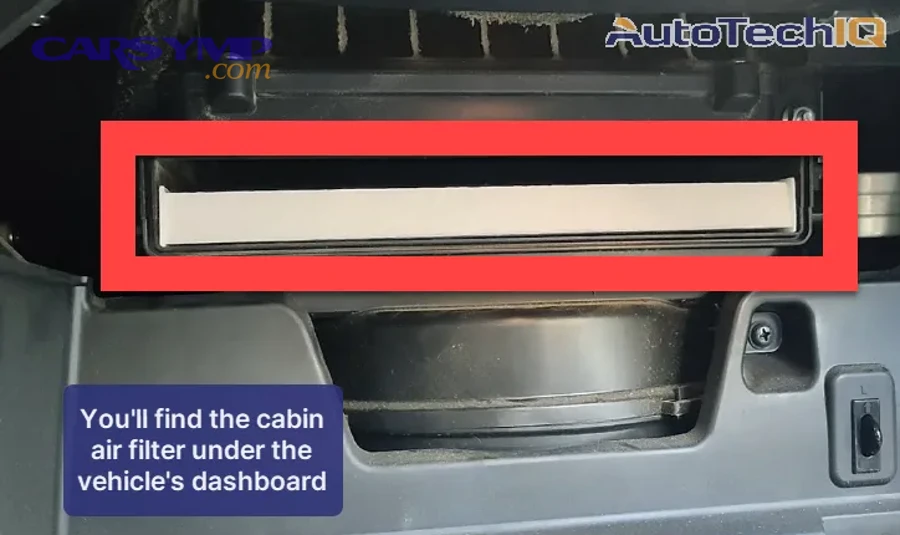
Most vehicles place the filter behind the glove box, under a small panel, or at the cowl. Start by clearing the passenger footwell and placing a towel down to catch dust. Open the access door gently; if you force clips, you can crack the cover and create air leaks later.
Để minh họa, many glove-box designs use side stops—compress the sides to let the box drop down rather than prying.
Remove the filter like a “dust tray,” not like a book
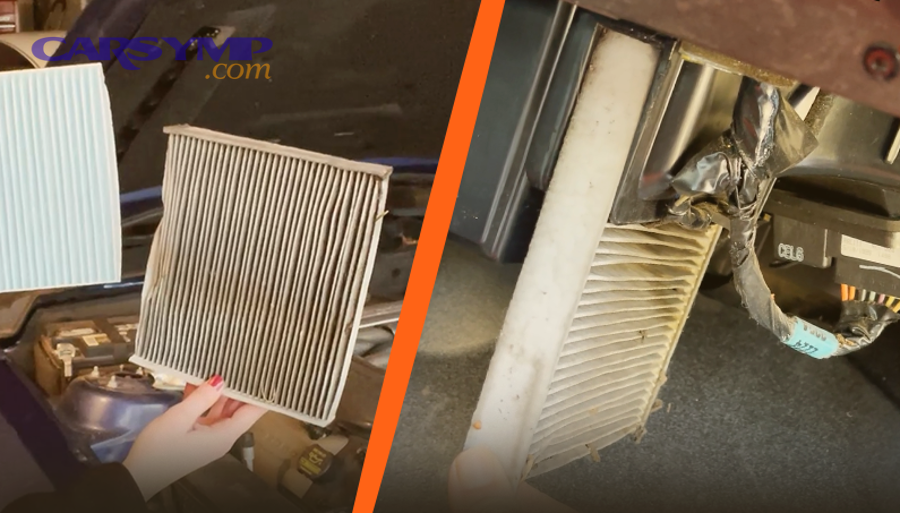
Pull the filter out slowly and keep it level. If it’s packed with leaves, tipping it dumps debris into the housing, where it can later blow out of vents or land on the fan wheel. Look for the airflow arrow on the filter frame; it should match the direction of air movement in your car.
Quan trọng hơn, a backwards filter can reduce effective surface area and load up faster in some media designs.
Clean the tray and check for obvious upstream blockers
Wipe the tray and the door seal. If you see leaf fragments beyond the filter, the filter may have been installed incorrectly, torn, or missing. Don’t spray cleaners into the housing; moisture can contribute to odors and promote growth on damp surfaces. If you must use a vacuum, keep the nozzle outside fragile fins and plastic flaps.
Sau đây, finish with a “post-install airflow check” so you know the change helped.
Confirm improvement with a simple post-install check
With the new filter installed, run the fan at low, medium, and high. You should feel a more linear increase in airflow as speed rises. Switch between fresh and recirculation; the difference should be smaller now. If airflow is still weak, that doesn’t mean the filter was pointless—it means you removed one bottleneck and revealed another.
Giới thiệu ý mới, the video below shows a typical replacement workflow you can map to your vehicle’s layout.
Which cabin filter type balances airflow and filtration best?
There are three common cabin filter types—basic particulate, activated carbon, and high-efficiency media—and the best choice balances your air-quality needs with how sensitive you are to airflow loss.
Tuy nhiên, “best” depends on your environment: dusty roads, wildfire smoke, urban pollution, or allergy seasons.
This table helps you choose a filter type by showing what it’s best at and how likely it is to feel restrictive if neglected.
| Filter type | Best for | Airflow impact risk | Notes |
|---|---|---|---|
| Particulate (standard) | Everyday dust and debris | Low to medium | Usually the most “free-breathing” when clean; good baseline for diagnosing airflow issues. |
| Activated carbon | Odors, light fumes, urban air | Medium | Often slightly denser media; can feel more restrictive when loaded, but improves perceived air freshness. |
| High-efficiency media | Allergies, fine particles | Medium to high | Can be excellent for air quality; replace on time to avoid noticeable airflow drop. |
How to decide without overthinking
If your primary complaint is weak airflow, start with a quality standard filter to establish a baseline. Once airflow feels normal, you can move to carbon or higher-efficiency media if you need better odor control or allergen reduction. The goal is to avoid stacking restrictions (dense filter + dirty intake + closed vents) that make the system feel underpowered.
Ngoài ra, choose a filter that fits tightly; gaps can bypass filtration and carry debris into the housing.
Why “more filtration” can feel like “less blower” over time
Any filter will load with debris, but denser media can reach the “noticeable restriction” point sooner if you drive in dusty conditions or park under trees. If you love high-efficiency media, treat replacement intervals as a comfort habit, not just a maintenance checkbox.
Như vậy, filter selection is part comfort, part environment, and part maintenance discipline.
How do recirculation and defrost settings change the filter’s impact?
Recirculation can reduce the perceived restriction of a clogged filter on some vehicles because it changes the airflow path, while defrost demands high airflow and will expose any restriction faster.
Để hiểu rõ hơn, consider these settings as “air routing strategies,” not just comfort buttons.
Recirculation: why it can feel stronger (and when it won’t)
In many designs, recirculation draws air from inside the cabin, which can be easier to pull than fresh air through the cowl intake area. If your filter is clogged, switching to recirculation may briefly make airflow feel stronger. But if the filter is placed in a shared path for both modes, the improvement may be small. Either way, the behavior is useful as a diagnostic clue.
Cụ thể, if recirc is dramatically better, inspect the fresh-air intake area for leaf buildup and check that the filter housing door seals correctly.
Defrost: why restriction becomes obvious in rain and cold
Defrost works best with strong airflow aimed at the glass, often with the A/C engaged to dry the air. A restricted filter reduces the system’s ability to move dry air across the windshield quickly, so fogging can linger. Drivers then crank the fan, which adds noise and can feel like “the blower is loud but ineffective.”
Quan trọng hơn, slow defogging is a safety issue—if you notice it, treat airflow like a priority, not a luxury.
Temperature and humidity: the “hidden multiplier” on airflow complaints
On mild, dry days, a partially restricted filter may not bother you. In humid weather, you need higher airflow to manage moisture, odors, and comfort. That’s why many airflow complaints spike during rainy season, after snow melts, or when the cabin is full of damp clothing and floor mats.
Tiếp theo, we’ll connect restriction to long-term wear and why ignoring it can become more than a comfort annoyance.
Does a dirty cabin filter increase wear risk for HVAC components?
Yes—while the filter won’t “break” parts by itself, restriction can increase fan workload, encourage debris accumulation in the housing, and amplify vibration/noise patterns that shorten component life over time.
Tuy nhiên, the risk depends on how long you drive with restriction and whether debris bypasses the filter.
Workload and heat: why higher fan settings matter
When airflow is reduced, drivers tend to run higher fan speeds more often. Higher fan speeds mean more electrical load and more heat in the control circuitry. Over time, that can stress connectors and control modules in hot, cramped under-dash spaces. Even if the system survives, you may notice speed steps behave oddly or feel inconsistent.
Ngược lại, keeping airflow healthy lets you achieve comfort at lower settings, which is gentler on the system.
Debris migration: how a “simple filter” protects more than your lungs
A well-fitted filter reduces the amount of fine debris that can settle inside the HVAC box. Debris that reaches the fan wheel can cause imbalance, which creates vibration and noise. Debris that reaches damp surfaces can contribute to musty odors. So, a clean filter is both an airflow tool and a cleanliness gatekeeper.
Đặc biệt, if you park under trees, leaf fragments can overwhelm the filter quickly and create a mat that blocks air like a blanket.
When airflow loss becomes “driver behavior risk”
Many drivers tolerate weak airflow by leaving windows cracked, driving longer with foggy glass, or running defrost constantly. These workarounds can reduce visibility, increase distraction, and make the cabin less comfortable on long trips. Fixing airflow at the source is often cheaper and safer than living with the workaround.
Tổng kết lại, a neglected filter can indirectly increase stress on the HVAC system and on the driver.
FAQ: Cabin filter impact on blower performance questions drivers ask
Here are quick, practical answers to common questions about airflow, odors, fogging, and timing—so you can decide whether a filter check is your next best step.
Sau đây, use these as “symptom-to-action” shortcuts.
How often should I replace it if airflow matters most?
If you care primarily about airflow, treat replacement as a comfort interval: replace sooner when you drive dusty roads, sit in traffic with pollution, or park under trees. If airflow drops noticeably between seasons, that’s a cue to inspect rather than wait for a mileage number.
Ví dụ, a quick visual check at oil-change time is often enough to keep airflow consistent.
Can a cabin filter cause bad smells even if airflow is okay?
Yes. Odors can come from debris and moisture trapped in the filter media or from damp surfaces downstream. A filter can still pass “enough” air while holding odor-causing material. If odor is your main complaint, a carbon filter and keeping the HVAC system dry (brief fan run before parking) often helps.
Ngoài ra, check floor mats and cabin moisture sources—odors aren’t always the filter’s fault.
Why is airflow strong on high but weak on low?
This pattern can happen when restriction is moderate: high speed overpowers resistance, but low speed can’t. It can also happen if vents are partially closed or mode doors are not fully opening. Start with the filter because it’s the simplest variable to eliminate.
Quan trọng hơn, if the fan speed steps behave strangely, look at control and electrical causes after you confirm the filter is clean.
Is it okay to run briefly without a filter to test airflow?
A short test can be useful, but keep it brief and avoid dusty environments. Running without a filter long-term can pull debris into the HVAC box and create future noise and odor issues. Use the test only as a diagnostic comparison.
Tóm lại, think “test,” not “solution.”
Contextual Border
Up to this point, we focused on how the filter itself changes airflow. Next, we move into expanded diagnostics for cases where airflow stays low even after a correct filter replacement.
Extra checks when airflow stays low after a new filter
If airflow remains weak after a clean, correctly installed filter, the next best move is to verify fan output and air routing, then confirm power delivery and noise clues—because the bottleneck is now likely elsewhere.
Để bắt đầu, approach this like a funnel: confirm the fan can push air, then confirm doors and ducts are letting it through.
If the fan assembly is worn, dragging, or contaminated
A worn fan can spin but move less air, especially if the wheel is clogged with dust or slightly warped. In this case, drivers often end up searching for blower motor replacement because airflow stays low even with a new filter. If you suspect internal wear, listen for uneven pitch, intermittent rubbing, or airflow that changes when you turn corners (debris shifting). Many shops will confirm airflow and current draw before recommending parts.
Hơn nữa, if you’re comparing repair quotes, ask what diagnostics were performed—not just what part is being sold.
If power delivery is limited at the fan
Low fan power can mimic restriction: the fan spins, but not with full strength. A practical next step is Electrical connector and fuse checks, especially if the fan speeds are missing, inconsistent, or only work on one setting. A loose connector, heat-damaged plug, or failing control resistor/module can limit fan output. Start with visual checks: melted plastic, discoloration, and loose pins are common red flags.
Quan trọng hơn, power issues should be handled carefully—if you’re not comfortable, have a technician test voltage and ground under load.
If the noise clues point to imbalance or debris, not just restriction
Not all “loud fan” complaints come from a dirty filter. Sometimes the filter was bypassed or installed poorly in the past, letting debris reach the wheel. In those cases, the root problem can be summarized by the phrase Noisy blower motor causes: leaf fragments, dust cakes on blades, worn bushings/bearings, or a wheel rubbing the housing. A clean filter helps prevent recurrence, but the current noise may require cleaning or component service.
Cụ thể, if noise increases sharply with speed and feels like vibration, imbalance is more likely than airflow restriction alone.
If you need realistic time planning for service decisions
When you decide between DIY and shop service, time expectations matter. People commonly search Blower motor replacement labor time to estimate downtime, but the real range varies widely by vehicle layout (under-dash access vs engine-bay access, number of panels, and whether the glove box or pedals interfere). Use your filter replacement experience as a clue: if the filter is hard to access, deeper HVAC work may also be time-consuming.
Tổng kết lại, treat the cabin filter as the first airflow gate; if it’s clean and correct, move to fan output, routing doors, and electrical supply with a structured symptom approach that matches your Car Symptoms rather than guessing parts.