


OBD2 trouble codes are standardized diagnostic labels your vehicle stores when it detects a fault, and they translate “what the computer saw” into a starting point for repair or troubleshooting.
Beyond the code itself, the real value comes from the context: whether the code is pending, confirmed, or permanent, plus freeze-frame data that shows the conditions when the fault was detected.
You can also use codes to avoid guesswork by linking each code family to a system (powertrain, body, chassis, network) and narrowing causes with a repeatable test-first workflow.
Next, we’ll break down how codes are built, what the most common ones mean, and how to triage urgency so you know what to do before you replace parts.
What is an OBD2 trouble code, and what does it actually represent?
An OBD2 trouble code is a standardized diagnostic identifier that flags a detected abnormal condition in a monitored system, and it points to a “fault category” rather than a single guaranteed broken part. Next, you’ll see why the same code can have multiple root causes.

Why a code is a symptom, not a verdict
A code is the vehicle’s way of saying, “I saw a value out of range” or “I couldn’t control something the way I expected.” For example, an oxygen-sensor-related code might be triggered by an exhaust leak, wiring resistance, a lazy sensor, a fuel delivery issue, or even an engine misfire upstream.
To connect the code to reality, you need the supporting evidence: live data, freeze frame, related codes, and a quick physical inspection (connectors, vacuum hoses, broken wiring, loose caps).
Generic, manufacturer-specific, and what “OBD2” really covers
OBD2 is a global baseline for emissions-related monitoring and diagnostics on most 1996+ vehicles in the U.S. (with variations by region and vehicle type). That’s why many “P0xxx” codes are consistent across brands, while “P1xxx” or enhanced codes often require manufacturer-specific definitions.
In practice, OBD2 is both a language and a rulebook: codes are the language, and the monitoring logic is the rulebook that decides when a fault is serious enough to store and illuminate the malfunction indicator.
Stored vs pending vs permanent codes
Stored (confirmed) codes mean the fault met criteria and was logged. Pending codes mean the fault was detected but not yet confirmed. Permanent codes are retained even if you clear memory, and they usually require the vehicle to pass its self-tests before they disappear.
This distinction matters because a pending code with a smooth-running engine can point to intermittent issues, while multiple stored codes in related systems can reveal one upstream cause triggering several downstream symptoms.
How are OBD2 codes structured (letters, digits), and how do you decode each character?
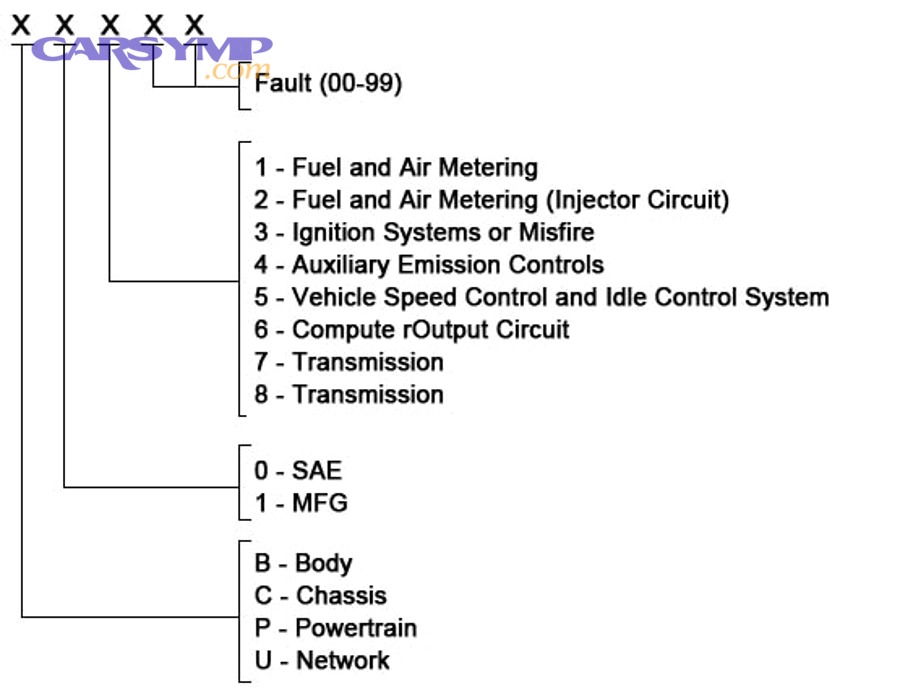
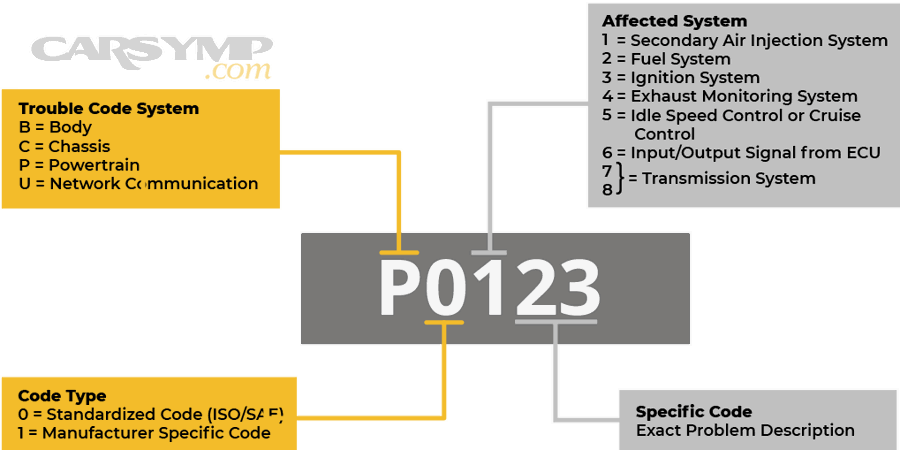
OBD2 codes follow a structured pattern (like P0301) where each character narrows the system, code type, and fault group. Next, decoding the format will help you interpret unfamiliar codes quickly.

First character: the system family (P, B, C, U)
P = Powertrain (engine, transmission, emissions). B = Body (comfort, airbags, lighting, HVAC). C = Chassis (ABS, steering, suspension). U = Network/communication (modules talking to each other).
As a rule, P-codes are most common when the check engine light is involved, while U-codes often appear as a secondary effect when a module loses power or communication.
Second character: generic vs manufacturer-specific
The second digit is typically 0 for generic (SAE standardized) or 1 for manufacturer-specific. Some platforms also use 2 and 3 ranges for additional definitions, depending on the family and generation.
Next, always identify whether you’re looking at a generic definition or a brand-specific one before you purchase a part based on a description alone.
Third character: the subsystem group
The third digit points to a subsystem, such as fuel/air metering, ignition, emissions controls, idle control, vehicle speed controls, or transmission-related categories. This is the character that often tells you which sensor group or actuator group to inspect first.
For example, many “P01xx” relate to fuel/air metering, while “P03xx” commonly relate to ignition and misfire.
Last two characters: the specific fault index
The last two digits identify the specific fault within that subsystem group (for example, cylinder number, circuit high/low, performance range, or “insufficient” / “excessive” behavior).
Next, you’ll see how code families cluster in predictable patterns, which is useful for building a fast, logical diagnostic shortlist.
Which code families matter most first, and how should you prioritize them?
Yes—prioritizing by severity and dependency is the fastest way to use OBD2 effectively: address safety-critical and catalyst-risk faults first, then drivability, then efficiency and comfort. Next, you’ll learn a triage order that prevents expensive secondary damage.
Start with “red-flag” conditions before you chase anything else
Begin with symptoms that suggest immediate risk: flashing warning indicators, severe misfire, loss of power, strong fuel smell, overheating, or loud mechanical noise. These can turn a manageable issue into a costly repair if you continue driving.
Next, correlate the code with the symptom: a serious symptom with a “minor-looking” code can mean you’re missing data or reading only a subset of modules.
Use dependency logic: upstream faults first
Many systems depend on stable voltage, clean grounds, and accurate airflow/load measurement. If you have low-voltage, communication, or reference-circuit faults, those can generate a cascade of unrelated-looking codes. Fix the foundation first.
Then, look for one “parent code” that could logically create the rest: for example, a vacuum leak can cause lean codes, misfire codes, and oxygen-sensor behavior codes without the sensors actually failing.
Cluster by system: fuel/air, spark, exhaust, and control
Grouping codes by system prevents “random part replacement.” If you have multiple codes across fuel trim, oxygen sensors, and catalyst efficiency, treat it as one story: the engine is running rich/lean or misfiring, and the exhaust sensors are reporting the result.
Next, you’ll use scanner features (freeze frame, pending, mode data) to decide whether the fault is constant or intermittent.
How do you read OBD2 codes correctly (scanner steps, freeze frame, and confirmation)?
To read OBD2 codes correctly, connect a compatible scanner, capture all codes (stored/pending/permanent), save freeze-frame data, and then confirm the fault with basic checks before clearing anything. Next, the step order below helps you avoid losing critical evidence.

Step 1: Capture the full code set from the right modules
Plug in the scanner to the diagnostic port (usually under the dash), turn the ignition on, and scan for codes. If your tool supports it, scan not only powertrain but also body, chassis, and network modules—especially if you have warning lights beyond the engine indicator.
Next, record the codes exactly, including status (pending/confirmed/permanent) and any “history” labeling.
Step 2: Save freeze-frame and snapshot data
Freeze-frame data can include engine load, coolant temperature, RPM, vehicle speed, fuel trims, and sensor readings at the time the fault set. This is often the difference between a five-minute diagnosis and a week of guessing.
For example, a lean code at high load suggests fuel delivery limits, while the same code at idle suggests vacuum leaks or airflow measurement problems.
Step 3: Look for related data: fuel trims, misfire counters, and oxygen behavior
Use live data to see whether the fault is currently present. If fuel trims are extreme, if misfire counts are accumulating, or if sensor values are stuck, you have a clue about direction even before you touch a tool.
Next, perform a quick physical check: loose connectors, cracked hoses, damaged harnesses, obvious exhaust leaks, and the condition of the intake tract.
Step 4: Decide whether to clear codes now or later
Do not clear codes immediately if you’re still collecting evidence, because clearing can erase freeze frame and make an intermittent issue harder to reproduce. Clear only after you’ve saved data and you have a plan to confirm the fix.
Later, you’ll learn how clearing affects monitor status and why that matters for inspections and long-term validation.
What do the most common generic P0xxx codes mean (and what are the usual causes)?
There are several major groups of generic P0xxx codes: misfire (P03xx), fuel/air metering (P01xx/P02xx), emissions system efficiency (P04xx/P0420), and sensor circuit performance codes. Next, the table below gives a practical “meaning + first checks” list.

This table contains common generic OBD2 P-codes, what they typically mean, and the first diagnostic checks that most often confirm or eliminate the most likely causes.
| Code | Common Meaning | Typical First Checks |
|---|---|---|
| P0101 | MAF sensor range/performance | Air filter/duct leaks, dirty MAF, intake cracks, wiring, fuel trims |
| P0113 | IAT sensor circuit high (often open circuit) | Connector unplugged, broken wires, shared 5V reference issues |
| P0128 | Coolant temperature below thermostat regulating temp | Thermostat stuck open, low coolant, ECT sensor accuracy |
| P0171 | System too lean (Bank 1) | Vacuum leaks, PCV leaks, MAF errors, fuel pressure/injectors |
| P0172 | System too rich (Bank 1) | Leaking injectors, fuel pressure regulator, MAF skew, O2 feedback |
| P0300 | Random/multiple cylinder misfire detected | Spark plugs/coils, vacuum leaks, fuel quality, compression, EGR issues |
| P0301 | Cylinder 1 misfire detected | Swap coil/plug/injector tests, compression/leak-down if needed |
| P0401 | EGR insufficient flow | Carbon blockage, EGR valve function, vacuum/solenoid control |
| P0420 | Catalyst system efficiency below threshold (Bank 1) | Exhaust leaks, misfires, upstream O2 issues, catalyst aging |
| P0442 | EVAP system small leak detected | Gas cap seal, EVAP hoses, purge/vent valves, smoke test |
| P0455 | EVAP system gross leak detected | Cap off/loose, cracked hoses, disconnected lines, vent valve stuck |
Misfire codes (P0300–P0308): what they mean beyond “bad spark plug”
Misfire codes indicate that combustion in one or more cylinders is unstable enough to exceed the ECU’s threshold. That can be caused by ignition failures (plugs/coils), fuel delivery issues (injector/pressure), air issues (vacuum leak), or mechanical issues (compression, valve timing).
Next, use a “swap test” approach for ignition components when safe: move a coil or plug to another cylinder and see if the misfire follows. If it doesn’t, shift toward fuel or mechanical tests.
Lean/rich codes (P0171/P0172): read them like a story
Lean means the ECU is adding fuel to reach target mixture; rich means it is pulling fuel. At idle, lean often points to vacuum leaks. Under load, lean often points to fuel pressure or volume limits. Rich can be leaking injectors, excessive pressure, skewed airflow measurement, or restricted intake/exhaust flow affecting sensor feedback.
Next, verify your data: short-term and long-term fuel trims, O2 sensor switching, and MAF grams/sec relative to engine displacement.
EVAP leak codes (P0440–P0457): why they feel “annoying” but still matter
EVAP codes often don’t change drivability, but they can prevent monitors from completing and can trigger inspection failures. Small leaks can be as simple as a worn cap seal, while gross leaks often indicate a disconnected or broken line.
Next, inspect the cap, neck, and visible EVAP hoses before you assume a purge or vent valve is dead.
How do you interpret manufacturer-specific codes (P1xxx) and “enhanced” data without getting misled?
Manufacturer-specific codes can be accurate and valuable, but they require the correct definition for your exact make, model, and engine, and they often point to control strategies unique to that platform. Next, you’ll learn how to validate a P1xxx code so it doesn’t trick you into unnecessary parts.

Why the same P1xxx can mean different things across brands
Unlike generic P0xxx codes, P1xxx definitions are not universally standardized. A scanner app might show a “best guess” definition that is wrong for your vehicle, especially if the tool’s database is incomplete.
Next, cross-check the code definition using a source that matches your exact powertrain and model year, and verify with sensor data before replacing anything.
Enhanced data: what it adds to the picture
Enhanced data can include manufacturer-specific PID lists, proprietary monitor results, component actuation tests, and cylinder-level misfire counters. This is how professionals move from “code meaning” to “proof of cause.”
For example, you might command an EVAP purge valve open while watching fuel trims, or run a fan relay test while observing current draw and voltage drop.
Freeze-frame and failure records: the “why now” clue
Many platforms store additional failure records beyond the generic freeze frame. If the fault happens only at certain temperatures, loads, or speeds, those records can help you recreate the condition safely and consistently.
Next, treat intermittent faults as pattern-matching problems: confirm conditions, recreate them, then test the most likely failure points (connectors, heat-soaked sensors, harness rub points).
What do U-codes (network communication) mean, and when are they the “real problem”?
U-codes indicate a communication or data-sharing fault between control modules, and they are often caused by power/ground issues, network wiring problems, or one failing module disrupting the bus. Next, you’ll see how to distinguish “symptom U-codes” from “root-cause U-codes.”

Symptom vs root cause: how to tell the difference
If many modules suddenly report communication loss, suspect low battery voltage, weak grounds, corroded power distribution, or a major connector issue. If a single module is consistently missing, suspect that module’s power supply, local wiring, or the module itself.
Next, check voltage first: battery health under load, charging system output, and voltage drop across grounds—because network faults often appear when voltage is unstable.
Common triggers: low voltage, water intrusion, and harness damage
Communication networks are sensitive to resistance changes and intermittent shorts. Water intrusion into connectors, collision repairs that pinch harnesses, and corrosion at ground points can create U-codes that come and go.
Next, inspect the easiest physical points: battery terminals, main grounds, and any recent repair areas before you suspect a high-cost module.
When to escalate to a professional network diagnosis
If the vehicle won’t start, modules are missing from the scan tool, or multiple safety systems are disabled, a professional with an oscilloscope and network knowledge can diagnose faster than repeated module swapping.
Next, keep your scan report: module list, code list, and timestamps help a shop pick up the case without repeating your entire workflow.
How do you diagnose an OBD2 code without guessing or replacing parts blindly?
You can diagnose most OBD2 codes by following a test-first workflow: verify the complaint, inspect basics, confirm with data, test the circuit or component, and only then replace parts. Next, the steps below show a repeatable method that works across code types.

Step 1: Verify symptoms and reproduce the condition safely
Start with what the driver notices: rough idle, hesitation, poor fuel economy, starting issues, or no symptoms at all. If the fault is intermittent, reproduce it using the freeze-frame conditions (temperature, load, speed) rather than random driving.
Next, note any recent changes: fuel type, battery replacement, repairs, aftermarket intakes, or jump-start events—because these often correlate strongly with new codes.
Step 2: Inspect fundamentals: air, fuel, spark, and electrical health
Many codes are triggered by basic issues: cracked intake boots, vacuum leaks, dirty filters, corroded connectors, loose grounds, or damaged wiring. A five-minute inspection can eliminate half the possibilities.
Next, confirm electrical health: battery voltage, charging voltage, and voltage drop across grounds under load, because weak electrical supply can distort sensor readings.
Step 3: Use live data to choose the next test
Live data tells you whether the fault is present now and which direction it’s moving. Fuel trims, oxygen sensor activity, coolant temperature, MAF flow, and throttle position help you decide whether to test for leaks, pressure, or circuit faults.
Next, compare what you see to what “should” happen: for instance, a coolant temperature that never reaches normal can validate thermostat issues associated with warm-up codes.
Step 4: Confirm with a targeted test (circuit, pressure, smoke, or swap)
Choose the cheapest, most definitive test: smoke test for leaks, fuel pressure/volume test under load, continuity/resistance test for wiring, or a controlled swap test for coils. This is where codes become answers.
Next, if the test results don’t match the code’s “typical cause,” trust the test—then broaden your view to shared circuits, reference voltages, and mechanical conditions.
Can you keep driving with a check engine light on, based on codes and symptoms?
Yes, sometimes you can drive cautiously with a steady warning light, but you should not ignore it: the safe decision depends on symptoms, the code category, and whether the engine is misfiring or overheating. Next, use the triage rules below to decide quickly.
Steady light with normal drivability: “limited driving” rules
If the vehicle runs smoothly, temperatures are normal, and there are no dangerous symptoms, you can often drive short distances while you schedule diagnosis. Still, a steady light can represent efficiency and emissions issues that can worsen over time.
In practical terms, the phrase Can you drive with check engine light on should be answered with conditions: drive gently, avoid hard acceleration, monitor temperature, and plan diagnostics soon—especially if fuel trim or catalyst-related codes are present.
When you should stop driving immediately
Stop driving if you have a flashing indicator, severe shaking, loss of power, overheating, oil pressure warning, or fuel smell. A flashing indicator often correlates with active misfire severe enough to risk catalytic converter damage.
Also treat sudden U-codes with no-start or multiple system failures as a “tow it” situation until power and ground integrity are confirmed.
How to use codes to judge urgency in minutes
Misfire codes (P0300–P030x), fuel pressure/lean under load patterns, and overheating-related faults are often higher risk than EVAP leak codes. Catalyst-efficiency codes may not be an instant stop, but they can be the result of a damaging upstream issue.
Next, if you are unsure, prioritize safety: reduce driving, avoid high loads, and get a proper scan that includes freeze-frame and pending data.
In the context of Flashing check engine light emergency guidance, treat flashing as an urgent warning: minimize driving, avoid load, and arrange a tow or immediate inspection if the engine is shaking or power is reduced.
How do you clear OBD2 codes properly, and what should you do after clearing?
To clear codes properly, fix or verify the underlying fault first, then clear with a scanner, and finally confirm the repair with a drive verification that includes rechecking for pending codes and observing key live data. Next, you’ll learn why clearing is not the same as “solving.”

Clearing codes vs resetting the problem
Clearing codes deletes stored information and may reset adaptive values depending on the vehicle, but it does not repair the underlying cause. If the cause remains, the code will return—sometimes immediately, sometimes after a specific self-test runs.
Next, treat code clearing as the final step in a repair sequence, not the first step of diagnosis.
Post-clear verification: what to re-check
After clearing, re-scan for pending codes, monitor fuel trims and sensor behavior, and re-check the conditions that originally triggered the code. If the issue was intermittent, use your freeze-frame notes to reproduce it systematically.
Also verify basics like connector seating and harness routing, because “fixed” issues can return if a connector is left loose or a harness rub point wasn’t secured.
Inspection and monitor completion: what drivers often miss
After clearing, some vehicles need time and specific driving conditions to complete self-checks. This matters for emissions readiness and inspection outcomes, and it’s why a vehicle can have “no light” but still not be ready for testing.
In many real-world cases, Readiness monitors and inspection implications appear right after code clearing: you must complete a drive verification pattern before the system reports full readiness again.
Common OBD2 questions drivers ask (and quick, accurate answers)
Drivers usually ask the same core questions—what the code means, what causes it, what’s urgent, and what to do next—so clear answers can reduce panic and prevent expensive mistakes. Next, the questions below connect code interpretation to practical decisions.

Why do I have multiple codes at once?
Multiple codes can be one root cause (like a vacuum leak or low voltage) triggering several symptoms across systems. Another pattern is a primary fault that creates secondary effects, such as a misfire causing oxygen sensor behavior and catalyst-efficiency codes.
Next, diagnose like a chain: fix foundational electrical and air-leak issues first, then reassess which codes remain.
Why does the light turn off by itself?
Some faults are intermittent and may not meet the threshold for illumination on every drive. The system may store a history code even if the light goes off, and a pending code might remain even when the symptom disappears.
Next, scan even when the light is off—because stored and pending information can still point to an issue that will return.
Is the code definition in my app always correct?
No. Generic codes are usually consistent, but manufacturer-specific definitions can vary, and some apps display incomplete or incorrect descriptions. Always confirm with vehicle-specific sources and validate with live data and simple tests.
Next, treat the definition as a label, then prove the cause with measurement.
What’s the fastest way to avoid wasting money on parts?
Use the smallest definitive test first: smoke test for leaks, fuel pressure test for lean under load, swap test for coils, and voltage-drop checks for electrical faults. Those tests convert “possible causes” into “confirmed causes.”
Next, if you’re stuck, capture and share your freeze-frame data with a professional—data reduces labor time.
Contextual Border: The sections above cover the core meaning and practical use of OBD2 codes. Next, we’ll move into advanced, less-obvious layers that help you interpret edge cases and avoid inspection surprises.
Advanced OBD2 insights that change how you interpret codes
Advanced OBD2 understanding comes from combining code meaning with monitor status, test modes, and communication context, which helps explain why a code returns “only sometimes” or why an inspection system says “not ready.” Next, these deeper details will sharpen your accuracy in tricky cases.

How monitor status affects real-world outcomes after repairs
Even after a successful repair, the vehicle may need specific operating conditions to re-run its self-checks. This can affect inspection readiness and can confuse drivers who assume “no light” means “all clear.”
To connect this to real driving, think of monitors as checklists that must be completed: certain speeds, temperatures, idle periods, and deceleration events can be necessary for the vehicle to confirm everything is functioning.
Mode $06 and component-level clues (without a new code)
Some scanners can show Mode $06 results, which reflect test outcomes for certain components (like catalyst, oxygen sensor, and misfire-related checks) even before a code becomes confirmed. This is useful for catching borderline failures early.
Next, if your scanner supports it, compare Mode $06 results over time: a trend toward the limit can explain “comes and goes” faults without guessing.
Permanent codes and why “clearing” doesn’t always erase everything
Permanent codes are designed to remain until the vehicle demonstrates that the issue is truly gone through completed self-tests. This reduces false “quick clear” strategies and helps ensure the vehicle genuinely meets monitoring requirements.
Next, if a permanent code remains, focus on completing the appropriate verification driving conditions and confirming that no pending faults are accumulating.
When communication faults create misleading symptoms
A weak battery, unstable charging system, or poor ground can create sensor readings that look like multiple failures, and it can also trigger network communication faults. In these situations, the “real fix” is often electrical health, not a long list of sensors.
Next, if you see a mix of unrelated codes plus U-codes, prioritize battery/charging and ground integrity testing before deeper component replacement.