


STEP 1: ANALYZE THE TITLE AND OUTLINE
1.1. Title analysis
– Given Title: Diagnose P0115–P0119 Codes: ECT Sensor Troubleshooting Basics for DIY Drivers (P0115 vs P0119)
– Main keyword (keyword focus): P0115–P0119 code diagnosis basics
– Predicate (main verb/action): Diagnose
– Relations Lexical used: Comparison (P0115 vs P0119)
1.2. Outline → search intent type(s)
– Definition: “What do P0115–P0119 codes mean…?”
– Boolean: “Is it safe to drive…?”
– Grouping: “What are the most common causes…?”
– How-to: “How do you diagnose step by step?” and “How do you fix…?”
– Comparison: “What is the difference between P0115 vs…?”
1.3. Break down the outline into specific intents
– Primary intent: Diagnose P0115–P0119 (ECT sensor code diagnosis basics for DIY drivers).
– Secondary intent 1: Understand meanings + symptoms of each code.
– Secondary intent 2: Decide if it’s safe to drive + what damage risk exists.
– Secondary intent 3: Identify causes, run a step-by-step diagnostic, and choose the correct fix.
1.4. Map headings to answering formulas
– H2(1) Definition → “X is…”
– H2(2) Boolean → “Yes/No + 3 reasons…”
– H2(3) Grouping → “There are N main types…”
– H2(4) How-to → “Method + steps + outcome…”
– H2(5) Comparison → “X wins in…, Y best for…, Z optimal for…”
– H2(6) How-to → “Fix method + steps + verification…”
– H2(7) Supplementary (micro-semantics) → advanced validation + edge cases
P0115–P0119 codes usually mean your engine computer can’t trust the engine coolant temperature (ECT) signal—so the fastest “basics” diagnosis is to confirm whether the sensor reading is wrong, missing, or unstable, then prove whether the fault is the sensor or the circuit.
Next, you’ll see what each code means in plain English and what symptoms drivers typically notice—because symptom patterns help you choose the right first test instead of guessing parts.
In addition, you’ll learn when it’s safe to drive (and when it isn’t), plus what kinds of damage and expensive side-effects happen when a bad ECT signal keeps the engine too rich, too lean, or stuck in the wrong warm-up strategy.
Introduce a new idea: below is a practical, step-by-step workflow that separates Wiring and connector issues vs sensor failure so you can fix the root cause the first time.
What do P0115–P0119 codes mean in plain English?
P0115–P0119 codes are OBD-II faults that say the car’s computer is receiving an ECT signal that is missing, out of expected range, stuck, or intermittent, so it can’t reliably calculate warm-up fueling, fan control, and overheat protection.
Then, to make the meanings actionable, start by thinking of the ECT sensor as a “temperature-to-voltage translator”: the PCM expects the voltage to move smoothly as coolant warms up, not jump, freeze, or contradict reality.
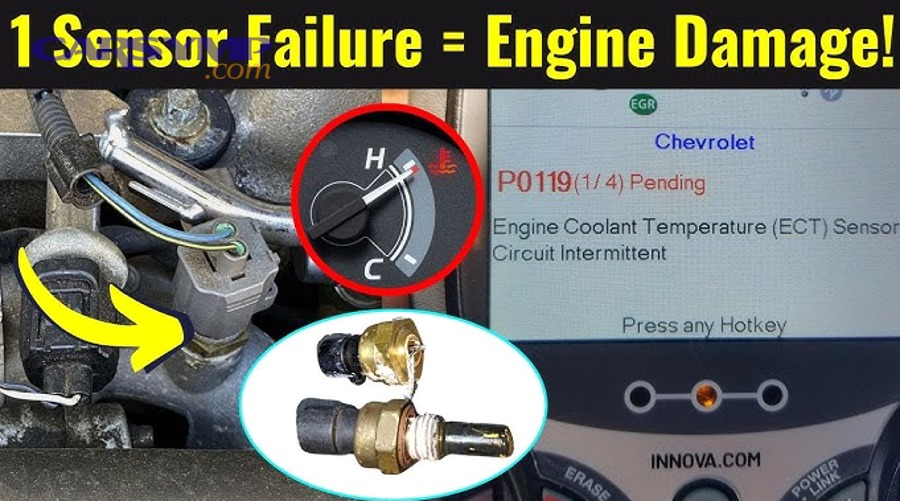
What does each code (P0115, P0116, P0117, P0118, P0119) indicate?
To diagnose fast, treat each code as a different “failure signature”:
- P0115 (Circuit Malfunction): The PCM sees an ECT circuit problem that’s too abnormal to classify as only high/low—often an open circuit, short, or a signal that makes no sense at key-on. (Meaning examples are widely summarized in industry guides.) (carparts.com)
- P0116 (Range/Performance): The ECT signal exists, but it doesn’t change the way it should (too slow, stuck, or inconsistent with other sensors/conditions). (carparts.com)
- P0117 (Low Input): The PCM sees low voltage from the ECT circuit (commonly interpreted as “very hot” in many designs).
- P0118 (High Input): The PCM sees high voltage (commonly interpreted as “very cold,” often caused by an open circuit).
- P0119 (Intermittent): The signal drops out or spikes—it looks normal sometimes, then fails briefly, usually from loose pins, corrosion, chafed wiring, or a failing sensor.
Quick mental shortcut (helps your next test):
– High input often points to open circuit / unplugged / broken wire.
– Low input often points to short to ground / insulation damage / water intrusion.
– Intermittent often points to connector tension, corrosion, vibration points, or harness rub-through.
What symptoms do these codes typically cause?
Most ECT-related codes show up as a strategy problem (the PCM chooses a backup plan), not just a warning light. Common driver-facing symptoms include:
- Check Engine Light (often with “pending” codes before it becomes “stored”)
- Hard cold starts or rich running (fuel smell, sooty tailpipe)
- Poor fuel economy (especially in warm-up)
- Cooling fans running constantly (failsafe to prevent overheating)
- Temperature gauge acting wrong (stuck cold, pegged hot, or jumping)
- Heater output inconsistent (because actual coolant temp behavior may be abnormal, or the gauge is lying)
Evidence: According to a study by North Carolina State University from the Department of Civil, Construction, and Environmental Engineering, published in 2022, real-world cold-start behavior shows coolant temperature rising from ambient toward steady state during the first miles of driving—meaning inaccurate ECT data can materially distort warm-up control decisions. (mdpi.com)
Is it safe to drive with a P0115–P0119 code?
It depends—but often “No, it’s not truly safe to keep driving normally,” because a bad ECT signal can (1) hide real overheating, (2) force incorrect fueling that overheats the catalyst, and (3) trigger fan/strategy behavior that creates drivability issues and secondary failures.
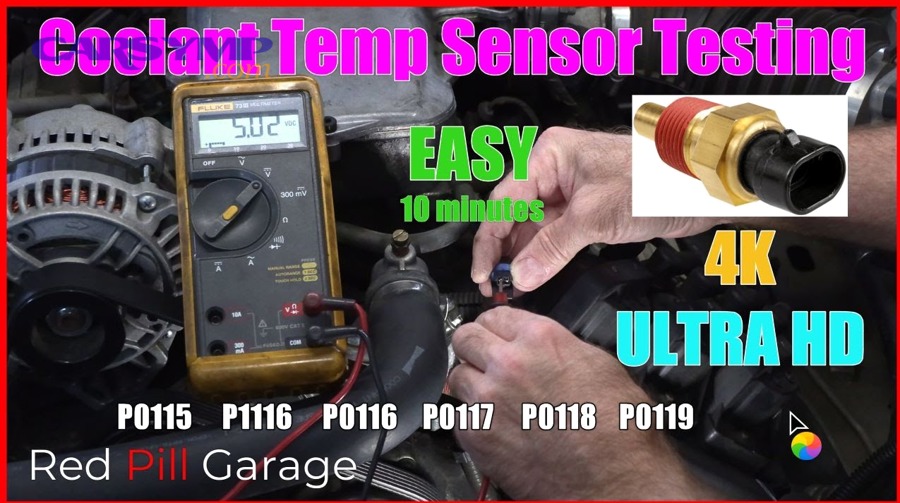
However, the risk changes dramatically based on whether the car is actually overheating right now and whether the ECT signal is merely “slightly wrong” versus completely broken.
When is it an emergency stop vs “drive to the shop”?
Use this quick decision rule:
Emergency stop now (treat as unsafe):
- Temperature gauge is climbing hot and you feel power loss, steam, coolant smell, or see a warning light.
- Coolant is visibly leaking, or the reservoir is empty.
- The engine is misfiring badly or you see severe drivability issues.
Usually okay to drive a short distance carefully (still fix ASAP):
- The engine feels normal, no overheating symptoms, but the CEL is on and the code is newly set.
- Fans are running full-time, but coolant level is correct and temperature is stable.
If you choose to limp it, keep RPM moderate, avoid heavy loads, and watch for any hint of overheating.
What damage can happen if you ignore it?
Ignoring an ECT signal problem can cause “hidden” damage patterns:
- Overheating risk: If the PCM is being lied to, it may not manage fans/thermostat strategies properly, and you may not trust the dash gauge.
- Catalytic converter stress: Overly rich mixtures during warm-up can overheat the catalyst and accelerate failure.
- Oil dilution and sludge risk: Excess fuel from rich warm-up strategies can contaminate oil over time.
- Repeated battery/fan wear: Fans that run constantly increase electrical load and component wear.
Evidence: According to a study by North Carolina State University from the Department of Civil, Construction, and Environmental Engineering, published in 2022, cold-start operation can produce substantially higher emissions than hot-stabilized operation—highlighting how critical accurate warm-up control inputs (including ECT) are for correct engine strategy. (mdpi.com)
What are the most common causes of P0115–P0119 codes?
There are three main cause groups of P0115–P0119 codes: (1) a faulty ECT sensor, (2) circuit faults (wiring/connector/ground/PCM), and (3) cooling-system conditions that make the temperature behavior look “wrong.”
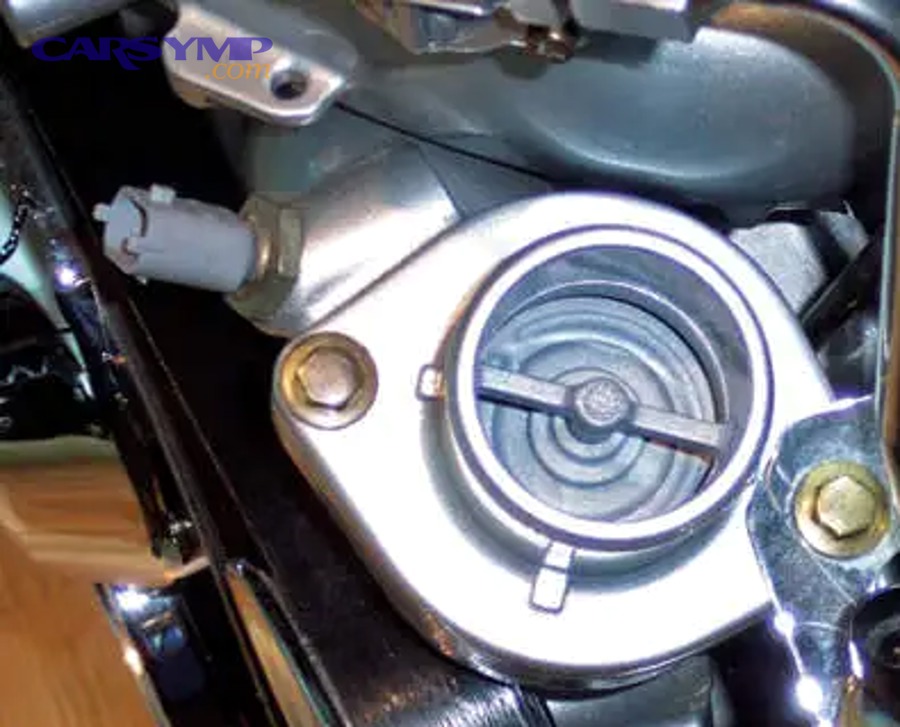
Next, the goal is to identify which group you’re in before buying parts—because these codes are famous for “sensor replaced, code comes back” when the real issue is in the connector or harness.
When is the ECT sensor itself faulty?
The ECT sensor is a common failure item when:
- The sensor becomes internally biased (reads consistently too hot or too cold)
- The sensor becomes slow to respond (lags real temperature changes)
- Heat cycling cracks the sensor body or allows coolant intrusion
- The internal thermistor drifts out of spec with age
A telltale sign is plausibility failure: the ECT reading is wildly different from reality and from the intake air temp (IAT) at cold start. At key-on after sitting overnight, ECT and IAT should usually be relatively close (not always identical, but not “70°F apart” without a reason).
When are wiring, connectors, or ECU issues the real cause?
This is where many DIY diagnoses go wrong. Circuit problems are common because the ECT sensor sits in a harsh environment.
Typical circuit failures include:
- Corroded pins (green crust, moisture, coolant wicking)
- Loose terminal tension (intermittent P0119, bumps trigger spikes)
- Harness rub-through near brackets, engine covers, or the radiator support
- Broken ground splice or shared sensor ground issues
- Rarely, PCM internal fault (usually after you’ve proven everything else)
This is exactly why the phrase Wiring and connector issues vs sensor failure matters: the same code can come from either, but the test path is different.
When can cooling-system problems mimic an ECT fault?
Sometimes the sensor is “honest,” but the engine temperature behavior is abnormal:
- Stuck-open thermostat → engine warms too slowly → P0116 range/performance plausibility
- Low coolant / air pockets → sensor sees steam/air intermittently → erratic readings (P0119)
- Overheating events → extreme readings that trigger failsafe and codes
- Wrong coolant mix or restricted flow → delayed warm-up or overheating patterns
Evidence: According to a study by Tampere University from the Aerosol Physics Laboratory, published in 2023, temperature-related start conditions (cold vs hot) significantly change real-world fuel consumption and emissions behavior—showing why the PCM is strict about temperature plausibility during warm-up. (trepo.tuni.fi)
How do you diagnose P0115–P0119 step by step?
The most reliable method is a 5-step workflow—scan → plausibility check → connector/wiring inspection → sensor electrical test → harness/ground verification—so you can identify whether the fault is signal quality, signal absence, or signal contradiction, and fix the right layer.
Then, use each step to eliminate an entire category of causes, not just “try something.”
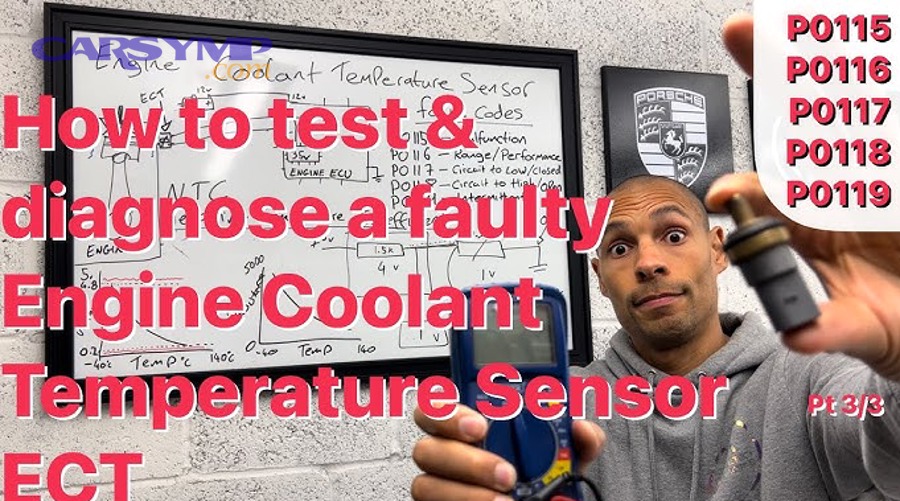
How do you confirm the code and read freeze-frame/live data?
1) Pull codes and freeze-frame. Note engine load, RPM, ECT, IAT, and vehicle speed at the moment the code set.
2) Check key-on ECT vs IAT plausibility. After an overnight sit, they should be reasonably close.
3) Watch live ECT while warming up. It should rise smoothly (no sudden -40 to 250 jumps).
4) Look for correlation clues. If the reading jumps when you wiggle the connector, you’re likely in P0119 territory.
If your scanner supports it, graph the ECT PID—patterns become obvious.
How do you test the ECT sensor with a multimeter (resistance/voltage)?
Most ECT sensors are thermistors whose resistance changes with temperature.
A practical DIY approach:
- Unplug the sensor (engine cool).
- Measure resistance across sensor pins and compare to a spec chart for your vehicle (service manual is best).
- If you don’t have a chart, do a direction test: warm the sensor area (or let engine warm slightly) and confirm resistance changes smoothly (not open, not short, not erratic).
If you back-probe the connector with it plugged in:
- Verify a stable reference voltage from the PCM (commonly ~5V) and a solid ground.
- If reference is missing, stop blaming the sensor and move to circuit diagnosis.
How do you check wiring, ground, and connector integrity?
Do this in a strict order (fastest wins):
- Visual inspection: bent pins, coolant residue, oil contamination, broken locks.
- Pin tension test: terminals should grip the sensor pins firmly.
- Wiggle test with live data: gentle harness movement while watching ECT.
- Continuity and short tests: check signal wire continuity to PCM and verify it’s not shorted to ground or power.
- Ground integrity: many sensors share grounds; a bad shared ground can create multiple sensor codes.
Evidence: According to a study by North Carolina State University from the Department of Civil, Construction, and Environmental Engineering, published in 2022, researchers logged ECT through an OBD scan tool alongside emissions measurements—showing that OBD-derived ECT is a core diagnostic/analysis signal when validating warm-up behavior. (mdpi.com)
What is the difference between P0115 vs P0116 vs P0117 vs P0118 vs P0119?
P0115 “wins” for electrical circuit malfunction, P0116 is best explained by plausibility/range behavior, and P0117/P0118/P0119 are most accurately diagnosed by what the voltage is doing (low, high, or intermittent) rather than by the temperature gauge alone.
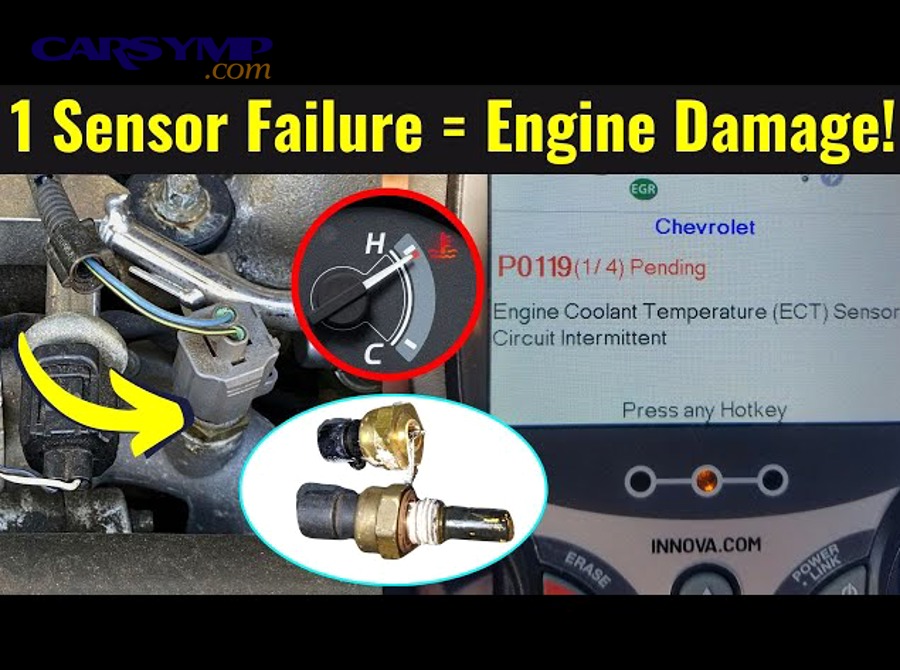
However, the codes overlap in symptoms, so you diagnose by signal behavior, not by guesswork.
To make this concrete, the table below summarizes what each code is really asking you to prove.
Table context: This table maps each code to the most common electrical meaning and the fastest “first test” so you can choose the right diagnostic starting point.
| Code | Plain-English meaning | Typical electrical clue | Fastest first test |
|---|---|---|---|
| P0115 | ECT circuit malfunction | missing/invalid signal | verify 5V reference + ground |
| P0116 | signal exists but not plausible | stuck/slow/doesn’t track warm-up | compare ECT vs IAT cold + watch warm-up graph (carparts.com) |
| P0117 | low input | short to ground / low voltage | unplug sensor and see if reading flips to extreme cold |
| P0118 | high input | open circuit / high voltage | check connector seating + continuity |
| P0119 | intermittent | spikes/dropouts | wiggle test + terminal tension |
How does “circuit” differ from “range/performance”?
- “Circuit” (P0115): The PCM is telling you the electrical signal is fundamentally invalid (open/short/implausible wiring-level fault). (carparts.com)
- “Range/Performance” (P0116): The PCM is telling you the signal exists, but the behavior over time doesn’t match what a real engine should do (too slow, stuck, contradictory to driving conditions). (carparts.com)
What does “low input” vs “high input” usually mean electrically?
In many common ECT circuits:
- High input often happens when the circuit is open (sensor unplugged, broken wire), so the PCM sees very high voltage and interprets it as extremely cold.
- Low input often happens when the signal is shorted to ground, driving voltage low and making the PCM interpret it as extremely hot.
Don’t treat that as universal physics—treat it as a strong diagnostic hint and verify with your wiring diagram.
What does an “intermittent” signal look like in live data?
A true P0119 pattern usually looks like one of these:
- Sudden jumps from plausible temps to a fixed extreme value (often -40°F/°C or 300°F/150°C equivalents)
- Brief dropouts under vibration (bumps, engine movement, fan kick-on)
- A temperature trace that “saws” up and down while actual engine behavior is steady
This is where your scan tool graph and wiggle test save hours.
Evidence: According to a study by North Carolina State University from the Department of Civil, Construction, and Environmental Engineering, published in 2022, coolant temperature during cold start rises gradually toward steady-state across the first miles—so any live-data trace that teleports between extremes without a real thermal reason strongly suggests an electrical intermittency. (mdpi.com)
How do you fix P0115–P0119 codes?
The fix is to restore a stable, plausible ECT signal by (1) correcting the electrical fault, (2) replacing the ECT sensor only when it fails tests, and (3) verifying the cooling system is properly filled so the sensor sees real coolant—not air.
Next, you confirm the repair by clearing codes and validating that ECT rises smoothly and matches reality.

When does coolant temperature sensor replacement solve it?
coolant temperature sensor replacement is the correct fix when:
- The sensor fails resistance/response tests
- The sensor reading is biased and doesn’t match reality even with a good circuit
- You have coolant intrusion inside the connector from a leaking sensor
This is also the moment to be honest about cost. A Coolant temp sensor replacement cost estimate varies by vehicle and access, but RepairPal’s national estimator reports an average range of $447–$532 for an engine coolant temperature sensor replacement (parts + labor), with vehicle-to-vehicle variation. (repairpal.com)
What wiring repairs fix intermittent/high-resistance faults?
When the sensor tests good, wiring fixes usually solve the problem:
- Clean corrosion and restore terminal tension (or replace the pigtail)
- Repair rubbed-through insulation and add loom protection
- Re-pin or replace connectors with broken locks
- Fix shared sensor grounds or broken ground splices
- Route harness away from hot/sharp edges to prevent repeat faults
This is the practical difference between “replace parts” and “repair the signal.”
How do you clear the code and verify the repair?
1) Clear codes with your scan tool.
2) Cold-start the engine and monitor ECT.
3) Confirm ECT rises smoothly and plausibly.
4) Verify the fans behave normally (not stuck on failsafe).
5) Drive a full warm-up cycle and re-scan for pending codes.
If you replaced the sensor or opened the cooling system, don’t skip Refill and bleed after sensor replacement: trapped air can create erratic readings and repeat P0119/P0116-type behavior. General bleeding guidance includes running the heater to open the heater core and letting air escape while topping off coolant carefully (vehicle-specific procedures may differ).
Evidence: According to a study by Tampere University from the Aerosol Physics Laboratory, published in 2023, cold-start conditions substantially shift measured emissions and fuel consumption behavior—so confirming a stable ECT warm-up trace after repair is not cosmetic; it’s how you verify the PCM can manage warm-up correctly again. (trepo.tuni.fi)
What advanced tips prevent misdiagnosis of P0115–P0119 ECT codes?
Advanced diagnosis is about validating reality (actual temps and coolant behavior) against reported data (ECT PID), so you don’t replace a sensor when the thermostat, air pockets, or dual-sensor architecture is the real culprit.
Then, once you treat the system as a whole, the misdiagnosis rate drops sharply.

How do thermostat issues create misleading ECT readings?
A stuck-open thermostat can keep the engine too cool or make warm-up too slow, which can trigger plausibility logic like P0116 even when the sensor is fine. A stuck-closed thermostat can cause real overheating, which can also produce “implausible” ECT behavior during events. Practical thermostat testing often includes comparing hose temperatures and observing warm-up behavior.
How can infrared temperature checks validate ECT sensor accuracy?
An infrared thermometer can be used as a sanity check:
- Compare IR readings at the thermostat housing or metal coolant outlet to the scan tool’s ECT
- Don’t measure shiny surfaces without accounting for emissivity; aim at consistent, dull surfaces when possible
- Expect some offset, but look for gross disagreement or non-sensical changes
This is the fastest way to prove “sensor says 40°F” while the housing is clearly hot.
What vehicle-specific quirks (dual ECT sensors, cylinder head temp sensors) matter?
Some vehicles use:
- Two temperature sensors (one for PCM, one for the dash)
- A cylinder head temperature (CHT) sensor strategy that changes how codes present
- Different fan control logic that makes a “bad ECT” look like a fan module problem
So always confirm which sensor your code refers to (Sensor 1 vs another location) before ordering parts.
What are the best habits to avoid repeat faults?
- Use proper loom and routing after repairs (prevent rub-through recurrence)
- Avoid yanking on connectors; release locks correctly
- After any cooling-system work, make sure the system is properly filled and purged
- Keep a simple Car Symp checklist: “cold start ECT vs IAT plausibility,” “smooth warm-up graph,” and “no spikes on wiggle test”
Evidence: According to a study by North Carolina State University from the Department of Civil, Construction, and Environmental Engineering, published in 2022, driving cold-start behavior and pollutant increments are highly sensitive to warm-up conditions—supporting the idea that validating ECT plausibility (not just clearing a code) is essential to preventing repeat faults and misdiagnosis. (mdpi.com)