


Most drivers should replace common car filters on a simple schedule: engine air and cabin air filters about every 15,000–30,000 miles (or yearly if you drive low miles), oil filters with your oil changes, and fuel filters on the interval your owner’s manual specifies.
Then, to make that schedule accurate for your car, you’ll want to understand what “interval” really means (miles vs time) and what conditions shorten it—because stop-and-go traffic, dust, and wildfire smoke can move you from “normal” to “severe” service faster than you think. (autocare.org)
Next, you’ll see the most practical “replace now” signs for each filter so you’re not guessing based only on mileage. (cars.com)
Introduce a new idea: once you know the baseline and the warning signs, you can use a one-page checklist to plan replacements, avoid wasted money, and protect comfort, performance, and long-term engine health.
What does “replace interval” mean for car filters, and why does it vary?
A filter replace interval is the mileage/time window after which a specific filter should be changed because its flow and trapping capacity degrade, and it varies because contamination load depends on where and how you drive, the filter’s media, and your vehicle’s design.
To better understand why intervals aren’t “one number,” start by separating how manufacturers measure time from how dirt actually accumulates.
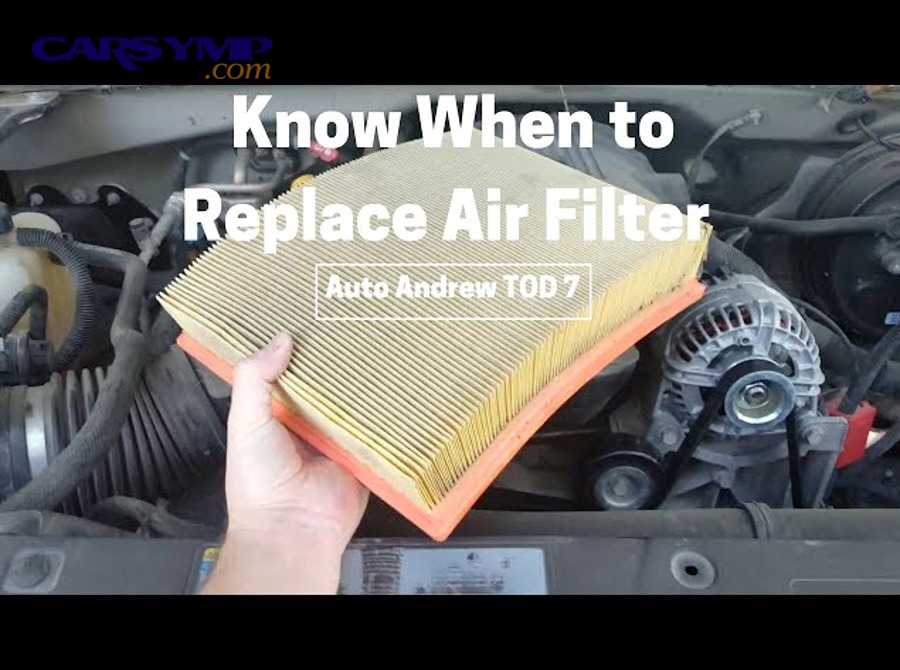
Is mileage or time the more important interval for filters?
Mileage is usually the primary interval, but time matters almost as much for low-mileage driving because filters can load from humidity, mold spores, and repeated short trips even when you don’t rack up miles.
- Use mileage when you drive consistently. If you commute and add steady miles, mileage predicts how much air and fuel has passed through the system.
- Use time when miles are low. If you drive under ~8,000 miles/year, “once per year” is often the safer rule for cabin air filters, and a solid reminder for engine air filters as well. (cars.com)
- Let your owner’s manual break ties. The manual’s maintenance chart is built around your specific intake, HVAC, and fuel system design.
What “severe driving” conditions shorten filter life?
Severe conditions are anything that increases dust/soot exposure or forces systems to work harder, and they shorten intervals by increasing restriction faster.
Common severe-condition triggers:
- Dusty or unpaved roads (construction zones, rural gravel)
- Heavy traffic and idling (more time inhaling dirty air per mile)
- Wildfire smoke / high pollution corridors
- Frequent short trips (humidity and debris accumulation without long airflow “dry-out”)
- Towing or heavy loads (higher airflow and higher fuel throughput)
A practical rule: if you routinely drive in any two of the above, treat your intervals as “severe” and tighten them by ~25–50% compared to a normal schedule.
How often should you replace the engine air filter?
Most drivers should replace the engine air filter every 15,000–30,000 miles, sooner in dusty conditions, because restriction reduces available airflow and can dull throttle response—especially under load.
However, the best interval is the one that matches how fast your filter loads in your real environment, so combine mileage with quick inspections.
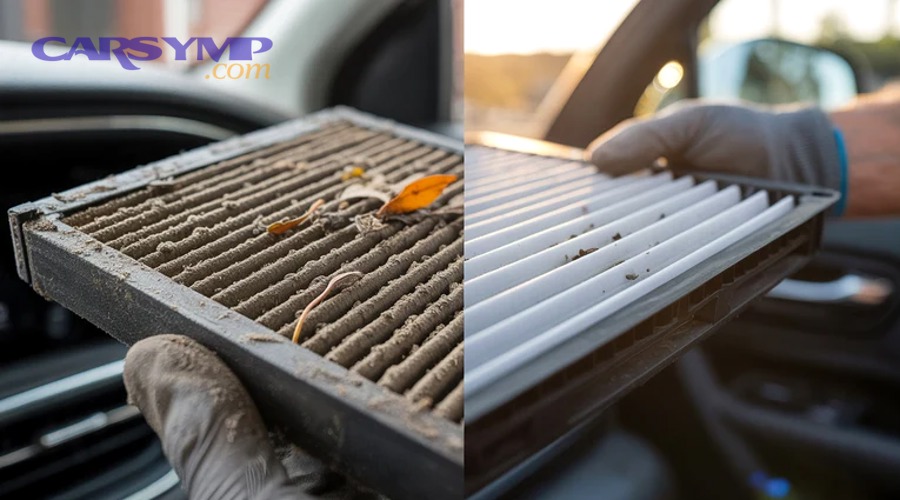
What’s the typical interval for engine air filter replacement?
A widely used baseline is:
- Normal conditions: ~15,000–30,000 miles
- Dusty/severe conditions: ~10,000–15,000 miles (sometimes less)
For many vehicles, Ford Motor Company explicitly recommends 15,000–30,000 miles depending on model, and also points owners back to the maintenance schedule for the final word.
Why this range is so wide: engine air filters load by mass of particles, not by the calendar. Two identical cars can have very different filter life if one is driven on clean highways and the other in dust, stop-and-go, or industrial areas.
According to a study by University of Žilina from the Department of Road and Urban Transport, in 2020, researchers measured that air-filter clogging generally had a relatively low impact on fuel consumption under typical conditions, but differences became much larger under extreme clogging (near-blocked filter area) and forced-induction scenarios. (mdpi.com)
What are the signs your engine air filter needs changing?
Use these “replace now” signals (especially if you’re near the mileage window):
- Visible dirt caking and darkening across most pleats (not just a few specks)
- Reduced acceleration feel or “lazy” throttle response under load
- Whistling intake noise or airbox sealing issues (sometimes from a warped/dirty filter edge)
- More frequent downshifts on hills (the engine works harder for air)
Quick DIY check (2 minutes):
- Pop the airbox clips/screws.
- Hold the filter up to bright light.
- If light barely passes through most pleats and the surface looks oily/dust-packed, it’s time.
How often should you replace the cabin air filter?
Most drivers should replace the cabin air filter every 12,000–15,000 miles or about once a year because a loaded filter reduces HVAC airflow, increases odor, and lets more fine particles circulate inside the cabin. (cars.com)
Next, it helps to recognize that cabin filters protect people comfort and air quality, not engine performance—so the “replace now” signs are different.
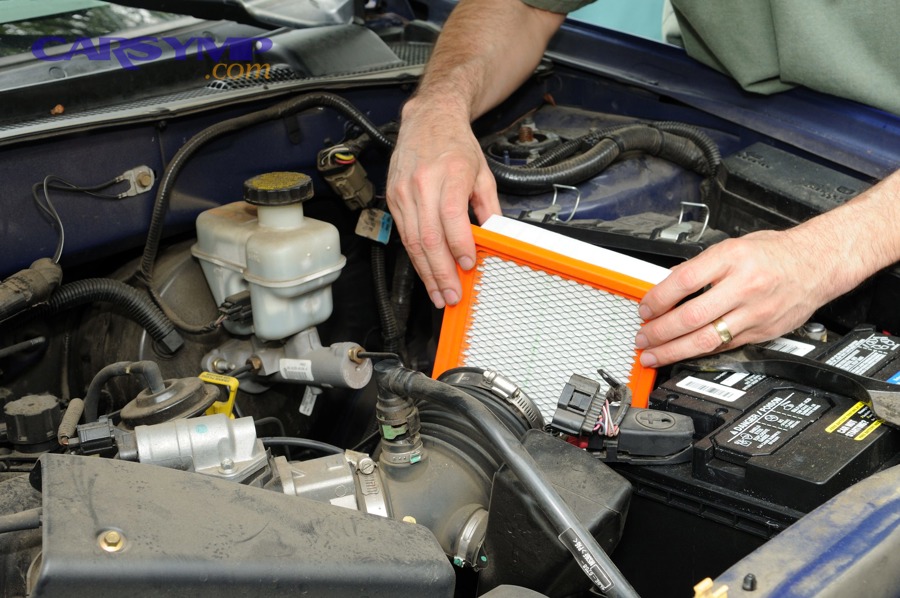
What’s the typical interval for cabin air filter replacement?
A straightforward baseline:
- Normal conditions: ~12,000–15,000 miles or yearly
- Dust/pollen/smoke heavy areas: every 6–12 months is common
For example, Cars.com recommends replacing a cabin air filter every year or 12,000–15,000 miles and more often in dirty areas. (cars.com)
What are the signs your cabin air filter needs changing?
Look for airflow and odor clues:
- Weak airflow from vents even on high fan settings
- Musty smell when HVAC starts (especially after rain/humidity)
- Fogging windows more easily (less effective defog airflow)
- More dust on dashboards or allergy flare-ups in the car
According to a study by University Hospital, Umeå from the Department of Occupational and Environmental Medicine, in 1999, researchers found that adding cabin filtration reduced in-car particle levels and that a charcoal-based system reduced certain irritation symptoms in sensitive individuals during driving.
How often should you change the oil filter?
An oil filter should usually be changed at every oil change because it fills with trapped contaminants and can enter bypass operation when restricted, reducing effective filtration during the interval your engine needs it most.
Meanwhile, some vehicles and filter types can safely run longer in specific cases, so the “always” rule should still defer to your manual.
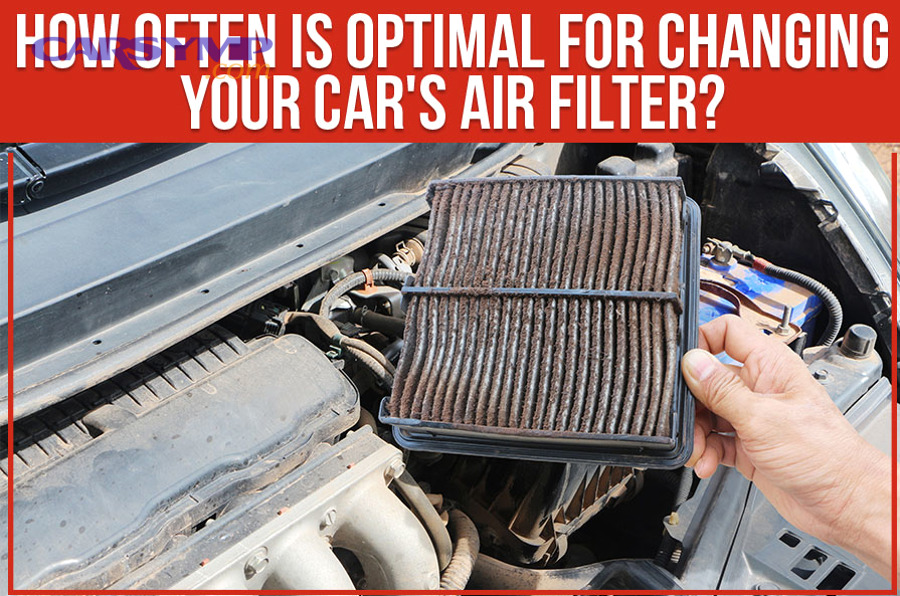
Should you change the oil filter every oil change?
Yes—most drivers should change the oil filter at every oil change for three reasons: it maintains filtration efficiency across the full drain interval, it reduces the risk of bypass flow under high demand, and it prevents old debris from re-circulating when fresh oil is added. (autocare.org)
More specifically, as oil change intervals have extended, industry guidance for “severe” use commonly pairs oil and filter changes together, while acknowledging that manuals define the final interval for each model. (autocare.org)
Practical exceptions (only when documented for your vehicle):
- Some long-life filters paired with shorter oil intervals
- Certain manufacturer schedules allowing filter replacement every second oil change
What happens if you skip an oil filter change?
Skipping the oil filter can cause three common problems:
- Higher restriction → more time in bypass mode (less filtered oil during peak demand)
- Reduced dirt-holding capacity → the filter saturates sooner on the next interval
- Higher contaminant circulation → more abrasive particles in the oil film
According to a study by University of Sheffield from the Department of Mechanical Engineering, in 2016, bench testing reported that improved oil filtration systems using advanced media could significantly reduce contamination and reduce measured wear of engine moving parts by up to roughly three times compared with a standard system in the tested setup. (etheses.whiterose.ac.uk)
How often should you replace the fuel filter?
Fuel filter intervals vary widely by vehicle and fuel system—some are replaced around 30,000–60,000 miles, others last much longer, and many modern setups are “lifetime” in-tank modules—so the owner’s manual is the only reliable default.
Next, focus less on internet averages and more on your engine type and symptoms, because fuel delivery problems have distinctive warning signs.
How do fuel filter intervals differ between gasoline, diesel, and direct-injection?
Fuel filter strategy depends on pressure and contamination sensitivity:
- Gasoline port-injected systems: often longer intervals; some have filters integrated with the pump module.
- Gasoline direct injection (GDI): higher pressures and more precise components make clean fuel critical, but filtration is often engineered into the module design.
- Diesel engines: typically more filtration stages and/or more frequent service due to water management and higher sensitivity to contamination.
Rule of thumb: if your vehicle has a serviceable, external fuel filter, it usually has a listed replacement interval—follow that.
What are the signs of a clogged fuel filter?
A restricted fuel filter typically shows up as “fuel starvation” behaviors:
- Hard starts or longer cranking
- Hesitation under load (merging, climbing, towing)
- Surging at steady speed
- Loss of power at high RPM
- Whining fuel pump (working harder against restriction)
Important caution: these symptoms can also be caused by a weak pump, dirty injectors, or ignition issues, so diagnosis matters if the symptom persists after replacement.
What’s the simplest replacement schedule checklist for the four common car filters?
There are four common filter replacement baselines—engine air, cabin air, oil, and fuel—organized best as a mileage checklist with a time-based fallback, because that makes planning easy while still respecting low-mileage driving.
Then, once you pick the baseline, adjust it for severe conditions so you don’t replace too early (waste) or too late (restriction).

What’s a simple mileage-based schedule for the four common filters?
Here’s a practical checklist table that summarizes common starting intervals for everyday drivers; use it as a planning baseline, then confirm against your manual:
| Filter | Baseline interval (normal) | “Severe” starting point | What you gain by staying on schedule |
|---|---|---|---|
| Engine air filter | 15k–30k miles | 10k–15k miles | Better airflow consistency; protects intake components |
| Cabin air filter | 12k–15k miles (cars.com) | 6–12 months | Stronger HVAC airflow; less odor/dust |
| Oil filter | With oil changes (autocare.org) | With oil changes | Stable filtration across the drain interval |
| Fuel filter | Manual-specific | Earlier if symptoms/severe | Stable fuel delivery; protects injectors/pump |
This table is meant to simplify your planning—not override the manufacturer schedule—so treat it as a “starting map,” not the final rule.
What’s a time-based schedule if you drive low miles?
If you drive low miles, time becomes the safer trigger:
- Cabin air filter: yearly (or every 6–12 months if you notice odors/allergies)
- Engine air filter: inspect at least yearly; replace if visibly loaded
- Oil + oil filter: follow the oil’s time limit in your manual (often 6–12 months even if miles are low)
- Fuel filter: follow the manual; don’t guess
How do you adapt the checklist for severe conditions?
Use a simple adjustment system:
- One severe factor: shorten interval by ~25%
- Two+ severe factors: shorten by ~50% or inspect twice as often
- Symptoms appear early: replace and reset the schedule based on what you observed
This is where consistent filter replacement planning saves money—because you’re responding to actual load, not anxiety.
Can you DIY filter replacement, and when should you use a mechanic?
Yes, most drivers can DIY common filter jobs safely, but you should use a mechanic when access is difficult, the fuel system is high-pressure or integrated, or mistakes could cause leaks, poor sealing, or damage.
Next, identify which filters are truly easy on your vehicle and which ones are “easy in theory, risky in practice.”

Which filter replacements are typically DIY-friendly?
Usually DIY-friendly (with a quick manual/YouTube check for your model):
- Engine air filter: often top-access airbox, minimal tools
- Cabin air filter: often behind glovebox; some cars are trickier but still manageable
- Oil filter: DIY-friendly if you can safely lift the car and manage spills
To reduce mistakes, read the label and compare the old and new filter dimensions before installing.
When is professional service the safer or smarter option?
Choose a mechanic when:
- Fuel filter is integrated with the pump module or requires depressurizing high-pressure lines
- Access requires disassembly (undertrays, tight engine bays, complex glovebox/HVAC panels)
- You see leaks or damaged housings (airbox warping, cracked clips, oil seepage)
- You’re due for additional service (oil + inspection + tire rotation) and want one visit
How do you avoid mistakes like incorrect filter fitment and leaks?
Avoiding incorrect filter fitment is mostly about verification and sealing discipline:
- Match the exact part number (VIN lookup or trusted catalog), not just “it looks close.”
- Confirm orientation arrows on cabin filters (airflow direction matters).
- Inspect sealing surfaces (airbox gasket, cabin filter frame, oil filter gasket seat).
- Oil filter gasket rule: remove the old gasket if it stuck, oil the new gasket lightly, and hand-tighten to spec.
- After install: run the HVAC fan and check airflow; start the engine and inspect for oil seepage.
This is also where Engine air filter vs cabin filter differences matter: the engine filter must seal against unfiltered intake leaks, while the cabin filter must align with airflow direction and frame seating to prevent bypass gaps and rattles.
What factors can change filter intervals beyond the basic schedule ?
Filter intervals change with climate, air quality, filter media design, and parts accuracy, so the smartest approach is to choose the correct filter type for your environment and verify fitment to prevent bypass leaks and premature loading.
In addition, you can use higher-efficiency filters strategically—without overpaying or restricting flow—when the use case actually demands it.

Does climate or air quality change how often you replace filters?
Yes—hot/dry/dusty climates and polluted corridors typically shorten both air-filter intervals because the contamination load per mile is higher.
Use these environment-based triggers:
- Dusty region: shorten engine air interval first
- High pollen/smoke: shorten cabin air interval first
- Humid + leaves/debris: cabin filters can mildew; consider more frequent changes even at low miles
Are “high-efficiency” cabin filters or reusable engine filters worth it?
It depends on what you’re optimizing:
- High-efficiency cabin filters (often with activated carbon): worth it if you drive in traffic pollution, smoke, or have allergies, because they improve perceived air quality and reduce odors.
- Reusable/oiled engine filters: can be worthwhile for some owners, but require correct cleaning/oiling; over-oiling can contaminate sensors on certain vehicles, so follow manufacturer guidance.
If you’re unsure, choose a quality OEM-equivalent paper engine filter and a cabin filter type (particulate vs carbon) that matches your air-quality needs.
How do you match the exact filter part number and avoid incorrect fitment?
To prevent “almost fits” problems:
- Use a VIN-based lookup or your owner’s manual part spec.
- Cross-check dimensions and gasket shape against your old filter.
- Confirm the frame thickness and latch points (especially cabin filters).
- Avoid “universal” filters for modern cars.
This step alone prevents a surprising share of airflow bypass issues and noise complaints.
What should you check after replacement to confirm it’s installed correctly?
Do a 60-second post-install validation:
- Engine air filter: airbox fully closed, clips seated, no pinched gasket, no loose snorkel tubes
- Cabin air filter: correct airflow direction, glovebox/panel fully seated, no rattles on fan high
- Oil filter: no drips after warm idle; re-check after a short drive
- Fuel filter (if serviced): verify no seepage/odor; ensure proper prime/start procedure
If everything checks out, your new baseline schedule starts with confidence—because the filter is sealing, flowing, and doing its job.