


A key stuck in the ignition is usually caused by a simple mechanical bind or an interlock not releasing, and you can often fix it safely by relieving steering-wheel tension, confirming the shifter is truly in Park, and gently working the key through the correct positions—without forcing the cylinder.
Next, the fastest way to stop guessing is to narrow the fault to the steering lock, the ignition lock cylinder (wafers/tumblers and debris), or the shift-interlock system that ties key release to Park and the brake pedal.
In addition, knowing the difference between cylinder wear and interlock faults helps you avoid expensive damage, recognize Car Symptoms that point to ignition switch problems, and decide when a locksmith or shop should take over.
Introduce a new idea: once you can remove the key safely, you can focus on permanent repairs, prevention habits, and the less-common electrical edge cases that mimic the same “stuck key” complaint.
What does it mean when your key is stuck in the ignition?
A key stuck in the ignition is a “release failure” where the key cannot return to the LOCK position or cannot slide out because a lock mechanism, steering bind, or safety interlock is still engaged.
Then, because the ignition system is both mechanical and electrical, the symptom you feel at the key often reflects a different part failing upstream.
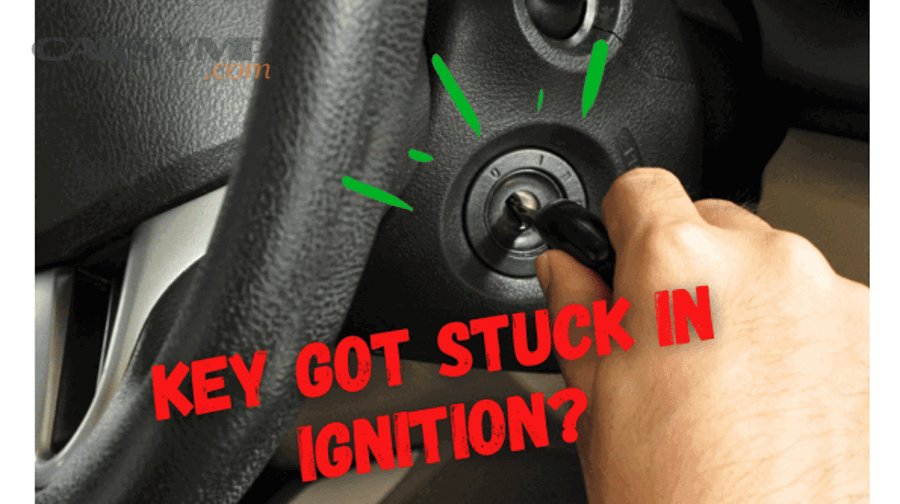
The key point is that “stuck” can mean three different situations, and each points to a different cause:
- Key won’t turn at all (feels jammed): often steering wheel lock tension or a worn/dirty lock cylinder.
- Key turns, but won’t rotate back to LOCK: often the shifter is not fully in Park (or Park is not being detected), or the ignition switch is not returning cleanly.
- Key rotates to LOCK but won’t pull out: often cylinder wear, debris, or a release pin not retracting.
If you treat all three scenarios the same, you risk bending the key, breaking it off inside the cylinder, or damaging internal wafers that turn a small nuisance into a tow.
Is the key stuck because the steering wheel lock is binding?
Yes—steering wheel lock binding is a common reason a key won’t turn or won’t come out, because the steering lock applies mechanical pressure that traps the ignition cylinder in place for anti-theft.
More specifically, when the front wheels rest against a curb or the steering wheel is turned hard at shutdown, the steering lock pawl can load the column and “pinch” the ignition cylinder.
Why this causes a stuck-key feeling (3 reasons):
- Column tension increases friction at the lock interface, making the key feel jammed.
- The lock pawl resists movement until steering torque is relieved.
- The cylinder can’t align fully to LOCK while the column is bound, blocking key release.
Safe fix (do this gently):
- Hold the key lightly in the “turn” direction (do not force).
- With your other hand, wiggle the steering wheel left-right through the small free-play zone.
- As tension releases, the key typically turns and/or returns to LOCK.
If the steering wheel is fully jammed, you’ll feel a “hard stop” on the wheel; keep movements small and controlled—your goal is to unload the lock, not to fight it.
Is the key stuck because the shifter isn’t fully in Park (or Park isn’t being detected)?
Yes—on many automatics, the key cannot release unless the vehicle is in Park, and if the shifter is not fully seated (or the car isn’t detecting Park), the interlock can trap the key.
Moreover, this is one of the most misunderstood causes because the lever can look like it’s in Park while the linkage, cable, or sensor is slightly off.

Why Park matters (3 reasons):
- Key-release interlock is designed to prevent rollaway by forcing Park before removal.
- Brake-shift interlock logic may require brake pedal input to confirm safe state.
- PRNDL/P-position sensing must match the actual gear selection before release.
Quick checks that often solve it:
- Press the brake pedal firmly.
- Move the shifter out of Park and back into Park with a deliberate, full motion.
- If safe, gently rock the vehicle slightly (foot on brake) to reduce drivetrain load, then re-seat the shifter.
- Look at the cluster: does “P” clearly illuminate? If “P” is missing or flickers, you may have a Park-detection issue rather than a key problem.
What are the most common causes of a key stuck in the ignition?
There are 5 main types of key-stuck causes—steering lock binding, ignition lock cylinder wear/contamination, shift-interlock/Park detection faults, low voltage/electrical release problems, and true ignition switch assembly issues—based on which mechanism is preventing LOCK-and-release.
Next, you can troubleshoot faster by matching each type to a symptom pattern instead of repeating random “wiggle” attempts.

Here’s the practical way to think about it: the key only comes out when (1) the cylinder can rotate fully to LOCK and (2) the release pin can retract. Anything that blocks either condition creates the same complaint.
Which causes are related to the ignition lock cylinder (wafers/tumblers, dirt, wear)?
There are 4 common ignition lock cylinder causes—worn key cuts, sticky wafers/tumblers, contamination/debris, and internal cylinder wear—based on whether the cylinder can align cleanly to its detents.
Specifically, these causes usually feel “mechanical” at your fingertips: gritty movement, inconsistent turning, or better performance with a spare key.
What to look for (common patterns):
- Worn key: key looks rounded at the cuts; spare key works better; sticking is intermittent.
- Dirty cylinder: key feels gritty; sticking worsens over time; sometimes improves after cleaning/lube.
- Worn wafers: key must be jiggled; cylinder occasionally “hangs” near ACC/LOCK; problem persists even when steering tension is relieved.
- Bent key: key inserts but binds while turning; may have been forced previously.
Why forcing it backfires: The wafers are small spring-loaded pieces that must align precisely. Excess torque can deform them, scar the cylinder walls, or snap the key—turning a minor maintenance issue into a cylinder replacement.
Which causes are related to the shift-interlock system (brake switch, BTSI solenoid, Park switch)?
There are 4 common shift-interlock causes—brake light switch faults, blown fuses/power loss to the interlock, misadjusted shifter cable/linkage, and P-position (Park) sensor/PRNDL signal errors—based on what the vehicle uses to authorize key release.
More importantly, these issues can present alongside other Car Symptoms, like a shifter that feels “stiff,” brake lights that don’t work, or a cluster that doesn’t reliably show “P.”
High-yield checks (fast and safe):
- Brake lights test: if brake lights don’t illuminate, the brake switch may not be sending the “brake applied” signal.
- Listen for a click: some interlocks make a faint click near the shifter when you press the brake.
- Confirm Park on the cluster: if “P” doesn’t show consistently, the car may not be authorizing release.
- Seat the shifter firmly: move out of Park and back to Park; don’t “float” the lever into place.
When this category is the cause, the key may rotate but won’t return fully to LOCK, or it returns but won’t release—because the interlock is still holding the release mechanism.
Can a weak battery or electrical issue keep the key from releasing?
Yes—a weak battery or electrical interruption can keep the key from releasing because some vehicles use electrically controlled solenoids or modules to confirm Park/LOCK states and allow the release.
Besides, low voltage can also create Electrical accessories cutting out diagnosis clues (radio resets, dash flicker, intermittent power), which can be mistaken for purely mechanical sticking.
Why voltage matters (3 reasons):
- Interlock solenoids need power to actuate consistently.
- Control modules may misread state signals at low voltage (Park, brake, key position).
- Ignition switch problems can appear worse when voltage is unstable, creating confusing “sometimes it works” behavior.
If your headlights dim heavily during cranking or your dash behaves erratically, treat voltage as part of the diagnostic picture—not just the key.
How do you safely get a key out of the ignition without causing damage?
You can safely remove a stuck key by using a least-to-most invasive sequence of 8 steps—relieve steering tension, confirm Park and brake input, cycle key positions correctly, reduce drivetrain load, try a spare key, clean/lubricate the cylinder appropriately, and stop before you force damage.
Then, following a strict order matters because each step tests a different mechanism and prevents the “panic twist” that breaks keys.

What are the first 5 no-tools steps you should try?
There are 5 best first steps—steering wheel relief, full Park re-seat, brake pedal confirmation, proper key cycling, and spare-key testing—based on solving the most common causes without touching the cylinder internals.
To begin, do them slowly and deliberately; speed and force are what damage ignition components.
- Relieve steering lock tension
- Light pressure on key in the turn direction
- Wiggle steering wheel in small motions until it frees
- Confirm Park with intent
- Press brake firmly
- Shift out of Park and back into Park with a full motion
- Verify “P” on cluster if available
- Cycle the key correctly
- Don’t try to “pull while turning”
- Rotate fully to the correct detent (often LOCK is required to remove)
- If it’s stuck between positions, gently rotate back and forth in the detent range
- Reduce drivetrain load (automatic)
- Keep foot on brake
- If safe and flat, slightly rock the vehicle with minimal movement, then re-seat Park
- This can release tension on the park pawl/linkage that blocks key return
- Try a spare key
- A spare that turns smoothly is a strong clue of key wear rather than a failing cylinder
- If the spare works, stop forcing the worn key and get a properly cut replacement
If any step requires you to “muscle” the key, stop—your goal is to restore alignment, not overpower the mechanism.
What lubricants or cleaning steps are safe for an ignition cylinder?
Safe ignition cylinder lubrication usually means using a lock-appropriate dry lubricant (like graphite or a purpose-made lock lubricant) applied sparingly, because heavy oils attract dirt and can worsen sticking over time.
Specifically, lubrication is a symptom reducer when debris or dryness is the issue, but it will not fix broken wafers or severe wear.
A safe, practical approach:
- If the key inserts but movement feels gritty, blow out loose debris first (short bursts of air).
- Apply a small amount of dry lock lubricant to the key (not a flood into the cylinder).
- Insert and remove the key several times to distribute it.
- Test turning gently through the detents.
What to avoid:
- Thick oils or grease: they can trap grit and accelerate wear.
- Excessive spray products: over-application can wash debris deeper and cause long-term sludge.
If lubrication gives only a short-lived improvement, that points toward wear, misalignment, or a failing component rather than simple contamination.
When is it unsafe to keep trying DIY fixes?
Yes—it is unsafe to continue DIY attempts when the key is bending, the cylinder is grinding or binding harder with each attempt, electrical burning smells appear, or the key is at risk of breaking off, because the cost and complexity can escalate rapidly.
More importantly, this is where “just one more twist” becomes a tow plus a lock-cylinder job.
Stop and get help if you notice:
- The key visibly flexes or starts to twist.
- The key partially turns and then locks solid (no elastic movement).
- You hear cracking/metallic snapping inside the cylinder.
- The key head gets hot, or there’s an electrical smell near the column (possible ignition switch problems).
- The car loses dash power or accessories unexpectedly (a sign to include Electrical accessories cutting out diagnosis in your plan).
A locksmith can often extract and address cylinder issues with far less collateral damage than repeated forcing.
Ignition lock cylinder vs shift-interlock: which one is more likely in your case?
Ignition lock cylinder issues are more likely when the key feels gritty, inconsistent, or works better with a spare, while shift-interlock issues are more likely when Park/brake state changes affect release and the cluster or shifter behavior seems involved.
Next, this comparison matters because it prevents you from replacing the wrong part—or blaming the “key” when the interlock is the real gatekeeper.
Use this quick symptom-to-system map:
- Feels mechanical at the key → likely cylinder/key wear/contamination
- Feels conditional on Park/brake → likely interlock/Park detection
- Comes with power weirdness → consider voltage, ignition switch, or wiring-related faults
How do the symptoms differ between cylinder wear and interlock faults?
Cylinder wear “wins” as the cause when tactile key feel and key condition predict the failure, while interlock faults “win” when vehicle state signals (Park, brake, PRNDL) control whether the key releases.
However, the two can overlap, so your job is to identify which system is the primary blocker.
Cylinder-wear leaning symptoms:
- Key insertion is sticky.
- Turning requires key jiggle independent of shifter position.
- Spare key works markedly better.
- The key sometimes sticks even in neutral situations (wheels straight, firm Park).
Interlock-leaning symptoms:
- Key releases only after re-seating Park or pressing the brake harder.
- “P” indicator is inconsistent or absent.
- Shifter feels misaligned or requires extra movement to lock in Park.
- The car shows other state-related quirks (brake lights out, shifter button sticky).
When your results are mixed, prioritize the condition that changes the outcome most dramatically—because that is usually the controlling mechanism.
What quick tests confirm it’s the shift-interlock (not the cylinder)?
There are 4 quick interlock confirmation tests—brake light verification, PRNDL/P-indicator validation, shifter re-seat with load reduction, and fuse/solenoid behavior checks—based on proving the release depends on vehicle state rather than key mechanics.
Meanwhile, each test is designed to be safe and non-destructive.
Test 1: Brake lights
- Press the brake and confirm rear brake lights illuminate.
- If they don’t, the brake switch or fuse may be involved.
Test 2: Park indicator
- Watch the dash: does “P” appear reliably?
- If “P” flickers or fails, Park detection may be blocking release.
Test 3: Shifter re-seat + load relief
- Move out of Park → back into Park firmly.
- If on a slight incline, tension can hold the mechanism; relieving load can change the result.
Test 4: Consistent state dependency
- If the key always releases after a specific state change (brake press, shifter movement), that’s classic interlock behavior.
If these tests repeatedly change the outcome, treat the interlock as the primary issue—even if the key also feels a little worn.
What repairs fix the root cause (and what should a shop check)?
There are 2 main repair paths—ignition cylinder/key repairs and shift-interlock/Park-sensing repairs—plus a third electrical path when ignition switch problems or wiring create power-state faults, based on what mechanism is blocking key release.
Next, understanding the repair logic keeps you from paying for parts that don’t address the real cause.

Shops typically diagnose this by combining symptom history with quick inspections: key condition, cylinder feel, scan data (Park status), brake switch output, and interlock power/fuse integrity.
What fixes address ignition cylinder problems?
There are 4 common fixes for ignition cylinder problems—cutting a fresh key, cleaning/lubricating the cylinder properly, rebuilding/rekeying the cylinder, or replacing the cylinder—based on how much wear or internal damage exists.
Especially when Bad ignition switch symptoms get confused with cylinder wear, shops will separate the “lock cylinder” (mechanical) from the “ignition switch” (electrical) to avoid misdiagnosis.
Fix option 1: Cut a new, correct key
- Best when the spare works better or the key is visibly worn
- Often the lowest-cost “repair” with high success
Fix option 2: Cylinder service (clean + correct lubricant)
- Best when sticking is mild and contamination-related
- Should improve feel consistently, not just briefly
Fix option 3: Rekey or rebuild
- Best when wafers are worn but the housing is serviceable
- Preserves keying in some cases
Fix option 4: Replace the lock cylinder
- Best when wafers are damaged, the key binds hard, or the cylinder is inconsistent
- Often paired with new keys; complexity depends on anti-theft design
If your key has already been forced and now “hangs” unpredictably, replacement becomes more likely because internal wafer damage is hard to reverse reliably.
What fixes address shift-interlock problems?
There are 4 common fixes for shift-interlock problems—brake light switch replacement, interlock solenoid/fuse repair, shifter cable/linkage adjustment, and Park sensor/PRNDL repair—based on which signal or actuator fails to authorize release.
More importantly, these repairs are often confirmed by restoring consistent “P” detection and normal brake-signal behavior.
Brake light switch replacement (common)
- If brake lights don’t work, the car may not see “brake applied,” blocking interlock logic
- Also addresses broader safety issues, not just key release
Interlock solenoid/fuse diagnosis
- A failed solenoid or lost power feed can prevent release
- This is where Electrical accessories cutting out diagnosis can help, because intermittent power can break state confirmation
Cable/linkage adjustment
- If Park is physically reached but not detected, adjustment can restore alignment
- Often shows up as needing to “push” the shifter harder into the gate
Park sensor/PRNDL issues
- If the cluster doesn’t reliably show “P,” the car may not grant key release
- Repair can involve sensors, wiring, or the shifter assembly depending on design
According to a study by Queen’s University from the Department of Sociology, in 2015, GM ignition-switch designs were documented as having detent and torque characteristics that could allow movement between positions and cut power to systems, illustrating how ignition-position changes can disable power-assisted functions. (qspace.library.queensu.ca)
(This evidence supports the broader concept that ignition-position control and detent behavior matter; for your specific vehicle, diagnosis still depends on your symptoms and system design.)
How can you prevent a key from getting stuck in the ignition again?
You can prevent most stuck-key incidents by reducing steering-lock load, keeping the key and cylinder in good condition, and ensuring Park and brake-interlock signals work consistently before you turn the car off.
Thus, prevention is less about “doing one magic trick” and more about removing the conditions that create binding and misalignment.

Prevention is especially valuable because repeated sticking accelerates wear: every forced twist slightly rounds key cuts and stresses wafers, which makes the next incident more likely.
Which daily habits prevent steering lock and interlock-related sticking?
There are 4 daily habits that prevent most sticking—straightening the wheel before shutdown, avoiding steering tension against a curb, fully seating Park with the brake applied, and letting the key return cleanly to LOCK without pulling—based on reducing the mechanical and interlock loads that trap the release.
Next, small habit changes reduce the number of “state conflicts” the vehicle must resolve at shutdown.
- Unload steering tension: Before turning off, straighten wheels when possible; avoid parking with hard wheel tension against a curb if you can safely reposition.
- Park with intent: Hold brake, shift firmly into Park, confirm the lever is fully seated; don’t rush the shutdown sequence.
- Keep the key ring light: Heavy keychains can add torque and bouncing forces; this is also relevant when you’re tracking ignition switch problems in vehicles sensitive to key rotation torque.
- Don’t pull while turning: Let the cylinder reach detent naturally, then remove the key; pulling early can scrape wafers and create long-term roughness.
When should you replace a worn key or duplicate a fresh spare?
A worn key should be replaced or freshly duplicated when its cuts look rounded, it requires frequent jiggling, it works worse than a spare, or it causes intermittent sticking that disappears with a properly cut key.
In short, replacing a worn key is one of the cheapest ways to reduce cylinder wear and prevent repeat incidents.
Practical cues a key is “done”:
- Shiny, rounded edges on the cuts
- Key inserts fine but binds while turning
- Spare key improves operation noticeably
- Sticking worsens over months rather than days
If your vehicle uses a transponder key, make sure the replacement is correctly programmed and cut to specification; a poorly cut duplicate can create new sticking even when the electronics are fine.
Contextual Border: Now that you can identify the cause and safely remove the key, the sections below expand into less common scenarios, vehicle-specific systems, and edge cases that can mimic the same symptoms.
What less-common issues can make a key get stuck in the ignition, and how do you diagnose them?
There are 4 less-common causes—electronic steering lock/push-start system faults, inaccurate Park signaling, aftermarket wiring conflicts, and temperature/moisture contamination effects—based on rare conditions that still block LOCK-and-release while looking like a simple stuck key.
Besides, these edge cases are where drivers often report confusing Car Symptoms that seem unrelated until you view them as a single state-and-power problem.

Could an electronic steering lock or push-button start system be causing a “stuck key” symptom?
Yes—electronic steering locks and some push-button start systems can create “stuck key” behavior because modules must confirm steering lock state, gear state, and ignition state before allowing release or shutdown.
However, the sensation may not be a literal mechanical jam; it can be a control-state deadlock.
Clues this might be your situation (3 reasons):
- The vehicle intermittently refuses to switch off or returns to ACC unexpectedly.
- You see warning messages related to steering lock or key detection.
- Power states behave oddly (accessories stay on or cut out), which overlaps with Bad ignition switch symptoms in older keyed systems.
What to do safely:
- Reduce steering load (small wheel movement).
- Ensure Park + brake input.
- Try a known-good key fob battery if applicable.
- If the vehicle won’t recognize state changes, stop repeated attempts and seek service to avoid battery drain or module faults.
Is your dashboard Park indicator inaccurate (PRNDL/P-position sensor issue) and blocking key release?
Yes—an inaccurate “P” signal can block key release because the car’s logic may refuse to authorize removal unless Park is confirmed, even if the shifter is physically in Park.
More specifically, this issue often appears as “I swear it’s in Park, but the cluster doesn’t show it,” followed by a trapped key.
How to diagnose without tools:
- Re-seat Park and watch whether “P” changes.
- Try shifting to Neutral and back to Park while holding brake.
- Notice if the key releases only when you press the shifter harder into the gate.
If “P” is unreliable, treat it as a system input problem (sensor/linkage/PRNDL), not as a lock-cylinder problem.
Can aftermarket alarms/remote starts create ignition or interlock conflicts?
Yes—aftermarket alarms, remote starts, and non-OEM wiring can create ignition or interlock conflicts by altering how the ignition circuit, brake signal, or Park/neutral logic is interpreted.
Moreover, these conflicts can present as intermittent Electrical accessories cutting out diagnosis issues—because a poor connection can momentarily drop voltage to the same circuits that control release.
Clues pointing to aftermarket conflict:
- The problem started soon after installation or electrical work.
- Symptoms are intermittent and worsen with vibration/bumps.
- Accessories cut out or reset while driving or at shutdown.
If you suspect this, returning to the installer (with a symptom log) is often faster than replacing mechanical components.
Does temperature, moisture, or contamination make the cylinder stick (seasonal sticking)?
Temperature and moisture can make a cylinder stick because condensation, light corrosion, or freezing contaminants increase friction and prevent wafers from moving freely—especially in cold weather or after repeated exposure to humidity and dust.
Especially when the symptom “comes and goes” with seasons, contamination and moisture become more likely than a sudden part failure.
What helps (without overdoing it):
- Keep the key clean and dry.
- Avoid flooding the cylinder with oily products that trap grit.
- Use a lock-appropriate dry lubricant sparingly if the feel is dry/gritty.
- If sticking is severe in cold snaps, consider professional cleaning or cylinder service rather than repeated forcing.
According to a study by Queen’s University from the Department of Sociology, in 2015, ignition-switch position changes were described as capable of cutting power to systems and altering vehicle functional states, reinforcing why state confirmation (Park/ignition position) can matter in real-world failures. (qspace.library.queensu.ca)
Evidence (summary)
According to a study by Queen’s University from the Department of Sociology, in September 2015, ignition-switch detent/position behavior and its downstream effects on power-state systems were documented in the context of ignition-switch failures. (qspace.library.queensu.ca)