


Most muffler replacement labor time estimates fall into a simple range: a straightforward, direct-fit muffler swap can take about 30–60 minutes, while jobs that involve upstream pipes or harder-to-reach sections often take longer. (midas.com)
Next, the “muffler swap vs full exhaust repair” difference matters because labor time changes more from scope than from the muffler itself—once the job expands to a mid-pipe or downpipe, the labor hours can jump by another hour or two. (midas.com)
Then, labor time also connects directly to what you pay: many cost estimators separate labor vs parts, and the labor line you see on a quote is basically your shop’s hourly rate multiplied by billed labor hours (plus any minimums or add-ons). (repairpal.com)
Introduce a new idea: the best way to avoid surprises is to understand what “labor time” includes, what makes it inflate (rust, cutting, welding, hangers), and how to recognize when a “muffler job” is really an exhaust-system repair waiting to happen.
What is “muffler replacement labor time,” and what does it include?
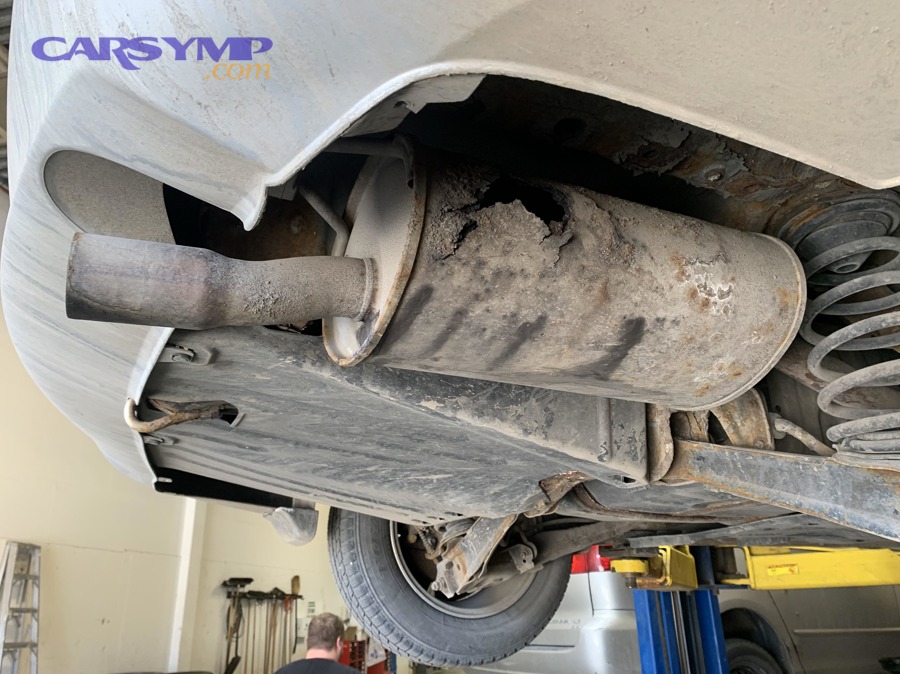
“Muffler replacement labor time” is the billed time a shop assigns to remove the old muffler, install the replacement, and verify the exhaust is secure and leak-free—often expressed as flat-rate (book) time rather than the exact minutes your car is on the lift.
To better understand why your estimate may not match the clock, you need to separate labor hours (billing) from elapsed time (real time in the bay), and you need to know what’s included in a normal muffler replacement versus what gets itemized.
Is labor time the same as “book time” or flat-rate time?
No—labor time can be billed as flat-rate “book time” even when the job is faster or slower in real life, because flat-rate systems are designed to represent the time a skilled technician needs with proper tools and standard conditions.
Specifically, “book time” is an estimating convention: it assumes a technician has lift access, the right tools, and typical fasteners that come apart without extraordinary effort. In contrast, real-world muffler replacement time can vary widely based on corrosion, access, previous repairs, and whether your muffler is direct-fit or universal.
Here’s how the difference shows up for everyday drivers:
- Flat-rate / book time (billing): A standard time used for quoting and consistency.
- Actual clock time (reality): The time your car is physically being worked on, which can be shorter (easy clamp job) or longer (rusted hardware, cutting, welding).
- Effective time (what you feel): The total time you wait, which includes intake, inspection, parts fetching, and test checks.
This matters because the same muffler replacement can be billed at 1.0 hours even if the tech completes it in 45 minutes—or it can take two hours in real time due to seized hardware while the shop still bills a set labor line plus “additional time” for extra operations. The cleanest estimates spell out what’s “included” and what triggers extra labor.
Does muffler replacement labor time include welding, hangers, and leak testing?
Yes for leak checks; sometimes for hangers; and welding is often treated as “included only if needed” or billed as an additional operation—because welding is not always required for muffler replacement.
Moreover, a typical muffler replacement labor line usually covers these basics:
- Raise and secure the vehicle
- Remove the old muffler (unbolt/unclamp/cut depending on design)
- Install and align the new muffler
- Verify tailpipe tip clearance and hanger alignment
- Quick leak check and rattle check
However, muffler replacement becomes more complex when the shop discovers you also have Exhaust hanger and mount replacement needs. A muffler is only stable if it’s supported at the right points; worn hangers cause sagging, vibration, or contact with heat shields and the body. If hangers are cracked, missing, or rusted through, a shop may add labor to replace them because it’s a separate operation that prevents repeat failures.
In short, you should treat “welding” and “hanger repair” as scope-dependent. The estimate is most accurate when it states: clamp-on vs weld-on, and whether hangers are included or itemized.
How many labor hours does a muffler replacement usually take?
There are three common labor-time bands for muffler replacement—quick (30–60 minutes), moderate (about 1–2 hours), and complex (2+ hours)—based on how the muffler attaches, how rusty the hardware is, and whether the job stays “muffler-only.” (midas.com)
Next, instead of guessing, you can place your car into the right band by looking at attachment type (clamps/bolts/welds), corrosion level, and whether you’re replacing a direct-fit unit or adapting a universal muffler.
Is a direct-fit muffler swap usually under 1 hour?
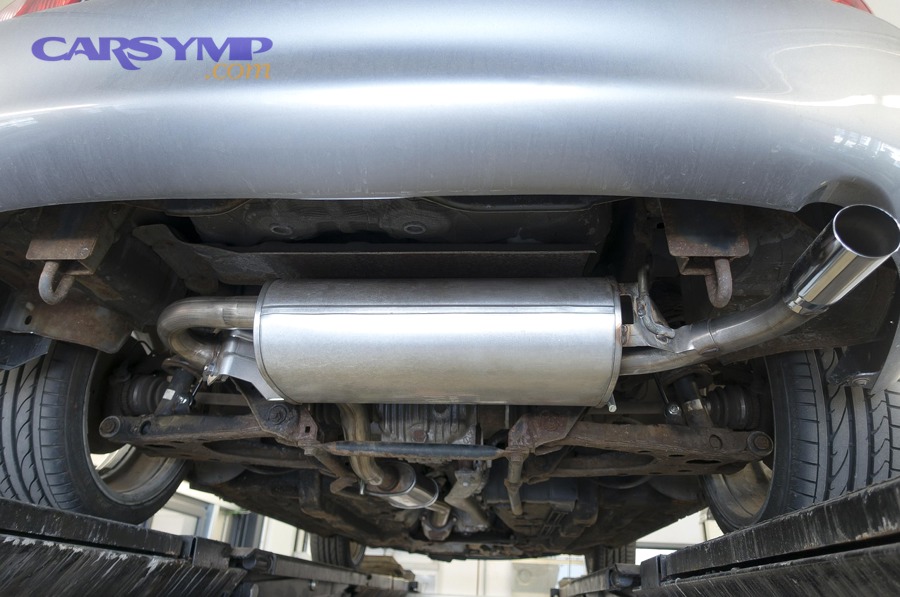
Yes—a direct-fit muffler swap is usually under 1 hour when the fasteners come apart normally, the muffler is a true bolt-on/clamp-on match, and the surrounding pipe is solid enough to seal properly. (midas.com)
Specifically, the “fast path” looks like this:
- Muffler is direct-fit (correct inlet/outlet diameter and hanger positions)
- Connections are clamps or bolted flanges that are not seized
- Pipe ends are intact (not thin, flaky, or ovaled by corrosion)
- Hangers are reusable and not torn
- No upstream leak forces additional repairs
When those conditions hold, the tech’s time is mostly controlled: remove, swap, align, tighten, leak-check. That’s why the simplest muffler replacement is often described as 30–60 minutes. (midas.com)
When does muffler replacement take 1–2+ hours instead?
Muffler replacement takes 1–2+ hours when it stops being “remove and replace” and starts requiring hardware recovery (rusted bolts), fitment work (adapters, alignment), or metal work (cutting and welding). (midas.com)
More specifically, time increases when:
- Clamps are fused by corrosion and need cutting
- Bolts/studs snap, requiring extraction or new hardware solutions
- Pipe ends crumble and need a sleeve or section replacement
- The job requires welding to create a durable joint
- You have Exhaust hanger and mount replacement needs (broken rubber isolators, missing brackets)
- There’s a second leak upstream that must be addressed to stop noise/fumes
A practical rule: every “unexpected operation” adds both time and decision points. Shops often pause to call you, explain why the quote changed, and get authorization—so the elapsed time can stretch even when the wrench time is manageable.
What warning signs tell you it won’t be a quick muffler job?
There are five common warning signs a muffler job won’t be quick: heavy rust scaling, visible patchwork, sagging exhaust, multiple leak noises, and misaligned or rattling heat shields.
In addition, you can spot risk before you schedule service:
- Rust belt clues: heavy scaling on clamps and seams; flaky pipe surfaces
- Hanger issues: exhaust sits low or swings; rubber isolators torn
- Patch history: wrap/putty or poorly welded seams indicate thin metal nearby
- Noise profile: loud leak near the middle of the car may point to pipe/resonator damage
- Smell or soot marks: black soot near joints suggests leakage points beyond the muffler
The key is scope: a muffler might be the obvious failure, but the pipes supporting it may be too compromised to seal. When that’s true, labor time rises because the shop must create a joint that holds.
What factors increase or reduce muffler labor time the most?
The biggest drivers of muffler replacement labor time are corrosion, attachment method (clamp/bolt/weld), and fitment complexity, because these determine whether the job is a predictable swap or a fabrication-style repair.
Besides, understanding these drivers helps you interpret a quote: if the shop mentions cutting, welding, broken hardware, or hanger replacement, you’re no longer in the “simple” labor-time bracket.
Does rust and corrosion add significant time to muffler replacement?
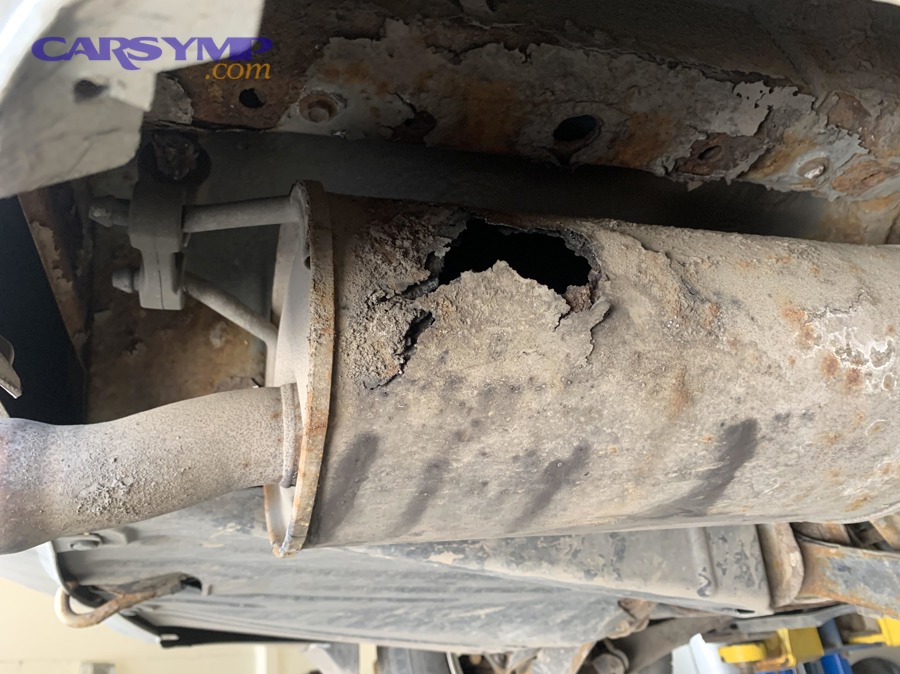
Yes—rust and corrosion significantly increase muffler replacement labor time because they turn routine unbolting into cutting, heating, extracting, and rebuilding connections, and they often reveal thin metal that won’t hold clamps.
Especially in snow-and-salt regions, corrosion accelerates underbody deterioration. Penn State engineering notes that road salt contributes to corrosion of the undersides of vehicles and speeds corrosion reactions. (psu.edu)
Here’s how corrosion consumes time:
- Seized clamp bolts: you spend time attempting removal, then cut and replace
- Rounded hardware: tools slip; removal takes longer and risks breakage
- Thin pipe ends: the “seal surface” is gone; a shop must sleeve, flare, or replace sections
- Broken studs: extraction is slow and may require rework
Evidence sentence: According to a study by Czestochowa University of Technology from the Department of Materials Engineering, in 2024, research on exhaust-system materials in a road-salt environment found corrosion behavior that supports why salt exposure accelerates degradation risk in exhaust components. (diagnostyka.net.pl)
Do clamp-on, bolt-on, and welded mufflers take different labor times?
Clamp-on wins for speed, bolt-on is fast when hardware is healthy, and welded installation is optimal for long-term sealing—because each method changes the number of operations and the risk of “stuck” fasteners.
However, the real-world comparison looks like this:
- Clamp-on (fastest when pipes are solid):
- Pros: quick install, easy future removal
- Cons: needs good pipe condition and correct sizing; can leak if surfaces are thin or distorted
- Bolt-on flange (predictable when hardware is healthy):
- Pros: consistent alignment, gasketed seal
- Cons: seized bolts are common; snapped studs can add major time
- Welded (best seal when metal is sound, slowest if fabrication is needed):
- Pros: durable, leak-resistant joint; helpful when clamping surfaces are compromised
- Cons: requires cutting/prep; more time to align and weld; safety and equipment requirements
This is why a shop may suggest welding even if you expected clamps: the “fastest” method isn’t fastest when it fails or leaks and needs a redo.
Does vehicle design (SUV vs sedan, AWD, heat shields) change labor hours?
Yes—vehicle packaging changes labor hours because access, shielding, and routing determine how quickly a technician can reach clamps, align hangers, and safely cut or weld without collateral damage.
More importantly, the same muffler can be “easy” on a vehicle with open rear access and “hard” on a vehicle where:
- The rear subframe blocks tool angles
- Heat shields cover fasteners (extra removal steps)
- AWD components reduce clearance
- The exhaust routing is tight near suspension arms
In practice, vehicles with tighter packaging have longer labor times even when the muffler itself is not special—because “getting to the work” is part of the work.
Muffler swap vs full exhaust repair: what’s the labor-time difference?
A muffler swap wins for speed, full exhaust repair is best for multiple failures, and a “hybrid” approach is optimal when only one upstream section is compromised—because labor time grows with the number of components and joints you must rebuild. (midas.com)
Next, you can protect your budget by defining scope: “muffler-only” means replacing one component; “exhaust repair” means chasing leaks, failed pipes, flanges, or mounts across a larger system.

What counts as a “muffler swap” versus “exhaust repair”?
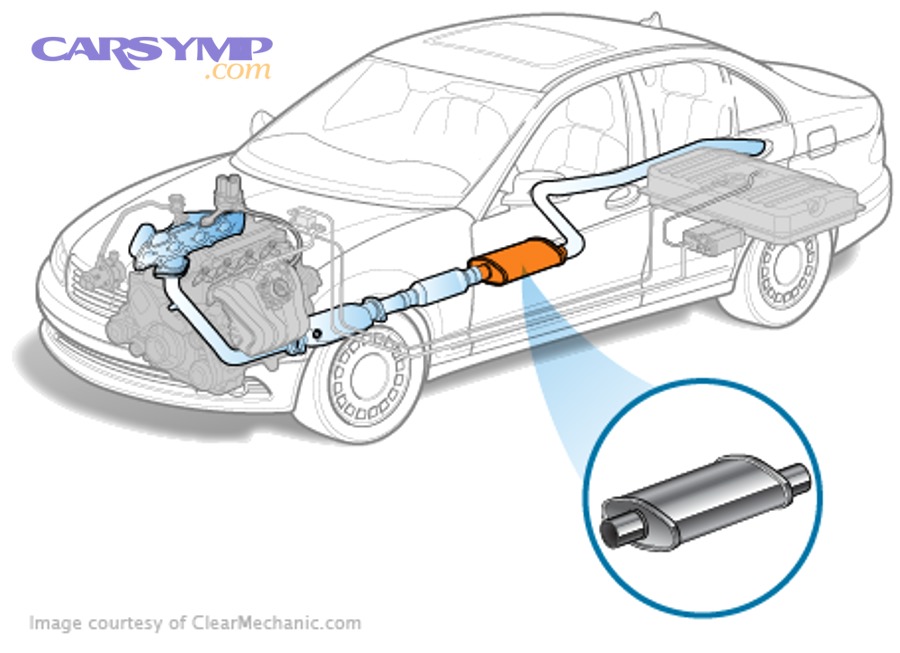
A “muffler swap” is a replacement of the muffler component only, while “exhaust repair” is any service that restores sealing, alignment, and support across multiple exhaust parts (pipes, joints, flanges, and hangers).
Specifically, the muffler is one part in a chain. Exhaust repair can include:
- Replacing or rebuilding a leaking joint
- Replacing a mid-pipe/downpipe section
- Repairing flanges and gaskets
- Replacing damaged mounts and hangers
- Fixing rattles and heat shield interference
This distinction is why time and cost can diverge so sharply. A muffler replacement can be a tidy swap—or it can be the entry point to rebuilding a deteriorated section.
Which added exhaust parts typically increase labor time the most?
There are four added parts/operations that usually increase labor time the most: mid-pipe/downpipe sections, flange/gasket work, fabrication/adapters, and hanger/mount repairs. (midas.com)
To illustrate why, each of these adds extra joints and alignment constraints:
- Mid-pipe or downpipe work: harder reach, more shielding, more seized hardware (midas.com)
- Flange and gasket restoration: requires clean mating surfaces; snapped bolts are common
- Fabrication/adapters: universal parts often need cutting and fitting cycles
- Exhaust hanger and mount replacement: alignment becomes a “system” problem, not a single-part swap
A reliable shop will explain which of these applies to your vehicle and whether it’s preventive (“replace weak hangers now”) or required (“pipe won’t seal without it”).
Can a muffler replacement turn into a larger exhaust job mid-repair?
Yes—a muffler replacement can turn into a larger exhaust job mid-repair when the shop finds thin pipe walls, hidden cracks, or upstream leaks that make a muffler-only fix incomplete or short-lived.
Moreover, this “scope expansion” often happens after disassembly. Once clamps and pipes are disturbed, the tech may discover:
- The pipe end is too corroded to clamp
- A resonator seam is split
- A flange surface is warped or pitted
- Mounts are failing and causing contact/rattle
This is not necessarily upselling; it’s often the difference between a quiet car today and a repeat visit next month. If you want to control cost, ask the shop to define a “stop point”—a threshold where they pause and get approval before proceeding with additional operations.
How do you estimate the labor charge from labor time (without getting surprised)?
You estimate the labor charge by multiplying the quoted labor hours by the shop’s hourly rate, then adding only the itemized extras you approve—so the final bill reflects scope rather than surprises. (repairpal.com)
Then, because muffler quotes often blend predictable labor with conditional add-ons (rust, welding, hangers), your best defense is a clear estimate that distinguishes “base muffler replacement” from “additional exhaust repair.”
How do you calculate labor cost from hours and shop rate?
You calculate labor cost using a simple formula: Labor cost = (Labor hours) × (Shop hourly rate), then you account for shop minimums or diagnostic fees if they apply.
For example, if a shop quotes 1.0 labor hour for a muffler replacement and the rate is $140/hour, the labor line is about $140 before taxes, fees, and parts. If the quote is 2.0 hours because cutting/welding is needed, labor becomes about $280.
This aligns with how many estimators present repairs: they separate labor and parts so you can see what portion is time-based. RepairPal’s muffler replacement estimate, for instance, lists labor and parts separately (with labor shown as a range), which reflects how labor time translates into a labor charge. (repairpal.com)
What line items commonly appear besides “muffler labor”?
There are six common line items besides “muffler labor”: clamps/hardware, gaskets, hangers/mounts, welding/fabrication, shop supplies, and disposal or environmental fees.
More specifically, watch for these typical add-ons:
- Clamps and hardware: new U-bolts, band clamps, flange bolts
- Gaskets: if a flange connection is involved
- Exhaust hanger and mount replacement needs: rubber isolators, brackets, hanger rods
- Welding/fabrication: cutting, sleeves, adapters, custom pipe sections
- Shop supplies: penetrating oil, anti-seize, consumables
- Disposal fees: old exhaust component disposal (varies by shop)
These aren’t automatically bad. They’re only a problem when they’re added without explanation or when you expected a direct-fit swap but the shop is effectively doing custom exhaust work.
What should you ask the shop to confirm the quoted labor time?
You should ask three things to confirm quoted labor time: (1) the install method, (2) the scope boundary, and (3) the “if-rust-then” plan, because those determine whether the quote holds.
Let’s explore a practical script you can use:
- “Is this a direct-fit muffler replacement or a universal/custom fit?”
- Direct-fit usually stays within the simplest time band. (midas.com)
- “Will you clamp it, bolt it, or weld it—and is that included?”
- Welding can be necessary, but it should be stated clearly.
- “If bolts snap or the pipe is too thin to seal, what happens next?”
- Ask whether they’ll pause for approval and what the expected added labor range is.
- “Do I have any Exhaust hanger and mount replacement needs that affect alignment?”
- Hangers change the job from “swap” to “system support repair.”
If a shop answers these clearly, your bill usually tracks the estimate. If they can’t describe the scope or method, the labor time is often a guess.
Contextual border: You now have the complete answer to the primary question—typical muffler replacement labor hours and what drives them—plus the meaning of “swap vs full exhaust repair” and how to turn hours into a labor charge. The next section expands into uncommon scenarios and micro-level decisions that can inflate time.
What uncommon scenarios can make muffler labor time much higher than expected?
Uncommon scenarios that push muffler labor time much higher include universal/performance fitment, active exhaust hardware, severe road-salt corrosion, and “patch vs replace” decision points, because each adds fabrication steps, alignment complexity, or additional parts replacement. (psu.edu)
In addition, these scenarios are where DIY muffler replacement considerations become critical—because what looks easy on paper can require specialized tools and safe lifting practices to avoid injury and avoid exhaust leaks.
Do universal or performance mufflers take longer than direct-fit mufflers?
Universal/performance mufflers win for customization, direct-fit mufflers are best for predictable time, and hybrid kits are optimal when you want a specific sound without fabrication—because universal parts often require cutting, adapting, and repeated test fitting.
However, time expands in very specific ways:
- Diameter mismatch: you need adapters or expanded ends
- Hanger mismatch: you must fabricate or reposition hangers
- Tip alignment: you spend time centering and preventing bumper contact
- Leak prevention: you may weld because clamps can’t seal imperfect surfaces
For everyday drivers, the practical meaning is simple: a direct-fit muffler replacement is closer to a “swap,” while a universal install can behave like a small exhaust fabrication job.
For DIY muffler replacement considerations, universal/performance installs are the point where home garages get stuck: you may need a saw, a welder, precise measuring, and enough clearance to test-fit safely under the vehicle. If you can’t lift the car safely and keep it stable, the job becomes risky even before you touch the exhaust.
Can active exhaust valves or dual-mode mufflers increase labor time?
Yes—active exhaust valves and dual-mode mufflers can increase labor time because they add alignment constraints and sometimes include wiring, actuators, or valve mechanisms that must be positioned correctly to avoid binding and to prevent rattles.
More importantly, these systems shrink your margin for “close enough.” A conventional muffler can tolerate minor rotational differences; a valved unit may not. If the shop has to route wiring safely, verify movement, or troubleshoot a control issue, your labor time becomes less predictable.
If your vehicle has a valve-equipped system, ask the shop: “Are we replacing the muffler only, or the valve assembly too?” That one question often decides whether you’re in a simple hour-long visit or a longer diagnostic-and-install appointment.
How much does severe rust (corrosion-belt) change the time expectation?
Severe rust changes the time expectation by shifting a muffler replacement from “remove and replace” into “remove, cut, rebuild connections, and restore support,” which can easily move a job from under an hour into a multi-hour repair. (psu.edu)
Specifically, road salt is widely associated with underbody corrosion; Penn State engineering highlights corrosion of vehicle undersides as a disadvantage of road salt use. (psu.edu) When that corrosion reaches clamps, flanges, and pipe seams, it directly increases labor time because:
- Cutting becomes necessary
- Hardware breaks during removal
- Pipe ends no longer seal
- Hangers tear away from thin metal
Evidence sentence: According to a study by Czestochowa University of Technology from the Department of Materials Engineering, in 2024, corrosion testing of materials used in car exhaust systems in road-salt environments documented corrosion behavior that helps explain why exhaust components in salted regions often require more invasive work to restore secure joints. (diagnostyka.net.pl)
When is replacing more of the exhaust faster than trying to patch one section?
Replacing more of the exhaust is faster than patching when the surrounding metal is thin, the leak is near multiple joints, or the system has repeated failures—because patching can require multiple small operations that add up to more time than swapping a larger, pre-formed section.
On the other hand, patching can be quicker when the damage is isolated, the metal is healthy around the hole, and the shop has a direct repair method that doesn’t require disassembly.
Use this decision logic to avoid wasted labor time:
- Choose patching when: the pipe is thick enough to weld, the failure is localized, and the rest of the system is structurally sound.
- Choose section replacement when: there’s widespread scaling, multiple leaks, poor prior repairs, or compromised hangers.
- Choose full-system planning when: the muffler is failing and upstream pipes are also near end-of-life, because doing it in stages can repeat setup labor.
Finally, this is where DIY muffler replacement considerations deserve honesty: patching often looks cheaper, but it can be technically harder than replacement if you don’t have clean metal, stable lifting, or welding skill. If you’re not equipped for safe cutting and welding, the “DIY savings” can disappear quickly—especially if you end up paying a shop to correct leaks afterward.
Evidence (if any)
- Midas notes the simplest muffler replacement can take 30–60 minutes, with another hour or two if mid-pipe or downpipe service is needed. (midas.com)
- RepairPal’s muffler replacement estimator separates labor vs parts and provides labor ranges, illustrating how labor time maps to billed labor cost. (repairpal.com)
- Penn State Engineering highlights road salt’s role in vehicle underside corrosion, supporting why rust is a major time driver for exhaust work. (psu.edu)
- A 2024 paper associated with Czestochowa University of Technology (Department of Materials Engineering) discusses corrosion in road-salt environments for exhaust-system materials, supporting corrosion as a mechanism behind longer, more invasive repairs. (diagnostyka.net.pl)