


STEP 1 — Title & outline analysis (Contextual Flow Content setup)
– Main keyword (focus): exhaust hanger & mount replacement needs
– Predicate (main action): How to tell / identify
– Relations lexical used: Meronymy (part–whole) via rubber isolators as a core component of the exhaust mounting system
– Search intent types present in the outline:
– Boolean (Yes/No): “Do you need replacement right now?” “Is it safe to drive?”
– Definition: “What are hangers/mounts (rubber isolators)?”
– Comparison: “Hanger failure vs leak vs heat shield vs loose clamp” and “OEM vs universal / DIY vs shop”
– Grouping: symptoms map, inspection checks, failure causes, related parts to replace
Primary intent (from the Title): diagnose whether an exhaust hanger/mount needs replacement using symptoms + quick checks.
Secondary intent 1: define hangers/mounts (rubber isolators) and their role.
Secondary intent 2: separate hanger/mount symptoms from other exhaust problems.
Secondary intent 3: decide urgency and choose replacement options (what to replace, DIY vs shop, OEM vs universal).
If your exhaust suddenly rattles, sags, or starts thumping under the car, you can usually tell whether you need exhaust hanger and mount replacement by combining three things: sound behavior, visible alignment, and a quick movement/clearance check—even before you price out repairs.
Next, understanding what “rubber isolators” actually do makes the diagnosis more reliable, because the same exhaust noise can come from a heat shield, a loose clamp, or a leak at a joint—not just a failed hanger.
Then, you’ll want a simple way to separate “needs replacement” symptoms from look-alikes, so you don’t chase the wrong fix (for example, doing a muffler replacement when the muffler is fine but the mounts are torn).
Introduce a new idea: once you can identify the failure pattern and urgency, you can choose the right next step—replace one isolator, refresh multiple mounts, or hand it to a shop when rusted hardware makes the job risky.
Do you need exhaust hanger & mount replacement right now? (Yes/No checklist)
Yes—most drivers need exhaust hanger and mount replacement when (1) the exhaust sags or shifts out of position, (2) there’s repeated rattle/clunk from contact, and (3) a rubber isolator is torn, stretched, or separated, because these conditions let the system move beyond its designed range.
Next, use this checklist to make a confident decision without overthinking it.
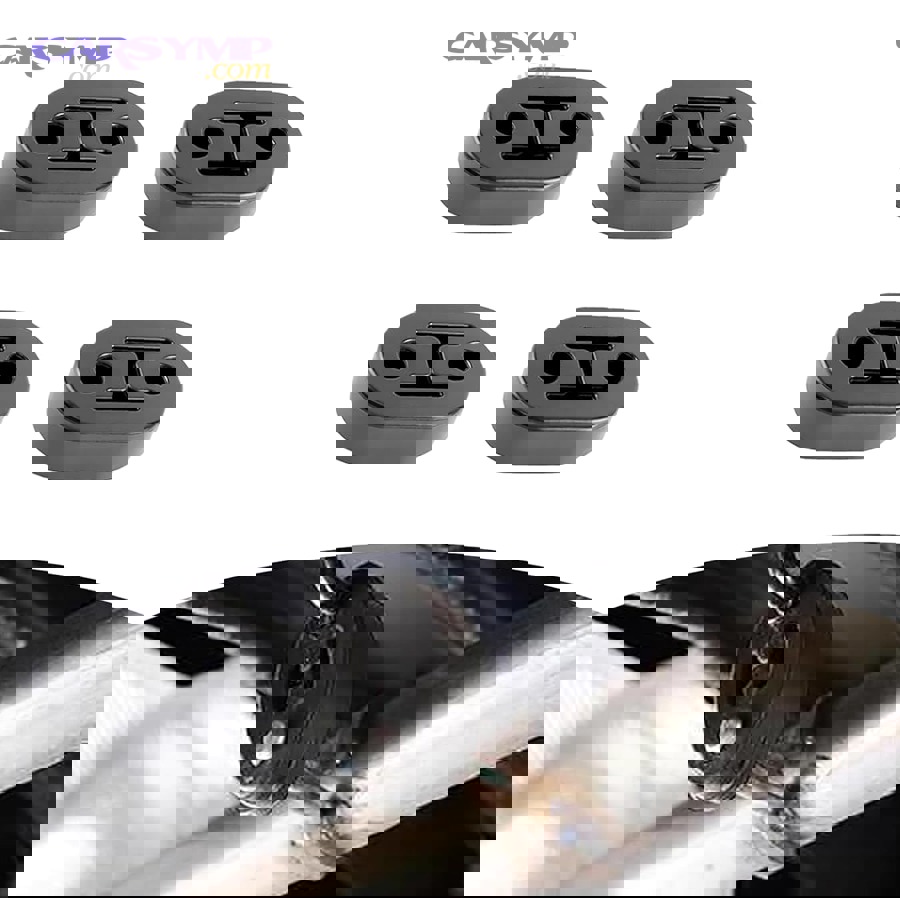
Is your exhaust rattling, clunking, or tapping over bumps? (Yes/No)
A “Yes” strongly points to a hanger/mount issue when the noise is impact-like (tap, clunk, knock) and appears over bumps, driveway angles, or quick throttle changes, because the exhaust is swinging and contacting nearby metal.
To connect that to a real check, match the sound to these patterns:
- Rattle over bumps at low speed: often the muffler or mid-pipe is bouncing into a brace, heat shield, or spare-tire well.
- Clunk on acceleration or when shifting into gear: often a mount is torn and the exhaust rotates, then snaps back.
- Tapping that changes with road vibration but not with engine RPM: often a loose system component moving on its hangers.
If the noise is constant and follows RPM like a “tick,” you may be hearing a leak or another issue, which you’ll sort out later in the comparison section.
Is the exhaust sagging, hanging lower than normal, or visibly off-center? (Yes/No)
A “Yes” is one of the most reliable signs you need replacement because hangers and mounts exist to hold the exhaust at a fixed height and centered path under the vehicle.
Use a simple visual baseline:
- Stand behind the car and look at the tailpipe: it should sit roughly centered in the cutout and not tilt sharply downward.
- Look under the car (safely, on level ground): the muffler body should appear supported, not drooping or skewed.
- If your car has twin outlets, compare left vs right—a big difference often means a failed isolator on one side.
When sagging is present, it can increase stress on joints and sometimes makes a future repair (including muffler replacement) more expensive because hardware seizes and pipes deform.
Is there metal-to-metal contact (pipe/muffler hitting the body, subframe, or axle)? (Yes/No)
A “Yes” means your replacement need is urgent because contact can damage both the exhaust and the car, and it can also create new leaks as joints get forced out of alignment.
Look for evidence of contact:
- shiny scuff marks on pipe or body
- dents on thin shields
- a “polished” spot where rust has been rubbed away
- a sound that appears exactly when the suspension compresses
Even if you can’t see it, consistent clunking over bumps is often the audible clue.
Is a hanger/mount missing, torn through, or separated? (Yes/No)
A “Yes” is a direct confirmation: a separated rubber isolator can’t isolate or support, so the exhaust will hang on the remaining points and move too far.
Common failure modes include:
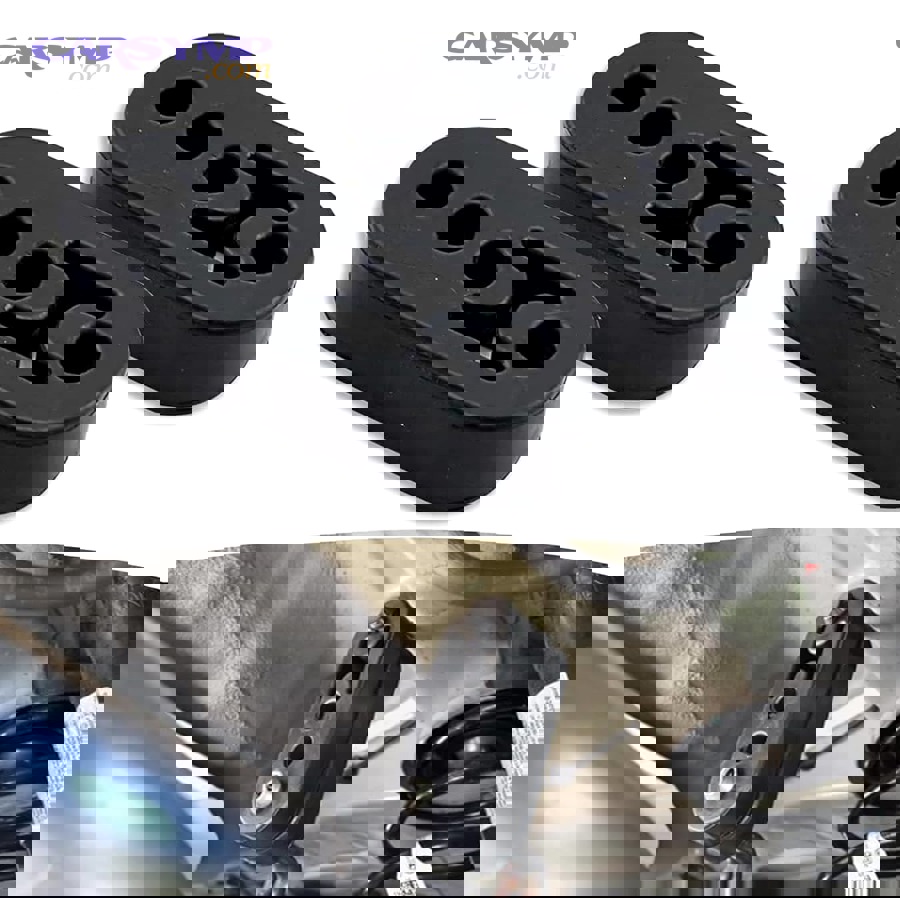
- Torn rubber donut (ring splits)
- Stretched holes (the hanger rod pulls through)
- Cracked rubber block (splits along molded lines)
- Broken bracket or hanger rod (metal failure, often with rust)
If the mount is missing entirely, drivers sometimes “temporarily” secure the exhaust with wire—this can prevent dragging, but it’s not a proper fix and can worsen vibration.
Evidence: According to a CarParts.com explainer published in 2024, exhaust hangers secure the exhaust pipe to the undercarriage to prevent it from hanging loose and getting dislocated. (carparts.com)
What are exhaust hangers and mounts (rubber isolators), and what do they do?
Exhaust hangers and mounts are support-and-isolation components that suspend the exhaust system from the vehicle body, using rubber isolators to control movement while damping vibration and noise, so the pipe and muffler can flex with the drivetrain and suspension without hitting the car.
Next, the easiest way to “get it” is to separate names from functions.
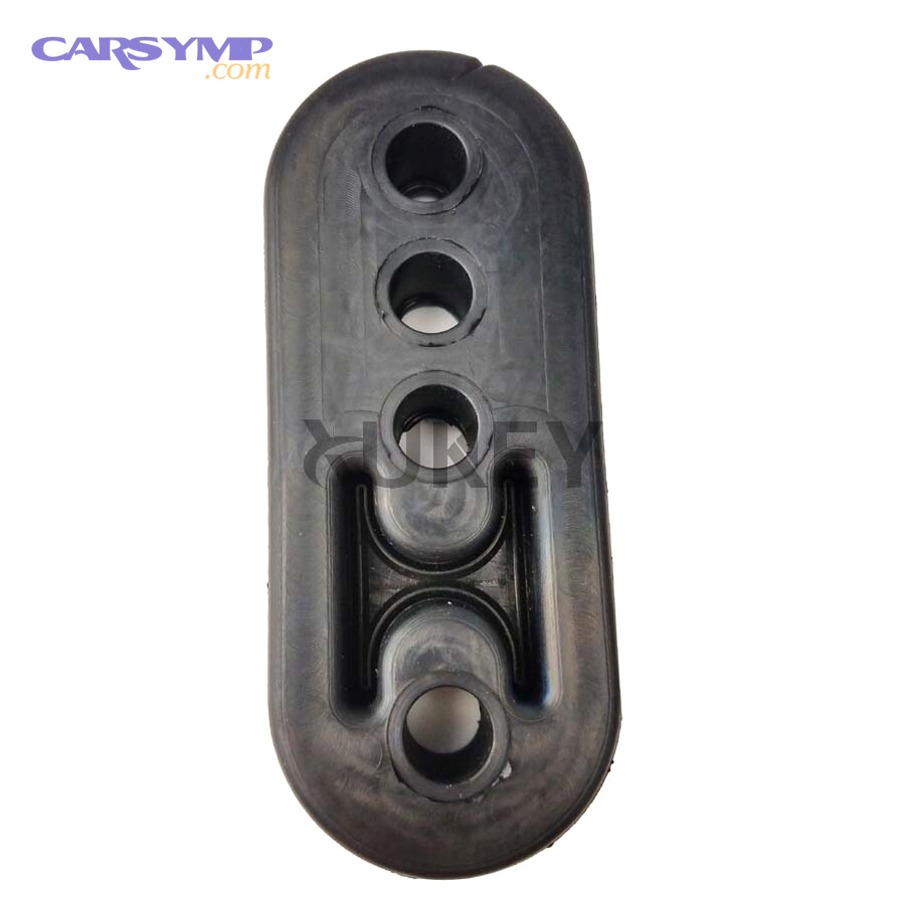
What’s the difference between a hanger, a mount, and a rubber isolator?
Think of the exhaust mounting system as a small chain of parts:
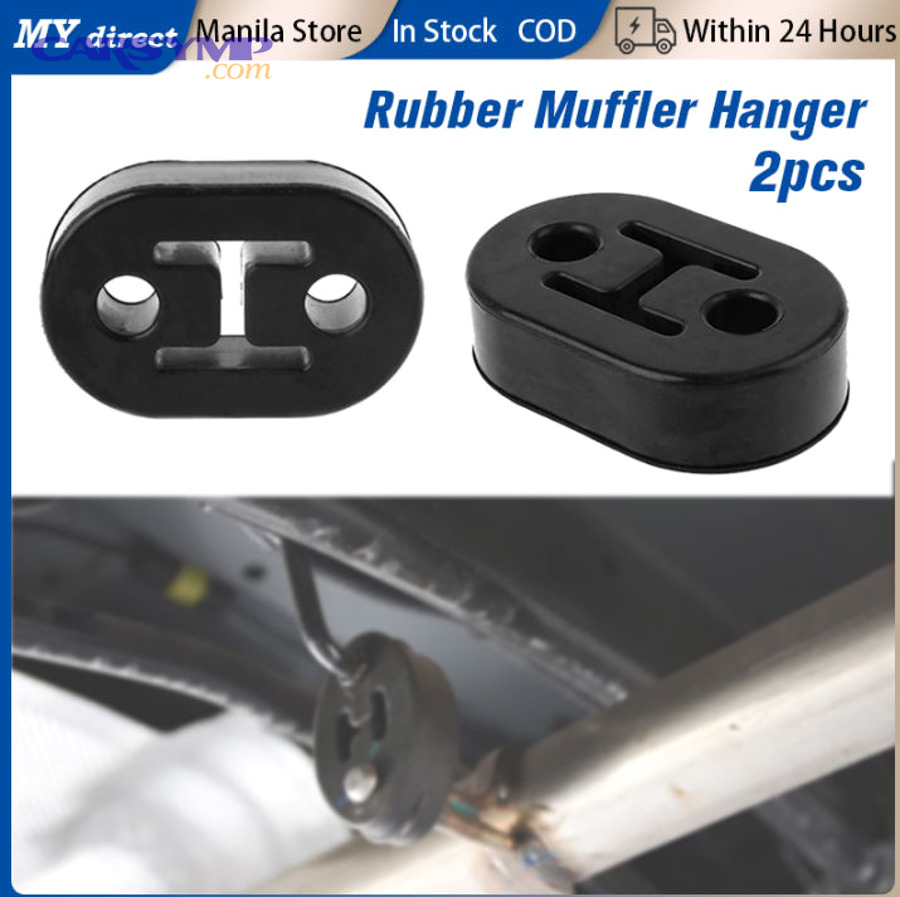
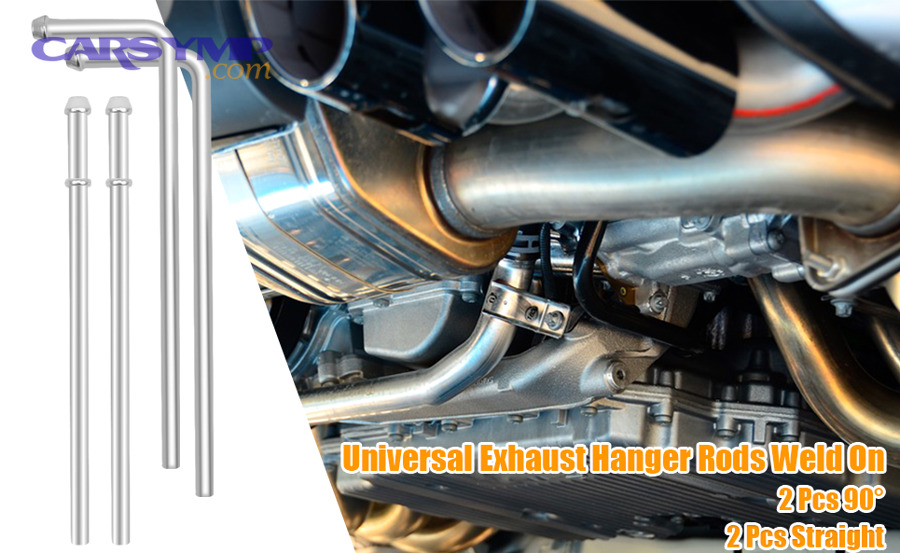
- Hanger rod (metal): a hook or rod welded to the exhaust pipe or muffler.
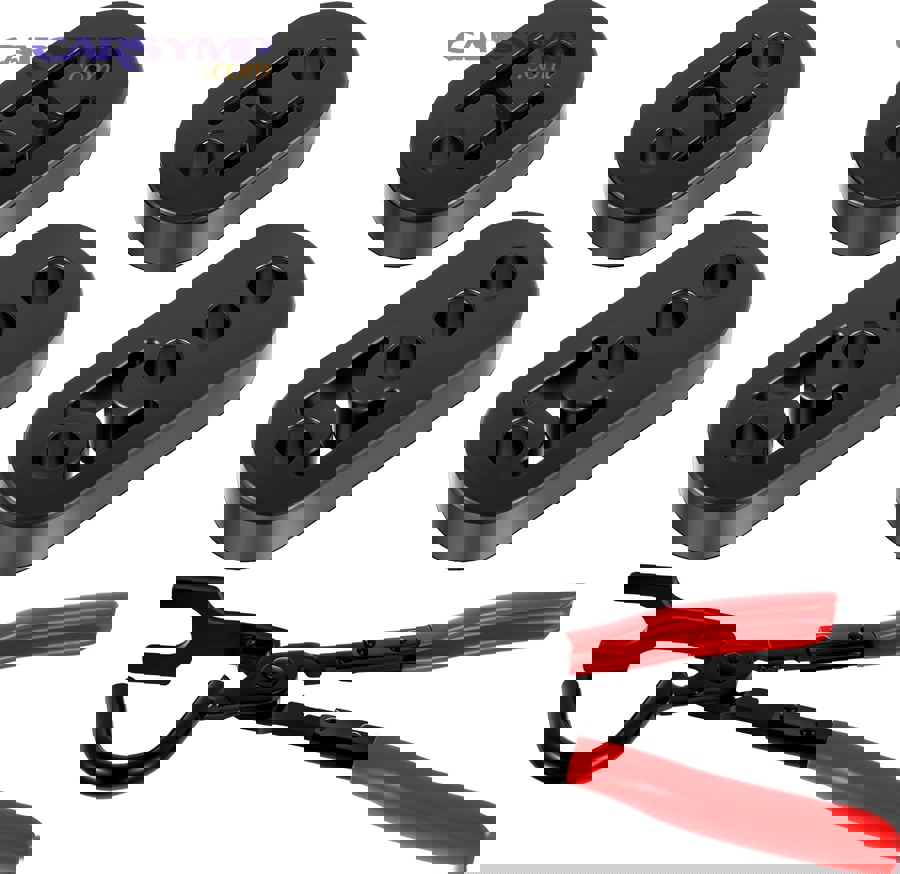
- Rubber isolator (rubber): the flexible piece with holes or loops that the rod passes through.
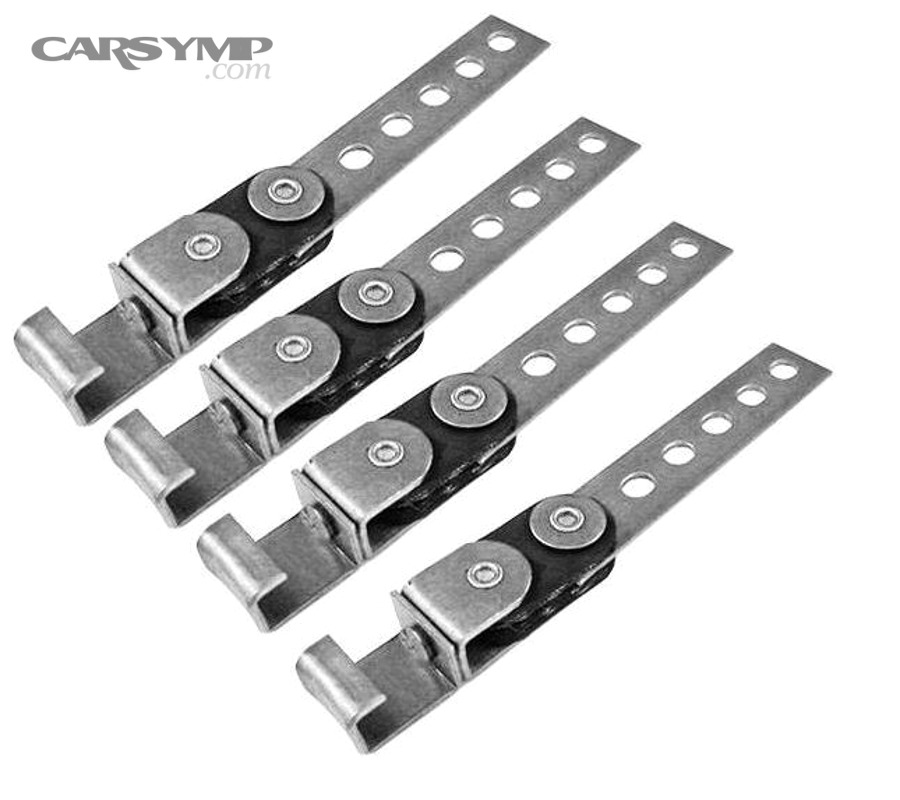
- Body bracket (metal): the anchor bolted or welded to the car’s underbody.
- Mount/hanger assembly (system): the complete support point that includes the above parts.
In everyday language, people call the rubber piece an “exhaust hanger,” but technically the hanger is often the metal rod, and the rubber isolator is the vibration-damping element. That meronymy matters because sometimes the rubber is fine but the bracket is rusted, or the rod breaks at a weld.
Where are exhaust hangers and mounts located on most cars?
Most cars use multiple support points, typically:
- Near the catalytic converter / mid-pipe area: supports the long run and prevents resonance movement.
- Near the resonator (if equipped): stabilizes the mid-section.
- At the muffler: usually at least one mount point, often two, to keep the muffler level.
- Near the tailpipe: keeps the outlet aligned to the bumper cutout.
The exact layout varies, but the logic stays the same: long, heavy sections (like the muffler) need more support so the exhaust doesn’t swing.
Why do rubber isolators prevent vibration and noise (NVH)?
Rubber isolators work because rubber is elastic and naturally damped: it allows controlled motion but absorbs energy that would otherwise become cabin vibration or rattling.
This is why hangers are more than “just support.” If you replace a soft isolator with a much stiffer one, you might reduce sagging but increase transmitted vibration or drone—especially on certain aftermarket exhaust setups.
Which symptoms strongly indicate hanger/mount replacement vs another exhaust problem?
Hanger/mount failure is the best match when the main symptom is movement—swaying, sagging, and impact noise—while leaks are best indicated by exhaust smell or ticking, and heat shields are best indicated by thin “tinny” rattle that changes with RPM.
However, you don’t need perfect diagnosis to take the right first step; you need a smart split that prevents wasted repairs.
Hanger/mount failure vs heat shield rattle: how can you tell?
Hanger/mount noise usually sounds like a heavier knock and appears with body motion (bumps, driveway transitions, engine torque).
Heat shield rattle often sounds tinny or buzzy, and it can appear when you rev the engine in park/neutral because the shield vibrates at certain frequencies.
Quick separation test:
- With the engine off and cool enough to touch safely, gently shake the tailpipe.
- If the whole exhaust swings excessively or contacts something solid, suspect hangers/mounts.
- If the exhaust feels supported but you hear a light rattle near a thin metal panel, suspect heat shield.
Hanger/mount failure vs exhaust leak: what signs are different?
A leak typically shows gas escaping where it shouldn’t, so the signs often include:
- ticking/puttering sound (often worse on cold start)
- exhaust smell (especially under the car)
- soot marks near a joint, flange, or crack
- change in exhaust note that feels “sharper” than normal
A hanger problem, by contrast, is a support and alignment problem. It can lead to leaks by stressing joints, but the first symptom is usually movement and impact noise.
This is where “Rusted muffler inspection and leak checks” fits naturally: if you see corrosion on a muffler seam or around a clamp, you can check for soot traces and listen for ticking while also checking whether a failing hanger is pulling the pipe out of alignment.
Hanger/mount failure vs loose clamp/bracket: what should you check first?
A loose clamp or bracket can mimic a hanger issue because it creates movement at a joint.
Check in this order:
- Rubber isolator condition: torn/stretched? That’s a replacement need.
- Hanger rods and brackets: bent, broken weld, missing bolt? That’s a mount repair.
- Clamps/flanges: visibly loose, rotated, or leaking? That’s a connection repair.
If you skip this order, you might do a muffler replacement when a clamp was the real issue—or you might tighten a clamp when a torn isolator is still letting the exhaust swing.
Evidence: A YourMechanic symptom guide notes that common signs of failing exhaust hangers/supports include the exhaust hanging low, the system seeming loose or swaying, and louder-than-usual exhaust noise. (yourmechanic.com)
What inspection steps confirm your exhaust hangers/mounts are worn out?
You can confirm worn-out hangers and mounts by (1) inspecting rubber for cracks/tears/stretching, (2) checking for excessive exhaust swing during a controlled shake test, and (3) verifying clearance so the exhaust doesn’t contact the body or suspension through its range of motion.
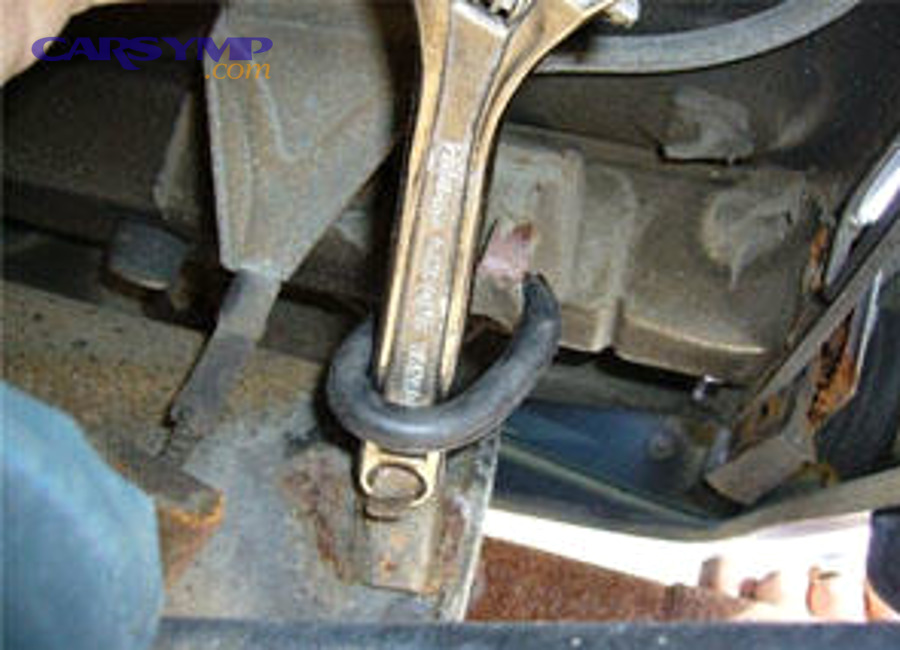
Next, treat this as a “three-proof” approach: if you collect all three proofs, your diagnosis becomes very strong.
What does a worn rubber isolator look like (cracks, stretching, tearing)?
A worn rubber isolator usually shows at least one of these:
- surface cracking (small cracks around edges/holes)
- splitting (a crack that opens into a tear)
- elongated holes (the hanger rod ovalizes the hole)
- rubber thinning (the rubber looks “necked down”)
- glazing/hardening (rubber looks shiny and feels stiff)
A key rule: a little surface weathering is normal; deformation that changes the hole shape or creates separation is not. If the rod is close to pulling through, replacement is the right move even if the exhaust hasn’t dropped yet.
How much exhaust movement is normal in a shake test?
Some movement is normal because the system is designed to flex. What you’re looking for is excessive travel or contact.
Use this method:
- Engine off; exhaust not dangerously hot.
- Grab the tailpipe or muffler edge and move it gently side-to-side and up-and-down.
- Normal: the exhaust moves but stays “centered,” and rubber returns it without clunking.
- Not normal: the exhaust swings far enough to hit something, or one support point “gives way” and doesn’t spring back.
If you hear a sharp clunk during the shake test, you’ve often reproduced the road noise in a controlled way—which is a strong confirmation.
What clearance and alignment checks reveal a stressed mounting system?
Clearance checks matter because an exhaust that barely clears the body when cold may contact when hot, or during suspension compression.
Look for:
- tailpipe centered in bumper cutout
- muffler level (not rotated)
- consistent gaps around the pipe where it passes near braces
- no signs of contact near the rear axle, sway bar, or body shields
If you have an aftermarket exhaust, small fitment changes can “preload” the mounts—meaning the rubber is being pulled sideways at rest—which shortens life and increases the chance of rattles.
What causes exhaust hangers and mounts to fail?
Exhaust hangers and mounts fail mainly due to (1) rubber aging from heat/ozone and repeated motion, (2) corrosion that weakens brackets and hanger rods, and (3) impacts or misalignment that overloads the support points.
Next, when you understand the cause, you also learn how to prevent the problem from coming right back.
How do heat cycles and age degrade rubber isolators?
Rubber isolators live in a harsh environment:
- heat cycling from the exhaust
- exposure to road grime, oil mist, and water
- ozone and oxygen that slowly attack rubber chemistry
- constant small motion that accumulates into fatigue
Over time, rubber loses elasticity, hardens, and cracks—especially around holes where stress concentrates. That’s why a mount can look “mostly fine” but still allow too much movement: the rubber is no longer doing its damping job.
Evidence: According to a university research poster from the University of the Bundeswehr Munich, ozone loading on strained natural rubber can lead to fast surface cracking at real-world ground-level concentrations measured in summer afternoons “after a few hours.” (unibw.de)
How do rust and corrosion damage brackets, hanger rods, and mounts?
Rust shifts the failure mode from rubber to metal:
- hanger rods thin and break near welds
- brackets lose strength or deform
- fasteners seize, turning a simple replacement into a cut-and-weld job
This is why “Preventing exhaust rust and corrosion” is a practical mindset even if you’re only replacing hangers: keeping brackets intact keeps future fixes cheap and quick.
If you live in a road-salt region, corrosion is also why “Rusted muffler inspection and leak checks” should be part of routine undercar checks—rust can attack muffler seams, flanges, and hanger welds at the same time.
How can impacts or aftermarket exhaust changes create premature hanger stress?
Impacts and misalignment overload mounts in a way rubber can’t tolerate for long:
- bottoming out on steep driveways or speed bumps
- off-road hits that bend rods or brackets
- aftermarket systems that sit slightly off-center, pulling the rubber sideways at rest
This is also where “Muffler vs resonator vs catalytic converter roles” becomes relevant: each component adds weight and changes how the exhaust vibrates. If an aftermarket muffler is heavier (or sits differently), the mounts may need adjustment or reinforcement to maintain clearance and reduce stress.
How urgent is exhaust hanger/mount replacement, and what happens if you wait?
Replacement urgency is high when there’s contact, sagging, or a torn isolator, moderate when there’s mild rattle without misalignment, and low when there’s only superficial rubber aging—because delaying can turn a cheap mount fix into joint damage, leaks, or a dragging exhaust.
Next, think in risk tiers rather than “fine vs not fine.”
When is it safe to drive short-term vs when should you fix it immediately?
Fix it immediately (high urgency) when you have any of these:
- exhaust dragging or nearly dragging
- metal-to-metal contact over bumps
- visible separation or missing mount
- exhaust close to fuel/brake lines or sensor wiring
Short-term driving may be reasonable (moderate urgency) if:
- mild rattle only, no sagging
- rubber shows cracking but no tearing/stretching
- exhaust stays centered with no contact during a shake test
Even in the moderate tier, plan the repair soon—because the “next bump” can be the moment a weakened isolator tears through.
Can bad hangers cause exhaust leaks or damage other components? (Yes/No)
Yes—bad hangers can cause leaks or damage because they let the exhaust move excessively, which loads joints and flanges, creates contact dents, and can stress flex sections and sensor wiring.
More specifically, when one mount fails, the remaining mounts take extra load. That uneven load twists the exhaust and can open tiny gaps at clamps or flanges. Over time, those gaps can become audible leaks. The same movement can also crack thin heat shields or push the muffler into the body.
This is a common “double repair” scenario: someone hears a loud sound and assumes muffler replacement is needed, but the real chain is failed hanger → stressed joint → leak → louder exhaust.
What replacement options make sense for car owners? (DIY vs shop, OEM vs universal)
The best replacement option depends on what failed: replace rubber isolators when rubber is torn or stretched, repair/replace brackets when metal is compromised, and choose DIY only when hardware is accessible and not severely rusted—otherwise a shop saves time and avoids broken fasteners.
Next, use the decision points below to avoid spending money twice.
Should you replace just one isolator or all hangers/mounts at once?
Replacing one makes sense when:
- the failure is isolated (one torn piece, others still elastic)
- the car is newer or mounts were recently serviced
- the remaining mounts show no stretching and hold alignment
Replacing multiple makes sense when:
- rubber is age-matched and similarly cracked/hardened
- the exhaust has been sagging for a while
- you want to reset alignment and reduce future rattles
A practical strategy is to replace the obviously failed isolator, then inspect adjacent mounts in the same session. If two mounts show similar aging, replacing both often restores alignment and damping more effectively.
OEM-style vs universal rubber isolators: which is better for fit and longevity?
OEM-style typically wins for:
- correct hole spacing and thickness
- predictable alignment and clearance
- reduced chance of unintended tension (“preload”) on the exhaust
Universal can be fine when:
- you need a quick fix and the sizing matches closely
- you’re working with an aftermarket exhaust where custom spacing is common
- the original design is no longer available
Longevity depends heavily on fit and stress, not just material. A perfectly fitted universal isolator may outlast a poorly fitted “OEM-style” substitute if the substitute pulls the exhaust sideways.
DIY replacement vs professional repair: what’s realistic for most people?
DIY is realistic when:
- you can access the mount points safely
- fasteners are not heavily rusted
- the job is rubber-only (no welding, no broken brackets)
A shop is often better when:
- bracket welds are cracked or rusted through
- bolts are seized and likely to snap
- you need alignment work to prevent contact
If you’re already dealing with heavy rust, it’s smart to combine the repair with a broader check (including rusted muffler inspection and leak checks) so you don’t fix one point and miss a leak at a corroded seam.
What else should you replace or upgrade with exhaust hangers/mounts to prevent repeat rattles?
To prevent repeat rattles, replace or service the related mounting hardware that shares the load—brackets, hanger rods, clamps, and worn fasteners—then choose isolator stiffness that balances support and noise control for your setup.
Next, treat this as “system maintenance,” not just a single part swap.
Which related mounting parts commonly fail too (brackets, hanger rods, clamps, straps)?
When hangers fail, these parts often deserve attention:
- brackets that are bent or rust-thinned
- hanger rods with cracks near welds
- clamps that have rotated or loosened after movement
- straps or supports (on some vehicles) that stretch or corrode
- fasteners that are heavily corroded and won’t torque properly
This is also why exhaust issues can cascade: one weak link creates motion, motion loosens clamps, and loosened clamps create leaks.
Do stiffer polyurethane isolators reduce sagging—or increase vibration and cabin noise?
Stiffer isolators can reduce sagging and motion, but they can also increase vibration transmission, which may worsen cabin buzz or drone depending on the vehicle and exhaust configuration.
If your priority is comfort and quiet, rubber-like damping usually stays the safer choice. If your priority is controlling movement on a heavy or modified exhaust, you may accept higher stiffness—especially if you’re already running a louder setup and thinking about Aftermarket muffler sound level legality in your area.
When does a broken hanger bracket require welding or fabrication instead of a simple swap?
You’re usually in weld/fabrication territory when:
- the bracket is rusted through
- the hanger rod is broken at the weld
- the mounting point on the body is compromised
- repeated failures suggest the geometry is wrong and needs repositioning
In those cases, a “simple rubber replacement” won’t hold because the supporting structure is compromised.
How can exhaust alignment and thermal expansion affect new hanger life?
Exhaust systems expand when hot. If the exhaust is already misaligned cold, heat expansion can push it into contact points or preload a mount, accelerating wear.
A simple habit helps: after replacement, verify clearance at rest, then re-check after a short drive (once cooled enough to inspect safely). If contact marks appear quickly, the alignment—not the isolator—may be the real issue.
Evidence: According to a Master’s thesis from Chalmers University of Technology (Department of Mechanics and Maritime Sciences, 2018) on rubber in engine mounts, automotive rubber mount “fatigue failure” is often defined as a functional stiffness loss of about 20%, which illustrates how mounts can be “not broken” yet no longer perform properly. (odr.chalmers.se)