


Oil consumption from a bad PCV system is real—and in many cases it’s one of the fastest, cheapest engine “oil loss” problems you can confirm or rule out at home. The practical goal is simple: prove whether the PCV path is pulling oil mist into the intake (or building crankcase pressure that pushes oil out), then correct the cause before you assume worn rings or valve seals.
Next, it helps to understand why crankcase ventilation can burn oil at all: the PCV system is designed to route blow-by vapors back into the engine to be burned, but if the valve, hoses, or oil separation/baffling isn’t working correctly, it can route liquid oil—not just vapor—into the intake stream.
Then, the most reliable approach is a structured troubleshooting workflow (symptoms → quick checks → confirm tests → repair options) that distinguishes “stuck open” from “stuck closed,” because those failure modes create different patterns of oil use, idle behavior, and leaks.
Introduce a new idea: once you’ve fixed the PCV system (or ruled it out), you can use oil tracking and a few targeted tests—like Compression and leak-down test basics—to decide whether the engine has a deeper mechanical oil-burning issue.
Can a bad PCV system really cause oil consumption? (Yes/No)
Yes—a bad PCV system can cause oil consumption because it can (1) pull oil mist or liquid oil into the intake under vacuum, (2) create abnormal crankcase pressure that pushes oil past seals and gaskets, and (3) disrupt airflow/fuel trim so the engine runs in conditions that worsen oil carryover.
To better understand why this happens, start with the idea that “oil consumption” is not one single failure; it’s a pathway problem—oil either leaks out, gets pulled into airflow, or gets burned inside cylinders.
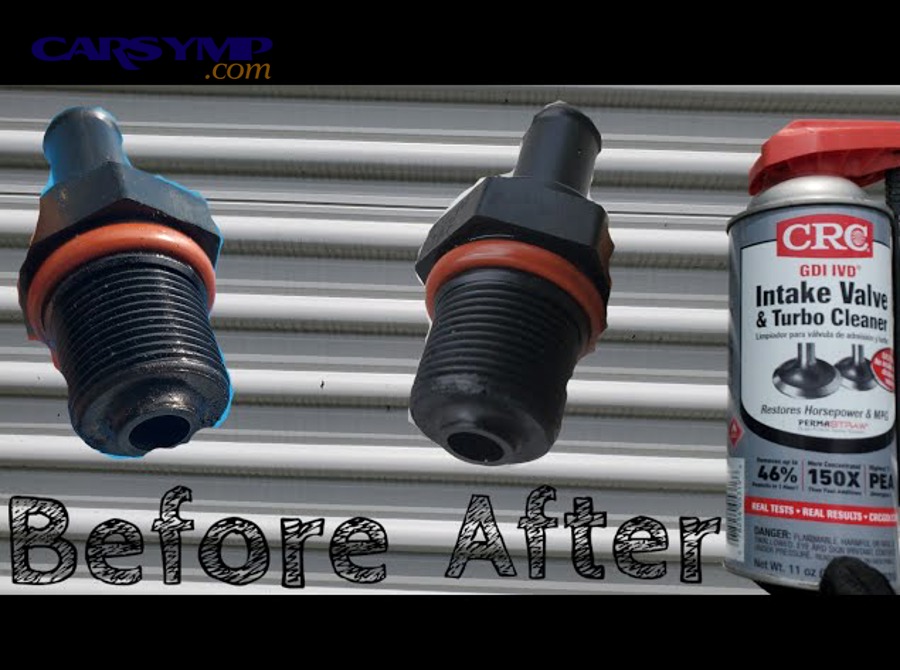
The PCV (positive crankcase ventilation) system is the engine’s controlled “breathing” circuit. Combustion gases that slip past piston rings (blow-by) pressurize the crankcase and carry fuel vapor and oil vapor with them. The PCV valve meters those vapors into the intake so they can be burned instead of vented to the atmosphere. That sounds harmless—until the system stops metering correctly or stops separating oil from vapor.
Here’s the core logic for DIY oil consumption diagnosis: if oil is present where only vapor should be, the PCV path is a top suspect. Oil in the intake tube, oily throttle body, oil pooled in intercooler pipes (turbo engines), and oil-wet PCV hoses are not “proof” by themselves, but they’re strong directional clues.
Also, PCV-related oil use often comes with behavioral symptoms you can feel or measure:
- A “vacuum leak” idle (rough, hunting, lean codes) when the PCV is stuck open or a diaphragm has failed.
- Oil leaks that appear “suddenly” around seals, valve cover, or dipstick tube when the system is restricted and crankcase pressure rises.
- Oil consumption that changes noticeably with driving pattern (more at idle/cruise vs more under boost/load), which is a hallmark of ventilation-driven carryover rather than purely mechanical ring wear.
What symptoms suggest the PCV system is pulling oil into the intake?
There are 2 main groups of symptoms that suggest PCV oil carryover: (A) intake-path oil evidence and (B) engine-behavior clues, based on where the oil shows up and how the engine responds to abnormal crankcase vacuum/pressure.
More specifically, separating symptoms into “what you can see” and “what you can feel” prevents a common mistake: chasing smoke without checking the intake tract first.
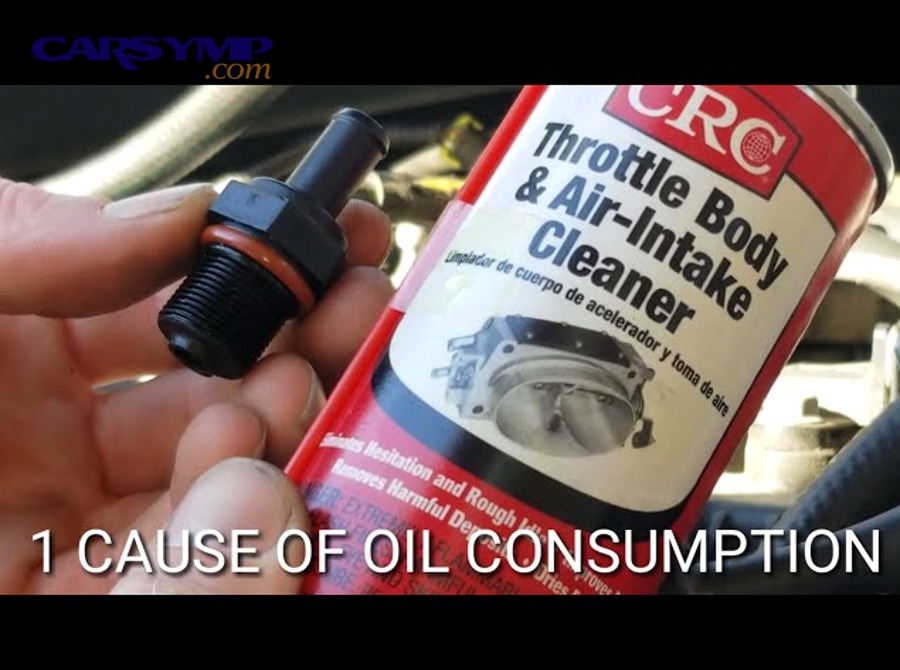
What visual signs should you look for in the intake tube, throttle body, and manifold?
Start with the simplest inspection: follow the airflow from the airbox to the throttle body, then locate where the PCV hose ties into the intake (and where the fresh-air/breather hose connects).
Look for these high-signal visual signs:
- Oil-wet PCV hose interior: If you remove the PCV hose and it’s dripping or pooling oil (not just stained), oil is being transported, not merely vaporized.
- Oily throttle body bore or plate: A light film can be normal on high-mileage engines, but heavy wetness or repeated pooling soon after cleaning points to excessive carryover.
- Oil inside the intake tube near the breather connection: When crankcase vapors enter upstream of the throttle, the intake tube often shows localized oil residue.
- Oil in intake manifold runners: This is harder to see without disassembly, but if you find oil puddling beyond the throttle body, treat it as a strong indicator.
- Turbo engines: check charge pipes and intercooler connections. A light oily haze can be normal over time, but measurable oil accumulation or dripping at couplers suggests abnormal carryover.
A practical way to grade what you find is:
- Normal-ish: thin tacky film, light staining, no pooling.
- Concerning: wet shine, oil droplets, oil collecting at low points.
- High concern: pooled oil, oil dripping from couplers/hoses, repeated fast buildup after cleaning.
This is also where Blue smoke patterns and what they indicate becomes useful. PCV carryover often creates smoke during idle-to-acceleration transitions (when vacuum is high then load changes), whereas worn rings often smoke more under sustained load.
What driveability clues show a PCV vacuum leak or pressure problem?
Driveability clues matter because PCV failures are often airflow problems as much as oil problems. The PCV valve (or integrated diaphragm) is designed to meter airflow; if it sticks open, it can behave like a vacuum leak.
Common “PCV vacuum leak” clues include:
- Rough or surging idle
- Whistling/hooting noises near the valve cover or PCV housing
- Lean fuel trim codes (depending on vehicle)
- Misfires at idle that improve off-idle
- Oil cap behavior that feels “too much suction” (more on safe testing later)
Common “PCV restriction/pressure” clues include:
- New oil leaks around seals/gaskets
- Dipstick pushed up or oil mist around dipstick tube
- Excessive oil smell in the engine bay
- Sludge or moisture buildup in the breather path (especially short-trip driving)
The key is not to treat any single symptom as a verdict. Use them to decide which direction to test next: vacuum-leak direction (stuck open) or pressure-build direction (stuck closed/restricted).
Is the PCV valve stuck open or stuck closed—and why does that matter?
A PCV valve stuck open wins in creating vacuum-driven oil pull and lean/rough idle issues, while a PCV valve stuck closed (or restricted system) is best known for crankcase pressure buildup that triggers leaks, oil mist, and sometimes oil pushed out of weak seals.
However, both failure modes can increase oil use—the difference is the pathway: suction into intake vs pressure out of the engine (and sometimes into the breather).
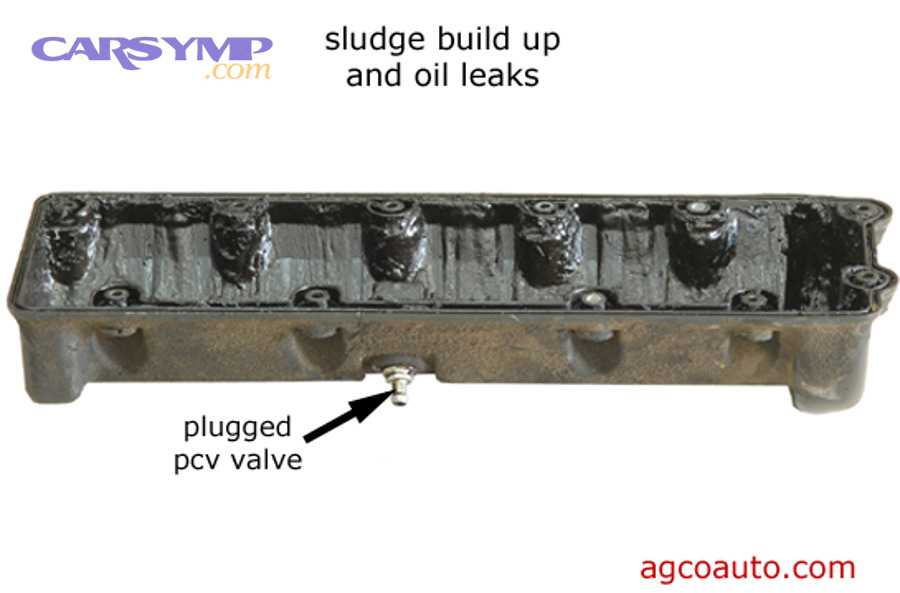
What happens when the PCV valve is stuck open?
When the PCV valve is stuck open, intake manifold vacuum can pull too much crankcase flow all the time. That does two important things:
- It increases oil carryover risk. Higher flow velocity through the valve cover baffles and separator passages can entrain more oil mist. If the separation system is marginal (common on some engines), oil mist becomes oil consumption.
- It creates an unmetered-air problem. Extra air entering through the PCV path can act like a vacuum leak, especially at idle. That’s why you’ll often see idle instability and sometimes lean trim behavior.
- It changes where oil shows up. You may see oil in the PCV hose, oil residue in the intake tube, and oily deposits around the throttle body.
In real-world oil consumption diagnosis, “stuck open” is often suspected when oil use is noticeable at idle/cruise and the engine also feels slightly “off” at idle.
What happens when the PCV valve is stuck closed or restricted?
A stuck-closed PCV valve—or a clogged breather/hoses/oil separator—prevents the crankcase from venting normally. That means blow-by gases have to go somewhere, and pressure builds.
This failure mode usually produces:
- External leaks: pressure pushes oil past seals/gaskets (valve cover, rear main, cam seals).
- Breather backflow: the fresh-air side may become the escape route, and if that side lacks baffling, it can carry more oil into the intake tube upstream.
- Oil mist everywhere: more vapor and mist escaping can coat intake plumbing and engine bay areas.
It can also amplify Blue smoke patterns and what they indicate in a different way: you may see smoke more during load changes or after long deceleration because pressure dynamics and oil control change rapidly.
The “why it matters” is simple: the same fix doesn’t fit both. A stuck-open condition is solved by restoring metering (valve/diaphragm integrity, correct hose routing). A restricted condition is solved by restoring flow capacity (clean/replace clogged lines, restore breather path, repair baffles/separators).
How do you diagnose PCV-related oil consumption step-by-step at home?
Diagnosing PCV-related oil consumption at home works best as a 6-step workflow—(1) baseline oil level, (2) intake-path inspection, (3) crankcase vacuum/pressure check, (4) PCV valve/diaphragm test, (5) hose and breather verification, and (6) confirmation drive—so you can identify the oil pathway instead of guessing.
Next, follow the steps in order, because skipping straight to part replacement is how DIY fixes become expensive experiments.
Does your engine show abnormal crankcase vacuum/pressure at idle? (Yes/No test)
Yes/No tests are useful here, but use them safely and interpret them conservatively.
Test 1: Oil cap “feel” check (gentle, quick).
- With the engine idling, loosen the oil cap.
- Normal: a slight change in idle or a mild suction feel can be normal on many engines.
- Concerning (too much vacuum): cap is difficult to lift, engine stumbles hard, or you hear strong whistling—this can suggest a stuck-open PCV or torn diaphragm on an integrated PCV system.
- Concerning (pressure): cap hovers, pushes upward, or you feel puffing—this suggests restriction/pressure buildup.
Test 2: Glove/balloon test (basic indicator, not a final verdict).
- Stretch a nitrile glove or balloon over the oil filler opening (cap removed).
- Normal tendency: slight inward pull or minimal movement (varies by engine design).
- Pressure sign: glove inflates outward steadily.
Be cautious: some engines are designed to run with measurable crankcase vacuum, and some designs behave differently due to their separator layout. Use this as a directional signal—then confirm with inspections and part tests.
How do you inspect and test the PCV valve, hoses, and fresh-air side correctly?
Treat this like a plumbing inspection: you’re verifying that flow is controlled, one-way where it should be, and not blocked where it shouldn’t be.
PCV valve (traditional, removable valve):
- Remove the valve and inspect the tip and passages for sludge.
- The “shake test” (listening for a rattle) is only a rough indicator; some good valves don’t rattle and some bad valves do.
- Check that the valve isn’t stuck with varnish and that the spring/plunger movement isn’t seized.
Hoses and grommets:
- Look for collapsed hoses, soft hoses that kink under vacuum, and cracks near connectors.
- Replace brittle grommets—vacuum leaks at the grommet can mimic a bad valve.
- Confirm routing: misrouted hoses can pull oil from the wrong place or bypass separation.
Fresh-air/breather side:
- Ensure the breather hose and any breather filter path is open.
- A blocked fresh-air side can force the system to pull air from seals and gaskets, increasing leaks and oil contamination.
- If the breather is connected to the intake tube, inspect that connection area for oil residue patterns.
A quick rule: if you find oil only at the PCV line and not elsewhere, suspect suction-driven carryover. If you find oil mist broadly and new leaks, suspect restriction/pressure.
What should you check if the PCV is integrated into the valve cover (diaphragm style)?
Integrated PCV systems (common on many modern engines) replace a simple valve with a molded housing and a rubber diaphragm that regulates flow. When the diaphragm tears, the system can behave like a massive vacuum leak and a direct oil pull.
Check for:
- Whistling noises from the valve cover area
- Sudden rough idle and lean running
- Oil in the vacuum port or oil wetness around the PCV housing
- Hard oil cap removal due to excessive crankcase vacuum
If the diaphragm is not serviceable separately, replacement may mean a full valve cover assembly. If it is serviceable, use the correct kit for your engine code—generic parts often fail quickly or meter incorrectly.
When is “oil in intake” normal residue vs a sign of a failing separator/baffle?
This is where many DIYers get stuck because “some oil film” can be normal, especially over long mileage.
Use these differentiators:
- Time-to-return after cleaning: If you clean the intake tube/throttle body and heavy wetness returns quickly (hundreds of miles, not thousands), that’s abnormal.
- Pooling vs film: pooled oil is rarely normal.
- Consistency across conditions: if oil appears after sustained highway vacuum cruising, suspect suction-driven carryover; if it appears after high load/boost (turbo), suspect separator limitation or routing issues.
- Oil level behavior: meaningful oil level drop that tracks with intake oil presence is the strongest practical correlation for oil consumption diagnosis.
If you need to escalate beyond PCV checks, this is the moment to plan Compression and leak-down test basics rather than guessing at rings or seals.
What fixes reduce oil consumption caused by the PCV system?
There are 3 main fix tiers for PCV-caused oil consumption—Tier 1: restore correct metering, Tier 2: restore correct flow capacity, and Tier 3: improve oil separation—based on whether your root problem is suction, restriction, or separation efficiency.
Besides saving money, thinking in tiers prevents the common mistake of adding a catch can to mask a broken PCV valve.
Which parts typically need replacement first (PCV valve, hoses, grommets, breather)?
Tier 1 (metering repairs):
- Replace the PCV valve with the correct spec part (OEM-equivalent flow characteristics matter).
- Replace a torn diaphragm or the valve cover assembly if required.
- Replace PCV grommets that leak vacuum and harden with heat.
Tier 2 (flow capacity repairs):
- Replace collapsed, restricted, or sludge-filled hoses.
- Clean or replace clogged breather passages where accessible.
- Verify the fresh-air side is not blocked (a surprisingly common cause of pressure behavior).
Tier 3 (oil separation improvements):
- Repair missing/damaged baffles if the design allows (some engines have serviceable baffle components; many do not).
- Replace an oil separator module if your engine uses one (cyclone separator, labyrinth separator, etc.).
A practical tip: if you discover the wrong “universal” PCV valve was installed, correct that first. A mismatched valve can create both oil pull and driveability problems even if nothing else is broken.
How do you clean oil-contaminated intake components safely after a PCV fix?
Cleaning matters because leftover oil can make it look like your repair “did nothing” for weeks.
Do it in a safe sequence:
- Intake tube and PCV hoses: remove and wipe/flush with a safe cleaner; let them fully dry.
- Throttle body (if needed): use throttle-body safe cleaner; avoid soaking sensors or electrical connectors.
- MAF sensor caution: do not use general solvents; use MAF-specific cleaner only if contamination is suspected.
- Turbo charge pipes/intercooler (turbo engines): if you have pooled oil, remove the lowest sections and drain. Large amounts of oil can reduce intercooler efficiency and, in extreme cases, increase risk of abnormal combustion.
After cleaning, reset your expectations: the goal is that new oil accumulation slows dramatically after the PCV fix, not that the intake becomes permanently spotless.
Should you add a catch can, or fix the root cause first?
Fix the root cause first, and treat a catch can as a supplement only when the system design still allows more oil mist than you want.
More importantly, a catch can can hide symptoms: if a PCV valve is stuck open or a diaphragm is torn, you’re still dealing with an airflow control fault even if the can collects oil.
Catch can pros:
- Reduces oil mist entering intake on engines known for high carryover
- Can keep intercooler piping cleaner on turbo engines
- Helps reduce intake deposits on some direct-injection setups
Catch can cons:
- Requires regular draining and can freeze/condense water in cold climates
- Adds hose joints that can leak vacuum if installed poorly
- Does not correct crankcase pressure problems from restrictions
According to a study by Colorado State University from the Walter Scott Engineering program, in 2025, a closed crankcase ventilation (CCV) system demonstrated filtration efficiencies between 99.22% and 99.89% while lowering oil concentration in crankcase ventilation gas, supporting the idea that effective separation can materially reduce oil carryover.
How do you confirm the repair worked and track oil consumption accurately?
Confirming a PCV repair worked means measuring oil consumption in a controlled way—set a consistent oil-level baseline, log miles per quart (or per liter), and recheck for intake oil and leaks—so you can separate real improvement from leftover residue and driving-condition noise.
In short, the fix isn’t “proved” by hope; it’s proved by repeatable tracking.
What’s the right way to measure oil consumption after a PCV repair?
Use a simple protocol:
- Park on the same level surface when possible.
- Check oil at consistent engine temperature conditions (many people choose “after sitting overnight,” but follow your manual’s guidance).
- Record the odometer and oil level (photo of dipstick can help).
- Recheck at a consistent interval (e.g., every 300–500 miles at first).
Then calculate a simple metric:
- Miles per quart (or miles per liter): this is your baseline before and after the repair.
Also, re-inspect two physical markers:
- Intake tract re-contamination speed (film vs wet vs pooling)
- Leak behavior around seals/gaskets (pressure-related leaks often calm down after restoring ventilation)
If oil consumption drops significantly and stays stable over multiple checks, you’ve confirmed the PCV pathway was a major contributor.
Did oil consumption drop after repair—and what if it didn’t? (Next steps)
If oil consumption drops: keep tracking for at least a few thousand miles because some engines show improvement gradually as old deposits clear and you refine driving pattern measurement.
If oil consumption does not drop meaningfully, you now have a clean decision tree:
- If intake oil is still heavy: suspect separator/baffle limitations, routing issues, or a missed restriction.
- If smoke persists: interpret Blue smoke patterns and what they indicate to narrow causes (idle vs decel vs load).
- If there are no leaks and intake oil is minimal: consider mechanical oil burning.
This is when Compression and leak-down test basics becomes the rational next move:
- A compression test screens for major sealing issues.
- A leak-down test helps locate where leakage occurs (rings vs valves) and can support or weaken the “worn engine” hypothesis.
Finally, be careful with When to use high-mileage oil or additives: these products can sometimes reduce consumption by conditioning seals or slightly changing viscosity behavior, but they should come after you fix airflow/ventilation faults. Otherwise, you may mask a PCV issue and delay the correct repair.
What PCV design details and edge cases can change the diagnosis?
PCV diagnosis changes most in 3 edge-case scenarios—turbocharged routing, integrated separators/diaphragms, and high blow-by operating conditions—because these designs alter where oil accumulates and how crankcase pressure behaves under load.
Below, use these edge cases to refine conclusions when your symptoms don’t match the “classic” PCV patterns.
How is PCV oil consumption different on turbocharged engines (oil in charge pipes/intercooler)?
Turbocharged engines complicate the picture because the intake system has both vacuum and boost conditions, and PCV routing often changes between them.
Common turbo-specific realities:
- Some oil film in charge pipes can be normal over long intervals.
- If you see pools of oil in the intercooler or dripping at couplers, it may indicate excessive crankcase carryover or a turbo seal issue.
- Under boost, the engine may rely on alternate ventilation paths (depending on the design). A failed check valve or incorrect routing can push oil mist into places that look like “turbo failure” when the real issue is crankcase ventilation control.
A practical approach: if the turbo system is oil-wet and you also have crankcase pressure clues (dipstick push, new leaks), prioritize ventilation verification first.
What does an oil separator/baffle do, and when is it the real failure point?
Oil separators and baffles are the “oil control” part of the PCV system. Their job is to slow vapor flow, change direction, and provide surfaces where oil droplets can coalesce and drain back to the engine.
They become the real failure point when:
- The baffle is damaged, missing, or poorly designed for your current engine conditions.
- Separator passages clog with sludge (especially short-trip vehicles that build moisture).
- The engine produces more blow-by than the separator can handle (high mileage, high load, performance modifications).
When the separator fails, replacing the PCV valve alone can leave the oil consumption unchanged—because the system is still carrying oil mist into the intake, just through a “properly metered” valve.
Catch can vs factory separator: which controls oil mist better for daily driving?
The factory separator wins for “set-and-forget” daily reliability when it’s healthy and properly sized, while a catch can is best for engines that still carry oil mist despite a healthy factory setup—especially in turbocharged or track-driven scenarios.
Meanwhile, the best solution is the one that preserves correct PCV metering and doesn’t create new vacuum leaks.
Daily-driving decision logic:
- Choose factory repair/restore if you have a failed diaphragm, clogged passages, incorrect hoses, or new leaks.
- Consider a catch can if you’ve confirmed the PCV system is healthy and still see meaningful oil mist over time, and you’re willing to maintain it.
When should you use advanced tests (smoke test or manometer) for crankcase ventilation?
Use advanced tests when symptoms conflict—oil use continues after PCV parts replacement, leaks persist despite clear hoses, or you suspect hidden vacuum leaks.
Two high-value advanced methods:
- Smoke test (for leaks): helps reveal cracks or leaks in PCV hoses and fittings that you can’t see.
- Manometer/low-pressure gauge (for crankcase pressure): provides a real measurement instead of relying on glove/oil-cap feel, especially helpful for diagnosing borderline restrictions and verifying that a “fix” normalized pressure under different RPM/load conditions.
At this point, you’ve crossed the contextual border from “basic PCV cause-and-fix” into “system verification and special-case refinement,” which is exactly where deeper mechanical tests (compression/leak-down) and targeted repairs become the most cost-effective next step.