


Weak coolant flow usually means your engine’s water pump (coolant pump) can’t circulate coolant fast or consistently enough to carry heat away—so you see temperature spikes, poor heater output, or repeat overheating even when the coolant level looks “okay.” Understanding the specific weak-flow symptoms matters because water-pump problems often start as intermittent circulation issues before they become full overheating events.
Next, the fastest way to confirm suspicion is to match the symptoms to when and how they appear (idle vs highway, A/C on vs off, cold start vs fully warm) and to look for supporting clues like coolant residue at the pump, bearing noise, or repeated air pockets after bleeding.
In addition, you’ll want a “rule-out” approach so you don’t replace the wrong part. A thermostat, radiator cap, air entrapment, radiator restriction, or fan issue can mimic weak flow—and each has its own pattern and telltales.
Introduce a new idea: once you can define weak flow, recognize the highest-value symptoms, and separate pump failure from look-alikes, you’ll know when it’s safe to drive, when it’s not, and how to prevent repeat overheating at idle with smart maintenance habits.
What does “weak coolant flow” mean for a car’s water pump and cooling system?
Weak coolant flow is reduced or unstable coolant circulation through the engine, radiator, and heater core—usually caused by a water pump that can’t move enough coolant, can’t maintain pressure/velocity, or loses efficiency under certain conditions.
To better understand why this creates confusing symptoms, let’s explore what “flow” actually does inside the cooling system—and why a small drop in circulation can turn into big temperature swings.
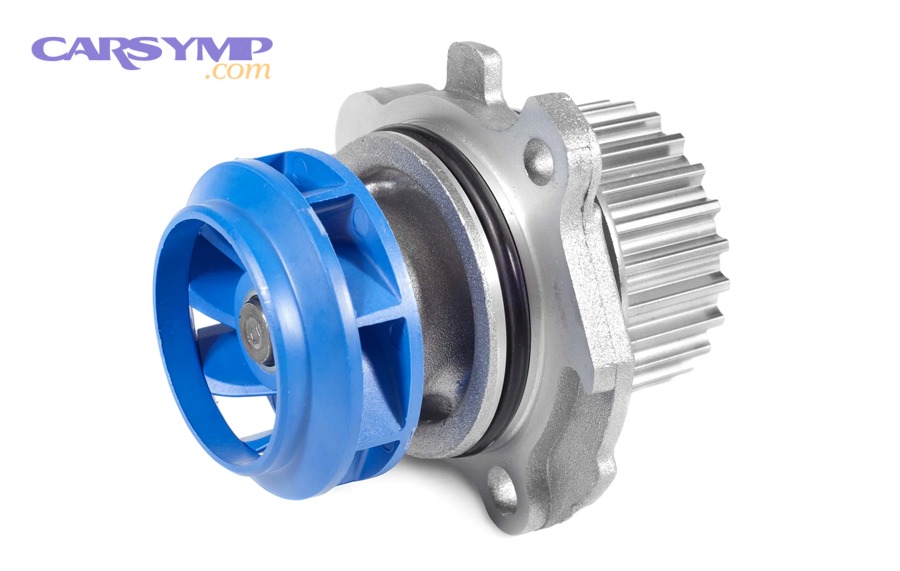
A healthy cooling system is a loop: the water pump pushes coolant through the engine’s coolant passages, sends heat-loaded coolant to the radiator, and returns cooler coolant back to the engine. When the pump is weak, heat doesn’t leave the engine fast enough, so the temperature may rise in bursts (especially at idle or low vehicle speed), and the heater may blow warm-then-cool as coolant circulation fluctuates.
Is weak coolant flow the same as an overheating problem?
No—weak coolant flow is a cause, while overheating is an outcome, and early weak flow can exist before you see a constant overheat.
More specifically, weak flow often shows up as intermittent overheating at idle, temperature spikes that “come and go,” or overheating that appears only when load increases (steep hills, towing, hot weather, A/C running). Overheating, by contrast, is the symptom you can’t ignore: the gauge climbs into the hot zone, warning lights appear, or steam pushes from the hood.
Think of weak flow as “the cooling system is struggling,” and overheating as “the struggle has already become dangerous.” AAA warns that once a car is overheating, you should not keep driving because you can cause further damage. (mwg.aaa.com)
What parts does the water pump circulate coolant through (engine, radiator, heater core)?
The water pump circulates coolant through three major areas:
- Engine block and cylinder head passages (where heat is absorbed)
- Radiator (where heat is released to air flow)
- Heater core (a small radiator inside the cabin that uses coolant heat for your heater)
This loop is the reason “weak flow” produces mixed signals. For example, the engine can run hot while the cabin heater goes lukewarm because insufficient flow reaches the heater core. Haynes describes the pump’s job as moving coolant through the engine block, radiator, and hoses to maintain operating temperature.
What are the most common weak coolant-flow symptoms of a failing water pump?
There are four main groups of weak coolant-flow symptoms of a failing water pump: temperature-pattern problems, heater-performance problems, leak/residue clues, and noise/vibration clues—because the pump’s job is circulation, sealing, and stable rotation.
Next, you’ll get the highest-accuracy symptom checks by focusing on patterns (when it happens) instead of only severity .
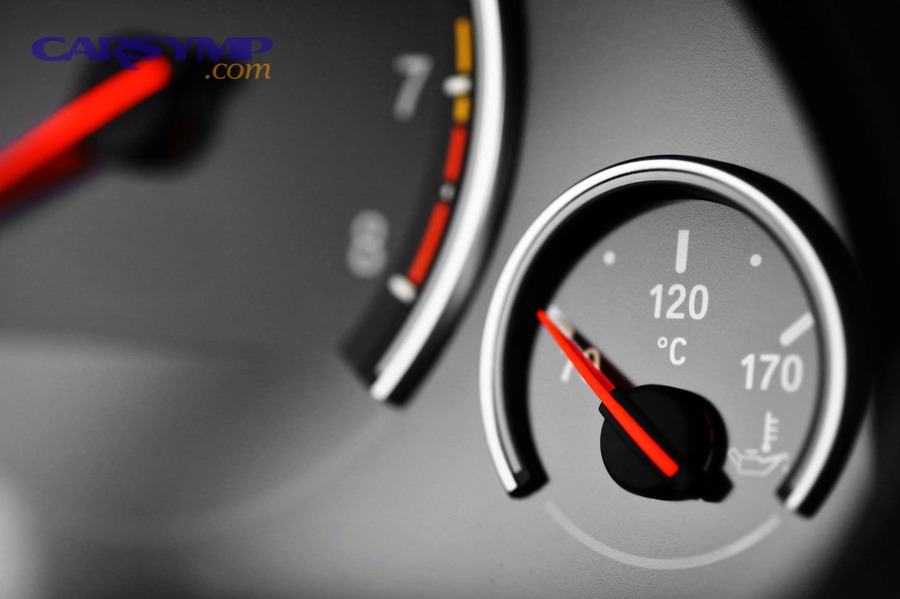
Does the temperature gauge spike at idle, in traffic, or under load when the pump is weak?
Yes—water pump weakness often shows up as temperature spikes, especially in stop-and-go conditions, because low RPM and low airflow reduce cooling margin.
Specifically, watch for these pattern clues:
- Overheating at idle or in traffic, then cooling down once you drive faster (more airflow through the radiator helps compensate for weak circulation).
- Temperature that’s normal on the highway but climbs when you sit at lights.
- Temperature spikes that worsen during heat waves, towing, or steep climbs.
If you’re diagnosing a “water pump weak flow” issue, log the conditions: outside temperature, time to overheat, whether fans are running, and whether you were idling. That pattern often narrows the cause faster than a single “it overheated once” story.
Also note the real-world complaint many owners report: AC on causes overheating at idle. Turning the A/C on adds heat load (condenser heat in front of radiator) and may demand more fan and coolant flow. If the pump is marginal, idle becomes the stress test where the weakness finally appears.
Can a weak water pump cause poor cabin heat or fluctuating heater output?
Yes—weak coolant flow can cause weak heat, delayed heat, or heat that cycles warm-to-cool, because the heater core needs steady coolant circulation to transfer heat into the cabin air.
More importantly, heater behavior is a useful early-warning signal because it often changes before the engine fully overheats.
Look for:
- Heat that’s strong while driving but weak at idle
- Heat that improves when you rev the engine slightly (increases pump speed on belt-driven pumps)
- Temperature changes that correlate with gauge movement (heater goes cooler as the engine gets hotter—classic circulation instability)
If your heater output drops while the engine temperature rises, that mismatch often points toward circulation or air pockets—not just “hot coolant exists,” but “hot coolant is not moving where it should.”
Are coolant leaks, crusty residue, or wetness near the pump a strong sign of pump failure?
Yes—coolant wetness or crusty residue near the pump is a strong sign of pump trouble because it usually indicates seal or gasket leakage, and leaks often worsen as the pump ages.
For example, many pumps leak from a small vent called the weep hole when internal seals fail, leaving visible stains or drip traces.
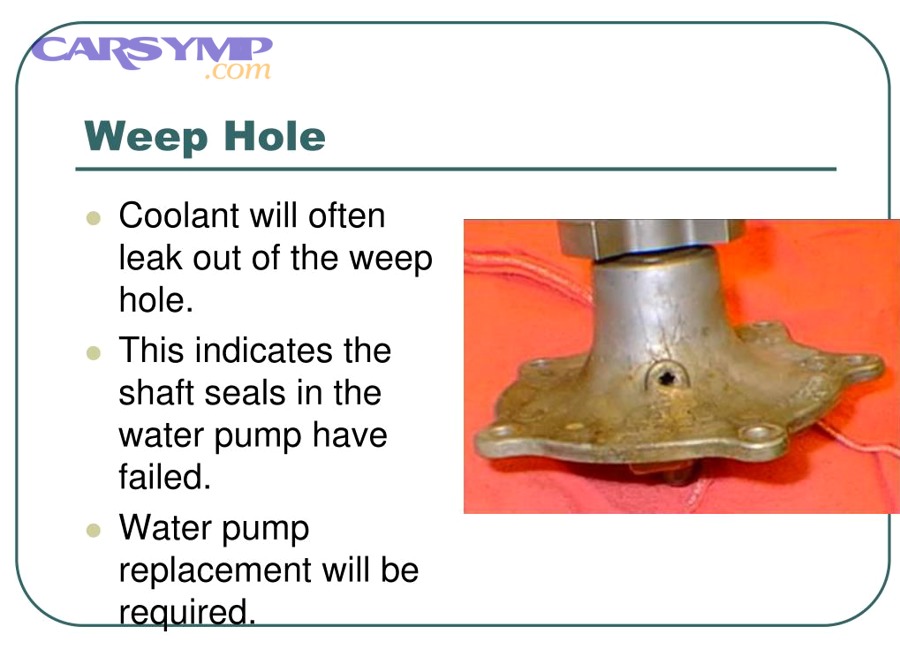
However, location matters. Coolant can drip downward and fool you, so don’t stop at “coolant on the ground.” Trace residue upward to find the highest wet point. If the highest wet point is the pump housing seam, weep hole area, or the pump-to-engine mating surface, the pump moves up your suspect list.
Do whining, grinding, or chirping noises point to water pump bearing failure?
Yes—unusual noises can point to water pump bearing failure because the pump relies on a rotating shaft and bearings to spin the impeller smoothly.
Meanwhile, not every squeal is a pump, so listen for the “character” of the sound:
- Grinding/rumbling: more consistent with bearing wear (often worsens with RPM)
- Chirp/squeal: could be belt slip, tensioner, or pulley alignment—but a failing pump pulley can trigger it too
- Growl that changes with engine speed: common rotating-component clue
A quick practical check (without touching hot parts): if the noise is strongest near the pump area and you also have leaks or overheating at idle, the combined symptom stack becomes much more convincing than noise alone.
How can you tell if the water pump is actually the cause of weak coolant flow?
A water pump is the likely cause when weak-flow symptoms match pump patterns and you rule out common look-alikes like thermostat faults, air pockets, cap pressure problems, and radiator restrictions.
To better understand this, use a “ladder of proof”: start with pattern checks, then visual evidence, then basic system comparisons.
Is the thermostat stuck (or slow) instead of the pump being weak?
Water pump weakness wins in circulation consistency, while a thermostat problem shows up more in warm-up and regulation behavior.
However, each can produce overheating—so compare the pattern:
- Thermostat stuck closed / slow to open: temperature rises steadily as coolant can’t reach the radiator effectively; heater may still be hot early because heat is trapped in the engine loop.
- Weak pump: temperature may swing, worsen at idle, and may correlate with heater fluctuations (flow instability).
If your car warms up normally, then later develops overheating at idle with inconsistent heater output, that pattern leans more toward circulation issues than a simple stuck-closed thermostat.
Could air pockets, low coolant, or a bad radiator cap mimic weak water-pump flow?
Yes—air pockets, low coolant, or a bad cap can mimic weak-flow symptoms because coolant needs a full, pressurized, bubble-free loop to circulate and transfer heat properly.
For example:
- Low coolant can starve the pump, introduce air, and reduce heater core flow first.
- Air pockets can create “hot spots,” sudden spikes, and gurgling sounds.
- Bad radiator cap can reduce system pressure and increase the chance of localized boiling, which disrupts stable circulation.
If symptoms started after a coolant service, hose replacement, or radiator work, suspect bleeding/air entrapment early—because a system that isn’t fully purged can behave like it has a weak pump even when the pump is fine.
Could a clogged radiator or heater core be the real reason for “weak flow” symptoms?
Yes—restrictions can mimic weak flow because they reduce effective circulation through key heat exchangers.
On the other hand, restriction patterns differ:
- Clogged radiator often overheats more at speed/load (engine makes more heat), and the radiator can’t reject it.
- Restricted heater core may show persistent weak cabin heat even when the engine is hot, with less correlation to idling.
A helpful mindset is “flow vs heat rejection.” The pump moves coolant; the radiator rejects heat. A weak pump can reduce coolant movement; a clogged radiator can reject less heat even with decent movement.
What quick checks can a car owner do safely to validate suspicion without special tools?
You can validate suspicion with four safe checks that don’t require opening a hot cooling system:
- Pattern diary (highest value): note whether the problem is worst at idle, in traffic, during hills, or with A/C on. Include whether AC on causes overheating at idle—that detail is diagnostic gold.
- Visual inspection (cold engine): look for dried coolant residue around the pump, weep hole area, and mounting seam; check belt condition and tension.
- Cabin heater behavior: observe whether heater output is stable or fluctuates with RPM and temperature.
- Listen for bearing noise: with the hood open (engine running), listen from a safe distance; compare front-of-engine components.
If you publish diagnostic content under a brand like Car Symptoms, these checks are also user-friendly because they don’t ask readers to do risky “cap off, rev engine” steps that can cause burns.
According to a study by Jiangsu University from the Research Center of Fluid Machinery Engineering and Technology, in 2022, researchers modeled and tested cavitation behavior in an automotive electronic water pump and reported required NPSH values that change with temperature (e.g., NPSHr of 1.15 m at 25°C, 1.01 m at 50°C, 0.91 m at 70°C), showing that pump operating conditions can materially affect performance and stability. (pmc.ncbi.nlm.nih.gov)
When are weak-flow symptoms serious enough to stop driving and book a repair?
Yes—weak-flow symptoms are serious enough to stop driving when you see rapid overheating, steam, warning lights, or repeat temperature spikes, because these indicate the cooling system can’t protect the engine reliably.
Besides, the most expensive engine damage often comes from the “I’ll just make it home” decision—so the safest rule is based on rate of temperature rise and loss of control over the gauge.
Should you stop driving immediately if you see steam or rapid overheating?
Yes—you should stop driving immediately if you see steam or rapid overheating for at least three reasons: (1) coolant may be boiling and pushing out, (2) the engine can suffer fast thermal stress, and (3) continued driving can warp components and turn a repair into a rebuild.
More importantly, pull over safely, shut the engine off, and let it cool. AAA’s guidance emphasizes that once a car overheats, you can’t keep driving without risking further damage. (mwg.aaa.com)
Can you drive short distances with mild symptoms if coolant level is stable?
Yes—sometimes you can drive short distances with mild symptoms if coolant level is stable, but only if the temperature stays controlled and you have a clear fallback plan, for three reasons: (1) not every symptom is active overheating, (2) you may be able to reach a safer location, and (3) stable temperature suggests the system still has reserve capacity.
However, “mild” must be defined:
- The temperature gauge stays near normal and does not spike toward hot.
- You do not see steam, smell burning coolant, or see warning lights.
- You are not repeatedly adding coolant.
If the car shows repeated overheating at idle, that’s a sign reserve capacity is gone at low airflow/low RPM—so driving “a little more” often repeats the problem at the next traffic light.
What information should you gather for a mechanic to diagnose faster?
You should gather a short, structured symptom packet because it reduces guesswork and speeds diagnosis:
- When overheating happens (idle vs highway, hills, weather)
- Whether A/C on causes overheating at idle
- Heater output behavior (steady vs fluctuating)
- Coolant loss rate (none / slow / rapid)
- Any visible residue location (front of engine, under pump area)
- Noises (grinding, chirping, rumble) and when they happen
This type of information helps a shop decide whether to inspect pump leakage, test cap pressure, verify thermostat operation, check radiator restriction, or confirm fan performance—without starting from scratch.
What else can cause weak coolant flow symptoms besides a failing water pump?
There are four common non-pump causes of weak-flow-like symptoms: electric pump control failures, cavitation/flow instability, coolant chemistry issues, and air entrapment after service—each can reduce effective circulation without a “traditional” belt-driven pump failure.
Especially if you already ruled out visible leaks and bearing noise, these micro-causes can explain why symptoms look like weak flow but don’t match a classic failing pump.
How do electric water pumps fail differently than belt-driven pumps (and what symptoms change)?
Electric water pumps win in control flexibility, belt-driven pumps are best for simplicity, and a failing electric pump often produces intermittent, logic-driven symptoms rather than purely mechanical ones.
Meanwhile, symptom differences matter:
- Belt-driven weak pump: symptoms often correlate with RPM and mechanical wear (leaks/noise).
- Electric pump issues: symptoms can be intermittent, may trigger warning messages, and can show abnormal temperature behavior even when belts are fine.
If your vehicle uses an electronic pump, “weak flow” might be a control or motor issue rather than an impeller slipping on a shaft.
What is cavitation, and can it damage the impeller and reduce flow?
Cavitation is the formation and collapse of vapor bubbles in low-pressure zones inside a pump, and it can reduce flow and damage the impeller because collapsing bubbles create shock and erosion on surfaces.
To illustrate, cavitation tends to occur where pressure drops—often near the impeller inlet—so even a pump that “spins” can lose efficiency, create vibration, and perform inconsistently under certain conditions (temperature, pressure, operating point). The Jiangsu University paper on an automotive electronic water pump describes cavitation as pressure-dependent and analyzes how it develops inside the impeller region under changing conditions. (pmc.ncbi.nlm.nih.gov)
Can incorrect coolant type or neglected coolant maintenance accelerate pump seal wear?
Yes—incorrect coolant type or neglected coolant maintenance can accelerate pump seal wear for at least three reasons: (1) degraded coolant can lose corrosion inhibitors, (2) contamination can increase abrasive wear, and (3) chemical imbalance can promote deposits that interfere with sealing and heat transfer.
In practice, “Preventing idle overheating with maintenance” often starts here: correct coolant, proper mixture, timely service intervals, and clean system components reduce the chance that a marginal pump becomes the weak link on the hottest day of the year.
When is “weak flow” actually a bleeding/air-entrapment problem after cooling system service?
Weak flow is actually an air-entrapment problem when symptoms appear right after cooling system work and present as gurgling, fluctuating heater output, and intermittent temperature spikes, because air pockets disrupt circulation and can cause localized boiling.
More importantly, if the system wasn’t bled correctly, you can chase the wrong part. A proper bleed restores stable circulation, stabilizes heater output, and often eliminates “mystery” overheating at idle that only started after a drain-and-fill.
Evidence (if any):
According to a study by Jiangsu University from the Research Center of Fluid Machinery Engineering and Technology, in 2022, researchers modeled and tested cavitation behavior in an automotive electronic water pump and quantified temperature-linked changes in required NPSH values (e.g., 1.15 m at 25°C, 1.01 m at 50°C, 0.91 m at 70°C), supporting the idea that pump stability and effective circulation can shift significantly with operating conditions. (pmc.ncbi.nlm.nih.gov)