


Preventing an engine from running hot at stoplights is mostly about disciplined cooling-system maintenance: keeping coolant healthy and full, ensuring the radiator can shed heat, and verifying the fan and thermostat do their jobs at low speed. When you follow a structured checklist, you reduce the most common triggers that make temperature creep upward when the car isn’t moving much.
Next, you’ll learn why this problem is so tied to low airflow and how small maintenance misses—like dirty radiator fins, a weak fan speed, or trapped air—turn into consistent heat buildup in traffic. That “why” matters because it tells you what to check first, and what can wait.
Then, you’ll get clear “safe-to-drive” guidance when the temperature rises, including quick steps that can buy you time to reach a safe place to stop without worsening the situation. The goal is to prevent panic decisions that can cause bigger damage.
Introduce a new idea: once the basics are handled, you’ll also see how to tell whether you’re still in maintenance territory or crossing into repair territory—and what advanced, vehicle-specific checks can confirm the real root cause.
What does “idle overheating” mean, and why does it happen more in traffic than on the highway?
Idle overheating is a pattern where engine temperature rises mainly when the vehicle is stopped or moving slowly because heat production stays high while airflow through the radiator drops, so the cooling system depends heavily on fan airflow and steady coolant circulation.
To better understand why this happens, it helps to picture your cooling system as two circuits that must work together: coolant flow inside the engine and airflow across the radiator core.
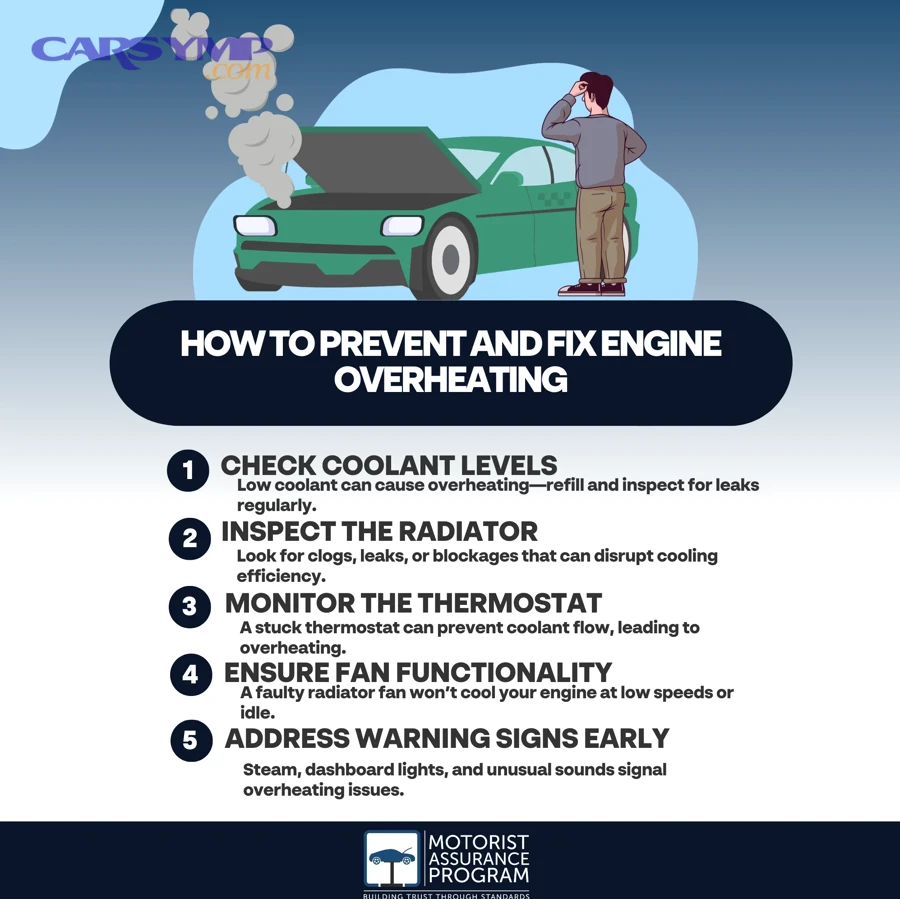
At highway speed, the car’s forward motion forces a large volume of air through the radiator and A/C condenser. That natural airflow can “mask” weaknesses—like a partially restricted radiator or a fan that only works at a low speed—because the system has enough air to dump heat anyway. At idle, that mask disappears. Now the fan, shroud, and radiator surface area must carry the cooling load almost alone, and any weakness shows up quickly.
Idle overheating is also “load sensitive.” You can be stopped in the same spot with two very different heat loads:
- Low load: engine warmed up, A/C off, mild ambient temperature.
- High load: A/C on, high ambient temperature, high electrical load (fans, lights), or towing earlier in the drive.
This is why one driver may only notice the issue on hot days or only with the A/C on: the cooling system’s margin is smaller, so maintenance gaps show up as temperature creep.
Is it normal for the temperature gauge to rise slightly at idle?
Yes—slight movement can be normal, but it should stay within the normal range because modern cooling systems are designed to cycle temperature as fans switch on and off; it becomes abnormal when the needle climbs toward hot, you get warning messages, or the temperature continues rising even after the fan should be running.
Then, use the gauge behavior to decide whether you’re seeing normal cycling or a true overheating-at-idle condition.
A normal pattern often looks like this:
- The gauge rises slightly while you idle.
- The fan turns on (or speeds up).
- The gauge stabilizes or drops back a bit.
An abnormal pattern usually includes one or more of these:
- The gauge steadily climbs without leveling off.
- You hear the fan never engage, or it sounds weak compared to normal.
- You smell coolant, see steam, or get a warning light/message.
- The A/C performance changes suddenly (blowing warmer) right before the temp rises.
If your vehicle has a digital temperature readout, treat it like a trend indicator rather than a single number. A few degrees of swing can be normal; a consistent upward climb in traffic is not.
What are the most common maintenance-related reasons a car overheats only when idling?
There are five main maintenance-related causes of overheating at idle: (1) low coolant or trapped air, (2) radiator fan not providing enough airflow, (3) radiator/condenser blockage reducing heat transfer, (4) thermostat or coolant-flow problems, and (5) pressure and leak issues that reduce boiling protection—based on whether the system is losing heat-rejection capacity, losing coolant, or losing pressure.
However, the fastest way to stop guessing is to link each cause to the specific “idle-only” symptom it creates.
- Low coolant and air pockets
When coolant is low, the system can’t carry heat away efficiently, and air pockets often form near hot spots. This tends to show up most when airflow is limited—exactly the idle condition. - Weak or non-operating radiator fan
At speed, airflow from motion helps. At idle, the fan is the airflow source. If the fan doesn’t come on, comes on late, or runs only at a weak speed, temperature climbs. - Blocked radiator fins or condenser
Debris on the outside of the radiator reduces airflow and heat transfer. This can be subtle until you’re stopped on a hot day. - Thermostat and coolant flow checks reveal restriction
A thermostat that sticks or a circulation issue (water pump, restriction, collapsed hose) may still look “okay” on the highway but fail under idle heat soak. - Pressure cap issues and small leaks
Cooling systems rely on pressure to raise the boiling point. A weak cap or slow leak reduces that safety margin, making idle heat spikes more likely.
According to a study by University of Petroleum and Energy Studies from the Mechanical Engineering Department, in 2013, every 10% increase in radiator area covered with silt soil increased radiator coolant outlet temperature by about 1.7°C, and mud coverage increased it by about 2°C, showing how reduced effective area directly raises coolant temperature.
Which cooling-system maintenance checklist prevents idle overheating most effectively?
The most effective prevention method is a five-part cooling-system checklist—coolant health, fan performance, radiator airflow, leak/pressure integrity, and thermostat/circulation verification—because it targets the exact conditions that cause temperature rise when the car isn’t moving.
Specifically, this checklist works best when you start with what’s easiest to confirm and most likely to fail, then move toward deeper checks only if needed.
Use this checklist in order. Each step includes what to look for, what “good” looks like, and what the finding usually means.
How do you check coolant level and condition to prevent low coolant and air pockets at idle?
Coolant level and condition checks prevent overheating at idle by ensuring the system has enough heat-carrying fluid, the correct mixture for boiling protection, and no recurring loss that creates air pockets at hot spots.
Next, follow a safe, repeatable routine so you don’t introduce air or risk burns.
Safety first (always):
- Check coolant only when the engine is cool unless your owner’s manual explicitly provides a safe hot-check method.
- Never remove a pressurized radiator cap on a hot engine.
Step-by-step coolant check (basic but decisive):
- Verify the reservoir level
Look at the coolant reservoir markings (MIN/MAX). A healthy system keeps the level stable between checks. If it’s below MIN, treat it as a problem to investigate, not just “top off and forget.” - Look for condition red flags
Coolant should look like a consistent fluid, not like sludge.- Good signs: clear color typical for the coolant type; no oil sheen.
- Bad signs: rust tint, floating debris, oily film, or milky contamination.
- Smell and residue check
A sweet smell after shutdown, crusty residue near hose joints, or dampness around the water pump/thermostat housing often signals small leaks that become big problems during stop-and-go heat soak. - Top-off correctly (only if appropriate)
Use the correct coolant spec for your vehicle. If you must add fluid to get home, use premixed coolant or distilled water temporarily (if compatible), then return to the correct mixture soon.
Why this stops idle overheating:
Low coolant reduces the system’s ability to absorb and move heat away from the engine. Air pockets insulate hot areas and cause erratic temperature behavior—often worst at idle when the system is already stressed.
According to a study published in Engineering Proceedings in 2025, different coolant formulations can measurably change engine cooling effectiveness and radiator material corrosion behavior, reinforcing why “correct coolant” is a real performance factor, not just a brand preference.
How do you confirm the radiator fan turns on (and at the right speed) to stop idle overheating?
You confirm radiator fan performance by checking that the fan engages at operating temperature (and under A/C load), reaches the correct speed, and pulls air through the radiator shroud—because at idle, fan airflow is the primary heat-rejection driver.
Then, use simple, non-invasive observations before you move to electrical diagnosis.
Quick fan checks you can do safely:
- Warm the engine to normal operating temperature
Let it idle until the thermostat opens and temperature stabilizes. Watch for the fan cycling on and off. - Turn the A/C on and observe fan response
On many vehicles, A/C demand triggers fan operation quickly. If the fan never comes on with A/C, you have a strong clue.
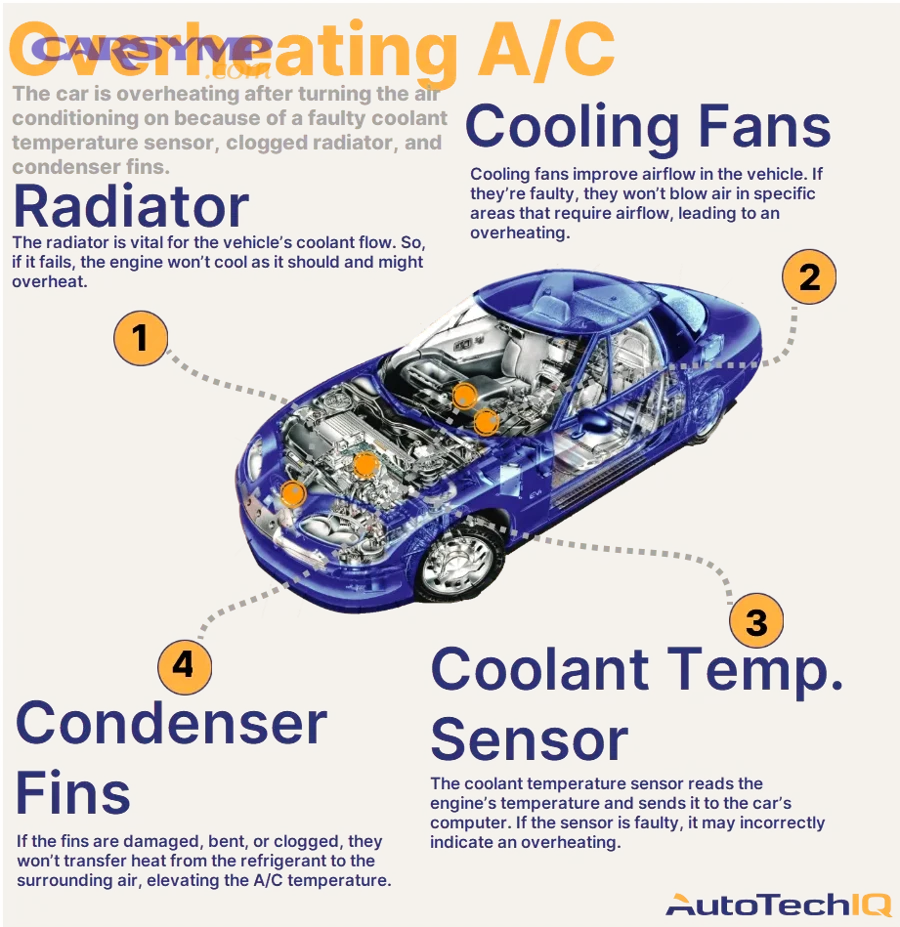
This is where the phrase matters: AC on causes overheating at idle when the system is already marginal, because the condenser adds heat in front of the radiator and the fan must move even more air to keep coolant temperature stable.
- Listen for speed changes
Some vehicles have two fan speeds or variable-speed control. A fan that “runs” but only weakly can still allow overheating at idle. - Check airflow direction and shroud integrity
The fan should pull air through the radiator (usually toward the engine bay). A missing shroud, broken fan blades, or gaps around the radiator reduce effective airflow.
What these observations usually mean:
- Fan never turns on → likely control, relay, fuse, sensor input, or fan motor issue.
- Fan turns on late, only at very high temperature → marginal cooling capacity; may be partly blocked radiator or weak fan.
- Fan turns on but sounds weak → fan motor aging, resistor/module issues, or partial electrical failure.
According to a study by Clemson University from an advanced thermal management research program, controlled electric fan strategies can reduce power consumption substantially while still maintaining target temperatures—evidence that fan control and airflow management are central levers in cooling performance.
How do you keep the radiator and airflow path clean enough for stop-and-go driving?
You keep the radiator airflow path effective by keeping the radiator and condenser fins unobstructed, maintaining intact ducting/shrouds, and preventing debris buildup that reduces the radiator’s usable heat-transfer area—because even a partial blockage can push temperatures higher at idle.
More specifically, focus on the “front stack” (grille → condenser → radiator) since idle cooling depends on air passing cleanly through that stack.
A practical cleaning and inspection routine:
- Visual inspection through the grille
Look for leaves, bugs, plastic bags, or bent fins. The condenser often catches debris first. - Gentle fin cleaning
Use low-pressure water and a soft brush if needed. Avoid high-pressure spray directly into fins, which can fold fins and reduce airflow. - Check for oil or grime film
Oil film attracts dust and acts as insulation. If you see heavy grime, you may need a careful degrease and rinse (without soaking electrical connectors). - Confirm shrouds and seals
Modern cars use foam seals and shrouds to force air through the core instead of around it. Missing seals can make the fan “work hard” while moving less useful air.
Why this matters at idle:
At speed, airflow volume is high. At idle, airflow volume is limited, so any reduction in effective radiator surface area has a bigger relative effect.
According to a study by University of Petroleum and Energy Studies from the Mechanical Engineering Department, in 2013, each 10% increase in radiator surface area coverage with silt soil increased coolant outlet temperature by about 1.7°C (and mud by ~2°C), showing a direct, proportional penalty from reduced heat-transfer area.
What thermostat and coolant-flow checks help catch problems before they cause idle overheating?
There are four practical Thermostat and coolant flow checks: (1) warm-up behavior and heater output, (2) upper/lower radiator hose temperature comparison, (3) overflow and circulation observations, and (4) signs of restriction or pump weakness—based on whether coolant is moving, being regulated, and shedding heat.
Besides, these checks help you distinguish a “fan/airflow” problem from a “flow/regulation” problem without guessing.
1) Warm-up behavior + cabin heat
A thermostat regulates when coolant begins flowing to the radiator. If it’s stuck closed or sluggish, you may see:
- Rapid temperature rise after a short idle.
- Inconsistent cabin heat output.
- Temperature spikes that don’t match fan cycling.
2) Hose temperature comparison (use caution)
After warm-up, the upper radiator hose typically gets hot as coolant flows into the radiator, and the lower hose should be cooler as coolant exits the radiator.
- Upper hot + lower much cooler can be normal.
- Upper hot + lower stays cool while gauge climbs can suggest flow restriction (thermostat not opening, blockage, or pump issues).
3) Reservoir behavior (no cap removal on hot engine)
If the reservoir level surges or burps bubbles repeatedly, suspect air pockets or gases entering the system. Persistent bubbling can be a repair red flag (covered later).
4) Signs of weak circulation
A weak water pump or restriction may show:
- Overheating at idle and sometimes under load.
- Poor heater performance at idle that improves with RPM (because higher RPM increases flow).
- Coolant seepage at pump weep hole or bearing noise.
The key is pattern recognition: idle overheating plus weak cabin heat at idle often points toward circulation issues, while normal cabin heat but rising engine temperature often points toward airflow/fan/radiator efficiency.
How often should you service the cooling system to prevent overheating at idle?
You should service the cooling system on a layered schedule—quick monthly checks, seasonal airflow inspections, and manufacturer-interval coolant service—because idle overheating prevention depends on staying ahead of gradual losses (coolant, pressure) and gradual restrictions (debris, corrosion).
Then, match the schedule to how your vehicle is actually used: commuting in traffic, hot climates, or heavy A/C use increases the cooling system’s workload.
A useful way to think about service timing is “what changes slowly” versus “what fails suddenly”:
- Slow changes: coolant degradation, fin blockage, hose aging.
- Sudden failures: fan electrical faults, cap failure, thermostat sticking.
What’s a practical maintenance schedule for car owners (monthly, seasonal, mileage-based)?
A practical schedule has three layers—monthly quick checks, seasonal airflow checks, and interval-based coolant service—based on how quickly each risk factor can develop and how severe the consequences are if you miss it.
To begin, use this schedule as a baseline and tighten it if you drive in dusty areas, heavy traffic, or extreme heat.
Monthly (5–10 minutes):
- Check coolant reservoir level (cold engine).
- Look for dried residue around hoses, radiator end tanks, and water pump.
- Watch for any change in gauge behavior during normal commutes.
Seasonal (every 3–4 months):
- Inspect radiator/condenser fins for debris and clean gently.
- Confirm fan operation during warm idle and with A/C on.
- Inspect belt condition (if your water pump is belt-driven).
Mileage/interval-based (follow owner’s manual, commonly 2–5 years for coolant depending on type):
- Coolant drain/fill or flush per manufacturer guidance.
- Replace pressure cap if it tests weak or shows obvious wear.
- Replace aging hoses if swollen, soft, cracked, or oil-soaked.
Why this prevents overheating at idle: small losses add up. A system can run “okay” at speed while it quietly loses idle margin—until the first truly hot day reveals the problem.
Which wear items should you replace proactively to reduce idle-overheating risk?
There are six wear items that most directly reduce idle-overheating risk when replaced proactively: pressure cap, upper/lower radiator hoses, hose clamps, thermostat (when aging symptoms appear), coolant (at interval), and fan-related relays/modules (when intermittent)—based on failure frequency and impact on idle cooling margin.
Moreover, proactive replacement works best when it’s symptom-guided and interval-guided rather than random.
- Pressure cap
A weak cap lowers system pressure and makes boiling more likely. Boiling creates steam pockets, and steam cannot carry heat like liquid coolant. - Radiator and heater hoses
Hoses can soften internally and collapse under suction at idle, restricting flow. They can also seep and slowly lower coolant level. - Clamps and connections
Tiny leaks at clamps often appear only when hot and pressurized. They leave crusty residue and gradually lower the system level. - Thermostat (context-dependent)
If warm-up behavior becomes erratic or the engine runs hotter than normal in traffic, the thermostat can be a strategic replacement—especially if it’s original and the vehicle has high mileage. - Coolant
Coolant isn’t “forever.” Additive packages degrade over time, and neglected coolant can promote corrosion and deposit formation that reduces heat transfer. - Fan relays/modules (when intermittent behavior appears)
If the fan sometimes runs and sometimes doesn’t—especially after rain, heat soak, or A/C cycling—an intermittent electrical control issue can be the real cause of idle overheating.
When is it safe to drive if your car overheats at idle, and what should you do immediately?
A car is only safe to drive with overheating at idle when the temperature is still in the normal range and stabilizes quickly after reducing load; it is unsafe when the gauge approaches hot, warning lights appear, steam is present, or temperature keeps climbing—because continued driving can warp components and cause engine damage.
However, even “mild” overheating should be treated as a short-term emergency, not a condition to ignore.
Should you keep driving if the temperature rises only at stoplights?
No—you should not keep driving with overheating at idle because (1) heat soak can escalate quickly once coolant starts boiling, (2) low coolant or fan failure can turn a mild rise into a severe overheat within minutes, and (3) repeated overheating events can damage gaskets, hoses, and sensors even if the engine doesn’t fail immediately.
Then, use a simple decision rule to act fast without guessing.
If the gauge is rising but not in the hot zone:
- Reduce load immediately (A/C off).
- Increase heat rejection briefly (heater on).
- Drive only long enough to reach a safe place to stop.
If the gauge is near hot, you see steam, or a warning light appears:
- Pull over as soon as it is safe.
- Shut the engine off.
- Do not open the radiator cap hot.
This guidance matches widely taught roadside safety practice: in heavy traffic, turning off the A/C and turning on the heat can buy you time, but only as a short-term move to reach a safe stop.
What immediate steps reduce temperature quickly without causing damage?
There are five immediate steps that reduce overheating risk at idle: (1) turn off A/C, (2) turn heater to hot with fan high, (3) move to a safe stop and shut off, (4) allow a controlled cool-down, and (5) check for obvious leaks only after cooling—based on reducing heat input, increasing heat output, and avoiding pressure burns.
Next, follow these steps in order so you lower temperature without creating new hazards.
- Turn off the A/C
This reduces engine load and reduces the heat dumped by the condenser into the radiator airflow path—especially important when AC on causes overheating at idle. - Turn the heater to HOT, fan to HIGH
The heater core acts like a small radiator. It can pull some heat from coolant to cabin air. - Find a safe place to pull over
Do not “push it” to the next exit if the gauge is climbing into the danger zone. - Shut the engine off and let it cool
Cooling systems are pressurized. Wait until the system cools before any cap removal. - Inspect for obvious leaks after cooling
Look for puddles, wet hoses, or sprayed residue. If coolant is low, don’t just keep refilling without finding the reason.
How do you tell whether you need maintenance or a repair when idle overheating persists?
You need maintenance when the problem is caused by reversible, routine factors (low coolant from a small leak, dirty fins, overdue coolant service), but you need repair when core components fail (fan motor/control, thermostat sticking, water pump failure, internal leaks) because persistent idle overheating means the system no longer has enough margin even after basic care.
More importantly, you should use symptom patterns—when it happens, what changes it, and what you observe—to decide the boundary.
A reliable “maintenance vs repair” approach is to run this sequence:
- Complete the checklist (coolant level/condition, fan operation, airflow cleanliness).
- Confirm the issue repeats under similar conditions.
- Look for one of the “repair signatures” below.
What symptoms point to a clogged radiator or weak water pump instead of simple maintenance?
A clogged radiator “wins” as the likely cause when temperature rises most in traffic and the radiator shows uneven heat transfer, while a weak water pump is best suspected when coolant circulation is inconsistent and heater output changes with RPM; simple maintenance is optimal when coolant level and airflow restoration resolves the issue quickly.
However, you can separate these with a few specific observations that don’t require disassembly.
Clogged radiator / restricted heat transfer clues:
- Overheats at idle and also runs warmer than normal under load.
- Fan is working, coolant level is correct, but temperature still creeps up.
- Radiator exterior is clean yet the system behaves like it can’t shed heat.
- You may notice uneven temperature behavior across the radiator (a shop can confirm with infrared scanning).
Weak water pump / circulation weakness clues:
- Heater output weak at idle but improves with RPM.
- Temperature fluctuates more than it should and may spike quickly.
- You hear bearing noise or see seepage near the pump weep hole.
- Hoses may feel inconsistent in temperature when they should be stable after warm-up.
Simple maintenance clues (still “fixable” without part replacement):
- Coolant was low and stabilizes after correcting level and addressing a minor leak.
- Radiator fins were blocked and cleaning restores normal idle temperature.
- Fan wasn’t coming on due to a simple fuse/relay issue (still a repair task, but often minor).
According to a study by University of Petroleum and Energy Studies from the Mechanical Engineering Department, in 2013, radiator blockage showed a measurable, proportional increase in coolant outlet temperature with increasing covered area—supporting why restricted radiator effectiveness can produce repeatable overheating behavior even when coolant level is fine.
What red flags suggest a head gasket issue rather than a maintenance problem?
There are six red flags that suggest a head gasket or internal engine sealing issue: persistent coolant loss with no external leak, repeated air pockets after proper bleeding, exhaust-smelling bubbles in the reservoir, milky oil or oily coolant, white smoke/sweet exhaust smell, and chronic overheating that returns immediately after maintenance—based on evidence of combustion gases or fluids crossing boundaries they shouldn’t.
Then, treat any combination of these as “stop driving and diagnose” signals, not as a checklist item.
- Coolant keeps disappearing with no visible leak
If you top up correctly and the level drops again with no residue or wet areas, suspect internal loss. - Repeated “burping” needed
If you bleed air successfully and it returns quickly, something is introducing gas into the system. - Reservoir bubbles that persist after warm-up
Some bubbles during filling can be normal; persistent bubbling after stabilization is not. - Oil/coolant cross-contamination
Milky oil, oily sheen in coolant, or sludge-like deposits can indicate mixing. - White smoke and sweet smell
Coolant entering combustion can create sweet-smelling exhaust and abnormal steam. - Immediate recurrence after doing everything right
When the system is full, clean, fans work, and Thermostat and coolant flow checks look normal—but overheating continues—internal issues become more likely.
If you see these signs, the correct next step is diagnostic testing (cooling system pressure test, combustion gas test, or professional evaluation). Continuing to drive risks severe overheating and engine damage.
What advanced (vehicle-specific) checks can confirm the real cause of persistent idle overheating?
Advanced confirmation comes from vehicle-specific fan-control verification, correct air-bleeding procedures, radiator temperature mapping, and identifying rare thermal-management issues—because some modern systems “look normal” while failing under specific control conditions at idle.
Below, these checks expand beyond routine maintenance and help you pinpoint the true failure mode when the basics don’t solve overheating at idle.
How do different electric fan control systems (single/dual, staged, PWM) change idle-overheating diagnosis?
A single-fan system often fails as “fan not running,” a dual-fan staged system can fail as “fan running but insufficient,” and PWM/variable-speed systems can fail as “fan runs but never reaches the needed airflow,” making variable-speed systems the most likely to hide idle-overheating causes behind partial operation.
Meanwhile, your diagnosis must shift from “does it spin?” to “does it move enough air at the right time?”
- Single fan (simpler): Failures are often obvious: no fan, blown fuse, dead motor.
- Dual fan staged control: One fan may run while the second never engages, or only low speed works when high speed is needed.
- PWM/variable-speed fan modules: Fan may run quietly at low duty cycle but never ramps up, or the module can fail intermittently with heat soak.
Because advanced controllers regulate airflow to hit temperature targets efficiently, partial-control failures can create the exact symptom pattern of overheating at idle while seeming “fine” on the highway.
What’s the correct way to bleed air from the cooling system on cars prone to air pockets?
The correct bleeding method is the one specified for your engine layout and fill points—often using a raised fill point, bleeder screws, a spill-free funnel, or vacuum fill—because trapped air tends to collect at high points and can cause overheating at idle even when the reservoir looks full.
Then, the key is consistency: you must complete a full heat cycle and confirm stable level afterward.
- Fill slowly to reduce aeration.
- Open factory bleeders if equipped (thermostat housing or upper hose area).
- Run engine to operating temperature with heater on (to open heater core flow).
- Allow fan cycle and thermostat opening.
- Cool down fully and recheck level; top off to the correct mark.
Mistakes that commonly reintroduce air:
- Topping up only the reservoir when the system requires radiator filling.
- Not running the heater circuit during bleeding.
- Closing bleeders too early before steady coolant flow.
A widely used DIY technique overview for purging air is demonstrated in popular instructional videos on cooling-system bleeding; use those for technique awareness but always follow your vehicle’s exact procedure.
Can infrared temperature readings across the radiator reveal partial blockages?
Yes—infrared temperature mapping can reveal partial blockages because a restricted radiator often shows uneven temperature drop across the core, with “cool spots” where coolant isn’t flowing and “hot bands” where heat isn’t being rejected effectively.
However, this method works best as a pattern check, not a single reading, and it should be done with the engine at stable operating temperature.
What patterns can suggest restriction:
- Large sections of the core remain significantly cooler than adjacent sections while the engine is hot.
- The inlet area is very hot, but the expected gradient across the core is inconsistent.
What can confuse results:
- Fan cycling changes airflow and surface temperatures.
- The A/C condenser in front changes surface readings.
- External debris can make spots appear cooler/hotter than they should.
If a shop confirms inconsistent heat transfer, the next step is often radiator flow testing or replacement rather than repeated coolant service.
What rare issues cause idle overheating even with normal coolant and fan operation?
There are four rare issues that can cause idle overheating even when coolant and fan appear normal: (1) airflow management problems (missing ducting/shrouds/seals), (2) intermittent sensor/control faults that prevent fan ramp-up, (3) after-run pump or thermal-management component faults on some turbo/modern engines, and (4) combustion-gas intrusion that creates recurring air pockets—based on failures that reduce effective heat rejection without obvious “low coolant” signs.
In short, these issues are uncommon, but they explain the frustrating cases where the basics check out and overheating at idle still returns.
- Airflow management gaps
A small missing seal can cause a big real-world airflow loss at idle because the fan pulls the path of least resistance. - Intermittent command problems
A fan may “work” during a quick check but fail to ramp under actual thermal load due to a control module, sensor input, or wiring fault that appears only when hot. - Specialized thermal systems
Some vehicles use additional pumps or complex thermal valves; failures can show up primarily in idle heat soak. - Internal gas intrusion
Even a small combustion leak can keep forming air pockets after bleeding, leading to repeatable idle temperature rise.
If you’ve completed the checklist, confirmed fan behavior under A/C load, cleaned the radiator stack, and verified Thermostat and coolant flow checks—yet the problem persists—these rare categories are where targeted diagnostics pay off.