


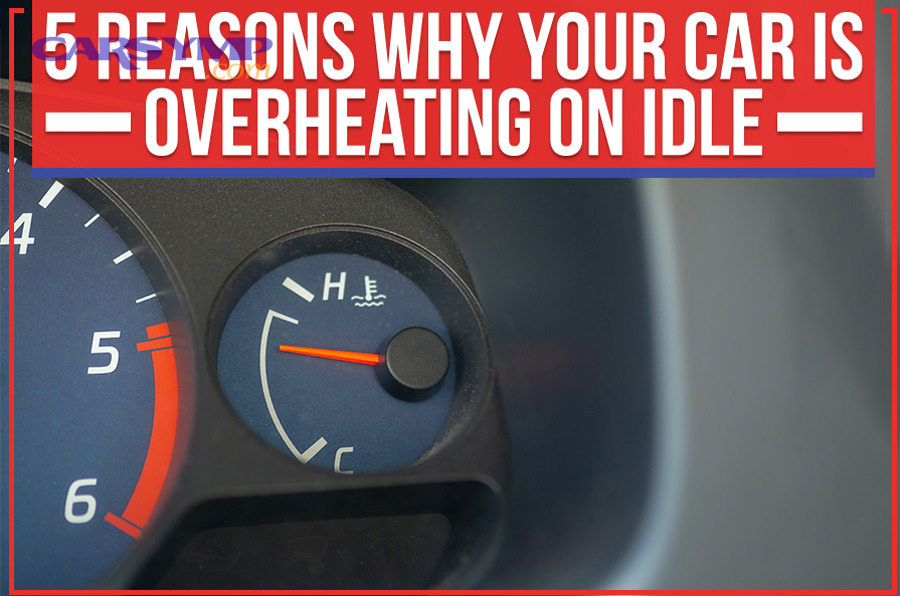
If your engine temperature climbs mainly when you’re stopped and the A/C is running, the most common reason is that your cooling system can’t reject heat fast enough at low airflow—so you need to diagnose the airflow and fan-control side first, then confirm coolant level and flow before replacing parts.
Next, this guide walks you through a quick, prioritized troubleshooting path so you can pinpoint whether the problem is a cooling fan that isn’t switching on (or isn’t reaching high speed), restricted airflow through the condenser/radiator stack, low coolant, or reduced coolant circulation.
Then, you’ll learn how to tell what’s “normal gauge movement” versus a true overheating event, plus what patterns—idle-only, speed-related, or load-related—mean for the most likely failure point.
Introduce a new idea: once you can match your symptom pattern to a specific failure mode, you can fix the root cause confidently instead of chasing guesses.
What does “overheating at idle with the A/C on” actually mean?
“overheating at idle with the A/C on” is a cooling-system capacity problem where heat builds up faster than the radiator can shed it at low airflow, made worse by A/C condenser heat and the extra load of the compressor, so temperature rises mostly when stopped.
To begin, the key is to understand the pattern—because the pattern tells you which part of the cooling system is failing under low-speed conditions.
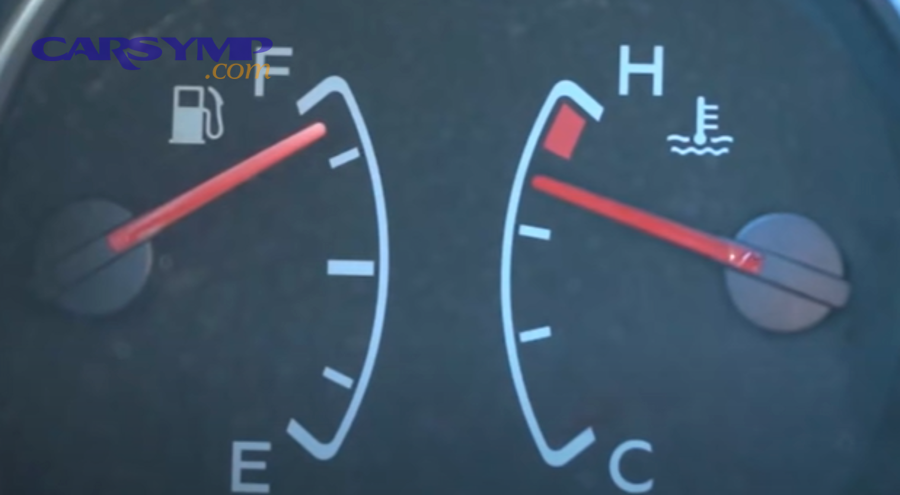
At idle, your car has two big disadvantages:
- Airflow is limited. When you’re moving, air rams through the front grille and across the A/C condenser and radiator. When you’re stopped, you rely on cooling fans and proper shrouding to pull air through.
- The A/C adds heat at the front of the radiator. The condenser sits in front of the radiator. When A/C is on, the condenser rejects heat—so the air reaching the radiator is already warmer than ambient.
- The engine is still producing heat. Even at idle, the engine generates combustion heat, and the cooling system must continuously move and reject it.
That’s why this problem often shows up as: temperature climbs at stoplights, then drops once you drive again.
Is it normal for engine temperature to rise slightly at idle when the A/C is running?
Yes—slight movement can be normal, but true overheating at idle is not normal, for three reasons: A/C condenser heat adds load, idle airflow is weak, and fan control strategies may delay high-speed fan engagement until a threshold is reached.
More specifically, a small rise can happen because the system is balancing competing demands: cabin cooling, engine cooling, and low airflow. However, “normal” has clear limits.
What “slight rise” typically looks like
- The gauge moves up a small amount, then stabilizes.
- The radiator fans cycle on and off.
- The A/C remains cold, and there’s no warning message.
What “not normal” looks like
- The gauge keeps climbing until it enters the hot zone.
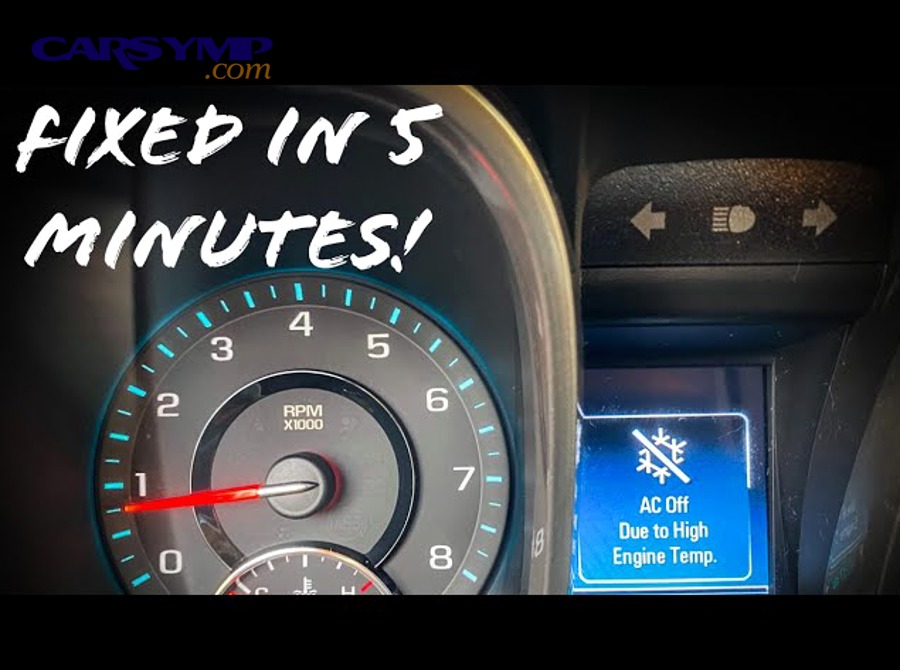
- You see a warning like “A/C off due to high engine temp,” or the A/C turns warm because the vehicle protects the engine by shedding A/C load.
- Coolant boils into the overflow tank, you smell hot coolant, or you see steam.
If your car repeatedly crosses into “hot,” treat it as a fault—not a quirk.
Why does it often cool down once you start driving?
It cools down when you drive because vehicle speed creates strong airflow through the condenser and radiator, which can compensate for a weak fan, marginal heat exchanger efficiency, or borderline coolant flow.
In addition, the cooling system is designed around airflow. At 30–60 mph, the radiator can reject dramatically more heat because the air mass flow rate increases. At a stop, the fans and shrouding must substitute for that airflow—so any weakness (bad fan relay, low fan speed, missing shroud, blocked fins) shows up immediately.
Which causes are most likely when a car overheats at idle only with A/C on?
There are 4 main types of causes of overheating at idle with A/C on: (A) fan operation problems, (B) airflow restriction through the condenser/radiator stack, (C) low coolant/pressure and trapped air, and (D) reduced coolant flow at idle—classified by whether they limit air movement or coolant movement.
Next, treat these as a ranked list: start with what most commonly fails in real cars and is fastest to confirm.
Here’s a quick “most-likely-first” view:
- Fan system not switching on or stuck on low speed (relay, fuse, motor, resistor, control module, wiring)
- Airflow restriction (packed bugs/leaves, bent fins, debris between condenser and radiator, missing shrouds/air seals)
- Low coolant and air pockets at idle (small leak, improper fill/bleed, weak cap)
- Coolant flow reduced at idle (thermostat behavior, water pump impeller wear, slipping belt/tensioner)
Is the radiator/condenser fan actually turning on—and at the right speed?
No—if your fans don’t turn on (or never reach high speed), the engine can overheat at idle with A/C on, because idle depends on fan airflow, A/C demands extra heat rejection, and low-speed fan airflow may be insufficient under combined load.
Specifically, A/C is a built-in stress test: in many vehicles, switching A/C on should trigger at least one fan immediately, and many systems will command higher fan speed as pressure and temperature rise.
What to look for (no tools required)
- With the hood open, start the engine and turn the A/C on.
- Watch the fans within the first minute:
- No fan at all: suspect fuse/relay/control/module/motor.
- Fan spins slowly only: suspect low-speed circuit/resistor/module or “high speed never engages.”
- Fan cycles but temp still rises: airflow may be restricted, fan is weak, or coolant/flow is marginal.
Why “spinning” doesn’t automatically mean “working”
- A worn motor can spin but move little air.
- A fan without a proper shroud can move air around the radiator instead of through it.
- Some vehicles use staged speeds; losing high speed can cause overheating at idle only when A/C load is high.
Could restricted airflow through the condenser/radiator stack be the real problem?
Yes—restricted airflow can cause idle-only overheating for three reasons: the condenser/radiator stack needs clean fin area, idle cooling depends on pulling air through the stack, and debris or bent fins reduce the radiator’s effective heat-transfer surface.
For example, packed bugs and road grime can block a surprising portion of fin area. Bent fins can also “seal” airflow channels, turning a heat exchanger into a wall.
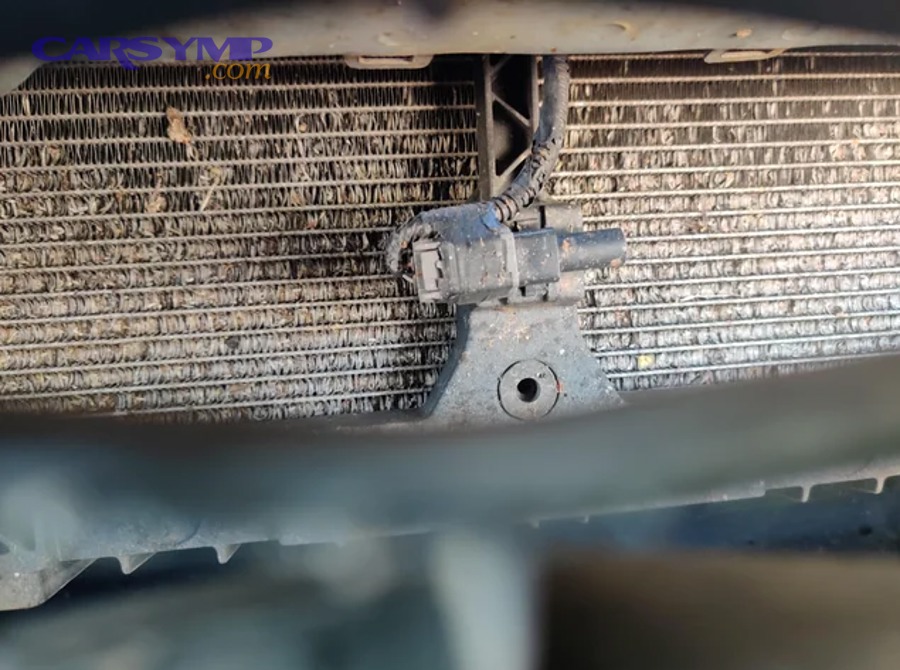
Airflow restriction hotspots
- Front face of the A/C condenser (takes the first hit from bugs and dirt)
- Gap between condenser and radiator (leaves can lodge there)
- Lower grille area (road debris)
- Missing foam seals or damaged undertrays that disrupt pressure zones
A simple clue: if you shine a light from behind and can barely see it through the fins, airflow is likely compromised.
Is coolant level/pressure the hidden cause that shows up only under A/C load?
Yes—low coolant or weak pressure can trigger idle overheating because there’s less thermal mass to absorb heat, air pockets reduce coolant contact with hot surfaces, and boiling can start earlier when pressure control is poor.
More importantly, low coolant often behaves like a “threshold” issue: while driving, airflow masks the problem; at idle with A/C load, the system crosses the threshold and the temp climbs.
Common ways this happens:
- A small leak slowly lowers coolant.
- A refill was done without proper bleeding, leaving air trapped.
- The radiator cap can’t hold pressure, lowering the boiling point and promoting hot spots.
Could coolant flow be reduced at idle (thermostat/water pump/belt)?
Yes—reduced coolant flow at idle can cause overheating because the radiator isn’t receiving enough hot coolant to shed, the pump may not circulate effectively, and belt/tensioner issues can slip more under A/C load.
However, this is usually your “third wave” check—after fans and airflow—because fan/airflow issues are both common and quick to verify.
Flow-related hints:
- Temperature rises at idle and improves when you raise RPM slightly.
- Heater output fluctuates (sometimes a sign of air pockets or flow instability).
- You hear belt squeal when A/C engages (possible slip).
How do you diagnose it in 15–30 minutes without guessing?
There are 5 fast diagnostic steps to isolate overheating at idle with A/C on: (1) confirm the symptom pattern, (2) verify fan command and fan speed, (3) check airflow and fin condition, (4) confirm coolant level/pressure and purge air, and (5) screen for flow and sensor issues.
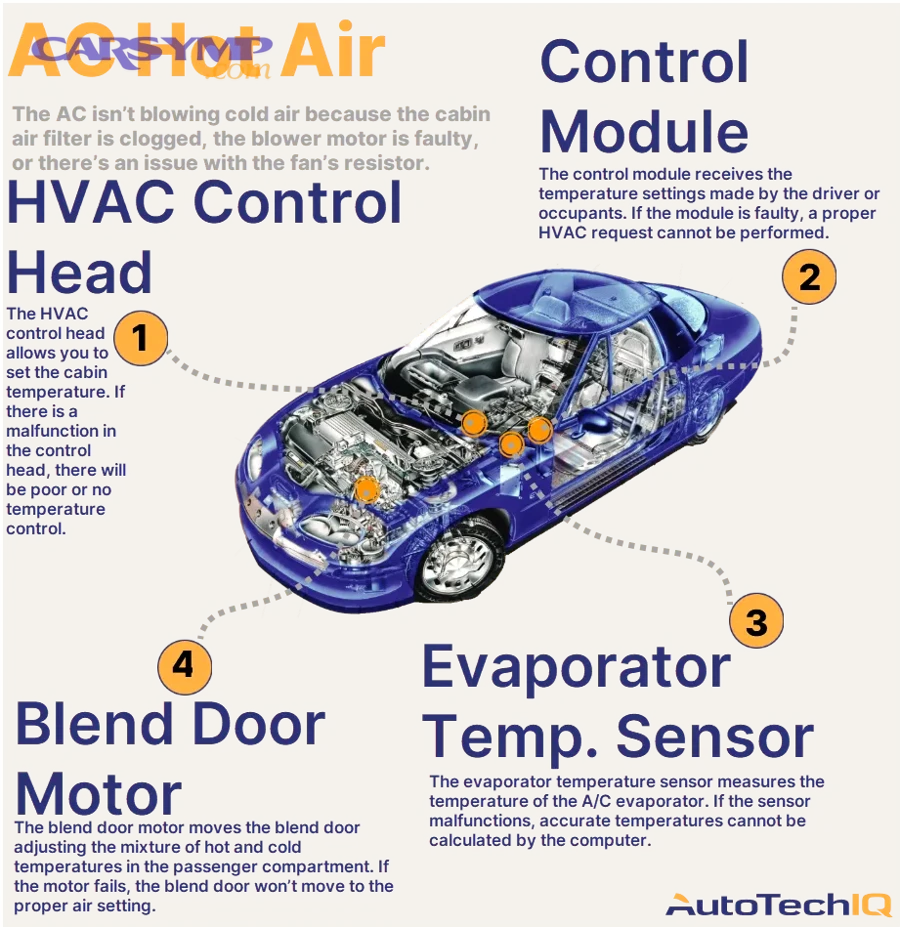
Then, you turn each check into a “yes/no decision” so you can stop guessing and start ruling things out.
To make this practical, the table below shows a quick mapping from symptom → most likely direction (airflow vs coolant flow). Use it as your 15–30 minute map.
| Symptom pattern you observe | Most likely category | Why it points there |
|---|---|---|
| Overheats at stoplights, improves at speed | Fan/airflow | Driving airflow masks weak fans or restricted fins |
| A/C gets warm at idle + temp rises | Fan/airflow or fan control | A/C condenser needs fan airflow; fan strategy often tied to A/C |
| Temp rises with A/C, fans silent | Fan control/electrical | A/C request should usually command fans |
| Temp drops when you rev engine | Coolant flow/air pockets | Pump flow increases with RPM; air can shift |
| Overheats even at speed or under load | Radiator efficiency / coolant flow | Airflow isn’t the only limit anymore |
What is the quickest fan-system test to confirm a control issue vs a mechanical issue?
The quickest fan-system test is to use A/C as a fan-command trigger, then observe whether fan(s) turn on and whether they step up to higher speed as temperature rises—because that separates a control/electrical failure from a purely thermal limitation.
Below, use this sequence:
- Cold start: turn A/C on.
- Watch the fans: do they turn on within a minute?
- Let it idle: as temperature rises, do fans increase speed or cycle more aggressively?
- Interpret the result:
- No fans = electrical/control problem (relay/fuse/module/motor/wiring)
- Fans run but weak airflow = worn motor, missing shroud, restriction, wrong fan direction
- Fans strong but still overheating = airflow restriction + heat exchange limits or coolant/flow issues
If you need a “next check” without tools: listen for a clear change in fan pitch as the system ramps. No change can mean you lost high speed.
What visual and touch checks reveal airflow restriction or heat-soak?
Airflow restriction checks focus on whether air can pass through the condenser and radiator fin field and whether the stack shows uneven heating (hot spots) that signal poor flow or blocked passages.
Especially, start with the easiest: look through the grille and inspect fin faces.
Visual checks
- Look for mud, bugs, leaves, and plastic bags.
- Inspect fins for flattening/bending.
- Confirm shrouds and seals are present (missing shroud often reduces pull-through).
Touch checks (use caution)
- After the engine is warm (not scalding), feel for:
- One area of the radiator far hotter than others (possible blocked section)
- A condenser face that feels uniformly hot while the radiator behind remains less warm (airflow may not be passing through)
If you see heavy fin damage, airflow becomes the first repair target because idle cooling depends on fin channel openness.
What coolant-system checks matter most at idle (and what can you skip)?
Coolant level/air removal wins for speed and impact, while “parts swapping” (thermostat/water pump) should wait until fans and airflow are proven, because most idle-only overheating comes from airflow/fan issues, not immediate catastrophic pump failure.
Meanwhile, do these in order:
Do first
- Confirm coolant level in reservoir and radiator (only when cool).
- Look for crusty residue at hose connections and radiator end tanks.
- Confirm the radiator cap seal is intact.
Do next
- Bleed air correctly if the system was recently opened.
- Confirm heater produces steady heat (a rough, inconsistent heater can hint at air pockets).
Skip initially
- Replacing thermostat “just because”
- Replacing water pump without evidence
- Flushing randomly before confirming airflow/fans
This is where many people waste money: they treat an airflow problem like a coolant problem.
Cooling fan vs radiator/condenser: which is the more likely culprit at idle?
Cooling fan issues win in idle-only cases, radiator restriction becomes more likely when overheating persists beyond idle, and condenser/airflow restriction is the best explanation when A/C performance and engine temperature both worsen at a stop.
To better understand the difference, compare what each component “controls”:
- Cooling fan: controls airflow when the car is not moving
- Condenser: adds heat load when A/C is on
- Radiator: rejects engine heat at all times, but needs airflow and clean fins
How do symptoms differ between a bad fan (or fan control) and a clogged radiator?
A bad fan/control usually causes overheating mainly at idle and improves with speed, while a clogged radiator more often causes overheating under load and can persist even at speed.
However, there’s nuance:
Bad fan/control typical pattern
- Temperature rises in traffic or while parked with A/C
- Drops when driving
- Fans are silent, intermittent, or stuck at one speed
Clogged/inefficient radiator pattern
- Overheats during hills, towing, hot days, or sustained highway load
- Cooling struggles even with strong fan operation
- Radiator may show uneven temperature distribution
If your car cools perfectly at speed but overheats at a stop, put the fan system at the top of your suspect list.
How do you tell condenser heat load from radiator inefficiency?
Condenser heat load is most likely when overheating appears specifically with A/C on and A/C performance degrades at idle, while radiator inefficiency shows up as broader cooling weakness across A/C on/off and across speed ranges.
Try this safe, controlled comparison:
- A/C OFF, idle: does temp remain stable?
- A/C ON, idle: does temp climb noticeably?
- A/C ON, driving: does temp recover quickly?
If the issue is strongly A/C-dependent, condenser airflow and fan strategy are key suspects. Firestone’s guidance specifically notes that idle overheating with A/C on can point to airflow problems or a failed radiator fan.
What fixes actually solve overheating at idle with A/C on (and in what order)?
There are 5 fix categories that actually solve overheating at idle with A/C on: (1) restore fan operation and correct fan speed, (2) restore airflow through the condenser/radiator stack, (3) correct coolant level, pressure, and bleeding, (4) restore coolant flow capacity, and (5) validate sensors and control strategy.
Next, you apply fixes in the same order you diagnose—because the fastest win is often the simplest airflow or fan-speed correction.
Here is the most reliable repair order for most vehicles:
- Fix fans and fan control first (most common idle-only root cause)
- Clean/repair airflow path second
- Correct coolant level and bleed air third
- Address thermostat/water pump/belt if evidence points there
- Validate sensor/control logic if the system behaves erratically
If the fan is the problem, what parts usually fail first (relay, motor, resistor, module)?
There are 4 common fan-related failures: relay/fuse power delivery, fan motor wear, low-speed resistor or PWM module failure, and wiring/connector corrosion—grouped by whether they prevent any fan operation or prevent high speed operation.
Specifically, these are the failure patterns car owners notice:
- Relay/fuse failure: fan never turns on; overheating happens quickly at idle.
- Fan motor wear: fan turns slowly, makes noise, or draws excessive current; airflow feels weak.
- Resistor/PWM module failure: low speed may work but high speed never engages (or vice versa).
- Wiring/connectors: intermittent operation (works sometimes, fails when hot/vibrating).
Why this matters: losing high speed can still look “fine” until you turn A/C on in hot weather—then idle heat overwhelms low-speed airflow.
Evidence (cooling impact of fan strategy): According to a study by Iran University of Science and Technology (Automotive Science and Engineering journal), in 2024, using a 2-speed radiator fan instead of single-speed reduced radiator coolant outlet temperature by 6.1% under the same test condition.
If airflow is the problem, what cleaning or sealing steps give the biggest gains?
There are 3 high-impact airflow repairs: cleaning fin faces, restoring fin channel shape, and restoring shrouds/air seals—based on whether they increase open fin area or improve pull-through efficiency.
For example, a perfectly good fan can fail to cool if air can “leak around” the radiator instead of being pulled through it.
Practical airflow steps
- Clean the condenser face gently (low-pressure rinse from the engine side outward is often safer for pushing debris out of fins than blasting from the front).
- Remove lodged debris between condenser and radiator if accessible.
- Straighten bent fins with a fin comb if damage is moderate.
- Restore missing shrouds/seals so fan suction pulls air through the stack.
If airflow is heavily restricted, even a new fan won’t fix the root cause.
If coolant flow is the problem, which repair is most justified by the evidence?
Thermostat replacement is most justified when warm-up behavior is abnormal and flow seems inconsistent, water pump work is most justified when circulation clearly improves with RPM or impeller wear is likely, and belt/tensioner work is most justified when A/C engagement produces slip/noise and cooling worsens under accessory load.
However, don’t miss the simplest flow killer: air pockets. Air reduces the coolant’s ability to contact metal surfaces and move heat. A common diagnostic list for idle overheating includes “air in the cooling system” as a cause that can overheat quickly.
Use this evidence-based selection:
- Air pockets suspected: recent coolant service, gurgling, inconsistent heater → bleed properly first.
- Thermostat suspected: slow warm-up or abrupt spikes → test/replace thermostat.
- Water pump suspected: temp drops when revving; poor circulation signs → inspect pump/belt drive.
- Belt/tensioner suspected: squeal on A/C engagement; visible belt dust → replace belt/tensioner.
When is it unsafe to keep driving—and what should you do immediately?
Yes—it can be unsafe to keep driving with overheating at idle, because overheating can warp engine components, boiling coolant can cause sudden loss of cooling, and continued heat exposure can damage gaskets and bearings.
Especially, this is where Safe-to-drive guidance when overheating at idle matters more than perfect diagnosis: your goal is to avoid engine damage first, then troubleshoot.
Should you keep the A/C on if the temperature climbs at idle?
No—you should not keep the A/C on when the temperature is climbing at idle, for three reasons: it increases condenser heat load, it adds compressor load to the engine, and it can force the cooling system beyond its capacity when airflow is weakest.
More importantly, if the vehicle is already struggling, turning off A/C removes both heat and load at once. In some cars, the system may shut A/C off automatically to protect the engine—so turning it off early helps you stay ahead of the problem.
Use a simple rule:
- Gauge rising + stopped: turn A/C off immediately.
- Gauge normal + stable: A/C use is fine.
- Gauge near hot zone: stop driving; protect the engine.
What immediate actions reduce engine temperature fastest at idle?
There are 4 immediate actions that reduce temperature fastest at idle: (1) shut off A/C, (2) increase airflow or reduce heat soak, (3) use the heater as an emergency heat exchanger, and (4) stop safely and cool down.
Then, follow this sequence:
- Turn off A/C and set the blower to a moderate speed (you’re reducing condenser heat load).
- If safe, shift to Park/Neutral and raise RPM slightly (only if the vehicle is stable and you know what you’re doing) to increase water pump and fan output on some systems.
- Turn the cabin heater on high for short periods if temperature is climbing—this can pull heat from coolant into the cabin air stream.
- If the gauge approaches hot: pull over, shut down, and let the engine cool.
- Never open the radiator cap hot. Wait until the system is cool enough to avoid burns.
Evidence (why fan airflow matters): According to a report archived by the University of North Texas Libraries (Digital Collections), in September 2005, a typical off-highway cooling fan can require 5%–8% of rated engine output power at rated fan speed—showing how significant fan airflow and fan strategy are to cooling performance.
What less-common or vehicle-specific issues can mimic “overheats at idle with A/C on”?
There are 4 less-common or vehicle-specific causes that can mimic overheating at idle with A/C on: staged fan systems stuck on low speed, engine-driven fan clutch problems, combustion gas leakage (head gasket) triggered by added heat load, and mismatched aftermarket parts or airflow sealing failures—grouped by whether they distort fan strategy, mechanical airflow, or cooling system integrity.
Below, these are the checks to consider only after you’ve confirmed the basics (fans, fins, coolant level, bleeding).
Could a staged fan system be stuck on low speed only (resistor/PWM module issue)?
Yes—a staged fan system can be stuck on low speed only, because a resistor or PWM module may fail, the control strategy may never command high speed due to sensor faults, and the low-speed circuit may still operate and hide the failure until A/C load increases.
Specifically, you’ll see fans running, but the engine still overheats when stopped with A/C on. The fan sound never changes, and airflow feels weak even though “the fan is on.”
This is one reason people misdiagnose: they look for “fan on/off,” but the real problem is fan speed.
Could an engine-driven fan clutch cause idle overheating even if the fan “spins”?
Yes—an engine-driven fan clutch can cause idle overheating because a worn clutch freewheels and moves little air at idle, engagement may be temperature-dependent and fail when hot, and A/C load adds heat the clutch can’t respond to quickly enough.
For trucks and older RWD vehicles, a weak fan clutch can mimic an electric fan problem: good highway cooling, poor idle cooling, and rising temperature with A/C on.
Clue: when hot, a healthy clutch often produces more “fan roar” as it engages; a failing clutch stays quiet.
Could a head gasket or combustion-gas leak show up only under A/C idle heat load?
Yes—combustion-gas leakage can show up under added thermal load, because higher temperatures increase pressure and expansion, small leaks can worsen as metal distorts, and air pockets form when gases enter the cooling system.
This is rare compared to fans and airflow, but it matters if:
- You have repeated overheating and coolant loss with no visible leak.
- The cooling system pushes coolant out of the reservoir after idling hot.
- You see persistent bubbles in the coolant when warm.
A block test or professional diagnosis is justified if the “normal causes” have been ruled out.
Could aftermarket cooling parts or airflow sealing issues be the real cause (condenser/radiator mismatch)?
Yes—aftermarket part mismatch or poor airflow sealing can cause idle overheating, because thicker stacks can restrict airflow, missing foam seals allow air to bypass the heat exchangers, and incorrect fitment can reduce effective fin area.
This tends to happen after repairs:
- New condenser or radiator installed without restoring seals/shrouds
- Aftermarket fans with weaker airflow than OEM
- Damaged undertray or grille ducting that disrupts pressure zones
If your problem started right after cooling/A/C work, look for a “missing piece” rather than a new failure.