


A parking brake stuck on is usually caused by corrosion, freezing, cable binding, seized hardware in the rear brakes, or an Electronic Parking Brake (EPB) fault—and you can often narrow it down quickly by noting whether one wheel drags or both do, and whether the lever/pedal/button behaves normally.
Next, the fastest way to confirm the likely cause is to use symptom-based checks: where the drag is coming from, when it started (after rain, after sitting, in freezing weather), and whether the warning light and release sound match what your system normally does.
Moreover, because a stuck parking brake can overheat a rotor or drum and damage pads/shoes, the decision point isn’t just “what caused it,” but also “is it safe to drive right now,” and when to stop and tow instead.
Introduce a new idea: once you understand the causes and safety thresholds, you can prevent repeat sticking with simple habits and maintenance—especially if you live in wet/salty climates or drive a vehicle with an EPB system.
What does “parking brake stuck on” mean, and what parts are usually involved?
A “parking brake stuck on” means the parking brake mechanism remains applied (fully or partially) even after you release the lever/pedal/button, causing wheel drag, heat, and reduced rolling freedom.
To better understand why it happens, it helps to map the system parts that can physically bind or electronically fail.
Most passenger vehicles use one of two parking brake architectures:
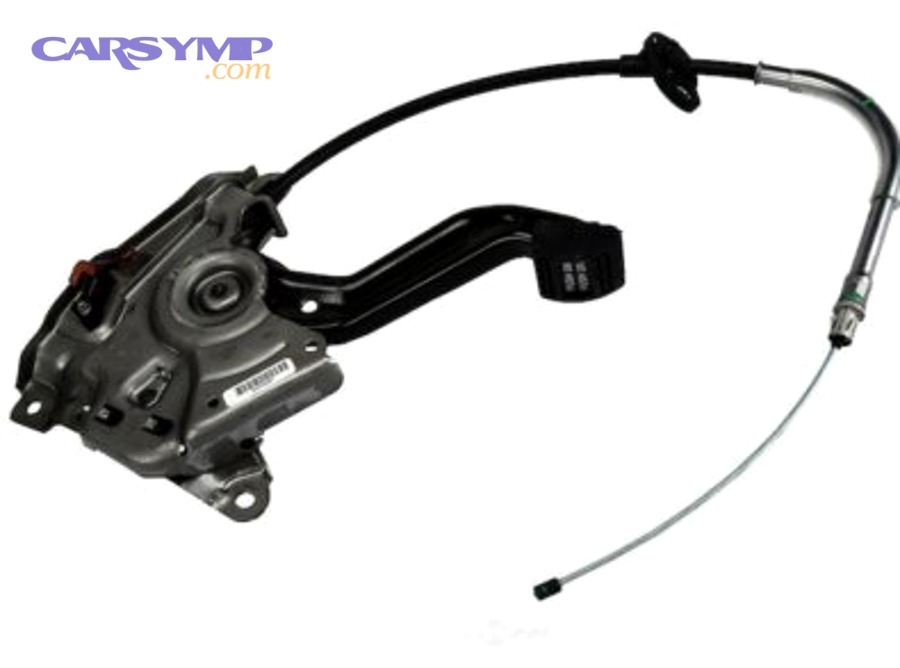
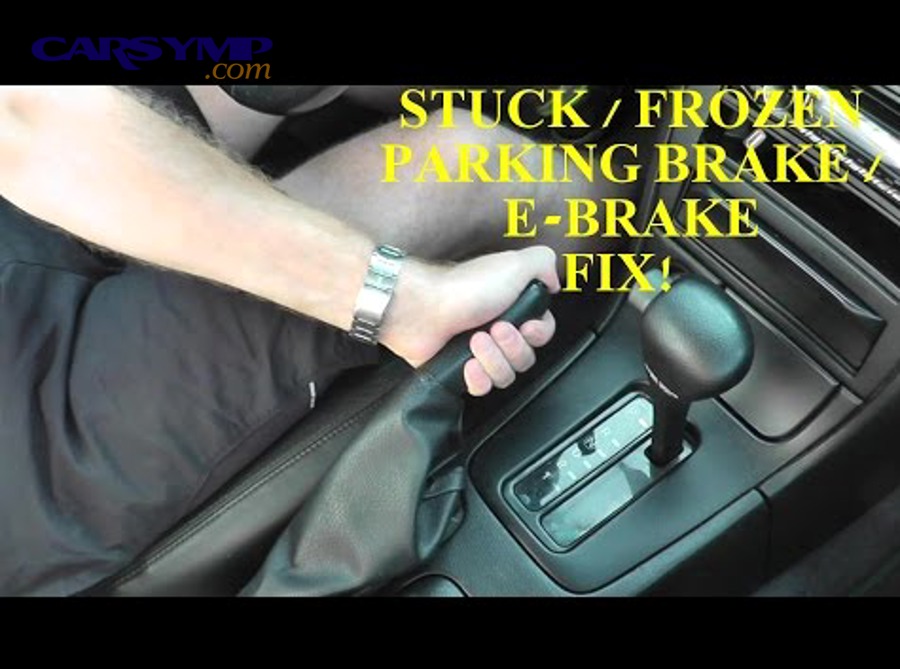
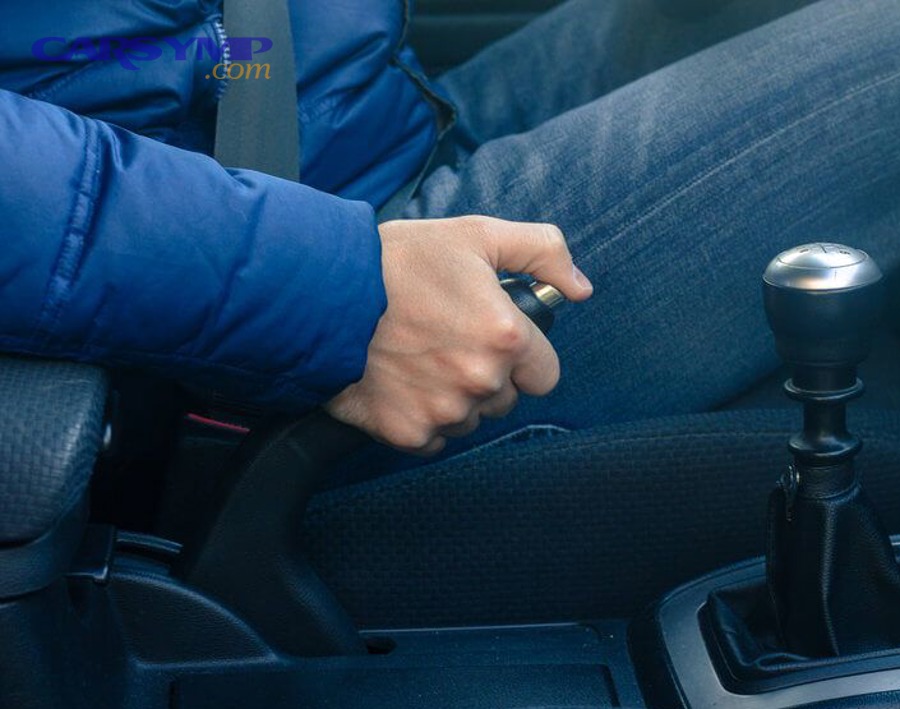
- Cable-operated parking brake (hand lever or foot pedal): A lever/pedal pulls a front cable, which pulls an equalizer and then two rear cables, applying force at the rear brakes.
- Electronic Parking Brake (EPB): A switch commands a control module to drive actuator motors (often on the rear calipers) that apply and release clamping force.
In either design, “stuck on” is not a mystery symptom—it’s a mechanical state you can verify because something is still holding friction material against a rotor or drum. The friction point can be:
- Rear disc brakes with a caliper-integrated parking mechanism: A lever or internal screw mechanism in the caliper doesn’t return fully.
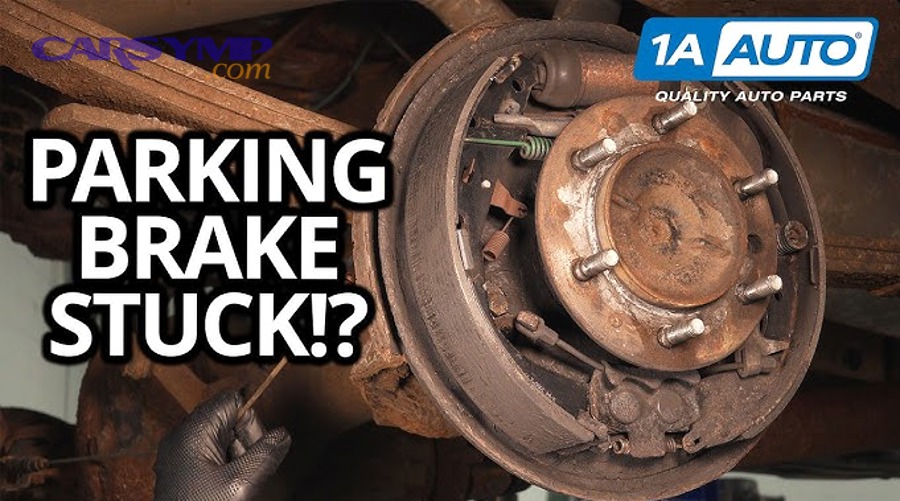
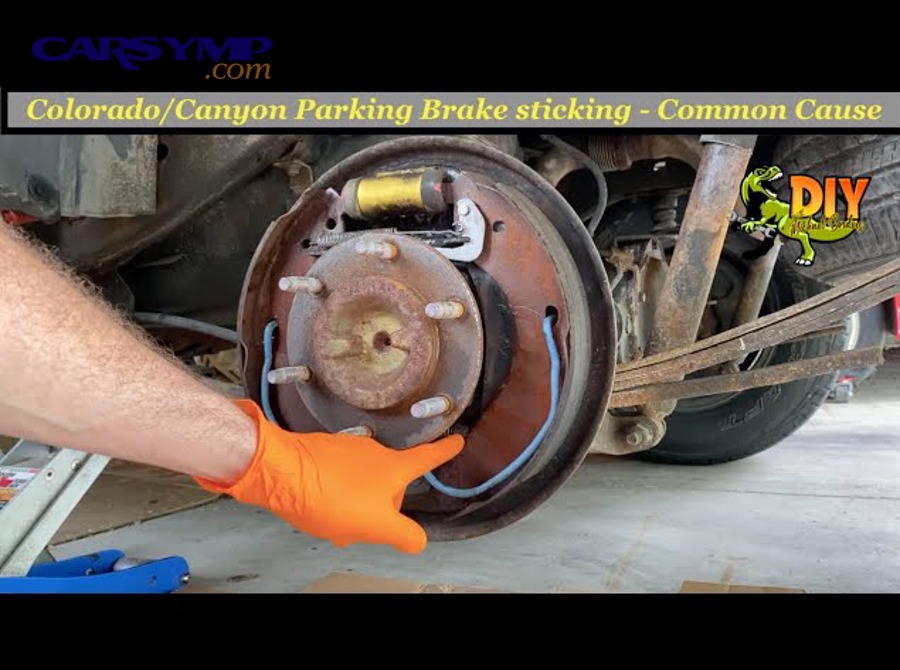
- Rear drum brakes (or “drum-in-hat” inside a rotor hat): Shoes remain expanded against the drum surface.
- EPB calipers: Actuators fail to retract, the system faults, or service mode was not completed correctly.
The parts most often involved in a stuck condition include the cable sheath and inner wire, equalizer and pivots, rear caliper parking lever/return spring, shoe hardware and adjuster, and—on EPB systems—the actuator motor, wiring, and control logic.
Is a “parking brake stuck on” the same problem as an “emergency brake stuck on”?
Yes—“parking brake” and “emergency brake” usually refer to the same system, and people use both terms because it’s designed to hold a parked vehicle and can also serve as a backup braking method in some emergencies.
However, the terminology matters because your diagnosis changes depending on whether you have a manual cable system or an Electronic Parking Brake (EPB).
Specifically, “emergency brake” is the common synonym for the parking brake, but modern EPB systems behave differently than older handbrakes:
- A cable handbrake feels mechanical and can stick from rust or frozen cables.
- An EPB can stick from motor/actuator faults, low voltage, or module errors, even if no cable is present.
So when you see “parking brake stuck on” and “emergency brake stuck on,” treat them as the same symptom label, then immediately identify which system you have.
Can a parking brake be “stuck on” even if the handle/pedal feels released?
Yes, a parking brake can be stuck on even if the handle/pedal feels released because (1) the rear mechanism can bind, (2) the cable can seize inside its sheath, and (3) the return spring or lever can fail to pull the system fully back to rest.
Then, the key is to separate “control feels normal” from “brakes are actually released.”
For example, a hand lever might drop normally, but the rear caliper lever remains rotated, or a drum shoe remains expanded due to rusted hardware. With EPB, the switch can indicate release while the module stores a fault and keeps actuator tension.
Practical signs the system is still applied include a dragging feel at low speed, a hot smell, reduced coasting, or one rear wheel that becomes much hotter than the other after a short drive.
What are the most common causes of a stuck parking brake?
There are 5 main cause groups of a stuck parking brake: corrosion/rust bonding, freezing/ice, cable binding or misadjustment, seized rear brake hardware (caliper mechanism or drum shoe components), and Electronic Parking Brake (EPB) faults—based on whether the hold-up is mechanical friction or electronic actuation.
Next, you can narrow the correct group quickly by matching the cause to your brake design and the moment the symptom began.
A useful way to think about “causes” is to separate what initiated the sticking (water + time, cold + moisture, long storage, recent service, etc.) from what component is now physically preventing release (cable, lever, adjuster, actuator).
Which causes are most common on cable-operated parking brakes?
There are 4 main cable-system causes: rusted/dragging cables, seized equalizer/pivot points, weak or broken return springs, and misadjusted or overtightened cable travel—based on where resistance builds in the linkage.
Moreover, cable systems tend to stick gradually (more drag over time) unless freezing creates a sudden lockup.
1) Rusted cable inside the sheath
The most common cable-related failure is internal corrosion. The outer sheath may look fine, but the inner wire rusts, frays, and binds. When you “release,” the lever goes down but the cable doesn’t slide back freely.
2) Equalizer binding or seized pivots
The equalizer is a small linkage that distributes pull to left and right rear cables. If it rusts or its pivots seize, both rear brakes can drag because the equalizer never returns to neutral.
3) Return spring weakness or failure
Many designs rely on springs at the rear brakes to pull the mechanism back. When springs weaken, you get incomplete release, which can feel like a mild drag that worsens under heat.
4) Misadjustment or cable stretch
Cables stretch over time, which usually creates a “won’t hold” problem—but misadjustment after service can also create a “won’t release fully” problem if someone tightens the adjuster too far. This is where Weak parking brake adjustment steps become relevant: the goal is to restore correct travel without preload that causes drag.
If your car has a traditional handbrake, these cable issues are also the most common reason you end up needing parking brake repair beyond simple cleaning and lubrication.
Which causes are most common on rear caliper–integrated parking brakes?
There are 3 main caliper-integrated causes: a stuck parking brake lever, a seized internal screw mechanism, and caliper slide/piston problems that mimic parking brake drag—based on whether the clamping force is failing to retract or the caliper body can’t float.
Then, you can spot caliper-related sticking because it often affects one side more severely.
1) Parking brake lever not returning
Some rear disc calipers have an external lever for the parking brake. Rust, dirt, or a damaged return spring can keep the lever from returning, which keeps pressure applied.
2) Internal screw mechanism seizing
Many rear calipers use an internal screw/ratchet mechanism for parking brake function. When it seizes or binds, it may apply but not retract smoothly, producing constant drag.
3) Slide pin or piston issues
Not every rear drag problem is the parking brake itself. A stuck slide pin or corroded piston seal can keep a pad dragging. However, because the symptom looks identical to a parking brake stuck on, you diagnose by checking whether the parking lever is resting fully and whether the drag changes when you operate the parking brake.
In real-world repairs, this is the crossroads where a shop decides between caliper replacement, cable service, or deeper brake hardware service—so accurate diagnosis saves money and time.
Which causes are most common on drum or “drum-in-hat” parking brakes?
There are 4 main drum-style causes: shoe-to-drum rust bonding, seized star-wheel adjusters, broken or mispositioned hardware springs, and shoe lining separation—based on how the shoes expand and retract inside the drum surface.
More specifically, drum-style parking brakes are highly sensitive to corrosion and long periods of non-use.
1) Shoe-to-drum rust bonding (“stiction”)
If the vehicle was parked wet, the shoe lining can rust-bond to the drum surface. This is especially common after rain, washing, or coastal exposure.
2) Star-wheel adjuster seizure
Adjusters are exposed to dust and moisture. When they seize, shoes may not retract or may remain too close, causing drag.
3) Broken hardware springs
Weak or broken springs fail to retract shoes properly. The result can be intermittent drag that gets worse with heat.
4) Lining separation
In older shoes, lining can separate from the metal shoe, wedge inside the drum, and “lock” the assembly.
When drum-in-hat designs stick, they can mislead DIYers because the rear caliper may look fine, yet the parking brake inside the rotor hat is the true culprit.
Which causes are most common on Electronic Parking Brake (EPB) systems?
There are 4 main EPB causes: actuator motor failure, low voltage or battery events, module/switch faults, and service-mode or calibration mistakes—based on whether the system cannot retract mechanically or is prevented from retracting electronically.
Besides mechanical sticking, EPB introduces diagnostic clues such as warning messages and scan-tool requirements.
1) Actuator motor/gear failure
Actuators can fail internally, strip gears, or bind. The system may apply but not release, or it may release slowly and inconsistently.
2) Low voltage events
EPB systems are voltage-sensitive. A weak battery can cause incomplete release, stored faults, or a system lock state designed to protect components.
3) Switch or module faults
A failed switch, damaged wiring, or module logic error can prevent correct release commands from executing.
4) Service-mode mistakes after brake work
Many vehicles require a scan tool or a specific procedure to place EPB into service mode for rear brake service. If the procedure is interrupted or not completed, the system can behave like it’s stuck.
If you suspect EPB issues, consider professional diagnosis early—because forcing components can damage actuators and raise repair costs.
How can you diagnose the cause of a stuck parking brake using symptoms?
You can diagnose the cause of a stuck parking brake by using 4 symptom checkpoints—(1) one wheel vs both rears, (2) when it started, (3) control feel and warning indicators, and (4) heat/smell—so you can match the symptom pattern to the most likely component.
Then, you move from observation to targeted checks instead of random part swapping.
Start with the safest “no-tools” observations:
- Is the vehicle hard to roll in neutral (flat surface, safely controlled)?
- Does it pull slightly to one side when moving?
- Do you smell heat near a rear wheel?
- Did this begin after rain/wash, freezing night, long storage, or recent brake service?
- Is there an EPB warning or parking brake light behavior that’s new?
Below is a quick diagnostic map to keep the process clear.
Does it usually mean a cable problem if both rear wheels drag?
Yes, both rear wheels dragging often indicates a cable/equalizer or upstream control issue because (1) a shared front cable/equalizer can hold both sides, (2) a seized equalizer can prevent return travel, and (3) EPB logic can apply both actuators together.
However, you still confirm by checking whether one side is dramatically hotter, which can point to a single seized component superimposed on a system-wide tension issue.
Specifically, if both rear wheels show similar drag:
- On manual cable systems, suspect the front cable, equalizer, or a misadjusted cable that never goes slack.
- On EPB, suspect a control/voltage condition or a command state affecting both rear actuators.
If only one side is significantly hotter, or if the vehicle yaws slightly, you may have a primary problem on one corner even though the linkage seems system-wide.
Does one hot wheel usually indicate a seized caliper or stuck parking-brake mechanism on that side?
Yes, one hot wheel usually indicates a seized mechanism on that side because (1) a stuck caliper lever or internal screw can hold clamping force, (2) a frozen cable on one side can keep one rear brake applied, and (3) broken shoe hardware can jam one drum-in-hat assembly.
Therefore, “one hot corner” is your strongest clue that the issue is localized.
More specifically, one-side drag typically follows these patterns:
- Rear caliper-integrated parking brake: lever doesn’t rest fully, return spring weak, internal screw binds.
- Single rear cable bind: sheath corrosion causes that cable to retract slowly or not at all.
- Drum-in-hat jam: broken spring or lining wedge causes constant drag.
A simple safety rule helps here: if the wheel is hot enough to smell strongly or radiate heat, stop driving and let it cool—heat is a damage multiplier.
If it happened after rain, washing, or sitting overnight, is rust bonding the likely cause?
Yes, rust bonding is likely when the problem starts after wet parking because (1) moisture sits between pad/shoe and iron surface, (2) corrosion products create adhesion under static pressure, and (3) non-use allows the bond to strengthen overnight.
Then, the “after rain” timing becomes your hook into the corrosion-stiction explanation.
This “stiction” phenomenon is well described in braking system corrosion literature: static contact in aggressive environments can create strong adhesion at the friction interface that impairs release. (pmc.ncbi.nlm.nih.gov)
Practical confirmations include:
- The car initially won’t move, then “pops” free once force overcomes adhesion.
- The problem is worse after longer parking.
- The braking system otherwise feels normal once freed, at least temporarily.
If rust bonding repeats frequently, that’s your cue to address the underlying exposure, add preventive habits, and consider a deeper inspection.
If it only happens in freezing temperatures, is ice/frozen cable the likely cause?
Yes, freezing conditions often point to ice or a frozen cable because (1) water can enter cable sheaths and freeze, (2) ice can bond shoes/pads to their surfaces, and (3) thaw/refreeze cycles make sticking unpredictable.
Next, you treat cold-weather sticking as a “conditions-driven” failure, not purely a wear-driven one.
Typical scenarios:
- You applied the parking brake after driving through slush or a car wash.
- The temperature dropped overnight.
- The brake will release after warming the vehicle or moving it into a warmer environment.
If freezing is the repeating trigger, prevention becomes as important as repair: avoid setting the parking brake when components are wet and temperatures will fall below freezing (use wheel chocks on flat ground when appropriate and safe).
When is a stuck parking brake unsafe to drive, and when should you tow?
No, it is not safe to keep driving with a parking brake stuck on because (1) heat can rapidly damage pads, rotors, and wheel bearings, (2) braking balance can become unstable, and (3) the risk of tire or component failure increases as temperature rises.
Thus, your safety decision should come before any DIY attempt to “test it further.”
A stuck parking brake is especially risky because the friction is continuous. Even light drag produces heat, and heat changes everything: friction materials glaze, hardware loses temper, and grease in bearings can degrade.
To make the decision clear, use these thresholds:
- Tow / stop immediately if the car won’t roll freely, a wheel is smoking, you smell strong burning, or the vehicle feels unstable.
- Avoid driving if the parking brake light remains on and you feel drag, even if it still moves.
- Proceed only minimally (very short repositioning) if you must move off a hazard—then stop and diagnose.
Should you stop driving if you smell burning or see smoke from a wheel?
Yes, you should stop driving immediately if you smell burning or see smoke because (1) you may be overheating friction material and rotor/drum surfaces, (2) you can ignite grease or rubber components, and (3) continued driving can turn a simple sticking issue into a major brake repair.
Then, the safe move is to reduce heat, not to “push through.”
Do this instead:
- Pull over safely and turn off the engine.
- Keep your foot brake applied only as needed to secure the car, then shift to Park (or gear) and use wheel chocks if available.
- Let the brakes cool naturally; avoid spraying water on hot components (thermal shock can crack rotors).
This is the point where towing is usually cheaper than replacing cooked brake components.
Is it safe to “force it loose” by driving with the brake dragging?
No, it’s not safe to force it loose by driving with drag because (1) you can overheat the braking system quickly, (2) you may damage calipers, shoes, or EPB actuators, and (3) you can lose braking performance when you actually need it.
However, the correct approach is controlled diagnosis, not force.
If you suspect light rust bonding (not seizure) and the vehicle is on flat ground, a gentle attempt to move the car a few inches can sometimes confirm whether it’s a temporary bond—but it should be brief, cautious, and stopped at the first sign of heavy resistance or heat.
If the vehicle fights movement, you treat it as a true stuck condition requiring inspection, lubrication, adjustment, or component replacement.
Should you get professional help if the EPB warning light stays on or the system won’t enter service mode?
Yes, you should get professional help for EPB warnings or service-mode issues because (1) EPB systems often require scan-tool commands to retract/calibrate, (2) forcing actuators can destroy gears or motors, and (3) fault codes are the fastest path to accurate diagnosis.
Moreover, EPB problems can masquerade as mechanical sticking even when the hardware is fine.
If your dashboard shows “Parking Brake Malfunction,” “Service Parking Brake,” or similar, treat it as a system fault first. A technician can read codes, check voltage history, and verify actuator operation.
If you want a visual primer on EPB behavior and sticking, one practical video reference is below.
How do you prevent a parking brake from sticking again?
You prevent a parking brake from sticking again by combining 5 habits—regular use, avoiding wet-and-freezing engagement, keeping cables and hardware protected, correcting adjustment without preload, and maintaining EPB voltage health—so the system releases cleanly every time.
In addition, prevention becomes easier once you know which cause group hit your vehicle in the first place.
The prevention plan differs slightly by system type:
- Cable systems: protect and maintain cable movement and correct adjustment.
- Drum/drum-in-hat: reduce corrosion exposure and keep hardware functional.
- EPB: keep electrical health stable and follow correct service procedures.
This is also where parking brake repair becomes proactive rather than reactive: you service the “stick points” before they seize.
Does using the parking brake regularly reduce sticking from corrosion?
Yes, regular use reduces sticking from corrosion because (1) movement scrubs light surface rust, (2) cables and pivots stay free instead of “setting” in one position, and (3) return springs cycle and maintain their function.
However, the exception is extreme cold and wet conditions, where you may choose alternative securing methods to prevent freezing.
If your vehicle is stored for long periods, occasional cycling of the parking brake (in safe conditions) can reduce the chance of a stuck-on surprise.
A key detail: regular use helps most when the system is healthy. If the cable is already fraying or the caliper mechanism is failing, use won’t fix it—inspection will.
What maintenance items reduce the risk of sticking?
There are 6 main maintenance items that reduce sticking risk: cable inspection, correct adjustment, rear brake hardware renewal, caliper lever/slide service, corrosion control, and EPB battery/charging checks—based on removing resistance points and restoring return force.
Especially, these items connect directly to the “why it stuck” causes you diagnosed earlier.
1) Inspect cables and sheaths
Look for cracked sheaths, rust trails, fraying strands, or uneven movement. If one side retracts slowly, you’re likely heading toward replacement.
2) Adjust correctly (avoid constant preload)
If your parking brake is weak, many people overtighten the adjuster until it drags. Instead, follow Weak parking brake adjustment steps as a concept: set the shoes/pads correctly first (where applicable), then adjust cable travel to spec so it holds firmly without dragging at rest.
3) Renew drum/drum-in-hat hardware kits when worn
Springs and adjusters age. Replacing weak hardware restores reliable retraction.
4) Service caliper levers and slide pins
On rear calipers with parking levers, ensure the lever returns fully and slide pins move freely with correct brake lubricant.
5) Address corrosion exposure
If you live in a salt-belt region, rinse undercarriage seasonally and avoid parking the car wet for long periods when possible.
6) Maintain battery/charging health for EPB
EPB systems respond badly to low voltage. A weak battery can create intermittent faults that look like mechanical sticking.
Evidence matters most when talking about heat risk: repeated friction generates high temperatures, and brake heat behavior is widely studied in engineering. According to a study by Chalmers University of Technology from mechanical engineering research, in 2019, brake systems can experience significant temperature changes that require accurate thermal modeling to manage heat transfer and avoid performance issues. (research.chalmers.se)
What related symptoms and special cases can look like a “stuck parking brake”?
A “stuck parking brake” can be confused with 4 related situations—warning light anomalies, hydraulic brake drag, EPB auto-hold behavior, and drum-in-hat quirks—because they produce similar signals while involving different mechanisms.
Next, this is where you refine your diagnosis and avoid fixing the wrong thing.
What does it mean if the parking brake light stays on but the brake doesn’t feel stuck?
A parking brake light that stays on without obvious drag usually means (1) the switch/sensor is misreporting, (2) the system detected an EPB fault, or (3) the vehicle uses a shared warning indicator that can also reflect other brake system alerts.
Then, you treat “light on” as a signal to confirm drag rather than assuming drag exists.
Practical checks:
- Confirm whether the car rolls freely and whether any wheel heats up.
- Check whether the light behavior changes when you apply/release the brake.
- On EPB vehicles, watch for a message indicating a malfunction.
If there’s no drag but the warning persists, the next step is often scan-tool diagnostics—because stored faults can tell you whether it’s a switch, actuator, or module issue.
What is the difference between “parking brake stuck on” and “parking brake won’t hold”?
A stuck-on parking brake is a failure to release, while a parking brake that won’t hold is a failure to apply sufficient holding force—so the first creates drag and heat, and the second creates roll-away risk.
However, the two can be linked if someone compensates for weak holding by overtightening adjustment until it drags.
Typical causes differ:
- Stuck on: corrosion, frozen cable, seized lever/adjuster, EPB fault.
- Won’t hold: stretched cable, worn shoes/pads, misadjustment in the “loose” direction, or worn hardware.
This is where a Parking brake cable replacement overview becomes useful conceptually: if cables are stretched, corroded internally, or fraying, replacement restores both correct holding and correct release because the cable can move freely and return fully.
How do EPB auto-hold and low battery issues contribute to stuck engagement?
EPB auto-hold and low battery issues can contribute to stuck engagement because (1) auto-hold can keep the rear brakes applied longer than a driver expects, (2) low voltage can interrupt release cycles, and (3) the module may lock or limit operation when faults occur to protect actuators.
Moreover, what feels like “stuck” can sometimes be the system doing exactly what it was programmed to do—until voltage or calibration issues push it into malfunction.
If the issue is intermittent and tied to cold starts, short trips, or battery warnings, electrical health rises on your suspect list. A battery test and charging system check is often cheaper than replacing actuators blindly.
What should you know about drum-in-hat parking brakes (rare design) that can confuse diagnosis?
Drum-in-hat parking brakes can confuse diagnosis because (1) the rear caliper can be healthy while the parking shoes inside the rotor hat are jammed, (2) hardware springs and adjusters can seize unseen, and (3) rust bonding inside the hat is common after wet parking.
Therefore, if you have rear rotors with an internal drum surface, you must include that hidden assembly in your cause checklist.
If your diagnosis points to drum-in-hat, the repair may require rotor removal and hardware inspection. Done correctly, this is often a straightforward mechanical service—yet it’s easy to miss without knowing the design exists.
According to a review of corrosion-stiction in braking systems, static conditions in aggressive environments can create adhesion at friction interfaces that impairs reliability—an effect that closely matches the “parked wet, stuck the next morning” pattern drivers report. (pmc.ncbi.nlm.nih.gov)