


Choosing between rim repair and replacement depends on seven critical factors: damage severity, cost comparison, safety implications, material type, timeline needs, environmental impact, and resale value considerations. Minor cosmetic damage like scratches typically costs $75-$150 to repair, while severe structural issues such as deep cracks or significant bends require replacement at $200-$1,000+ per wheel to ensure driving safety.
The first decision factor centers on understanding cost differences between both options. Rim repair delivers substantial savings for minor damage, whereas replacement becomes necessary when repair costs approach 70-80% of a new wheel’s price. This cost-benefit analysis shifts dramatically based on whether you own steel rims with lower replacement costs or alloy rims where repair becomes more economically justified.
Safety assessment forms the second critical consideration in your decision process. Structural integrity determines whether a repaired rim can safely support your vehicle’s weight and withstand road stresses. Professional inspection reveals when damage compromises the wheel’s core structure, making replacement the only safe option regardless of repair costs.
Material composition, turnaround time, sustainability concerns, and vehicle resale value round out the remaining factors that influence your choice. Below, we’ll examine each decision factor in detail to help you make an informed choice that balances safety, cost, and long-term value.
What Is the Difference Between Rim Repair and Rim Replacement?
Rim repair involves restoring a damaged wheel through straightening, welding, refinishing, or surface treatment processes, while rim replacement means installing a completely new wheel that matches your vehicle’s specifications. The fundamental difference lies in whether you restore the existing component or substitute it entirely with a new part.
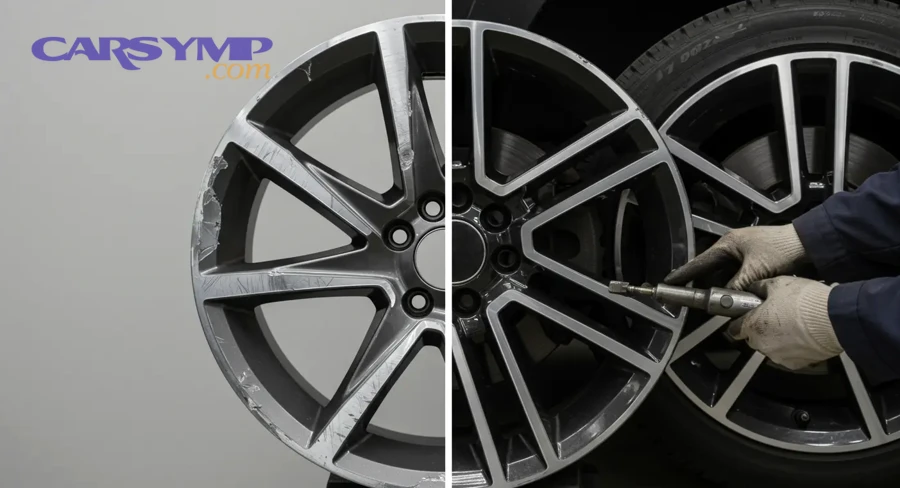
Understanding these two approaches helps clarify when each option becomes appropriate for your situation. Rim repair addresses damage without removing the wheel permanently from service, whereas replacement provides a fresh start with guaranteed structural integrity.
The Rim Repair Process Explained
The Wheel straightening process explained begins with professional assessment using specialized equipment to measure deviation from true roundness. Technicians mount the damaged rim on a hydraulic press or computerized straightening machine that applies controlled pressure to bent areas. The process gradually reshapes the metal back to factory specifications, typically achieving tolerances within 0.5mm of original measurements.
For surface damage, repair shops employ sanding, welding, and refinishing techniques. Minor scratches and curb rash receive treatment through progressive sanding with finer grits, followed by powder coating or paint application that matches the original finish. More substantial damage may require TIG welding to seal small cracks before refinishing, though Safety concerns with welded wheel repairs remain significant when cracks extend beyond surface level.
The entire rim repair typically takes 1-2 days for standard damage, with same-day service available for minor cosmetic issues at many facilities. Professional shops conclude repairs with wheel balancing to eliminate vibrations and ensure smooth rotation at highway speeds.
The Rim Replacement Process Explained
Rim replacement starts with identifying the correct wheel specifications for your vehicle, including diameter, width, bolt pattern, offset, and center bore measurements. You face choices between Original Equipment Manufacturer (OEM) wheels that exactly match factory specifications or aftermarket options that meet industry standards while potentially offering different styling.
Once you select a replacement wheel, installation involves removing the tire from the damaged rim, mounting it on the new wheel, and properly balancing the assembly. This process requires specialized tire-changing equipment and balancing machines to ensure safe operation. The replacement wheel must undergo torque verification to confirm lug nuts meet manufacturer specifications, preventing wheel detachment during operation.
Total replacement timelines extend from immediate installation if the wheel is in stock to 5-10 business days when special ordering is required for uncommon sizes or luxury vehicle applications. The process concludes with a test drive to verify proper fit and absence of vibration or handling issues.
How Much Does Rim Repair Cost Compared to Replacement?
Rim repair costs $75-$150 per wheel for standard damage, while replacement ranges from $200-$500 for basic steel wheels and $400-$1,000+ for alloy or performance wheels, making repair approximately 50-75% less expensive for minor to moderate damage. The cost advantage of repair diminishes when damage requires extensive welding or multiple repair processes that push pricing toward replacement thresholds.
However, comparing the price tags alone overlooks important financial considerations. The true cost comparison must factor in long-term value, safety implications, and whether the repaired wheel will require additional service within the next few years.
When Is Rim Repair More Cost-Effective?
Single-wheel damage scenarios favor repair most strongly because you avoid purchasing a complete set to maintain matching appearance. When one wheel sustains curb damage while the other three remain pristine, repair costs of $100-$150 preserve your existing matched set without the $800-$3,000 expense of four new wheels.
Minor cosmetic damage delivers the strongest cost-benefit ratio for repair. Surface scratches, scuffs, and shallow curb rash affect only the wheel’s outer coating without compromising structural metal. These repairs typically cost $75-$100 and restore appearance to near-original condition through refinishing techniques that sand away damage and apply fresh protective coating.
Budget constraints often make repair the only viable immediate option when replacement costs exceed available funds. A $100 repair allows you to maintain safe vehicle operation while saving for eventual replacement if desired, whereas delaying all service creates safety risks from driving on damaged wheels. This approach works best for cosmetic damage or minor bends that don’t compromise structural safety.
Light bends affecting wheel balance represent another cost-effective repair scenario. When Bent rim symptoms include steering wheel vibration at highway speeds but no visible cracking, professional straightening restores proper geometry for $100-$150. The repair eliminates vibration and uneven tire wear that would otherwise cost hundreds in premature tire replacement.
When Does Replacement Provide Better Long-Term Value?
Severe structural damage tips the cost equation toward replacement despite higher upfront costs. When rim repair requires extensive welding, multiple straightening attempts, or addresses damage approaching structural failure points, repair costs climb to $200-$300 per wheel. At this price level, replacement provides superior long-term value through guaranteed structural integrity and manufacturer warranties.
Multiple previous repairs on the same wheel signal diminishing returns for additional repair attempts. Each repair cycle stresses the metal through heat application or mechanical pressure, reducing the material’s fatigue resistance. A wheel with two or three prior repairs becomes increasingly likely to fail even after successful subsequent repairs, making replacement the safer long-term investment.
Deep cracks extending through the wheel’s cross-section cannot be safely repaired regardless of cost. While some shops offer welding services for crack repair, safety concerns with welded wheel repairs include reduced fatigue strength at weld points and invisible internal crack propagation. Replacement costs of $300-$500 for standard alloy wheels eliminate these safety risks entirely.
Cost approaching the replacement threshold creates a clear decision point. When repair estimates reach 70-80% of replacement cost—for example, a $350 repair quote versus $450 for new—replacement delivers better value through longer service life and no compromise in structural integrity. This calculation changes based on wheel type, with expensive performance or luxury wheels justifying higher repair costs before replacement becomes economically superior.
According to industry data from tire and wheel specialists, properly repaired wheels serve 3-5 years on average before requiring additional service, while new replacement wheels typically last 7-10 years under normal driving conditions, making replacement 40-50% more cost-effective over a decade-long ownership period.
Is Your Rim Damage Minor or Severe Enough to Require Replacement?
Your rim damage requires replacement if it includes structural cracks exceeding 1 inch, bends greater than 15 degrees from true, or damage affecting multiple wheel sections simultaneously, while surface scratches, minor curb rash, and small bends under 10 degrees typically qualify for safe repair. The severity classification depends on whether damage compromises the wheel’s structural integrity or merely affects cosmetic appearance.
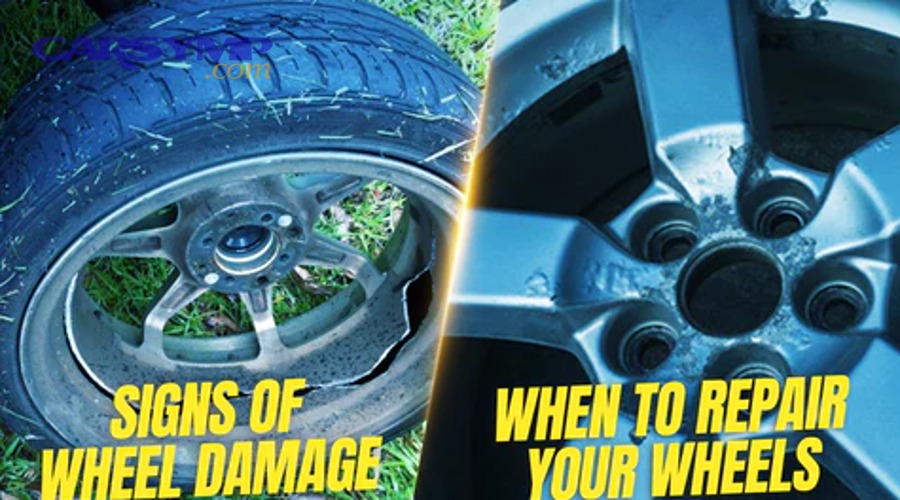
Determining damage severity requires understanding both visible indicators and potential hidden damage that affects wheel strength. Let’s examine which damage types permit repair and which necessitate immediate replacement for safety.
What Types of Rim Damage Can Be Safely Repaired?
Surface scratches and curb rash represent the most common repairable damage category. These cosmetic issues affect only the wheel’s protective coating and outer 1-2mm of material without penetrating to structural layers. Scratches ranging from hairline marks to gouges up to 3mm deep respond well to sanding, filling, and refinishing processes that restore appearance without compromising wheel strength.
Minor bends fall into the repairable category when deviation measures less than 0.25 inches (6mm) from true roundness. Professional straightening equipment can safely reshape alloy and steel wheels with slight warping caused by pothole impacts or curb strikes. The wheel straightening process explained involves computerized measurement followed by hydraulic pressure application at specific points to restore factory geometry. This repair works best on bends affecting a single area rather than multiple points around the wheel’s circumference.
Small superficial cracks measuring under 0.5 inches may qualify for repair through specialized welding techniques, though this represents the most controversial repairable damage category. TIG welding can seal hairline cracks in non-critical areas like the outer rim lip, but only when the crack hasn’t propagated into the wheel’s structural spokes or barrel. Many safety-conscious shops decline crack welding entirely due to liability concerns and the impossibility of detecting invisible internal crack extension.
Light corrosion affecting the wheel’s surface qualifies for repair when pitting depth remains under 1mm. Surface oxidation responds to chemical treatment, sanding, and protective coating application. The repair removes compromised material and seals the wheel against further corrosion progression. This damage type occurs most frequently in regions using road salt, where aluminum alloy wheels develop white oxidation patches.
Bent rim symptoms that indicate repairable damage include:
- Steering wheel vibration appearing at specific speeds (typically 45-60 mph)
- Tire pressure loss of 2-3 PSI per week without visible punctures
- Slight wobble visible when spinning the wheel off the vehicle
- Difficulty achieving proper wheel balance despite multiple attempts
- Uneven tire wear on the inner or outer edge
What Rim Damage Requires Immediate Replacement?
Severe bends exceeding 15 degrees from true or affecting multiple points around the wheel’s circumference demand immediate replacement. When a wheel shows visible egg-shaped deformation or requires more than 0.5 inches of correction, the metal has exceeded its elastic limit and entered plastic deformation range. Attempting to straighten such damage creates internal stress fractures that lead to catastrophic failure under load.
Deep or extensive cracks represent the clearest replacement indicator regardless of location or size. Any crack extending more than 1 inch, penetrating through the wheel’s thickness, or appearing in structural areas like spokes or the inner barrel compromises safety beyond repair. Cracks often indicate impact damage severe enough to create additional hidden fractures throughout the wheel’s structure. Safety concerns with welded wheel repairs intensify with crack length, as weld strength never matches parent material strength and creates heat-affected zones vulnerable to further cracking.
Large lug hole damage makes replacement mandatory because these critical load-bearing points cannot be safely repaired. Elongated, cracked, or stripped lug holes prevent proper torque application and allow wheel movement during operation. The lug holes experience repeated stress cycles from braking, acceleration, and cornering forces, making any compromise in this area extremely dangerous.
Deep corrosion penetrating beyond the surface layer into structural material requires replacement. When corrosion pitting exceeds 2mm depth or affects more than 20% of the wheel’s surface area, remaining material thickness cannot safely support vehicle loads. Aluminum alloy corrosion progresses rapidly once it penetrates protective coatings, creating internal voids that dramatically reduce strength.
Multiple damage types appearing simultaneously indicate replacement necessity even when individual issues might be repairable in isolation. For example, a wheel with both moderate bending and small cracks suggests impact severity that likely created additional hidden damage. The cumulative effect of multiple compromises reduces safety margins below acceptable levels.
Bent rim symptoms requiring immediate replacement include:
- Severe vibration starting immediately upon acceleration
- Visible wheel wobble observable while driving
- Tire pressure loss exceeding 5 PSI within 24 hours
- Inability to maintain wheel balance despite professional service
- Audible clicking or popping noises from the wheel area
- Irregular tire wear patterns across multiple areas
How Do You Determine If a Repaired Rim Is Safe to Drive On?
A repaired rim is safe to drive on when professional inspection confirms it meets three criteria: restoration to within 0.5mm of original specifications, successful completion of balancing without correction weights exceeding 2 ounces, and absence of structural cracks or stress fractures under dye penetrant testing. These verification steps ensure the repair hasn’t compromised the wheel’s ability to safely support vehicle loads and withstand road stresses.
Specifically, determining repair safety requires professional equipment and expertise beyond visual inspection capabilities. The verification process combines measurement precision with structural integrity testing that reveals invisible damage.
Professional inspection begins with mounting the wheel on a runout measurement device that rotates it while precision sensors detect deviations from perfect roundness. Acceptable repairs show lateral runout (side-to-side wobble) under 0.030 inches and radial runout (out-of-round) under 0.050 inches. Measurements exceeding these tolerances indicate incomplete repair that will cause vibration and premature tire wear.
Structural integrity testing employs several verification methods depending on repair type. For straightened wheels, technicians examine the repair area under magnification for hairline cracks that indicate over-stressing during the straightening process. Welded repairs require dye penetrant testing, where colored liquid seeps into surface cracks and reveals defects invisible to naked eye inspection. Properly executed repairs show no dye indication around weld areas.
Post-repair balancing serves as a functional safety test that reveals hidden damage. The wheel mounts on a computerized balancing machine that measures weight distribution while spinning. Repairable wheels should balance with correction weights totaling under 2 ounces—heavier weight requirements suggest internal damage or geometric irregularities that compromise safety. The balancing process also detects slight bends that measurement devices might miss through high-speed rotation.
What Are the Safety Risks of Driving on Improperly Repaired Rims?
Tire pressure loss represents the most common safety risk from inadequate rim repairs. When straightening fails to completely restore the bead seating surface, microscopic gaps allow air to escape between tire and wheel. Progressive pressure loss reduces tire stiffness, increases rolling resistance, and generates excessive heat buildup that can trigger sudden blowouts at highway speeds.
Vibration and handling issues stem from incomplete repairs that leave residual geometric irregularities. Even 1mm of remaining bend creates noticeable vibration that intensifies with speed, making the vehicle difficult to control at highway velocities. The vibration transmits through suspension components, accelerating wear on ball joints, tie rod ends, and wheel bearings while creating driver fatigue from constant steering corrections.
Brake system complications arise when repaired wheels don’t maintain proper alignment with brake components. Slight wheel wobble causes brake pads to make uneven contact with rotors, creating pulsation during braking and accelerating pad and rotor wear. Severe cases produce brake fade from inconsistent contact pressure that reduces stopping power in emergency situations.
Complete rim failure represents the catastrophic safety risk from structurally inadequate repairs. Wheels operating with hidden cracks or over-stressed material gradually deteriorate until sudden fracture occurs. Failure typically happens during heavy loading from cornering, braking, or pothole impacts, causing immediate loss of vehicle control. Front wheel failure commonly results in complete loss of steering, while rear wheel failure creates violent instability.
ABS and traction control system impacts occur when damaged or poorly repaired wheels create irregular rotation patterns. The vehicle’s electronic stability systems detect unexpected wheel speed variations and may activate inappropriately, interfering with normal driving. Severe irregularities can disable these safety systems entirely, leaving the vehicle without electronic stability assistance during emergency maneuvers.
According to research published by the National Highway Traffic Safety Administration in 2023, wheel-related failures contribute to approximately 6,000 crashes annually in the United States, with improper repairs identified as a contributing factor in 15-20% of these incidents.
Can You Trust Professional Rim Repairs for Safety?
Professional rim repairs meet safety standards when performed by certified technicians using industry-standard equipment and procedures. Reputable shops employ wheel straightening machines with computerized measurement systems, TIG welding equipment for aluminum alloy repairs, and proper refinishing capabilities that restore both appearance and corrosion protection.
Certification standards from organizations like the Tire Industry Association provide verification that technicians have completed training in proper repair techniques and safety assessment. Certified professionals understand material limitations, recognize unrepairable damage, and decline service when repairs would compromise safety. This expertise separates professional service from discount operations that prioritize profit over proper repair protocols.
Warranty offerings signal shop confidence in repair quality and provide customer protection against premature failure. Established repair facilities typically guarantee work for 12-24 months, covering both workmanship and material defects. The warranty should specifically address structural integrity, not merely cosmetic finish, and include remedies if the repair fails to perform as promised.
Proper repairs matching OEM specifications restore wheels to factory performance levels when damage falls within repairable parameters. Professional straightening achieves tolerances identical to new wheel manufacturing standards, while refinishing processes duplicate factory coating thickness and adhesion properties. These repairs deliver service life comparable to undamaged wheels when executed correctly on appropriate damage types.
Red flags indicating unsafe repair practices include:
- Shops willing to repair severe structural damage or deep cracks
- Absence of precision measurement equipment for verifying repair accuracy
- No written warranty on structural integrity
- Reluctance to show the repair process or equipment used
- Significantly lower pricing than competitor quotes (suggesting shortcuts)
- Pressure to accept repairs without discussing replacement options
- Welding repairs on high-stress areas like spokes or inner barrels
The difference between safe and unsafe repairs often comes down to equipment investment and technician training. Shops charging premium prices typically operate computerized straightening machines costing $15,000-$30,000 that achieve precision impossible with manual hydraulic presses. This equipment investment reflects in both repair quality and safety verification capabilities.
Does Your Rim Material (Alloy vs Steel) Affect the Repair vs Replacement Decision?
Your rim material significantly affects the repair versus replacement decision, with alloy wheels justifying repair costs up to 80% of replacement price due to $400-$1,000+ replacement costs, while steel wheels favor replacement when repair exceeds 50% of the $200-$300 replacement price. Material properties also determine repairability, as aluminum alloy responds better to straightening and welding compared to steel’s tendency toward permanent deformation and limited weldability.

Material composition influences both the economic calculation and technical feasibility of repair. Understanding these material-specific factors helps you make appropriate decisions based on your wheel type.
Are Alloy Rims Worth Repairing More Often Than Steel Rims?
Alloy rims justify higher repair investment because replacement costs create favorable economics even for moderate damage. A $250 repair on an alloy wheel damaged by curb impact costs 25-40% of a $600-$1,000 replacement, whereas the same repair on a steel wheel costing $200-$300 to replace represents 80-125% of replacement cost. This economic reality makes repair viable for alloy wheels in situations where steel wheel replacement becomes more sensible.
Aluminum alloy material properties enable superior repair outcomes through better responsiveness to straightening processes. The alloy’s ductility allows technicians to reshape bent areas without creating the stress fractures common in steel. Alloy wheels can undergo straightening for bends up to 20 degrees in some cases, while steel wheels develop cracks when straightening exceeds 10-12 degrees of correction.
Refinishing results favor alloy wheels through better coating adhesion and appearance retention. Powder coating applied to properly prepared aluminum alloy creates durable finishes matching or exceeding factory quality. The refinishing process for alloy wheels includes chemical cleaning that removes oxidation and creates microscopically rough surfaces for superior coating adhesion. This preparation enables repairs to maintain appearance for years without peeling or discoloration.
Higher original value preservation through repair makes alloy wheel service worthwhile. Vehicle resale value suffers more from mismatched or damaged alloy wheels than from steel wheel issues, as alloy wheels represent a premium feature. Investing $600-$800 to repair all four alloy wheels preserves potentially $2,000-$3,000 in vehicle resale value, while steel wheel condition has minimal impact on overall vehicle valuation.
Aesthetic customization availability gives alloy wheels additional repair value. During refinishing, owners can select custom colors or finishes different from original equipment, essentially combining repair with appearance upgrade. This customization option adds value beyond simple damage correction, making repair costs easier to justify.
When Should Steel Rims Be Replaced Instead of Repaired?
Steel rims favor replacement over repair when damage extends beyond superficial cosmetic issues. The lower replacement cost of $200-$300 per wheel creates a narrow window where repair makes economic sense. Only minor cosmetic damage like small scratches or paint chips justify steel wheel repair, as more substantial damage repair costs approach or exceed replacement pricing.
Corrosion penetration in steel wheels progresses rapidly once protective coatings fail. Unlike aluminum alloy which forms self-limiting oxide layers, steel corrosion continues unchecked through the material thickness. Deep rust penetrating beyond surface layers reduces load-bearing capacity and cannot be safely repaired. Replacement becomes necessary when rust pitting exceeds 1mm depth or affects more than 10% of wheel surface area.
Structural damage in steel construction creates irreparable scenarios more frequently than alloy damage. Steel’s higher rigidity means impact energy transfers directly to material fracturing rather than bending. Cracks in steel wheels propagate quickly through crystalline structures, creating failure risks that welding cannot adequately address. Professional shops typically decline welding steel wheels due to low success rates and safety liability.
Limited refinishing value on steel wheels makes appearance restoration economically questionable. Steel wheels typically feature painted finishes requiring complete coating removal, rust treatment, priming, and repainting. This process costs $100-$150 per wheel, approaching replacement cost for basic steel wheels. The refinished appearance also deteriorates faster than powder-coated alloy as paint chips more easily than powder coating.
The following comparison table summarizes key differences affecting repair decisions:
| Factor | Alloy Wheels | Steel Wheels |
|---|---|---|
| Average Replacement Cost | $400-$1,000+ | $200-$300 |
| Typical Repair Cost | $100-$250 | $75-$150 |
| Repair Cost as % of Replacement | 25-40% | 50-100% |
| Maximum Repairable Bend | Up to 20° | Up to 10° |
| Welding Success Rate | 70-80% (minor cracks) | 30-40% (limited application) |
| Refinishing Durability | Excellent (powder coating) | Moderate (paint) |
| Corrosion Resistance | Self-limiting oxide | Progressive rusting |
| Economic Repair Threshold | Up to 80% of replacement cost | Up to 50% of replacement cost |
How Quickly Can You Get Back on the Road: Repair vs Replacement Timeline?
You can get back on the road within 1-2 days through rim repair for standard damage, while replacement typically requires 3-10 days due to parts ordering, though same-day repair service exists for minor cosmetic issues and immediate replacement is possible when matching wheels are in stock. Timeline differences stem from service complexity and parts availability rather than actual work duration.
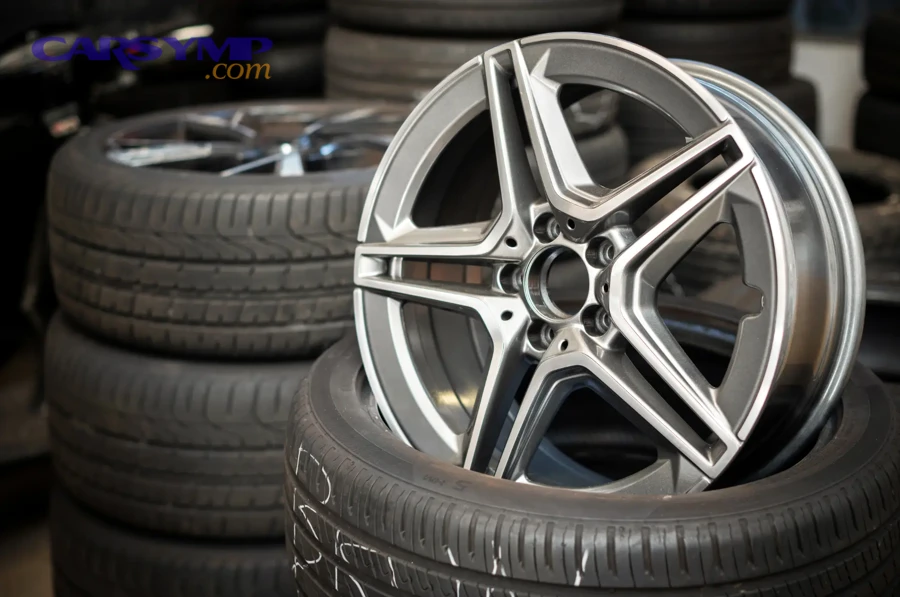
To better understand these timeline variations, we need to examine specific scenarios where each option delivers faster results.
When Does Repair Offer Faster Turnaround?
Common damage types with readily available shop capacity enable same-day repair completion. Curb rash, minor scratches, and light surface damage require only sanding, refinishing, and curing time totaling 3-6 hours. Shops specializing in cosmetic wheel repair often provide while-you-wait service for these minor issues, allowing customers to drive away the same day with restored wheels.
Mobile repair services availability further accelerates the repair timeline by eliminating shop visit requirements. Mobile wheel repair technicians travel to customer locations with portable equipment capable of addressing minor bends, scratches, and refinishing needs. This service model reduces total time investment to 2-4 hours including travel, setup, repair, and curing time, making it ideal for busy professionals unable to visit traditional repair facilities.
Local shop capacity affects repair timelines significantly during off-peak periods. Shops experiencing lighter workload during mid-week typically complete straightening and basic repairs within 24 hours, including full refinishing cycles. The repair process itself consumes only 1-2 hours of actual work time, with most delays coming from coating cure requirements and shop scheduling rather than repair complexity.
Simple straightening procedures without refinishing needs deliver fastest turnaround times. When rim damage involves only slight bends without cosmetic damage, shops can complete measurement, straightening, balancing, and reinstallation within 2-3 hours. This rapid service works particularly well for steel wheels where appearance concerns don’t demand refinishing.
When Might Replacement Actually Be Faster?
Specialty rim ordering requirements can extend replacement timelines to 7-14 days for uncommon sizes or discontinued models. Vehicles equipped with staggered fitments (different front and rear wheel sizes), luxury brands with proprietary designs, or older models with discontinued wheel patterns face extended wait periods. In these scenarios, repair becomes faster by default regardless of damage severity, as even immediate replacement order fulfillment takes longer than multi-day repair processes.
However, availability of matching replacement stock inverts this timeline equation. Vehicles using common wheel specifications—particularly mainstream manufacturer models and popular aftermarket sizes—often have replacement wheels in stock at dealerships or tire retailers. Same-day replacement becomes possible when shops stock the exact wheel specification needed, reducing the process to tire mounting and balancing time of 1-2 hours per wheel.
Severe damage requiring multi-step repairs extends timelines beyond simple replacement. When wheels need both straightening and crack welding, followed by refinishing, the repair process can span 3-5 days due to multiple curing cycles and sequential procedures. If a replacement wheel is available, installation may actually complete faster than complex repair procedures.
Seasonal demand fluctuations impact both repair and replacement timelines. During winter months in northern regions, wheel repair shops experience high volume from pothole damage, creating 3-7 day backlogs. Conversely, wheel suppliers may stock higher inventory levels during these peak damage seasons, making replacement wheels more readily available. Summer typically sees faster repair turnaround but potentially lower replacement inventory.
According to tire industry statistics compiled in 2024, average wheel replacement lead time is 4.2 days for in-network stock and 8.7 days for special orders, while average repair completion time is 1.8 days for standard damage and 3.1 days for complex repairs requiring welding or extensive refinishing.
Should You Consider Environmental Impact and Sustainability in Your Decision?
Yes, you should consider environmental impact in your rim repair versus replacement decision, as repairing a wheel prevents 20-35 pounds of aluminum or steel from entering landfills and eliminates manufacturing emissions equivalent to 150-250 pounds of CO2 per wheel for new production. Repair also consumes 85-90% less energy than manufacturing new wheels while preserving raw materials including bauxite, iron ore, and the significant water resources required for metal processing.

Specifically, the environmental calculation extends beyond simple waste reduction to encompass the entire lifecycle impact of rim production. Manufacturing new wheels demands substantial resource extraction, energy-intensive processing, and generates emissions at multiple production stages.
Manufacturing resource consumption for new rims begins with raw material extraction requiring extensive mining operations. Aluminum alloy wheels use bauxite ore that undergoes energy-intensive electrolytic processing to produce pure aluminum. This refining process consumes approximately 12-15 kWh of electricity per pound of aluminum, with a typical alloy wheel containing 20-25 pounds of material. Steel wheels require iron ore mining and blast furnace processing that, while less energy-intensive per pound, still consumes 3-4 kWh per pound for basic steel production.
Production processes release carbon emissions throughout the manufacturing chain. Aluminum smelting ranks among the most carbon-intensive industrial processes, generating approximately 6-8 pounds of CO2 per pound of aluminum produced. A single 22-pound alloy wheel therefore creates 132-176 pounds of direct production emissions before accounting for transportation, finishing, and distribution impacts. Steel wheel production generates 4-5 pounds of CO2 per pound of steel, yielding 80-100 pounds of emissions per 20-pound wheel.
Discarded wheels add to landfill waste creating long-term environmental impacts beyond initial disposal. Aluminum wheels remain in landfills essentially forever without decomposing, occupying space that could accommodate biodegradable materials. Steel wheels eventually rust but leave concentrated iron deposits that don’t reintegrate into soil ecosystems. Approximately 30 million wheels enter U.S. landfills annually, representing 300,000+ tons of metal that could be recycled or repaired for continued use.
Water resource consumption during manufacturing adds another environmental consideration often overlooked in production impact assessments. Aluminum refining requires approximately 1,000-1,500 gallons of water per ton of metal produced, primarily for cooling in electrolytic processes. A single alloy wheel therefore consumes 11-17 gallons of water during primary production, before accounting for secondary processes like machining, finishing, and quality control that add additional water requirements.
Rim repair significantly reduces these environmental impacts through material preservation. The repair process uses minimal new materials—limited to refinishing compounds, welding wire (when needed), and protective coatings. Energy consumption consists primarily of electricity for hydraulic straightening equipment and heating for powder coating curing, totaling approximately 5-8 kWh per wheel repair. This represents 90-95% energy reduction compared to new wheel manufacturing.
When sustainability aligns with practical choice, repair delivers environmental benefits without compromising safety or value. Minor to moderate damage repairs offer the most compelling environmental case, as they prevent waste while consuming minimal resources for the restoration process. The decision becomes more complex with severe damage where safety concerns may override environmental considerations, though proper recycling of replaced wheels through metal reclamation facilities can partially offset disposal impacts.
According to a 2023 study by the Aluminum Association, recycling or repairing aluminum products rather than producing new ones reduces energy consumption by 90-95% and cuts greenhouse gas emissions by 92%, making wheel repair one of the most environmentally beneficial automotive service options available.
Will Repair or Replacement Better Protect Your Vehicle’s Resale Value?
Replacement better protects resale value for severe visible damage affecting appearance, while professional repair maintains value for minor damage when refinishing restores original appearance, with the decision hinging on whether damage remains detectable after service and whether wheel specifications match OEM requirements. Potential buyers scrutinize wheel condition during vehicle inspections, assigning diminished value to visible damage or mismatched wheels regardless of structural soundness.

More importantly, the resale impact depends on vehicle category and buyer expectations. Luxury and performance vehicle buyers demonstrate higher sensitivity to wheel condition and originality than economy car buyers, making the repair versus replacement decision more consequential for premium vehicle resale.
Impact of Visible Damage on Buyer Perception
Cosmetic imperfections create immediate negative impressions during vehicle showings regardless of mechanical condition. Curb-rashed or scratched wheels signal neglect or careless driving to potential buyers, reducing perceived overall vehicle care. This perception extends beyond actual wheel value to color entire vehicle assessments, often triggering closer inspection of other components and more aggressive price negotiations.
Professional refinishing eliminates visual damage evidence when properly executed. Wheels restored through complete powder coating or paint refinishing show no detectable difference from original equipment finish. This invisibility allows sellers to present vehicles without wheel-related value deductions, maintaining asking prices that factor in good overall condition.
Visible weld repairs or incomplete refinishing undermine resale value more than original damage in some cases. Buyers recognize crude repair attempts as potential safety concerns, creating doubt about overall vehicle maintenance quality. Mismatched finish quality between repaired and original wheels draws attention even when damage was minor, suggesting incomplete restoration efforts.
The resale value difference between properly repaired and damaged wheels ranges from $500-$2,000 depending on vehicle class. Economy vehicles with damaged wheels typically see $300-$500 deductions, while luxury vehicles suffer $1,500-$2,000+ reductions for similar wheel condition issues. Professional repair costing $400-$600 therefore preserves net value of $100-$1,400 compared to selling with damaged wheels.
OEM Matching Requirements for Premium Vehicles
Luxury vehicle buyers expect complete OEM specification matching including identical wheel design, finish, and specifications across all four corners. Aftermarket replacement wheels, even when meeting or exceeding OEM quality standards, reduce resale appeal for these discriminating buyers. Original equipment preservation through repair maintains the vehicle’s factory-delivered configuration that luxury buyers value.
Premium brand certifications (like Mercedes-Benz Certified Pre-Owned) require OEM wheel compliance for program eligibility. These certification programs add $2,000-$5,000 to resale values through enhanced warranties and manufacturer backing. Single aftermarket wheel substitutions can disqualify vehicles from certification, making repair of damaged OEM wheels financially superior to replacement with even higher-quality aftermarket alternatives.
Staggered wheel configurations on performance vehicles create matching challenges that favor repair over single-wheel replacement. When front and rear wheels differ in size and offset, replacing one damaged wheel requires sourcing an exact match to three remaining wheels. Repair maintains the complete factory matched set, avoiding visual discontinuity from slightly different finishes that occur even with identical replacement models from different production batches.
Documentation of professional repairs adds value through transparency about vehicle history. Service records showing timely, professional wheel repair demonstrate responsible ownership, potentially offsetting buyer concerns about prior damage. This documentation proves more valuable than attempting to conceal repaired damage, as thorough pre-purchase inspections often reveal repair history regardless of seller disclosure.
The following scenarios demonstrate optimal choices for resale value protection:
Choose Repair When:
- Damage is minor and refinishing fully restores original appearance
- Vehicle requires OEM wheel matching for certification eligibility
- Maintaining original factory wheel set adds premium brand value
- Repair cost is under $500 and prevents $1,000+ resale value loss
- Service documentation can demonstrate quality professional restoration
Choose Replacement When:
- Damage is severe enough that repair evidence remains visible
- Structural repairs create buyer safety concerns regardless of quality
- Replacement wheels offer appearance upgrade that increases buyer appeal
- OEM replacement maintains certification eligibility better than repaired originals
- Vehicle age and class make wheel condition less influential on resale value
What Additional Factors Should You Consider Beyond the 7 Main Decision Points?
Beyond the seven main decision factors, you should consider insurance coverage availability, custom upgrade opportunities, professional assessment quality, and multi-repair history implications before finalizing your rim repair versus replacement decision. These supplementary considerations often reveal cost-recovery options or long-term safety concerns that alter the economic and practical calculus established through primary decision factors.
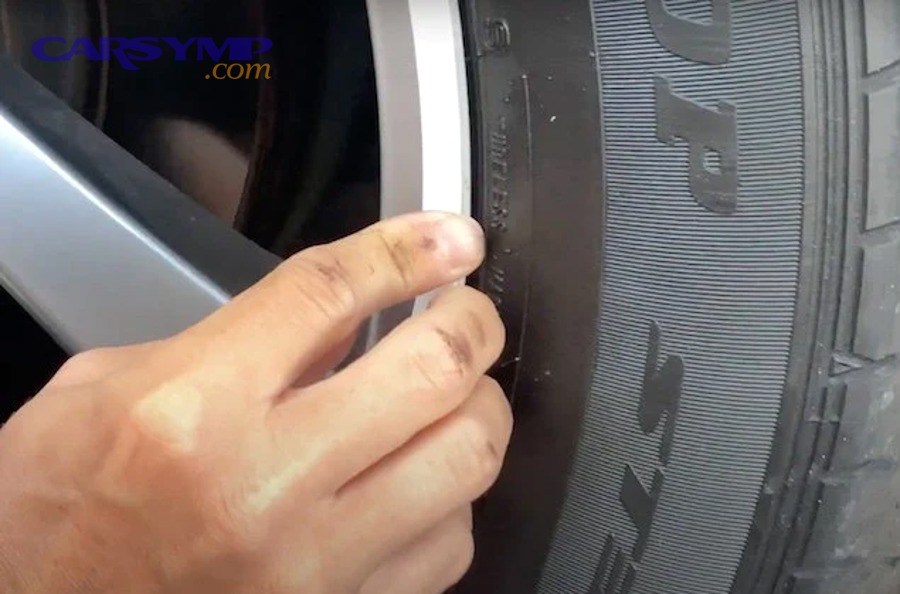
These additional elements expand your decision framework by addressing specific circumstances that may not apply universally but significantly impact outcomes when relevant to your situation.
How Does Insurance Coverage Affect Rim Repair vs Replacement Decisions?
Comprehensive insurance coverage typically covers rim damage from road hazards, though deductible amounts determine whether filing claims makes financial sense. Standard comprehensive deductibles range from $250-$1,000, meaning rim damage repair costs of $100-$150 per wheel remain below deductible thresholds for most policies. However, severe damage requiring $800-$1,200 in repairs or replacement may justify claim filing when deductibles are $500 or lower.
Claims process differences between repair and replacement favor repair for faster settlement. Insurance adjusters readily approve repair estimates when damage appears fixable, whereas replacement requests often trigger additional scrutiny regarding necessity. Some insurers maintain preferred repair shop networks offering direct billing, eliminating out-of-pocket expenses even before deductible thresholds, making repair the path of least administrative resistance.
Deductible considerations shift the cost-benefit analysis by introducing insurance company cost-sharing. When damage exceeds your deductible amount, insurance covers the difference between deductible and total repair or replacement cost. For example, with a $500 deductible and $1,200 replacement cost, you pay $500 while insurance covers $700. This changes the economic calculation from comparing $150 repair versus $1,200 replacement to comparing $150 repair versus $500 out-of-pocket replacement.
Out-of-pocket payment often proves superior for minor rim damage despite insurance coverage availability. Filing claims for damage under $500 risks premium increases at renewal that exceed claim payouts over multi-year periods. Industry data shows comprehensive claims averaging under $1,000 can trigger 5-15% premium increases lasting 3-5 years, potentially costing $300-$800 in total additional premiums that exceed the original damage cost.
Premium impact analysis requires calculating whether deductible plus potential rate increases exceed paying full repair or replacement costs directly. When dealing with $150 repair costs, paying directly avoids claim records that might affect future insurability or premium calculations. For $1,000+ replacement costs, insurance utilization becomes more justifiable even with potential rate impacts, as out-of-pocket savings exceed likely premium increases.
According to insurance industry data from 2024, only 12-15% of wheel damage incidents result in insurance claims, with most policyholders choosing out-of-pocket payment for repairs under $500 to avoid deductibles and potential premium impacts.
What If You Want to Upgrade to Custom or Performance Rims Instead?
Wheel damage presents strategic opportunities to upgrade from factory wheels to custom or performance alternatives rather than simply repairing or replacing with identical specifications. This approach transforms necessary expenditure into vehicle enhancement, improving appearance, performance, or both while addressing damage correction.
Using damage as justification for aesthetic upgrades allows you to allocate budget toward desired wheels rather than restoring damaged originals. When facing $400-$600 in repair costs for damaged alloy wheels, redirecting this budget plus additional funds toward $800-$1,200 custom wheels provides superior value through performance or appearance improvements. The damaged wheels may retain $200-$400 salvage value through sale to repair shops or metal recyclers, further offsetting upgrade costs.
Performance specifications matter for enthusiasts seeking handling improvements through wheel upgrades. Lightweight forged wheels reduce unsprung weight by 30-40% compared to standard cast alloy wheels, improving acceleration, braking response, and suspension effectiveness. While these performance wheels cost $1,500-$3,000+ per set, drivers prioritizing driving dynamics gain measurable performance improvements that justify costs beyond simple damage correction.
Matching custom sets versus single replacement creates all-or-nothing upgrade scenarios. When one wheel sustains severe damage, upgrading requires purchasing complete four-wheel sets to maintain appearance uniformity. This increases total expenditure from $300-$500 single replacement to $800-$2,000+ full set replacement but delivers cohesive appearance impossible with mixed wheel types.
Timing considerations favor upgrades during damage incidents for vehicles approaching scheduled wheel replacement. If factory wheels show 60,000+ miles of wear with curb damage, minor corrosion, and finish deterioration across all four corners, damage to one wheel provides impetus for complete set replacement with upgraded alternatives. This timing combines necessary repair with planned upgrade, justifying full-set expenditure that might otherwise be deferred.
Financial justification requires comparing repair costs against incremental upgrade investment. The calculation subtracts repair cost from upgrade cost to determine true upgrade premium:
Upgrade Cost Premium = (New Custom Wheels) – (Repair Cost) – (Salvage Value)
For example:
- Custom wheel set cost: $1,200
- Repair cost avoided: $400
- Damaged wheel salvage value: $200
- True upgrade premium: $600
This $600 premium represents actual additional investment beyond necessary repair costs, making upgrade decisions more palatable than comparing full custom wheel prices against repair costs.
Should You Get a Professional Assessment Before Deciding?
Professional assessment before deciding between repair and replacement provides objective damage evaluation, cost-accuracy, and safety determination that prevents expensive mistakes from DIY evaluation errors. Wheel damage often includes hidden structural issues invisible to untrained observation, making professional inspection essential for safety-critical decisions.
Shop evaluation procedures during inspection employ specialized equipment revealing damage extent beyond visual assessment. Technicians mount wheels on runout measurement devices detecting slight bends, cracks, or deformations invisible during casual inspection. These precision measurements quantify deviation from specifications, enabling data-driven decisions rather than subjective judgment about damage severity.
Critical questions to ask rim repair specialists include:
- Can you show me the measurement data indicating damage severity?
- What specific repair processes would address this damage type?
- Do you decline any repairs for safety reasons, and does my damage fall into that category?
- What warranty do you provide on structural integrity versus cosmetic finish?
- How does repair cost compare to replacement with equivalent wheel specifications?
- Would you drive on this wheel after repair with your own family in the vehicle?
Multiple quote acquisition provides cost comparison and reveals consensus about repair feasibility. When three independent shops provide similar repair versus replacement recommendations, confidence increases in the suggested approach. Dramatically different recommendations between shops suggest varying risk tolerance or capability levels, warranting additional investigation.
Red flags in shop recommendations include willingness to repair damage that other shops declined, pricing significantly below market rates suggesting shortcuts, or pressure tactics rushing decisions without adequate explanation. Reputable shops demonstrate patience explaining damage specifics, showing measurement data, and discussing both repair and replacement options without pushing either alternative.
Free estimate offerings from competitive shops enable cost-free professional assessment before financial commitment. Most wheel repair facilities provide complementary inspection and estimation services, understanding that transparent evaluation builds customer confidence. Taking advantage of multiple free estimates costs only time investment, providing comprehensive information supporting optimal decisions.
What Are the Long-Term Implications of Multiple Rim Repairs?
Wheels undergoing multiple repairs experience diminishing structural integrity from cumulative material stress, heat exposure, and fatigue accumulation that increases failure risk even when individual repairs meet quality standards. Each repair cycle—particularly those involving welding or aggressive straightening—reduces the metal’s resistance to future damage and shortens overall service life.
Diminishing structural integrity with repeated repairs occurs through material fatigue from stress cycling during straightening operations. Hydraulic presses applying thousands of pounds of force to reshape bent areas create microscopic internal fractures in the metal’s crystalline structure. The first repair may leave material strength at 90-95% of original, second repair reduces it to 80-85%, and subsequent repairs continue degrading strength until the wheel becomes unsafe for service.
Repair history indicating replacement necessity typically shows three or more repair incidents on the same wheel within 24-36 months. This pattern suggests either operating conditions that repeatedly damage wheels or accumulating structural compromise making the wheel increasingly vulnerable. Safety-conscious shops decline further repair on wheels showing multiple previous repair areas, recognizing that additional work pushes failure probability beyond acceptable limits.
Maintenance records for future reference document repair history that affects subsequent service decisions and resale transparency. Recording repair dates, damage types, shop names, and work performed creates history enabling informed decisions about whether additional repair remains viable. This documentation also provides disclosure information for vehicle resale, demonstrating transparency that builds buyer confidence despite repair history.
Safety thresholds for previously repaired rims establish two-repair maximum for structural damage and unlimited repairs for cosmetic-only issues. Industry best practices suggest replacing wheels after two significant structural repairs (straightening, welding) regardless of apparent condition, as material degradation from multiple repair cycles creates unpredictable failure risks. Cosmetic repairs involving only refinishing don’t affect structural integrity and can be repeated indefinitely without safety concerns.
Consider replacement over additional repair when wheels show:
- Two or more previous straightening repairs in the same area
- Any previous weld repair combined with new structural damage
- Three or more total repair incidents within 36 months regardless of type
- Visible stress fractures or material fatigue indicators around previous repair areas
- Recommendation from multiple shops to replace rather than attempt further repair
The cumulative effect of repair history ultimately determines safe service life limits. While properly executed single repairs don’t significantly compromise wheel safety, multiple repair cycles create compounding material degradation that professional assessment must evaluate before additional service authorization.
Final Recommendation: Your rim repair versus replacement decision should synthesize all seven primary factors plus relevant supplementary considerations based on your specific situation. Minor cosmetic damage with clear repair cost advantages strongly favors repair, while severe structural damage, multiple previous repairs, or damage approaching replacement cost thresholds indicate replacement as the superior choice. When uncertainty exists, professional assessment provides objective evaluation ensuring your decision balances safety, cost-effectiveness, and long-term value appropriately. Always prioritize structural safety over short-term cost savings, as wheel failure risks far exceed any financial benefits from questionable repairs.