


Yes, wheel misalignment directly causes tire noise — and it does so in ways that are specific, progressive, and often mistaken for other problems. When your tires are not aligned to the manufacturer’s specified angles, they no longer roll cleanly across the road surface. Instead, they scrub, drag, or skew against the pavement with every rotation. That friction generates sound. The worse the misalignment, the louder and more persistent the noise becomes. For any car owner hearing unexplained sounds from their wheels, alignment is one of the first systems that deserves a serious look.
The sounds produced by misalignment are not random. They follow recognizable patterns that correspond to specific types of alignment problems. A persistent low hum at highway speeds, a squeal that appears only during turns, or a rhythmic thumping that intensifies with acceleration — each of these points toward a different alignment angle going wrong. Understanding how to connect a sound to its source is the foundation of accurate tire noise diagnosis and helps car owners avoid spending money on the wrong repair.
Beyond the noise itself, misalignment leaves a trail of physical evidence on the tire surface. Uneven tread wear is one of the most reliable secondary indicators, and its pattern — whether it appears on one edge, across alternating ribs, or in a sawtooth formation — directly corresponds to which alignment angle is out of spec. Recognizing these wear signatures gives car owners a way to self-assess before visiting a shop, and gives mechanics a faster path to the correct diagnosis.
Fixing alignment noise is not simply a matter of booking an alignment service. Some noise from uneven wear persists even after the alignment is corrected, because the damage to the tire contact surface is already done. Understanding when realignment is sufficient, when tire rotation is also required, and when the tire must be replaced entirely is critical for restoring a quiet, safe ride. The sections below walk through every layer of this issue — from confirming the cause, to identifying the exact sound, to taking the right corrective action.
Does Misalignment Cause Tire Noise?
Yes, misalignment causes tire noise because misaligned tires do not roll in a straight, clean path — they drag sideways across the road surface, generating friction, vibration, and sound with every mile driven.
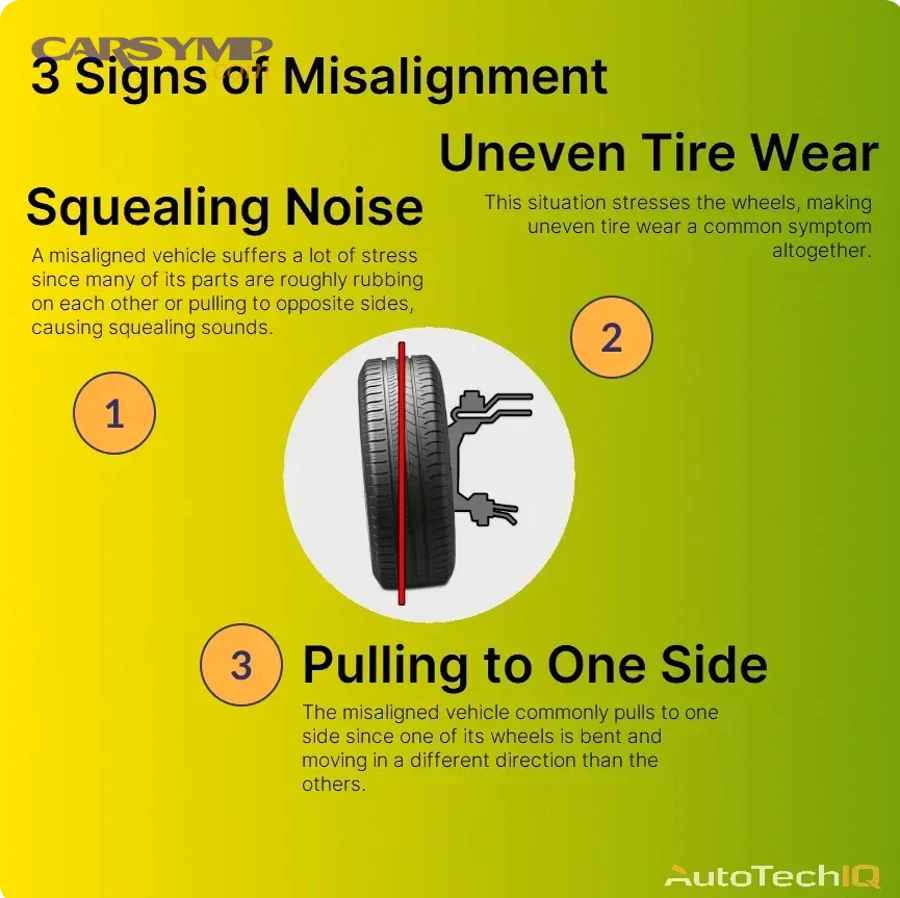
To understand why this happens, it helps to picture what a properly aligned tire does. When all four wheels sit at precisely the correct angles relative to each other and to the road, each tire rolls forward along a single straight line with minimal lateral friction. The contact patch — the portion of the tire actually touching the road — presses evenly and releases cleanly. The result is a quiet, efficient ride.
When alignment is off, even slightly, that clean rolling motion is disrupted. A tire with incorrect toe angle, for instance, is pointed slightly inward or outward while being forced to travel straight ahead. The tread blocks are no longer aligned with the direction of travel, so instead of lifting cleanly off the road, they scrape. This scraping is the mechanical source of alignment-related tire noise.
How Does Wheel Alignment Affect Tire Noise?
Wheel alignment is defined by three primary angles — toe, camber, and caster — and each one, when out of specification, affects the tire’s road contact in a distinct way that produces a distinct type of noise.
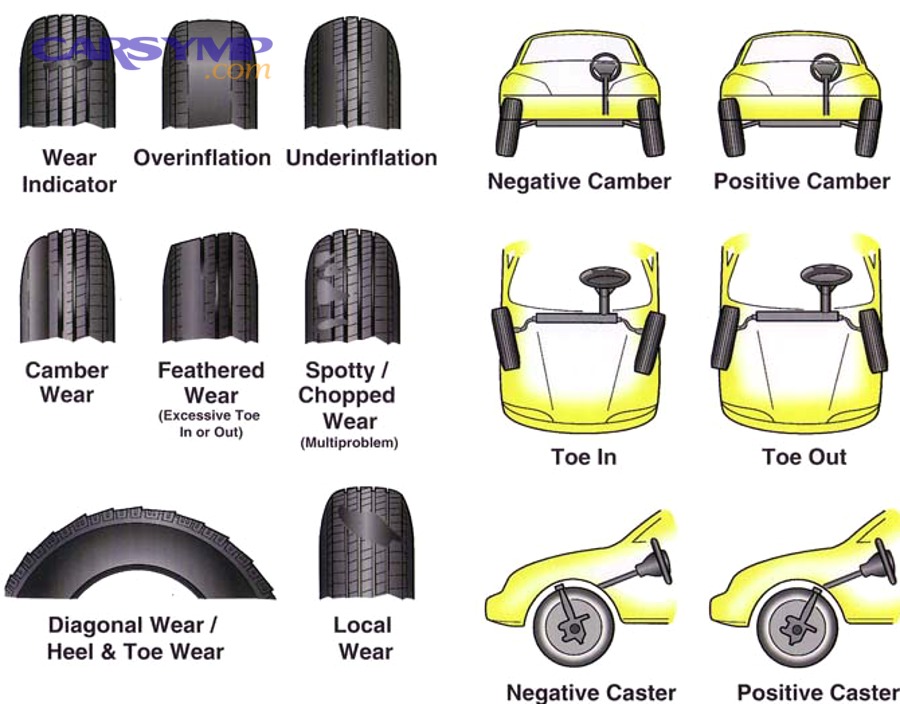
Toe refers to whether the fronts of the tires point inward (toe-in) or outward (toe-out) relative to the vehicle’s centerline. Even a fraction of a degree of toe misalignment causes the tread to scrub laterally across the pavement rather than roll forward cleanly. This lateral scrubbing is the most common source of alignment-generated squealing and feathering wear noise.
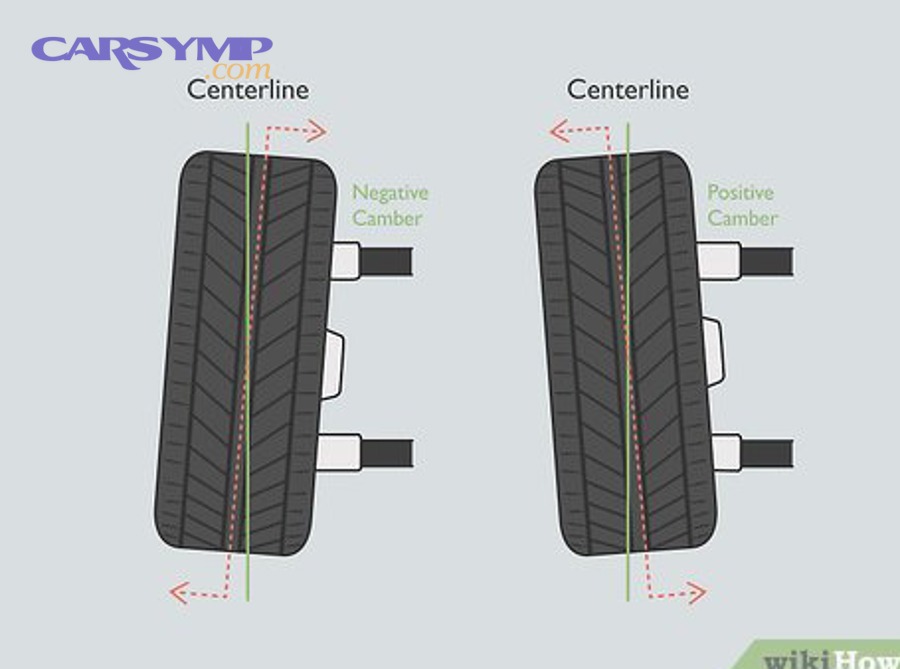
Camber is the vertical tilt of the tire when viewed from the front of the vehicle. A tire leaning too far inward (negative camber) or outward (positive camber) concentrates all road contact pressure on one edge of the tread. That concentrated pressure wears the inner or outer shoulder rapidly and creates a persistent humming or droning sound as the worn, uneven surface rotates against the road.
Caster affects steering feel and straight-line stability more than it directly causes noise. However, uneven caster between left and right wheels can cause the vehicle to pull to one side, which in turn creates uneven loading across the tires — and uneven loading accelerates uneven wear, which eventually becomes a noise source.
The key insight for tire noise diagnosis is that the noise does not appear instantly when alignment goes wrong. It builds gradually as uneven wear develops on the tread. This is why many car owners notice the noise weeks or even months after the alignment event — the pothole, curb strike, or collision that caused the misalignment — rather than immediately after.
Is All Tire Noise Caused by Alignment Issues?
No — alignment is one of the most common causes of tire noise, but it is not the only one, and distinguishing alignment noise from other sources is essential before committing to a repair.
Several other conditions produce tire noise that can closely resemble alignment-related sounds:
- Low tire pressure causes a low roar or thumping because the tire sidewall flexes excessively and the contact patch deforms with each rotation.
- Worn or failed wheel bearings produce a humming or grinding noise that is often confused with alignment hum, particularly at highway speeds.
- Out-of-balance tires generate vibration and noise at specific speed ranges, typically between 55 and 70 mph, that smooths out above and below that range.
- Aggressive tread patterns (such as all-terrain or winter tires) produce noise simply because of their tread block design, regardless of alignment status.
- Flat spots from extended parking create a rhythmic thumping that disappears after the tire warms up and rounds out.
The most reliable way to begin narrowing down the source is to note when and how the noise changes — does it appear only during turns, only at certain speeds, only on one side? These behavioral patterns, covered in the sections below, are the foundation of accurate diagnosis.
What Is Wheel Misalignment?
Wheel misalignment is a condition in which one or more of a vehicle’s tires deviate from the manufacturer’s specified angles for toe, camber, or caster, causing the tires to contact the road surface unevenly or at an incorrect angle.
Alignment is not a single measurement — it is a system of geometric relationships between the tires, the suspension, and the road. Every vehicle manufacturer publishes precise angle specifications for each of the three alignment parameters, and those specifications are calibrated to optimize tire wear, fuel efficiency, handling stability, and safety. When any one of those angles drifts outside the specified range — even by a small margin — the consequences compound over time.
What Are the Most Common Causes of Wheel Misalignment?
There are four primary causes of wheel misalignment, each acting on the suspension and steering geometry in different ways.
Pothole and curb impacts are the single most common cause. When a tire strikes a pothole or rolls over a curb at speed, the sudden vertical and lateral force can bend or shift suspension components — control arms, tie rods, struts — enough to push alignment angles out of spec immediately.
Normal wear and tear is a slower but inevitable cause. The rubber bushings, ball-and-socket joints, and other flexible components in the suspension system degrade gradually over tens of thousands of miles. As they lose their rigidity and precision, the angles they were designed to hold begin to drift.
Minor accidents and collisions — even low-speed fender-benders that leave no visible body damage — frequently disturb alignment. The force transmitted through the bumper and frame can shift suspension mounting points enough to throw all four wheels out of alignment.
Overloading or uneven loading of the vehicle places excess stress on suspension components designed for a specific weight range. Regularly carrying heavy loads on one side, or exceeding the vehicle’s gross vehicle weight rating, accelerates the wear of alignment-critical components.
How Quickly Can Misalignment Develop After an Impact?
Misalignment can develop instantaneously after a single significant impact, and tire noise may follow within days or weeks as uneven wear begins to develop on the affected tires.
This timeline matters for diagnosis. If a car owner can recall a specific pothole strike, curb impact, or minor collision that preceded the onset of tire noise by one to three weeks, alignment is a highly probable cause. The brief delay between the alignment event and the appearance of noise reflects the time needed for uneven wear to develop to a level that generates audible friction. The harder the impact and the more severe the angle deviation, the faster the noise develops.
What Are the Sounds of Bad Wheel Alignment?
There are four main categories of sounds associated with bad wheel alignment — humming, squealing, clunking, and thumping — each corresponding to a different mechanism by which misalignment disrupts normal tire operation.
Identifying the specific character of the noise is the first and most practical step in narrowing down whether alignment is the cause and, if so, which aspect of the alignment is affected. Below is a breakdown of each sound type, its likely alignment cause, and the behavioral clues that confirm it.
What Does a Humming or Droning Noise from Misalignment Sound Like?
A humming or droning noise caused by misalignment is a low, steady, continuous sound that grows louder as vehicle speed increases, typically becoming most noticeable above 45 to 50 mph.
The mechanical source of this sound is the air chamber effect combined with uneven tread contact. When a tire develops uneven wear from sustained misalignment — particularly camber wear concentrated on one edge — the irregular tread surface no longer interfaces smoothly with the road. As the tire rotates at highway speeds, the worn, uneven tread blocks create rhythmic vibrations that resonate through the tire’s air column, producing the characteristic hum.
An important distinction for accurate diagnosis: alignment-generated hum is relatively constant in pitch across a range of speeds and does not change noticeably when you shift lanes. Wheel bearing hum, by contrast, shifts in pitch or intensity when the vehicle changes direction — such as when gently weaving within a lane — because lateral weight transfer changes the load on the bearing. If the hum stays constant through lane changes, alignment and uneven wear are the more likely culprits.
Why Does My Car Squeal or Screech When Turning — Is It Alignment?
Squealing or screeching during turns at normal speeds is one of the clearest and most specific indicators of toe misalignment, and it warrants prompt attention because it signals that tire grip is being compromised.
The mechanism is straightforward: a tire with significant toe misalignment is pointed at an angle to its actual direction of travel. When the vehicle turns, the tire is asked to change direction while already crabbing sideways. The result is lateral scrubbing across the pavement — the same friction that produces a tire squeal during an aggressive emergency stop, but occurring at ordinary turning speeds because the geometry forces the tire to drag rather than roll.
This sound is not merely annoying. It is a direct indication that the tire’s contact patch is not maintaining full, even grip with the road surface. In wet conditions, the reduced contact quality can meaningfully impair handling and increase stopping distance. Squeal during turns at normal speed should be treated as a safety-relevant symptom, not just an acoustic nuisance.
What Causes a Clunking, Thumping, or Grinding Noise from Alignment Problems?
Clunking, thumping, and grinding noises associated with alignment problems generally indicate that the misalignment has progressed to the point of affecting — or originating from — worn suspension components, severe uneven tread wear, or in extreme cases, contact between the tire and a suspension part.
- Clunking over bumps is the sound of loose or worn suspension components — ball joints, tie rod ends, control arm bushings — that are both a cause and a consequence of misalignment. These components allow alignment to drift when they wear out, and misalignment accelerates their deterioration. The clunk is the sound of the worn component moving in its socket when the suspension compresses over a bump.
- Thumping at speed is typically the sound of irregular or flat-spotted tread wear that has developed after prolonged driving on misaligned tires. Each rotation brings a worn section of tread into road contact, creating a rhythmic impact. Unlike flat spots from parking, this thumping does not diminish as the tire warms — it remains constant or worsens because the wear pattern is permanent.
- Grinding is the most severe category and can indicate that a tire in extreme negative camber is rubbing against a suspension component, or that tread wear has progressed to a dangerously thin level where the tire carcass is being stressed beyond its design limits. Grinding noises demand immediate inspection.
How Does Tire Noise from Misalignment Change at Different Speeds?
Alignment-related tire noise almost universally intensifies with speed, and its behavior across the speed range provides one of the most reliable diagnostic clues available without specialized equipment.
The table below summarizes typical noise behavior by speed range to assist with tire noise diagnosis:
| Speed Range | Typical Alignment Noise | Likely Cause |
|---|---|---|
| Under 20 mph | Minimal or absent | Wear not yet audible at low rotation speed |
| 20–40 mph | Faint hum or occasional squeal in turns | Early-stage uneven wear or moderate toe misalignment |
| 40–65 mph | Clear hum or drone, increasing volume | Camber wear, advancing uneven tread contact |
| 65+ mph | Loud humming, vibration, possible steering pull | Significant uneven wear, possibly multiple alignment angles affected |
The speed-dependency of alignment noise is particularly useful for distinguishing it from tire balance noise, which typically peaks at a specific speed window and then diminishes above it. Alignment noise, by contrast, follows a generally linear increase with speed because it is driven by the uneven tread contact area, which simply rotates faster — not by a resonant frequency that can be outrun.
What Are the Other Symptoms of Bad Wheel Alignment?
There are three principal symptoms of bad wheel alignment beyond noise — uneven tire wear, vehicle pulling or drifting, and steering wheel vibration or off-center positioning — and identifying which combination is present helps confirm whether alignment is truly the root cause.
Noise alone is rarely the only symptom of misalignment. Most drivers experiencing alignment-related tire noise will also notice at least one of these physical signs, and the presence of multiple symptoms simultaneously significantly increases diagnostic confidence. Preventing tire noise with proper maintenance begins with recognizing these early warning signals before they escalate into costly tire or suspension damage.
What Does Uneven Tire Wear from Misalignment Look Like?
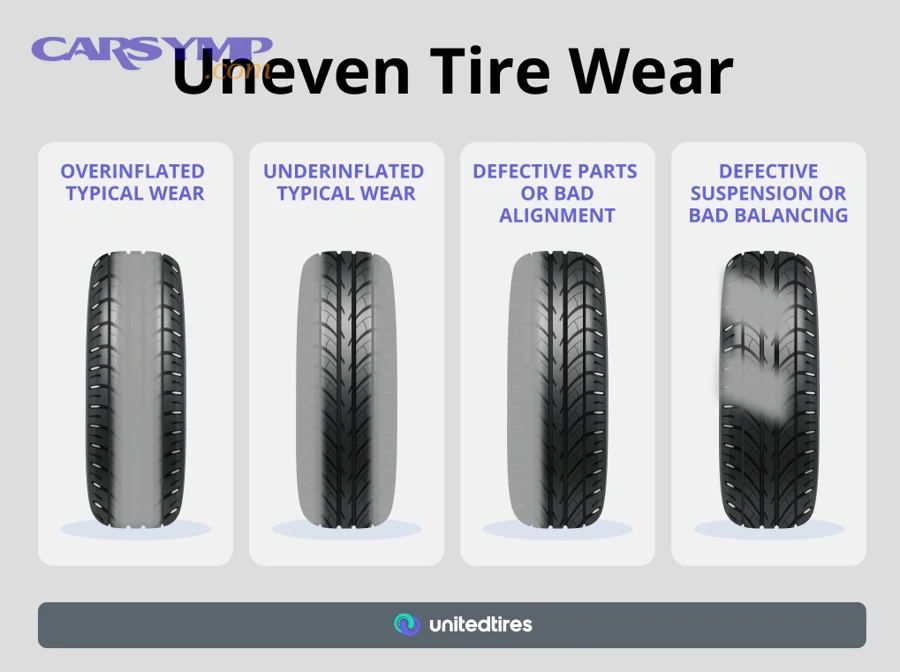
Uneven tire wear from misalignment follows specific visual patterns that correspond directly to which alignment angle is out of specification, and learning to read these patterns is a practical skill for any car owner.
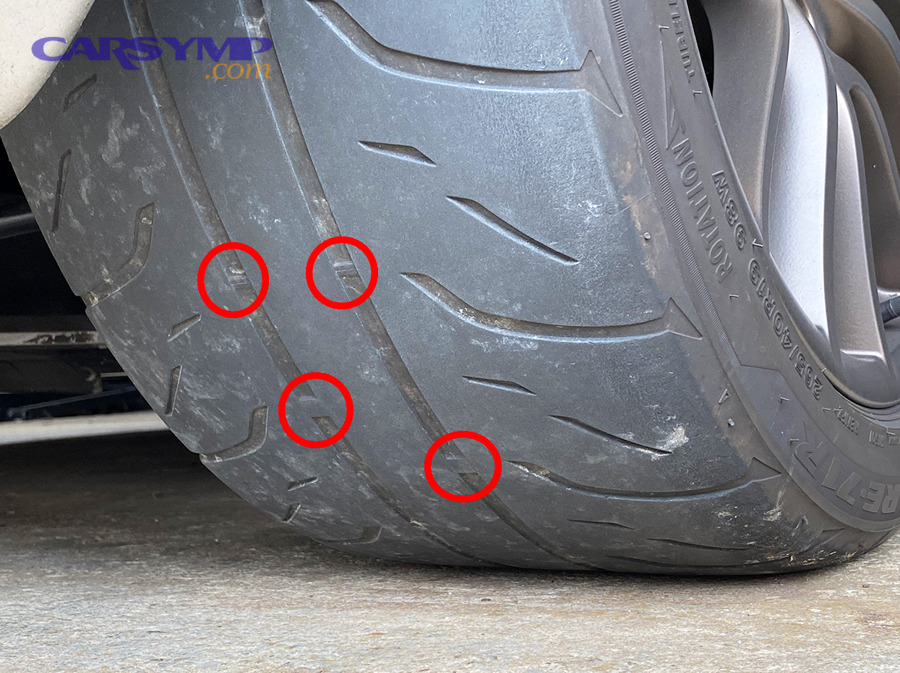
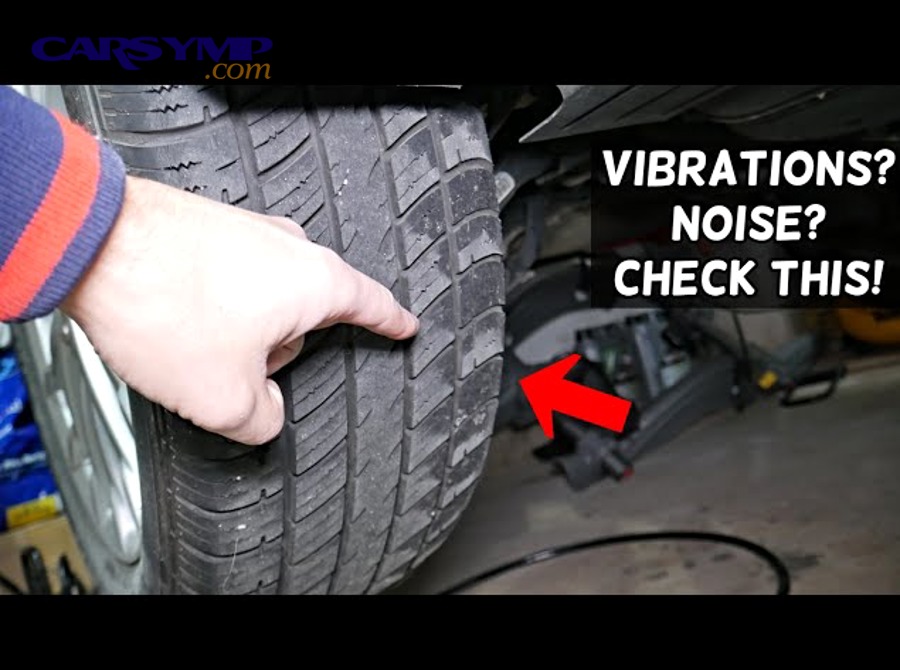
Feathering — where the tread ribs are smooth and rounded on one side but sharp and pointed on the opposite side, like the teeth of a saw viewed at an angle — is the signature of toe misalignment. Running a hand across the tread will reveal the difference in edge sharpness between the inside and outside of each rib. Feathered tires produce a directional swooshing or hissing noise at speed.
One-sided edge wear — where the inner or outer shoulder of the tread is significantly more worn than the center or opposite edge — is the signature of camber misalignment. Excessive negative camber (tire tilting inward at the top) wears the inner edge; excessive positive camber wears the outer edge. This wear pattern produces a persistent low-frequency hum and accelerates the risk of a tire blowout on the worn shoulder.
Heel-toe wear — the sawtooth pattern visible when viewing the tread from the side — can result from aggressive toe misalignment combined with insufficient tire rotation, and produces a rhythmic thumping noise that worsens progressively with mileage. Rotating tires to confirm noise source is a practical diagnostic technique here: if thumping or noise changes position after a rotation (moving from front to rear or side to side), uneven wear and alignment are confirmed contributors.
Does a Pulling or Drifting Car Always Mean Alignment Is Off?
No — pulling or drifting does not always mean alignment is the sole cause, but it is one of the strongest behavioral indicators of alignment problems, particularly when it occurs alongside tire noise and uneven wear.
A simple self-diagnostic test: on a flat, straight, empty road, briefly release the steering wheel. A properly aligned vehicle holds its course. A misaligned vehicle drifts consistently to one side. This pulling occurs because unequal alignment angles across the axle create unequal rolling resistance — one side of the vehicle is working harder than the other to maintain direction, and the vehicle naturally moves toward the path of least resistance.
However, tire pressure differences between left and right tires can produce a similar pulling effect. Before concluding that alignment is the cause, check that all four tires are inflated to the manufacturer’s specified pressure. If pressures are equal and pulling persists, alignment is the primary suspect.
Can a Vibrating Steering Wheel Be Caused by Misalignment?
Yes, a vibrating steering wheel can be caused by misalignment, though it can also indicate tire balance issues, and distinguishing between the two matters for choosing the right repair.
Alignment-related steering vibration tends to be consistent across a range of speeds and is often accompanied by the steering wheel sitting off-center when driving straight — a direct indicator that the front wheels are not aligned symmetrically. This off-center position is one of the most unambiguous visual cues of a front-end alignment problem.
Balance-related vibration, by contrast, typically occurs most intensely within a specific speed window — often 55 to 70 mph — and diminishes above and below that range. If the vibration is speed-specific and the steering wheel is centered, tire balancing is the more likely solution. If the vibration is present across speeds and the wheel sits crooked at highway cruise, alignment is the dominant issue.
From a safe-to-drive guidance perspective: a vibrating steering wheel caused by misalignment represents a safety concern at higher speeds, where the reduced steering precision and increased tire stress make emergency maneuvers less predictable. Driving short distances at low speed to reach a shop is generally acceptable; continuing high-speed highway driving with persistent alignment-caused vibration is not advised.
How Do You Fix Tire Noise Caused by Misalignment?
Fixing tire noise caused by misalignment requires three actions in the correct sequence — a professional wheel alignment service, followed by tire rotation to equalize wear patterns, and in cases of advanced wear, tire replacement on the affected positions.
Treating only the alignment without addressing the wear condition of the tires is one of the most common errors in this repair process. The alignment corrects the mechanical cause, but the uneven tread surface that has already developed on the tire continues to generate noise until it is either rotated to a lower-stress position or replaced. The right fix depends on how far the wear has progressed.
What Does a Professional Wheel Alignment Service Include?
A professional wheel alignment service includes four core components: measurement of current alignment angles, comparison to manufacturer specifications, adjustment of the correctable angles, and inspection of the steering and suspension components that affect alignment.
Modern alignment services use computerized laser or camera-based systems that measure all relevant angles across all four wheels simultaneously. The technician begins by recording the current toe, camber, and caster values for each wheel and comparing them to the vehicle manufacturer’s published specifications. Angles that fall outside the acceptable range are then adjusted — toe and camber are typically adjustable on most vehicles; caster adjustment may require aftermarket components on some models.
A thorough alignment service will also include a visual inspection of tie rod ends, ball joints, control arm bushings, and strut condition. This matters because worn suspension components are frequently both the cause of the misalignment and an obstacle to holding the new alignment. A fresh alignment set on worn components will drift back out of spec faster than one set on healthy hardware.
Typical alignment service costs range from $75 to $150 for a standard four-wheel alignment at a dedicated auto service center, with pricing varying by region and vehicle type.
Will Getting an Alignment Immediately Stop the Tire Noise?
Not necessarily — alignment corrects the source of the problem, but tire noise generated by existing uneven wear patterns may persist after the service, particularly if the misalignment was severe or went unaddressed for many thousands of miles.
This is one of the most important expectations to set correctly. Many car owners book an alignment expecting the noise to disappear immediately afterward, and are surprised when it does not. The reason is that the alignment service corrects the angle deviation going forward — it does not restore a feathered, cupped, or edge-worn tire to a uniform tread surface. The damaged contact patch continues to interact with the road the same way it did before, just without the condition worsening further.
The practical next step after alignment is rotating tires to confirm noise source. Moving the affected tires to different positions — typically from front to rear or across axles — serves two purposes: it shifts the worn tires to positions with lower stress and different noise characteristics, and it confirms whether the noise follows the tire (indicating tread wear as the noise source) or stays in the same corner of the car (indicating a remaining mechanical issue such as a wheel bearing).
How Often Should You Get a Wheel Alignment to Prevent Tire Noise?
Preventing tire noise with proper maintenance requires a wheel alignment check at minimum once every 12 months or every 12,000 miles, whichever comes first, and immediately following any significant road impact or new tire installation.
The 12-month / 12,000-mile interval is a general guideline; vehicles driven frequently on roads with poor surface quality may benefit from more frequent checks. The following situations warrant an immediate alignment inspection regardless of the regular schedule:
- After striking a significant pothole or curb at speed
- After any collision, even minor
- When new tires are installed (to protect the investment in new rubber)
- When tire noise, pulling, or steering vibration appears without another confirmed cause
- When visual inspection reveals the beginning of uneven wear
Pairing alignment checks with the recommended tire rotation interval — typically every 5,000 to 7,000 miles — creates a comprehensive maintenance routine that addresses both the cause (alignment angles) and the consequence (uneven wear) simultaneously. This combination is the single most effective strategy for maximizing tire lifespan and keeping road noise at a minimum.
How Is Alignment Noise Different from Other Tire Noises?
Alignment noise is most reliably distinguished from other tire noises by three behavioral characteristics: it tends to increase progressively with speed rather than peaking at a specific speed, it does not noticeably change pitch when shifting lanes, and it is frequently accompanied by visual uneven wear or steering wheel offset.
Understanding how to differentiate alignment noise from wheel bearing noise, tire pressure noise, and balance noise is an essential part of tire noise diagnosis. Making the wrong determination leads to unnecessary repairs and leaves the actual problem unaddressed.
Alignment Noise vs. Wheel Bearing Noise — How Can You Tell the Difference?
Alignment noise is distinguished from wheel bearing noise primarily by its response to directional changes: alignment noise stays constant when weaving or changing lanes, while wheel bearing noise changes pitch or volume as lateral forces shift the load on the bearing.
The following table provides a behavioral comparison to help clarify the distinction between these two commonly confused noise sources:
| Characteristic | Alignment Noise | Wheel Bearing Noise |
|---|---|---|
| Speed behavior | Increases steadily with speed | Often peaks at 40–60 mph, may vary |
| Lane change / weave | No significant change | Pitch or volume changes noticeably |
| Sound quality | Hum, squeal, or thump | Grinding, roaring, or cyclic hum |
| Accompanied by | Uneven wear, steering pull | Looseness in wheel, possible vibration |
| Urgency | Moderate — address within weeks | High — can lead to wheel detachment |
A useful self-test: at highway speed on an empty road, gently and smoothly weave the vehicle within the lane, first loading the left side, then the right. If the noise intensifies when weight shifts to one side and diminishes when it shifts away — consistently — a wheel bearing on the loaded side is the likely cause. If the noise remains constant through the maneuver, alignment and uneven wear are more probable.
Alignment Noise vs. Tire Pressure Noise — What’s the Difference?
Alignment noise differs from tire pressure noise in that pressure-related sounds are uniform across all driving directions and resolve or change noticeably when tires are inflated to correct pressure, while alignment noise persists regardless of inflation adjustments.
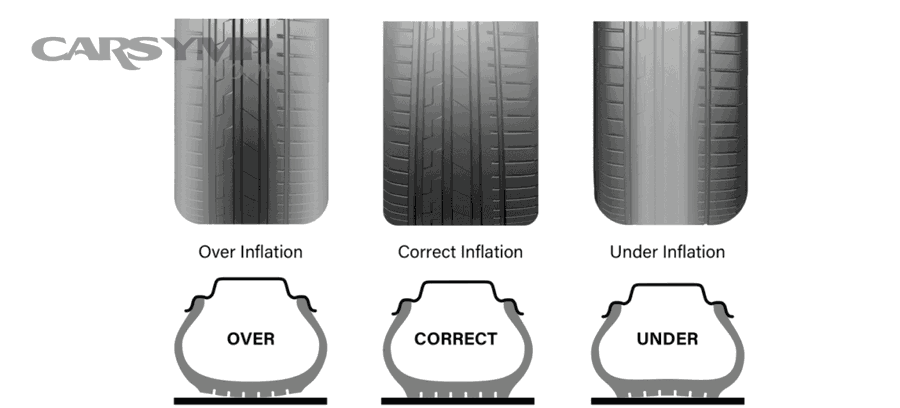
Under-inflated tires produce a low, hollow roar as the sidewall flexes excessively and the contact patch deforms rhythmically with each rotation. Over-inflated tires produce a harsh, buzzing road harshness because the rigid contact patch cannot absorb road texture. Both pressure-related noises affect the entire tire uniformly and do not vary meaningfully between straight-line driving and cornering.
The fastest diagnostic step: check all four tires with a quality pressure gauge and inflate to the pressure specified on the driver’s door jamb sticker (not the maximum pressure listed on the tire sidewall). Drive at highway speed. If the noise changes significantly — diminishes, disappears, or changes character — tire pressure was a contributing factor. If the noise continues at the same intensity and character, alignment and wear remain the suspects. This simple check takes five minutes and can eliminate one variable before any money is spent.
Alignment Noise vs. Tire Balance Noise — How Do You Know Which One It Is?
Alignment noise is distinguished from balance noise by its speed independence: alignment noise increases consistently with speed, while balance noise peaks within a specific speed window — typically 55 to 70 mph — and then diminishes at higher speeds as the rotational frequency moves past the resonant vibration point.
Balance noise presents most often as a rhythmic vibration felt through the steering wheel, seat, or floorboard at specific speeds, often accompanied by a low-frequency droning sound in that same speed window. Drivers frequently describe it as the car feeling “shaky” at freeway on-ramp speeds but smoothing out on the open highway. This speed-specific behavior is the defining characteristic.
It is worth noting that alignment and balance problems frequently coexist. A vehicle that has been driven for an extended period on misaligned tires often develops both uneven wear (an alignment consequence) and tread cupping (which disrupts wheel balance). In these cases, both a four-wheel alignment and a four-wheel balance service are needed simultaneously to fully resolve the noise. Addressing only one and not the other will leave residual noise and may cause the car owner to incorrectly conclude that the service did not work.
Advanced Tire Wear Patterns Caused by Alignment Problems
There are four primary wear patterns caused by alignment problems — feathering, camber wear, heel-toe wear, and advanced cupping — each serving as a physical record of how and how severely the alignment has been off, and each producing a distinct noise signature.
These wear patterns represent the micro-semantic layer of the alignment noise topic. Where the previous sections explained the sounds and the alignment causes, this section connects those two domains through the physical evidence left on the tire surface itself. For a car owner who wants to go beyond the basics, reading tire wear patterns is a skill that turns a visual inspection into a diagnostic tool.
What Is Feathering Wear and Which Alignment Angle Causes It?
Feathering wear is a tread condition in which individual tread ribs are rounded and smooth on one side and sharp and pointed on the opposite side, created by toe misalignment that forces the tread blocks to scrub laterally across the road rather than roll forward cleanly.
To identify feathering, run a hand along the tread from one side of the tire to the other. In one direction, the ribs will feel relatively smooth; in the opposite direction, they will feel noticeably sharper, like the back of a comb. This texture asymmetry is the physical trace of the lateral scrubbing motion.
Feathered tires produce a directional hissing or swooshing noise at speed. The noise is caused by the asymmetric tread blocks creating uneven airflow and uneven road contact with each rotation. Because the direction of the feathering indicates whether the tire was scrubbing inward or outward, an experienced technician can determine the direction of toe error from the wear pattern alone — without needing to mount the vehicle on an alignment rack.
What Is Camber Wear and How Does It Sound Different from Toe Wear?
Camber wear is a one-sided tread wear condition in which the inner or outer shoulder of the tire is significantly more worn than the center or opposite edge, caused by excessive positive or negative camber angle that tilts the tire and concentrates road contact pressure on a narrow band of tread.
Excessive negative camber — the top of the tire tilting inward — wears the inner shoulder. Excessive positive camber — the top tilting outward — wears the outer shoulder. The worn shoulder carries a disproportionate share of the vehicle’s weight and traction demands, and deteriorates much faster than the rest of the tread.
Acoustically, camber wear sounds different from toe wear. Toe wear produces a higher-pitched hissing or feathering noise because the scrubbing action affects the fine tread rib edges. Camber wear produces a lower-frequency, more monotone hum or drone because the worn, smooth shoulder section creates a wide, consistent band of altered road contact. The two sounds reflect the two different physical textures — irregular rib edges versus a smooth, worn shoulder band.
Can Heel-Toe Wear from Alignment Cause a Thumping Noise?
Yes — heel-toe wear from alignment problems causes a rhythmic thumping noise that worsens progressively and is one of the more commonly misdiagnosed tire sounds, often mistaken for a flat spot or a wheel balance problem.
Heel-toe wear creates a sawtooth profile on the tread blocks when viewed from the side. One face of each tread block — the leading face as the tire rotates into road contact — wears more aggressively than the trailing face. The result is a series of tread blocks that are each slightly wedge-shaped in cross-section rather than rectangular. As the tire rotates, these wedge-shaped blocks create a series of small impacts as each leading edge contacts the road, generating the thumping.
Unlike flat spots from extended parking, which tend to diminish after the tire warms and re-rounds during driving, heel-toe thumping from wear is permanent and does not diminish with heat or mileage. It will remain until the tire is replaced. The distinction is diagnostic: if thumping is present from the moment of driving and remains constant or worsens, wear is the cause; if it is present only when cold and gradually diminishes after 10 to 15 minutes, a flat spot from parking is more likely.
Does Alignment-Caused Wear Damage Become Permanent — Even After Realignment?
Yes — wear damage caused by alignment problems is permanent on the individual tire, and correcting the alignment going forward does not restore a feathered, edge-worn, or heel-toe worn tire to a uniform tread surface.
This is the most important concept to understand when planning the repair sequence. Once a feathering or camber wear pattern is established, the tread blocks have been physically reshaped by the scrubbing and uneven loading forces. Realignment removes the cause of further wear, but the existing surface irregularity continues to generate noise and, in the case of severe camber wear, continues to compromise the structural integrity of the tire shoulder.
The practical decision point is based on remaining tread depth and the severity of the wear pattern. If the worn area still has adequate tread depth and the wear is localized — as in early-stage feathering — rotating the affected tires to rear positions can allow them to wear more evenly over time while the corrected alignment prevents further asymmetric deterioration. If the wear has reduced tread depth below 2/32 of an inch on any portion of the tire, or if a shoulder blowout risk is present due to camber wear, replacement is the correct decision.
From a safe-to-drive guidance perspective, a tire with advanced camber wear on the inner or outer shoulder represents a genuine blowout risk at highway speeds and under hard cornering. The worn shoulder has reduced material thickness and heat resistance, making it vulnerable under conditions that would be routine for a properly worn tire. In these cases, continued driving — even with a fresh alignment — is not advisable until the tire is replaced.
Conclusion: Putting It All Together for a Quieter, Safer Ride
Wheel misalignment is one of the most common and most consistently underestimated sources of tire noise, and it earns that status because its effects develop gradually, its symptoms overlap with other conditions, and its consequences — if ignored — extend well beyond noise into tire safety and vehicle handling.
The core answer is unambiguous: yes, misalignment causes tire noise, and it does so through a clear mechanical chain. Incorrect alignment angles force tires to scrub, drag, or skew against the road surface rather than rolling cleanly. That friction generates heat, wears the tread unevenly, and produces sounds that range from a faint early-warning hum to a loud, persistent drone, squeal, or thump depending on how far the misalignment has progressed and which angle is affected.
For practical purposes, the most important takeaways from this article can be summarized as follows.
Identifying the noise correctly is the first priority. A hum that intensifies with speed and stays constant through lane changes points toward alignment and uneven wear. A squeal during turns at normal speeds points toward toe misalignment causing lateral tire scrubbing. A rhythmic thumping that does not diminish with heat points toward established heel-toe or irregular wear. A noise that changes pitch when weaving the vehicle points toward a wheel bearing, not alignment. Getting the diagnosis right before spending money on a repair is the most efficient and cost-effective approach to tire noise diagnosis.
Physical evidence on the tire confirms the diagnosis. Feathering, one-sided edge wear, and heel-toe sawtooth patterns are not just cosmetic — they are alignment records written on the rubber surface. Learning to read these patterns by hand and by eye takes less than five minutes and adds a second, independent layer of confirmation to any noise-based diagnosis. Rotating tires to confirm noise source after the diagnosis is a simple, no-cost verification step that should precede any major repair commitment.
The repair sequence matters. Alignment correction alone is not always sufficient when uneven wear has already developed. The correct sequence is: align first, inspect tread condition, rotate if wear is moderate and tread depth is adequate, replace if wear is severe or shoulder damage is present. Skipping the tread inspection step after alignment is the most common reason car owners return to a shop complaining that “the alignment didn’t fix the noise.”
Prevention is far cheaper than correction. Preventing tire noise with proper maintenance requires three parallel habits: checking tire pressure monthly with a quality gauge, scheduling tire rotations every 5,000 to 7,000 miles, and booking a wheel alignment check every 12 months or immediately after any significant road impact. These three practices together address the three most controllable contributors to tire noise — pressure uniformity, wear equalization, and angle correctness — before any of them has the opportunity to generate an audible problem.
Know when it is safe to drive and when it is not. Safe-to-drive guidance with tire noise depends on the severity of the condition. A faint hum from early-stage misalignment is generally safe for short-distance driving to a service appointment. A squeal during turns indicating active tire scrubbing, a vibrating or off-center steering wheel, or a grinding noise indicating possible component contact are all conditions that warrant prompt — not deferred — attention. A tire showing advanced camber wear on one shoulder should not be driven at highway speeds or under hard cornering, as the thinned shoulder material represents a genuine blowout risk.
The overarching message is straightforward. Tire noise is not background noise — it is information. Alignment problems in particular announce themselves acoustically well before they cause catastrophic tire or suspension failure, which means the car owner who pays attention to the sounds their vehicle makes has a meaningful safety advantage over the one who does not. Recognizing the sounds, reading the wear, understanding the fix, and acting promptly is the complete path from a noisy, misaligned vehicle to a quiet, safe, and properly maintained one.