


Rotating your tires is one of the most effective and underused methods for tire noise diagnosis — and yes, it can directly confirm whether an annoying hum, roar, or grind is coming from your tires or from a deeper mechanical component. When a tire is moved to a new wheel position and the noise travels with it, the tire itself is the confirmed source. When the noise stays fixed at the same corner of the vehicle regardless of which tire sits there, the problem lies in the wheel bearing, suspension, or brake system. This simple logic transforms a routine maintenance task into a powerful diagnostic tool available to any driver with basic mechanical confidence.
Understanding what tire conditions actually generate noise after rotation is equally important. Tire cupping, uneven tread wear, and imbalance are the three most common culprits that rotation brings to the surface — often because a problem that was quietly developing on a rear axle becomes dramatically audible the moment that tire moves to the front, where road feedback travels directly through the steering column to the driver’s hands and ears. Knowing how to read these noise signatures before and after a rotation allows you to identify the root cause rather than simply tolerating the symptoms.
The diagnostic rotation process itself differs meaningfully from a standard maintenance rotation. A routine tire rotation follows a fixed pattern — straight swap, X-pattern, or front-to-rear — designed purely for even wear distribution. A diagnostic rotation is intentional and targeted: you may swap only one side, isolate a single suspect tire, or reverse a recent rotation to see whether noise disappears. Each of these moves is a controlled test, and the result tells you something specific about where the problem originates.
Once you can confirm the noise source, the next critical step is ruling out non-tire causes — particularly wheel bearings and suspension — which produce sounds that can closely mimic tire noise but behave very differently under diagnostic conditions. Below, this guide walks through every stage of the process: from understanding the noise, to executing the diagnostic rotation, to correctly interpreting what the results mean for your vehicle.
Can Rotating Tires Help Confirm the Source of Car Noise?
Yes, rotating tires can absolutely help confirm the source of car noise, for three key reasons: noise migrates with the tire when the tire is the source, noise stays fixed at a corner when the source is mechanical, and the test is repeatable with no specialized tools required.
This Boolean premise is the foundation of the entire diagnostic method. To better understand why this works so reliably, it helps to examine what each noise outcome actually tells you.
What Does It Mean When Car Noise Follows a Rotated Tire?
Noise migration is the single most important signal in tire noise diagnosis. When you move a tire from the rear-left position to the front-left, for example, and a humming or roaring sound that was previously absent from the front now appears there, the conclusion is clear: that specific tire is generating the noise, not the wheel assembly it was previously mounted on.
This happens because the noise-producing condition — whether cupping, flat-spotting, or aggressive tread wear — is physically embedded in the rubber of the tire itself. The tire carries that condition to every position it occupies. The wheel hub, bearing, and suspension components at each corner remain stationary in their positions; only the tire moves. So when the noise moves too, you have direct physical confirmation that the tire is the origin point.
This is especially useful when a driver suspects a wheel bearing but wants to rule out the tire first, since bearing replacement is significantly more expensive. A single targeted tire swap that makes the noise relocate saves both time and diagnostic cost.
Is Road Noise After Tire Rotation Always a Sign of a Problem?
No, road noise after tire rotation is not always a sign of a serious problem — in many cases it is a temporary and expected result of tires resettling into new wear positions. However, the distinction between normal break-in noise and structural noise matters enormously.
Tires develop micro-wear patterns shaped by their specific position on the vehicle — the camber angle, the load distribution, and the direction of force applied during braking and acceleration. When a tire moves to a new position, those worn-in patterns briefly conflict with the new contact dynamics, creating a period of elevated road noise that typically fades within 500 to 1,000 miles as the tread adapts. This is especially common when rear tires — which tend to develop subtle cupping due to lower steering load — are rotated to the front axle, where every vibration and sound is amplified through the steering wheel.
The noise becomes a genuine concern when it persists beyond that break-in window, intensifies over time, occurs in combination with vibration or pulling, or changes character rather than simply diminishing. In those cases, the rotation has not introduced a new problem — it has revealed one that was quietly developing and is now in a position where it cannot be ignored.
What Are the Common Tire Conditions That Cause Noise Rotation Can Expose?
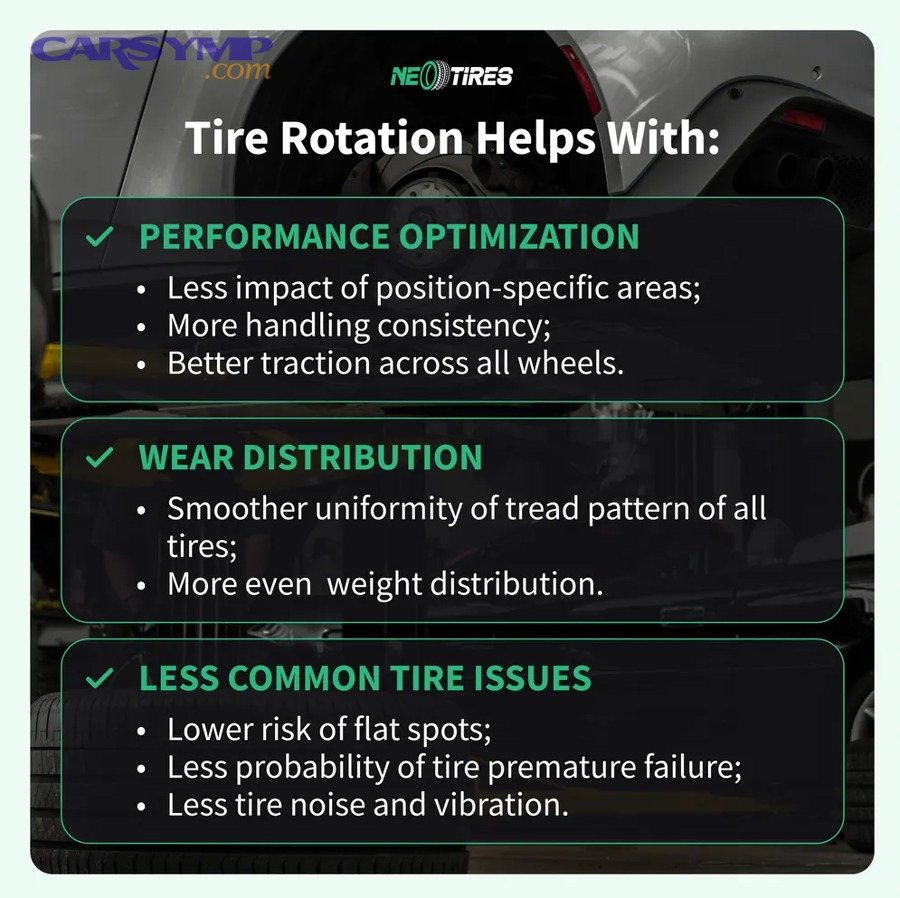
There are three main tire conditions that cause noise rotation can expose: tire cupping, uneven tread wear, and tire imbalance — each identifiable by a distinct noise signature and each rooted in specific maintenance or alignment failures.
Specifically, understanding each condition helps you not only identify the noise after rotation but also address the underlying cause so it does not return. The following sections break down each condition in detail.
What Is Tire Cupping and How Does It Create Noise After Rotation?
Tire cupping is a type of irregular wear in which the tread surface develops a scalloped or wavy pattern — alternating high and low spots — caused by suspension components that allow the tire to bounce slightly as it rolls rather than maintaining consistent road contact.
- The resulting tread surface is uneven at a microscopic to visible level, with peaks and valleys across the circumference of the tire.
- When a cupped rear tire rotates to the front axle, the steering column transmits every bounce and harmonic directly to the driver, turning what was a barely audible hum in the rear into a loud, rhythmic roar or whine at the front.
- You can detect cupping without any equipment: run your bare hand firmly across the tread surface from the outside edge to the inside edge. A smooth tire feels uniformly flat; a cupped tire has a clearly wavy or rippled texture.
- Cupping is most often caused by worn shock absorbers or struts, which lose their ability to dampen wheel oscillation, and by under-inflation, which allows excessive tread flex.
According to data published by the Tire Industry Association, worn shock absorbers are responsible for a significant majority of premature cupping cases in passenger vehicles, making suspension inspection an essential companion to any tire noise diagnosis.
How Does Uneven Tread Wear Cause Noise to Change After Rotation?
Uneven tread wear causes noise to change after rotation because the worn-in contact pattern of a tire — shaped by misalignment, over-inflation, or neglected rotation intervals — no longer matches the force dynamics of the new wheel position, creating friction, vibration, and audible tread noise.
The most common form of uneven wear tied to post-rotation noise is inside-edge wear caused by toe misalignment. When a vehicle’s wheels point slightly inward or outward instead of straight ahead, the inside or outside edge of the tread scrubs against the road surface continuously. Over thousands of miles, this creates a feathered or beveled edge on one side of the tire. Once that tire is rotated to the front, the beveled edge interacts with road contact at a new angle, generating a persistent hum or whirring sound — what drivers often describe as a “tire whine explained by nothing obvious,” since the tread depth may still appear adequate.
Over-inflation produces a different wear pattern: excessive wear concentrated in the center of the tread, leaving the shoulder relatively intact. This central wear ridge can cause a subtle vibration after rotation, particularly noticeable at highway speeds. Both conditions respond poorly to rotation alone — they require the alignment or pressure issue to be corrected before new tires are installed or before existing tires can wear evenly going forward.
What Types of Car Noise Can Tire Rotation Help Identify?
There are four primary types of car noise that tire rotation can help identify, classified by acoustic character and likely cause.
| Noise Type | Sound Description | Most Likely Tire Cause | Behavior After Rotation |
|---|---|---|---|
| Humming | Low-frequency, rhythmic drone | Cupping or imbalance | Moves with tire to new position |
| Roaring | Loud, aggressive road sound | Severe uneven or feathered wear | Amplified when moved to front axle |
| Grinding/Scraping | Harsh, mechanical contact sound | Debris between tire and shield, or severe cupping | May stay fixed (if mechanical) or move (if tire debris) |
| Whirring/Whining | High-pitched, speed-dependent tone | Inside-edge toe wear, Tire pressure and noise relationship imbalance | Moves with tire; pitch increases with speed |
The table above summarizes the four most common noise types associated with tire conditions, mapped to their probable cause and how each behaves during a diagnostic rotation. This matching process is the core of systematic tire noise diagnosis — once you identify the character of the sound and observe whether it moves with the rotated tire, you can narrow down the cause with high accuracy before spending money on repairs.
How Do You Rotate Tires Step by Step to Diagnose a Noise Source?
The diagnostic tire rotation method involves 5 targeted steps — note the noise, choose a strategic swap pattern, torque correctly, conduct a controlled test drive, and map the result — with the expected outcome being a clear answer about whether the tire or the vehicle’s mechanical components are responsible.
This how-to process is intentionally different from standard maintenance rotation. To better understand how to execute it correctly, the sub-sections below walk through each critical decision point.
How Should You Set Up a Diagnostic Tire Rotation Differently from a Routine Rotation?
A diagnostic rotation differs from a routine rotation in one fundamental way: its purpose is isolation, not even wear distribution, meaning you make the minimum swap necessary to test a specific hypothesis about which tire is generating the noise.
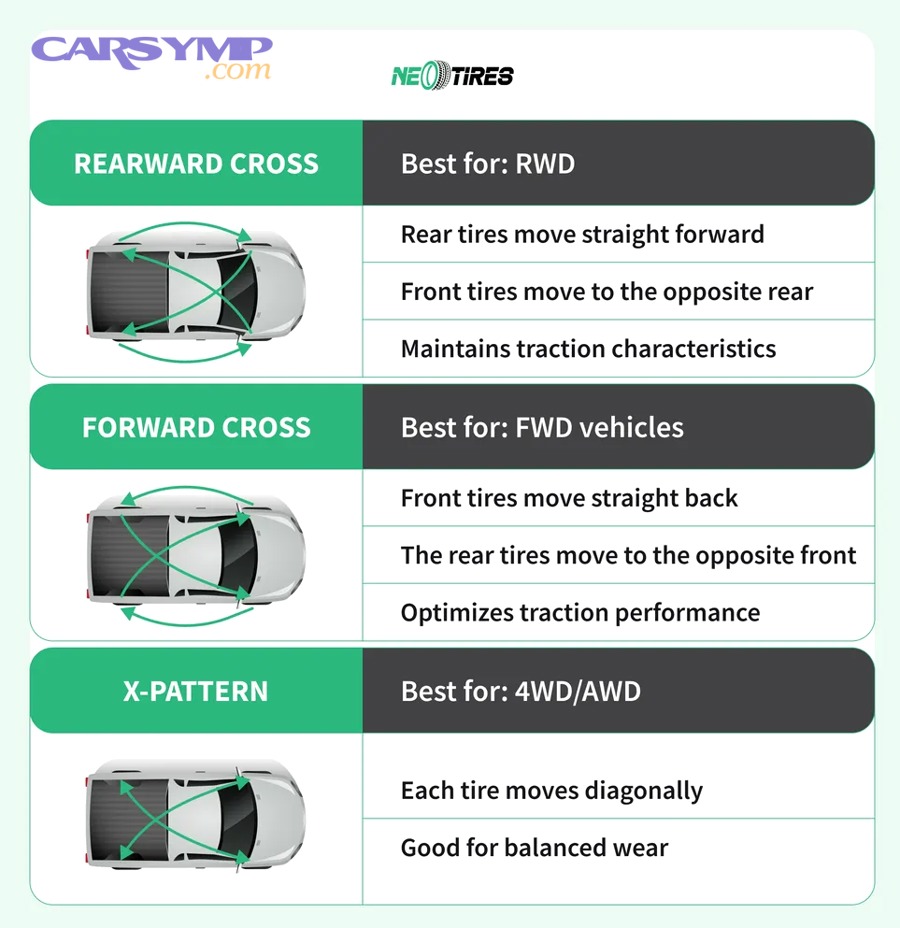
In a routine front-to-rear or X-pattern rotation, all four tires move simultaneously. This is efficient for maintenance but useless for diagnosis because when multiple tires move at once and the noise changes, you cannot know which tire caused the change. A diagnostic rotation solves this by moving as few tires as possible — ideally one or two — so the result is unambiguous.
Diagnostic swap patterns and when to use each:
- Side-to-side swap (e.g., front-left ↔ front-right): Use when noise is localized to one axle but the exact corner is unclear. If noise disappears or moves to the other side, the swapped tire is confirmed as the source.
- Front-to-rear swap on one side only (e.g., left-front ↔ left-rear): Use when noise seems to originate from one side of the vehicle. Moving both left tires while leaving right tires untouched clearly reveals whether the problem is on that side.
- Single-tire isolation swap: Move only the single suspect tire to the opposite axle. This is the highest-precision method and is particularly valuable when diagnosing a specific hum or whine on a vehicle with directional tires or a staggered fitment (where front and rear tires are different sizes).
For all-wheel-drive vehicles, consult the manufacturer’s guidelines before performing any partial rotation, as AWD systems can be sensitive to tire diameter differences between axles.
What Is the Step-by-Step Process to Rotate Tires for Noise Diagnosis?
The diagnostic rotation process follows five deliberate steps designed to produce a clear, interpretable result:
Step 1 — Document the noise precisely before touching anything.
Before lifting the vehicle, drive the same road segment where the noise is most audible. Note: Which corner or axle does it seem to come from? At what speed does it appear or peak? Does it change when you gently swerve left or right (a hallmark of bearing noise)? Does it change on different road surfaces? Write this down. This baseline is what you will compare against after the rotation.
Step 2 — Choose your targeted swap pattern.
Based on your noise assessment, select the minimum swap needed. If the noise seems to come from the right-rear corner, your first diagnostic move is to swap only that tire — move it to the right-front and move the right-front tire to the right-rear. Label each tire with chalk or tape as you remove it so you know exactly which tire went where.
Step 3 — Execute the swap with correct torque.
Use a torque wrench to tighten lug nuts to the vehicle manufacturer’s specification — typically between 80 and 120 ft-lbs for most passenger cars. Over-torqued lug nuts warp brake rotors; under-torqued lug nuts create vibration and noise of their own, which would corrupt your diagnostic result. While wheels are off, inspect dust shields to ensure none are bent or contacting the rotor.
Step 4 — Conduct the test drive on the exact same route.
Drive the same road segment at the same speed. Use the same lane position if possible, as concrete expansion joints and surface texture affect how tire noise presents. This controlled repetition is what makes the before-and-after comparison valid.
Step 5 — Record the result and interpret.
Did the noise move to the front-right? Stay in the same corner? Disappear? Worsen? Each outcome maps to a specific conclusion, detailed in the next section.
How Do You Confirm the Noise Source After Completing the Test Rotation?
You confirm the noise source after the test rotation by comparing the post-rotation noise location and character against the pre-rotation baseline, using the following decision framework:
| Result After Rotation | Interpretation | Recommended Next Action |
|---|---|---|
| Noise moved to the new position of the swapped tire | Tire confirmed as source | Inspect for cupping, uneven wear, or imbalance; balance or replace tire |
| Noise remained at the same corner of the vehicle | Mechanical source confirmed | Inspect wheel bearing, suspension components, or brake hardware at that corner |
| Noise disappeared entirely | Positional or directional wear | Tire may self-correct; monitor for 500–1,000 miles; check alignment |
| Noise worsened significantly | Severe underlying condition | Stop driving; inspect for structural tire damage, bearing failure, or alignment damage |
The table above provides a complete decision tree for interpreting your diagnostic rotation results. This framework removes guesswork and gives you a clear, evidence-based answer about the noise source — which is the entire goal of the diagnostic rotation process.
How Is Diagnosing Tire Noise Different from Diagnosing a Wheel Bearing or Suspension Noise?
Tire noise wins in position-responsiveness (it moves with the tire during rotation), while wheel bearing noise is best identified by its load-sensitive behavior during cornering, and suspension noise is most clearly distinguished by its connection to road irregularities rather than vehicle speed.
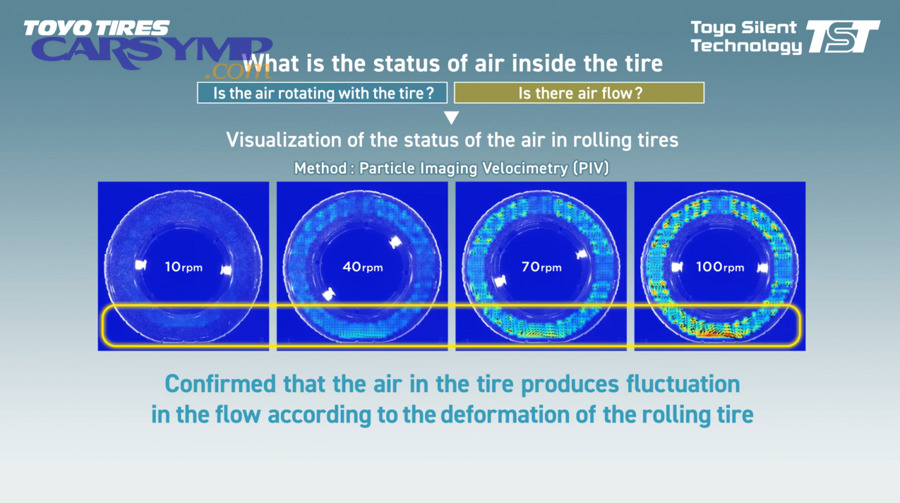
However, understanding each comparison in detail is critical, because misidentifying a wheel bearing as a tire noise — or vice versa — leads to incorrect and potentially dangerous repair decisions. The following sections provide a direct comparison of each noise type.
What Is the Difference Between Tire Noise and Wheel Bearing Noise?
Tire noise and wheel bearing noise are the most commonly confused sounds in automotive diagnosis, but they behave distinctly differently under controlled conditions.
Tire noise characteristics:
- Changes with road surface texture (louder on concrete, quieter on smooth asphalt)
- Moves to a new vehicle position when the tire is rotated
- May be rhythmic or tonal, linked to tread pattern frequency
- Remains relatively consistent whether the vehicle tracks straight or corners gently
Wheel bearing noise characteristics:
- Produces a constant, speed-dependent roar or hum that does not change meaningfully with road surface
- Does not move when tires are rotated — the noise stays fixed at the same corner because the bearing is part of the wheel hub assembly, which never moves
- Intensifies when the vehicle’s weight shifts onto the bad bearing during cornering: a failing left-front bearing will grow louder when you gently turn right (loading the left side) and quieter when you turn left (unloading it)
- Often described as a “tire whine explained by nothing visible” — because the tread appears normal while the bearing is degrading internally
The lateral-load test is the single most reliable field method for differentiating the two: at 50–60 mph on an empty road, gently weave the vehicle left and right. If the noise changes intensity with direction, the bearing is the likely source. If the noise remains constant through the weave, suspect the tire.
According to the National Highway Traffic Safety Administration (NHTSA), wheel bearing failures that go undiagnosed are a documented contributor to wheel separation events, underscoring the importance of distinguishing bearing noise from tire noise accurately and promptly.
What Is the Difference Between Tire Noise and Suspension or Brake Noise?
Tire noise, suspension noise, and brake noise each occupy distinct acoustic profiles and diagnostic contexts, making them separable with careful observation.
Suspension noise:
- Presents primarily as clunks, rattles, or knocking sounds that occur over bumps, potholes, or rough pavement transitions
- Is not strongly speed-dependent — a worn ball joint or end link makes noise at 5 mph over a pothole as clearly as at 40 mph
- Does not change during a diagnostic tire rotation because the suspension components remain attached to the vehicle, not the tire
- Common sources: worn strut mounts, loose sway bar end links, degraded control arm bushings
Brake noise:
- Appears as squealing, squeaking, or grinding that is specifically tied to the act of braking — it activates when the brake pedal is depressed and diminishes or disappears when coasting without braking
- A worn brake pad with an audible wear indicator produces a consistent squeal at low speeds during braking; a completely worn pad produces grinding at any braking intensity
- Like bearing noise, brake noise does not migrate during a tire rotation because the brake caliper, rotor, and hardware are fixed to the vehicle’s corner assembly
The key diagnostic separator: Tire noise is always present during rolling at speed, regardless of whether you are braking, cornering, or driving straight. Suspension noise links to road surface inputs. Brake noise links to braking events. If the noise is constant while rolling and disappears when you coast to a stop, suspect the tire or bearing first.
What Causes the Tire Conditions That Rotation Exposes — and How Can You Prevent Them?
There are four primary causes of the tire conditions that rotation exposes — wheel misalignment, suspension wear, incorrect tire pressure, and neglected rotation intervals — and each has a specific prevention strategy tied directly to Preventing tire noise with proper maintenance.
In addition, understanding two rare but significant factors — road surface behavior and single-tire isolation techniques — completes the picture of how to both diagnose and prevent recurring noise conditions. The following sub-sections address each cause and its corresponding prevention measure.
How Does Wheel Alignment Cause Tire Cupping and Post-Rotation Noise?
Wheel alignment directly causes tire cupping and post-rotation noise by creating a persistent angular error in how the tire contacts the road — a condition that compounds mile after mile until rotation moves the damaged tire to a position where the noise becomes impossible to ignore.
The most damaging alignment parameter for tire wear is toe — the degree to which the wheels point inward (toe-in) or outward (toe-out) from the vehicle’s centerline. Even a small toe deviation of 0.2 to 0.3 degrees beyond specification causes the inside or outside tread shoulder to scrub the road surface rather than roll cleanly across it. Over 10,000 to 15,000 miles, this scrubbing creates a feathered tread edge on one side of the tire — smooth in one direction, sharp in the other when you run your hand across it.
Camber misalignment — the inward or outward lean of the tire when viewed from the front — produces a similar one-sided wear pattern but distributed more broadly across the shoulder. Both toe and camber errors are invisible to casual inspection until the tire is rotated to a position where its worn edge creates audible road noise.
Prevention strategy:
- Have alignment checked every 12,000 miles or any time the vehicle strikes a curb, pothole, or road debris hard enough to be felt
- Request the printed alignment report and verify that toe and camber values fall within the inner half of the manufacturer’s specified tolerance range, not just within the outer boundaries of the spec
- Pair every alignment service with a visual inspection of the tire tread edges for early signs of feathering
Does Driving Surface (Concrete vs. Asphalt) Affect How Tire Noise Is Perceived After Rotation?
Yes, driving surface significantly affects how tire noise is perceived after rotation, and failing to account for this variable can lead to false conclusions during a diagnostic test drive.
Concrete road surfaces — particularly older concrete with exposed aggregate or expansion joint patterns — amplify tire noise substantially more than smooth asphalt. The rigid surface creates stronger harmonic resonance between the tread pattern and the road, making any existing cupping, feathering, or imbalance sound dramatically louder than it would on a quiet asphalt segment. This is a direct expression of the tire pressure and noise relationship as well: a tire even slightly outside its optimal pressure range will exhibit more surface-contact variability on concrete than on the forgiving texture of asphalt.
The practical implication for diagnostic testing is straightforward: always conduct your before-and-after test drives on the same surface, at the same speed, over the same route segment. If your baseline observation was made on a concrete highway interchange and your post-rotation test drive is on smooth asphalt, a genuine noise reduction may simply be a surface change — not evidence that the rotation resolved the problem. Conversely, a noise that seems to appear only on concrete sections is worth noting; it may indicate a tread frequency resonance with that surface type rather than a severe structural tire condition.
Can You Isolate a Single Noisy Tire Without Rotating All Four?
Yes, you can isolate a single noisy tire without rotating all four, and in many situations this single-tire isolation method is the most precise and appropriate diagnostic approach available.
The technique involves moving only the suspected tire — the one most likely to be the noise source based on your directional assessment — to its opposite axle position on the same side of the vehicle. For example, move only the right-rear tire to the right-front, and move the right-front tire to the right-rear. All other tires remain in their original positions.
When single-tire isolation is preferable to a full rotation:
- Directional tires: Tires with a directional tread pattern can only move front-to-rear on the same side of the vehicle — they cannot cross from left to right without being dismounted and remounted on a different rim. A single-side, same-direction swap is fully compatible with directional tires.
- Staggered fitments: Some performance vehicles use wider rear tires than front tires (a staggered setup). These tires cannot be cross-rotated at all. The only diagnostic option is a same-side front-to-rear swap or a side-to-side swap on the same axle if sizes match.
- AWD vehicles with tight torque specifications: Some all-wheel-drive systems are sensitive to even slight differences in tire circumference between axles. Moving fewer tires minimizes this risk. Always consult the owner’s manual for AWD rotation restrictions before performing any diagnostic swap.
- When you are highly confident in the noise’s location: If the noise clearly originates from one specific corner — identifiable through the lateral-load test or careful listening — moving only that tire provides a clean answer without introducing multiple variables.
How Often Should You Rotate Tires to Prevent the Wear Patterns That Cause Noise?
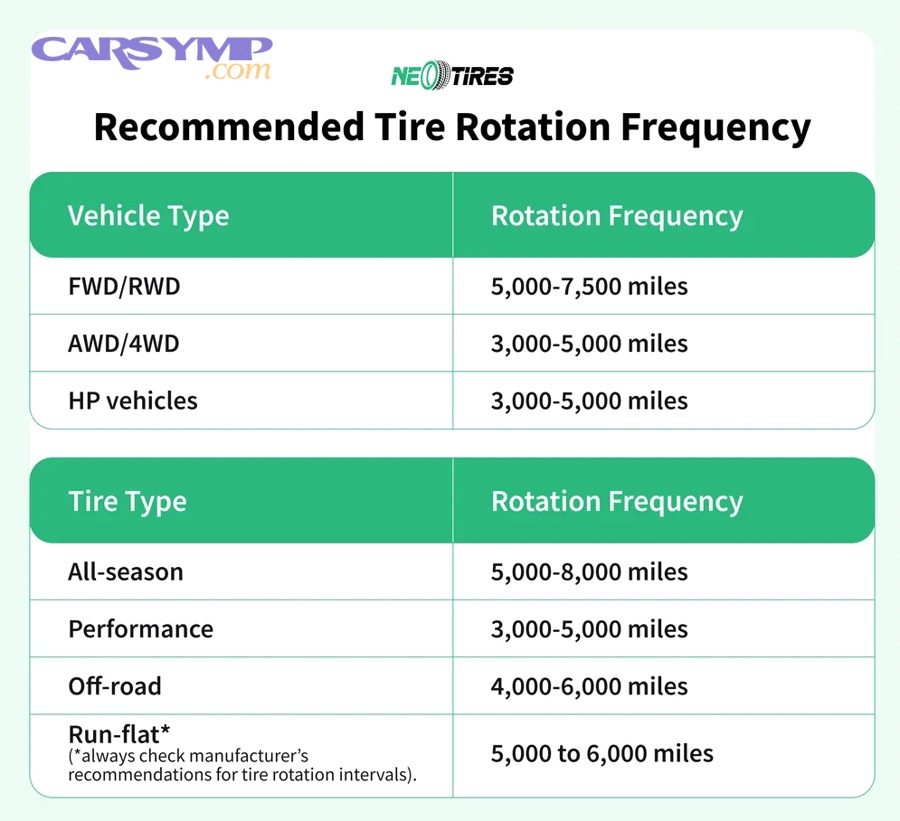
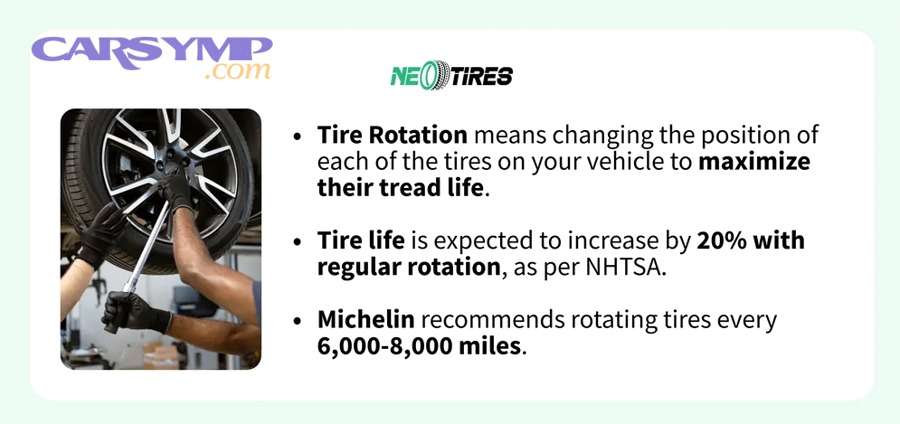
You should rotate tires every 5,000 to 7,500 miles as the standard interval for preventing tire noise with proper maintenance — but vehicles prone to cupping or uneven wear benefit most from the shorter 5,000-mile interval, which dramatically reduces the development of noise-generating wear patterns.
The logic behind rotation frequency as a noise prevention tool is straightforward: uneven wear is a function of accumulated miles in a fixed position. Front tires on a front-wheel-drive vehicle carry the braking, steering, and power-delivery loads simultaneously, causing them to wear two to three times faster than the rear tires. Left unrotated past 7,500 miles, the wear differential between axles grows large enough that rotating the tires at that point introduces immediate and pronounced noise — exactly what the forum discussions cited throughout this article consistently describe.
By rotating at 5,000-mile intervals, no single tire accumulates enough positional wear to develop a noise-generating pattern before it is redistributed. The tires wear more uniformly, and when they are moved to a new position, the adjustment period is shorter and quieter because the wear differential is smaller.
Preventing tire noise with proper maintenance comes down to five habits:
- Rotate at 5,000–7,500 miles — earlier if front-wheel-drive or if previous rotation was skipped
- Check and correct tire pressure monthly — maintain the door-placard specification, not the tire sidewall maximum
- Inspect alignment annually or after any significant road impact
- Have shocks and struts inspected every 50,000 miles to prevent cupping-inducing suspension bounce
- Request a road force balance — not just a standard spin balance — when installing new tires or investigating persistent vibration
Together, these five practices address every root cause that tire rotation diagnosis reveals, ensuring that the next rotation is a maintenance event rather than a surprise investigation into an unexpected and unwelcome noise.