


Choosing between OEM and aftermarket water pump quality usually comes down to one practical conclusion: OEM is the safer default for exact fit and predictable performance, while a high-quality aftermarket pump can deliver equal or near-equal value when the manufacturer truly follows OE specifications and quality control. For most car owners, the smartest decision is not “OEM or aftermarket” in the abstract, but “which pump gives the right fit, flow, durability, and risk profile for this specific vehicle.” (gmb.net)
That comparison matters because water pump quality is not defined by the label alone. The real quality signals live in the bearing, seal, impeller, housing precision, and testing standard, which is why some aftermarket pumps perform very well while others fail early from leaks, noise, or poor coolant circulation. In other words, the name on the box matters less than the engineering and consistency inside it. (usmotorworks.com)
Car owners also need a framework for comparing replacement pumps before purchase. Fitment accuracy, bearing durability, seal integrity, coolant compatibility, and warranty support usually matter more than the lowest shelf price. That is especially true during a water pump replacement, when labor often costs more than the part itself and a second repair can erase any short-term savings from choosing the cheapest option. (usmotorworks.com)
Some of the most important quality differences also appear only after installation. Bleeding air after water pump replacement, checking for belt tension problems, and evaluating whether Replacing thermostat and belts during water pump job makes sense can affect the result just as much as the pump brand itself. Introduce a new idea: the best way to choose is to start with the core OEM-versus-aftermarket comparison, then move into the quality factors and hidden risks that actually decide long-term success.
What Is the Difference Between OEM and Aftermarket Water Pump Quality?
OEM and aftermarket water pump quality differ mainly in fitment predictability, supplier consistency, price, and quality-control variation.
To better understand that issue, it helps to separate branding from engineering. “OEM” usually means the part is sold through the automaker’s channel and built to the original specification for that vehicle. “Aftermarket” means the part is sold outside the automaker’s branded parts network, but that does not automatically mean lower quality. In fact, some automakers outsource production to the same contract manufacturers that also sell pumps under their own aftermarket brands. That is why a reputable aftermarket pump can sometimes mirror OEM dimensions, coolant flow targets, and bearing standards, while a low-end generic alternative may fall far below them. (gmb.net)
In practical terms, OEM wins when a buyer wants the highest confidence in exact fit, installation simplicity, and factory-level compatibility. The aftermarket wins when the buyer can identify a supplier with real OE experience or proven manufacturing standards and wants to control repair cost without stepping down in reliability. The problem is that the aftermarket is not one thing. It includes premium OE-grade suppliers, mid-tier brands, and bargain parts with inconsistent machining, weaker bearings, or lower seal quality. That spread is the real reason this comparison matters. (gmb.net)
Is OEM water pump quality always better than aftermarket?
No, OEM water pump quality is not always better than aftermarket because some aftermarket pumps are made by OE suppliers, some use equivalent dimensions and flow targets, and some are tested to very high durability standards.
However, that answer needs context. OEM still has a strong advantage in trust because it reduces the number of unknowns. If you buy the factory-branded part, you are generally paying for the highest confidence that the pulley offset, gasket design, impeller clearance, and coolant compatibility match what the engine was designed around. That matters on vehicles with cramped engine bays, sensitive cooling systems, or timing-belt-driven pump layouts where a poor fit or premature failure can create expensive secondary damage. (gmb.net)
A premium aftermarket pump can still be the right answer when the manufacturer has genuine OE background, publishes fitment carefully, and builds to OE dimensions. GMB, for example, states that major automakers contract with outside manufacturers and that some aftermarket pumps are built to the same specs as OEM units. That does not prove every aftermarket brand is equal, but it does show why “aftermarket” should never be treated as a single quality category. The meaningful question is whether the specific supplier has the materials, tolerances, and testing discipline to match the original part. (gmb.net)
The buyer should also remember that many water pump failures blamed on “bad parts” actually begin with cooling system contamination, belt tension errors, old related components, or trapped air. A good pump installed into a neglected system can fail early and make the part look worse than it is. That is one reason experienced technicians often evaluate the entire cooling system instead of the pump alone. (usmotorworks.com)
How do OEM and aftermarket water pumps differ in fit, materials, and reliability?
OEM wins in consistency of fit and validation, while premium aftermarket can compete on value and selected materials, and low-end aftermarket usually loses on tolerance control, durability, and long-term reliability.
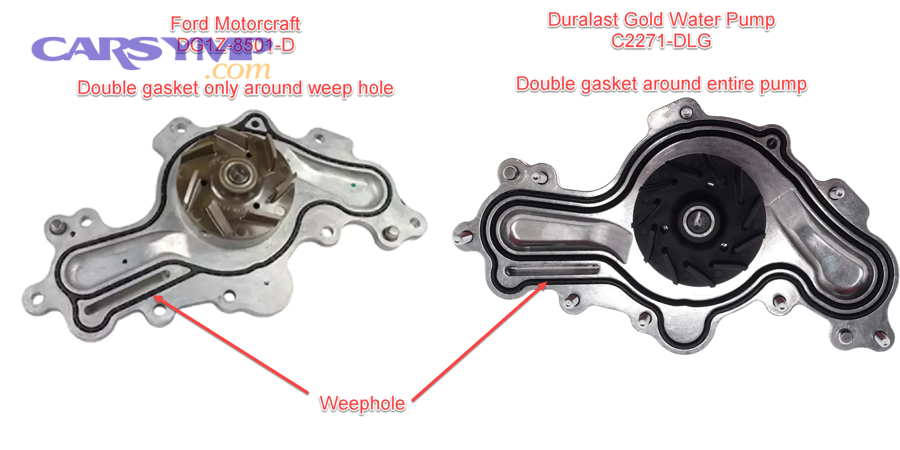
More specifically, fitment is the first quality checkpoint. A water pump has to align correctly with the block, pulley path, gasket surface, and coolant passages. Small dimensional errors can create leaks, noise, belt wear, or reduced coolant circulation. GMB notes that quality and fitment are critical in replacement pumps and describes OE-quality pumps as built to exact OEM dimensions and tested for leakage and bearing noise. That kind of language matters because precision is not cosmetic here; it directly affects installation outcome and cooling performance. (gmb.net)
Materials come next. US Motor Works identifies five main water pump components—the hub, bearing, housing, seal, and impeller—and states that the seal and bearing have the highest instances of failure. That means quality differences in those hidden parts matter more than a polished exterior. A stronger bearing handles load and vibration better. A better seal keeps coolant out of the bearing cavity. A durable impeller resists deformation, corrosion, and cavitation. When those pieces are engineered well, the pump tends to run quieter, leak less, and last longer. (usmotorworks.com)
Reliability depends on how those parts work together under real operating stress. Over-tensioned belts, contaminated coolant, cavitation, corrosion, and reused worn accessories can shorten life dramatically. That is why OEM often feels “better” in the field: not because every OEM pump is magical, but because it is more likely to have been validated as part of the original system. A high-grade aftermarket pump can still be highly reliable, but the buyer must verify the brand, not just the category. According to US Motor Works’ 2025 professional guide, the water pump seal and bearing are the most common failure points, and coolant contamination, imbalance, and belt-related stress are major causes of premature failure. (usmotorworks.com)
What Factors Should Car Owners Compare Before Choosing a Replacement Water Pump?
Car owners should compare seven main water pump quality factors: fitment, bearing quality, seal quality, impeller design, coolant compatibility, warranty support, and total repair cost.
Let’s explore those factors in the same order a careful buyer should use them. Fitment comes first because even a durable pump is a poor choice if the gasket, bolt pattern, pulley depth, or connector arrangement does not match the vehicle exactly. Bearing quality comes second because the bearing supports the rotating shaft and impeller and must survive heat, load, vibration, and belt force. Seal quality follows because once coolant reaches the bearing cavity, grease washes out and the pump is already in a failure path. Then come impeller design and housing quality, which influence flow, efficiency, and resistance to erosion or breakage. Finally, buyers should compare warranty, supplier support, and the real cost of doing the job again if the first part fails. (usmotorworks.com)
This is also where many buyers underestimate the labor side of water pump replacement. If the pump sits behind timing components or requires extensive front-engine disassembly, the labor exposure is high enough that the best-value part is usually the one least likely to require repeat work. On a simple belt-driven external pump, a premium aftermarket choice can make more economic sense because replacement is less invasive. On a timing-belt-driven design, risk tolerance should be lower and part quality should move up the priority list. (usmotorworks.com)
What are the most important signs of good water pump quality?
There are seven main signs of good water pump quality: exact fitment, strong bearings, durable seals, stable impeller construction, corrosion resistance, proper included sealing hardware, and credible manufacturer testing.
Specifically, exact fitment means the pump matches OE dimensions, mounting surfaces, and coolant flow design. Strong bearings matter because they keep the shaft rotating smoothly under load; if they wear early, the impeller can wobble or seize. Durable seals matter because even a small leak can begin the chain that destroys the bearing. Stable impeller construction matters because the impeller is what actually moves coolant; if it erodes, loosens, or deforms, cooling performance drops even if the pump does not immediately leak. Corrosion resistance matters because poor coolant chemistry and contaminated fluid can eat away at internal surfaces over time. (usmotorworks.com)
Good pump quality also shows up in what comes with the part. US Motor Works notes that a quality water pump should include the proper sealing devices required for the repair and that excess sealant is not recommended unless the OEM design specifically calls for it. That is a useful buying clue because serious manufacturers design the installation package around the job, not just the casting. Quality control clues include factory leakage testing, bearing-noise testing, OE-dimensional validation, and transparent fitment documentation. (usmotorworks.com)
For everyday buyers, the practical screening checklist is simple: avoid unknown bargain brands, verify whether the brand has OE background or professional-market credibility, confirm the pump includes correct gaskets or seals, and look for evidence of testing rather than vague marketing language. A pump should not be chosen only by online star ratings or the lowest price. It should be chosen by how confidently it can complete one repair cycle without drama. According to GMB, OE-quality replacement water pumps are tested for leakage, durability, and bearing noise and are designed to work with OE coolant flow rate and pressure. (gmb.net)
Which matters more when comparing water pumps: price, lifespan, or fitment?
Fitment matters most first, lifespan matters most second, and price matters most third for most water pump replacement decisions.
That order may sound conservative, but it reflects how cooling-system repairs actually fail. A pump that does not fit or seal properly can create immediate problems no matter how cheap it was. A pump that fits but uses weaker bearings or poor seals can turn into a repeat job months later. Price matters, but only after the buyer has protected the first two variables. This is why many technicians and experienced owners prefer either OEM or a short list of trusted aftermarket brands instead of shopping the entire aftermarket by price alone. (gmb.net)
There is also a hidden math problem in cheap parts. The purchase price difference between OEM and a premium aftermarket pump may be meaningful, but the price difference between a premium aftermarket pump and an ultra-cheap generic unit is often small compared with the labor, coolant, belt removal time, and downtime involved in replacing the pump again. Once you factor in the cost of fresh coolant, possible gasket cleanup, possible belt contamination, and the chance of overheating, the cheapest pump can become the most expensive choice. (usmotorworks.com)
A good buying rule is this: if the water pump is easy to access and the vehicle is older, a reputable aftermarket pump can be a rational value decision. If the pump is buried behind major components, the engine is known to be cooling-sensitive, or the vehicle must stay dependable, prioritize fitment and lifespan above part price. That hierarchy aligns with the way seals, bearings, and related components fail in service. (usmotorworks.com)
When Should You Choose OEM vs Aftermarket Water Pump Quality for Your Vehicle?
You should choose OEM for higher-risk applications and choose premium aftermarket for lower-risk, budget-sensitive, or clearly OE-grade replacement scenarios.
That answer becomes easier when you sort vehicles by consequence of failure. The more expensive the labor, the tighter the packaging, the more sensitive the engine, and the higher the penalty of overheating, the stronger the case for OEM or a known OE supplier. By contrast, the more accessible the pump, the older the car, and the more transparent the aftermarket brand’s quality record, the stronger the case for premium aftermarket value. (usmotorworks.com)
This is also the point where smart owners widen the job scope. Replacing thermostat and belts during water pump job is often worth considering when those parts are worn, contaminated, overdue by service interval, or removed anyway during access. Likewise, bleeding air after water pump replacement is not optional on a modern cooling system; trapped air can imitate a bad new pump by causing temperature swings, poor cabin heat, or repeat overheating.
Should you choose OEM water pump quality for newer, complex, or sensitive vehicles?
Yes, you should usually choose OEM water pump quality for newer, complex, or cooling-sensitive vehicles because exact fitment, system validation, and lower installation risk matter more in those applications.
More importantly, newer vehicles often integrate tighter packaging, more precise coolant routing, and sometimes electric or electronically managed pump assemblies. On those vehicles, even a small fitment mismatch, connector issue, or flow-rate difference can complicate diagnosis and create comeback risk. OEM reduces that uncertainty. It also makes sense when the car is still under warranty, when the owner wants to preserve factory-like service history, or when the engine is known for intolerance to overheating. (gmb.net)
Timing-belt-driven water pumps raise the stakes even further. Haynes notes that if the water pump is driven by the timing belt, many manufacturers recommend renewing the pump when the belt is replaced because a seized pump can affect timing-belt operation. In those engines, the labor overlap is large and the risk of failure is too expensive to treat casually. That does not mean only factory-box pumps are acceptable, but it does mean the buyer should stay within OEM or clearly OE-grade territory. (usmotorworks.com)
Owners should also think in terms of total confidence, not just part origin. If the vehicle is a daily commuter, family hauler, fleet unit, or long-trip car, then predictability matters. A water pump is not a styling part; it is a cooling-system control point. Choosing the most validated option is often worth the extra upfront cost when downtime and overheating risk would be disruptive. According to AutoZone’s cooling-system bleeding guide, trapped air can cause overheating, fluctuating gauge readings, and poor heater performance, which shows how little margin for error exists after this repair.
When is a high-quality aftermarket water pump the better value?
A high-quality aftermarket water pump is the better value when the brand has OE-grade credibility, the application is straightforward, and the repair cost must stay reasonable without sacrificing core durability.
For example, an older vehicle with a simple external pump and no unusual cooling-system sensitivity is often an ideal case for premium aftermarket. In that scenario, the owner may reasonably prioritize cost control while still buying a pump with correct dimensions, tested bearings, proper seals, and proven fitment support. GMB explicitly argues that the best value is an OE-quality water pump at an aftermarket price, and that claim reflects a real market segment: parts that are not dealer-branded but are still engineered around original specifications. (gmb.net)
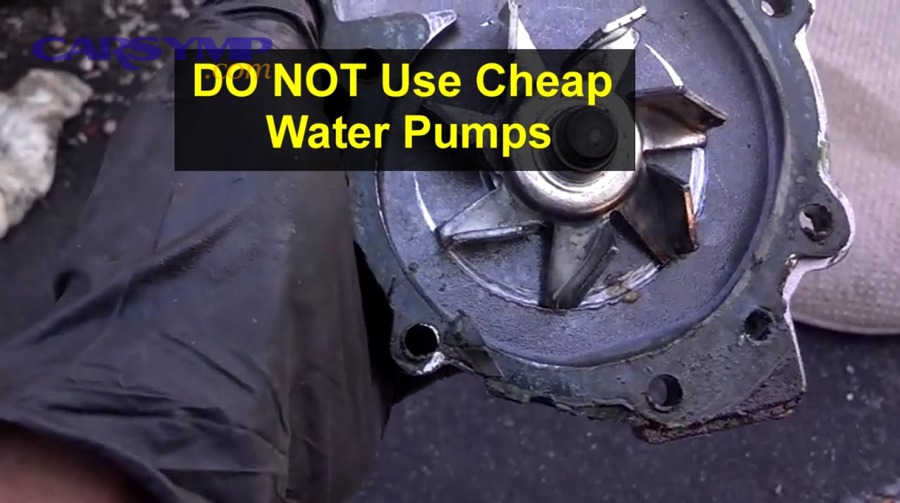
The key phrase there is “high-quality,” not merely “aftermarket.” Good value appears when the buyer can connect the brand to OE experience, strong documentation, or professional-market acceptance. Poor value appears when the buyer only sees a low price and ignores material quality, bearing design, or seal reputation. The water pump may look similar in photos, but the internal life of the part often depends on details the cheapest listing never explains. (usmotorworks.com)
This is also where a broader service decision helps. If you are already opening the front of the engine, inspect the thermostat, accessory belt, timing-belt components if applicable, fan clutch where relevant, and tensioners. Replacing thermostat and belts during water pump job is not mandatory in every case, but it is often cost-effective when access overlaps or coolant contamination has affected adjacent parts. US Motor Works specifically warns that over-tensioned belts, faulty tensioners, and reusing worn related parts can accelerate pump failure. (usmotorworks.com)
What Hidden Quality Differences Can Affect OEM vs Aftermarket Water Pump Performance?
Hidden quality differences that affect water pump performance include supplier identity, internal component design, coolant-system condition, installation quality, and air management after the repair.
In addition, these factors explain why two pumps that look similar on a product page can behave very differently in service. Most buyers never see the bearing metallurgy, the seal quality, the impeller balance, or the machining precision at the gasket surface. Yet those hidden differences decide whether the pump runs quietly for years or starts seeping, wobbling, or overheating early. That is why a comparison based only on OEM-versus-aftermarket branding always misses part of the story. (usmotorworks.com)
What is the difference between OEM, OE supplier, and OEM-equivalent water pumps?
OEM is the factory-branded part, an OE supplier part is made by the company that may also supply automakers, and OEM-equivalent usually means an aftermarket part marketed as matching original specifications.
That distinction matters because it explains why some aftermarket pumps are excellent and others are merely advertised well. A true OE supplier may manufacture water pumps for automakers and also sell very similar units through the independent parts channel. By contrast, “OEM-equivalent” is often a marketing phrase rather than a documented production relationship. It may still be a good pump, but the burden shifts to the buyer to verify testing, reputation, and fitment quality. (gmb.net)
For car owners, the safe takeaway is to ask a more specific question: who engineered and validated this pump, and what evidence shows it matches the original application? Dealer branding answers that by default. Premium aftermarket brands answer it through track record, OE ties, and test claims. Weak brands often do not answer it at all. That is why supplier identity is a hidden quality difference even when the exterior castings look alike. (gmb.net)
How do impeller design and internal component quality affect water pump durability?
Impeller design and internal component quality affect durability by controlling coolant flow, shaft stability, leak resistance, and resistance to corrosion, cavitation, and mechanical stress.
More specifically, the impeller is the part that actually moves coolant, so its material and shape matter. US Motor Works highlights the benefits of metal impellers, including durability, resistance to deformation, high-temperature capability, and high-RPM performance. That does not mean every non-metal impeller is defective, but it does show why impeller design should be treated as a serious engineering variable instead of a cosmetic difference. A weak or eroded impeller can reduce flow long before the owner identifies the pump as the cause. (usmotorworks.com)
The bearing and seal matter just as much. The bearing supports the rotating shaft, while the seal keeps coolant out of the bearing cavity. Once coolant enters that cavity, grease washout begins and bearing life falls sharply. GMB and US Motor Works both describe contamination, cavitation, and poor coolant maintenance as major contributors to pump damage. Those hidden internal stresses are why a water pump can fail gradually with noise, leakage, or rising temperatures rather than one dramatic break. (usmotorworks.com)
According to US Motor Works’ 2025 guide, the water pump seal and bearing are the two components with the highest failure incidence, and metal impellers offer advantages in durability, high-temperature resistance, and high-RPM operation. (usmotorworks.com)
Are electric water pumps judged differently from mechanical water pumps?
Yes, electric water pumps are judged differently from mechanical water pumps because electronics, control logic, connector quality, and module integration matter alongside traditional pump durability.
Mechanical pumps are