


In practice, the “better” choice often changes over the vehicle’s life—from warranty years to high-mileage ownership—because the strengths of a dealership service lane are not the same strengths that make a strong independent shop invaluable.
And because modern cars are rolling networks of modules, calibrations, and software, your outcome depends less on a logo on the building and more on how the technician gets information, tests hypotheses, documents proof, and communicates approvals.
To begin, the core difference is not just “dealer vs shop,” but the entire workflow: parts sourcing, factory information access, tool depth, warranty policies, scheduling pressure, and how accountability is enforced through paperwork and inspection standards.
What’s the real difference between dealership technicians and independent certified mechanics?
A dealership technician is factory-aligned and system-supported, while an independent certified mechanic is brand-agnostic and problem-adaptive; one wins on OEM pathways and updates, the other often wins on flexible diagnostics and long-term relationship service.
Next, that difference becomes clearer when you look at how each environment builds repeatable repair decisions.

How a dealership system shapes repairs
Dealership service departments are built around factory workflows: repair procedures, special tools, campaign bulletins, software flashes, and structured warranty documentation. That structure can be a huge advantage when the “right answer” is already known by the manufacturer—especially for common failures, updates, recalls, and TSB-driven fixes.
However, the same structure can create friction when a problem is rare, intermittent, or not recognized in factory guidance. In those cases, your outcome hinges on how much time is authorized for diagnosis, how the shop communicates uncertainty, and whether the technician can go beyond “replace-by-chart.”
How an independent environment shapes repairs
A strong independent shop often builds its reputation on repeat customers, local word-of-mouth, and a broader mix of makes/models. That encourages practical problem-solving, cost-sensitive options (when appropriate), and creative testing for intermittent faults.
In addition, independents frequently compete on communication—photos, explanations, and staged approvals—because that’s how trust is retained when there’s no manufacturer brand halo doing part of the work.
What “certified” really signals
Certification can indicate baseline competence and commitment to continuing education, but it does not automatically guarantee honesty, careful diagnosis, or good scheduling discipline. The best signal is a pattern: written estimates, documented test results, and a transparent process for “what we know / what we don’t know / what we will prove next.”
According to research by Cox Automotive from its Insights Hub, in November 2025, dealership repair costs in 2025 averaged $261 versus $275 at general repair shops, while dissatisfaction was tied strongly to unexpected costs and poor communication—showing process can matter as much as price.
Which choice is better for warranty, recalls, and software-heavy repairs?
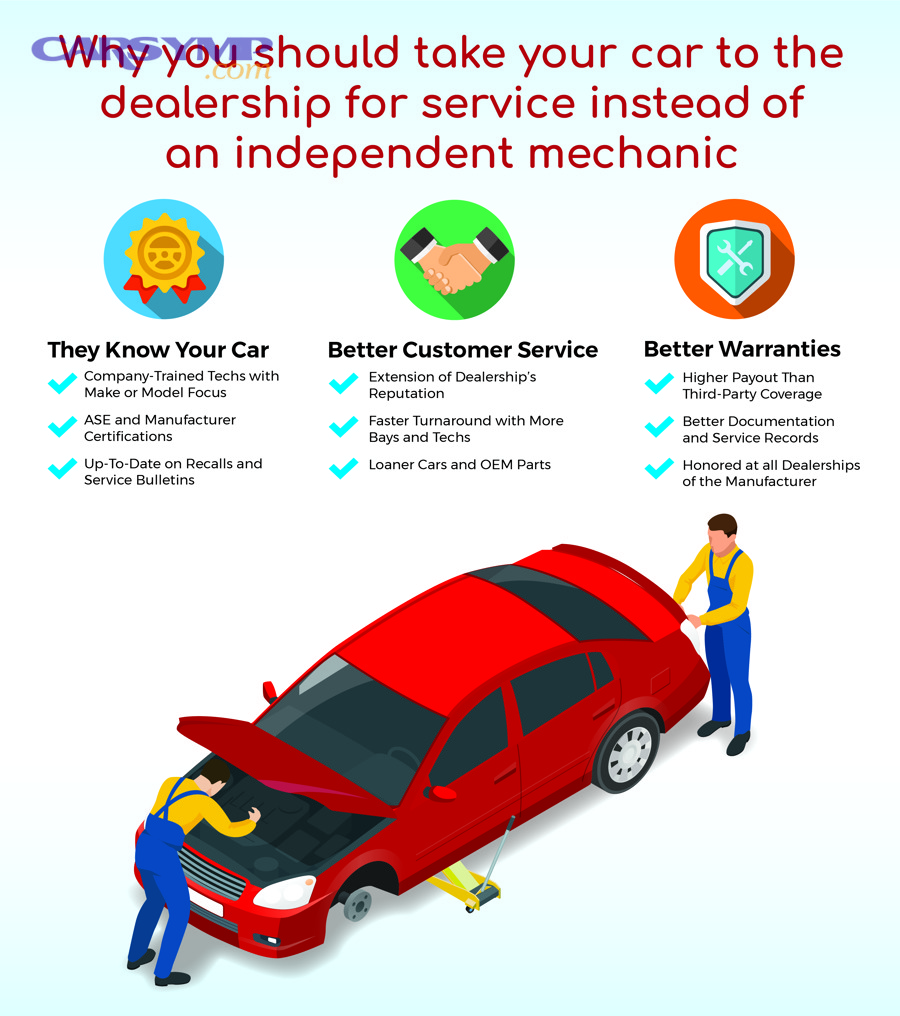
Dealership technicians usually have the edge for warranty claims, recalls, and software or module programming, while independents can be excellent once warranty ends—especially when they can document OEM-equivalent procedures and calibrations where required.
However, the best decision depends on whether the repair requires manufacturer authorization, restricted tools, or a paper trail tied to coverage.
Warranty and recall reality
Warranty work is not just “free repair.” It is a specific billing system that demands correct documentation, eligible parts, and manufacturer approval pathways. Dealerships are designed for that: they can file claims, apply recall campaigns, and follow brand-specific rules without improvisation.
Meanwhile, an independent shop may still be the smarter first stop for “is it really a warranty issue?” If you suspect a warranty-covered defect but want a second opinion before committing to a dealership visit, a careful inspection can help you arrive with evidence—videos, photos, and symptom notes—so the dealer visit is more productive.
Software updates and module programming
Many modern repairs are not complete until software is updated and calibrations are performed: throttle relearns, steering angle sensors, camera/radar alignments, battery management registration, and ADAS calibrations after certain mechanical or glass work.
In addition, some manufacturers restrict certain programming functions to dealer equipment or subscription-based access that not every independent chooses to maintain. That’s not a skill issue; it’s a business model issue.
What to do when you want the “dealer fix” without the dealer overhead
A practical path is split-service: diagnosis and mechanical work at a trusted independent, then programming/calibration at a dealership (or a specialized calibration facility) if your car requires it. This can work well when the independent documents exactly what was replaced and why, and you schedule the programming as a defined final step.
According to research by J.D. Power from its U.S. Customer Service Index (CSI) unit, in March 2024, dealer service satisfaction rankings still show meaningful variation by brand—suggesting the “dealer experience” is not uniform, so choosing the right dealer can matter as much as choosing dealer vs independent.
Who diagnoses intermittent electrical problems faster?
Independent certified mechanics often diagnose intermittent faults faster when they can spend flexible time testing, but dealership technicians can win when the fault matches known patterns, bulletins, or brand-specific network behavior that factory tools reveal quickly.
Next, you can predict which side will be quicker by identifying whether your issue is “known-pattern” or “unknown-pattern.”
Known-pattern vs unknown-pattern
If your symptom matches common failure modes—repeatable codes, specific drive-cycle triggers, a known module fault—dealers may solve it faster because they can jump straight to a factory decision tree and apply updates that independents might not prioritize.
On the other hand, unknown-pattern problems (random battery drains, intermittent no-start, ghost warning lights, sporadic CAN glitches) often require patient testing across time: voltage drop checks, thermal stress testing, wiggle tests, parasitic draw logging, and staged isolation of circuits. A high-skill independent with flexible diagnostic billing is frequently better positioned for that work.
Tooling isn’t everything, but it matters
Factory scan tools can expose deeper data and guided test functions, but independents with high-end aftermarket tools can still do exceptional work—especially when they combine scan data with scope captures, pressure testing, and mechanical verification.
To illustrate, the true differentiator is whether the shop can prove causality before replacing parts: “we measured X, it failed under Y condition, replacing Z removed the failure and verified on a retest.”
Communication is part of diagnosis speed
Diagnosis drags when your approvals are delayed, the shop can’t get you on the phone, or the estimate changes without a clear “why.” Fast diagnosis is not just technician skill; it’s a system that keeps decisions moving and evidence documented.
According to research by Consumer Reports from its Auto Test Center, in March 2024, survey findings favored independent shops overall, reinforcing that consistent process and customer-facing clarity can correlate with better owner experience even when cars and problems vary widely.
How do labor rates, parts choices, and policies change your final bill?
Dealerships can be cost-competitive on some repairs but often carry higher overhead, while independents can offer more parts options and flexibility; your final bill is driven by diagnostic time, parts sourcing, and how the shop handles comebacks and warranties.
However, the only fair comparison is “apples to apples”: same parts grade, same warranty, same included calibrations, same documentation.
This table helps you compare the cost drivers that typically differ between dealership service and independent shops, so you can ask better questions before you approve work.
It’s not a price list; it’s a “what changes the outcome” checklist in table form.
| Cost Driver | Dealership Technician Path | Independent Certified Mechanic Path | What You Should Ask |
|---|---|---|---|
| Labor rate | Often higher, but may bundle brand tools and procedures | Varies widely; may be competitive with stronger flexibility | Is diagnosis billed flat, by time, or by step approvals? |
| Parts grade | Typically OEM parts by default | OEM, OE-equivalent, or aftermarket options | What parts tier is quoted, and why is it the right tier? |
| Programming/calibration | More likely included or directly available | May require sublet or specialty partner | Will this repair trigger resets, relearns, or ADAS calibration? |
| Policy on comebacks | Structured warranty claim process | Shop-specific warranty policies vary | What’s covered if the symptom returns, and for how long? |
| Communication cadence | Can be formal but sometimes less personal | Often more direct, depending on shop culture | Will you receive photos, test results, and a written authorization trail? |
Why “cheaper per hour” can still cost more
If the shop replaces parts by guesswork, the bill grows even with a lower hourly rate. Conversely, a higher rate paired with precise testing can reduce total spend by avoiding wrong parts and repeated labor.
Parts sourcing and lead times
Dealerships often have faster access to certain OEM parts and more predictable supply channels. Independents may have broader sourcing options—including remanufactured assemblies, upgraded components, or reputable OE-equivalent parts—when the vehicle is older and budget constraints matter.
How to price-compare correctly
Request a written estimate that separates diagnostics, labor, parts, shop fees, and calibrations. Then confirm whether the quote assumes OEM parts, includes programming, and includes post-repair verification steps (road test, scan clear, readiness checks).
According to research by Cox Automotive from its Insights Hub, in November 2025, average repair spend reported was $261 at dealerships versus $275 at general repair shops—indicating that perceived “dealer equals more expensive” is not always true once you compare real invoices.
When does an independent certified mechanic outperform the dealer?
Independents often outperform dealerships when the car is older, the problem is intermittent or multi-factor, or you need tailored options and deeper explanation—because flexibility and relationship-based accountability become the performance engine.
Next, you can use scenario matching to decide without guessing.
High-mileage vehicles and “best option” repairs
Once a vehicle is out of warranty, owners often want choices: repair vs replace, upgraded part vs stock, staged repairs across paychecks, or “fix it enough to be safe” vs “restore it to perfect.” Independents are typically better at building those choice frameworks—if they document risks clearly.
Complex, cross-system symptoms
Many failures are not single-component faults: a charging issue combined with parasitic draw, a misfire caused by both vacuum leak and injector imbalance, or a vibration rooted in multiple worn suspension points. Independents who see a broader range of vehicles often sharpen a “systems thinking” approach because they can’t rely on a single brand playbook.
Time-based diagnostics and iterative proof
Intermittent problems often require “observe, test, reproduce, isolate, confirm.” If the shop can keep the car longer, perform controlled tests, and communicate findings step by step, you get fewer wrong parts and more confident approvals.
According to research by Consumer Reports from its Auto Test Center, in March 2024, independent shops scored better overall in survey results, supporting the idea that for many owners the independent model can deliver a stronger experience when repairs are not purely warranty-driven.
When is the dealership the safer bet?
The dealership is usually the safer bet for recall work, warranty repairs, brand-specific programming, and issues tied to factory campaigns or restricted tools—because the OEM pipeline reduces guesswork and enforces a standardized paper trail.
However, even within dealerships, outcomes vary by service culture and technician assignment.
Recalls, campaigns, and warranty documentation
When the manufacturer is paying, the dealership process is designed to capture what they need. You’re less likely to be stuck in “who covers this?” disputes if you start where coverage is administered.
Brand-specific procedures and special tools
Some repairs are tool-gated: specialty timing tools, immobilizer pairing, certain transmission adaptations, or advanced driver assistance calibrations requiring OEM targets. Even if an independent is skilled, it may not be economical for them to maintain every brand’s specialty ecosystem.
Software-level problems that mimic hardware failures
Modern cars can throw symptoms that look mechanical but are software logic issues: network sleep problems, module communication faults, or calibration drift. A dealership may solve these faster because it can apply firmware updates or follow bulletins that specify an update rather than a parts replacement.
According to research by J.D. Power from its U.S. CSI unit, in March 2024, service satisfaction measures show brand-by-brand differences—so if you choose a dealership, selecting a high-performing service department can materially improve your experience.
How can you choose confidently for your specific repair?
You can choose confidently by matching the repair type to the shop’s strengths, then verifying process quality with a short checklist that forces clarity on diagnosis, authorization steps, and post-repair verification.
Next, use these steps to reduce risk before you spend money.
Step 1: Classify the job correctly
Start by labeling your need as one of these: (1) warranty/recall/software, (2) routine maintenance, (3) mechanical repair, (4) intermittent electrical/driveability, (5) collision/ADAS calibration, or (6) EV/high-voltage related. The label determines which shop model is most likely to deliver a clean outcome.
Step 2: Demand a proof-based diagnostic plan
Ask: “What will you test first, what result will confirm or reject that hypothesis, and what will you do next based on the result?” A shop that can answer this in plain language is more likely to avoid guesswork.
Step 3: Require documentation before approvals
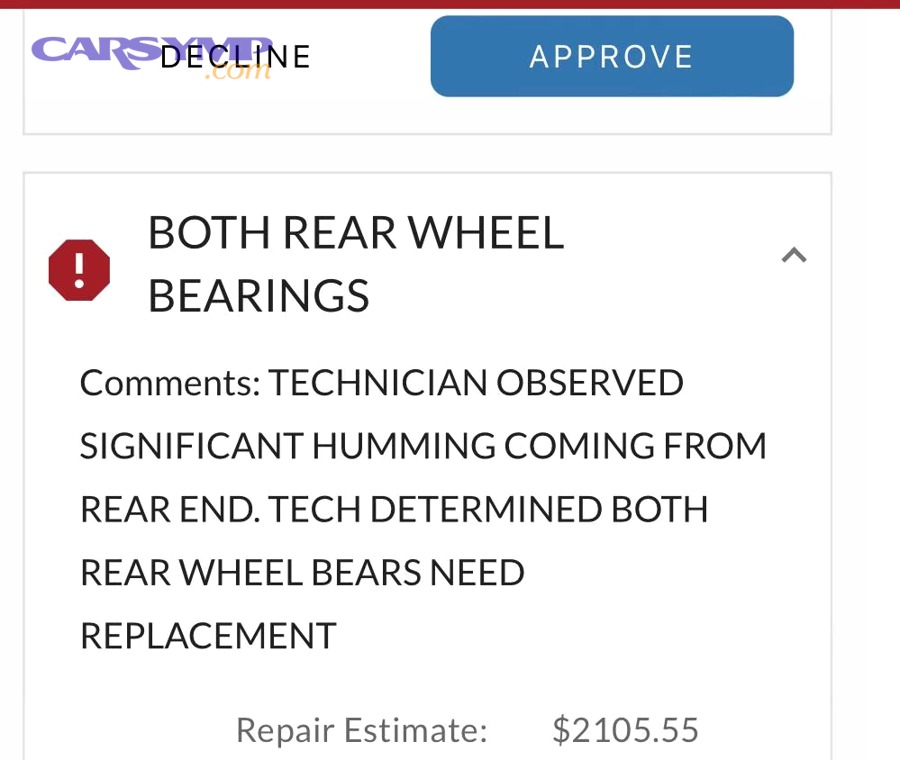
Request photos of failures, scan reports with freeze-frame data, measured values (voltages, pressures, wear measurements), and a written estimate. This keeps the decision from becoming “trust me” and turns it into “here’s the evidence.”
Step 4: Confirm post-repair verification
A good repair ends with verification: road test, re-scan, readiness checks when relevant, no-leak confirmation, and a short note describing what was verified. This protects you from paying for an unverified “maybe fixed.”
According to research by the U.S. Bureau of Labor Statistics from its Occupational Employment and Wage Statistics data, in May 2024, the median annual wage for automotive service technicians and mechanics was $49,670—underscoring why technician time is a major cost driver and why proof-based diagnostics protect your budget by reducing wasted hours.
What should you clarify before approving the work?
You should clarify scope, assumptions, and “stop points” before approving any work, because most repair disappointments come from silent assumptions about what the estimate includes and how surprises will be handled.
Next, use communication guardrails that prevent misunderstandings.
Define the diagnostic boundary
Ask whether diagnosis is capped (a fixed fee) or open-ended (time-based). Then set a stop point: “Call me before diagnosis exceeds X hours or X dollars.” This is especially important for intermittent electrical problems.
Define parts quality and return policy
Confirm the parts tier (OEM, OE-equivalent, aftermarket) and whether the shop will return replaced parts upon request. This is not about distrust; it’s about transparency and learning.
Define who owns the risk of “could be multiple causes”
For complex symptoms, demand a staged plan: prove cause A first, re-test, then decide whether cause B still exists. This prevents paying for a long chain of “maybes.”
Define the “finish line”
Ask what counts as “fixed”: no warning lights, no symptom recurrence for a stated period, verified readiness monitors, or verified calibration results. Put the finish line in writing.
According to research by Cox Automotive from its Insights Hub, in November 2025, owner dissatisfaction was strongly linked to unexpected costs and communication gaps—making pre-approval clarity a practical tool for better outcomes.
Contextual Border: The main comparison above helps you choose based on repair type and service workflow. Below, we expand into the micro-level signals—how credentials, specialization, and documentation practices can predict quality in both dealership and independent settings.
Credentials, specialization, and documentation signals that predict a better outcome
The most reliable quality signals are not marketing claims but verifiable habits: ongoing training, specialty capability, measurable diagnostics, and a written record that explains what was found and what was proven.
Next, use the micro-signals below to evaluate the people and process behind the shop sign.
Credential signals that matter more than slogans
Look for a shop that can show active training evidence and explain what it changes in daily work—not just hang certificates. In the real world, a certified mechanic is most valuable when certification translates into a repeatable diagnostic method and fewer “parts darts.”
To be concrete, ask for Questions to verify mechanic credentials in a way that is respectful but specific: what training is current, what systems they specialize in, and what tools they use to validate failures.
Specialization for hybrids and EVs
EV and hybrid service is not only “different parts.” It’s different safety protocols, isolation checks, and high-voltage awareness. Shops that routinely handle high-voltage systems tend to have clear safety steps, lockout processes, and a disciplined approach to verifying results.
In addition, Specialty certifications for hybrids and EVs can be useful when they align with real shop capability: insulated tools, battery service procedures, and access to correct service information.
According to research by the National Renewable Energy Laboratory from its transportation and mobility research reporting, in January 2025, public planning documents referencing NREL analysis estimate the future charging network needs at scale (including large numbers of public DC fast charging ports), reinforcing that EV adoption and service demand will continue rising—making EV-competent service pathways increasingly important.
How documentation protects you from wrong repairs
Strong shops can provide: pre-scan and post-scan reports, freeze-frame snapshots, before/after measurements, and a short narrative of what was validated. This is where many “bad experiences” are prevented because the story of the repair is captured in evidence, not memory.
How training and pricing interact
Owners often assume higher skill automatically means higher cost. In practice, How certification affects labor rates is not just about a bigger hourly number; it can mean fewer billed hours through faster root-cause identification and fewer repeat visits due to correct-first-time repairs.
According to research by the U.S. Bureau of Labor Statistics from its Occupational Outlook data, in May 2024, technician wage statistics show a wide pay distribution—supporting why specialized skill and proven diagnostics can influence labor pricing and why a process that reduces wasted hours can protect total cost.
FAQ
Is the dealer always better for newer cars?
No. The dealer is often best for warranty, recalls, and software-heavy needs, but a high-quality independent can be excellent for maintenance and many repairs—even on newer vehicles—if they document procedures and handle calibrations correctly.
Are independent shops always cheaper?
No. Total cost depends on diagnostic accuracy, parts choice, and whether programming/calibration is included. Some data shows average repair spend can be comparable or even higher at general repair shops depending on the situation.
What’s the fastest way to reduce repair risk?
Choose a shop that works by proof: a defined diagnostic plan, written estimates, photos/measurements, and post-repair verification. Then approve work in stages when multiple causes are possible.
When should I split work between independent and dealer?
Split-service works well when you want an independent for diagnosis/mechanical repair and the dealer for programming, immobilizer work, or brand-restricted calibrations—so long as documentation is shared and the finish line is defined.