


AC pressure readings can reveal leak clues fast: the low-side and high-side numbers, plus vent temperature and ambient temperature, form patterns that often separate “low refrigerant” from “something else.” A clean manifold gauge test doesn’t prove a leak by itself, but it tells you where to look and what to test next.
Tiếp theo, this guide shows how to run a manifold gauge test safely, what “normal” pressure behavior looks like, and which abnormal patterns commonly line up with an undercharge caused by slow leaks.
Ngoài ra, you’ll learn how to avoid false readings (airflow, overheat, bad test conditions), how to compare static vs running pressures, and how to turn gauge clues into a targeted next step instead of random recharging.
Giới thiệu ý mới: we’ll connect each pressure pattern to a practical troubleshooting move—so your readings become a roadmap, not a guessing game.
What can AC pressure readings tell you about leak clues?
They can suggest “likely low charge” when both sides trend low for the conditions, which often happens after refrigerant escapes through a small leak. Sau đây, you’ll learn the exact cues and the checks that prevent misdiagnosis.
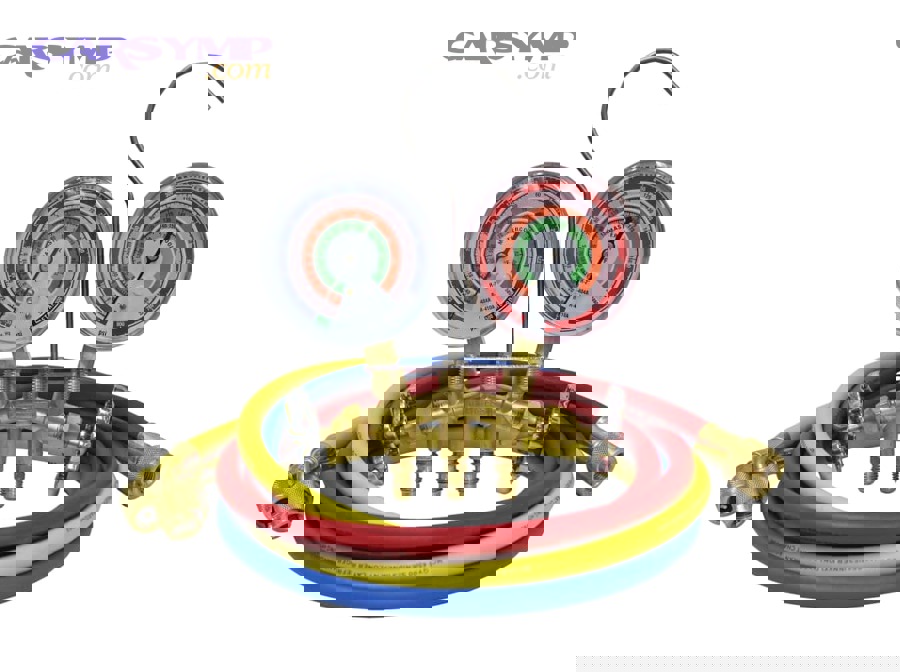
Start by treating pressure readings as clues, not verdicts. A leak reduces refrigerant mass; that usually lowers suction pressure and can also reduce discharge pressure because the compressor has less vapor to compress. However, many non-leak issues mimic low charge (weak condenser fan, blocked fins, stuck blend door, restriction, or incorrect test setup).
To interpret the numbers correctly, always pair pressure readings with: (1) ambient temperature, (2) condenser airflow, (3) engine RPM, (4) vent temperature, and (5) whether the compressor is staying engaged or cycling rapidly.
The most useful “leak clue” is repeatability over time. If the system cools well right after a recharge but loses performance over days/weeks, that pattern strongly suggests refrigerant loss rather than a one-time airflow issue.
The U.S. EPA has noted that mobile A/C systems commonly experience ongoing refrigerant leakage over a vehicle’s life, and their documentation discusses typical annual leak-rate ranges (context for why slow leaks are common).
Theo nghiên cứu của U.S. Environmental Protection Agency (EPA) từ Stratospheric Protection Division, vào 12/2016, tài liệu về MVAC ghi nhận mức rò rỉ hằng năm có thể ở khoảng vài phần trăm tùy thiết kế và tình trạng hệ thống.
How do you perform a manifold gauge test without creating false readings?
You perform it by controlling conditions—stable ambient temperature, strong airflow across the condenser, correct couplers, and consistent RPM—so the pressures reflect system behavior instead of test noise. Để bắt đầu, follow this step-by-step method.
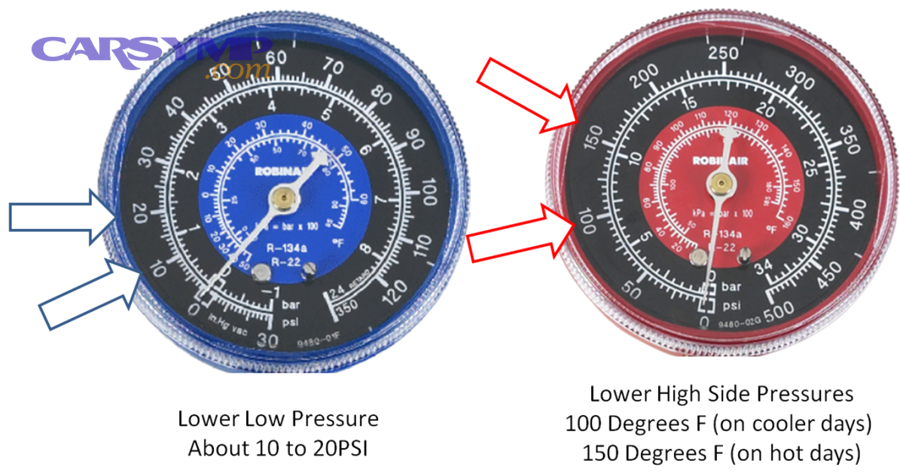
Safety first: Wear eye protection and gloves. High-side pressure can be dangerously high; never loosen hoses under pressure. Only connect to the correct ports (low-side is larger on many systems; couplers are different sizes on many refrigerants).
Set the stage:
- Park in shade if possible (consistent ambient temperature helps).
- Open doors/windows, set A/C to MAX cool, recirculation ON, blower high.
- Confirm radiator/condenser fans run when A/C is on.
- Let the engine reach normal operating temperature.
Connect the gauges correctly: Blue hose to low-side service port, red hose to high-side service port. Keep the center (yellow) hose capped/closed unless you are performing recovery/evacuation/charging with proper equipment.
Run the test consistently:
- Record static pressure with engine OFF after the vehicle sits 10–15 minutes.
- Start engine, hold ~1,500 RPM for a stabilized reading.
- Record low-side pressure, high-side pressure, ambient temp, and vent temp after 2–3 minutes stabilized.
- Note compressor behavior (steady vs rapid cycling) and condenser fan operation.
To minimize gauge error, use quality gauges and avoid kinked hoses. Measurement accuracy matters; metrology agencies like NIST publish pressure-measurement standards and calibration frameworks that exist precisely because pressure readings can be misleading if instruments drift.
Theo nghiên cứu của National Institute of Standards and Technology (NIST) từ Sensor Science Division, vào 06/2016, các chuẩn đo áp suất nhấn mạnh sai số dụng cụ và hiệu chuẩn có thể làm lệch kết luận nếu không kiểm soát điều kiện đo.
Which pressure patterns most strongly suggest an undercharge from a leak?
The strongest clue is low-side lower than expected and high-side also lower than expected for the ambient temperature, paired with poor cooling. Cụ thể, these patterns become clearer when you compare them against airflow and compressor engagement.
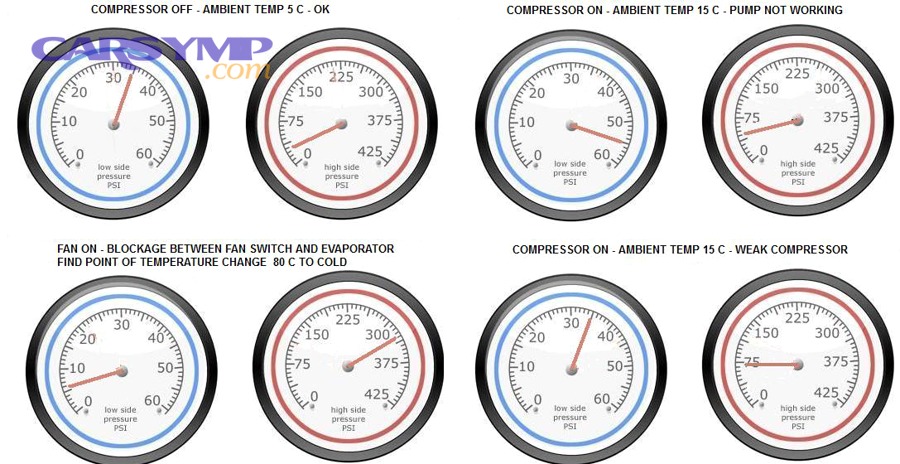
When refrigerant mass is low, the evaporator may be “starved,” so suction pressure drops and vent temperature rises (or fluctuates). Meanwhile, discharge pressure may not build normally because there is less vapor flow through the compressor.
Common undercharge-style patterns:
- Low low-side + low/normal-low high-side: Often consistent with low charge, especially if condenser airflow is good and compressor stays engaged.
- Low low-side + cycling compressor: Many systems will cycle the compressor off via low-pressure switch when charge is low.
- Low low-side + high-side that rises slowly then stalls: Can happen when the compressor is working but mass flow is limited.
Confirming clue: Frosting at the evaporator outlet or along the suction line can occur when pressure is too low and the evaporator runs below freezing, but frosting also depends on humidity and airflow.
Do not “prove” a leak from this alone. Instead, treat it as a trigger to move into targeted leak verification (visual inspection, dye, electronic detection, pressure decay testing), because simply recharging can mask the real fault.
Theo nghiên cứu của U.S. Environmental Protection Agency (EPA) từ Stratospheric Protection Division, vào 12/2016, rò rỉ chậm là kịch bản phổ biến khiến hiệu suất giảm dần theo thời gian—đây là lý do nên ưu tiên xác nhận rò rỉ khi có dấu hiệu thiếu môi chất.
How do you separate “leak-style low pressures” from airflow and heat-load problems?
You separate them by checking whether high-side pressure is behaving like an airflow-limited condenser: airflow problems often push high-side higher, not lower. Quan trọng hơn, condenser performance can distort readings more than many people expect.
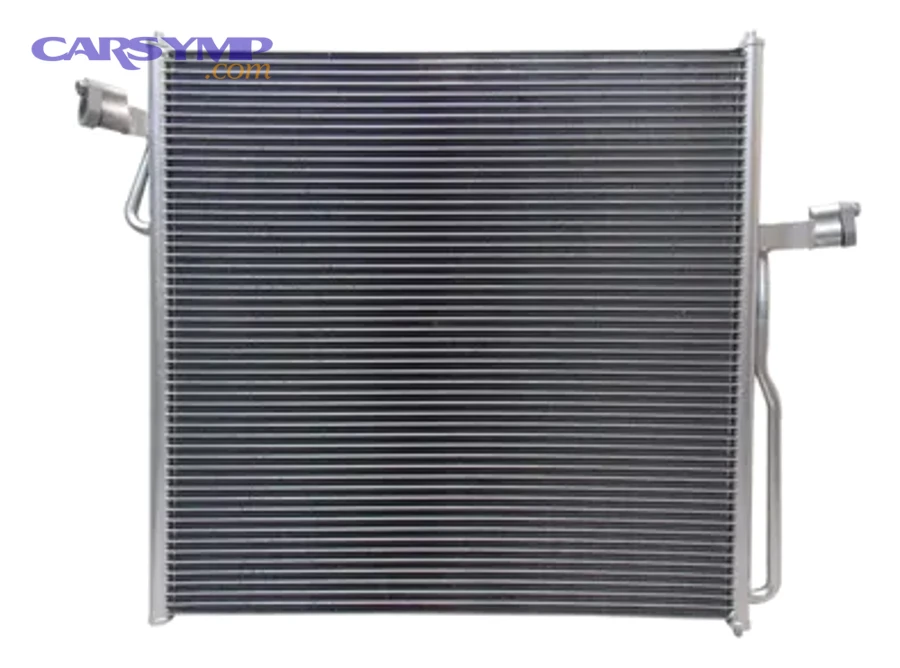
Airflow/heat-load “look-alikes”:
- Weak condenser fan / blocked condenser: High-side pressure climbs higher than expected; low-side may be higher than normal (because the system struggles to reject heat).
- Overheated engine bay / extreme ambient heat: High-side increases; vent temperature may be warm even if charge is fine.
- Cabin airflow issue (clogged cabin filter, blend door fault): Pressures can look “okay,” but vent temp is wrong or inconsistent.
Quick discriminator test: With the A/C on and fans running, lightly mist water across the condenser (do not soak electrical components). If high-side pressure drops quickly and vent temperature improves, that points toward condenser heat rejection (airflow or fin blockage) rather than a pure leak-driven undercharge.
Visual check: Look for bent fins, packed debris, or oil stains. Oil residue near fittings often hints at a leak because refrigerant oil can escape with the refrigerant.
At this stage, you’re building a case: if airflow is clearly weak and high-side is high, fix airflow first; if airflow is strong and both sides are low, move toward leak verification.
Theo nghiên cứu của SAE International từ Technical Standards Board, vào 03/2019, các tiêu chuẩn dịch vụ và kiểm tra nhấn mạnh kiểm soát điều kiện vận hành (airflow/heat load) để tránh diễn giải sai thông số hệ thống lạnh.
What do “restriction-style” readings look like, and why they’re not the same as a leak?
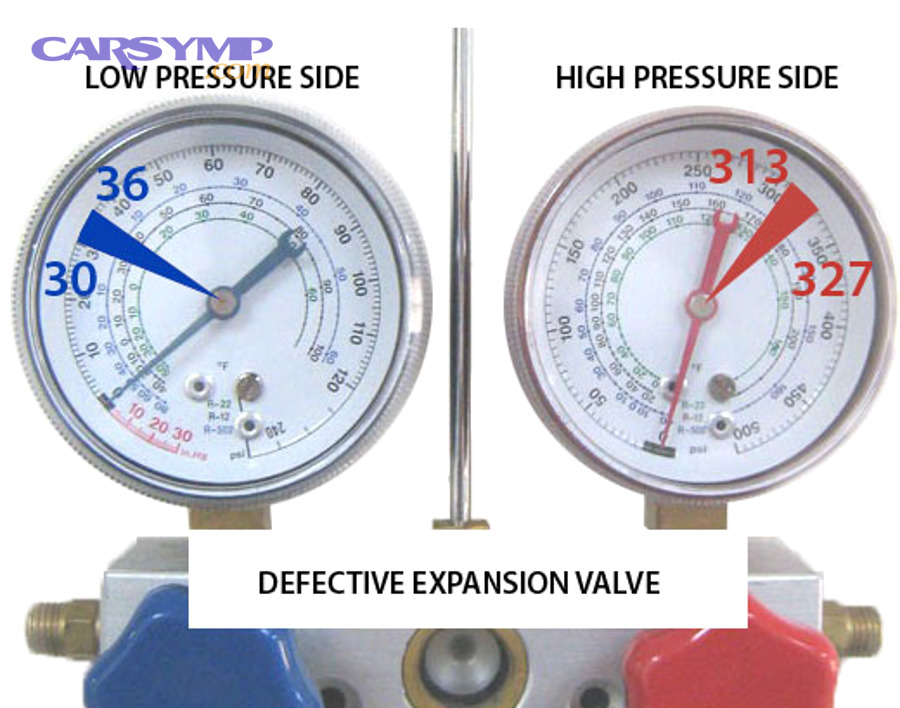
A restriction often shows low low-side but high high-side, because the compressor is building pressure against a bottleneck (like a clogged expansion device). Tuy nhiên, restrictions can temporarily resemble low charge if you don’t observe stability and temperature changes.
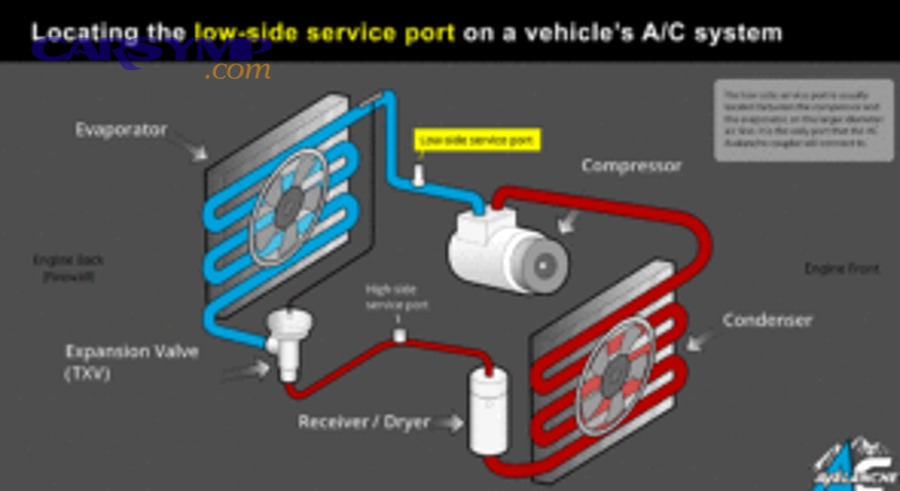
Restriction-like patterns:
- Low-side very low (sometimes near vacuum) while high-side is high.
- Large temperature drop across the restriction point (line suddenly cold/frosty right after the restriction).
- Vent temperature may be inconsistent; evaporator may freeze.
Why it matters for leak hunting: If you misread a restriction as low charge and add refrigerant, you can drive high-side pressures even higher and increase risk to components.
Field move: Use an infrared thermometer on lines before/after the expansion device and across the receiver/drier (if accessible). A sudden temperature step often points to a restriction rather than a simple undercharge.
If your readings suggest restriction, the next step is component-level diagnosis, not just leak detection. This is where trend logging (how fast pressures change, where temperatures spike) beats single snapshots.
Theo nghiên cứu của National Institute of Standards and Technology (NIST) từ Sensor Science Division, vào 06/2016, việc đo áp suất cần kết hợp đo nhiệt độ tại các điểm trong hệ để diễn giải đúng cơ chế (tắc nghẽn vs thiếu môi chất).
How does ambient temperature change “normal” pressures, and how do you adjust your expectations?
Normal pressures rise with ambient temperature because the condenser must reject more heat, so comparing readings without temperature context leads to wrong conclusions. Bên cạnh đó, fan speed and vehicle airflow matter as much as ambient temperature.
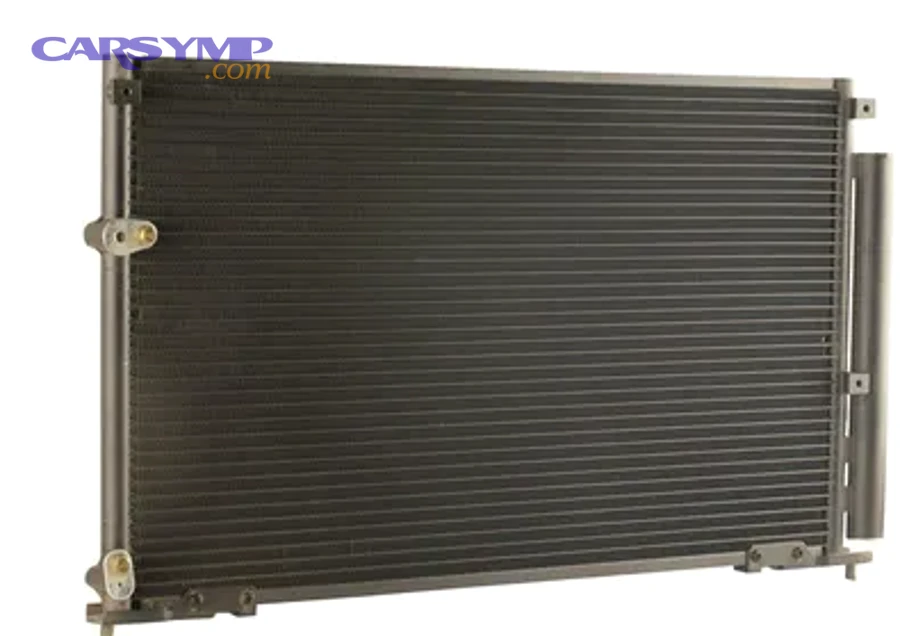
Three rules that keep you honest:
- Rule 1: Compare readings to the same ambient range (a 20°F difference can move the “normal” window a lot).
- Rule 2: Stabilize airflow—fans on, condenser unobstructed—before you interpret high-side pressure.
- Rule 3: Look at vent temperature split (ambient vs vent) along with pressures; the combo is more diagnostic than either alone.
To make this actionable, record your “baseline” when the system is known good (or after a verified repair and correct charge). Later, you can compare new readings against that baseline under similar conditions.
Below is a practical pattern guide (not a substitute for OEM specs). This table helps you decide whether your next step is “leak verification,” “airflow check,” or “restriction diagnosis.”
| Low-Side Pattern | High-Side Pattern | Most Likely Direction | Best Next Step |
|---|---|---|---|
| Lower than expected | Lower than expected | Undercharge (possible leak) | Verify leak, don’t just top off |
| Higher/normal | Higher than expected | Condenser airflow / heat rejection issue | Fans, fins, airflow path inspection |
| Very low / unstable | High / climbing quickly | Restriction or overcharge risk | Temperature checks across components; stop charging |
| Normal | Normal | Cabin airflow/blend door or sensor control issue | Blend door, cabin filter, control system checks |
Theo nghiên cứu của SAE International từ Technical Standards Board, vào 03/2019, quy trình dịch vụ khuyến nghị đối chiếu điều kiện môi trường và tiêu chí ổn định hệ thống trước khi kết luận từ số đo.
When are static (engine-off) pressure readings useful for leak clues?
Static pressure is useful for quick screening: if it’s far below what you’d expect at ambient temperature, you likely have very low refrigerant—often due to a significant leak. Hơn nữa, static readings help catch “no-charge” cases before you run the compressor.
How to use static pressure properly:
- Let the vehicle sit with engine OFF 10–15 minutes so pressures equalize.
- Record ambient temperature and static pressure.
- If static pressure is extremely low, avoid forcing the compressor to run—some systems rely on pressure switches to protect the compressor.
What static pressure cannot do: It cannot distinguish a small leak from a big one in one snapshot, and it cannot prove where the leak is. It also won’t diagnose airflow or restriction problems.
Best use: Combine static pressure with system history. If cooling has worsened gradually and static pressure is now clearly low, treat that as a strong signal to move into leak verification before repeated recharges.
Theo nghiên cứu của U.S. Environmental Protection Agency (EPA) từ Stratospheric Protection Division, vào 12/2016, rò rỉ theo thời gian làm mức môi chất giảm dần, nên đo tĩnh giúp phát hiện sớm tình trạng “thiếu nhiều” trước khi chạy hệ thống.
How do you turn pressure clues into a targeted leak check plan?
You turn them into a plan by choosing the most likely leak zones first—ports, seals, compressor nose, condenser, and service caps—then confirming with an appropriate detection method. Đặc biệt, a methodical plan saves time versus randomly adding refrigerant.
Once your readings point toward undercharge, shift from “reading” to “confirming.” This is where AC leak detection becomes the priority: you’re no longer asking “Is it low?”—you’re asking “Where is it escaping?”
Targeted leak zones (high-yield checks):
- Service ports & caps: Schrader cores and missing/damaged caps can seep. Caps are seals, not decorations.
- Compressor shaft seal: Oil residue near the clutch/pulley area can be a hint.
- Condenser: Front-of-vehicle impact, corrosion, and pinhole leaks are common.
- Hose crimps & fittings: Look for oil wetness at crimp sleeves and O-ring joints.
- Evaporator: Harder to see; often suspected when no external leak is found.
Use pressure behavior to prioritize: If pressures are low and the drop happened over a short period, suspect a larger leak (condenser damage, loose fitting). If it’s gradual, suspect O-rings, service ports, or slow seepage zones.
Theo nghiên cứu của CPS Products từ Product Engineering/Technical Documentation, vào 2025, tài liệu sản phẩm nhấn mạnh rò rỉ môi chất là nguyên nhân hàng đầu khiến làm lạnh kém và khuyến nghị dùng bộ phát hiện rò rỉ để xác định vị trí sửa chữa.
What common mistakes make gauge readings “lie” during leak troubleshooting?
The biggest mistakes are uncontrolled airflow, wrong test RPM, misidentified ports, and interpreting pressures without vent temperature or cycling behavior. Cụ thể hơn, small setup errors can flip your conclusion from “leak” to “restriction” or vice versa.
- Testing at idle only: Some vehicles need slightly raised RPM to stabilize condenser airflow and compressor output.
- Ignoring fans: A dead fan can inflate high-side pressure and ruin the reading story.
- Reading too early: Pressures swing during the first minute; wait for stabilization.
- Not using recirc/MAX: Cabin heat load changes vent temperature and can alter cycling behavior.
- Assuming “one number fits all”: Different systems and controls (variable displacement compressors, electronic expansion valves) behave differently.
- Misidentifying ports: Connecting incorrectly can be dangerous and can also produce nonsense readings.
Practical fix: Build a simple test sheet. Each time you run a manifold gauge test, write down: ambient temp, humidity (optional), RPM, blower setting, recirc, fan operation, low/high pressures, vent temp, and cycling notes. Trend beats memory.
Theo nghiên cứu của National Institute of Standards and Technology (NIST) từ Sensor Science Division, vào 06/2016, sai số phép đo và điều kiện đo không chuẩn có thể tạo kết luận sai—vì vậy cần quy trình ghi nhận và lặp lại nhất quán.
Should you recharge immediately when readings suggest a leak, or stop and verify first?
You should usually verify first when the system is low, because repeated top-offs waste refrigerant, hide the leak, and can risk overcharge if the true fault isn’t low charge alone. Tóm lại, use pressure clues to justify the next test, not endless recharging.
There are exceptions: in a controlled professional setting, a small “diagnostic charge” might be used to run the system long enough to confirm the leak location. But the goal is still confirmation and repair, not “make it cold for now.”
A practical decision rule:
- If the system is very low and the compressor cycles off, prioritize leak verification and proper service procedures.
- If the system is slightly low but still stable, you may have enough runtime to locate leaks with the right method.
- If readings suggest restriction or airflow problems, do not add refrigerant “just to see.” Fix the underlying issue first.
EPA documentation on mobile A/C emphasizes the reality of leakage over time; that context supports why “verify and repair” is the responsible path rather than repeated top-offs.
Contextual Border: At this point, you can interpret pressures and choose the next diagnostic move. Below, we expand into tool selection and rare-but-important scenarios that pressure readings alone can’t solve.
Which leak detection method fits your situation beyond gauge clues?
The best method depends on leak size, accessibility, and whether the leak is constant or intermittent; gauges tell you “low,” but tools tell you “where.” Hãy cùng khám phá how to pick the right tool and sequence.
What’s the practical UV dye vs electronic sniffer comparison for intermittent leaks?
In a real-world UV dye vs electronic sniffer comparison, dye excels when leaks are slow and the system can run long enough to carry dye to the leak site; electronic detectors excel at finding small vapor leaks quickly in tight spaces, but can be fooled by airflow and residual refrigerant.
UV dye is a “trace and confirm” method: you inject, run, then visually inspect with UV light and proper glasses. An electronic detector is a “scan and pinpoint” method: you sweep suspected joints, ports, and components and listen for signal change.
SAE standards exist around both approaches—UV dye practices and leak detector performance—helping ensure tools and procedures meet baseline expectations.
Theo nghiên cứu của SAE International từ Technical Standards Board, vào 01/2013 và 03/2019, các tiêu chuẩn liên quan đến thuốc nhuộm UV và thiết bị dò rò rỉ đặt ra yêu cầu/khuyến nghị để giảm báo sai và tăng khả năng phát hiện rò rỉ nhỏ.
Where are the common AC leak points by vehicle design?
“Common AC leak points by vehicle” often follow design stress zones: front-impact components (condenser), vibration points (hose crimps), service points (ports), and seal interfaces (compressor shaft seal, O-rings). On some vehicles, evaporator leaks become a prime suspect when external checks come up empty.
Use vehicle layout to prioritize: small cars with tight engine bays can stress hose routing; trucks/SUVs can see more condenser damage from debris; older vehicles may develop O-ring seepage and service port leaks.
How should you sequence AC leak detection after gauge readings suggest undercharge?
A strong sequence is: (1) visual/oil inspection, (2) service-port core and cap check, (3) scan accessible joints with an electronic detector, (4) use dye for slow or hard-to-locate leaks, and (5) confirm repair with a controlled pressure/vacuum procedure appropriate for your equipment and regulations.
When dye is used, choose a controlled approach and allow enough runtime for the dye to circulate; product documentation for UV kits describes dye visibility under properly tuned UV light and the value of blocking blue light for contrast.
How do you build a pressure-and-temperature log that catches slow leaks early?
Instead of chasing a single “perfect” reading, log a repeatable snapshot: ambient temp, low/high pressures at ~1,500 RPM, vent temp, and compressor cycling. A slow leak shows up as a trend: the same conditions produce gradually lower pressures and weaker vent performance over weeks.
This logging approach is also how you avoid confusing seasonal temperature swings with refrigerant loss: you compare like-for-like test conditions as closely as possible.
FAQ
Are low pressures always a leak?
No. Low pressures can come from low charge (often from a leak), but also from control issues, compressor problems, or test conditions that aren’t stabilized. Use pressure patterns plus airflow and vent temperature before concluding.
Can I rely on a single manifold gauge test?
A single test is a snapshot; it’s useful, but trend data is stronger. If you can repeat the test under similar conditions, the direction of change (getting worse over time) is more diagnostic for leaks.
Why do pressures look “normal” but cooling is poor?
This often points to cabin airflow/blend door issues, sensor control strategy, or heat-load problems. In such cases, gauges don’t show the whole story—vent temperature behavior and airflow checks become the deciding evidence.
What’s the safest next step if I suspect a leak?
Confirm the leak location and repair it before repeated recharging. If you’re not equipped for proper recovery/evacuation/charging, a professional shop can perform verified leak testing and correct service procedures.