


A knocking (clunking/tapping) sound can be safe to drive with only in narrow, low-risk cases, but it is not safe when the noise is sudden, loud, worsening, or paired with warning lights, overheating, vibration, or steering/brake changes—because those signs point to failures that can escalate quickly.
Next, this guide gives you a practical “right now” plan: what to do in the first 60 seconds, what quick checks are safe to perform, and when to choose a tow instead of “limping” to a shop.
Then, you’ll learn how to narrow down the most likely source by matching sound type + driving trigger (idle, acceleration, bumps, turning, braking) to the system involved—engine, suspension/steering, brakes, or exhaust/drivetrain—so your next step is based on evidence, not guesswork.
Introduce a new idea: once you know whether it’s safe to move the car, you can use a structured process to reduce risk, capture useful clues for a mechanic, and avoid the most common mistakes that turn a small rattle into a big repair.
Is it safe to drive with a knocking (clunking/tapping) sound right now?
No—driving with a knocking (clunking/tapping) sound is not safe by default because the noise often signals a loose, worn, or failing part, the severity can increase without warning, and some causes can affect steering, braking, or engine lubrication. More importantly, safe-to-drive guidance for knocking sounds depends on what else is happening with the car, so use a quick decision screen before you “just keep going.”
Is the sound loud, sudden, or getting worse—does that mean “No, don’t drive”?
If the sound is loud, sudden, or worsening, the safest answer is No, don’t drive, for three reasons:
- Worsening noise usually means increasing clearance or metal contact. Loose joints, worn bushings, or failing bearings often get louder as load shifts.
- Sudden onset can signal a new failure state. A heat shield can suddenly loosen, but so can a steering component or engine mount—both feel “sudden.”
- Progressive noise can lead to loss of control or major damage. A suspension/steering knock can change alignment and handling; an engine knock can indicate lubrication or combustion problems that accelerate wear.
Specifically, treat these combinations as stop-now red flags because they directly change safety outcomes:
- Knock + oil pressure warning light (or low oil pressure message)
- Knock + overheating (temperature rising, steam, coolant smell)
- Knock + heavy vibration (steering wheel shake, drivetrain thump)
- Knock + steering looseness (wandering, pulling, clunk on turn-in)
- Knock + brake symptoms (pulsation, grinding, longer stopping distance)
- Knock + smoke or burning smell (oil on exhaust, overheating parts)
If any of those appear, do the safest move: slow down, signal, pull over, shut the engine off, and arrange a tow (or roadside inspection). That is the “no-regrets” path because it protects both people and the vehicle.
Can you “limp” to a mechanic if the knock is mild and the car drives normally?
Yes—sometimes you can drive a short distance carefully, but only if all the conditions below are true (and each condition matters):
- Mild, stable noise (not rapidly worsening, not a heavy metal-on-metal knock)
- No warning lights related to oil pressure, engine temperature, brakes, or stability control
- Normal steering and braking feel (no wandering, no clunk that changes direction control)
- No overheating signs (normal temp gauge, no coolant smell/steam)
- No obvious leaks (oil/coolant dripping, puddle forming)
Then, drive as if you’re protecting fragile cargo:
- Keep RPM low, avoid hard acceleration, avoid high speeds
- Avoid potholes and sharp turns
- Take the shortest, safest route to a shop
- If the noise changes suddenly, stop and reassess
This is the core logic: “limp mode” is only for stable, low-risk symptoms, not for unknown knocks that come with safety signals.
According to a study by Queensland University of Technology from the School of Engineering Systems, in 2011, excessive knock in their testing produced pressure fluctuations more than three times higher than acceptable operating regimes—showing how quickly “abnormal knock” can move into a potentially damaging range.
What does a “knocking vs clunking vs tapping” sound usually indicate?
Knocking vs clunking vs tapping are different sound families: knocking is usually combustion- or bearing-related impact, clunking is typically a loose suspension/steering or mount movement, and tapping often points to rapid valvetrain or accessory noise. To better understand why this matters, the sound type helps you predict whether you’re dealing with a control risk (steering/suspension/brakes) or primarily a damage risk (engine internals/exhaust).
What is “engine knock” (pinging) vs “rod knock” (deep knock)?
Engine knock (pinging) wins as a combustion clue, rod knock is best for identifying internal bearing wear, and tapping is often linked to top-end or accessory noise—and the difference matters because the safe-to-drive call changes.
- Engine knock / pinging (spark knock, detonation-like ping):
- Usually a higher-pitched ping that appears under load (accelerating, climbing hills)
- Often changes with throttle and fuel quality
- Can be caused by incorrect timing, carbon buildup, lean conditions, overheating, or low-octane fuel for the engine’s needs
- Risk: repeated knock can damage pistons/valves over time, and severe events can be destructive
- Rod knock (deep, rhythmic knock):
- Typically a deeper, heavier knock that follows engine speed (faster RPM = faster knock)
- Often most noticeable under light load “blipping” or when oil pressure is low
- Commonly linked to bearing wear, oil starvation, or serious internal clearance issues
- Risk: high, because continued running can lead to catastrophic failure
- Tapping/ticking:
- Faster, lighter, more “rapid” noise
- Can come from valvetrain clearance, lifters, injectors (normal on some engines), or accessory components
- Risk varies widely—some ticking is normal; a sudden loud tap is not
The practical takeaway: pings can sometimes be managed short-term, but deep rhythmic knock should be treated as “stop/tow” until proven otherwise.
What does a front-end clunk suggest compared with an engine-bay knock?
Front-end clunking wins as a steering/suspension clue, an engine-bay knock is best for engine/accessory diagnosis, and underbody clunking is often linked to exhaust/drivetrain movement. However, you should treat front-end noises as a higher immediate safety priority because they can affect vehicle control.
- Front-end clunk: often shows up over bumps, during braking transitions, or while turning—classic for sway bar links, strut mounts, control arm bushings, ball joints, or tie rods.
- Engine-bay knock: more likely tied to RPM and load—could be combustion knock, bearing knock, accessory pulley issues, or mounts.
- Underbody clunk/rattle: often worse on rough roads—heat shields, exhaust hangers, loose brackets, driveshaft components (on some vehicles).
If you’re hearing a clunk that changes the way the steering wheel feels, do not “test it longer.” The correct safety move is to stop and inspect.
What should you do immediately when you hear knocking while driving?
Yes—you should treat a knocking (clunking/tapping) sound as an urgent safety check because slowing down reduces load, pulling over prevents escalation, and quick observations can separate “tow now” from “drive carefully to service.” Then, use a simple sequence so your reaction is calm and consistent.

Should you slow down and avoid acceleration (and why)?
Yes—slow down and avoid acceleration because it lowers cylinder pressure and drivetrain load, reduces suspension impact energy, and minimizes the chance a loose part shifts into a dangerous failure. More specifically, acceleration is the “stress test” that makes many knocks louder and more damaging.
- Ease off the throttle and let the car decelerate smoothly
- Avoid high RPM and avoid downshifting to high revs
- Avoid hard braking unless needed for safety
- Move to the right lane/shoulder when safe
If the knock gets worse when you apply throttle, that’s a strong sign you should stop and reassess instead of pushing onward.
What quick checks can you do safely at the roadside?
There are 5 quick checks you can do safely—warning lights, temperature, leaks/smells, loose external parts, and cabin/trunk rattles—because these checks reduce uncertainty without requiring tools or risky under-car inspection. Besides, you’re not trying to fix the car roadside; you’re trying to decide tow vs cautious drive vs stop-and-wait.
- Dashboard scan: oil pressure light, temperature warnings, check engine flashing, brake warnings, stability control warnings
- Temperature scan: gauge rising, steam, coolant smell
- Leak/smell check: oil smell, burning smell, fuel smell; look for fresh drips under the car
- Loose external rattle check: gently press on visible heat shields or splash shields only if accessible and safe (no crawling under a hot car)
- Cabin/trunk check: loose tools, spare tire/jack, cargo shifting—these can mimic a “clunk”
If you must check oil, do it carefully:
- Park on level ground, engine off, wait a few minutes
- Use the dipstick properly and wipe/reinsert
- If oil is critically low or the oil light is on: tow is the safer choice
This is also a good time to start your knocking noise diagnosis notes: when it started, what you were doing, and whether any warning lights appeared.
Where is the knock coming from—engine, suspension/steering, brakes, or exhaust/drivetrain?
There are 4 main source groups for knocking (clunking/tapping) sounds—engine, suspension/steering, brakes, and exhaust/drivetrain—based on when the sound appears (idle, load, bumps, turning, braking). Next, match the trigger to the system so you don’t chase the wrong problem.
Does knocking on bumps point to suspension components?
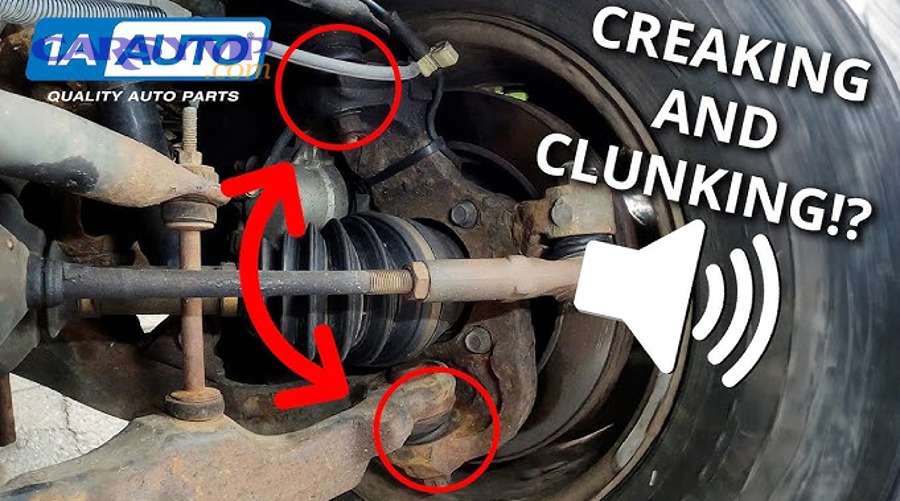
Yes—knocking on bumps usually points to suspension components because vertical impacts load bushings and joints, repeated movement amplifies clearance noise, and worn parts clunk most clearly when the wheel moves up and down. Specifically, bumps are a “joint clearance detector.”
- Sway bar end links (often a sharp clack over small bumps)
- Strut mounts (clunk when steering + bumps)
- Control arm bushings (thud/clunk during braking transitions and bumps)
- Ball joints (knock/clunk, sometimes steering wander)
- Loose caliper hardware or worn pads (can also clunk—don’t overlook brakes)
Safety angle: if the clunk is paired with wandering steering or the car feels unstable, treat it as a control risk and avoid driving.
According to a study by Universitas Syiah Kuala from the Department of Mechanical Engineering, in 2021, suspension components experienced drastically shorter fatigue life on rough roads—for example, the coil spring fatigue life was reported as 19,060 cycles on flat roads vs 1,248 cycles on rough roads, highlighting how repeated impacts accelerate wear.
Does knocking when turning point to steering or CV joints?
Yes—knocking when turning often points to steering or CV joints because steering input shifts load across tie rods and rack components, turning changes joint angles, and worn components make noise at the moment direction forces peak. More importantly, turning noises are a safety priority because they can predict steering instability.
- Tie rod / steering rack knock: clunk or knock when turning the wheel at low speed, sometimes felt in the steering wheel
- Strut mount noise: clunk or pop when steering, especially combined with bumps
- CV joint noise: typically more of a repeating click on acceleration while turning (front-wheel-drive common)
If you feel looseness, play, or “dead zone” in the steering wheel, do not keep driving for diagnosis. That’s when Steering knock when turning diagnosis should move from “listen and note” to “stop and inspect.”
Does knocking under acceleration suggest engine or drivetrain?
Yes—knocking under acceleration often suggests engine or drivetrain issues because throttle increases cylinder pressure, mounts twist under torque, and drivetrain components load up and reveal slack. However, you can sort this into two buckets based on what else changes.
Engine-related acceleration knock clues:
- Appears on hills or heavy throttle
- Sounds like pinging/rattling rather than a single thud
- May improve if you ease off throttle
- May be linked to overheating, poor fuel quality, carbon buildup, or timing issues
Drivetrain/mount-related clues:
- Feels like a thump as you shift from coast to throttle
- Appears during gear changes or when you first apply torque
- Often more “single clunk” than “rapid ping”
- Can be engine mounts, transmission mounts, or driveline slack
If you suspect engine pinging and you have no warning lights, you can reduce risk by driving gently and avoiding load—but you still need inspection soon because persistent pinging is not “normal.”
Does knocking at idle suggest accessories, mounts, or exhaust rattles?
Yes—knocking at idle often suggests accessories, mounts, or exhaust rattles because the engine is vibrating at low speed, loose shields resonate, and worn mounts allow movement that creates contact noises. Meanwhile, true internal bearing knock can also appear at idle, so you still need severity checks.
- Heat shields and exhaust hangers (tinny rattle, often changes with light revving)
- Loose splash shields or skid plates (rattle at certain RPM)
- Accessory pulleys/tensioners (rhythmic tapping/knock near the belt area)
- Worn engine mounts (thud when shifting into gear or blipping throttle)
A safe micro-test (parked, brake engaged, hood open only if safe):
- If the sound changes dramatically with a slight RPM increase, it often suggests a resonance/rattle rather than a deep internal knock.
- If the sound stays deep and rhythmic with RPM changes, treat it more seriously.
Which symptoms mean tow immediately vs drive carefully to service?
Tow immediately wins when safety-control signals or lubrication/overheat warnings are present, drive carefully only fits mild stable noises with normal vehicle behavior, and “stop and reassess” is best when uncertainty remains. Next, use a simple decision matrix so you don’t debate the same question repeatedly.
To make this easy, the table below summarizes tow vs cautious drive based on the highest-risk signals.
| Situation | What it likely means | Best action |
|---|---|---|
| Oil pressure light on + knock/tick | Possible oil starvation / severe lubrication risk | Tow now |
| Temperature rising/overheating + knock | Heat stress, possible detonation or damage | Tow now |
| Steering feels loose + clunk when turning | Steering/suspension control risk | Tow now |
| Brake warning/feel change + clunk/grind | Brake system risk | Tow now |
| Mild stable rattle, no warnings, normal control | Possible shield/bracket/cargo rattle | Drive carefully to service |
| Noise worsening quickly, unknown cause | Escalating failure risk | Stop, reassess, likely tow |

Tow now: what are the non-negotiable red flags?
There are 6 non-negotiable red flags that mean tow now: oil pressure warning, overheating, smoke/burning smell, severe vibration, steering/brake changes, and loud worsening metal-on-metal knock—because each indicates immediate risk of failure or loss of control. More specifically, these are not “diagnose later” symptoms.
- Oil pressure warning light (especially with ticking/knocking)
- Overheating (temp gauge rising, steam, coolant smell)
- Smoke from engine bay or exhaust that wasn’t there before
- Violent vibration or banging that shakes the cabin
- Steering changes (wandering, pulling, clunk + looseness)
- Brake changes (grinding, pulling, pedal feel change, warning light)
If you’re unsure whether a warning light is critical, treat it as critical when it pairs with a new knock.
Drive carefully: what conditions make a short trip acceptable (if any)?
Yes—short careful driving can be acceptable when the noise is mild and stable, the car’s control systems feel normal, and there are no lubrication or temperature warnings—because the immediate safety risk is low and you can minimize load while reaching inspection. However, “acceptable” does not mean “ignore.”
- Keep speeds moderate and avoid highways if possible
- Avoid hard acceleration, towing, and hills
- Avoid potholes and sudden steering inputs
- Turn off loud audio and monitor changes
- If the sound changes in pitch/volume suddenly, stop
This is the safe balance: you reduce risk while still acting quickly to get the car checked.
What can happen if you keep driving with a knock?
Continuing to drive with a knock can cause escalating damage, secondary failures, and in some cases loss of vehicle control—because knocks often come from parts that wear faster under load and can fail abruptly once clearance or heat crosses a threshold. In short, the cost of ignoring a knock is usually higher than the cost of checking it.
Is a knocking noise always dangerous, or sometimes just annoying?
Knocking is not always dangerous—some noises are benign rattles—but deep rhythmic knocks, steering-related clunks, and knocks paired with warning lights are dangerous because they indicate high-risk systems or failure states. Meanwhile, the tricky part is that “annoying” and “dangerous” can sound similar in a parking lot.
Usually “more annoying than dangerous” (still worth fixing):
- Loose heat shield rattle at a certain RPM
- Loose interior trim or cargo movement
- Minor exhaust hanger rattle (no control symptoms)
Usually “dangerous or potentially catastrophic”:
- Deep rhythmic knock that follows RPM (possible internal engine issue)
- Clunk tied to steering input or unstable handling
- Knock with oil pressure warning or overheating
- Loud metal-on-metal grinding/clunking
The most reliable tie-breaker is this: if the noise changes the way the car controls—steering, braking, stability—treat it as unsafe. If it’s purely noise with normal control and no warnings, you may cautiously move to a shop, but you still need inspection.
How can you diagnose knocking sounds more accurately at home (without making it worse)?
You can diagnose knocking sounds more accurately at home by using 4 DIY listening tests and inspection steps—idle vs rev, load vs coast, turning input, and bump correlation—because each test isolates a different system without requiring risky disassembly. Then, use your results to communicate clearly to a mechanic and avoid “parts roulette.”
Which DIY listening tests and inspection steps help confirm the source (idle, rev, turning, bumps)?
There are 4 main DIY listening tests and inspection steps—idle/rev listening, load/coast comparison, turning-in-place check, and bump-pattern check—because each one changes forces on a specific group of components. Specifically, you want repeatable patterns, not one-off sounds.
- Idle vs light rev test (parked):
- If the noise appears at idle and changes smoothly with RPM, suspect accessories, mounts, or resonance rattles.
- If it’s a deep knock that tracks RPM, treat it as higher risk.
- Load vs coast test (short, safe drive if allowed):
- Noise louder under throttle: engine combustion knock, mounts, drivetrain load issues.
- Noise unchanged under throttle vs coast: suspension/exhaust resonance is more likely.
- Turning input test (low speed, safe area):
- Clunk when turning wheel at low speed: steering rack/tie rod/strut mount pattern.
- Clicking while accelerating in a turn: CV-joint-like pattern.
- Bump correlation test (slow speed on small bumps):
- Clunk on bumps: sway bar links, bushings, ball joints, loose brake hardware.
- Rattle that sounds “tinny”: heat shields and thin metal components.
Basic inspection steps (no special tools, safety-first):
- Check that the spare tire/jack/tools are secured
- Look for obvious loose underbody shields (without crawling under)
- Check visible exhaust hangers if accessible
- Note any uneven tire wear or steering wheel off-center (clues for suspension)
These DIY listening tests and inspection steps don’t replace professional inspection, but they reduce guessing and help you choose tow vs drive.
According to a study by Queensland University of Technology from the School of Engineering Systems, in 2011, acoustic emission signals from a sensor located on the engine block were able to clearly distinguish an excessive knock operating regime, and the excessive regime produced pressure fluctuations over three times higher than acceptable regimes—supporting why “abnormal knock” deserves fast action.
How do you tell “steering knock when turning” apart from CV joint clicking?
Steering knock wins as a low-speed steering-input clunk, CV joint clicking is best identified as a rhythmic click during powered turns, and strut-mount clunk often bridges both when bumps are involved. Meanwhile, your hands can help as much as your ears.
- Steering knock pattern:
- Often audible when turning the wheel at low speed or even while stopped
- May feel like a knock through the steering wheel
- May come with wandering steering or alignment drift
- Often more “single clunk” than repeated clicks
- CV joint clicking pattern:
- More commonly a repeating click-click-click while accelerating in a turn
- May be more pronounced turning one direction than the other
- Usually doesn’t create steering “play,” but it can worsen over time
- Strut mount / top mount pattern:
- Clunk or pop when turning, often worse over bumps
- Can sound like it’s near the top of the wheel well
If you suspect steering components, prioritize safety over diagnosis time. That is the heart of Steering knock when turning diagnosis: control risks come first.
What rare situations can mimic a serious knock (loose cargo, skid plates, heat shields)?
There are 4 rare-but-common “false knock” situations—loose cargo, spare tire/jack movement, skid plate/splash shield contact, and heat shield resonance—because they create impact noises that imitate mechanical failure under bumps or acceleration. However, “false knock” is not a guarantee, so you still confirm with patterns.
- Empty the trunk and secure the spare tire/jack
- Remove loose items from door pockets and cargo bins
- Check whether the sound disappears with a different road surface (smooth vs rough)
- Listen for “tinny” resonance that changes with a small RPM shift (heat shield behavior)
The key difference is consistency: mechanical failures usually produce a repeatable pattern tied to a specific trigger, while loose cargo can be more random.
What should you record for a mechanic to speed up diagnosis?
You should record 6 items—audio/video, trigger condition, speed/RPM, location, dashboard lights, and recent events—because these details let a mechanic reproduce the symptom quickly and avoid unnecessary parts swapping. In addition, your notes form a clean chain from symptom to test.
- A 10–20 second audio clip from inside the cabin
- A second clip from outside (only if safe)
- Exactly when it happens: idle, acceleration, bumps, turning, braking
- Approximate speed and RPM range
- Any warning lights or messages
- Recent context: pothole impact, curb hit, recent repair, fluid top-up, fuel change
This turns your knocking noise diagnosis into actionable information instead of a vague complaint like “it makes a noise sometimes.”