


STEP 1 — Title & outline analysis (for intent alignment)
– Main keyword (focus): thermostat test + coolant flow (circulation) checks
– Predicate (main action): test / verify
– Relations Lexical used: Meronymy (radiator hose = a part used to confirm circulation) + Synonymy (test/check/verify signal the same diagnostic action)
– Search intent type (from outline): Primarily How-to + Definition, supported by Boolean, Grouping, and Comparison intents
– Primary intent (from Title): Test thermostat operation and verify real coolant circulation using a radiator hose check
– Secondary intent 1 (from first heading): Understand what “thermostat testing” and “coolant flow verification” actually prove
– Secondary intent 2 (from second heading): Recognize stuck-open vs stuck-closed patterns and safety stop signs
– Secondary intent 3 (from third heading): Perform practical circulation checks and interpret outcomes
If you want to test your thermostat and confirm coolant is truly circulating, the most reliable DIY approach is to combine a controlled warm-up with a radiator-hose circulation check and a few temperature observations that reveal exactly when (and if) the thermostat opens.
If the temperature gauge behavior confuses you, you can still diagnose confidently by matching symptoms to thermostat patterns—especially the “stuck closed” rapid overheat vs the “stuck open” slow warm-up—so you don’t replace parts blindly.
If you need proof beyond “hand feel,” you can verify coolant flow using simple tools like an IR thermometer or scan-tool live data, which turns vague impressions into repeatable numbers.
Introduce a new idea: once you’ve confirmed thermostat behavior and coolant circulation, you can decide whether your real issue is airflow, pressure, or pump-related—common culprits behind overheating at idle that often get mistaken for a bad thermostat.
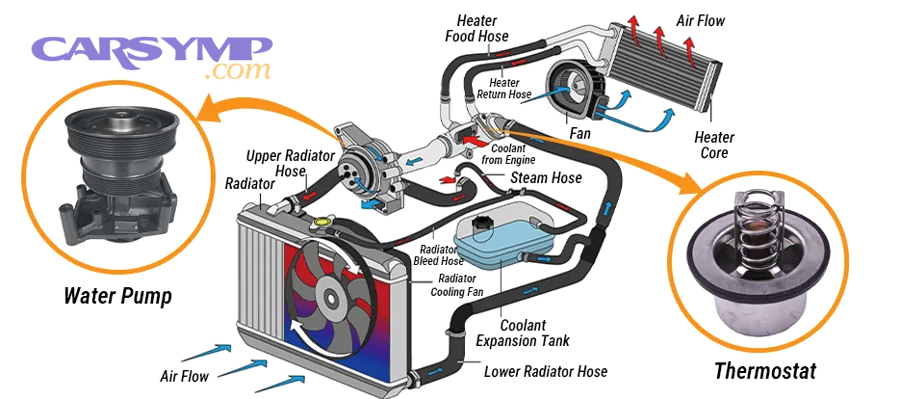
What does “thermostat testing” and “coolant flow verification” mean in a DIY diagnosis?
Thermostat testing and coolant flow verification is a diagnostic process that confirms the thermostat opens at the right time and that coolant actually circulates through the radiator/heater circuit, not just “looks hot,” so you can pinpoint overheating causes without guesswork.
To better understand why this matters, you need to separate “temperature rising” from “coolant moving,” because an engine can get hot even when the radiator stays relatively cool if flow is blocked.
What is the thermostat’s job in controlling engine temperature and coolant circulation?
The thermostat’s job is to restrict coolant flow during warm-up and then open to route hot coolant to the radiator (and stabilize operating temperature), which protects efficiency, emissions, and engine wear while preventing overheating once load increases.
Specifically, the thermostat creates two different cooling behaviors: a bypass-dominant warm-up (little to no radiator flow) and a radiator-flow regulation phase (thermostat modulates opening to maintain a stable temperature). That’s why a cold-start test is so revealing: you’re watching the system switch states in real time.
In practical DIY terms, the thermostat is “working” when:
- The engine warms up at a normal pace (not forever cold, not instantly overheating).
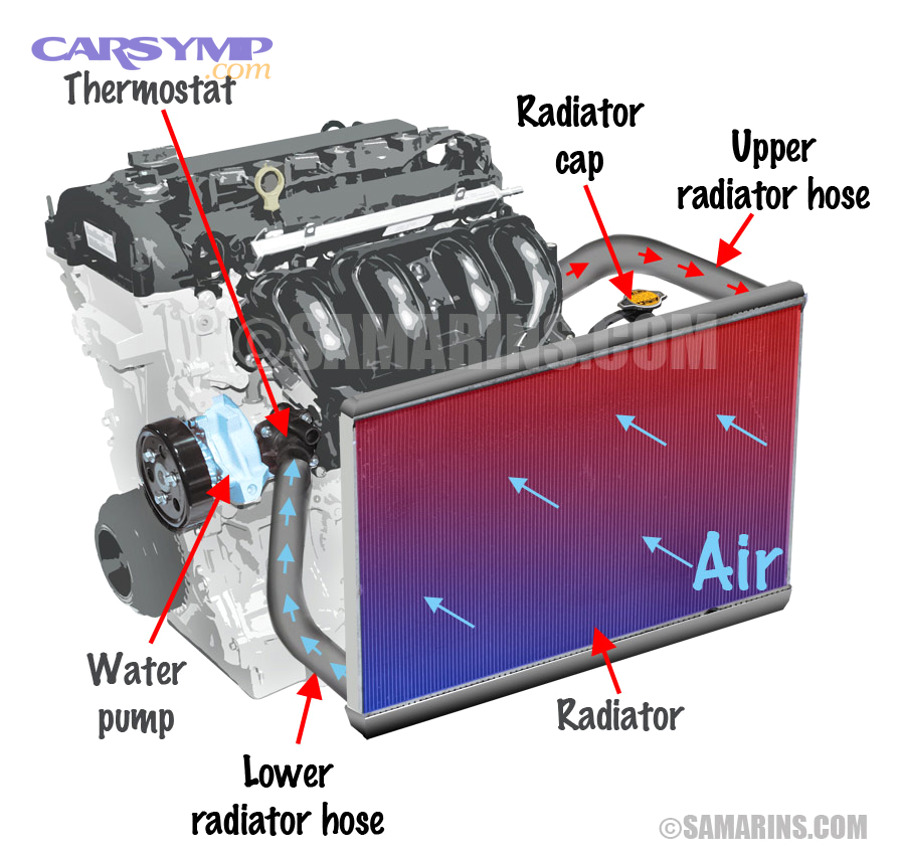
- The upper radiator hose stays relatively cool early, then becomes hot when the thermostat opens.
- Temperature stabilizes instead of climbing uncontrollably.
What counts as “normal coolant flow” once the thermostat opens?
Normal coolant flow is present when hot coolant begins circulating through the radiator and returns cooler to the engine, producing a clear temperature gradient (hot inlet side, cooler outlet side) and stable operating temperature rather than runaway heat.
More specifically, once the thermostat opens, you should see a chain reaction:
- Upper hose temperature rises sharply (hot coolant reaches radiator inlet).
- Radiator core begins warming across its surface (top/near inlet warms first).
- Lower hose gradually warms (coolant returning after heat is shed).
- Cabin heater output becomes consistent (if the heater circuit is open).
- Temperature gauge settles near its normal midpoint rather than creeping upward.
A key point: you’re not trying to see a “waterfall” of coolant in the radiator neck (many modern systems make that hard to observe). You’re confirming circulation using temperature changes and stabilization behavior.
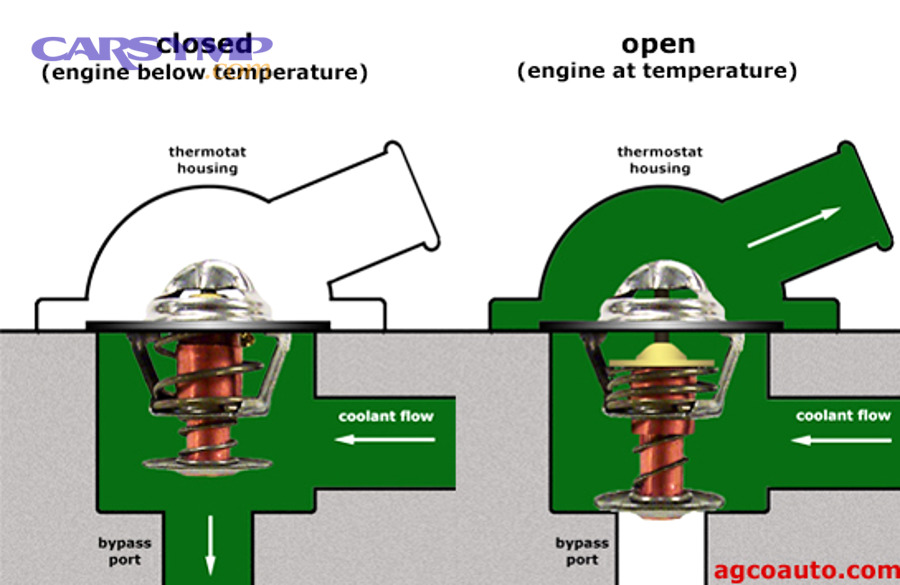
Is it possible to have overheating even if the thermostat is working?
Yes—overheating can happen even if the thermostat is working because (1) airflow across the radiator may be insufficient, (2) the system may not hold pressure, and (3) coolant flow can still be weak due to pump or restriction issues.
Next, that’s why DIY diagnosis must include both “thermostat opening” and “heat removal” checks. A thermostat can open perfectly, but if the radiator fan never comes on during idle, you can get classic overheating at idle symptoms even with a healthy thermostat. Likewise, a pressure cap that can’t hold pressure can let coolant boil earlier, causing hot spots and overflow even when flow exists.
Is the thermostat opening correctly based on symptoms and temperature behavior?
Yes, you can determine whether the thermostat is opening correctly by using (1) warm-up timing, (2) radiator hose temperature changes, and (3) stable-vs-rising gauge behavior—three observable signals that reveal stuck-open, stuck-closed, or normal operation.
Then, once you tie symptoms to temperature behavior, your diagnosis stops being “maybe thermostat” and becomes “thermostat pattern confirmed” or “thermostat ruled out.”
Does a “stuck closed” thermostat usually cause rapid overheating with a cool radiator hose?
Yes—a stuck-closed thermostat commonly causes rapid overheating while the radiator and upper hose stay comparatively cool because hot coolant remains trapped in the engine loop and can’t shed heat through the radiator.
Specifically, this pattern often looks like:
- Temperature gauge climbs quickly after a short drive or even at idle.
- Cabin heat may turn hot briefly then fade or fluctuate (air pockets/hot spots can do this).
- Upper radiator hose stays lukewarm longer than expected (no hot coolant reaching radiator).
- Radiator itself stays cooler than it should relative to the gauge reading.
Important caution: never remove a radiator cap on a hot engine. If you suspect a stuck-closed thermostat and the gauge is climbing fast, stop the test and let the system cool.
Does a “stuck open” thermostat usually cause slow warm-up and weak cabin heat?
Yes—a stuck-open thermostat commonly causes slow warm-up and weak cabin heat because coolant circulates through the radiator too early, shedding heat before the engine reaches normal operating temperature.
For example, you may notice:
- Temperature gauge takes a long time to reach normal (or never reaches it in cold weather).
- Heater output stays mediocre at low speeds.
- Fuel economy may drop because the engine runs below ideal temperature.
- Some vehicles set an OBD code related to coolant temperature not reaching expected range.
This pattern matters because it’s the “opposite” of the stuck-closed situation: instead of overheating quickly, you struggle to get heat and stable temperature at all.
Which warning signs mean you should stop testing and shut the engine off immediately?
There are 6 main stop-now warning signs: (1) steam from the engine bay, (2) temperature needle entering the red zone, (3) coolant boiling/overflowing into the reservoir, (4) sudden loss of cabin heat while temp rises, (5) loud pinging/knocking under load, and (6) coolant leaks spraying or dripping rapidly.
More importantly, these signs protect you from head gasket damage and warped components. If you are diagnosing overheating at idle, it’s easy to let the engine “just idle a bit longer,” but prolonged overheating at idle can be just as damaging as overheating on the highway.
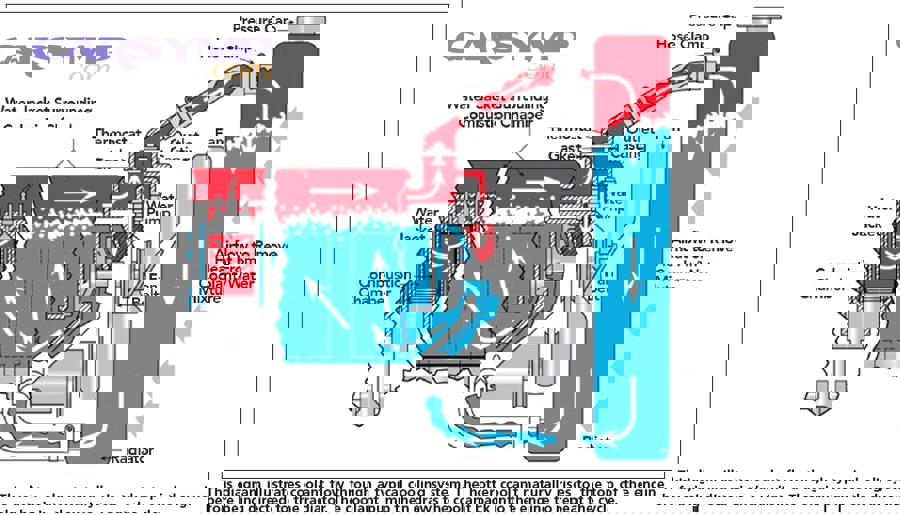
How can you verify coolant flow using a radiator hose circulation check without special tools?
You can verify coolant flow with a radiator hose circulation check by warming the engine from cold, observing the “thermostat opening moment,” and confirming a hot-to-cool temperature gradient across the radiator circuit—three steps that prove circulation without disassembly.
Below, the goal is to make a simple test behave like a professional one: repeatable, safe, and based on clear indicators.
How do you do a “warm-up to thermostat open” hose-temperature check step by step?
You do a warm-up hose check by starting cold, monitoring temperature rise, and confirming the upper hose changes from cool to hot when the thermostat opens—then verifying the lower hose warms after the radiator begins removing heat.
To illustrate, use this sequence:
- Start cold and confirm coolant level is correct
- Check reservoir level (engine cold).
- If level is low, top up with the correct coolant mix before testing.
- Idle with the hood open, heater set to “hot” (fan low to moderate)
- Heater setting helps reveal whether coolant is flowing through the heater core circuit.
- Observe temperature behavior
- Gauge should climb steadily.
- Watch for overheating at idle symptoms if the fan doesn’t activate.
- Feel hoses carefully (or use an IR thermometer)
- Upper hose should stay cooler at first.
- When the thermostat opens, the upper hose typically becomes hot relatively quickly.
- Confirm radiator heat spread
- The radiator should begin warming near the inlet side/top region (varies by design).
- Lower hose should warm more gradually after heat exchange begins.
- Confirm stabilization
- A healthy system stabilizes near normal operating temperature rather than climbing without limit.
If the fan is not running when the gauge climbs at idle, begin a Radiator fan not coming on diagnosis immediately—because airflow failure can mimic a circulation problem at low vehicle speed.
What does it mean if the upper hose never gets hot but the engine temperature climbs?
If the upper hose never gets hot while the engine temperature climbs, it usually means hot coolant is not reaching the radiator because the thermostat may not be opening, an airlock may be blocking flow, or circulation is severely restricted.
More specifically, interpret it like this:
- Thermostat stuck closed: classic “engine hot, radiator cool” split.
- Air pocket near the thermostat housing: the thermostat may not “see” hot coolant correctly and may not open as expected.
- Severe restriction: collapsed hose, blocked passage, or extreme radiator inlet blockage.
- Very weak pump action: coolant is not being pushed effectively into the radiator circuit.
If you’re dealing with recurring overheating at idle, this “upper hose stays cool” clue is especially valuable because it tells you the issue may be upstream of the radiator fan.
What does it mean if both hoses get hot but the engine still overheats?
If both hoses get hot but the engine still overheats, it often means coolant is circulating but heat is not being removed effectively—commonly due to poor airflow (fan/shroud), a restricted radiator, or insufficient system pressure.
In practice, this is where many DIY diagnoses go wrong. People replace a thermostat because they saw “hot hoses,” but hot hoses can also appear when:
- The radiator is internally restricted, so temperature drop across it is too small.
- The radiator fan isn’t pulling enough air at idle (classic Overheating at idle causes checklist item).
- The system can’t hold pressure, so coolant boils earlier and forms steam pockets.
A fast way to think about it: hot in + hot out suggests the radiator isn’t removing heat, even though flow exists.
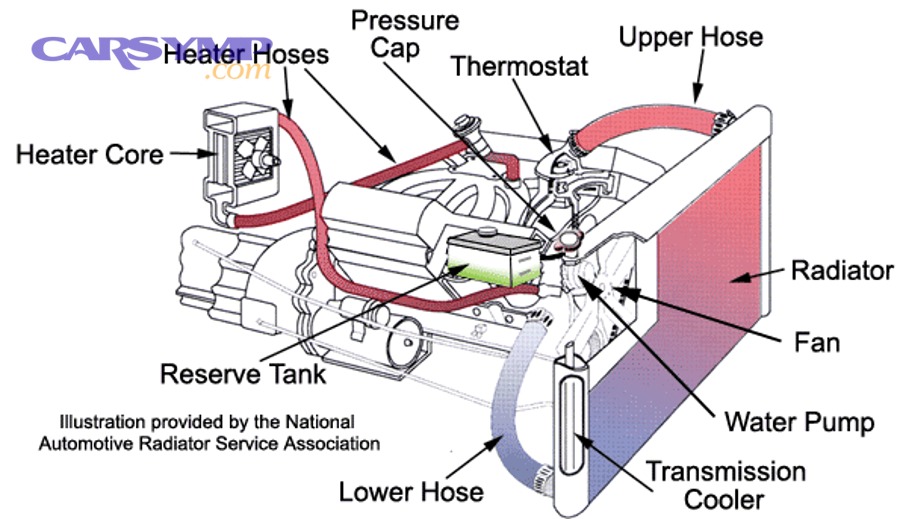
Should you use an IR thermometer or scan tool to confirm thermostat opening and coolant circulation?
An IR thermometer wins for quick surface temperature mapping, a scan tool is best for seeing true coolant sensor trends, and “hand feel” is optimal only as a rough baseline—so the best choice depends on whether you want speed, precision, or deeper data.
However, combining tools is what creates confidence: you use the scan tool (coolant temp trend) and the IR thermometer (radiator inlet/outlet pattern) to confirm the same story from two angles.
Is an IR thermometer more reliable than “hand feel” for hose temperature checks?
Yes—an IR thermometer is more reliable than hand feel because it provides measurable temperatures, reduces subjective error, and lets you compare multiple points quickly (upper hose, radiator inlet, radiator outlet, lower hose).
For example, a strong DIY method is to measure:
- Upper hose temp (radiator inlet supply)
- Radiator core temp near inlet vs outlet
- Lower hose temp (return)
You’re looking for a meaningful temperature drop across the radiator once the thermostat opens. If the inlet is very hot and the outlet stays much cooler, the radiator is shedding heat. If everything is uniformly hot, airflow/restriction/pressure becomes more likely.
One caution: IR thermometers can misread shiny surfaces. Aim at a matte surface area or place a small piece of matte tape on the hose for consistent readings.
What scan-tool readings best confirm thermostat behavior (ECT trends) for DIYers?
There are 4 key scan-tool readings that confirm thermostat behavior: (1) coolant temperature rise rate from cold, (2) stabilized operating temperature, (3) fan-on temperature event, and (4) temperature drop/flattening when the thermostat opens and radiator flow increases.
Specifically, you want to see:
- A steady climb from ambient toward operating range.
- A flattening/stabilization once the thermostat opens and radiator begins controlling temperature.
- Fan activation when temperature reaches the vehicle’s threshold (varies by model).
- No runaway increase during idle unless airflow is compromised.
These readings are especially powerful when your complaint is overheating at idle—because you can watch whether temperature climbs until a fan event happens (or never happens).
What temperature patterns suggest restricted flow vs thermostat failure?
Thermostat failure typically shows a “state-change problem” (no opening event or opening too soon), while restricted flow often shows “circulation present but insufficient” (temperature keeps creeping, heater may be inconsistent, and radiator gradient may look abnormal).
To compare:
- Stuck closed thermostat: engine temp climbs fast; upper hose stays cool longer; radiator stays cooler than expected.
- Restricted flow / weak circulation: hoses may warm, but radiator delta can be small or inconsistent; temperature may creep under load or at idle; heater may fluctuate.
- Airflow failure at idle (fan issue): temps climb mostly at idle/low speed; improve while driving; this belongs on your overheating at idle causes checklist.
How can you test a thermostat off the vehicle, and when is that test worth doing?
You can test a thermostat off the vehicle using a controlled hot-water test that checks whether it opens and moves smoothly at the expected temperature, and it’s worth doing when in-car results are ambiguous or you suspect sticking or partial opening.
Next, remember what this test does and does not prove: it confirms thermostat movement, but it doesn’t prove system airflow, pressure, radiator condition, or pump strength.
Can you accurately test a thermostat in hot water to confirm opening temperature?
Yes—you can accurately test a thermostat in hot water by heating water gradually, monitoring temperature with a thermometer, and watching the valve begin to open and then open further as temperature rises.
A practical DIY procedure:
- Suspend the thermostat in a pot so it doesn’t touch the metal bottom.
- Heat water gradually while monitoring temperature.
- Watch for:
- Start-to-open temperature (valve begins moving)
- Smooth travel (no sticking)
- Approach to full open at a higher temperature
This method is commonly recommended in DIY guides because it’s direct and visual. (autozone.com)
What results mean “replace it” vs “it’s probably okay”?
There are 5 common “replace it” results: (1) no opening movement, (2) delayed opening far beyond its rating, (3) partial opening only, (4) sticky/jumpy movement, and (5) physical damage or corrosion that suggests binding.
On the other hand, “probably okay” looks like:
- It begins opening near its rated temperature range.
- It moves smoothly and progressively.
- It reaches a wide-open position without hesitation.
Even if it passes a bench test, you still need to consider system context. For example, if your symptom is overheating at idle, a thermostat that opens correctly might not be the root cause—your airflow or fan control might be failing.
If coolant flow checks fail, what are the most common next causes and fixes?
There are 4 most common next causes after failed coolant flow checks: (1) trapped air/airlock, (2) radiator fan or airflow failure, (3) weak circulation from the water pump, and (4) pressure/boiling issues from a faulty radiator cap—each with distinct signs and quick DIY checks.
Especially, you should approach this like a funnel: start with the highest-probability, easiest-to-verify items, then move to deeper mechanical causes.
Could trapped air (airlock) mimic a bad thermostat and block circulation?
Yes—trapped air can mimic a bad thermostat because it can prevent hot coolant from contacting the thermostat pellet properly, disrupt heater-core flow, and create temperature spikes that look like “no circulation.”
For example, airlock signs include:
- Gurgling sounds behind the dash
- Heater output that cycles hot/cold
- Temperature that spikes and drops unpredictably
- Coolant level changing after heat cycles
A safe, general bleeding approach:
- Start cold, set heater to hot, allow warm-up with reservoir monitored.
- Follow vehicle-specific bleed screw procedures if equipped.
- Avoid opening a pressurized cap hot.
If you repeatedly get overheating at idle right after a coolant service, air bleeding should be high on your checklist.
How do you distinguish water pump problems from thermostat problems during testing?
Thermostat problems are defined by when flow begins (opening event), while water pump problems are defined by how strongly coolant circulates after it should be flowing—so you distinguish them by comparing opening behavior to sustained heat control under idle and light rev conditions.
Use this comparison in practice:
- Thermostat issue:
- No clear “upper hose gets hot” opening event, or it happens too early (stuck open).
- Temperature behavior matches stuck-open/stuck-closed patterns.
- Water pump weak flow:
- Thermostat appears to open (upper hose warms), but temperature keeps creeping, heater may fluctuate at idle, and radiator temperature gradient may be poor.
- You may see Water pump weak flow symptoms such as intermittent overheating, poor cabin heat at idle, or overheating that worsens with load or higher RPM (depending on impeller slip/cavitation or belt issues).
A helpful rule: if the thermostat opens but the engine still struggles to shed heat, don’t stop at the thermostat—evaluate pump strength and radiator performance next.
Which simple checks confirm the issue is airflow or radiator-related instead of thermostat-related?
There are 5 simple checks to confirm airflow/radiator issues: (1) fan activation at idle, (2) radiator face blockage inspection, (3) A/C-on fan behavior comparison, (4) inlet-to-outlet radiator temperature drop check, and (5) pressure cap condition check.
More importantly, these checks map directly to an Overheating at idle causes checklist:
- Fan doesn’t come on: prioritize Radiator fan not coming on diagnosis (fuse, relay, fan motor, temperature switch/module). (autozone.com)
- Radiator blocked externally: debris, bent fins, restricted airflow.
- Radiator internally restricted: small temperature drop across core; uniform heat suggests poor exchange.
- Cap can’t hold pressure: boiling and overflow happen earlier, especially at idle.
A pressure-based insight: raising cooling-system pressure increases the boiling point, helping prevent localized boiling at hot spots. MACS notes that coolant boiling point rises roughly ~3°F per psi, and a 15 psi cap can significantly raise boiling point compared to no pressure. (macsmobileairclimate.org)
What less-common factors can distort thermostat and coolant flow check results?
Yes—less-common factors can distort your results because (1) pressure behavior changes boiling and sensor readings, (2) thermostat designs behave differently than older wax-only units, and (3) measurement technique can create false patterns even when the cooling system is healthy.
In addition, these “micro factors” matter most when your symptoms are inconsistent—like intermittent overheating at idle, temperature swings after coolant service, or conflicting hose-vs-gauge observations.
Can radiator cap pressure problems cause “false circulation” symptoms or boil-over even with good flow?
Yes—a weak radiator cap can cause boil-over and unstable temperature behavior even with good circulation because it fails to maintain system pressure, lowering the coolant’s effective boiling point and allowing vapor pockets that disrupt heat transfer.
For example, you might see:
- Coolant pushed into the reservoir early
- Overflow after shutdown (heat soak)
- Sudden spikes despite hoses being hot (flow exists but heat transfer collapses at boiling points)
Caltech explains that thermostat restriction can influence pressure behavior in the cooling system and how boiling relates to pump and system dynamics, reinforcing why pressure integrity matters during diagnosis. (caltech.edu)
How can thermostat design differences (electronic/mapped vs wax pellet) change what ‘normal’ looks like?
Electronic or “mapped” thermostats can open differently than classic wax-pellet units because the ECU may influence target temperatures and opening behavior based on load, emissions strategy, and efficiency—so normal temperature patterns may shift by design rather than by failure.
Meanwhile, classic thermostats tend to show a more predictable “opening moment.” With mapped thermostats, you might observe:
- Different stabilization points under different driving modes
- Faster warm-up strategies with later fan events
- Temperature ranges that look “high” but are actually normal for that engine calibration
If you’re diagnosing by hose temperatures, the key is consistency: you still expect a clear change from warm-up phase to radiator-control phase, but the exact temperature thresholds may vary.
Does jiggle-pin orientation or poor bleeding technique create misleading hose-temperature patterns?
Yes—jiggle-pin orientation (on thermostats that have one) and poor bleeding technique can create misleading hose-temperature patterns because trapped air can prevent consistent contact between coolant and the thermostat, delaying opening and causing intermittent heater output.
To illustrate, if air is trapped near the thermostat housing, you can see:
- Upper hose warms late (looks like a stuck thermostat)
- Heater output fluctuates (looks like weak pump flow)
- Temperature spikes at idle (looks like fan failure)
That’s why bleeding quality belongs on every Overheating at idle causes checklist after coolant service.
Can IR thermometer technique errors (emissivity/reflection) mislead your diagnosis?
Yes—IR thermometer technique errors can mislead diagnosis because reflective or glossy surfaces can return inaccurate readings, causing you to “see” a temperature pattern that isn’t real and pushing you toward the wrong conclusion.
A simple technique fix:
- Measure on matte rubber hose, not shiny metal.
- Use consistent distance and angle.
- Compare multiple points (upper hose, radiator inlet area, radiator outlet area, lower hose) rather than trusting one reading.
Evidence (selected, credible)
According to a study by Chalmers University of Technology from the Department of Applied Mechanics, in 2011, researchers modeled coolant warm-up and reported measurable accuracy improvements for coolant-temperature prediction models, including an average improvement reported in their comparison table, supporting how thermostat behavior and coolant temperature trends can be validated with data-driven methods. (publications.lib.chalmers.se)