


Yes, a stuck thermostat significantly reduces fuel economy by 10-15% because it prevents the engine from reaching optimal operating temperature, forces the ECU to maintain rich fuel mixture compensation, and keeps the engine in open loop mode where fuel efficiency is sacrificed for cold-start enrichment. When your thermostat fails in the open position, coolant flows continuously through the radiator regardless of engine temperature, causing your vehicle to run perpetually cold and consume substantially more fuel than necessary. This mechanical failure creates a cascade of efficiency problems that directly impact your wallet at the pump, with documented cases showing vehicles dropping from 26 MPG to as low as 20-22 MPG after thermostat failure.
Understanding the technical mechanism behind this fuel economy loss requires examining how your engine’s computer—the ECU—responds to temperature data from the coolant temperature sensor. The ECU relies on this temperature information to calculate the precise air-fuel mixture your engine needs, and when it receives signals indicating a cold engine, it automatically enriches the fuel mixture to compensate. A stuck open thermostat tricks your ECU into believing your engine never warms up, perpetuating this fuel-wasting enrichment cycle for your entire drive.
Diagnosing a stuck thermostat involves recognizing specific symptom patterns that distinguish this problem from other fuel economy issues. Your temperature gauge behavior tells a revealing story—if it fails to reach normal operating temperature, drops significantly during highway driving, or fluctuates erratically, you’re likely dealing with thermostat malfunction rather than sensor problems, oxygen sensor failures, or fuel system issues. Quick diagnostic tests using scan tools and infrared thermometers can confirm thermostat behavior within minutes, saving you from unnecessary parts replacement and continued fuel waste.
The solution requires thermostat replacement with proper attention to specifications, cooling system maintenance, and post-repair verification, but the implications extend beyond immediate fuel savings. Below, we’ll explore exactly how this small component creates such substantial fuel economy loss, identify the warning signs your vehicle displays, and provide the technical knowledge you need to address this problem effectively.
Does a Stuck Thermostat Really Reduce Fuel Economy?
Yes, a stuck thermostat genuinely reduces fuel economy by 10-15% because it disrupts optimal engine operating temperature, forces continuous rich fuel mixture operation, and prevents the transition from open loop to closed loop fuel control mode. This isn’t speculation or minor efficiency loss—it’s a measurable, significant impact documented across multiple vehicle makes and models.
To understand the severity of this impact, consider how your engine achieves maximum efficiency. Modern engines are engineered to operate within a specific temperature range, typically between 195-220°F depending on the manufacturer. Within this range, fuel vaporization is optimal, combustion chamber surfaces reach temperatures that promote complete fuel burning, and engine oil maintains proper viscosity for minimal friction. When a thermostat sticks open, coolant flows continuously to the radiator, preventing the engine from ever reaching this efficiency sweet spot.
The fuel economy impact manifests differently depending on driving conditions, with highway driving showing more severe degradation than city operation. During highway cruising, maximum airflow through the radiator compounds the cooling effect of a stuck open thermostat, driving engine temperatures even lower. The engine requires minimal power to maintain highway speeds, so it produces less waste heat to counteract the excessive cooling. Drivers frequently report their temperature gauge dropping toward the cold zone during sustained highway driving—a telltale sign of thermostat failure that directly correlates with the worst fuel economy losses.
Real-world examples from automotive forums and repair facilities consistently demonstrate this 10-15% loss pattern. One documented case involved a 1994 Honda Civic EX that experienced fuel consumption increasing from approximately 26-32 MPG on the highway to just 9 gallons per 140 miles in city driving after thermostat failure—a dramatic decrease in efficiency. Another case with a Volvo showed improvement from approximately 24 MPG to over 26.5 MPG immediately after thermostat replacement, representing roughly an 10% gain in fuel economy from this single repair.
The distinction between stuck open and stuck closed thermostats matters significantly for fuel consumption patterns. A stuck closed thermostat causes overheating but doesn’t necessarily reduce fuel economy before catastrophic engine damage occurs—the engine may actually run slightly more efficiently at higher temperatures until it crosses into dangerous territory. However, a stuck open thermostat creates the opposite problem: chronic under-temperature operation that continuously wastes fuel without the immediate danger signals of overheating. This makes stuck open thermostats particularly insidious—they silently drain your fuel economy for weeks or months while you wonder why your MPG has mysteriously declined.
Statistical evidence from automotive repair databases shows thermostat-related fuel economy complaints represent a significant portion of driveability issues. When mechanics systematically test vehicles with unexplained fuel economy losses, stuck open thermostats rank among the top five causes, alongside oxygen sensor failures, dirty air filters, underinflated tires, and fuel system problems. The prevalence of this issue stems from thermostat exposure to extreme thermal cycling—constantly opening and closing thousands of times over the component’s lifespan—which eventually causes mechanical failures in the wax pellet, spring mechanism, or valve seal.
What is a Stuck Thermostat and How Does It Occur?
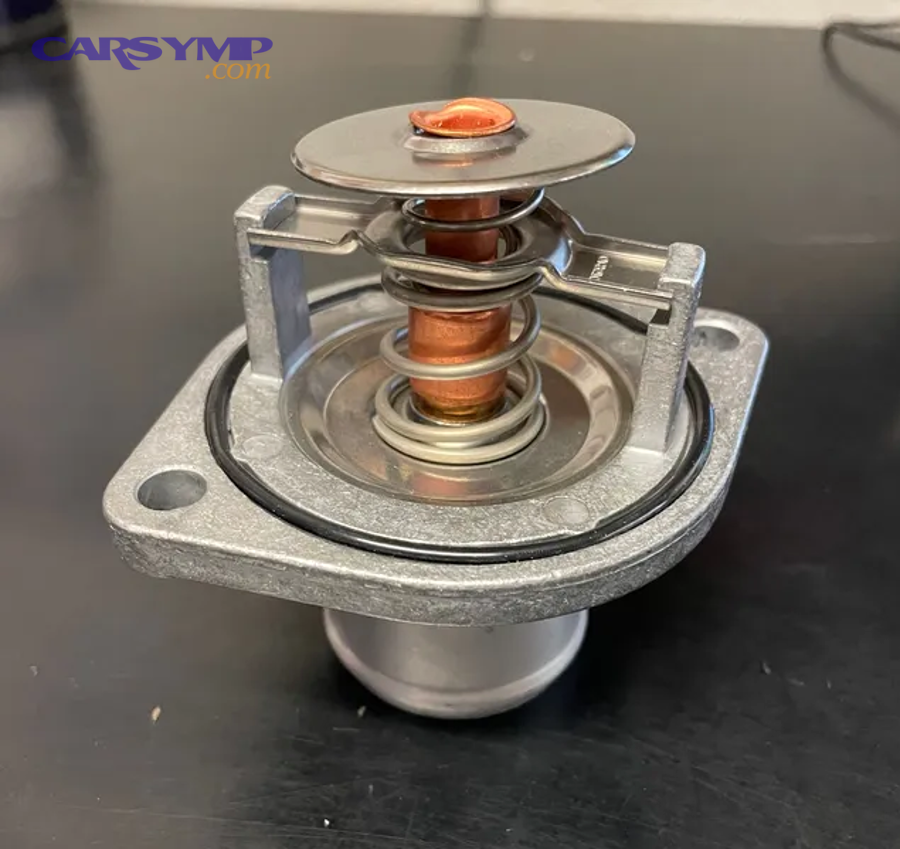
A stuck thermostat is a failed engine cooling system component that remains fixed in either the open or closed position rather than regulating coolant flow based on temperature, caused by mechanical wear, debris contamination, or internal component degradation. The thermostat normally acts as a temperature-sensitive valve that opens when coolant reaches a specific temperature (typically 180-205°F depending on vehicle specifications) and closes when coolant cools below that threshold.
Understanding normal thermostat operation provides essential context for recognizing failure. Your thermostat sits between the engine block and the radiator, strategically positioned to control whether coolant circulates through the radiator for cooling or remains trapped in the engine block to accelerate warm-up. The mechanism relies on a wax pellet sealed inside the thermostat body—as this wax heats, it expands, pushing a piston that opens the valve. When coolant cools, the wax contracts, allowing a spring to close the valve. This elegant thermomechanical system requires no electrical power or computer control, making it remarkably reliable under normal conditions.
During actual engine operation, the thermostat never fully closes or completely opens in a binary fashion. Instead, it gradually modulates between states, precisely controlling coolant flow to maintain the engine’s target operating temperature. When you start a cold engine, the thermostat remains closed, blocking coolant flow to the radiator and forcing coolant to circulate only through the engine block and heater core. This restricted flow allows the engine to reach operating temperature quickly—typically within 5-10 minutes of normal driving. As the coolant temperature rises and approaches the thermostat’s rated opening temperature, the valve begins to open progressively, allowing increasing amounts of coolant to flow through the radiator. Once the engine reaches full operating temperature, the thermostat maintains a partially open position, continuously adjusting to balance heat generation and heat dissipation.
What Causes a Thermostat to Get Stuck?
Wax pellet degradation represents the most common cause of thermostat failure, occurring when the specialized wax compound loses its expansion and contraction properties over time. The wax pellet contains a precisely formulated mixture of wax and copper particles engineered to expand at a specific temperature. Years of thermal cycling—repeatedly heating to 200°F+ and cooling to ambient temperature—eventually break down this compound’s molecular structure. When the wax loses its expansion capability, the thermostat can no longer generate sufficient force to open the valve against spring pressure, leaving it stuck closed. Conversely, if the wax pellet’s seal fails, the wax can leak out, eliminating the mechanism that closes the valve and leaving the thermostat stuck open.
Spring fatigue develops after thousands of thermal cycles cause the return spring to lose its tension and elasticity. The spring must maintain sufficient force to close the valve when coolant cools, but repeated compression and release gradually weaken the metal. A weakened spring may fail to fully close the valve, allowing excessive coolant flow even when the engine is cold. In severe cases, the spring can break completely, leaving the thermostat permanently open. This type of failure typically occurs in high-mileage vehicles—generally those exceeding 100,000 miles—or in vehicles subjected to extreme temperature variations.
Debris jamming presents another major failure mode, particularly in cooling systems with inadequate maintenance. Corrosion particles from aging radiators, water pump impeller fragments from failed pumps, and sludge from mixed or degraded coolant can lodge between the valve and its seat, preventing proper sealing. Even tiny particles can compromise the valve’s ability to close completely, creating a gap that allows continuous coolant flow. Mechanics frequently discover visible grit, rust flakes, or coolant sludge jammed under the thermostat seal during inspection—clear evidence of contamination-caused failure. This underscores the importance of using the correct coolant type and following manufacturer-recommended replacement intervals.
Physical binding can occur when the thermostat housing or valve stem warps due to mechanical stress or thermal distortion. Over-torquing the thermostat housing bolts during previous repairs can compress and deform aluminum housings, particularly in modern engines where weight reduction leads to thinner housing walls. This deformation can bind the valve stem, preventing smooth movement. Similarly, severe overheating events can warp the housing enough to create binding. Some manufacturers have issued technical service bulletins documenting specific engine families with higher-than-normal thermostat failure rates due to design issues affecting the wax pellet formulation or housing geometry, though these cases represent exceptions rather than the rule.
How Does a Stuck Thermostat Cause Poor Fuel Economy?
A stuck thermostat causes poor fuel economy by maintaining engine temperatures below the optimal range where fuel efficiency peaks, triggering the ECU to compensate with rich fuel mixtures designed for cold-start conditions. This creates a permanent state of inefficient combustion that wastes fuel throughout your entire driving cycle.
The relationship between engine temperature and fuel efficiency follows well-established thermodynamic principles. Cold engines exhibit poor fuel vaporization—gasoline remains in liquid droplet form rather than fully vaporizing into a combustible air-fuel mixture. These liquid fuel droplets don’t burn efficiently in the combustion chamber; some pass through into the exhaust system unburned, wasting fuel while increasing emissions. Additionally, cold engine oil maintains higher viscosity, creating increased friction between moving parts and requiring more energy to overcome mechanical resistance. Cold metal in the combustion chamber absorbs heat from combustion rather than reflecting it back into the expanding gases, reducing thermal efficiency. All these factors combine to make cold engines significantly less efficient than properly warmed engines.
Your vehicle’s ECU uses coolant temperature as a critical input for calculating fuel delivery. The coolant temperature sensor (CTS) sends a voltage signal to the ECU that varies based on temperature—typically higher voltage when cold, lower voltage when hot. The ECU contains fuel maps—lookup tables programmed by the manufacturer—that specify how much fuel to inject based on various inputs including engine speed, load, throttle position, and crucially, coolant temperature. When the ECU receives signals indicating cold coolant (typically below 160°F), it references the cold-start fuel maps that command substantially richer air-fuel mixtures.
Under normal operating temperature (typically 195-220°F), gasoline engines run at or near stoichiometric ratio—approximately 14.7 parts air to 1 part fuel by weight. This ratio provides complete combustion with minimal wasted fuel. However, during cold starts and warm-up, the ECU may command ratios as rich as 10:1 or even 8:1, meaning significantly more fuel than the chemically ideal amount. This excess fuel compensates for poor vaporization and ensures reliable combustion despite cold engine conditions. The problem with a stuck open thermostat is that these temporary cold-start conditions become permanent operating conditions.
Why Does a Stuck Open Thermostat Increase Fuel Consumption?
A stuck open thermostat increases fuel consumption because it prevents the engine from reaching the temperature threshold where the ECU transitions from open loop to closed loop fuel control, forcing continuous operation with rich fuel mixtures and ignoring oxygen sensor feedback. This represents one of the most significant efficiency losses from a single failed component.
Open loop operation describes the ECU’s fuel control strategy when the engine is cold or when certain fault conditions exist. In open loop mode, the ECU calculates fuel delivery based solely on programmed maps and sensor inputs like throttle position, airflow, and engine speed—it completely ignores feedback from the oxygen sensors. The ECU assumes cold engines require rich mixtures and delivers fuel accordingly, without verifying whether combustion is actually occurring at the commanded air-fuel ratio. This “blind” fuel delivery continues until the ECU determines the engine has warmed sufficiently to transition to closed loop operation.
Closed loop operation engages when specific conditions are met: coolant temperature exceeds a threshold (typically 160-180°F depending on manufacturer), the oxygen sensors have reached operating temperature (typically 600°F+), and a minimum time has elapsed since engine start. In closed loop mode, the ECU actively monitors oxygen sensor voltage, which indicates whether combustion is running rich (excess fuel) or lean (excess air). The ECU then adjusts fuel delivery in real-time to maintain stoichiometric ratio, constantly fine-tuning the mixture for optimal efficiency and emissions. This represents a massive efficiency improvement over open loop operation—the engine burns only the fuel it needs rather than the excess fuel programmed for cold conditions.
When your thermostat sticks open, coolant temperature may never rise above 140-160°F, particularly during highway driving with maximum radiator airflow. The ECU interprets these low temperatures as indicating a cold engine that hasn’t completed warm-up, so it refuses to enter closed loop mode. Your engine runs continuously with rich cold-start fuel mixtures designed for 30-second warm-up periods, not hour-long highway drives. The oxygen sensors may be hot enough to provide feedback, but the ECU ignores their signals because coolant temperature indicates the engine isn’t ready for closed loop operation.
Highway driving experiences the worst fuel economy degradation because the combination of low engine load and maximum cooling airflow drives temperatures to their lowest point. Your engine requires minimal power to maintain 65 MPH on level highway—perhaps only 20-30 horsepower depending on vehicle weight and aerodynamics. This low power output generates minimal waste heat, so the engine produces less thermal energy to counteract the excessive cooling from the stuck-open thermostat. Simultaneously, highway speeds force maximum airflow through the radiator—60-70 MPH winds blast through the radiator fins, extracting heat with maximum efficiency. The temperature gauge visibly drops during highway cruising, sometimes falling to the bottom of the normal range or even into the cold zone. Drivers notice this pattern and correctly identify it as abnormal, but may not immediately connect it to their declining fuel economy.
How Much Fuel Economy Loss Can You Expect?
You can expect fuel economy loss of 10-15% from a stuck open thermostat, with actual impact varying based on driving conditions, ambient temperature, and vehicle design, where highway driving shows more severe degradation than city operation. This translates to real-world decreases from typical MPG in the mid-20s down to the low 20s or even high teens.
Quantifying the exact loss requires understanding the variables that influence severity. Ambient temperature plays a crucial role—a stuck open thermostat in Phoenix during summer may cause only 8-10% fuel economy loss because warm ambient air limits how much the radiator can cool the engine. The same failed thermostat in Minneapolis during winter can cause 15-20% loss because frigid air blasting through the radiator at highway speeds can drop engine temperature to barely above freezing. Wind chill effects at highway speeds amplify this cooling, creating the worst-case scenario for fuel economy.
City versus highway driving patterns show opposite effects compared to normal thermostat operation. With a functioning thermostat, highway driving typically delivers better fuel economy than city driving because the engine operates at steady load with minimal acceleration/deceleration cycles. However, with a stuck open thermostat, this relationship inverts. City driving allows the engine to reach higher temperatures because: stop-and-go traffic provides less radiator airflow, the engine idles frequently where it generates heat without strong cooling, and acceleration events briefly increase power output and heat generation. Highway driving provides the worst fuel economy with a stuck thermostat because maximum radiator airflow and minimal engine load combine to keep temperatures at their lowest point.
Real-world documented cases provide concrete examples of fuel economy degradation. A Volvo owner reported long-term fuel economy averaging 24 MPG with a partially stuck thermostat, then immediately improving to 26.5+ MPG after replacement—a gain of approximately 10.4%. The owner expressed surprise at the magnitude of improvement from this single repair, having assumed 24 MPG represented normal performance for their driving style. A Honda Integra forum member documented improvement from approximately 20 MPG to 24-26 MPG after thermostat replacement, representing a 20-30% gain. These cases demonstrate that stuck thermostats often degrade performance gradually, allowing drivers to adjust their expectations downward without recognizing an underlying mechanical problem.
The table below illustrates typical fuel economy patterns comparing normal operation versus stuck open thermostat across different driving conditions:
| Driving Condition | Normal Thermostat MPG | Stuck Open Thermostat MPG | Percentage Loss |
|---|---|---|---|
| City (warm climate) | 24 MPG | 21-22 MPG | 8-12% |
| Highway (warm climate) | 32 MPG | 27-28 MPG | 12-16% |
| City (cold climate) | 22 MPG | 19-20 MPG | 9-14% |
| Highway (cold climate) | 30 MPG | 24-26 MPG | 13-20% |
| Mixed driving (moderate climate) | 26 MPG | 23-24 MPG | 8-12% |
This table demonstrates how environmental factors and driving patterns interact with thermostat failure to produce varying fuel economy impacts.
Factors affecting loss severity include engine displacement and design characteristics. Smaller displacement engines (1.5-2.0L four-cylinders) may show more severe percentage losses because they generate less waste heat and cool more readily with excessive coolant flow. Larger engines (3.5L+ V6 or V8 engines) generate more waste heat even at low loads, partially compensating for stuck-open thermostat cooling. Modern engines with aggressive fuel economy tuning—particularly those with direct injection, variable valve timing, and stop-start systems—may show more dramatic losses because they’re optimized for very precise temperature control. These engines depend on reaching target temperature quickly to activate efficiency features like cylinder deactivation or lean-burn modes.
What Are the Symptoms of a Stuck Thermostat Affecting MPG?
The primary symptoms of a stuck thermostat affecting MPG include temperature gauge reading below normal operating range, gauge dropping during highway driving, prolonged engine warm-up times, weak heater performance, increased fuel consumption without other obvious causes, and black carbon deposits on the tailpipe. These thermostat stuck symptoms create a distinctive pattern that differentiates thermostat failure from other fuel economy issues.
Temperature gauge behavior provides the most visible and immediate symptom of thermostat malfunction. Under normal operation, your temperature gauge should rise from cold to the normal range (typically the middle of the gauge or slightly below) within 5-10 minutes of driving, then remain stable regardless of driving conditions. A stuck open thermostat prevents this normal behavior. The gauge may rise slowly toward normal during city driving with frequent stops, but then drop noticeably when you enter highway speeds. Some drivers report their gauge falling all the way to the cold zone during sustained highway driving—an unmistakable indication of excessive cooling. This dropping pattern occurs because highway speeds force maximum airflow through the radiator while the engine operates at low load, generating minimal heat to counteract the cooling effect.
Slow warm-up represents another key symptom where Heater performance changes from thermostat issues become apparent. With a functioning thermostat, your engine should provide adequate cabin heat within 5-10 minutes of cold start in moderate climates. A stuck open thermostat may require 15-20 minutes or longer before the heater blows warm air, and even then, the air may be lukewarm rather than hot. Highway driving may cause previously warm heater air to cool noticeably as engine temperature drops. This heater performance changes from thermostat issues because cabin heat comes from coolant flowing through the heater core—if coolant never reaches proper temperature, neither does your cabin air.
Poor fuel economy without other obvious symptoms often prompts diagnostic investigation that reveals thermostat failure. Drivers notice they’re filling up more frequently or calculating lower MPG than historical averages, but the vehicle otherwise runs normally—no check engine light, no rough idle, no performance loss. This pattern suggests a problem affecting efficiency without creating obvious driveability faults. When scan tool diagnosis shows coolant temperature remaining low (140-160°F) during normal driving, the thermostat becomes the prime suspect.
Black carbon soot accumulating on the tailpipe provides visual evidence of rich combustion. Normally, your exhaust system should show light gray or tan deposits. Black, sooty deposits indicate incomplete combustion from excess fuel—a telltale sign of rich air-fuel mixtures. While multiple issues can cause rich operation (faulty oxygen sensors, leaking fuel injectors, excessive fuel pressure), the combination of black tailpipe deposits with low coolant temperature readings points strongly toward stuck thermostat.
How Can You Diagnose a Stuck Thermostat?
You can diagnose a stuck thermostat by monitoring coolant temperature with a scan tool during a test drive, comparing scan tool temperature readings against infrared thermometer measurements at the thermostat housing, and observing whether engine temperature responds appropriately to driving conditions. These Quick tests to confirm thermostat behavior provide definitive evidence within 15-20 minutes.
Scan tool diagnosis represents the most accessible and reliable method for confirming thermostat problems. Any OBD-II scan tool—from basic code readers to professional diagnostic platforms—can display live coolant temperature sensor data. Start your engine cold and monitor the temperature reading as it warms. With a functioning thermostat, you should see steady temperature rise from ambient (70-90°F depending on weather) to the thermostat opening temperature (typically 180-205°F), then stabilization as the thermostat modulates. A stuck open thermostat shows slower temperature rise and may plateau well below normal operating temperature. Take the vehicle for a highway test drive while monitoring temperature—a functioning thermostat maintains stable temperature during highway cruising, while a stuck open thermostat shows temperature dropping as highway speeds increase airflow through the radiator.
Infrared thermometer testing provides physical verification of scan tool data and can reveal When to replace thermostat vs sensor. Point an infrared thermometer at the thermostat housing outlet hose (the hose that exits the thermostat toward the radiator) with the engine at operating temperature. Compare this temperature against the scan tool’s coolant temperature sensor reading. The readings should match within 10-20°F—any greater difference indicates either a faulty coolant temperature sensor or a stuck thermostat creating temperature differentials in the cooling system. If the infrared reading shows 140°F at the thermostat housing but the sensor reads 185°F, you likely have a stuck open thermostat with the sensor mounted in a warmer location. If the infrared reading shows 200°F but the sensor reads 140°F, you likely have a faulty sensor rather than a thermostat problem.
Physical inspection of the thermostat housing can reveal external evidence of problems. Look for coolant stains or crusty deposits around the thermostat housing gasket—signs of leakage that may have allowed air into the system or contamination that contributed to thermostat failure. Check the upper and lower radiator hoses with the engine at normal operating temperature (after 10+ minutes of driving). The upper radiator hose should be hot and pressurized, while the lower radiator hose should be noticeably cooler. If both hoses are equally warm or the lower hose feels nearly as hot as the upper hose, coolant is flowing through the radiator when it shouldn’t—evidence of a stuck open thermostat.
Visual inspection of the removed thermostat provides conclusive evidence after replacement. When you remove a suspected failed thermostat, examine it carefully. A stuck open thermostat often shows visible damage to the rubber seal ring around the valve perimeter—deterioration, tears, or chunks missing from the seal allow coolant to bypass even when the valve attempts to close. Some thermostats show corrosion or debris lodged in the valve seat preventing proper sealing. You can perform a simple bench test by suspending the thermostat in a pot of water with a thermometer, heating the water, and observing whether the valve opens at the rated temperature. However, this test only confirms opening function—it cannot reveal stuck-open conditions where the valve fails to close properly when cooled.
The diagnostic decision tree for stuck thermostats involves systematic elimination of other possibilities. First, verify the coolant temperature sensor provides accurate readings by comparing against infrared temperature measurements. Second, confirm adequate coolant level and no air pockets in the system—low coolant can mimic stuck thermostat symptoms by preventing proper circulation. Third, check for other fuel economy culprits like oxygen sensor faults, fuel system problems, or ignition issues by reviewing fuel trim data and oxygen sensor readings on the scan tool. If coolant temperature remains persistently low (below 170°F), no sensor faults exist, and fuel trims show normal correction ranges, thermostat failure becomes the most likely diagnosis.
How Do You Fix Fuel Economy Problems Caused by a Stuck Thermostat?
You fix fuel economy problems caused by a stuck thermostat by replacing the thermostat with an OEM-specification unit, replacing the thermostat gasket, flushing the cooling system to remove debris, refilling with the correct coolant mixture, and properly bleeding air from the system. This repair typically takes 1-3 hours depending on thermostat accessibility and your mechanical skill level.
Thermostat replacement procedure varies significantly between vehicles, but follows a general pattern. Begin by allowing the engine to cool completely—never attempt to remove cooling system components on a hot engine due to risk of pressurized coolant causing severe burns. Locate the thermostat housing, typically positioned where the upper radiator hose connects to the engine block or cylinder head. Some vehicles mount the thermostat in an easily accessible location requiring only removal of 2-3 housing bolts, while others bury it beneath intake manifolds, timing covers, or accessory brackets requiring substantial disassembly. Drain sufficient coolant from the system to drop the level below the thermostat—you don’t need to drain the entire system, just enough to prevent spillage when opening the housing.
Remove the thermostat housing bolts and carefully separate the housing from the engine. The old gasket may stick, requiring gentle prying with a plastic scraper to break the seal. Extract the old thermostat and clean all gasket surfaces thoroughly—any remaining gasket material, sealant, or corrosion can prevent proper sealing and cause leaks. Inspect the thermostat housing for cracks, warping, or corrosion damage. Aluminum housings sometimes develop cracks from thermal stress or over-torquing during previous repairs. If the housing shows damage, replacement is necessary to prevent future leaks.
Install the new thermostat with careful attention to orientation—thermostats have a specific directional installation, typically with the spring-side facing toward the engine block and the sensing element facing toward the radiator. Installing a thermostat backwards creates a permanent stuck-closed condition and immediate overheating. Some thermostats include an air bleed valve (a small jiggle pin or bleed hole) that must be positioned at the top to allow air to escape during filling. Install a new gasket—never reuse the old gasket even if it appears intact. Some thermostats come with integrated rubber seals that eliminate separate gaskets; ensure proper seating of these seals in their grooves.
Selecting the correct temperature rating thermostat is critical for proper operation. OEM-specification thermostats are rated for specific opening temperatures matched to the engine’s design—common ratings include 180°F, 192°F, 195°F, and 205°F depending on manufacturer. Installing a thermostat with too low an opening temperature causes the issues you’re trying to fix—early opening prevents the engine from reaching optimal operating temperature and reduces fuel economy. Installing a thermostat with too high an opening temperature can cause inadequate cooling under high load conditions, potentially leading to overheating. Stick with OEM-specification temperature ratings unless you have specific performance requirements and understand the tradeoffs.
Cooling system flushing during thermostat replacement provides opportunity to remove debris and contaminants that may have contributed to the failure. After removing the old thermostat, use a garden hose to flush water through the system, forcing water backward through the engine block and out through the radiator. This reverse-flush technique dislodges sediment and debris more effectively than normal coolant flow direction. Continue flushing until the water runs clear. Some technicians use chemical flush products designed to dissolve scale and corrosion, particularly in systems showing evidence of neglected maintenance. Follow the flush product instructions carefully, as some require warm engine operation while others work with cold systems.
Refill the system with the correct coolant type and mixture ratio. Modern vehicles use various coolant formulations—traditional green ethylene glycol, extended-life orange DEX-COOL, Asian red or blue formulations, or European pink/purple coolants. Using the wrong coolant type can cause corrosion, seal degradation, or even chemical reactions that create sludge. Consult your owner’s manual or service information for the specified coolant type. Mix the coolant with distilled water at the recommended ratio, typically 50/50 for most climates, providing freeze protection to approximately -34°F and optimal corrosion inhibition. In extreme cold climates, you can use up to 70% coolant / 30% water for enhanced freeze protection, but never exceed 70% as pure coolant actually provides worse freeze protection and cooling performance than proper mixtures.
Proper bleeding eliminates air pockets that can prevent proper circulation and create false temperature readings. Air trapped in the cooling system acts as an insulator, preventing heat transfer and causing localized hot spots. Many vehicles include a bleed screw or valve at the highest point in the cooling system specifically for air removal. Open this valve while filling the system, and close it when coolant (rather than air bubbles) flows from the valve. For vehicles without bleed valves, the burping method works effectively: fill the radiator or expansion tank to the proper level, start the engine with the radiator cap or expansion tank cap removed, allow the engine to warm while monitoring coolant level, and add coolant as air bubbles escape and level drops. Run the heater at maximum temperature during bleeding to circulate coolant through the heater core and purge air from that circuit.
Post-replacement verification confirms successful repair and proper system operation. Take the vehicle for a test drive that includes both city and highway operation while monitoring coolant temperature. The temperature should rise smoothly to the normal range (typically indicated by the gauge reaching the middle position or the scan tool showing temperatures in the 190-210°F range depending on thermostat rating) within 5-10 minutes of driving. The temperature should remain stable during highway driving rather than dropping as it did with the failed thermostat. Cabin heater should produce hot air within the same warm-up timeframe. Monitor fuel economy over the next several tanks—you should see gradual improvement returning to previous normal levels or better as the ECU adapts to proper operating temperatures.
Can You Prevent Thermostat Failure?
You can significantly reduce thermostat failure risk through regular coolant replacement every 30,000-50,000 miles or per manufacturer specifications, using the correct coolant type, preventing cooling system contamination, and avoiding coolant mixing that creates corrosive sludge. While thermostats eventually wear from thermal cycling, proper maintenance extends their service life substantially.
Regular coolant replacement represents the single most effective preventive measure. Coolant isn’t just water and antifreeze—it contains corrosion inhibitors that protect aluminum, iron, and copper components from oxidation and chemical attack. These inhibitors deplete over time, typically losing effectiveness after 30,000-50,000 miles with conventional green coolant or 100,000-150,000 miles with extended-life formulations. Depleted inhibitors allow corrosion to form in the radiator, engine block, water pump, and thermostat, creating the particles and debris that jam thermostat valves. Following the manufacturer’s coolant replacement interval prevents this corrosion from developing.
Using the correct coolant type prevents chemical incompatibilities that accelerate component degradation. Different coolant formulations use different corrosion inhibitor packages—conventional green coolant uses inorganic additives, DEX-COOL uses organic acid technology (OAT), Asian vehicles often use hybrid OAT formulations, and European vehicles may use phosphate-free hybrids. Mixing incompatible coolants can cause the inhibitor packages to react, forming gel-like sludge that clogs narrow passages and jams thermostat valves. If you don’t know what coolant type is currently in your vehicle, drain and flush the entire system before refilling with the correct specification rather than risking contamination from mixing.
Preventing air pockets during cooling system service avoids localized overheating that can damage thermostat components. Air acts as an insulator and prevents heat transfer in the cooling system. Air pockets near the thermostat can cause the thermostat housing to overheat even while the coolant temperature sensor shows normal readings elsewhere in the system. This overheating can warp the thermostat housing, distort the valve, or accelerate wax pellet degradation. Proper bleeding procedures after any cooling system service—water pump replacement, hose replacement, coolant change—prevent these air pocket problems.
Avoiding coolant contamination with tap water, stop-leak products, or incompatible additives preserves thermostat longevity. Tap water contains minerals that deposit scale on heating surfaces and cooling passages, gradually restricting flow and creating debris that can jam thermostats. Stop-leak products work by intentionally clogging small leaks, but they can also clog thermostat bypass passages and jam the valve mechanism. Use only distilled or deionized water for mixing coolant or topping off the system. Avoid aftermarket coolant additives unless specifically recommended by the manufacturer—most modern coolants are carefully formulated and don’t benefit from additional additives that may create chemical incompatibilities.
Quality thermostat selection during replacement ensures longer service life. OEM thermostats undergo extensive testing to verify reliable operation under the specific thermal conditions of your engine. Aftermarket thermostats vary in quality—premium brands often match or exceed OEM specifications, while budget brands may use inferior wax pellet formulations, weaker springs, or less precise manufacturing tolerances. The cost difference between budget and quality thermostats is typically $10-30, insignificant compared to the labor cost of replacement or the fuel wasted by premature failure. Choose established automotive parts brands with proven track records rather than unknown budget alternatives.
What Other Engine Problems Can a Stuck Thermostat Cause Beyond Poor Fuel Economy?
A stuck thermostat causes additional engine problems including accelerated cylinder wall and piston ring wear from oil dilution, acid formation in engine oil, carbon buildup on intake valves and combustion chambers, increased emissions, and potential catalytic converter damage from prolonged rich operation. These long-term effects compound over months or years of operation with an undiagnosed stuck thermostat.
Understanding these secondary effects requires examining what happens when an engine runs continuously cold with rich fuel mixtures. The excess fuel commanded by the ECU during cold operation doesn’t magically disappear—it enters the combustion chamber where it’s supposed to burn. However, cold combustion chambers with low wall temperatures don’t provide the thermal energy needed for complete combustion. Some fuel burns inefficiently, some passes through the combustion chamber into the exhaust as unburned hydrocarbons, and critically, some escapes past the piston rings into the crankcase.
How Does Prolonged Cold Running Damage Your Engine?
Prolonged cold running damages your engine through oil dilution where liquid fuel washes down cylinder walls and mixes with engine oil, reducing lubrication quality, accelerating wear on pistons and rings, and promoting corrosive acid formation in the oil that attacks bearing surfaces. This process operates silently without obvious symptoms until significant wear has accumulated.
Oil dilution occurs when excess fuel in the combustion chamber doesn’t burn completely and instead condenses on cold cylinder walls. During the compression and power strokes, some of this liquid fuel escapes past the piston rings into the crankcase where it mixes with engine oil. Gasoline dilution reduces oil viscosity—the oil becomes thinner and less capable of maintaining a protective film between moving parts. A 5W-30 oil diluted with 5% gasoline may effectively behave like a 5W-20 or even 0W-20, with viscosity dropping further as dilution increases. This reduced viscosity allows metal-to-metal contact between bearings and journals, between piston rings and cylinder walls, and between camshaft lobes and lifters, accelerating wear throughout the engine.
The fuel washing effect compounds the wear problem beyond simple viscosity reduction. Liquid fuel flowing down cylinder walls physically washes away the oil film that normally protects the cylinder bore. Without this protective oil film, the piston rings make direct contact with the cylinder wall during each stroke, creating abrasive wear that gradually enlarges the cylinder bore and wears down the ring faces. This wear manifests as increased oil consumption (oil burning produces blue exhaust smoke), reduced compression (causing hard starting and power loss), and eventually blow-by where combustion gases escape past the rings into the crankcase, further contaminating the oil with combustion products.
Acid formation represents a particularly insidious form of damage from fuel dilution. When gasoline mixes with moisture and combustion products in the crankcase, it forms various acids including sulfuric acid, nitric acid, and organic acids. These acids attack bearing surfaces—the thin babbitt metal layers on connecting rod and main bearings are especially vulnerable to acid corrosion. Acid attack appears as pitting, erosion, and darkening of bearing surfaces. Unlike mechanical wear which develops gradually and proportionally to mileage, acid corrosion can accelerate suddenly if oil change intervals are extended, causing bearing failure that requires complete engine rebuild.
Carbon buildup on intake valves and in combustion chambers results from incomplete combustion of excess fuel. The rich mixtures commanded during cold operation produce more partially-burned fuel molecules—soot, tars, and varnish compounds—that deposit on any surface they contact. Intake valves accumulate carbon deposits on their backsides (in port-injection engines) or faces (in direct-injection engines), gradually restricting airflow into the cylinders. Combustion chamber surfaces develop carbon deposits that create hot spots, increase compression ratio slightly, and can contribute to pre-ignition or detonation. These deposits build up over thousands of miles but eventually cause rough idle, hesitation, reduced power, and increased emissions.
Increased emissions occur both directly and indirectly from stuck-open thermostat operation. Directly, the rich air-fuel mixtures produce more carbon monoxide (CO) and unburned hydrocarbons (HC) in the exhaust because insufficient oxygen exists to fully oxidize all the fuel. The oxygen sensors detect this rich condition, but the ECU ignores their feedback while in open loop mode. Indirectly, the carbon deposits and oil dilution eventually cause compression loss, misfires, and further combustion inefficiency that generates even more emissions. Vehicles with stuck thermostats often fail emissions testing even without check engine lights, showing elevated CO and HC readings that indicate rich operation.
Catalytic converter damage develops when exhaust gas temperatures remain abnormally high for extended periods. This seems counterintuitive with a cold engine, but rich mixtures containing excess fuel produce higher exhaust temperatures because unburned fuel continues combusting in the exhaust manifold and catalytic converter. The converter’s catalyst (platinum, palladium, rhodium) forces oxidation of the excess CO and HC, generating heat. Prolonged exposure to these elevated temperatures can sinter the catalyst material, reducing its surface area and efficiency. Additionally, raw fuel can deposit on the catalyst substrate, fouling it and further reducing efficiency. Catalytic converter replacement costs $500-2500 depending on the vehicle, making this a very expensive consequence of an inexpensive failed thermostat.
According to research by the Society of Automotive Engineers published in their technical paper series, engines operating 30°F below design temperature show measurable increases in wear metals in oil analysis, particularly iron from cylinder walls and chromium from piston rings, with wear rates increasing 40-60% compared to properly warmed engines over equivalent operating hours.
What Is the Difference Between Stuck Thermostat and Other Fuel Economy Issues?
The difference between stuck thermostat and other fuel economy issues lies in the symptom pattern: stuck thermostat shows low, stable coolant temperature with temperature gauge dropping during highway driving, while faulty oxygen sensors show normal operating temperature with check engine lights for sensor faults, and clogged air filters show normal temperature with reduced power under acceleration. Distinguishing these requires systematic diagnosis.
Stuck thermostat versus faulty oxygen sensor presents one of the most common diagnostic challenges because both conditions cause rich operation and poor fuel economy. However, oxygen sensor failure typically triggers check engine lights with diagnostic codes P0130-P0167 (various oxygen sensor fault codes), while stuck-open thermostat rarely sets codes in older vehicles unless the temperature drops extremely low for extended periods. Oxygen sensor problems show normal coolant temperature (190-210°F) on the scan tool, while stuck thermostat shows persistently low temperature (140-170°F). Fuel trim data provides another distinction: faulty oxygen sensors cause large positive fuel trims (+15% to +25%) as the ECU attempts to compensate for false lean readings, while stuck thermostats show moderate positive fuel trims (+5% to +15%) reflecting the programmed cold-start enrichment rather than sensor-driven compensation.
Stuck thermostat versus fuel pressure regulator failure can both cause rich operation, but fuel pressure problems typically show additional symptoms. Failed fuel pressure regulators that stick closed or have failed diaphragms allow excessive fuel pressure, overfilling the cylinders with fuel during injection. This creates severe rich conditions that produce black smoke from the exhaust, rough idle, hesitation, and potentially flooding and hard starting—symptoms rarely seen with stuck thermostats alone. Fuel pressure testing with a mechanical gauge reveals the problem: readings above specification (typically 60+ PSI when 40-55 PSI is specified) confirm regulator failure, while normal pressure readings point toward thermostat or other causes.
Stuck thermostat versus clogged air filter shows distinct performance characteristics. Clogged air filters restrict airflow into the engine, reducing power output especially during acceleration and at high RPM. This creates lean conditions (insufficient fuel for the available air) that trigger different fuel trim responses—the ECU adds fuel to compensate, creating negative fuel trims. Clogged filters don’t affect engine temperature or warm-up characteristics. Visual inspection of the air filter provides immediate diagnosis—a heavily contaminated filter loaded with dirt and debris confirms the problem, while a clean filter redirects diagnosis toward other causes.
Stuck thermostat versus PCV valve failure shows overlapping symptoms of oil consumption and rough idle, but different temperature and fuel economy patterns. Failed PCV valves that stick open create vacuum leaks that lean the fuel mixture, causing rough idle and hesitation but improved (though inconsistent) fuel economy. Failed PCV valves that stick closed create crankcase pressure that forces oil past seals and rings, causing oil consumption and blue exhaust smoke. Neither condition affects coolant temperature or temperature gauge behavior, distinguishing them from stuck thermostat.
The diagnostic decision tree for fuel economy problems should begin with scan tool data collection: monitor coolant temperature, oxygen sensor readings, fuel trims, and any diagnostic codes. Low coolant temperature (below 170°F) with no related codes points toward thermostat. Normal coolant temperature with oxygen sensor codes points toward sensor replacement. Normal temperature with high positive fuel trims and no codes suggests air intake problems (filter, intake leaks) or fuel system issues (pressure, injectors). This systematic approach prevents parts-throwing and misdiagnosis.
How Do Open Loop and Closed Loop Modes Affect Fuel Consumption?
Open loop and closed loop modes affect fuel consumption dramatically: open loop operation ignores oxygen sensor feedback and commands fixed rich air-fuel mixtures from programmed maps, typically consuming 15-30% more fuel than closed loop operation which actively adjusts fuel delivery based on oxygen sensor feedback to maintain stoichiometric ratio. This represents one of the largest efficiency differences in engine management strategy.
Open loop fuel control relies entirely on pre-programmed fuel maps stored in the ECU’s memory. These maps were created by the manufacturer during engine development, specifying how much fuel to inject for every combination of engine speed, load, throttle position, and temperature. The ECU follows these maps blindly without feedback correction. For cold-start and warm-up conditions, the maps intentionally command rich mixtures—air-fuel ratios of 12:1, 10:1, or even 8:1 compared to the stoichiometric ideal of 14.7:1. This ensures reliable cold starting and quick warm-up despite poor fuel vaporization in cold engines. The excess fuel compensates for droplets that don’t vaporize and fuel that condenses on cold intake walls.
The fuel enrichment during open loop operation follows a temperature-based decay curve. When you first start a cold engine at 32°F ambient temperature, the ECU might command 8:1 air-fuel ratio—nearly double the normal fuel quantity. As coolant temperature rises to 100°F, the commanded ratio might lean to 11:1. At 140°F, it might reach 13:1. These progressive steps lean the mixture as the engine warms, but the process stops if a stuck thermostat prevents temperature from rising further. The ECU remains locked at whatever enrichment level corresponds to the current temperature, never completing the transition to efficient operation.
Closed loop fuel control engages sophisticated feedback algorithms that compare actual combustion results against desired outcomes. The narrow-band oxygen sensors in the exhaust stream generate voltage signals (typically 0.1-0.9 volts) that indicate whether combustion is rich (high voltage, approximately 0.8V) or lean (low voltage, approximately 0.2V). The ECU constantly monitors this voltage and adjusts fuel delivery to make it oscillate rapidly around stoichiometric—adding fuel when the sensor indicates lean, reducing fuel when the sensor indicates rich. This creates a controlled oscillation, typically cycling several times per second, that averages to stoichiometric ratio. The real-time feedback correction compensates for variations in fuel quality, air density, engine wear, and other factors that would otherwise cause deviations from ideal mixture.
Fuel trim values provide visibility into how aggressively the ECU is correcting fuel delivery. Short-term fuel trim (STFT) shows instantaneous corrections—percentages adding or subtracting from base fuel delivery. Long-term fuel trim (LTFT) shows learned corrections that the ECU has averaged over many drive cycles and stored in memory. Positive fuel trims (+10%, +15%, etc.) indicate the ECU is adding fuel beyond base maps, suggesting the engine is running lean from air leaks, weak fuel pressure, or clogged injectors. Negative fuel trims (-10%, -15%, etc.) indicate the ECU is reducing fuel, suggesting rich conditions from excessive fuel pressure, leaking injectors, or contaminated mass airflow sensors. With a stuck thermostat forcing open loop operation, fuel trims may appear normal or show only small positive values because the ECU isn’t trying to correct—it’s simply following the rich cold-start maps without feedback.
FITV (Fast Idle Thermo Valve) and IACV (Idle Air Control Valve) interaction during cold operation adds another layer of fuel consumption impact in Honda vehicles and some other manufacturers. The FITV is a temperature-sensitive valve that allows extra air bypass around the throttle blade during cold operation, raising idle speed to prevent stalling. As coolant warms, the FITV gradually closes, reducing idle speed to normal. With a stuck-open thermostat, the FITV remains open longer or never fully closes, maintaining higher idle speeds that consume more fuel. The IACV controls idle speed based on ECU commands, but it can’t fully compensate for a FITV that won’t close due to low coolant temperature.
The transition from open loop to closed loop operation requires multiple conditions: coolant temperature above threshold (typically 160-180°F), oxygen sensors heated above operating temperature (typically 600°F requiring several minutes of exhaust heat exposure), and minimum time elapsed since engine start (typically 2-3 minutes preventing premature transition if temperature rises unusually fast). All conditions must be met simultaneously. A stuck-open thermostat prevents the coolant temperature condition from being satisfied, blocking the transition regardless of whether other conditions are met. Modern vehicles may also require specific drive cycle conditions—maintaining steady speed for a minimum duration—before enabling closed loop, but coolant temperature remains a non-negotiable prerequisite.
The efficiency difference between open and closed loop operation translates directly to fuel consumption. In open loop with rich mixtures, your engine might achieve only 60-70% of its potential thermal efficiency, wasting 30-40% of fuel energy compared to stoichiometric operation. This manifests as the 10-15% fuel economy loss documented with stuck thermostats, but the actual combustion inefficiency is larger—some of the loss is offset by reduced friction in the slightly colder engine and reduced heat rejection to the cooling system. Closed loop operation achieves 80-85% thermal efficiency in modern engines, representing a massive improvement that stuck thermostats prevent.
Does Thermostat Temperature Rating Matter for Fuel Economy?
Yes, thermostat temperature rating significantly affects fuel economy because higher opening temperatures keep the engine warmer, improving thermal efficiency and allowing advanced timing and lean-burn strategies, while lower temperatures reduce efficiency but may provide better protection under extreme load conditions. The optimal rating balances efficiency with cooling capacity for your specific application.
OEM thermostat temperature specifications represent engineering compromises between multiple competing objectives. Manufacturers select thermostat opening temperatures based on fuel economy requirements, emissions compliance, engine longevity, and cooling system capacity. Modern engines increasingly use higher thermostat temperatures (200-210°F) compared to older designs (180-195°F) because higher temperatures provide measurable efficiency benefits. Each 10°F increase in operating temperature typically improves fuel economy by 1-2% through reduced friction, better fuel vaporization, and more complete combustion.
The thermal efficiency improvement from higher operating temperatures stems from fundamental thermodynamic principles. Hotter combustion chambers reduce heat losses to the cylinder walls—instead of thermal energy escaping into the cooling system, more energy converts to mechanical work pushing the pistons. Higher coolant temperatures reduce oil viscosity throughout the engine, decreasing friction losses in bearings, on cylinder walls, and in the valve train. This friction reduction is most significant during warm-up and light-load operation where friction represents a larger percentage of total engine load. The combustion process itself benefits from higher temperatures—fuel vaporizes more completely, flame propagation is faster and more complete, and combustion stability improves allowing leaner air-fuel mixtures and more advanced ignition timing.
Modern engine management systems actively exploit higher operating temperatures for efficiency optimization. Many current engines use thermostats rated at 200-205°F or even incorporate variable thermostats that adjust opening temperature based on operating conditions. Under light load (highway cruising), the system maintains higher temperatures to maximize efficiency. Under high load (acceleration, towing), the system may command cooler temperatures for component protection. These variable systems provide the best of both worlds—efficiency when possible, cooling capacity when needed.
Aftermarket thermostat temperature selection requires understanding the tradeoffs. Some enthusiasts install lower-temperature thermostats (160°F or 180°F) believing this improves cooling capacity and prevents overheating. While lower thermostats do reduce normal operating temperature, they sacrifice fuel economy and may actually worsen overheating problems. Here’s why: the engine management system compensates for low operating temperatures by enriching the fuel mixture and retarding ignition timing, both of which increase heat generation. The net result may be similar heat load but worse efficiency. Additionally, engines operating too cool experience increased wear from oil dilution and incomplete fuel vaporization, potentially causing long-term damage that outweighs any perceived cooling benefit.
Climate considerations do legitimately affect optimal thermostat temperature. In extreme heat environments—Phoenix in summer, Middle Eastern countries, tropical climates—ambient temperatures approaching 120°F reduce radiator cooling effectiveness. In these conditions, a moderately lower thermostat (192°F instead of 205°F) may provide beneficial cooling margin without excessive efficiency sacrifice. Conversely, in cold climates, higher thermostats (205-210°F) provide better cabin heating while maintaining efficiency. However, these climate adjustments should use thermostats within the manufacturer’s acceptable range, not extreme deviations that trigger check engine lights or cause the ECU to operate in fault modes.
Vehicle-specific engineering considerations override general recommendations. Some engines generate more waste heat and require more aggressive cooling, legitimately benefiting from lower thermostat temperatures. Turbocharged engines, high-compression performance engines, and engines in heavy-duty applications (towing, commercial use) may specify lower thermostats to maintain safety margins under sustained high load. Direct-injection engines may specify higher thermostats because their superior fuel vaporization tolerates higher operating temperatures without detonation risk. Always consult the manufacturer’s specifications and understand why a particular temperature was chosen before substituting alternatives.
The specification range provided by manufacturers typically spans 5-10°F to accommodate manufacturing tolerances and regional variations. A thermostat specified as “195°F” might actually open anywhere from 192-198°F and still meet specifications. This tolerance exists because the wax pellet’s expansion properties vary slightly between manufacturing batches and the opening process occurs gradually over a temperature range rather than at a single precise point. Quality thermostats from reputable manufacturers control these tolerances tightly, while budget thermostats may show wider variations that affect consistency and potentially performance.
Ultimately, for optimal fuel economy, use the OEM-specified thermostat temperature unless you have specific reasons to deviate. The engineers who designed your engine invested thousands of hours optimizing the cooling system, and their chosen thermostat temperature reflects that optimization. Aftermarket temperature substitutions should only be made with clear understanding of the tradeoffs and ideally with supporting modifications (upgraded radiator, oil cooler, temperature monitoring) that mitigate risks while achieving specific performance objectives.