


Paying for diagnosis can be smart—paying for unclear diagnosis is where most people get burned. This guide shows you how to prevent unnecessary charges by defining the problem tightly, setting boundaries before any work begins, and insisting on evidence-based results instead of guesswork.
Many drivers also need a clean definition of what diagnosis actually includes (and what it doesn’t), because the fastest way to overpay is to assume every “check” is the same service. Once you understand the process, it becomes easier to tell whether a charge is justified.
Next, you’ll learn what to ask for in writing so you don’t get stuck in a vague back-and-forth. The goal is simple: make the shop’s process visible and measurable, so cost and value can be compared fairly.
Introduce a new idea: you can still protect yourself even after the bill is printed—because the most powerful tool in a pricing dispute is documentation, not arguments.
What is a car diagnostic fee, and what does it actually pay for?
A car diagnostic fee is a labor-based charge for identifying the cause of a vehicle problem using technician time, test steps, and tools—covering diagnosis, not the actual repair or parts replacement.
Specifically, that definition matters because it separates finding the cause from fixing the cause, and most overcharging conflicts happen when those two get blended.
In plain terms, diagnosis is the “work of knowing,” not just “work of doing.” A competent diagnostic process typically includes:
- Confirming the customer’s concern
- Checking vehicle history and basics (recent repairs, codes, freeze frame data, technical service info)
- Running targeted tests (data analysis, leak tests, electrical tests, mechanical verification)
- Ruling out alternatives (not just naming one possible cause)
- Providing a conclusion you can act on
Some dealerships and independent shops explain that the charge compensates the technician’s time and expertise to interpret vehicle data and run tests, separate from repairs. (finn.com)
To keep terminology consistent throughout this article:
- Diagnosis = the methodical process of testing and confirming the cause.
- Repair = replacing/adjusting the component(s) that correct the cause.
- Result = documented findings that justify a repair recommendation.
Is a diagnostic fee the same as a code scan or check engine light reading?
No—these are different services, and treating them as identical is one of the most common reasons drivers accept unnecessary charges.
However, the confusion is understandable because both steps may involve plugging into the car’s computer.
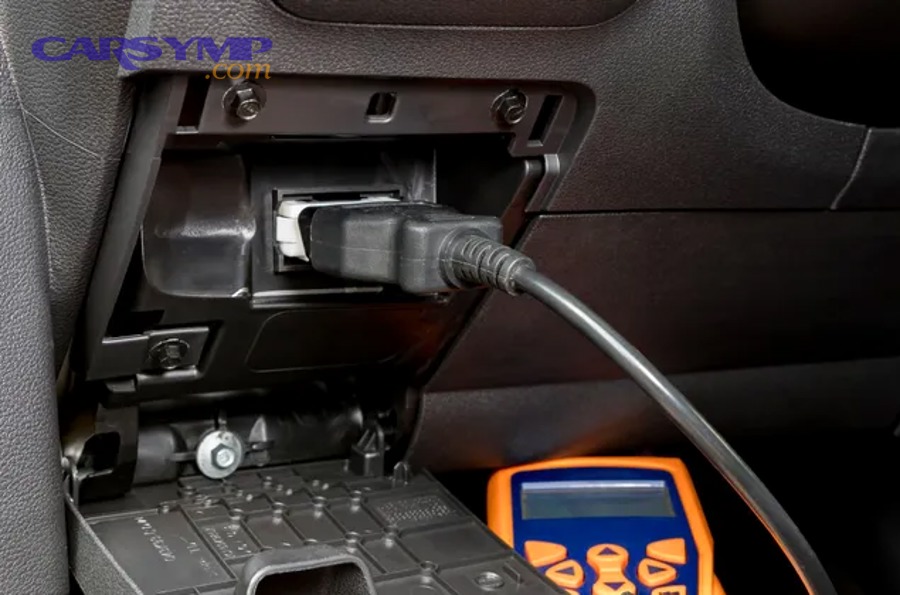
A code scan is usually a fast retrieval of stored trouble codes (and sometimes basic data). It can point to a system (misfire, evap, oxygen sensor circuit) but may not prove the failed part. Codes are clues—often helpful, sometimes misleading.
A real diagnostic goes beyond retrieving codes and focuses on proof:
- Reproducing the symptom (if possible)
- Validating sensor readings against expected values
- Testing wiring integrity (voltage drop, continuity under load)
- Confirming mechanical causes (compression, vacuum, fuel pressure)
- Verifying the fix with a retest
If you want a simple mental model: a scan suggests; diagnosis proves.
What proof should you receive for a “necessary” diagnostic charge?
There are 6 main types of proof you should receive—scan evidence, test evidence, measurement evidence, elimination evidence, conclusion evidence, and verification evidence—because diagnosis only has value when it creates a clear decision.
More specifically, here’s what “proof” looks like in the real world:
- Scan report or data capture
- Codes, freeze frame data, readiness monitors, key PIDs relevant to the symptom
- Test results
- Smoke test outcomes, fuel pressure readings, battery/charging test printout, misfire counters, etc.
- Measurements with numbers
- “Fuel pressure: 38 psi under load (spec 50–55 psi)” beats “fuel pressure low.”
- What was ruled out (elimination)
- “Wiring load-tested OK; no voltage drop beyond spec”
- Clear recommendation + rationale
- “Replace X because test Y failed, and retest Z afterward.”
- Verification plan
- How the shop will confirm the repair solved the problem (road test, monitor completion, recheck data)
This is the heart of Getting diagnostics in writing and printouts: when you leave with tangible evidence, you can compare quotes, seek a second opinion, or approve repairs with confidence.
How can you tell if a diagnostic fee is necessary or unnecessary?
Necessary diagnostics win in evidence and repeatability, unnecessary charges are worst for transparency, and a time-capped diagnostic approach is optimal for budget control when the problem is uncertain.
Meanwhile, the easiest way to judge “necessary vs unnecessary” is to ask one question: Did the shop produce test-backed information that changes what you should do next?

Think in outcomes, not feelings. A necessary charge typically produces at least one of these outcomes:
- Confirms the failed component (not just a code)
- Rules out expensive guesses
- Prevents repeat repairs
- Creates a repair plan with verification
An unnecessary charge typically produces:
- A vague conclusion you can’t verify
- A recommendation that sounds like a guess
- Repeated fees for the same symptom without new evidence
To make this practical, here’s a quick table that separates “legit” from “suspect.” The table below lists common shop behaviors and what they usually mean for you as the customer.
| What you receive | Usually indicates | What you should do next |
|---|---|---|
| Itemized tests + numbers + clear conclusion | Necessary diagnostic work | Decide repair vs second opinion using the evidence |
| Codes only + “needs part X” | Likely incomplete diagnostic | Ask what tests proved X failed |
| Vague line item (“diagnose problem”) with no notes | Low transparency / possible unnecessary charge | Request documentation before paying in full |
| Fee repeated for same issue with no new tests documented | Possible double billing | Ask what changed, what new tests were performed |
What are the most common red flags that a diagnostic charge is unnecessary?
There are 8 common red flags—vague labor, no deliverables, repeat billing, parts-guessing, bundling, moving goalposts, refusal to explain tests, and “pay to continue” pressure—because unnecessary charges thrive in ambiguity.
More importantly, these red flags are behavioral, meaning you can spot them even if you don’t understand every technical detail.
Red flag checklist:
- No written findings: “We checked it” with nothing to show.
- No time disclosed: you can’t tell whether you paid for 15 minutes or 2 hours.
- Parts guessing: “Let’s try this sensor” instead of “this test failed.”
- Bundled mystery charges: diagnosis embedded inside unrelated fees with no breakdown.
- Repeat diagnostic charges for the same symptom without new tests documented.
- Diagnosis used as a sales tactic: “You need $X in repairs” before findings are explained.
- Inconsistent story: explanation changes when you ask for proof.
- Refusal to return old parts or show evidence (where applicable/legal).
Here’s why this matters: a classic “parts cannon” approach can cost you more than careful diagnosis. A Transportation Research Record paper describing diagnostic inspection programs reports meaningful rates of unnecessary repairs in multiple sources and indicates that clearer repair information can reduce unnecessary repair frequency. (onlinepubs.trb.org)
When is it reasonable to pay a diagnostic fee even if you don’t do the repair there?
Yes, it can be reasonable—because (1) skilled testing takes time, (2) the information can prevent costly wrong parts, and (3) documented results let you make a better decision at any shop.
In addition, paying makes sense when the diagnostic work produces portable value. You should be able to take what you paid for and use it elsewhere.
A charge is usually reasonable even if you decline repairs when you receive:
- Clear test results with numbers
- An explanation of what was ruled out
- A repair recommendation tied to proof
- A verification plan
A charge is usually not reasonable when you receive:
- Codes only
- Vague conclusions with no test data
- “We think” without “we tested”
- No paperwork or proof
This is also When a second opinion makes sense: if the findings are thin, contradictory, or extremely expensive, you’re not being difficult—you’re being rational.
What checklist can you use before authorizing diagnostics to prevent overcharges?
There are 6 checkpoints you should use: symptom scope, price agreement, time cap, deliverables, approval checkpoints, and credit policy—because a checklist turns an open-ended process into a controlled agreement.
Then, once those checkpoints are set, you remove most of the “surprise invoice” risk without fighting the shop.

Here’s the checklist you can use verbatim before you authorize anything:
- Define the symptom in one sentence
- “Rough idle when warm, occasional stalling at stoplights.”
- Agree on the diagnostic fee (price or range) upfront
- Ask: “What is the diagnostic fee for this concern?”
- Set a diagnostic time cap and a stop point
- “Please stop and call me after 1 hour if more time is needed.”
- Define deliverables (what you get for the fee)
- Notes, printouts, test results, scan report, measurements.
- Require approval before repairs
- “No parts replacement or additional labor without my authorization.”
- Confirm how the fee applies if you proceed with repairs
- Credited fully, partially, or not at all.
This approach maps to research showing that consumer price expectations and informed negotiation can change outcomes in auto repair quote environments. (kellogg.northwestern.edu)
Do you need a written scope and a diagnostic time cap before work starts?
Yes—you need it because (1) it prevents open-ended billing, (2) it forces the shop to define the test plan, and (3) it creates a decision checkpoint where you control the next spend.
To begin, keep the “scope” short and specific. Scope is not a novel; it’s a boundary:
- What symptom(s) are being diagnosed
- What conditions reproduce it (if known)
- What the shop will do before asking for more time
A time cap is your safety valve. It protects you from paying multiple hours before you even understand the direction of the diagnosis. Time caps are normal in many professional services; car diagnosis is no different.
What questions should you ask to lock down scope, evidence, and next steps?
There are 10 questions that protect your wallet—because each question forces clarity on cost, method, and deliverables.
Below are customer-friendly questions that don’t insult the shop but still protect you:
- “What symptom are you diagnosing—can we write it in one sentence?”
- “What is the diagnostic fee for this concern?”
- “How much diagnostic time does that cover?”
- “What tests will you run first?”
- “What will you give me when the diagnosis is complete (notes/printouts/results)?”
- “When will you call me if more time is needed?”
- “If the issue can’t be reproduced today, what happens next?”
- “Will any part be replaced without my approval?”
- “How do you verify the repair fixed the issue?”
- “If I approve repairs, is the fee credited or applied to the final invoice?”
Notice the thread: every question ties back to either scope, proof, or decision control—the three pillars of avoiding unnecessary charges.
How do shops apply diagnostic fees to repairs, and how can you negotiate it?
Full credit is best for fairness, partial credit is optimal for complex cases, and standalone (non-credit) diagnosis only makes sense when the shop provides a complete written deliverable you can use elsewhere.
Besides, you can’t negotiate what you don’t define—so this section is about putting names to common shop policies and choosing the one that fits your situation.

Should the diagnostic fee be credited to the repair—always or only sometimes?
A fee credit should happen sometimes, not always—because credit policies vary by shop model, problem complexity, and whether diagnosis itself is the deliverable you’re purchasing.
However, “sometimes” shouldn’t be vague. Here’s a practical framework:
Reasonable to expect a credit:
- The diagnostic work directly leads to a specific repair performed at that shop
- The shop policy clearly states credit terms before authorization
- The fee represents initial diagnostic time that transitions into repair labor
Reasonable not to expect a full credit:
- The diagnostic work took substantial time and produced a detailed deliverable
- The issue is intermittent and required extended testing
- The “repair” is actually a multi-stage process and the shop separates diagnosis from repair labor
The key is transparency. If the shop can explain the policy in one minute and put it on the estimate, you’re in safer territory.
What wording should appear on the estimate or invoice so the fee doesn’t become “double-billed”?
There are 5 must-have lines—diagnostic labor time, tests performed, findings summary, repair recommendation, and fee application statement—because double billing usually hides inside vague wording.
Ask for wording like this (or similar):
- “Diagnostic labor: 1.0 hr (includes test plan + scan + verification steps)”
- “Tests performed: smoke test / fuel pressure test / electrical load test (as applicable)”
- “Findings: [clear summary]”
- “Recommended repair: [specific] + verification: [specific]”
- “Diagnostic fee credited toward repair labor if repair is approved: $___”
If the invoice can’t show “what happened” and “how the fee was applied,” you can’t judge value—and you can’t challenge it effectively.
According to a study by Northwestern University from the Kellogg School of Management, in 2012, asking for a price concession after receiving a quote reduced prices by about 13% on average in their field experiment on auto-repair price quotes. (kellogg.northwestern.edu)
How can you challenge a diagnostic charge after the fact if it looks inflated?
Challenge questionable diagnostic charges with a 6-step documentation method—request records, match billed time to tests, clarify what was ruled out, negotiate adjustments, pay undisputed amounts, and record next steps—so you leave with evidence instead of uncertainty.
More specifically, disputes go best when you treat them like an accounting question, not a personal conflict.
Here’s the 6-step method that works in most real-world situations:
- Ask for the diagnostic notes and test results
- You’re not asking for trade secrets—you’re asking for proof of work.
- Match the bill to the documentation
- If you were billed 2.0 hours, the notes should reflect meaningful testing, not a vague statement.
- Ask what was ruled out
- Diagnosis is as much about elimination as it is about identification.
- Ask for the conclusion in one sentence
- If they can’t summarize clearly, the work may not be complete.
- Request a fair adjustment if evidence is thin
- “I’m happy to pay for documented tests; I’m not seeing documentation for the full time billed.”
- Pay the undisputed portion and keep everything
- Receipts, printouts, estimates, and any messages.
This is also where When a second opinion makes sense becomes a practical decision. If the shop’s documentation is weak or the proposed repair is expensive, paying another shop for an evidence-based evaluation can be cheaper than paying for the wrong repair twice. A consumer guidance article notes that seeking another evaluation after an unsatisfying repair may involve paying for diagnosis again, but can be worthwhile for accurate re-evaluation. (capitalone.com)
Can you request itemized diagnostic notes and test results, and will that usually help?
Yes—because (1) itemization reveals whether real tests occurred, (2) it prevents “vague labor” billing, and (3) it gives you portable information for negotiating, approving repairs, or getting another evaluation.
In addition, requesting documentation is a reasonable consumer action—not an accusation. A good shop often welcomes it because it demonstrates professionalism.
If the shop says, “We don’t provide notes,” you can respond calmly:
- “I’m not asking for proprietary procedures—I’m asking what tests were performed and what results led to the recommendation.”
That phrasing keeps the conversation constructive and centered on evidence.
What is the simplest step-by-step process to dispute or reduce questionable diagnostic charges?
There are 7 steps to dispute effectively—because each step either clarifies facts or creates a fair resolution path without escalation.
Use this exact sequence:
- “Can I get the diagnostic findings in writing and any printouts?”
- “What tests were performed, and what were the results?”
- “How much time was spent on each testing step?”
- “What was ruled out?”
- “If I approve the repair, how is the fee applied?”
- “Based on what’s documented, can we adjust the charge to match the documented time?”
- “I’ll pay the undisputed portion today—please note the remaining amount is under review pending documentation.”
According to a study by the University of Alabama in Huntsville from its Auto Check Diagnostic Inspection Demonstration Project, in 1975–1977, the overall unnecessary repair frequency was about 26%, and providing motorists clearer repair instructions (“prescription forms”) was associated with a drop to roughly 15% in later data. (onlinepubs.trb.org)
What special cases can legitimately raise car diagnostic fees, and how should owners handle them?
There are 4 special cases that can legitimately increase diagnostic complexity—intermittent faults, safety-critical systems, high-voltage/EV platforms, and calibration-dependent driver assistance—because they require specialized tools, controlled procedures, or extended time to reproduce and verify.
Especially with modern vehicles, higher charges can be justified if the shop provides stronger documentation and clearer boundaries.

Do EVs and hybrids require different diagnostic steps that affect fees?
Yes—because (1) high-voltage safety protocols limit what can be tested quickly, (2) specialized training and equipment may be required, and (3) verifying faults can involve controlled conditions and additional checks before repairs are authorized.
Next, the practical takeaway is not “EVs always cost more,” but “EV diagnosis should be better documented.” If the shop says diagnosis costs more, ask for:
- The specific system being tested (high-voltage battery, inverter, charging, thermal management)
- The safety procedure required
- The deliverables you’ll receive (results and next steps)
How do ADAS and calibration-related issues change diagnostic scope and cost?
ADAS-related diagnosis is the process of identifying sensor/camera/radar faults and determining whether calibration is required, often involving controlled setups and verification procedures that standard mechanical issues don’t require.
Then, keep two terms separate on your paperwork:
- Diagnosis (what’s wrong and why)
- Calibration (the procedure to restore correct sensor alignment/operation)
Your protection here is the same as everywhere else: demand scope, time caps, and written deliverables before authorizing multi-step work.
What happens to diagnostic fees in warranty or insurance situations (including “no fault found”)?
Customer-pay diagnosis tends to prioritize clear evidence for authorization, while warranty/insurance workflows often require stricter documentation and may produce “no fault found” outcomes when intermittent issues can’t be reproduced during approved testing windows.
Meanwhile, you should ask:
- Who authorizes diagnostic time (you, warranty admin, insurer)?
- What documentation is required for approval?
- What happens if the symptom cannot be reproduced today?
If you hear “no fault found,” it doesn’t automatically mean nothing is wrong—it can mean the shop couldn’t reproduce the issue under the approved process. In that situation, ask for what was tested and what conditions would be needed to test further.
Is remote/mobile diagnostics a cheaper alternative—or can it miss what a shop finds?
In-shop diagnosis wins for controlled testing and verification, remote scanning is best for quick early clues, and a hybrid approach is optimal when you want to narrow possibilities before paying for deeper testing.
More specifically, remote scan tools can retrieve codes and basic data, but they can’t always:
- Perform load testing on wiring
- Validate mechanical causes
- Reproduce conditions safely under controlled observation
- Verify repairs with repeatable procedures
So yes, remote checks can be cheaper—but if they cause false confidence, they can also lead to repeat visits and repeat charges. Use remote results as inputs, not final answers.
According to a study by a NHTSA Task Force (U.S. Department of Transportation), in the late 1970s report period, consumers were estimated to lose about $20 billion annually due to improper or unnecessary repair and maintenance practices, underscoring why evidence-based diagnosis matters. (crashstats.nhtsa.dot.gov)