


Yes—you can jump-start most hybrids and EVs safely as long as you target the 12-volt battery system (not the high-voltage pack) and follow a controlled, spark-minimizing connection sequence that protects electronics and people.
Next, the “safe” part is not a vague warning label—it’s a practical set of checks that prevent the two biggest real-world failures: reverse polarity and sparks near battery gases, both of which can damage modules or cause injury.
Then, the fastest way to get it right on the roadside is to treat the process like a repeatable jump start guide: confirm the correct jump points, follow the Correct cable order and common mistakes checklist, and stabilize the car in READY/ON long enough for the DC-DC system to recharge the 12-volt battery.
Introduce a new idea: if the jump works but the 12-volt battery keeps dying, the real fix is not “jump it again”—it’s diagnosing what drained it and knowing What to do if jump start doesn’t work so you don’t waste time or create risk.
Can you safely jump-start a hybrid or EV using the 12-volt battery?
Yes, you can safely jump-start a hybrid or EV’s 12-volt battery because (1) the 12-volt system is designed to be externally supported, (2) the high-voltage battery remains isolated from jumper clamps, and (3) correct grounding and cable order reduce sparks and protect electronics.
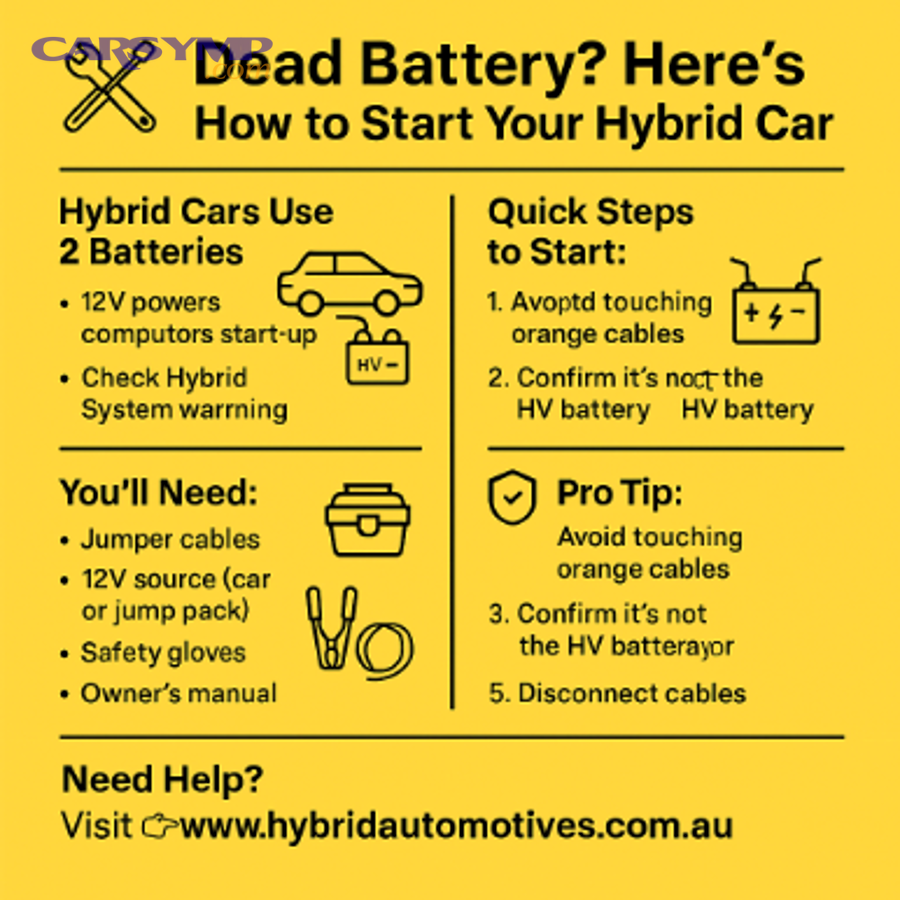
To better understand this, the key is to think “12-volt wake-up power,” not “recharging the big battery,” because hybrids and EVs use the 12-volt battery to boot computers, close contactors, and enable READY/ON states.
Is it “No” if the car is a full EV with a dead battery?
No—“full EV” does not automatically mean “can’t be jump-started,” because the jump-start targets the 12-volt auxiliary battery, not the traction battery.
Specifically, many EV “won’t start” scenarios are actually “won’t wake,” where screens stay dark, doors won’t present handles, and the vehicle refuses to go into Drive because the 12-volt battery is too low to power control modules.
More specifically, an EV can still have plenty of energy in the traction battery while the 12-volt battery is depleted. When you supply stable 12-volt power, the car can boot up, and the DC-DC converter can begin recharging the 12-volt system from the traction battery once the vehicle is awake.
Practical signs it’s a 12-volt issue:
- Cabin screens are dead or flicker.
- Locks behave oddly or the car unlocks but won’t “go ready.”
- You hear relays clicking but no stable boot sequence.
- Interior lights are dim or inconsistent.
What is a “No” scenario is when the car shows high-voltage fault warnings, you detect smoke/heat, or there’s crash damage—then the correct decision is to stop and call roadside assistance.
Is it safe to use a jump pack instead of another car?
Yes—Jump starting with a portable booster pack is often the safest option because it delivers controlled power without relying on a donor vehicle’s alternator behavior, and it reduces the risk of awkward parking or cable routing near moving fans and belts.
Then, you still must treat the booster pack like a live electrical source: confirm polarity, clamp on solid metal, and keep clamps from touching each other.
A simple booster-pack safety checklist:
- Use a pack rated for 12-volt automotive use with reverse-polarity protection.
- Turn the pack off (or keep it unarmed) until clamps are firmly attached.
- Clamp red to positive first; clamp black to a chassis ground last.
- Keep the pack away from heat sources and moving parts.
- After the vehicle is ON/READY, disconnect in reverse order.
Evidence: According to guidance from AAA, you should only attempt to jump-start an EV’s 12-volt battery with a combustion-engine vehicle or a jumper pack, and you should never attempt to jump-start the main lithium-ion battery because it can damage the battery or electrical system.
What does “jump-start precautions” mean for hybrid and EV 12-volt systems?
Jump-start precautions are a safety-and-damage-prevention protocol that focuses on the 12-volt system: verify correct jump points, prevent reverse polarity, minimize sparks near battery gases, and avoid voltage spikes that can upset sensitive vehicle electronics.
Next, that protocol matters more in hybrids and EVs because they are computer-dense and rely on stable voltage to bring modules online in a predictable sequence.
What are the most important safety checks before connecting cables?
The most important checks are the ones that prevent the two irreversible mistakes: wrong terminals and unsafe conditions.
Besides, these checks also help you avoid wasting time if the problem isn’t the 12-volt battery at all.
Do these checks before any clamp touches metal:
- Confirm you are working on the 12-volt system.
- In hybrids/EVs, orange cables and orange-labeled components usually indicate high voltage—do not touch those.
- Shut the vehicle down and secure it.
- Park, parking brake, hazards on, and keep keys away from the car so it can’t unexpectedly wake.
- Inspect for danger signs.
- Smoke, popping sounds, fluid leaks, melted wiring smell, or visible battery swelling = stop.
- Identify jump points and polarity.
- Look for a “+” post or under-hood jump terminal; identify a solid chassis ground.
- Remove metal jewelry and keep the area ventilated.
- Batteries can vent gases; sparks are the enemy.
- Check cable/booster condition.
- Damaged insulation, loose clamps, or corroded clamp teeth reduce contact and increase heat.
Why this matters: the last connection is typically made away from the battery to reduce the chance of igniting battery gases.
What warning signs mean you should not attempt a jump-start?
You should not attempt a jump-start if you see or smell indicators that suggest a thermal, chemical, or high-voltage hazard, because a jump-start is not worth escalating a safety event.
Stop immediately if you notice:
- Smoke, hissing, gurgling, popping, or abnormal heat.
- Burning plastic odor or strong chemical smell.
- Crash damage near the battery area or underbody.
- Wet battery area (water intrusion) or leaking electrolyte.
- Dash messages suggesting high-voltage system fault or “pull over safely.”
Evidence: According to guidance published by NHTSA for electric and hybrid-electric vehicles with high-voltage batteries, responders should avoid contact with orange high-voltage cabling and treat the high-voltage system as potentially energized—reinforcing why DIY jump-start efforts must stay strictly on 12-volt jump points.
What are the exact steps to jump-start a hybrid or EV 12-volt battery without mistakes?
Use the 12-volt jump-start method in 7 steps—identify the correct posts, connect clamps in spark-minimizing order, power the vehicle into READY/ON, and stabilize it long enough for the DC-DC system to recharge the 12-volt battery.
Below, the sequence is designed to reduce spark risk and prevent the most common errors that damage electronics or create frustration during a roadside restart.

What is the correct connection order for cables (and why does it reduce sparks)?
The correct order is: red to dead positive, red to donor positive, black to donor negative, then black to dead vehicle chassis ground, because the final connection is where a spark is most likely—and placing it away from the battery lowers the chance of igniting vented gas.
Then, keep your body position stable and avoid leaning directly over the battery area while making the final connection.
Correct cable order (quick reference):
- Red clamp → Positive (+) on the dead vehicle’s 12-volt post/jump terminal
- Red clamp → Positive (+) on the donor battery or booster pack positive
- Black clamp → Negative (–) on the donor battery or booster pack negative
- Black clamp → Chassis ground (unpainted metal) on the dead vehicle, away from the battery
Why it works (plain language):
- The circuit is incomplete until the last clamp, so the last clamp is the “spark point.”
- A chassis ground away from the battery reduces spark exposure to battery vent gases.
- Solid grounding also improves current flow and reduces heat at clamps.
Evidence: According to a study by North Carolina State University, in 1999, participants exposed to a pictorial warning tag showed improved correctness in diagramming jumper cable connection procedures and were reminded that the last connection should be made to an earth point away from the battery to avoid a spark igniting hydrogen gas.
Where should you connect the negative clamp if there’s a designated grounding point?
Connect the negative clamp to the designated ground point (or a sturdy, unpainted engine/chassis bolt) because it provides a safer spark location and a reliable electrical return path.
Specifically, many hybrids and EVs provide an under-hood grounding lug or a marked bolt intended for boosting; using it reduces guesswork and improves contact quality.
How to choose a good ground point:
- Pick bare metal (no paint, no heavy rust).
- Choose a point away from the battery and fuel system components.
- Prefer a factory-provided ground stud or bracket if present.
- Avoid thin sheet metal that can flex or heat up.
If you can only reach the battery area, follow the owner’s manual guidance—some vehicles specify a particular stud even near the battery because of packaging constraints.
What should you do immediately after the vehicle powers on (READY mode / accessory mode)?
Immediately after the vehicle powers on, you should keep it in READY (hybrid) or ON (EV) to allow the DC-DC converter to recharge the 12-volt system, and you should avoid cycling accessories that create sudden voltage drops.
Next, the goal is not “start and unplug instantly,” but “start and stabilize,” because the 12-volt battery may be extremely depleted.
For hybrids:
- Confirm READY appears (engine may or may not start right away—this is normal).
- Leave the vehicle in READY for 10–20 minutes if practical.
- Avoid turning on high loads (rear defrost, max heat, high fan) immediately.
For EVs:
- Turn the vehicle ON and keep it awake.
- Allow a stabilization period so the DC-DC converter can recharge 12-volt.
- If the car repeatedly shuts down, keep the booster connected briefly (per pack instructions) while the system boots.
What post-jump steps prevent the battery from dying again today?
To prevent a repeat failure today, you should (1) recharge the 12-volt system sufficiently, (2) reduce parasitic loads immediately, and (3) plan a battery test or replacement if the 12-volt battery is aging or repeatedly discharging.
Besides, hybrids and EVs can mask a weak 12-volt battery until one bad day makes the car look “dead.”
Post-jump “same day” checklist:
- Keep the car in READY/ON long enough to stabilize the 12-volt system.
- Turn off cabin lights, unplug accessories, and check that doors fully latch.
- If the 12-volt battery is more than ~3–5 years old (common lifespan range varies), schedule a test.
- Carry a booster pack if you’re traveling—especially in cold weather or during long parking periods.
Evidence: According to guidance from Kelley Blue Book, EV jump-start procedures emphasize the 12-volt system and advise using a portable jump-start device or a gas-powered vehicle—not another EV—reflecting the practical focus on stable 12-volt recovery rather than improvised methods.
What are the most common jump-start mistakes on hybrids and EVs ?
There are 5 main jump-start mistakes on hybrids and EVs—wrong battery, wrong cable order, wrong grounding point, wrong donor choice, and rushing the “wake-up” phase—based on the criterion of what causes damage or failure-to-start.
However, each mistake has a simple prevention rule that you can apply even when you’re stressed on the side of the road.

Is it a mistake to jump the wrong battery (high-voltage pack vs 12-volt)?
Yes—it’s a serious mistake to attempt to jump anything related to the high-voltage traction battery, because jump-start tools are meant for 12-volt systems and high-voltage components can present shock and fire hazards.
Then, use a simple visual rule: orange cables and orange warning labels mean high voltage—hands off.
How to avoid it:
- Look for the 12-volt jump post (often under the hood even when the 12-volt battery is elsewhere).
- Use the owner’s manual diagram if available.
- If you cannot confidently identify 12-volt jump points, stop and call roadside assistance.
Evidence: According to Popular Mechanics (Jan 2026), you can jump-start a hybrid, but you must connect to its 12-volt battery—not the large high-voltage battery—to do it properly and safely.
Is it a mistake to use an EV or hybrid to jump-start another car?
Yes, it’s often a mistake because many EV/hybrid 12-volt systems are not designed to provide sustained donor current to another vehicle, and the risk-to-reward ratio is poor compared with using a dedicated jump pack or an ICE donor vehicle.
Meanwhile, this mistake is common because people assume “a battery is a battery,” but EVs and hybrids manage 12-volt power through converters and protection logic that may not behave like a traditional alternator system.
Safer alternatives:
- Use Jump starting with a portable booster pack (preferred).
- Use a conventional gas vehicle as the donor if necessary.
- If you must assist someone, do so with a jump pack rather than using your EV as the donor.
Evidence: According to Kelley Blue Book, you should never use an electric vehicle to jump-start another 12-volt battery, because the EV’s charging points are for jump-starting the car itself, not assisting another vehicle.
Is “let them sit connected for a long time” a mistake with modern electronics?
Yes, it can be a mistake because prolonged connections can hide poor clamp contact, increase heat at resistance points, and encourage repeated cranking that stresses modules and starters instead of solving the underlying issue.
More specifically, the smarter approach is a controlled wake-up: ensure solid connections, let the system stabilize briefly, then attempt a start with short crank attempts rather than long, repeated cranking.
A safer timing approach:
- Connect correctly and wait 1–3 minutes for initial voltage stabilization.
- Try starting (or READY/ON) once.
- If it fails, wait another 1–2 minutes and try again.
- If it repeatedly fails, shift to diagnostics rather than “more time connected.”
This is also where “What to do if jump start doesn’t work” becomes essential: repeated attempts without a plan can escalate risk and frustration.
How is jump-starting a hybrid different from jump-starting a full EV?
Hybrid jump-starting wins in predictable READY-mode recovery, full EV jump-starting is best for 12-volt wake-up and DC-DC recharge, and conventional gas-car jump-starting is optimal for straightforward alternator-based charging, because each system uses the 12-volt battery differently once the vehicle is “on.”
On the other hand, the clamps-and-cable fundamentals stay the same: correct posts, correct order, and safe grounding.

What changes in procedure when the 12V battery is in the trunk or under a seat?
When the 12-volt battery is in the trunk or under a seat, the procedure changes mainly in access, not electrical theory: you typically use under-hood remote jump terminals instead of clamping directly to the battery.
Besides, remote terminals are designed for safe roadside service where the actual battery is hard to reach.
What to do differently:
- Open the hood and locate the positive jump post (often under a red cap).
- Locate the recommended ground point (often a nearby bolt or lug).
- Avoid tearing interior panels to reach the trunk battery unless the manual explicitly instructs it.
Why this matters:
- Interior access can be blocked when the 12-volt battery is dead (some cars lock the trunk electronically).
- Remote posts reduce the chance you clamp onto the wrong hardware in a cramped area.
What does READY mode mean on hybrids compared with “vehicle on” in an EV?
READY mode on hybrids means the vehicle’s control system is fully active and can use the traction battery and engine (as needed) to provide propulsion, while “vehicle on” in an EV means the traction battery can power the DC-DC converter to recharge the 12-volt system and enable driving—often silently.
Especially in hybrids, the engine may not start immediately even when the jump is successful; the READY indicator is the real proof of success.
Key practical differences:
- Hybrid: READY confirms systems are online; DC-DC charging begins; engine start may be delayed.
- EV: ON confirms systems are awake; DC-DC charging begins; no engine noise to confirm status.
- Driver action: prioritize stability (leave ON/READY), then disconnect safely.
Evidence: According to AAA’s EV guidance, EV roadside procedures still revolve around the 12-volt battery for wake-up, reinforcing that “jump-starting” in electrified vehicles is primarily a 12-volt recovery operation.
Why does the 12-volt battery keep dying in hybrids and EVs (and what fixes are most effective)?
There are 4 main reasons a hybrid or EV 12-volt battery keeps dying—battery aging, parasitic drain, insufficient recharge behavior, and DC-DC/charging control faults—based on the criterion of what repeatedly pulls 12-volt voltage below boot threshold.
In short, if you keep needing a jump, the best fix is to stop treating it like a one-time event and start treating it like a repeatable diagnosis path.

What are the most common 12V drain causes specific to hybrids/EVs?
The most common drains are the ones that keep the car “half-awake” even when parked: telematics check-ins, security systems, accessory power ports, frequent short trips that don’t stabilize recharge, and doors/hatches that don’t fully latch.
Then, hybrids and EVs can be more sensitive because they rely on the 12-volt battery to boot modules before the DC-DC converter can take over.
Common drain patterns to look for:
- Long parking intervals with frequent app checks or remote wake-ups.
- Interior lights or cargo lights staying on due to latch misalignment.
- Aftermarket accessories wired to constant power.
- Cold weather reducing effective 12-volt capacity.
- Repeated short trips where the car never stays ON/READY long enough to recharge.
Evidence: According to an industry explainer on 12-volt batteries and telematics, many telematics devices are engineered to draw very low current (often in the tens of milliamps) and enter sleep modes—suggesting that repeated dead batteries often involve broader vehicle wake cycles, accessory loads, or battery health rather than one single device alone.
What battery test results indicate replacement rather than repeated jump-starts?
Replace the 12-volt battery when testing shows it cannot hold voltage under load, recovers poorly after charging, or repeatedly drops below boot threshold, because repeated jump-starts are a symptom-management loop, not a cure.
More specifically, a weak 12-volt battery can appear “fine” at rest but fail during the high-demand wake-up moment when modules and relays pull current.
Practical indicators (ask a shop or use a tester):
- Fails a load test (voltage collapses under rated load).
- Resting voltage drops quickly after charging and sitting.
- Battery age is beyond typical service life for your climate and usage pattern.
- Corrosion and leakage are present at terminals or casing.
If replacement is needed, choose a battery type that meets OEM specs (including AGM where required), because hybrids/EVs often specify particular 12-volt battery characteristics.
When should you call roadside assistance or a technician instead of trying again?
Call for help when you see safety red flags, when the vehicle repeatedly won’t go READY/ON after a correct jump attempt, or when the battery dies again within a short window, because those patterns suggest a deeper electrical or charging-control problem.
Besides, repeated DIY attempts increase the chance of clamp slippage, heat buildup, and mistakes.
Escalate immediately if:
- The car shows high-voltage warnings or abnormal smells/sounds.
- The 12-volt battery will not hold charge even after a long ON/READY period.
- You cannot identify safe jump points confidently.
- The vehicle has crash damage, water intrusion, or underbody impact concerns.
And here is the clear fork in the road for What to do if jump start doesn’t work:
- If clamps were wrong / contact was poor: redo with correct posts, clean contact points, and retry once.
- If clamps were correct and still no READY/ON: stop and diagnose (battery health, fuses, DC-DC behavior) or call service.
What prevention checklist reduces future no-start events?
A prevention checklist reduces no-start events by keeping the 12-volt battery healthy and minimizing unnecessary drain, especially when the car sits.
To sum up, this is the “do once, benefit for months” part that turns a stressful roadside experience into a rare exception.
Prevention checklist:
- Keep a compact jump pack in the car (stored per manufacturer guidance).
- Avoid leaving accessories plugged into always-on ports.
- Ensure doors/hatches fully latch; watch for cargo light issues.
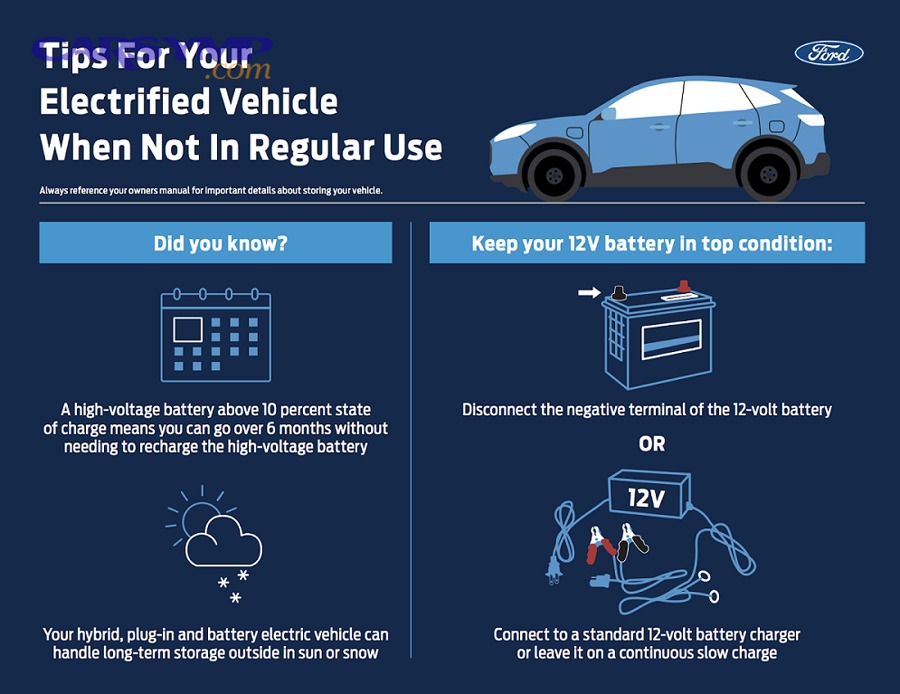
- If the vehicle sits for long periods, follow the OEM storage guidance (some recommend periodic ON/READY time or maintenance charging).
- Schedule a 12-volt battery test at the first repeat event.
- If you add aftermarket electronics, have them wired correctly (ignition-switched where appropriate).
Evidence: According to NHTSA’s interim guidance documents for electric and hybrid vehicles, high-voltage components should be treated with caution and identified by warning labels and orange cabling—supporting the prevention mindset that the safest ownership path is minimizing DIY improvisation around electrical systems and sticking to the 12-volt procedures.