


Coolant-burning smoke diagnosis is the process of confirming whether engine coolant is entering the combustion chamber and turning into persistent white smoke, then tracing the exact leak path so you can choose the right repair before the engine overheats or hydrolocks. The fastest way to get certainty is to combine symptoms + cooling-system loss patterns + a confirmatory test (pressure test and/or block test).
Next, you’ll learn what “white smoke” really means in real-world conditions, including how to separate harmless condensation from true coolant burn, and why smell, duration, and coolant level behavior matter more than color alone.
Then, you’ll walk through the most reliable DIY-to-pro diagnostic tests—cooling system pressure testing, combustion gas (block) testing, spark plug and misfire pattern reading, and compression/leak-down logic—so you can pinpoint whether the cause is a head gasket, cracked head/block, intake-side coolant leak, or another failure.
Introduce a new idea: Once coolant burning is confirmed, the priority shifts from “what is it?” to “what prevents engine damage and what repair makes financial sense,” including a realistic cost range based on the failure type.
What does coolant-burning white smoke from the exhaust mean?
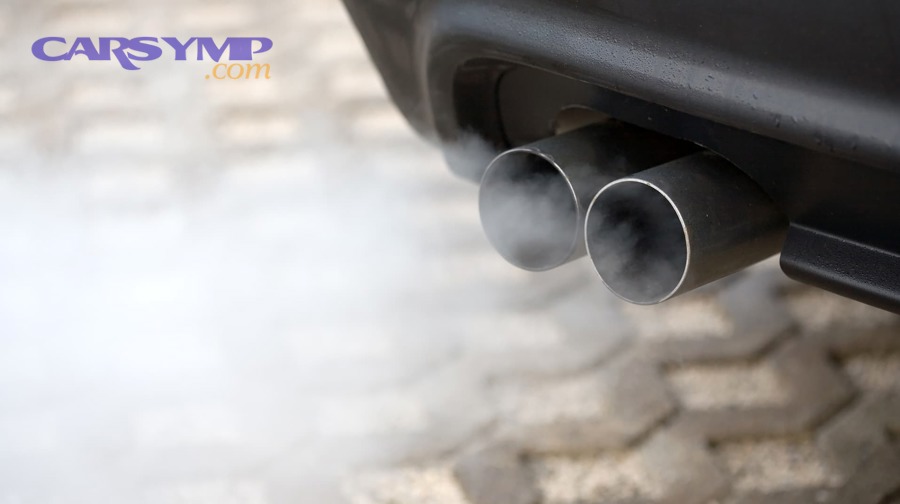
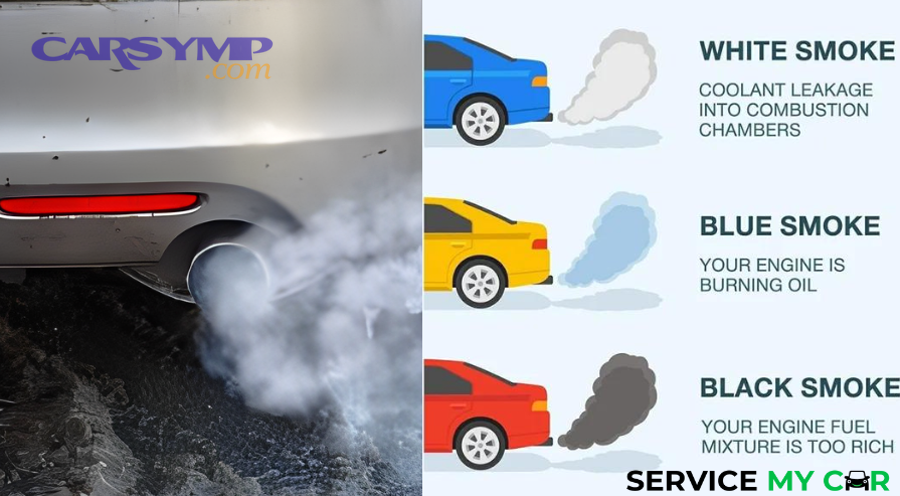
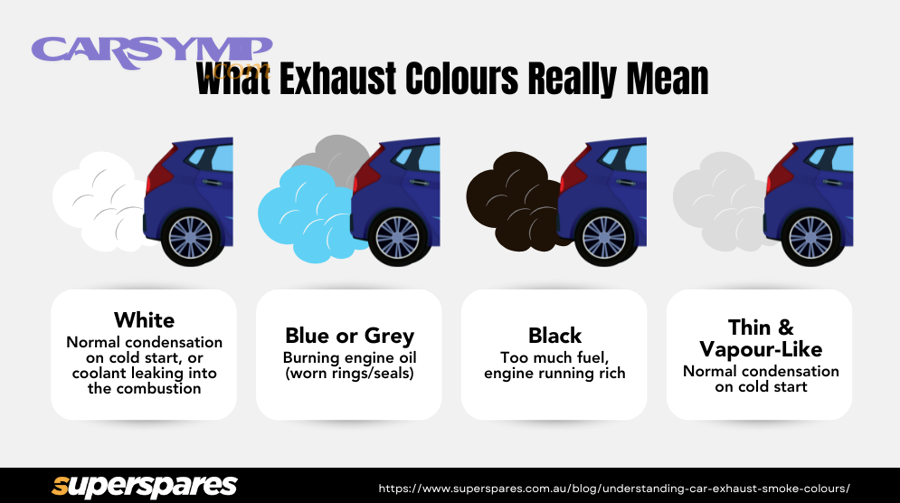
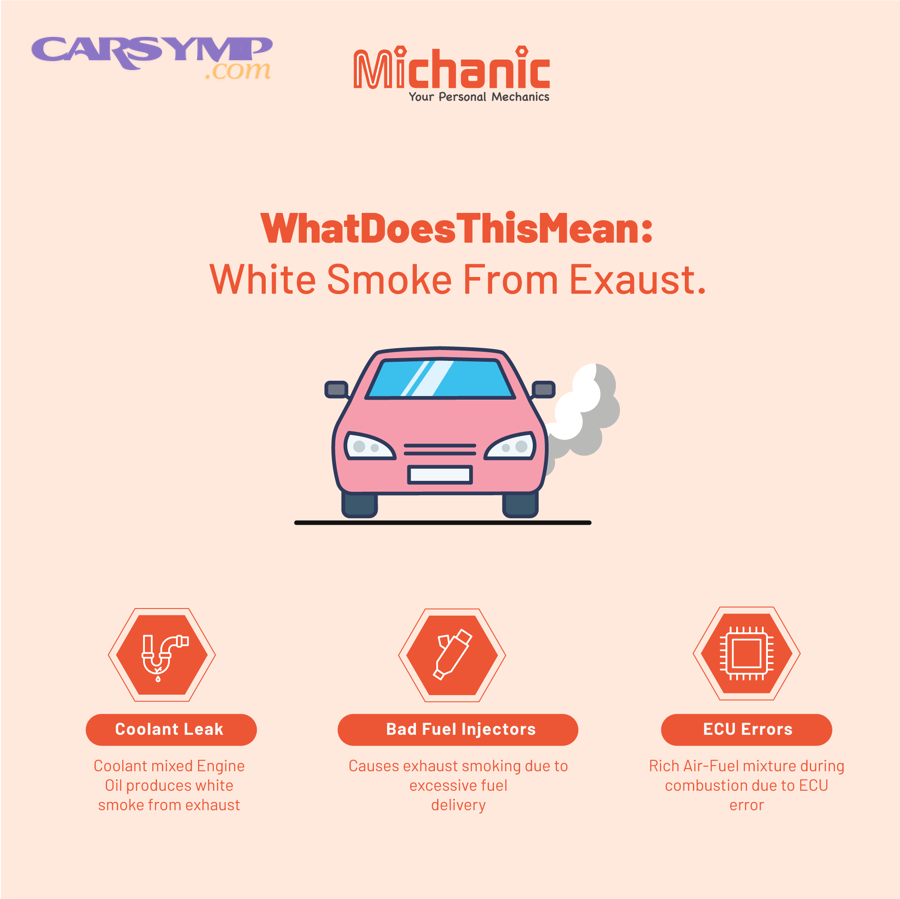
Coolant-burning white smoke from the exhaust means coolant is entering a hot combustion space (cylinder, exhaust port, or turbo hot side) and vaporizing into a thick, lingering white plume, often paired with coolant loss and misfires. To better understand this, focus on persistence, smell, and coolant behavior, not just color.
How is coolant steam different from normal condensation?
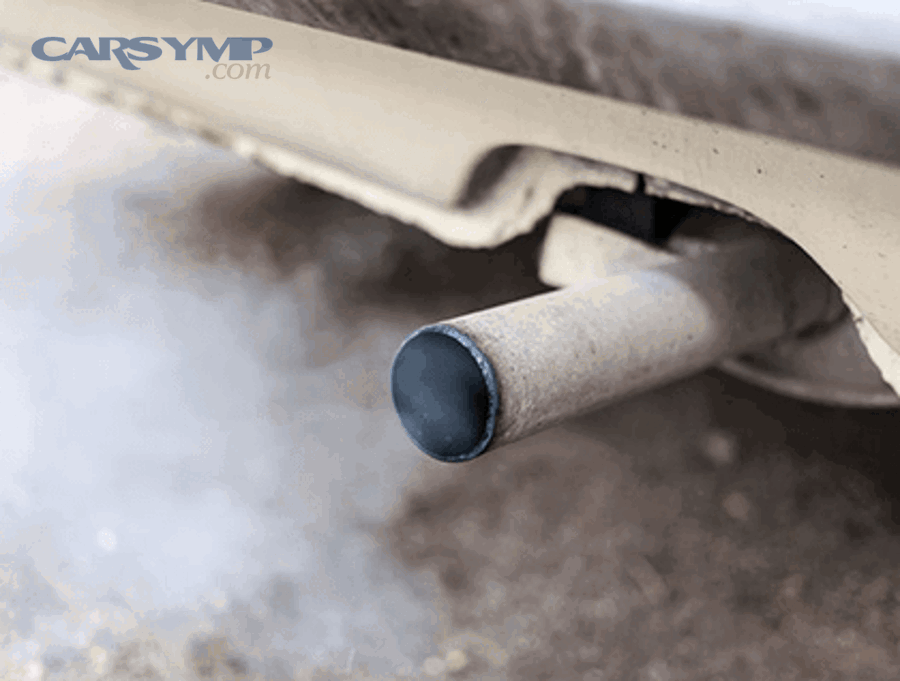
Normal condensation is thin, wispy, and short-lived, typically strongest in cold weather and fading quickly as the exhaust warms. Coolant-burning white smoke tends to be:
- Thicker and “cloud-like”, not just a light haze
- Persistent after warm-up (doesn’t disappear after a few minutes of driving)
- Moisture-heavy (can leave water droplets at the tailpipe)
- Paired with coolant loss over days or weeks, not just “a smoky morning”
A practical rule: if the smoke is still heavy after the engine is fully warm and you’re also topping off coolant, treat it as coolant-burning until proven otherwise.
What does coolant smell like and why?
Coolant often produces a sweet, chemical odor when it burns because most automotive coolants contain glycol-based compounds and additive packages. The smell can be obvious near the tailpipe or under the hood after a drive, especially when the leak is active.
Be careful: smell alone is not proof. Some fuel additives, rich running, or certain exhaust conditions can confuse the nose. Use smell as a supporting clue, then verify with tests.
Is white smoke always a sign of a blown head gasket?
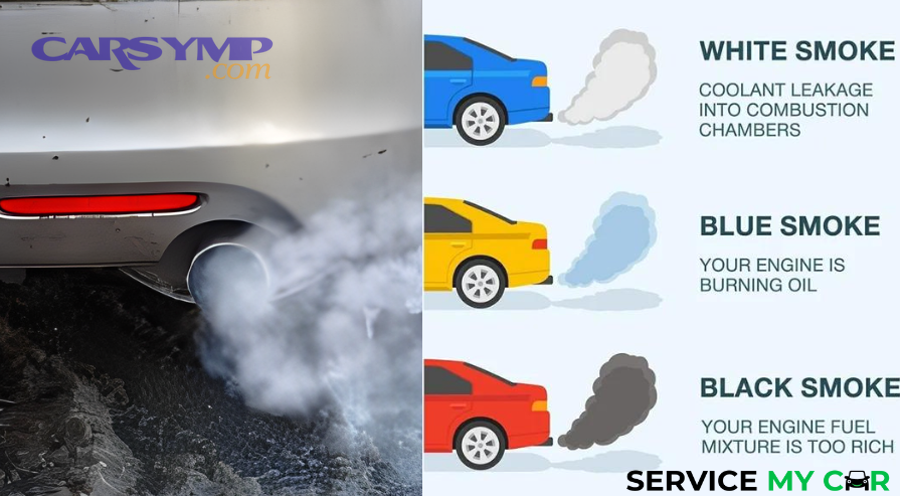
No—white smoke is not always a blown head gasket, because white exhaust can come from harmless condensation, coolant leaks other than the head gasket, or (less commonly) non-coolant sources that appear white. However, if white smoke persists and coolant level drops, a head gasket rises to the top of the suspect list—so the smartest move is to test rather than guess.
What are the most common coolant-leak paths into the cylinders?
Coolant can reach the combustion process through several paths:
- Head gasket breach between a coolant passage and a cylinder
- Cracked cylinder head (often from overheating)
- Cracked engine block (rarer, but serious)
- Intake manifold gasket leak on certain engines where coolant passes through the intake
- EGR cooler failure on some turbocharged engines (coolant enters intake/exhaust stream, depending on design)
The leak path matters because it determines whether you’re facing a gasket job, machining, replacement parts, or deeper engine work.
When can white smoke be harmless?
White exhaust is often harmless when it’s:
- Only present at cold start
- Light and watery, not thick
- Gone after a short warm-up
- Not associated with coolant loss, overheating, rough running, or misfires
If you see white smoke once on a cold morning and never again, that’s usually not a coolant-burning scenario. The problem cases are the ones that repeat and persist.
What symptoms confirm coolant is burning in the engine?
There are several symptom clusters that strongly suggest coolant is burning: persistent white smoke, coolant loss without an external leak, rough running/misfires, overheating behavior, and cross-contamination signs. More importantly, these symptoms tend to link together, so you’re looking for a pattern—not a single clue.
What visual and smell clues matter most?
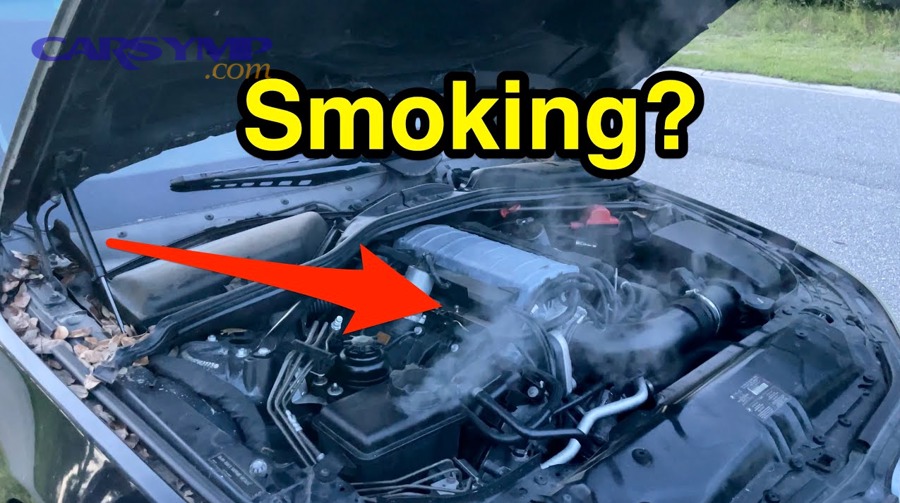
The most diagnostic “sensory” clues are:
- White smoke that continues after warm-up
- Sweet odor near tailpipe or engine bay
- Coolant level dropping over time (especially with no visible puddles)
- Bubbles in the coolant reservoir during revs (possible combustion gas intrusion)
- Wet tailpipe beyond normal condensation patterns
A critical nuance: smoke that’s thick and persistent usually points to a meaningful leak. Smoke that comes and goes exactly with ambient temperature often points to condensation.
What driving symptoms show up first?
Many engines show early operational signs before a major failure:
- Intermittent misfire on startup (coolant seeps into a cylinder overnight)
- Rough idle that improves as the engine warms
- Loss of cabin heat (air pockets from coolant loss)
- Temperature gauge fluctuation (air pockets/flow disruptions)
- Overheating under load (hill climbs, highway)
If the engine ever cranks slowly, “stutters” while cranking, or suddenly misfires hard after sitting, treat it urgently—coolant in a cylinder can cause hydrolock, which can bend connecting rods.
Which tests diagnose coolant-burning smoke most reliably?
The most reliable diagnosis uses two layers: (1) tests that prove the system is losing coolant internally, and (2) tests that identify where and how it’s leaking. Next, use the tests in an order that saves time: pressure test → block test (if needed) → cylinder-specific checks.
How do you perform a cooling system pressure test?
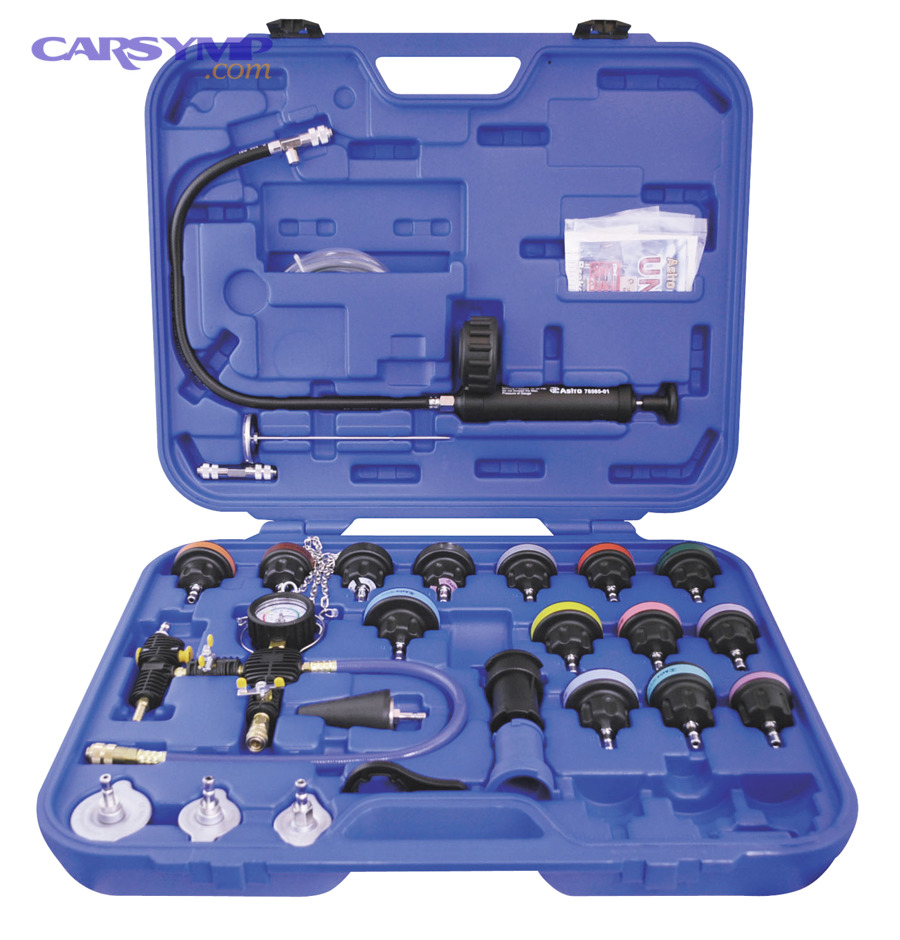
A cooling system pressure test checks whether the cooling system holds pressure when the engine is off.
- Start cold (hot systems are dangerous).
- Remove the radiator cap (or reservoir cap on some designs).
- Attach the pressure tester and pump to the cap’s rated pressure (often printed on the cap).
- Watch the gauge for 10–20 minutes.
Interpretation:
- Pressure drops + external drip appears → external leak (hose, radiator, water pump, etc.)
- Pressure drops + no external leak → possible internal leak (cylinder, oil, or hidden coolant path)
For internal leaks, pull spark plugs after the test; a “steam-cleaned” plug or coolant mist in a cylinder can be a strong indicator.
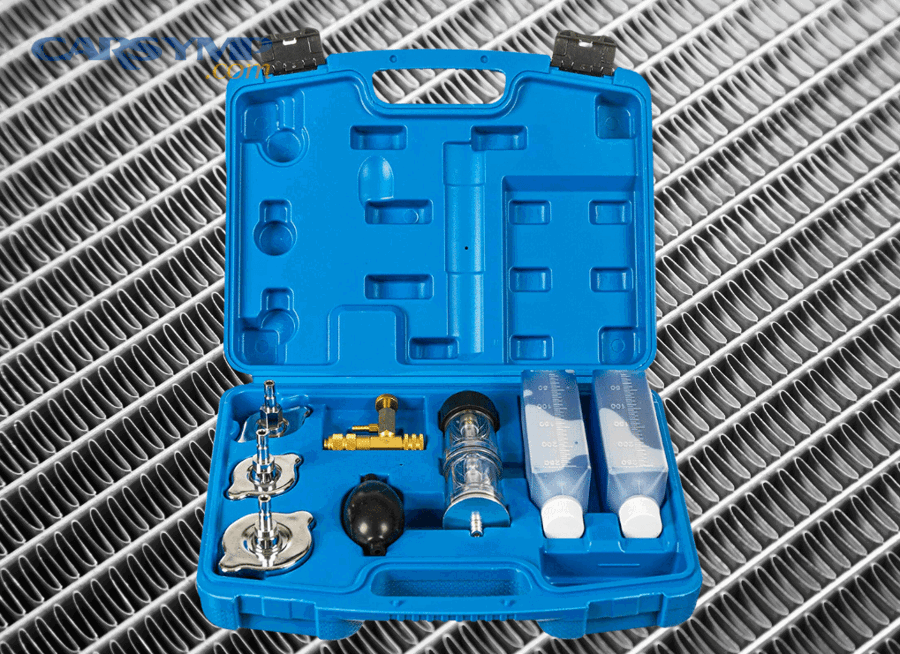
How do you use a combustion leak (block) tester?
A block tester (combustion leak detector) checks for combustion gases in the cooling system—often a strong sign of head gasket or head/crack issues.
- Warm the engine (follow product instructions).
- Use the tester over the radiator neck/reservoir opening.
- Draw vapor through the test fluid.
- Watch for a color change that indicates combustion gases.
Key cautions:
- A negative result does not 100% clear the engine—some leaks are temperature- or load-dependent.
- A positive result is highly meaningful, especially when paired with coolant loss and persistent white smoke.
What can an OBD-II scan and exhaust gas readings tell you?
An OBD-II scan helps connect symptoms to cylinders and operating conditions:
- Misfire codes (P0300–P030X) can point to a specific cylinder ingesting coolant.
- Coolant temperature behavior (if available) may show overheating trends.
- Fuel trim data can reveal compensations that aren’t coolant-related but still affect smoke interpretation.
Use scan data to guide cylinder-specific inspection (spark plugs, compression/leak-down). It’s not a “coolant burn detector” by itself, but it’s excellent for pinpointing where to look next.
How can you pinpoint the failure: head gasket vs cracked head vs intake gasket?
You can pinpoint the failure by matching where the symptoms concentrate (which cylinder, which bank, which temperature condition) to the failure pattern shown by plugs, compression/leak-down behavior, and pressure-test outcomes. Then, confirm the most likely cause with one additional test rather than doing every test blindly.
What patterns in misfires and spark plugs point to each cause?
Spark plugs are a direct window into what’s happening inside each cylinder.
Look for:
- One unusually clean plug (steam-cleaned appearance) → coolant intrusion in that cylinder
- Repeated misfire on one cylinder after sitting → coolant seep overnight
- Multiple cylinders on the same bank acting up → gasket breach along that bank or localized head issue
Intake gasket / intake-side coolant leak patterns often show:
- Symptoms stronger at idle and light throttle
- Coolant loss with less dramatic overheating
- Evidence concentrated around intake passages (engine-specific)
Cracked head patterns often show:
- History of overheating
- Symptoms that worsen under load or sustained heat
- Sometimes intermittent behavior (crack opens when hot)
How do compression and leak-down tests differentiate them?
Compression and leak-down tests help determine whether a cylinder is sealing correctly.
- Compression test: checks peak cylinder pressure during cranking
- Leak-down test: pressurizes a cylinder and measures how quickly it leaks, while helping you hear where it leaks
Differentiation logic:
- Low compression + bubbles in coolant during leak-down → cylinder-to-coolant leak (gasket/head/crack)
- Normal compression but coolant still disappears → leak might be intermittent, intake-side, or EGR cooler path
- Two adjacent cylinders low → classic head gasket pattern between cylinders (may or may not involve coolant)
If you can only do one, leak-down is often more informative—especially if you can observe bubbling in the reservoir during the test.
What DIY checks should you do before major repairs?
DIY checks should focus on confirming coolant loss patterns, spotting cross-contamination early, and ruling out look-alike smoke causes so you don’t authorize the wrong repair. In addition, do these checks before the engine overheats again—because overheating can turn a small leak into a warped head.
How to check coolant level, oil condition, and cross-contamination?
Start with three fast checks:
- Coolant level trend
- Mark the reservoir level cold, then re-check daily for a week.
- A steady drop without external leaks strongly suggests internal loss.
- Oil condition
- Look for a milky or creamy appearance on the dipstick or oil cap (late-stage indicator).
- Smell for sweet/coolant-like odor in the oil.
- Coolant condition
- Look for oil sheen in the reservoir, sludge, or abnormal discoloration.
Important nuance: you can have coolant burning without obvious milky oil—especially if coolant is going straight into a cylinder and out the exhaust rather than into the crankcase.
According to a Master’s Thesis by Umeå University from the Department of Physics, in 2023, glycol in engine coolant can contaminate oil via seals or head gaskets and is substantially more corrosive than water, breaking down into acids that contribute to corrosion and sludge formation.
How to inspect PCV and valve seal related smoke issues to avoid misdiagnosis?
This matters because oil-burning issues can sometimes be mistaken for coolant-burning issues—especially when smoke looks pale in certain lighting.
To rule out PCV and valve seal related smoke issues:
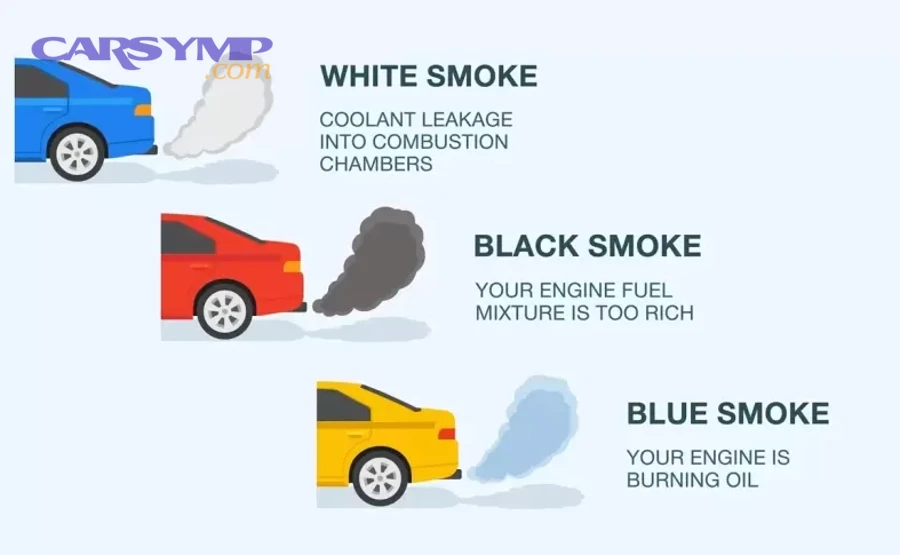
- Check for blue-tinged smoke after long idle or after deceleration (classic valve seal behavior).
- Inspect the PCV system for stuck valves, clogged hoses, or excess crankcase pressure.
- Look for oil fouling on plugs (oily deposits tend to look different than “steam-cleaned” plugs).
If you find oil-burning evidence, it doesn’t automatically clear coolant issues—but it prevents you from chasing only one cause when multiple problems coexist.
How to rule out turbocharger smoke symptoms on boosted engines?
Turbocharger smoke symptoms can overlap if the turbo seals are leaking oil into the intake or exhaust.
To differentiate:
- Turbo oil-seal problems often create blue smoke (oil) and worsen under boost or after idling.
- Coolant-burning typically keeps presenting as white smoke and often pairs with coolant loss.
On some modern engines, coolant can enter intake/exhaust streams through components like EGR coolers (design-dependent). If you drive a turbo diesel or an engine known for EGR cooler failures, put that on the shortlist when pressure tests and block tests don’t perfectly align.
What is the safest “exhaust smoke fix” path once coolant burning is confirmed?
The safest exhaust smoke fix path is to stop conditions that accelerate damage (overheating, hydrolock risk), confirm the leak path, and repair the root cause—not the smoke. Then, prioritize repairs based on what fails first: cooling integrity, combustion sealing, and mechanical straightness of the head/block.
What immediate steps prevent overheating and engine damage?
If coolant burning is confirmed or strongly suspected:
- Do not keep driving to “see if it clears.”
- Top off coolant only to move the vehicle to a safe location (if you must).
- Watch for rapid overheating, loss of heater output, or severe misfire—these are “stop now” signs.
- If the engine cranks unevenly after sitting, do not force it—that’s a hydrolock risk.
A small leak can become a big repair when repeated overheating warps the head.
What repair options match each failure type?
Match repair type to confirmed cause:
- Head gasket failure (no cracks, head flat within spec)
- Replace gasket set, head bolts (often torque-to-yield), and correct underlying cause (thermostat, radiator, fan, etc.)
- Machine head if needed
- Warped head
- Machine or replace head, then gasket job
- Verify cooling system is healthy to prevent repeat overheating
- Cracked head/block
- Head replacement (sometimes repairable by specialized machining)
- Block cracks often push toward engine replacement/rebuild decisions
- Intake gasket / intake-side coolant leak
- Replace intake gaskets, check manifold mating surfaces, and re-test
A strong process: repair → refill/bleed → pressure test again → road test → re-check levels.
What is a repair cost estimate by smoke type for white smoke caused by coolant?
A Repair cost estimate by smoke type is best done by tying the smoke pattern to the most probable repair: gasket-only, gasket + head machining, component replacement, or engine replacement, because “white smoke” is a symptom—not a line item. Next, use ranges and decision points rather than a single number.
The table below maps common “white smoke + coolant loss” outcomes to typical repair scopes and what drives cost (labor time, parts, machining, and whether the engine overheated):
| Smoke pattern & confirmed cause | Typical repair scope | Common cost range (USD, broad) | Cost drivers |
|---|---|---|---|
| Persistent white smoke + positive block test + no cracks found | Head gasket replacement | $1,200–$3,500 | Engine layout, labor hours, bolt type, cooling-system add-ons |
| White smoke + overheating history + head warp | Head gasket + head machining | $1,800–$4,500 | Machine shop work, downtime, replacement components |
| White smoke + repeated coolant loss + cracked head confirmed | Head replacement + gasket | $2,500–$6,000+ | Head price/availability, valve work, labor |
| White smoke + severe internal damage/hydrolock risk | Engine rebuild/replacement | $4,000–$12,000+ | Vehicle type, used vs reman, installation labor |
Use this table as a planning tool, not a quote. A shop quote should always follow confirmed diagnosis.
What factors drive head gasket repair cost?
Head gasket costs swing widely because labor is highly engine-specific.
Major drivers include:
- Inline vs V engines (access complexity)
- Timing chain/belt involvement
- Turbo plumbing complexity
- Whether the head needs machining
- Whether overheating damaged ancillary parts (radiator, water pump, thermostat)
If the engine overheated severely, assume the job is more than a gasket until measured and verified.
When does replacement engine make more sense?
Engine replacement becomes more rational when:
- The engine has low compression across multiple cylinders, severe overheating history, or suspected block crack
- The vehicle’s value doesn’t justify extensive machine work
- There’s hydrolock damage risk or confirmed bent rods
A good decision rule is to compare total repair cost vs. vehicle value + expected remaining life and choose the option that restores reliability, not just “stops the smoke.”
How can you prevent coolant-burning smoke and future cooling-system failures?
You can prevent coolant-burning smoke by maintaining cooling-system integrity, avoiding overheating events, and catching small leaks early, because most catastrophic coolant-to-cylinder failures escalate after heat stress and neglected coolant service. In addition, prevention is the antonym of “run it until it breaks,” and it’s usually far cheaper than a gasket or engine job.
What maintenance intervals reduce risk (coolant, hoses, caps)?
Prevention basics:
- Follow your manufacturer’s coolant service interval (type matters: long-life coolants aren’t “forever”).
- Inspect hoses for swelling/soft spots and replace aging clamps.
- Replace a weak radiator cap/reservoir cap if it won’t hold pressure (it’s a small part with a big role).
- Keep radiator fins clean and verify fans work correctly.
What overheating habits accelerate gasket failure?
Overheating accelerates failure through warping and sealing stress. Common habits that make it worse:
- Ignoring temperature spikes “because it came back down”
- Driving with low coolant and relying on topping off
- Using incorrect coolant mixtures or mixing incompatible coolants
- Delaying repair of small leaks until the engine repeatedly overheats
What early-warning tests can you add to routine service?
To catch problems early:
- Track coolant level changes monthly (a simple mark on the reservoir helps).
- Do a periodic pressure test if you suspect slow loss.
- Scan for intermittent misfires that correlate with cold starts.
- Check oil condition—especially if the engine has a known history of cooling-system issues.
According to a study by Politehnica University of Timișoara from the Doctoral School of Engineering Studies, in 2025, even relatively low water contamination levels (about 0.1% to 0.2%) can significantly compromise lubricant effectiveness and may not be detectable by visual inspection in early stages.
When should you stop driving and call a tow?
Stop driving and call a tow when:
- The temperature gauge climbs quickly or enters the red
- The engine misfires severely and loses power
- You see persistent thick white smoke plus rapid coolant loss
- The engine cranks unevenly after sitting (hydrolock risk)
- You notice repeated overheating cycles
That one tow often costs far less than the damage caused by one more overheating event.