


If your muffler is rusted, you can still inspect it safely and accurately by following a simple DIY flow: look for thinning metal and holes, confirm leak clues like soot and sound direction, and then validate your suspicion with a careful, repeatable check that pinpoints where exhaust is escaping.
Next, the fastest way to avoid guessing is to learn the most reliable leak signs—what a muffler leak sounds like, how soot marks form, and why a “new loud exhaust” can mean a small hole that will grow if you ignore it.
Then, you’ll want a safety-first checklist that works in a driveway: cooling time, proper support, and a step-by-step visual inspection from muffler shell to clamps and hangers, so you don’t miss the most common failure points.
Introduce a new idea: after you confirm a leak, the real decision becomes risk and value—whether a temporary patch makes sense, when muffler replacement is the safer choice, and which red-flag symptoms mean you should stop driving and get the exhaust checked immediately.
What is a “rusted muffler,” and why does rust often lead to exhaust leaks?
A rusted muffler is a corrosion-weakened exhaust component whose metal has oxidized, thinned, and often developed pinholes or split seams—making it prone to exhaust leaks where hot gases escape before reaching the tailpipe.
To better understand why that matters, it helps to connect rust to how a muffler is built and where it fails first.

A muffler lives in a harsh environment: it heats and cools repeatedly, it collects condensation inside, and it gets blasted from the outside by water, grit, and sometimes road salt. Those forces don’t just discolor metal; they change the thickness and strength of the shell and seams. When the muffler skin becomes thin enough, exhaust pulses can force their way through tiny holes. When seams and welds lose integrity, the muffler can crack open along the edges—often louder than you’d expect for a “small” break.
Rust also tends to “travel” across weak points rather than staying isolated. A muffler can look “mostly fine” and still be structurally compromised at the seam, around the inlet/outlet neck, or near a hanger weld where metal is already stressed. That’s why inspection isn’t just looking for orange color—it’s looking for perforation, seam separation, and crumbling metal.
Is surface rust on a muffler always a problem?
No—surface rust on a muffler is not always a problem, because (1) light oxidation can be cosmetic, (2) the muffler can still have full wall thickness, and (3) there may be no active leak signs like soot, noise, or fumes.
However, the issue with “just surface rust” is that it can hide thinning metal underneath, especially around seams and low points where moisture sits. So the smarter yes/no rule is this:
- If rust is smooth and shallow, and you see no soot trails, no holes, and no unusual noise, you can usually monitor it.
- If rust is flaky, scaly, or crumbling, treat it as structural rust and inspect more carefully.
- If you can poke a thin spot or see a darkened “burn” area around a seam, assume a leak is developing.
The benefit of this approach is that it prevents overreacting to normal aging while still catching failures early. A muffler rarely goes from “perfect” to “broken” overnight—most leaks give warnings if you know what to look for.
What parts of a muffler rust through first (shell, seams, inlet/outlet)?
There are 4 main parts of a muffler that rust through first: the shell low point, the seam, the inlet/outlet neck, and the hanger weld area, based on where moisture collects and where stress concentrates.
More specifically, here’s how those failure zones typically show up:
- Shell low point (bottom of muffler can)
- Water and condensation collect there.
- Rust often starts as a wide scaly patch, then becomes pinholes.
- Seams (the crimped or welded edge)
- Seams are “thin by design” compared to the body.
- Rust can split the seam, creating a long opening that sounds louder than a pinhole.
- Inlet/outlet neck (where pipe meets muffler)
- Heat cycling plus vibration works the joint.
- Rust can form a ring crack or holes around the junction.
- Hanger weld area
- The hanger carries weight and movement.
- Rust plus stress can crack the weld, causing rattle and eventual separation.
A useful mental model is this: rust chooses the places where the muffler is weakest or wettest, and those spots often aren’t the biggest, most obvious surfaces.
What are the most reliable signs of an exhaust leak from a rusted muffler?
There are 6 reliable signs of a rusted-muffler exhaust leak: louder exhaust tone, new rumble under load, soot marks, exhaust smell, vibration/rattle near the muffler, and visible holes or seam gaps, based on how escaping gases and pressure pulses behave.
Next, let’s turn those signs into practical diagnostics so you can move from “I think it’s leaking” to “I know where it’s leaking.”
What does a muffler leak sound like compared to other exhaust leaks?
A muffler leak usually sounds deeper and boomier, while an upstream leak (near the engine or manifold) often sounds sharper and more “ticky,” and a loose shield/hanger sounds more metallic and rattly.
However, sound can trick you, so use these comparisons as a guide—not a verdict:
- Muffler hole/seam leak:
- Deeper rumble, “roar,” or “blowing” sound under the rear/middle of the car
- Gets noticeably louder during acceleration
- Often feels like the car’s “voice” got bigger overnight
- Joint/clamp leak near muffler:
- Puffing sound close to a connection
- Can change with bumps if the joint shifts
- Often leaves soot at the slip joint or clamp edge
- Upstream leak (manifold/gasket area):
- Faster “tick tick tick” at cold start, sometimes fades as metal expands
- More noticeable from the front of the vehicle
- Heat shield/hanger rattle (not a leak):
- Metallic buzzing, especially at certain RPM
- Often changes when you tap the shield (engine off) or hit a bump
The practical benefit of this comparison is that it narrows your inspection zone. If the tone is deep and strongest near the rear, start at the muffler shell and seam. If it’s sharp and front-biased, the muffler might be innocent.
What does soot, moisture, or a “puff” at the muffler indicate?
Soot, moisture, or a visible “puff” indicates exhaust is escaping at that exact point, but the meaning depends on what you see: soot often signals an ongoing leak, while moisture can be normal condensation unless it appears at a seam or hole.
More specifically:
- Black soot around a seam or joint
- Strong sign of a leak because exhaust carries carbon residue that deposits where it escapes.
- If soot forms a streak, it usually points away from the leak like a “wind trail.”
- Moisture at the tailpipe
- Often normal, especially on cold starts, because water is a combustion byproduct.
- Not a leak by itself.
- Moisture or drips at the muffler body or seam
- More suspicious, because it suggests a perforation where condensation is escaping through the muffler itself.
- A rhythmic puff you can feel near a joint (from a safe distance)
- Often indicates a joint leak, especially if paired with soot.
The goal is to connect visuals to mechanisms: soot is evidence of gas flow, and abnormal moisture exit points are evidence of structural openings.
How can you inspect a rusted muffler for leaks safely at home?
You can inspect a rusted muffler safely at home by following 7 steps—cool the exhaust, secure the vehicle, ensure open-air ventilation, scan for rust-through zones, check joints and hangers, confirm with visual/soot clues, and stop if fumes or instability appear—so you find leaks without taking unnecessary risks.
Below, the key is to treat safety as part of the inspection, not something you do “after you’re done.”
What safety steps should you do before checking the exhaust system?
Before checking the exhaust system, you should do 5 safety steps: let the system cool, park on level ground, secure wheels, support the vehicle correctly, and inspect in open air, because hot exhaust parts burn skin, unstable lifting can injure you, and exhaust fumes can accumulate.
Specifically, use this pre-check routine:
- Cool-down time:
- Let the car sit until the exhaust is cool enough to be near without discomfort. Exhaust components can stay dangerously hot long after shutdown.
- Flat surface + wheel chocks:
- Park on level ground and chock wheels to prevent rolling. Set the parking brake.
- Use jack stands (not just a jack):
- If you need clearance, lift properly and support with rated jack stands at correct points.
- Open-air only:
- Do inspections outside. Don’t run the engine in an enclosed garage for “just a minute.” The CDC warns that even small exhaust issues can create dangerous conditions. (cdc.gov)
- Protective gear:
- Wear gloves and eye protection. Rust flakes and debris fall directly downward.
These steps reduce the two biggest risks: heat and exposure. When those are controlled, you can focus on diagnosing the leak instead of reacting to hazards.
What is the step-by-step visual inspection checklist for a rusted muffler?
There are 8 key visual checkpoints for a rusted muffler inspection: muffler shell, seam, welds, inlet/outlet necks, clamps and slip joints, hangers/isolators, heat shields, and nearby piping, based on where leaks and failures most often occur.
Below is a repeatable checklist you can use every time:
- Start at the muffler shell (the big can):
- Look for scaly rust, flaking metal, and dark “burned” areas.
- A dark patch with rust edges often signals escaping gas.
- Follow the seam all the way around:
- Check for splits, gaps, or places where the seam looks swollen or separated.
- Inspect weld areas and brackets:
- Rust loves weld edges.
- Look for hairline cracks near bracket mounts.
- Inspect inlet and outlet necks:
- Check for ring-shaped rust lines or missing metal where the pipe enters/exits.
- Check clamps and slip joints:
- Look for soot at the joint edge.
- Check for missing bolts or uneven clamp pressure.
- Check hangers and rubber isolators:
- A sagging exhaust stresses joints and can create or worsen leaks.
- Check heat shields:
- Loose shields mimic leaks by buzzing loudly.
- Scan nearby pipe sections:
- A muffler can look bad while the real leak is two feet forward at a joint.
If you want to make this checklist even more reliable, take a quick phone photo of suspect areas. Comparing images over time helps you see progression from surface rust to structural rust.
How do you confirm and pinpoint a muffler leak (not just “it’s loud”)?
You confirm and pinpoint a muffler leak by combining direct evidence (holes, seam gaps, soot trails) with location tests (sound direction, visible pulses, joint inspection) so you can identify whether the leak is in the muffler body or at a connection.
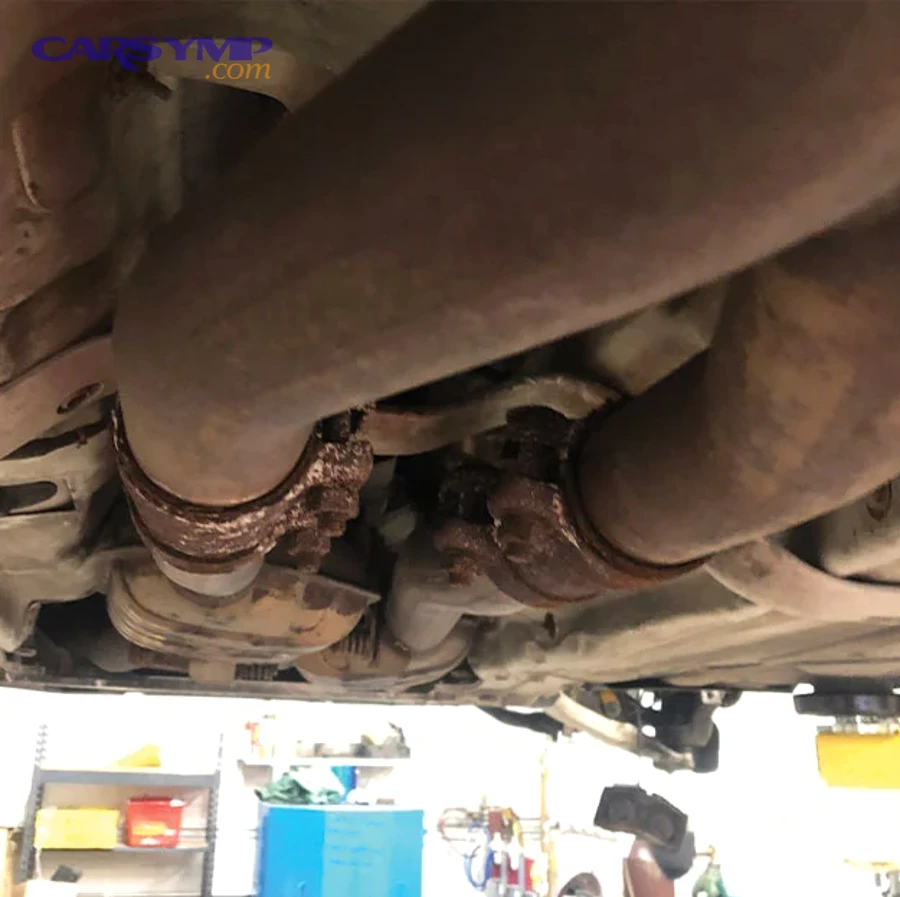
Next, the goal is to turn the most common “maybe” clues into a high-confidence diagnosis.
Can you use the “soot trail” method to locate a leak accurately?
Yes, you can use the soot trail method to locate a leak, because (1) exhaust deposits carbon residue where it escapes, (2) the residue often forms a directional streak, and (3) the pattern concentrates around the leak source more than surrounding areas.
However, it works best with a clean starting point. Here’s the practical way to apply it:
- Wipe the suspect area (cool exhaust only):
- Use a rag to remove loose soot and dirt. You don’t need perfection—just a clearer surface.
- Drive briefly, then re-check:
- After a short drive, look for a fresh soot mark reappearing.
- Follow the trail “upstream”:
- The darkest, tightest soot ring usually sits closest to the actual leak opening.
- Know the limitations:
- Leaks that only appear under load may not show strong soot at idle.
- Heavy road grime can hide early soot patterns.
- A leak near the tailpipe can be less sooty than a leak near a joint.
The biggest benefit is that soot trails are mechanical evidence. They reduce guesswork and help you avoid replacing the wrong part.
What simple tests can help pinpoint the leak at the muffler vs at a joint or clamp?
A muffler-body leak is easiest to confirm with visual hole/seam evidence, while a joint/clamp leak is best confirmed by localized puffing at the connection and soot at the joint edge, and a rattle issue is best confirmed by metallic vibration clues.
Meanwhile, here are simple, safer “no-special-tools” tests you can use outdoors:
Test 1: Directional sound sweep (engine running outdoors)
- Stand near the side of the car (not behind the tailpipe).
- Listen along the exhaust path.
- The loudest, most “blowing” point is often near the leak.
Test 2: Visual pulse check (from a safe distance)
- Look for rhythmic movement of dust or a faint “puff” near a seam or joint.
- Joint leaks often appear like a small exhaust “breath” at the connection.
Test 3: Joint edge inspection
- Clamp leaks often leave a soot crescent where gas escapes around the clamp edge.
- Muffler seam leaks often leave soot on the seam line itself.
Test 4: Rattle differentiation (engine off)
- Gently tap the heat shield and hanger areas.
- If you can reproduce the sound without engine pressure, it may be a shield/hanger issue rather than a leak.
If you do only one thing, make it this: don’t treat loudness as location. Exhaust sound bounces under the car. Evidence (soot, holes, seam gaps) is more reliable than volume alone.
When is it safer or cheaper to replace the muffler instead of patching it?
Replacing the muffler is usually safer and cheaper over time when rust has thinned the metal widely, while patching can make sense only when the leak is small, isolated, and surrounded by solid metal—because patches need strong material to adhere to and resist heat cycles.
To better understand the tradeoff, you need to think about durability, not just today’s noise.
Here’s a quick comparison table to help you decide. This table summarizes when a temporary patch might hold versus when the muffler is too far gone and replacement is the more reliable option.
| Condition you see | Patch likely outcome | Replacement likely outcome |
|---|---|---|
| One small pinhole with solid surrounding metal | Short-term improvement possible | Full reliability restored |
| Flaky, thin, crumbling metal across the shell | Patch often fails quickly | Eliminates repeated leaks |
| Seam split or seam rot along an edge | Patch rarely holds | Correct, long-lasting fix |
| Multiple holes in different areas | Chasing leaks | One-and-done repair |
| Hanger weld cracking + rust | Patch doesn’t address stress | Restores support integrity |
When you start thinking in these “conditions,” your decision becomes much clearer—and your repair becomes more predictable.
Is a muffler patch or exhaust tape a real fix for rust holes?
Yes, a muffler patch or exhaust tape can be a real fix in limited cases, because (1) it can seal a small leak temporarily, (2) it can reduce noise quickly, and (3) it can buy time until a proper repair—especially if the surrounding metal is still strong.
However, the important caveat is heat and metal quality. Exhaust components expand and contract constantly. A patch that grips thin, rotten metal is like a bandage on crumbling drywall—it looks fine until vibration and heat cycles pull it loose.
A realistic expectation is this:
- Best-case patch scenario: small isolated hole, solid metal, minimal stress area.
- Worst-case patch scenario: seam rot, large perforation, multiple thin spots, or bracket stress nearby.
If you rely on a patch, treat it as a temporary strategy, not a permanent solution. For many drivers, the more stable long-term plan is muffler replacement, because it stops the cycle of patching one hole while another forms nearby.
What conditions indicate “replace now” rather than repair?
There are 7 conditions that indicate “replace now”: large holes, crumbling metal, seam separation, multiple perforations, severe joint distortion, broken hangers/isolators causing sag, and fumes entering the cabin, based on safety risk and low repair durability.
More specifically, replace now if you see any of the following:
- A hole you can clearly see through (not just a pinhole)
- Metal that flakes off in chunks when touched lightly (cool system only)
- A seam that has split open or looks like it’s peeling
- More than one leak point on the same muffler can
- A sagging exhaust because hangers or isolators have failed
- A joint that no longer clamps evenly because the pipe has rotted or deformed
- Any cabin fume symptom (safety overrides cost considerations)
This is also the point where budgeting helps. If you’re comparing options, ask a shop (or a mobile mechanic) for a Muffler replacement cost estimate so you can weigh “one replacement” against “multiple patch attempts + extra labor.”
Also consider legality and inspection: some jurisdictions enforce noise standards or prohibit modifications that bypass proper muffling. If you’re considering an aftermarket solution, you’ll want to understand Aftermarket muffler sound level legality before you spend money—because “louder” is not always “legal,” and compliance varies by location. (worldpopulationreview.com)
What safety signs mean you should stop driving and get the exhaust checked immediately?
There are 5 safety signs that mean you should stop driving and get the exhaust checked immediately: exhaust smell in the cabin, headache/dizziness/nausea, visible smoke from underbody, sudden extreme noise change, or a dragging/sagging exhaust, because these can signal carbon monoxide exposure risk or a component about to detach.

More importantly, these signs are not “wait until the weekend” problems. They’re “act now” problems.
Do exhaust fumes inside the cabin mean an emergency?
Yes—exhaust fumes inside the cabin can be an emergency, because (1) carbon monoxide can build up without obvious warning, (2) symptoms can begin as mild headache or dizziness and worsen quickly, and (3) the source may be a leak positioned where airflow pulls gases into the cabin.
In addition, the CDC specifically notes that even a small exhaust leak can allow carbon monoxide to build up inside a car. (cdc.gov)
If you notice fumes inside the cabin, do this immediately:
- Open windows to increase fresh air.
- Turn off recirculation (fresh-air mode can reduce concentrated cabin air).
- Do not idle the vehicle “to see if it goes away.”
- Pull over safely and arrange inspection or towing if symptoms persist.
A key point: your nose is not a carbon monoxide detector. CO can be present without a strong smell. That’s why cabin symptoms are treated as urgent even when the odor seems faint.
What are the top “urgent” leak scenarios (location + symptom combinations)?
There are 6 urgent leak scenarios based on a dangerous pairing of location and symptoms: cabin fumes, underbody smoke near the floor, extreme noise change plus vibration, dragging exhaust, leak near a damaged joint, and a leak that worsens dramatically under acceleration.
Below are the highest-risk combinations:
- Cabin smell + headache/dizziness
- Treat as urgent exposure risk.
- Underbody smoke or burning smell
- Heat near underbody materials can create fire risk in severe cases.
- Sudden loud roar + strong vibration
- Can signal seam split or partial separation.
- Dragging exhaust pipe or muffler hanging low
- Risk of road strike, detachment, and secondary damage.
- Leak at a joint with visible soot and a loose clamp
- Joint may separate; repair is usually straightforward but should be prompt.
- Leak that “sounds normal” at idle but gets violent under load
- Often indicates a crack that opens with pressure; it can progress quickly.
If you hit any of these, treat the car as “needs inspection now,” not “keep driving until it fails.” That mindset prevents roadside breakdowns and reduces the chance you’ll damage other parts of the exhaust system.
Evidence: According to guidance from the CDC on carbon monoxide safety, a small leak in a vehicle exhaust system can allow CO to build up inside the car. (cdc.gov)
What related factors can change leak diagnosis and long-term rust outcomes?
There are 4 related factors that change leak diagnosis and long-term rust outcomes: the type of joints used, the condition of hangers and heat shields, the vehicle’s exposure to salt/condensation, and whether professional smoke/pressure testing is needed, because each factor changes how symptoms appear and how quickly corrosion progresses.

Next, these “micro” details help you avoid false conclusions—like replacing a muffler when the real issue is a clamp joint, or chasing a leak when the sound is a loose shield.
How do clamp joints, flanges/gaskets, and welds change where leaks form?
Clamp joints tend to leak at the slip fit edge, flanges/gaskets leak at the mating surface, and welds leak at cracks or pinholes—so the “best place to look” depends on which connection your system uses.
However, here’s the practical way to use that knowledge:
- Clamped slip joints:
- Look for soot crescents near the clamp line.
- Check for uneven clamp pressure or a missing bolt.
- Flange + gasket joints:
- Look for soot around the flange perimeter.
- Listen for puffing near the gasket plane.
- Welded connections:
- Look for hairline cracks at the heat-affected zone.
- Cracks may open more under acceleration.
This matters because joint leaks can mimic muffler leaks in sound, but the fix can be very different—and often simpler.
Why do broken hangers or heat shields sometimes mimic a leak?
Broken hangers or heat shields mimic a leak because they produce metallic buzzing, rattling, or resonance at specific RPM, even when no exhaust gas is escaping.
Besides, a sagging hanger doesn’t just create noise—it can cause leaks by pulling joints out of alignment. If your muffler looks rusted and you also see a stretched rubber isolator, you may be dealing with a combined problem: noise from movement + leak from joint stress.
A quick differentiation method is: if you can reproduce the noise by tapping a shield (engine off), it’s likely not a leak. If the noise only appears when exhaust pressure is present, it may be a leak.
How do road salt, short trips, and condensation accelerate muffler rust?
Road salt, short trips, and condensation accelerate muffler rust by keeping moisture and corrosive chemicals on metal surfaces and inside the muffler, which speeds up corrosion reactions and thins metal faster.
More specifically:
- Short trips often mean the exhaust doesn’t stay hot long enough to fully evaporate internal moisture. That moisture sits inside the muffler.
- Road salt increases the conductivity of water and accelerates corrosion on underbody metal. (psu.edu)
- Parking after salted driving can trap salty slush on the exhaust as it warms and dries into a corrosive film.
This is where your long-term strategy matters. Preventing exhaust rust and corrosion isn’t about one product—it’s about consistent habits:
- Rinse the undercarriage after heavy salt exposure when practical.
- Avoid frequent “cold start, short drive, park” routines when possible (combine errands).
- Fix small leaks early so moisture doesn’t enter and stagnate in new places.
Evidence: According to a study by Jagielska-Wiaderek and Golański published in Diagnostyka in 2024, materials used in car exhaust systems show increased corrosion challenges in a road-salt environment, reinforcing why salt exposure accelerates exhaust component degradation. (researchgate.net)
When is a professional smoke/pressure test worth it for a “mystery leak”?
Yes, a professional smoke/pressure test is worth it for a mystery leak when (1) symptoms are strong but visual evidence is unclear, (2) multiple joints could be leaking, and (3) you need a precise leak location to avoid replacing the wrong part.
Especially, smoke or pressure testing helps when leaks only appear under load, or when the exhaust path is complex and sound reflection makes location confusing. It’s also useful when you’re weighing cost—because a correct diagnosis reduces repeat visits and prevents buying parts you don’t need.
If you’re already considering an upgrade, this is also a good time to ask about compliance. Some aftermarket setups can be louder than expected, and regulations vary by area—so it’s smart to confirm Aftermarket muffler sound level legality before committing to a part that could create inspection or noise issues. (worldpopulationreview.com)
Evidence (summary of the most important safety and corrosion points)

- The CDC warns that a small exhaust leak can lead to carbon monoxide buildup inside a car, supporting the urgency of cabin-fume symptoms. (cdc.gov)
- Penn State’s engineering guidance explains that road salt accelerates corrosion reactions, supporting why salt exposure worsens exhaust rust. (psu.edu)
- A 2024 paper in Diagnostyka discusses corrosion of materials used for car exhaust systems in a road salt environment, supporting the link between salt exposure and exhaust degradation. (researchgate.net)