


Toe, camber, and caster are the three core wheel alignment angles that explain how your wheels point, tilt, and steer. Together, they shape how a car tracks on the road, how quickly tires wear, and how stable the steering feels at highway speed. To begin, the simplest way to understand them is this: toe is the direction the tires point, camber is the visible tilt of the tires, and caster is the steering-axis tilt that affects stability and return-to-center.
These three angles are not the same, even though many drivers hear them together during a wheel alignment service. Specifically, each angle influences a different part of vehicle behavior. Toe often has the fastest effect on tire scrub and steering wheel position, camber changes how the tire contacts the road, and caster changes steering feel more than tire shape or visible lean.
Drivers usually search this topic because they want more than definitions. More specifically, they want to know why a car pulls, why the steering wheel sits off-center, why one shoulder of a tire wears faster, and When to align after suspension or tire work. That practical side matters because alignment is not just geometry on a printout; it is something you can feel every time you drive.
A beginner also needs context around real-world symptoms, service timing, and cost. Introduce a new idea: once you understand what each angle means, it becomes much easier to spot problems early, discuss repair recommendations confidently, and understand an Alignment cost estimate and what’s included in a typical shop visit.
What Do Toe, Camber, and Caster Mean on a Car?
Toe, camber, and caster are three wheel alignment angles that describe where a wheel points, how it tilts, and how the steering axis leans. To better understand these terms, picture the same front wheel from three different viewpoints: above, front, and side.
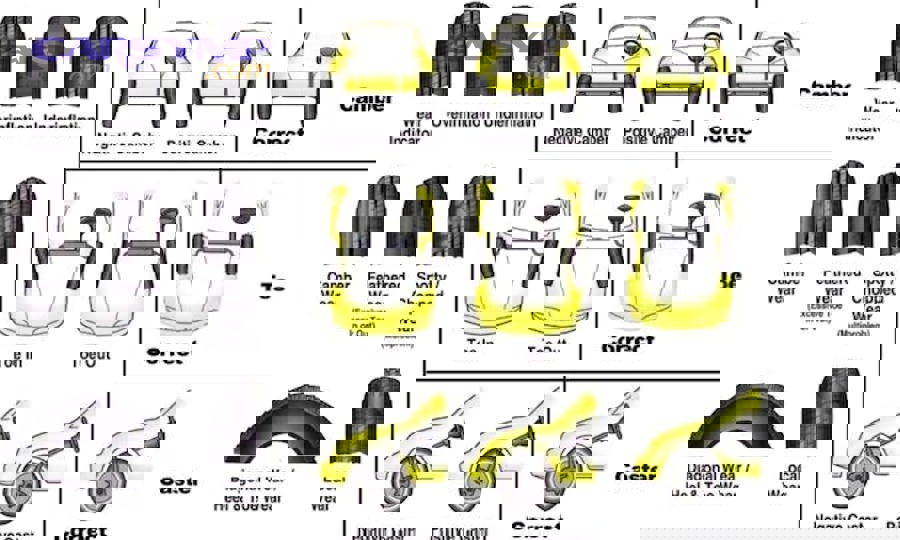
That visual approach removes most of the confusion. When you look from above, you are thinking about toe. When you look from the front, you are thinking about camber. When you look from the side, you are thinking about caster. These three views create the foundation for almost every alignment discussion a car owner will have.
What Is Toe in Wheel Alignment?
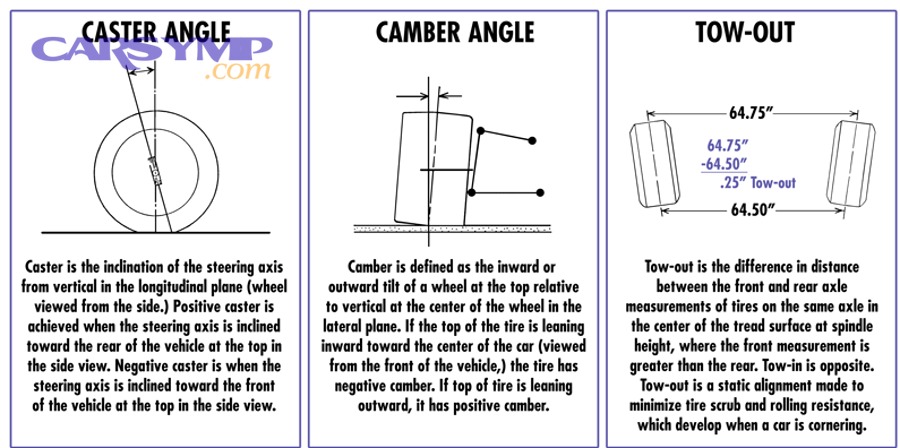
Toe is the angle that shows whether the front edges of the tires point slightly inward or outward when viewed from above. Specifically, toe tells you if the tires are aiming toward each other or away from each other as the vehicle rolls forward.
If the fronts of the tires point toward each other, that is called toe-in. If they point away from each other, that is toe-out. The amount may be very small on the alignment rack, but even a small toe error can produce fast tire wear because the tires scrub across the road instead of rolling straight.
Toe matters because it directly affects straight-line tracking, steering response, and tire life. A car with too much toe error may wander, feel nervous, or wear tread in a feathered pattern. In daily driving, toe is often the first angle to notice because it quickly shows up in how the steering wheel sits and how the car follows the road.
A simple mental picture helps here. Imagine your shoes while walking. If your feet point too far inward or outward, each step feels less natural. Wheel alignment works in a similar way. When the tires do not point correctly, the car spends energy correcting itself instead of rolling smoothly.
What Is Camber in Wheel Alignment?
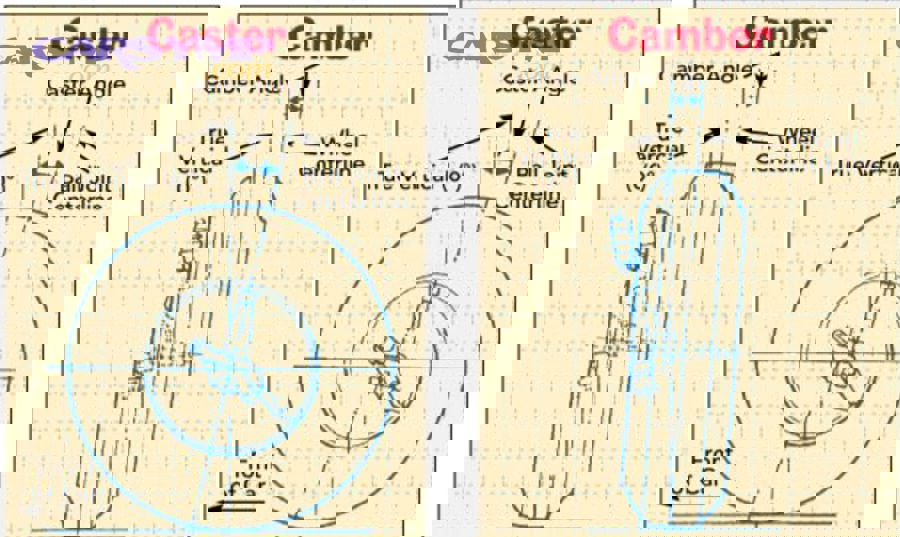
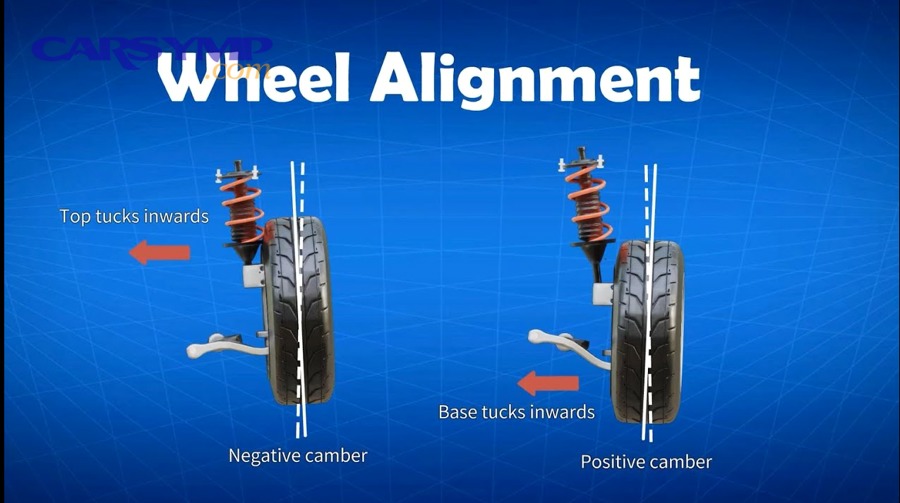
Camber is the angle that shows whether the top of the tire leans inward or outward when viewed from the front of the vehicle. For example, if the top of the tire leans toward the center of the car, that is negative camber; if it leans away, that is positive camber.
Camber changes the tire’s contact patch with the road. That matters because the tire can only grip and wear properly when the tread meets the pavement in the right way. Too much negative camber often loads the inner shoulder of the tire more heavily, while too much positive camber can do the opposite.
In moderate amounts, camber can improve cornering behavior because the tire stays better planted during body roll. That is one reason some performance cars use more negative camber than a typical commuter vehicle. However, a daily driver needs balance, not an aggressive race setup. Excess camber on a street car can shorten tire life and reduce braking or straight-line comfort.
Many people notice camber because it is easier to see than caster. If one wheel appears visibly leaned in or out, camber is often the first suspect. Still, visible lean does not always mean the alignment is adjustable in a simple way. Sometimes bent parts, worn bushings, or ride-height changes influence what you see.
What Is Caster in Wheel Alignment?
Caster is the angle of the steering axis when viewed from the side, and it mainly affects stability, steering effort, and return-to-center. More specifically, caster describes how the line through the steering pivot leans forward or backward relative to vertical.
Caster is harder to picture because you cannot usually see the steering axis directly. A good everyday analogy is the front wheels on a shopping cart. The pivot sits ahead of the wheel contact point, so the wheel naturally trails behind and straightens itself as it rolls. That trailing effect is similar to positive caster in a road car.
Positive caster usually improves straight-line stability and helps the steering wheel return toward center after a turn. Too little caster can make the vehicle feel light, vague, or less stable at speed. A side-to-side caster difference can also contribute to a pull.
Unlike toe and camber, caster usually does not create a dramatic tire wear pattern by itself. Instead, drivers feel it through steering behavior. That is why many alignment explanations say toe and camber show up on the tires, while caster shows up in the steering feel.
According to engineering research commonly used in vehicle dynamics education, steering-axis geometry strongly influences self-centering behavior and straight-line stability, which is why caster remains a core alignment angle even when drivers rarely see it directly.
Are Toe, Camber, and Caster the Same Thing?
No, toe, camber, and caster are not the same thing because each angle controls a different part of wheel alignment behavior. However, they work together, so a beginner often hears them as one package during a wheel alignment discussion.
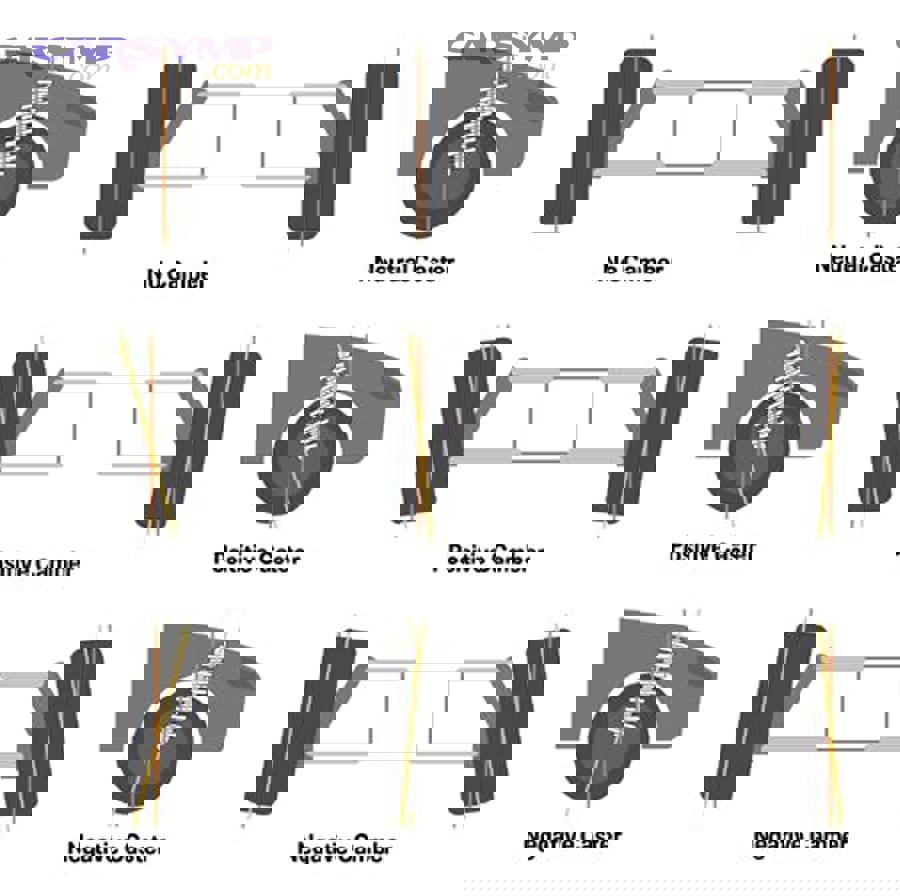
That combined language can be misleading. A service advisor may say your alignment is off, but the actual problem could be mostly toe, mostly camber, or a cross-caster issue. Understanding the difference helps you read the printout and ask better questions about what really changed.
How Is Toe Different From Camber?
Toe controls the direction the tires point, while camber controls the inward or outward tilt of the tire. More specifically, toe is viewed from above and camber is viewed from the front.
This difference matters because the symptoms differ. Toe errors often create feathered tread wear, unstable tracking, and an off-center steering wheel. Camber errors more often create inside-edge or outside-edge wear because one shoulder of the tire carries more load.
Toe can ruin tires surprisingly fast because it creates rolling friction across the tread face. Camber usually wears one side of the tire more gradually, although a severe camber problem can still become expensive quickly. In short, toe changes where the tire aims; camber changes how the tire sits on the road.
Another difference is visibility. Many drivers can spot extreme camber by standing in front of the car. Toe is not as easy to see with the naked eye unless it is severe. That is why a car can look normal in the driveway but still need alignment because toe is out of specification.
How Is Caster Different From Toe and Camber?
Caster mainly affects steering feel and straight-line stability, while toe and camber more directly affect tire orientation and tread wear. Meanwhile, caster is viewed from the side through the steering axis, not through the wheel face itself.
This makes caster the least intuitive of the three. Toe is easy to imagine as pointing inward or outward. Camber is easy to imagine as leaning inward or outward. Caster requires you to think about the invisible line around which the wheel turns.
That invisible geometry has practical results. More positive caster often improves highway stability and return-to-center. Less caster can make steering feel lighter but less settled. Unequal caster from left to right may encourage a drift or pull, especially when combined with road crown and tire variation.
Caster also differs in adjustability. On many modern vehicles, toe is easily adjustable, camber may or may not be adjustable from the factory, and caster is sometimes fixed unless special hardware or repair procedures are used. That is why an alignment printout may show caster out of range even when the shop is not able to adjust it directly without additional parts.
How Do Toe, Camber, and Caster Affect Driving and Tire Wear?
Toe, camber, and caster affect driving by changing tracking, steering feel, stability, and the way the tire touches the road. Specifically, toe influences tire scrub, camber influences contact patch shape, and caster influences steering self-centering and directional confidence.
Those effects are not theoretical. You feel them as soon as the car leaves the alignment rack or as soon as something shifts after a pothole impact, curb strike, suspension repair, or ride-height change. Even new tires can feel wrong if the angles beneath them are not correct.
Can Bad Toe, Camber, or Caster Cause Uneven Tire Wear?
Yes, bad toe, camber, or caster settings can contribute to uneven tire wear, though toe and camber are usually the main causes. Specifically, toe scrubs tread across the pavement, camber overloads one shoulder, and caster usually affects wear indirectly through handling balance.
Toe wear often appears as feathering across the tread blocks. If you slide your hand across the tread and it feels sharp in one direction and smoother in the other, excessive toe may be involved. This type of wear can develop faster than many drivers expect because the tire is being dragged slightly sideways as it rolls.
Camber wear usually appears on the inner or outer edge. Too much negative camber commonly eats the inner shoulder, while too much positive camber can wear the outer shoulder. The exact pattern also depends on tire pressure, driving style, suspension condition, and rotation habits.
Caster alone is less likely to create a clear edge-wear pattern. Even so, caster problems can still matter because they influence how the car tracks and how the driver corrects the wheel over time. Indirectly, that can change loading and contribute to irregular wear when combined with other issues.
This is why alignment should never be judged from one clue alone. Tire wear patterns, steering feel, recent repairs, and a proper alignment reading all belong in the same diagnosis. That is also why shops often recommend alignment immediately after installing new tires; fresh tires can hide old wear patterns, but they cannot fix the geometry that caused them.
Can These Angles Cause Pulling, Wandering, or Poor Steering Feel?
Yes, incorrect toe, camber, or caster can cause pulling, wandering, and poor steering feel because they change how the tires follow the road and how the steering system recenters itself. More importantly, different angles create different kinds of complaints.
A toe problem often feels like nervous tracking or a steering wheel that is not centered. The vehicle may not hold a clean line and may seem to dart slightly with lane grooves or pavement changes. Camber differences side to side can contribute to a pull because one tire carries the load differently than the other. Caster differences can also encourage pull and can make the steering feel uneven from left to right.
Road crown complicates this picture. Many roads slope slightly for drainage, so even a perfectly aligned car may drift gently right on some surfaces. Tire conicity can also mimic alignment pull. That means a real diagnosis should separate normal road influence from true alignment error.
Poor steering feel may show up as delayed response, weak return-to-center, heaviness, lightness, or a vague on-center sensation. Because those symptoms overlap with worn suspension parts, tire defects, and low tire pressure, alignment should be checked as part of a broader inspection rather than as the only possible cause.
One practical rule helps car owners: if the car recently had suspension work, steering work, ride-height changes, or new tires installed, alignment becomes a more likely reason for fresh handling complaints. That is also the right time to ask about when to align after suspension or tire work rather than waiting for abnormal wear to appear.
Which Alignment Problems Do Car Owners Notice Most Often?
There are three common groups of alignment complaints that car owners notice most often: tire wear symptoms, tracking symptoms, and steering feel symptoms. To better understand them, it helps to connect each complaint to the angle most likely involved.
This symptom-first approach is useful because drivers rarely search for alignment by angle at first. They usually search for the effect: the car pulls, the tire wears on one edge, the steering wheel is crooked, or the vehicle feels unstable on the highway.
What Symptoms Usually Point to a Toe Problem?
Toe problems usually show up as feathered tread wear, unstable straight-line tracking, and a steering wheel that sits off-center. Specifically, toe changes the rolling direction of the tires, so the car often feels wrong even before the wear becomes obvious.
When toe is out, the car may need frequent small corrections to stay in its lane. Some drivers describe this as wandering or dartiness. Others notice that the vehicle feels fine at low speed but unsettled on the highway. A steering wheel that remains slightly turned while driving straight is another common clue, especially after steering or suspension work.
Toe errors can come from impact damage, worn tie-rod components, settling after parts replacement, or adjustment drift over time. Because toe is the most commonly adjusted angle on many vehicles, it is also the angle most often corrected during routine alignment service.
What Symptoms Usually Point to a Camber Problem?
Camber problems usually show up as inside-edge or outside-edge tire wear and, in severe cases, a visible lean of the wheel. In addition, camber can affect braking confidence and cornering balance because it changes how much tread sits flat on the road.
A vehicle with too much negative camber may wear the inside shoulder of the tire while the rest of the tread still looks acceptable. This can mislead owners into thinking the tire has life left, even though the inner edge is already compromised. Too much positive camber tends to wear the outer shoulder more.
Camber changes often follow suspension damage, lowered ride height, sagging springs, worn joints, or parts installed without a final alignment. This is one reason the answer to when to align after suspension or tire work is usually simple: align as soon as the parts are installed and settled according to manufacturer guidance, because geometry changes immediately once the suspension position changes.
What Symptoms Usually Point to a Caster Problem?
Caster problems usually show up as poor straight-line stability, weak return-to-center, or a side-to-side steering feel difference. However, caster is less likely to create an obvious visual clue or tire wear pattern than toe or camber.
A car with insufficient positive caster may feel light or vague on-center. The steering wheel may not return naturally after a turn, and highway driving may require more attention. If caster differs from left to right, the car may drift toward the side with the lower positive caster, though road crown and tires can influence that feeling too.
Caster issues may result from bent suspension parts, shifted subframes, worn bushings, or incorrect repair setup after front-end work. Because the average driver cannot see caster, a professional alignment check becomes especially valuable when the steering feels wrong but the tires do not yet show a clear wear pattern.
How Can You Understand Toe, Camber, and Caster Without Technical Jargon?
The easiest way to understand toe, camber, and caster without technical jargon is to link each one to a viewing angle and a driving effect. Specifically, toe is viewed from above and affects direction, camber is viewed from the front and affects tire tilt, and caster is viewed from the side and affects stability.
That simple pattern gives beginners a mental map they can reuse anytime they read an alignment printout or hear a shop recommendation. Instead of memorizing numbers first, start with what the angle changes in real driving.
What Is the Easiest Way to Picture These Three Angles?
The easiest way to picture the three angles is to imagine looking at the same front wheel from above, from the front, and from the side. For example, above equals toe, front equals camber, and side equals caster.
This visual sequence works because each angle answers a different question. Is the wheel pointing inward or outward? That is toe. Is the wheel leaning inward or outward? That is camber. Does the steering axis lean backward or forward? That is caster.
A short memory aid can help:
- Toe = point
- Camber = lean
- Caster = steer axis tilt
These simple labels are useful for beginners because they reduce the chance of mixing up tilt with pointing. Once that confusion disappears, most alignment conversations become much easier to follow.
Which of the Three Angles Matters Most for Everyday Drivers?
All three angles matter, but toe and camber are often the most noticeable for everyday drivers, while caster is especially important for steering feel and highway stability. In short, toe and camber usually show up on the tires, and caster usually shows up in the steering.
For a daily-driven vehicle, toe often deserves the most immediate attention because it can wear tires quickly and make the car feel unsettled. Camber matters next because it controls shoulder wear and cornering contact. Caster matters because it makes the car feel planted and helps the steering wheel return properly after turns.
That does not mean one angle can replace another. A good wheel alignment works as a system. The right toe setting cannot fully compensate for a bent part that changed camber. A stable caster reading cannot rescue tires that are being scrubbed by incorrect toe. Shops therefore measure all the key angles together, even when only one angle is clearly out.
When drivers ask about alignment cost estimate and what’s included, this systems view explains the answer. A proper alignment service usually includes measuring current angles, comparing them to factory specifications, adjusting available settings, centering the steering wheel, and providing a before-and-after printout. The exact price depends on vehicle type, whether it is a two-wheel or four-wheel procedure, and whether frozen hardware or damaged parts prevent adjustment.
What Other Alignment Terms Should Beginners Know After Learning Toe, Camber, and Caster?
After learning toe, camber, and caster, beginners should also know sign directions, cross-angle terms, thrust angle, and the difference between daily-driving and performance settings. In addition, these terms help you understand what an alignment printout actually means.
This supplementary knowledge expands the topic without changing the core lesson. Once the basics are clear, these extra terms make service recommendations and shop explanations much easier to follow.
What Is the Difference Between Positive and Negative Camber, Positive and Negative Caster, and Toe-In and Toe-Out?
Positive and negative labels describe the direction of the angle, while toe-in and toe-out describe whether the front edges of the tires point toward or away from each other. Specifically, these labels tell you not only which angle is involved, but which way it has moved.
Negative camber means the top of the tire leans inward. Positive camber means it leans outward. Positive caster usually means the steering axis tilts rearward at the top and generally supports stability and return-to-center. Toe-in means the fronts of the tires point toward each other, while toe-out means they point away.
These terms matter because an alignment printout is just numbers unless you know the direction behind the number. A car owner who understands positive, negative, in, and out can make far more sense of what changed during service.
What Are Cross-Camber and Cross-Caster?
Cross-camber and cross-caster are side-to-side differences between the left and right wheel alignment angles. More specifically, they matter because a vehicle can technically have acceptable individual readings yet still drift if the left-right balance is off.
A small amount of cross-angle difference may be used intentionally by manufacturers to account for road crown or steering feel targets. However, too much difference can create a noticeable pull. For example, a car may drift even when total camber or caster values look close to normal because the left side and right side do not match closely enough.
This is one reason alignment diagnosis is not only about whether each single number is red or green on the printout. The relationship between left and right often matters just as much as the absolute value.
What Is Thrust Angle, and Why Can Rear Alignment Affect Front Steering Feel?
Thrust angle is the direction the rear wheels push the vehicle relative to the centerline, and it can affect how straight the vehicle travels. More importantly, rear alignment can make the steering wheel look crooked even when the front toe is adjusted.
If the rear axle points slightly to one side, the car may travel down the road at a slight angle while the driver holds the steering wheel off-center to compensate. This creates a “dog tracking” sensation or at least a mismatch between body direction and steering wheel position. That is why many modern shops recommend four-wheel alignment even when the complaint seems to come from the front.
Rear toe and rear camber therefore matter more than many drivers realize. A proper wheel alignment is about the vehicle’s total path, not just the front tires in isolation.
How Are Alignment Settings Different for Daily Driving and Performance Use?
Daily-driving and performance alignment settings differ because they optimize different goals: comfort and tire life for the street, and cornering grip and response for performance. Meanwhile, factory settings usually aim for balance, predictable behavior, and practical tire wear.
A performance setup may use more negative camber to keep the outside tire flatter during cornering. It may also use toe choices that sharpen turn-in response. Those same settings can reduce tire life and make a street car more sensitive to road surfaces. A daily-driving setup usually keeps tread wear, braking stability, and long-term comfort at the center of the decision.
This is why copying a race-inspired specification onto a commuter vehicle often disappoints owners. The best alignment is not the most aggressive one. It is the one that matches the vehicle’s real use, tire type, suspension condition, and driver priorities.
As a final practical note, when to align after suspension or tire work depends on the kind of work performed, but the safe rule is to align after any job that changes steering geometry, ride height, control arm position, tie-rod length, strut position, subframe position, or tire installation that follows uneven previous wear. And when you ask for an alignment cost estimate and what’s included, make sure the shop explains whether the quote covers inspection, adjustment of all available angles, a steering wheel centering procedure, and the before-and-after measurements that confirm the result.
In sum, toe, camber, and caster are not mysterious once you reduce them to their simplest meanings. Toe points, camber leans, and caster stabilizes. Once you understand that sequence, you can connect wheel alignment symptoms to the right angle, ask smarter questions after repairs, and protect both tire life and driving confidence.