


Metal debris and fluid condition clues reveal hidden mechanical wear by acting as a direct window into the internal health of your engine or transmission — long before any audible symptom, dashboard warning, or catastrophic failure announces itself. When internal components begin to degrade, they shed particles into the circulating fluid, and that fluid simultaneously changes in color, smell, and texture. Together, these two signals form a diagnostic language that trained technicians — and informed vehicle owners — can learn to read with accuracy.
The type, size, color, and shape of debris found in your fluid each point to a specific component under stress. Fine metallic powder coating a drain plug magnet tells a very different story than sharp silver shavings or large bronze-colored flakes resting at the bottom of a transmission pan. Recognizing these distinctions early is the difference between a routine fluid change and a complete transmission rebuild, and in some cases, it is also the difference between Preventing converter problems and replacing the torque converter entirely.
How you inspect and interpret fluid condition clues follows a clear, repeatable process — one that requires no specialized laboratory equipment at first pass. Visual inspection, the magnet test, a white rag wipe, and a careful check of fluid color and odor provide enough information for an initial triage. These foundational steps are accessible to anyone who performs their own maintenance or wants to hold an informed conversation with their mechanic before authorizing repairs.
Once debris is identified and its source component mapped, the next step is determining urgency and corrective action. Not every particle in your fluid pan demands an emergency shutdown, but some absolutely do. Next, this article walks you through every layer of that diagnostic process — from the first definition of what these clues are, through the identification of debris types, the inspection procedure, the component mapping, and finally the concrete maintenance response you should apply in each scenario.
What Are Metal Debris and Fluid Condition Clues?
Metal debris and fluid condition clues are observable physical and chemical indicators — particles, discoloration, odor, and texture changes — found in engine oil or transmission fluid that signal the internal mechanical state of a vehicle’s drivetrain components.
Specifically, these clues exist because every mechanical system that uses a liquid lubricant also uses that lubricant as a carrier. When internal parts wear, corrode, or fracture, the resulting particles enter the fluid stream and travel with it. At the same time, the fluid itself undergoes chemical degradation in response to heat, contamination, and extended use — changing its appearance and smell in ways that are directly linked to the severity of internal conditions. Together, particle content and fluid condition form a two-channel diagnostic system that reflects what is happening inside a sealed mechanical assembly without requiring disassembly.
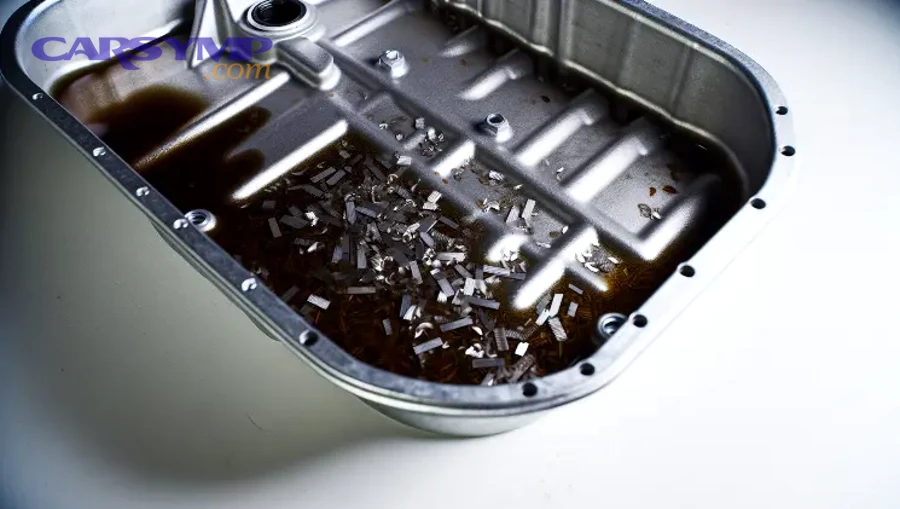
What Is the Difference Between Normal Wear Particles and Harmful Metal Debris?
Normal wear particles are microscopic metallic fragments produced by the controlled friction between moving components operating within designed tolerances, while harmful metal debris consists of larger, irregularly shaped pieces that indicate damage exceeding normal operational limits.
The key distinction lies in particle size, shape, and quantity. In a healthy transmission or engine, internal components generate a fine metallic powder as a natural byproduct of friction — this powder is typically invisible to the naked eye and appears only as a thin, gray, velvety coating on the drain plug magnet. This type of residue is expected and generally harmless, particularly in higher-mileage vehicles or after the first fluid service on a new unit.
Problematic debris, by contrast, is large enough to see, feel, and pick up with your fingers. Shavings with sharp edges, flakes larger than a grain of sand, rubber-like chunks, or any single fragment bigger than a pencil tip all indicate that a component has moved beyond normal wear into active structural failure. The following table summarizes the threshold between acceptable and alarming findings:
| Debris Characteristic | Normal (Monitor) | Concerning (Service Soon) | Critical (Stop Driving) |
|---|---|---|---|
| Particle Size | Powder / dust | Fine flakes (visible) | Chunks / shavings |
| Texture | Soft, velvety | Gritty | Sharp-edged |
| Quantity on magnet | Light coating | Moderate buildup | Heavy accumulation |
| Fluid appearance | Clear to slightly tinted | Darkening | Dark, murky, or milky |
The table above maps observable debris characteristics to urgency tiers, providing a quick reference for deciding whether to monitor, schedule service, or stop operating the vehicle immediately.
What Do Different Fluid Colors and Smells Indicate About Mechanical Health?
Fluid color and odor are the most immediate and accessible fluid condition clues available, and each change in appearance or smell maps to a specific category of internal problem.
Healthy automatic transmission fluid (ATF) is typically a clear, bright red or pink, with a slightly sweet, neutral odor. Engine oil in good condition ranges from amber to light brown, depending on the base stock and additive package. Deviations from these baselines carry meaningful diagnostic information:
- Clear to bright red/amber — Fluid is in good condition; no immediate concern
- Brown or murky — Fluid has oxidized or is contaminated with debris or water; indicates the fluid is overdue for a change and the system should be inspected
- Dark brown to black — Fluid has experienced significant heat breakdown; the transmission may be slipping internally, overheating, or operating with a failing cooler
- Milky or foamy — Water or coolant has entered the fluid circuit, often through a failed cooler or cracked housing; this is an urgent condition that can destroy bearings and clutch material rapidly
- Burnt smell — A sharp, acrid odor indicates that the fluid has been subjected to excessive heat, most commonly caused by clutch slippage, low fluid level, or a blocked cooling circuit
According to guidance published by Weaver Transmission Service, burnt-smelling ATF almost always accompanies internal slippage or overheating, and in such cases the fluid is actively degrading the components it was designed to protect.
What Types of Metal Debris Are Found in Fluid — and What Does Each Type Reveal?
There are four primary types of metal debris found in transmission and engine fluid: brass or gold-colored flakes, silver or gray metallic shavings, black particles or dark debris, and large metal chunks or fragments — each classified by color, composition, and the component from which it originates.
To better understand what each type signals, it helps to know that every major component inside a transmission or engine is made from a distinct alloy or material. Bushings and thrust washers use brass or bronze. Gear teeth and bearing races use hardened steel. Clutch packs use friction composite material. This material diversity means that the color and texture of debris found in the fluid pan functions as a fingerprint pointing back to its source.

What Do Brass or Gold-Colored Flakes in Fluid Indicate?
Brass or gold-colored flakes in fluid indicate wear of the thrust washers and bushings — components made from brass or bronze alloys that support rotating shafts and absorb axial loads within an automatic transmission.
These components wear gradually over time and mileage, making small quantities of gold-tinted flakes a relatively common finding during routine fluid services on higher-mileage vehicles. A light scattering of fine gold particles is not an immediate emergency, but it does signal that the bushings are past their optimal service life and that a more thorough inspection is warranted.
Larger quantities of brass flakes, or the presence of this debris alongside abnormal shifting behavior or a transmission that hesitates to engage, suggest that the bushings have worn beyond their tolerance and are allowing excessive shaft movement. This shaft play accelerates wear on adjacent components, including the torque converter, because misalignment places uneven stress on seals, thrust faces, and pump components. Catching brass debris early is one of the most effective means of preventing converter problems from developing downstream.
What Do Silver or Gray Metal Shavings in Fluid Reveal?
Silver or gray metallic shavings in fluid reveal that hardened steel components — most commonly gear teeth, bearing races, or planetary gear set members — are experiencing abnormal surface contact, chipping, or progressive fatigue failure.
The morphology of these shavings provides additional diagnostic precision. Short, hairlike magnetic strands suggest early-stage bearing fatigue, where the rolling elements or races are beginning to pit and shed fine material. Angular, flat shavings with sharp edges indicate that gear tooth surfaces are chipping or spalling — a more acute condition that can escalate rapidly under load. Larger, irregular steel fragments point to sudden fracture of a gear tooth or bearing cage, representing a critical failure state.
Because steel is ferromagnetic, a simple magnet test can confirm the presence and approximate quantity of steel debris in a fluid sample. A drain plug with a built-in magnet that is heavily coated in steel fuzz after a normal service interval is a reliable indicator that bearing or gear wear has accelerated beyond acceptable rates.
What Do Black Particles or Dark Debris in Fluid Signal?
Black particles or dark debris in fluid signal one of two conditions: the shedding of clutch friction material from worn clutch packs, or the thermal breakdown and oxidation of the fluid itself — both of which indicate a system operating under excessive heat or load.
Black fibrous or rubbery particles originate from clutch discs and band friction linings. These components are designed to wear, but the rate of material loss should be minimal under normal operating conditions. When the clutch pack slips excessively — due to low fluid level, incorrect fluid type, worn solenoids, or overloading — friction material sheds at an accelerated rate, rapidly contaminating the fluid and clogging the filter. This condition is strongly associated with a burnt fluid odor, and it is one of the clearest combined clues that the transmission is experiencing internal slippage.
Black rubber-like chunks or fragments indicate seal or O-ring degradation, often caused by fluid that has lost its additive package and is attacking elastomers. Fine black soot suspended throughout the fluid, without visible particles, typically indicates that the fluid itself has oxidized from sustained overheating — a condition that both degrades lubrication quality and accelerates wear on every component the fluid contacts.
What Do Large Metal Chunks or Fragments in Fluid Mean?
Yes — finding large metal chunks or fragments in fluid is a serious mechanical emergency that requires the vehicle to be taken out of service immediately, because it indicates catastrophic internal component failure.
Large fragments — pieces large enough to be picked up with fingers, resembling broken pencil tips, gear teeth, or irregular shards — originate from sudden structural failures: a torque converter impeller blade breaking free, a planetary gear carrier fracturing, a bearing cage collapsing, or a ring gear tooth shearing completely. Unlike gradual wear, which produces progressively larger particles over time, sudden fractures deposit high volumes of large debris into the fluid circuit simultaneously.
The danger of continued operation is compounding damage. Large metal fragments circulate with the fluid, are carried into the valve body, oil passages, and pump, where they score precision-machined surfaces, jam check valves, and block fluid galleries. torque converter problems are a common downstream consequence of this type of debris migration, as fragments lodged in the pump or converter inlet can destroy seals and impeller fins within minutes of continued operation. The question of whether you can drive with torque converter issues caused by large debris contamination has a definitive answer: no, because every additional mile of operation under these conditions multiplies repair costs and increases the likelihood of total drivetrain loss.
How Do You Inspect Fluid and Identify Metal Debris Clues?
The most effective method for inspecting fluid and identifying metal debris clues involves a three-part process — visual fluid assessment, drain plug magnet examination, and pan inspection — which together provide a complete picture of internal mechanical condition in approximately 20 to 30 minutes.

This process requires no specialized equipment beyond basic hand tools, a clean white rag or paper towels, a flashlight, and a shallow inspection tray. The procedure is applicable to both engine oil and transmission fluid, though the drain point and pan configuration differ between the two systems.
How Do You Perform a Visual and Magnet Inspection of the Fluid Pan?
A visual and magnet inspection of the fluid pan involves four sequential steps: checking fluid color and odor on the dipstick or during drain, inspecting the drain plug magnet for debris, examining the pan bottom for particle accumulation, and performing a rag wipe test to assess particle size.
Step 1 — Fluid color and odor check: Before draining, check the fluid on the dipstick under good lighting. Note the color against a white paper towel and identify any odor. This baseline assessment immediately flags burnt, contaminated, or water-infiltrated fluid.
Step 2 — Drain plug magnet inspection: Remove the drain plug slowly and allow it to drain into a clean container. Examine the magnet on the plug with your fingers and a flashlight. A light, gray, velvety coating is normal. A thick mat of dark fuzz, discrete flakes, or any gold-colored particles warrants further investigation.
Step 3 — Pan bottom examination: Once fully drained, remove the pan and allow residual fluid to drain. Tilt the pan under a flashlight and examine the base. Normal residue is a very light, uniform metallic haze. Any visible shavings, flakes, or fragments resting on the pan floor indicate abnormal wear.
Step 4 — Rag wipe test: Wipe the pan bottom and magnet with a clean white rag. Under light, examine the smear: an even gray smear is normal; distinct metallic particles that catch light as individual reflective points indicate shavings; sharp-edged residue that scratches the rag surface confirms problematic debris.
What Symptoms Accompany Metal Debris in Fluid That Confirm a Problem?
There are four primary symptoms that accompany metal debris in fluid and confirm an active mechanical problem: ticking or tapping noises, rough idle or shuddering, slipping gears or delayed engagement, and an illuminated check engine light.
Each symptom corresponds to a specific physical mechanism caused by debris contamination or lubrication failure:
- Ticking or tapping sounds arise when metal debris partially blocks oil passages, reducing lubricant flow to bearings and valve train components. The resulting metal-to-metal contact produces rhythmic tapping that varies with engine speed.
- Rough idle or shuddering occurs when friction between inadequately lubricated components causes uneven rotational forces that manifest as vibration at idle or under low-load conditions.
- Slipping gears or delayed engagement indicate that clutch pack material contamination or debris-clogged valve body passages are preventing proper hydraulic pressure from building in the transmission’s clutch circuits.
- Check engine light can be triggered by debris-induced oil pressure drops, torque converter clutch (TCC) codes, or transmission range sensor faults — all of which may appear when fluid quality has sufficiently degraded to affect sensor readings and hydraulic pressures.
When multiple symptoms are present simultaneously alongside debris findings from the pan inspection, the diagnostic confidence for an active component failure is high, and professional evaluation should not be delayed.
What Components Are Most Likely Failing Based on the Debris and Fluid Clues Found?
Mapping debris type and fluid condition to probable failing components reveals that bearings most commonly produce fine ferrous powder, gear sets generate angular silver shavings, and clutch packs shed black fibrous material — with each pattern pointing to a distinct repair pathway.

This component-to-clue mapping works because every major rotating assembly inside a transmission or engine operates under different stress conditions, is manufactured from different materials, and fails in characteristically different ways. The following sections outline the three most diagnostically significant failure patterns in detail.
How Do You Identify Bearing Failure From Fluid Clues?
Bearing failure produces fine ferrous powder with a gray, velvety texture on the drain magnet, often accompanied by a subtle whining or rumbling noise that increases with vehicle speed and may vary when turning — because lateral load shifts weight between wheel bearings.
Ball and roller bearings fail through a process called spalling, in which the hardened surface layer of the raceway or rolling element develops micro-cracks under cyclical fatigue stress. These cracks propagate until small flakes of surface material break free and enter the fluid circuit. In early-stage bearing failure, the particles are fine enough that they appear only as an elevated magnetic residue on the drain plug. As the failure progresses, larger flakes and occasional short metallic strands appear, and the whining noise becomes more pronounced and consistent.
The challenge with bearing debris is that many frictional surfaces share the same lubricating circuit, making the specific failing bearing difficult to pinpoint from fluid analysis alone. Noise diagnosis — identifying whether the sound intensifies under cornering load, changes with speed, or appears only under specific load conditions — is typically required alongside fluid inspection to localize bearing failure accurately.
How Do You Recognize Gear or Gearset Damage Through Metal Debris Clues?
Gear or gearset damage is recognizable through angular, flat silver shavings with sharp, light-reflective edges in the fluid pan, typically accompanied by grinding, growling, or a sudden increase in operational noise under load.
Gear tooth damage occurs in two patterns. Progressive spalling produces increasingly coarser surface material as the tooth face degrades over many operating cycles, giving the mechanic warning through gradually worsening debris between service intervals. Acute fracture, in contrast, deposits a sudden large volume of angular steel fragments in a single failure event — often triggered by shock loading, aggressive shifting, or operating a worn transmission at high torque output.
In either case, gear debris is typically non-flexible and cannot be confused with clutch friction material. The particles reflect light sharply, feel rigid and gritty between the fingers, and in the case of acute fractures, may include identifiable tooth profile shapes. When gear shavings are found, it is important to also inspect the torque converter input for debris migration, as the pump and converter assembly are directly exposed to particles circulating in the main fluid circuit.
How Do You Detect Clutch Pack Wear Using Fluid Condition Clues?
Clutch pack wear is detectable through a combination of black fibrous particles in the fluid, a burnt or acrid odor, and dark-brown to black fluid discoloration — a three-clue pattern that confirms friction material is shedding at an accelerated rate due to slippage or overheating.
Clutch packs in an automatic transmission rely on a precise combination of hydraulic pressure, fluid viscosity, and friction material integrity to engage and disengage cleanly. When any of these factors falls outside specification — due to worn solenoids, low fluid level, degraded fluid viscosity, or physical clutch wear — the clutch discs begin to slip against each other under load instead of engaging cleanly. This slippage generates intense localized heat that simultaneously burns the fluid and accelerates friction material wear.
The maintenance correlation is important: clutch pack debris findings are strongly associated with missed or delayed fluid change intervals. Transmission fluid that has exceeded its service life loses viscosity modifiers and friction modifiers, reducing its ability to maintain the precise film thickness required for controlled clutch engagement. According to guidance from Traction Concepts, in extreme and endurance racing applications where thermal loads are high, transmission oil should be changed as frequently as every 20 hours of hard use to prevent accelerated clutch and gear wear from undetected debris accumulation.
What Should You Do After Finding Metal Debris or Degraded Fluid?
After finding metal debris or degraded fluid, the correct response depends on debris severity — fine powder warrants monitoring, visible shavings require prompt professional service, and large fragments or chunks demand immediate vehicle shutdown and transport to a repair facility.

The urgency hierarchy exists because the risk of continued operation scales directly with debris particle size. Fine metallic powder poses minimal immediate risk to a functioning system, whereas large fragments actively circulate through precision hydraulic passages, creating new damage with every operating cycle. The following sections provide specific decision guidance and maintenance protocols for each scenario.
Is It Safe to Keep Driving When Metal Debris Is Found in Fluid?
No — it is not safe to keep driving when significant metal debris is found in fluid, because metallic particles circulating through fluid passages score precision valve body surfaces, clog oil galleries, and accelerate component failure exponentially with each additional operating cycle.
The safety determination depends on a three-tier classification of what was found:
- Fine powder only (gray/velvety residue on magnet, no visible particles in pan): Monitor. Complete the fluid service, install a fresh filter, and re-inspect at the next scheduled interval. No immediate restriction on vehicle operation is required.
- Visible flakes or shavings (gold brass flakes, silver steel shavings, or black fibrous material clearly visible in pan): Service soon. Do not ignore. Schedule a professional inspection within the current service period and avoid high-load driving — highway towing, mountain grades, or performance driving — until the source is identified and addressed.
- Large chunks or multiple large fragments: Stop immediately. Do not drive the vehicle further. Continuing to operate with large metallic fragments in the fluid circuit can destroy the transmission, damage the torque converter beyond economic repair, and in severe cases, cause sudden drivetrain seizure. Have the vehicle towed.
The question of whether you can drive with torque converter issues depends entirely on the nature and cause of those issues. If the problem is early-stage TCC shudder with clean fluid, limited driving under specific guidance may be acceptable in the short term. If the problem involves metal debris contamination reaching the converter, operation must cease.
What Are the Recommended Maintenance Steps After Detecting Fluid Contamination or Metal Debris?
The recommended maintenance steps after detecting fluid contamination or metal debris follow a five-step protocol: fluid drain and flush, filter and pan cleaning or replacement, magnet re-inspection, refill with correct fluid specification, and a scheduled follow-up inspection.
Step 1 — Complete fluid drain: Remove the drain plug and drain fully. Do not perform a partial drain-and-fill if significant debris has been found; the goal is to remove as much contaminated fluid as possible in a single service event.
Step 2 — Filter and pan service: Remove the transmission pan or oil pan as applicable. Clean the pan thoroughly with lint-free cloths. Inspect and replace the filter or screen. On transmissions, replace the pan gasket. Examine the filter inlet for debris volume — a heavily loaded filter confirms the fluid circuit has been carrying significant particulate.
Step 3 — Magnet cleaning and re-examination: Clean the drain plug magnet completely and note what was removed. After reinstalling the pan and completing the refill, allow the vehicle to reach operating temperature, and then re-examine the magnet after a 30–60 minute drive to assess ongoing debris generation rate.
Step 4 — Correct fluid specification: Always refill with the fluid type specified by the vehicle manufacturer for that specific transmission or engine. Using an incorrect fluid — wrong viscosity grade, wrong friction modifier chemistry — can accelerate wear on clutch packs and bushings and produce debris patterns that mimic component failure in a system that would otherwise be healthy.
Step 5 — Follow-up inspection: Schedule a re-inspection at a shortened interval — typically half the normal service interval — to confirm that debris generation has stabilized at normal levels after the service. If debris is still elevated at the follow-up inspection, professional teardown and internal inspection are required. Preventing converter problems, bearing failure, and premature clutch wear is far more cost-effective than rebuilding or replacing the assembly after contamination has progressed, and consistent short-interval follow-up is the most reliable way to confirm that a debris event was isolated rather than ongoing.
What Advanced Methods Can Detect Metal Debris and Fluid Degradation Before Visible Clues Appear?
There are three primary advanced detection methods that identify metal debris and fluid degradation before visible clues appear: spectrometric oil analysis (ICP/OES), quantified ferrous debris measurement using FerroQ technology, and the blotter spot test — each operating at a different sensitivity level and application context.

These methods extend the diagnostic horizon beyond what visual inspection and magnet testing can reveal. They are particularly valuable in fleet maintenance programs, industrial machinery, aviation, and performance vehicle applications where early detection of sub-visible wear prevents catastrophic failures that would be both operationally and financially devastating. Together, they represent the advanced layer of the fluid condition diagnostic system — moving from qualitative observation to quantified, data-driven maintenance decision-making.
What Is Spectrometric Oil Analysis (ICP/OES) and How Does It Detect Wear Metals in Fluid?
Spectrometric oil analysis using ICP-OES (Inductively Coupled Plasma – Optical Emission Spectrometry) is a laboratory technique that quantifies dissolved and sub-micron wear metal concentrations in a fluid sample by exciting the sample with a plasma torch and measuring the wavelength of light emitted by each element present.
Each metallic element — iron, copper, aluminum, lead, chromium, nickel — emits light at a characteristic wavelength when excited, allowing the laboratory to simultaneously measure the concentration of multiple wear metals in parts per million (ppm) from a single small fluid sample. This capability allows fleet managers and maintenance engineers to track wear metal trends across successive oil samples, identifying when a specific metal’s concentration begins to rise above its established baseline — a signal that the corresponding component is entering an accelerated wear phase.
The critical limitation of ICP/OES is its particle size sensitivity. The technique is effective only for particles below approximately 5 to 10 microns in diameter — sub-visible, dissolved, or colloidal metal content. Larger particles, including the shavings and fragments that would be visible during a pan inspection, are not reliably quantified by spectrometric analysis alone. For this reason, ICP/OES is most valuable as an early warning system for incipient wear — detecting rising iron or copper trends before any particle is large enough to be seen, felt, or caught on a magnet.
According to analysis published by Machinery Lubrication, when only one or two screening methods are routinely deployed in a maintenance program, there is a distinct risk that an early-stage failure condition will be overlooked or dismissed as inconsequential — underlining the importance of combining spectrometric analysis with particle counting and ferrous density measurement for complete coverage.
What Is the Difference Between PQ Index and FerroQ in Ferrous Debris Measurement?
The PQ Index wins for simplicity and established industry familiarity, while FerroQ is superior for precision, quantifiability, and compliance with NIST traceability standards — making FerroQ the preferred method when maintenance decisions require defensible, data-driven documentation.
Both the PQ (Particle Quantifier) Index and FerroQ measure the concentration of ferrous particles in a fluid sample using magnetic induction principles, but they differ fundamentally in how they report results. The PQ Index produces a dimensionless relative index number — a higher number indicates more ferrous debris, but the value is not calibrated to a physical unit of mass or concentration. FerroQ, by contrast, reports results in parts per million (ppm), calibrated against NIST-traceable standards, making the output directly comparable across laboratories, instruments, and time periods.
This distinction has practical significance for condition monitoring programs. A maintenance team tracking a critical industrial gearbox or fleet transmission over hundreds of service cycles needs results expressed in consistent, comparable units to build statistically meaningful trend lines. An index that can shift based on instrument calibration drift introduces ambiguity into trend analysis, whereas ppm-based FerroQ results provide a stable, comparable baseline. POLARIS Laboratories has formally transitioned from PQ Index to FerroQ reporting for this reason, citing the need for more precise and quality-standard-compliant analysis in its fluid testing services.
How Does the Blotter Spot Test Reveal Hidden Fluid Contamination Clues?
The blotter spot test reveals hidden fluid contamination clues by using paper chromatography to separate suspended contaminants in an oil or fluid sample — producing a radial pattern on absorbent paper that visually represents the type, concentration, and mobility of contaminants that spectrometric methods and visual inspection may miss.
To perform the test, a small drop of used fluid is placed on a piece of absorbent blotter paper and allowed to diffuse outward for several hours. As the fluid migrates through the paper’s fiber matrix, different suspended particles and dissolved contaminants travel at different rates determined by their molecular weight, polarity, and particle size. The resulting pattern — concentric rings with distinct zones — is then interpreted:
- A uniform, evenly diffused spot with no distinct rings indicates fluid in relatively good condition with normally dispersed contaminants
- A dark central core surrounded by a pale outer ring indicates high soot or oxidation byproduct concentration — a sign of thermal degradation
- Irregular radial patterns with visible ring differentiation can reveal the presence of water contamination, glycol intrusion, or dispersant depletion
- Outer ring coloration changes may indicate the presence of oxidized metal compounds or spent organometallic additives
The blotter spot test is notable for its sensitivity to contaminants with low specific gravity — substances like oxides, dispersed carbon fines, resins, and microorganisms that do not separate under centrifugal force and therefore remain undetected by density-based separation methods. It requires no laboratory instrumentation, can be performed in the field with basic supplies, and provides complementary information that strengthens the overall fluid condition diagnostic picture when combined with visual inspection and magnet testing.
How Is Metal Debris Screening Different in Aviation Engines vs. Automotive Transmissions?
Aviation metal debris screening is more rigorous, more prescriptive, and carries mandatory operational consequences — including mandatory grounding — that have no direct equivalent in automotive transmission maintenance, where responses are guided by condition severity but not governed by regulatory mandate.
In automotive applications, the response to metal debris findings is condition-driven and technician-guided. Finding brass flakes prompts a conversation about inspection and monitoring. Finding steel shavings triggers a service recommendation. The decision framework is risk-based but ultimately discretionary — the vehicle owner and technician weigh debris findings against symptoms, operating history, and repair economics.
Aviation engine debris screening, as documented in Lycoming’s published maintenance guidance, operates under a fundamentally different framework. Debris is categorized by precise quantity thresholds, particle type (magnetic vs. non-magnetic), size, and shape — and each category triggers a specific, non-negotiable operational response. A small number of shiny flakes may allow return to service with a 25-hour re-inspection. Larger quantities require ground testing and hourly inspection intervals. Any chunks exceeding the size of a broken pencil point require immediate grounding and full investigation before return to service. This tiered mandatory response structure reflects the consequence difference between a failed automotive transmission — an inconvenience — and a failed aircraft engine, which is potentially fatal. The disciplined categorization and documentation standards of aviation debris analysis represent a best-practice model that commercial fleet operators and industrial maintenance programs increasingly adopt as the consequence of undetected failure in their applications rises.