


transmission leak repair costs range from $150 to over $2,000, depending entirely on where the leak originates, how severe it has become, and how much labor it takes to reach the damaged component. A loose pan bolt or worn gasket sits at the affordable end of the spectrum, while a failed front pump seal that requires pulling the entire transmission can push labor costs alone past $800. The price variation is not random — it follows a clear logic tied to accessibility, parts cost, and the mechanical complexity of each repair type.
Understanding what type of leak you are dealing with is the fastest way to narrow down what you will actually pay. The transmission system contains several distinct sealing points — the pan gasket, input and output shaft seals, front pump seal, torque converter seal, and cooling lines — and each carries its own cost profile. Grouping these leak sources by location and repair difficulty gives car owners a reliable framework for budgeting before they ever set foot in a shop.
Beyond the leak type itself, several compounding factors drive the final bill higher or lower: your vehicle’s make and model, whether the transmission must be removed, local labor rates, and how long the leak has been running unchecked. A minor drip caught early is a quick, affordable fix. The same leak left unaddressed for weeks can quietly erode internal components, transforming a $200 seal swap into a $3,000 rebuild.
Knowing when to repair, when to replace, and whether a DIY approach is realistic are decisions that hinge on the same cost data. This guide walks through every layer of the transmission leak repair cost breakdown — by leak type, by severity, by vehicle, and by the stage-by-stage economics of the repair process itself — so you can make a fully informed decision before spending a dollar.
What Is a Transmission Leak and Why Does the Repair Cost Vary So Much?
A transmission leak is a failure in one of the sealing components that keep transmission fluid contained within the system, allowing pressurized fluid to escape and gradually starve the transmission of the lubrication and hydraulic pressure it needs to function.
To better understand the wide cost range, it helps to examine the mechanics behind why some leaks are cheap and others are not.

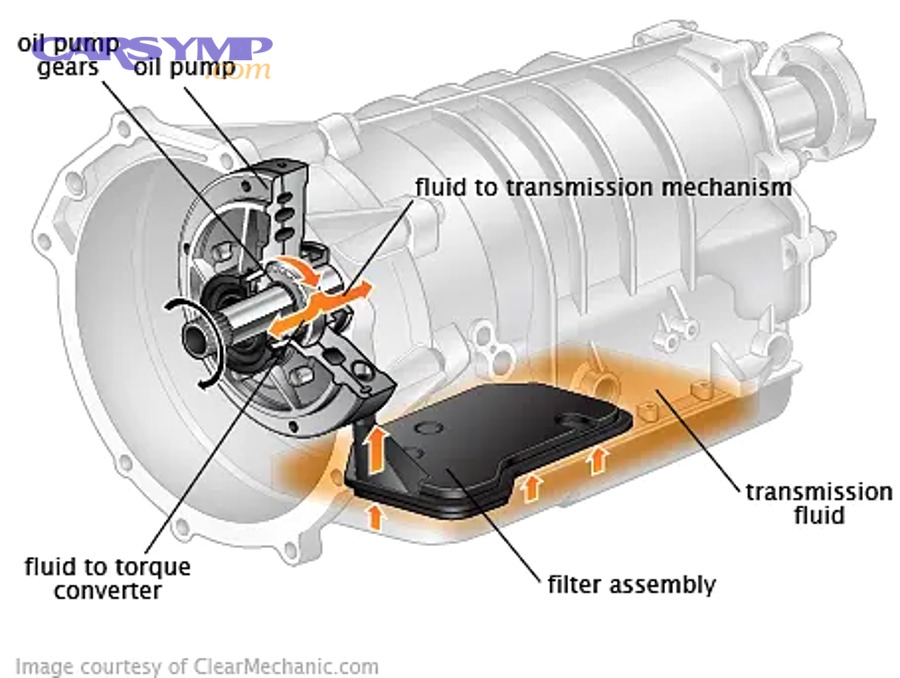
Your transmission relies on a sealed, pressurized fluid circuit to shift gears smoothly, lubricate hundreds of moving parts, and dissipate heat. Seals and gaskets are the barriers that hold this circuit intact. When they fail — due to age, heat exposure, physical damage, or improper installation — fluid escapes. The cost of stopping that escape depends almost entirely on which barrier has failed and what it takes to reach it. An external gasket on the transmission pan is right at the bottom of the vehicle, accessible in under an hour. A front pump seal sits at the heart of the transmission and cannot be reached without removing the entire unit from the car — a job that adds five to eight hours of labor before the actual seal replacement even begins.
What Are the Most Common Types of Transmission Leaks?
There are 6 main types of transmission leaks, classified by their location within or around the transmission housing: pan gasket, input shaft seal, output shaft seal, front pump seal, torque converter seal, and cooling line connections.
Specifically, these break down into two broad categories based on repair accessibility:
External leaks (cheaper, no transmission removal required):
- Pan gasket leak — The gasket that seals the transmission pan to the main housing wears down with heat cycles, overtightening, or age. This is the most common transmission leak and the most affordable to fix.
- Cooling line leak — Transmission cooler lines carry fluid to and from the radiator. They can corrode, crack from road debris impact, or develop loose fittings over time.
- Output shaft seal — Located where the driveshaft or axle exits the transmission. Accessible from underneath the vehicle without full disassembly.
Internal leaks (more expensive, often require transmission removal):
- Input shaft seal — Located at the front of the transmission where the torque converter connects. More labor-intensive to access than the output side.
- Front pump seal — Sits at the very front of the automatic transmission. Reaching it requires complete transmission removal, making this one of the most expensive common leaks.
- Torque converter seal — The torque converter itself can develop cracks or a faulty seal around its hub, requiring removal of the transmission to diagnose and repair.
What Are the Symptoms That Tell You How Severe the Leak Is?
There are 3 severity levels of transmission leaks, identifiable through a combination of fluid behavior, driving symptoms, and fluid condition: minor, moderate, and severe.
More specifically, here is how each level presents:
Minor leak:
- A slow drip or occasional spot on the driveway, usually red or reddish-brown
- No noticeable change in shifting quality
- Fluid levels drop slowly over weeks
Moderate leak:
- A consistent puddle forming within hours of parking
- Occasional hesitation or slight delay when shifting gears
- Fluid levels require topping off every few weeks
- Possible faint burning smell if fluid is reaching hot exhaust components
Severe leak:
- Rapid fluid loss; large puddles within minutes of driving
- Gear slipping, hard shifts, or failure to engage a gear
- Transmission temperature warning light activating
- Audible whining or clunking under load
Catching a leak at the minor stage is not just about comfort — it is the single most effective way to keep the repair cost in the $150–$400 range rather than the $1,500–$3,500 range of a full rebuild caused by fluid starvation.
How Much Does Transmission Leak Repair Cost by Leak Type?
There are 6 primary transmission leak repair cost ranges, classified by leak source: pan gasket ($150–$350), output shaft seal ($100–$300), cooling lines ($100–$500), input shaft seal ($200–$500), front pump seal ($500–$900), and torque converter seal ($400–$1,000+).
The table below summarizes the full cost breakdown for each leak type before diving into the details of each repair:
| Leak Type | Parts Cost | Labor Cost | Total Estimated Range | Transmission Removal Required? |
|---|---|---|---|---|
| Pan Gasket | $20–$80 | $80–$200 | $150–$350 | No |
| Output Shaft Seal | $15–$50 | $80–$250 | $100–$300 | No |
| Cooling Lines | $30–$150 | $80–$300 | $100–$500 | No |
| Input Shaft Seal | $20–$80 | $180–$400 | $200–$500 | Sometimes |
| Front Pump Seal | $30–$100 | $500–$800 | $500–$900 | Yes |
| Torque Converter Seal | $150–$400 | $400–$700 | $400–$1,000+ | Yes |
This table covers the most common leak repair scenarios. Actual costs vary based on labor rates, vehicle type, and whether additional damage has occurred.
How Much Does It Cost to Fix a Transmission Pan Gasket Leak?
A transmission pan gasket leak typically costs $150 to $350 to repair, making it the most affordable and accessible transmission leak fix available.
Specifically, the pan gasket is the rubber or cork seal that sits between the transmission pan and the main transmission housing. When it fails — due to normal aging, heat cycling, or over-torqued bolts — fluid seeps from the bottom edge of the transmission. Because the pan is externally mounted at the bottom of the vehicle, a technician can access it without removing the transmission.
The Pan gasket and filter replacement overview is as follows: drain remaining fluid, remove the pan bolts, drop the pan, replace the gasket and filter, reinstall the pan to the correct torque specification, and refill with the manufacturer-specified transmission fluid. The entire job typically takes one to two hours. Parts cost $20 to $80; labor adds $80 to $200 depending on the shop rate. A filter replacement is often performed at the same time, adding $20 to $50 to the parts cost but no significant labor time since the filter is inside the pan.
This is also the most realistic DIY transmission leak repair for a mechanically competent home mechanic, as no specialized transmission tools are required.
How Much Do Transmission Seal Replacements Cost? (Input, Output & Front Pump)
Transmission seal replacement costs range from $100 for an output shaft seal to $900 for a front pump seal, with the dramatic price difference driven entirely by whether transmission removal is required.
More specifically, here is how each seal breaks down:
Output shaft seal ($100–$300): Located where the driveshaft or CV axle exits the transmission, this seal is accessible externally. A technician disconnects the driveshaft or axle shaft, pulls the old seal, presses in a new one, and reinstalls. Labor runs one to two hours.
Input shaft seal ($200–$500): Located at the front of the transmission where it connects to the torque converter. Access varies by vehicle — some can be reached by removing the torque converter without dropping the transmission, while others require a full pull. Cost depends heavily on this variable.
Front pump seal ($500–$900): This seal sits at the very front of the automatic transmission housing. There is no way to replace it without removing the transmission entirely. On a standard vehicle with $100–$150/hour labor rates, five to seven hours of labor for removal, seal replacement, and reinstallation quickly brings the total to $600–$900 even though the seal itself costs only $30 to $100.
How Much Does It Cost to Fix a Transmission Cooling Line Leak?
A cooler line leak repair typically costs $100 to $500, making it a mid-range transmission leak repair that is generally straightforward but variable depending on line accessibility and vehicle design.
Transmission cooling lines run from the transmission body to the radiator (or a dedicated transmission cooler), allowing fluid to shed heat before recirculating. Over time, the metal or rubber lines corrode, crack from road debris, or develop weeping fittings at connection points.
Cooler line leak repair options include: tightening a loose fitting (minimal cost, under $50), replacing a section of rubber hose ($80–$200), replacing a full metal line ($150–$400), or replacing the entire cooler line assembly ($250–$500). A quality shop will inspect the entire line run rather than patching a single weak point, since lines that have begun corroding at one location often have additional wear elsewhere. Ignoring a cooling line leak is particularly risky because reduced fluid flow causes the transmission to overheat — one of the fastest paths to internal damage and a dramatically higher repair bill.
How Much Does a Torque Converter Leak Repair Cost?
A torque converter seal leak repair costs $400 to $1,000 or more, depending on whether the converter itself must be replaced or whether only the seal is faulty.
Torque converter seal leak diagnosis begins with confirming that the leak source is the converter seal rather than the front pump seal — both are located at the same end of the transmission and can produce similar leak patterns. A dye test or careful inspection after cleaning the area can differentiate the two. If the torque converter seal has failed, the transmission must be removed to access it. The seal itself costs $30 to $80; however, the labor to remove and reinstall the transmission accounts for the majority of the bill.
In cases where the torque converter has developed a crack, has damaged needle bearings, or the hub has worn through the seal repeatedly, full torque converter replacement becomes necessary. A replacement torque converter costs $150 to $400 for most vehicles, pushing the total repair into the $500 to $1,000+ range. According to RepairPal industry estimates, torque converter replacement (inclusive of labor) typically ranges from $600 to $1,000 on most domestic vehicles, with import and luxury vehicles running higher.
What Factors Make Transmission Leak Repair Cost Higher or Lower?
There are 4 primary cost factors that determine how high or low your transmission leak repair bill will be: the leak’s location and accessibility, your vehicle’s make and transmission type, the labor rate at your chosen shop, and how long the leak has been active.
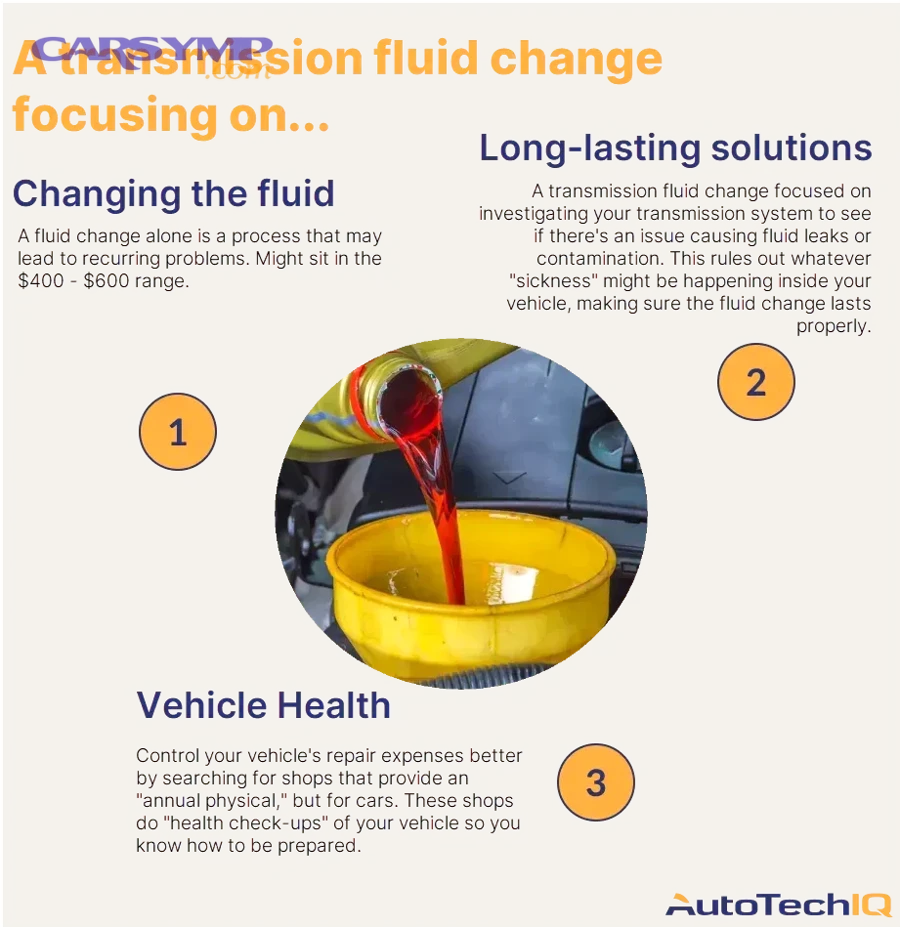
In addition to the leak type itself, these variables can push a repair from the bottom to the top of its cost range — or beyond.
How Does Vehicle Make, Model, and Transmission Type Affect the Price?
Vehicle make and transmission type affect repair cost in three key ways: domestic vehicles are cheapest, imports and luxury models cost 20–40% more, and CVT or dual-clutch transmissions carry the highest parts and fluid premiums.
To illustrate: replacing a pan gasket on a Ford F-150 with a 6-speed automatic might cost $180 total. The same job on a BMW 5 Series with a ZF 8-speed transmission may cost $350 or more because the pan is integrated differently, the required fluid is a proprietary BMW-spec product at $15–$20 per liter, and the dealer-level diagnostics add time. AWD and 4WD vehicles introduce transfer case seals as additional potential leak sources, meaning a single leak symptom may require inspecting two or three separate sealing systems.
CVT transmissions used in many compact cars (Nissan, Subaru, Honda) require specialized seals and manufacturer-specific CVT fluid that cannot be substituted. Parts availability is lower, and shops without CVT experience may charge more for the additional diagnosis time.
How Much of the Transmission Leak Repair Cost Is Labor vs. Parts?
Labor accounts for 60–80% of the total transmission leak repair cost for internal leaks, while parts dominate the cost structure only on minor external repairs where labor time is minimal.
This distinction matters enormously for budgeting. Consider the front pump seal: the part itself costs $30 to $100. Yet the total repair runs $500 to $900 because five to seven hours of labor are required to remove the transmission, replace the seal, and reinstall everything. The parts cost is almost irrelevant — labor is the real expense.
On the other end of the spectrum, a pan gasket repair involves $20 to $80 in parts and only one to two hours of labor. Here, parts make up a meaningful share of the bill. This labor-to-parts ratio is why the choice of repair shop matters: an independent shop at $90/hour will produce a significantly lower bill than a dealership at $150/hour for the same identical job, particularly on labor-heavy internal seal repairs.
Does the Severity and Age of the Leak Change What You’ll Pay?
Yes — the severity and age of a transmission leak directly increases what you will pay, because a neglected leak triggers a cascade of secondary damage that compounds the original repair cost.
Here is the compounding risk chain: a small seal leak reduces fluid volume → lower fluid volume increases friction and heat → increased heat degrades remaining seals and clutch packs → degraded clutch packs begin slipping → continued operation accelerates wear on planetary gears and bearings → eventual transmission failure requiring a full rebuild or replacement.
A seal leak caught at the drip stage costs $150 to $900 to fix. The same leak discovered after three months of driving on low fluid can require a full rebuild at $1,500 to $3,500, or a replacement transmission at $1,500 to $5,000 installed. According to data compiled by RepairPal, the average transmission rebuild costs significantly more than any individual seal repair, reinforcing the financial logic of early intervention.
Is It Worth Repairing a Transmission Leak, or Should You Replace the Transmission?
Repairing a transmission leak is the right financial decision in most cases — specifically when the leak is localized to a single component, the vehicle has significant remaining life, and the repair cost does not approach the vehicle’s market value.

However, the repair-vs-replace calculation shifts when the leak has been running long enough to cause internal damage.
When Is Repairing a Transmission Leak the Right Financial Decision?
Yes, repairing a transmission leak is financially sound when three conditions are met: the leak source is identifiable and isolated, the transmission has not suffered secondary damage from fluid loss, and the total repair cost stays below 50% of the vehicle’s current market value.
For most drivers, these conditions are met when the leak is caught early. A $300 pan gasket repair on a vehicle worth $12,000 is an obvious financial win. Even a $900 front pump seal repair makes clear economic sense on a vehicle with 80,000 miles and several years of useful life remaining. The calculus flips only when multiple seals are failing simultaneously, or when the transmission has already suffered internal damage that a seal repair alone will not resolve.
When Does a Transmission Leak Signal You Need a Full Replacement or Rebuild?
A transmission leak signals replacement or rebuild territory when internal damage from fluid starvation has already occurred — indicated by metal shavings in the fluid, slipping gears under normal loads, hard banging between gears, or complete failure to engage.
At that point, the options are:
- Transmission rebuild ($1,500–$3,500): The existing transmission is disassembled, worn components are replaced, and it is reassembled to factory specification. Best option when the case and hard parts are intact.
- Remanufactured transmission ($1,500–$4,000 installed): A factory-remanufactured unit replaces the existing transmission. Typically comes with a warranty (12–36 months) and is the most reliable replacement option.
- Used transmission ($800–$1,500 installed): A salvage-yard unit with unknown wear history. Lowest upfront cost, highest risk of repeat failure.
The decision rule: if the estimated repair cost (including any secondary damage correction) exceeds 70–80% of the vehicle’s current private-party value, replacement or sale of the vehicle becomes the more rational economic choice.
Should You Repair a Transmission Leak Yourself or Hire a Professional?
Hiring a professional is the correct choice for any transmission leak involving internal seals or transmission removal, while DIY is a realistic option for a narrow set of external, accessible repairs such as pan gasket replacement and cooling line tightening.
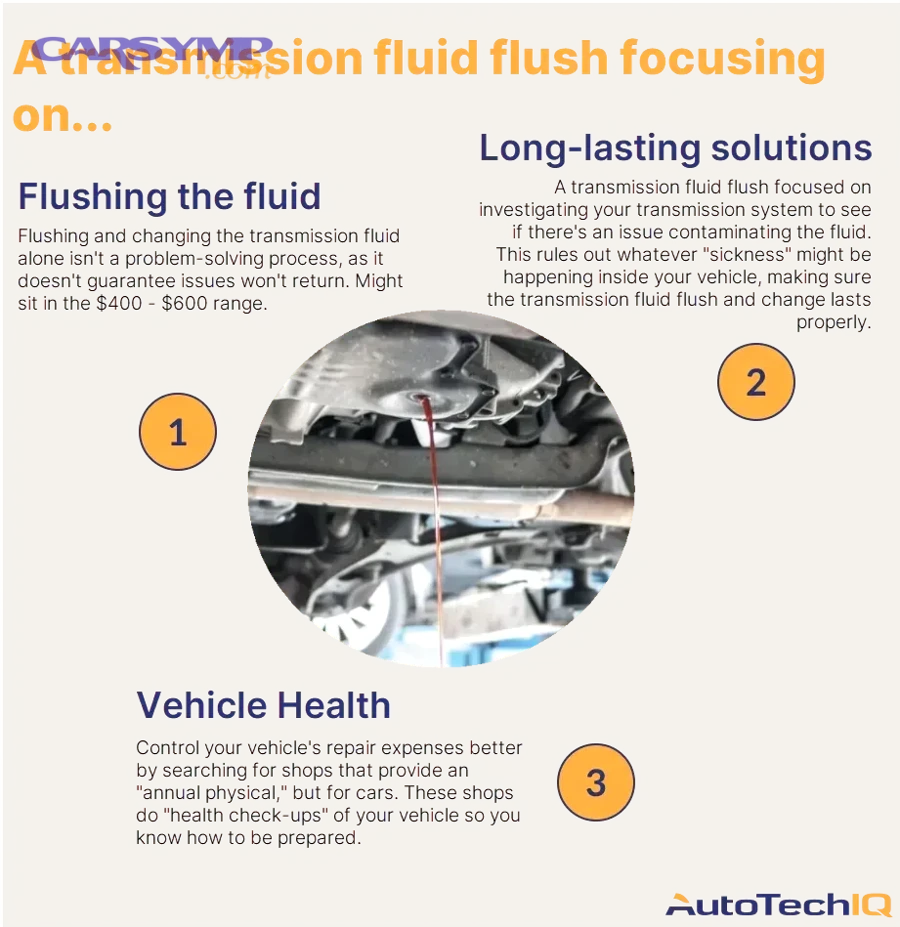
What Transmission Leak Repairs Can a DIYer Realistically Handle?
There are 3 transmission leak repairs that fall within the realistic scope of a competent home mechanic with basic tools: pan gasket replacement, drain plug re-sealing, and cooling line connection tightening or hose section replacement.
Specifically, here is what each DIY repair involves:
Pan gasket replacement:
- Tools needed: socket set, torque wrench, drain pan, gasket scraper, transmission fluid
- Estimated DIY savings: $80–$200 in labor
- Risk level: Low, if bolts are torqued to specification and the correct replacement gasket is used
- Key caution: Over-torquing the pan bolts will warp the pan flange and create a new leak
Drain plug re-sealing:
- Replace the crush washer or thread sealant on the drain plug
- Cost: Under $10 in parts; 30 minutes of work
- Savings: Eliminates a shop visit for a trivial repair
Cooling line tightening or short hose section replacement:
- Tightening a loose fitting requires only a wrench; replacing a rubber section requires cutting, new hose, and clamps
- Estimated DIY savings: $80–$150
- Risk level: Low for tightening; moderate for hose replacement (must confirm fluid-compatible hose material)
What Are the Risks of DIY Transmission Leak Repair Going Wrong?
Yes, DIY transmission leak repair carries real risks — specifically fluid contamination, improper seal seating, incorrect torque, and misdiagnosis — any one of which can escalate a minor repair into a major rebuild.
The three most damaging DIY mistakes are:
- Using the wrong transmission fluid: Mixing fluid types or using an incompatible substitute can damage solenoids, degrade seals further, and alter hydraulic pressure. Always use the exact fluid specified in the owner’s manual.
- Improper seal seating: A new seal installed at an angle or driven in unevenly will leak from day one. Seal installation often requires a proper driver tool to ensure square, even seating — a step that is easy to skip and costly to redo.
- Misidentifying the leak source: What looks like a pan gasket leak from the outside may actually be fluid migrating down from a higher internal seal. Replacing the pan gasket without finding the true source guarantees repeat failure.
For any repair involving the torque converter, front pump seal, input shaft seal, or transmission removal, professional service is not just recommended — it is the financially safer choice. A single mistake on an internal transmission repair can turn a $700 job into a $3,000 one.
Special Scenarios That Can Change Your Transmission Leak Repair Cost
Several uncommon but important scenarios can significantly alter the cost trajectory of a transmission leak repair — from additive shortcuts that backfire, to vehicle-specific engineering that commands a premium, to warranty coverage that may eliminate the out-of-pocket cost entirely.
Does Using a Stop-Leak Additive Actually Save Money on Transmission Leak Repair?
No — using a stop-leak additive does not save money on transmission leak repair in the long run, and in many cases increases the total cost by delaying proper repair while creating new secondary damage.
Stop-leak additives are chemical compounds designed to swell rubber seals, temporarily reducing or stopping fluid seepage. The product itself costs $10 to $30, which appears to be a dramatic saving compared to a $200 seal repair. However, the economics break down quickly. Additives do not fix the underlying seal failure — they buy time, measured in weeks or months, before the leak resumes. More importantly, the same chemical that temporarily swells the target seal also affects every other rubber seal in the transmission. Over time, this can cause solenoid seals to swell shut, alter fluid viscosity and hydraulic pressure, and accelerate degradation of other gaskets throughout the system. A $15 additive applied to delay a $250 pan gasket repair can contribute to $800 in solenoid damage three months later.
How Does Transmission Type (CVT, Dual-Clutch, AWD) Specifically Change Repair Costs?
CVT transmissions carry the highest repair cost premium at 20–40% above a standard automatic, dual-clutch systems add complexity through their wet-clutch architecture, and AWD/4WD vehicles introduce transfer case seals as an additional leak source that must be inspected simultaneously.
To illustrate each scenario:
CVT (Continuously Variable Transmission): Found in many Nissan, Subaru, and Honda models, CVTs use a belt-and-pulley system that requires proprietary fluid unavailable as a generic substitute. CVT-specific seals are also less universally stocked, meaning longer parts lead times and higher parts cost. Shops without CVT experience may spend additional diagnostic time, further raising labor cost.
Dual-Clutch Transmission (DCT): Wet-clutch DCTs (common on VW/Audi DSG, Ford PowerShift, and many modern performance vehicles) share their fluid reservoir between the clutch packs and the transmission gear circuit. A seal leak in this system can affect clutch performance directly, making accurate diagnosis more complex and potentially requiring clutch inspection alongside the seal repair.
AWD/4WD: These vehicles have a transfer case mounted at the rear of the transmission, with its own set of input and output seals. A fluid leak presenting at the rear of the drivetrain may originate from the transmission output seal, the transfer case input seal, or the transfer case output seal. Properly diagnosing the source requires inspecting all three, adding time and cost to the initial assessment.
What Does a Full Transmission Leak Repair Cost Look Like Stage by Stage?
A full transmission leak repair moves through 4 distinct cost stages: diagnosis, parts procurement, labor, and fluid replacement — with each stage contributing to the final bill in different proportions depending on leak severity.
The table below outlines the expected cost at each stage for both a minor and a major repair, giving car owners a transparent view of where their money goes:
| Stage | Minor Repair (Pan Gasket) | Major Repair (Front Pump Seal) |
|---|---|---|
| Stage 1: Inspection/Diagnosis | $60–$150 | $60–$150 |
| Stage 2: Parts | $20–$80 | $30–$100 |
| Stage 3: Labor | $80–$200 | $500–$800 |
| Stage 4: Fluid replacement | $30–$80 | $50–$120 |
| Total | $150–$350 | $500–$900 |
This stage-by-stage view makes one thing clear: for minor external repairs, diagnosis and fluid refill represent a meaningful share of the total cost. For major internal repairs, labor completely dominates. Understanding this distribution helps car owners evaluate quotes intelligently — a shop charging $200 labor for a pan gasket is overcharging, while $700 labor for a front pump seal is entirely reasonable.
Can Car Insurance or a Warranty Cover Transmission Leak Repair Costs?
Yes — a transmission leak repair can be covered, but only under specific warranty or protection plan conditions, not standard auto insurance.
Here is how each coverage type applies:
Standard auto insurance: Does not cover mechanical failures, including transmission leaks, unless the leak was directly caused by a covered collision event. A seal that fails from normal wear is explicitly excluded under comprehensive and collision policies.
Powertrain warranty (new vehicle): Most new vehicles carry a 5-year/60,000-mile powertrain warranty that covers seals, gaskets, and internal transmission components. A transmission leak developing within this window is typically repaired at no cost at an authorized dealership.
Extended warranty / third-party protection plan: Coverage varies widely by plan. Many extended warranties include transmission seals and gaskets under powertrain coverage. Policyholders should review their contract specifically for exclusions on “wear items” — some plans exclude seals as normal wear components.
Certified Pre-Owned (CPO) vehicles: Manufacturer CPO programs extend powertrain coverage beyond the original warranty period. A transmission leak on a CPO vehicle within the CPO warranty window is typically covered without out-of-pocket cost.
The practical advice: before authorizing any transmission leak repair, check your vehicle’s remaining warranty status through the manufacturer’s online portal and review your extended warranty documentation. A single phone call can eliminate a $500 to $900 expense entirely.