How to Fix a Transmission Leak: Causes, Repair Options & Cost Guide for Car Owners
A transmission leak is one of those car problems that starts small but can spiral into one of the most expensive repairs you’ll ever face. The good news is that fixing a transmission leak is entirely manageable — whether you handle it yourself or take it to a shop — as long as you catch it early, correctly identify the source, and choose the right repair method for the severity of the leak. This guide walks you through everything you need to know to go from spotting a puddle on your driveway to driving confidently again.
Understanding what causes a transmission leak is the essential first step before any repair attempt. Leaks can originate from several distinct points in the transmission system — the pan gasket, the input or output shaft seals, the cooling lines, or the torque converter — and each source calls for a different repair approach. Misidentifying the cause is one of the most common reasons DIY repairs fail or cost more in the long run.
Repair costs vary widely depending on where the leak originates and how long it has been ignored. A simple Pan gasket and filter replacement overview typically runs between $150 and $300, while a Torque converter seal leak diagnosis can lead to repair bills exceeding $1,000. Knowing the cost range upfront puts you in a stronger position when talking to a mechanic or deciding whether to DIY.
The decision between fixing a leak yourself and hiring a professional is not just about skill level — it is also about safety, access to tools, and the risk of making the problem worse. Beyond the repair itself, Preventing repeat leaks through proper maintenance habits is the most cost-effective strategy any car owner can adopt. With that foundation in place, let’s explore the full picture from definition to diagnosis to repair.
What Is a Transmission Leak?
A transmission leak is a fluid escape condition in which transmission fluid exits the sealed transmission system through a compromised component — such as a gasket, seal, line, or housing — reducing the fluid level needed for the system to function.
To better understand why this matters so much, it helps to know what transmission fluid actually does inside your vehicle.

Transmission fluid serves three simultaneous functions: it lubricates the hundreds of moving parts inside the transmission, it carries heat away from friction-generating components, and it acts as the hydraulic medium that enables gear changes in automatic transmissions. When fluid escapes the system, all three functions degrade at once. Gears begin slipping because hydraulic pressure drops. Components run hotter because the cooling capacity is reduced. Metal parts wear faster because lubrication is insufficient.
What Does Transmission Fluid Look Like When It Leaks?
Transmission fluid has a distinctive appearance that makes it identifiable compared to other vehicle fluids — and reading those visual cues correctly is the first practical skill in diagnosing a leak.
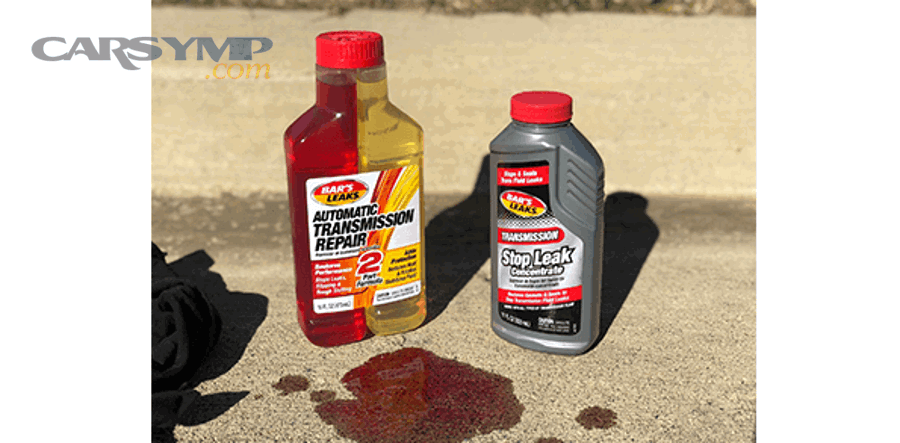
- Bright red or pink: Fresh, healthy transmission fluid. A bright red puddle almost always confirms an active transmission leak rather than an engine oil or coolant issue.
- Dark brown or black: Aged, degraded fluid that has been burned or contaminated over time. This color often indicates the fluid has not been changed in a long time, which compounds the leak problem.
- Pink and milky or foamy: A serious warning sign. This color indicates coolant has mixed with transmission fluid — typically through a failed transmission cooler inside the radiator — and requires immediate professional attention.
To locate the source on your driveway, observe where the puddle sits relative to your vehicle. A puddle near the center of the vehicle typically points to the transmission pan area. A puddle toward the front may indicate a torque converter or front pump seal. A puddle near the wheels suggests an axle seal leak. These positional clues feed directly into the Diagnosing transmission leaks step-by-step process covered later in this guide.
Is a Transmission Leak Serious Enough to Warrant Immediate Repair?
Yes, a transmission leak is serious enough to warrant immediate repair for three critical reasons: it reduces lubrication, drops hydraulic pressure, and can cause irreversible internal damage within a surprisingly short driving distance.
The urgency depends on the rate of fluid loss. A slow seep from a slightly loose pan bolt is less immediately dangerous than an active drip from a cracked cooling line. However, even a slow leak becomes critical over time because transmission fluid does not replenish itself — every mile driven at low fluid level accelerates wear on internal components. Car Symptoms that signal the problem has already affected performance include delayed gear engagement, shuddering during acceleration, slipping between gears, and a burning smell from under the hood. Any of these symptoms combined with a visible fluid spot means the transmission service window for a low-cost fix is closing fast.
According to transmission repair data compiled by AAA, deferred maintenance on transmission fluid leaks is one of the top contributors to full transmission replacement costs, which average between $3,000 and $5,000 — compared to minor leak repairs that typically cost under $400 when caught early.
What Are the Main Causes of a Transmission Leak?
There are four main causes of a transmission leak: pan gasket failure, seal and O-ring deterioration, cooling line damage, and torque converter faults — classified by their location within the transmission system.

Specifically, each of these failure points has its own set of triggers, symptoms, and repair requirements. Understanding them as a group allows you to approach any leak with a diagnostic framework rather than guesswork.
Why Do Transmission Pan Gaskets Fail and Leak?
The pan gasket fails and leaks primarily due to normal age-related wear, heat cycling, and installation errors — making it the most common and most accessible transmission leak to repair.
The transmission pan sits at the bottom of the transmission and holds a reservoir of fluid. A gasket creates the seal between the pan and the transmission housing. Over years of thermal expansion and contraction, that gasket compresses, hardens, and eventually loses its ability to form a perfect dry seal. This is entirely normal and expected on higher-mileage vehicles.
Installation errors are another frequent culprit — particularly when a previous transmission service was performed. If the pan bolts were over-tightened (which warps the pan flange) or under-tightened (which allows fluid to seep between surfaces), the gasket will leak even if it is brand new. A pan gasket and filter replacement overview typically involves draining the fluid, removing the pan, inspecting and cleaning both mating surfaces, installing a new gasket with correctly torqued bolts, replacing the filter, and refilling with the correct fluid — a procedure well within DIY capability for most car owners with basic tools.
Why Do Transmission Seals and O-Rings Cause Leaks?
Transmission seals and O-rings cause leaks when they lose elasticity due to heat exposure, age, or physical damage — allowing fluid to escape past surfaces they were designed to keep dry.
There are several seal locations in a typical transmission, but the most consequential are the input shaft seal (where the torque converter interfaces with the transmission), the output shaft seal (where the driveshaft connects), and the axle seals on front-wheel-drive vehicles. Axle seal leak repair basics involve removing the CV axle, pressing out the old seal, pressing in a new one, and reinstalling the axle — a moderately skilled DIY job that typically costs $40–$80 in parts but $150–$250 at a shop due to labor.
The output shaft seal deserves special attention because a leak there does more than lose fluid. Once the seal fails, road debris, dirt, and water can enter the output shaft cavity, contaminating the transmission fluid and accelerating internal wear. This is one of the scenarios where delaying repair introduces a compounding cost problem — what starts as an inexpensive seal replacement can evolve into a situation where you need to consider When to rebuild instead of fixing leaks.
Can Transmission Cooling Lines Cause a Fluid Leak?
Yes, transmission cooling lines can cause a fluid leak because they are made of rubber or metal materials that degrade over time — rubber cracks with age, and metal lines corrode or sustain impact damage from road debris.
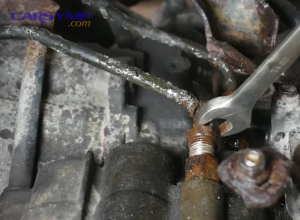
Transmission cooling lines run from the transmission to a small cooler, typically housed inside or alongside the radiator. Their job is to carry hot fluid away from the transmission and return it cooled. Cooler line leak repair options include replacing rubber hoses with new OEM-spec hoses, replacing corroded metal lines, or installing upgraded braided stainless-steel lines for improved durability. The repair itself is not mechanically complex — in most cases, it is a matter of loosening fittings, removing the damaged line, and installing a replacement — but working near the radiator requires care to avoid additional damage.
Car symptoms of a cooling line leak include visible fluid on the lines themselves, transmission fluid dripping from the undercarriage in the middle-to-front of the vehicle, hard or delayed shifting (caused by low fluid pressure), and transmission overheating warnings on the dashboard.
How Does a Faulty Torque Converter Cause a Transmission Leak?
A faulty torque converter causes a transmission leak when its internal seal fails, its body develops a crack, or its needle bearings are damaged — allowing pressurized fluid to escape from what should be a completely sealed hydraulic unit.
The torque converter performs a hydraulic coupling function between the engine and the transmission. It contains fluid under pressure, and that pressure is generated and maintained by an internal pump. When the seal around the converter’s hub deteriorates, fluid leaks out at the front of the transmission — which is why torque converter seal leak diagnosis requires distinguishing between a front pump seal leak (at the transmission housing) and a converter body leak (inside the bellhousing), both of which produce similar-looking symptoms from the outside.
This is the most expensive leak source on the list. Because accessing the torque converter requires removing the transmission from the vehicle, labor costs dominate the repair bill. A torque converter replacement typically costs between $500 and $1,200 depending on vehicle make and model. This is also the point at which a transmission rebuild conversation becomes relevant — if internal damage has already occurred from running low on fluid, rebuilding the transmission while it is already out of the vehicle can be more economical than reinstalling it and dealing with further failures shortly after.
How Do You Fix a Transmission Leak Step by Step?
You fix a transmission leak using a four-phase method — diagnosis, preparation, repair, and post-repair verification — across approximately 4 to 8 steps depending on the leak source, with the expected outcome being a fully sealed transmission at the correct fluid level.

This process applies whether you are doing the repair yourself or preparing for a shop visit with enough knowledge to ask the right questions.
How Do You Diagnose the Exact Location of a Transmission Leak?
Diagnosing transmission leaks step-by-step involves cleaning the transmission area first, then using UV dye or direct visual inspection to isolate the precise leak origin before any repair work begins.
Here is the recommended diagnostic sequence:
- Degrease the area: Spray the transmission and surrounding components with brake cleaner or degreaser and wipe clean. This removes existing fluid residue so that new leaks show clearly.
- Add UV dye: Pour a UV dye compatible with your transmission fluid type into the fill point. Drive the vehicle for 15–20 minutes to circulate the dye.
- Inspect with UV light: Using a UV/black light flashlight (available at auto parts stores for under $15), trace the fluid path back to its origin point. The dye fluoresces bright green or yellow, making the source unmistakable.
- Lift the vehicle: For a thorough inspection, raise the vehicle safely on jack stands or ramps. Inspect the pan, seals, lines, and bellhousing from underneath.
- Document the source: Note whether the leak is at a static joint (gasket, seal) or a dynamic one (shaft seal, torque converter). This determines the repair method.
How Do You Fix a Leaking Transmission Pan Gasket Yourself?
You fix a leaking transmission pan gasket yourself by draining the fluid, removing the pan, replacing the gasket and filter, reinstalling with correct torque, and performing the Post-repair fluid level setting procedure.
Tools needed: Drain pan, socket set, torque wrench, gasket scraper, brake cleaner, new OEM-spec gasket, new transmission filter, and fresh transmission fluid (check your owner’s manual for the correct type and quantity).
Step-by-step process:
- Place the drain pan and remove the pan bolts gradually, tilting the pan to drain remaining fluid
- Remove the old filter and discard
- Scrape all old gasket material from both the pan and transmission housing mating surfaces — this step is critical; any residue will cause the new gasket to leak
- Clean both surfaces with brake cleaner and allow to dry
- Install the new filter, then position the new gasket on the pan
- Reinstall the pan and torque all bolts to specification (typically 12–15 ft-lbs in a cross pattern — check your vehicle’s service manual)
- Refill with fresh transmission fluid through the dipstick tube or fill port
The post-repair fluid level setting procedure is where many DIY repairs go wrong. Transmission fluid level is typically checked with the engine running, the vehicle on level ground, and the transmission cycled through each gear. Add fluid in small increments and recheck rather than overfilling — overfilling is as damaging as underfilling.
How Do You Replace a Leaking Transmission Seal?
You replace a leaking transmission seal by removing the component connected to the seal (axle, driveshaft, or torque converter), extracting the old seal with a seal puller, pressing in the new seal, and reassembling.
The process varies meaningfully by seal type. Axle seal leak repair basics on a front-wheel-drive vehicle involve removing the wheel, unbolting the control arm or strut as needed to create clearance, pulling the CV axle out of the transmission, prying out the old seal with a seal removal tool (avoid screwdrivers that can gouge the seal bore), pressing or tapping a new seal flush with a seal driver, and reinstalling the axle. The entire job takes 1–3 hours depending on vehicle access.
For output shaft seals on rear-wheel-drive vehicles, the driveshaft must be disconnected first. This is still a moderate DIY job, but it requires working under a raised vehicle and proper safety stands — not just a floor jack.
When the leak originates from the front pump seal or torque converter, the transmission must come out entirely. At this level, most car owners should defer to a professional unless they have significant mechanical experience, a transmission jack, and a service manual for their specific vehicle.
When Should You Take a Transmission Leak to a Professional Instead of Fixing It Yourself?
You should take a transmission leak to a professional instead of fixing it yourself when the leak source requires transmission removal, when internal damage is suspected, or when car symptoms indicate the transmission is already operating in a compromised state.
Specifically, the following conditions call for professional repair:
- Torque converter leaks: Require transmission removal; no DIY workaround exists
- Internal leaks: Fluid appearing inside the bellhousing with no external seal as the obvious source
- Leaks accompanied by slipping, shuddering, or hard shifting: These suggest the fluid level has already dropped far enough to cause operational damage
- Unfamiliar vehicle architecture: Many modern AWD and CVT transmissions have complex designs where incorrect reassembly causes additional failures
When selecting a shop, prioritize a dedicated transmission specialist over a general repair facility. Transmission specialists have the diagnostic equipment, tooling, and rebuild experience that general mechanics typically lack. Ask whether the shop offers a warranty on transmission repairs — reputable shops typically provide 12-month/12,000-mile guarantees on transmission work.
How Much Does Transmission Leak Repair Cost?
Transmission leak repair cost ranges from $150 for a simple seal or gasket replacement to over $1,200 for a torque converter repair, with the final number determined by leak location, vehicle type, labor rates, and whether secondary damage has occurred.
The table below summarizes the Transmission leak repair cost breakdown by leak source to give you a clear reference before speaking with a mechanic.
| Leak Source | DIY Parts Cost | Professional Repair Cost | Urgency Level |
|---|---|---|---|
| Pan gasket & filter | $20–$60 | $150–$300 | Moderate |
| Axle seal (per side) | $15–$40 | $120–$250 | High |
| Cooling lines | $25–$80 | $100–$300 | High |
| Output shaft seal | $20–$50 | $200–$400 | High |
| Front pump seal | $30–$70 | $600–$900 | Very High |
| Torque converter | $150–$400 (parts) | $500–$1,200 | Very High |
| Full rebuild (if damaged) | Not recommended DIY | $1,500–$3,500 | Emergency |
This table presents approximate cost ranges based on standard labor rates of $100–$150/hour. Your actual cost may differ based on regional labor rates and vehicle-specific complexity.
What Does It Cost to Fix a Minor Transmission Leak?
A minor transmission leak costs between $150 and $400 to fix professionally, covering repairs such as pan gasket replacement, axle seal replacement, or cooling line repair — the three most accessible and affordable leak sources.
Pan gasket replacement is the most straightforward: most shops complete it in 1–2 hours, meaning labor accounts for the majority of the $150–$300 total. Axle seal replacement runs slightly higher due to the added complexity of removing the CV axle — budget $120–$250 per side, and note that if one axle seal is leaking, the other side is often not far behind given similar age and mileage. Cooler line repair sits in a similar range: $100–$300 depending on whether hoses or metal lines are involved and how accessible they are on your specific vehicle.
What Does It Cost to Fix a Major Transmission Leak?
A major transmission leak costs between $500 and $3,500 to fix professionally, depending on whether the repair involves the front pump seal, torque converter, or a full rebuild triggered by damage from prolonged fluid loss.
Front pump seal replacement requires transmission removal, which is typically a 4–8 hour job. At a $100–$150/hour labor rate plus parts, costs settle in the $600–$900 range for most vehicles. Torque converter replacement pushes into the $500–$1,200 range because the unit itself carries a significant parts cost on top of the removal labor.
The rebuild threshold is reached when a leak has been running long enough to cause internal clutch pack wear, bearing damage, or solenoid failure. At that point, the question shifts from “how much does it cost to fix the leak?” to the more complex calculation of when to rebuild instead of fixing leaks. A partial rebuild addressing specific failed components typically runs $1,500–$2,500, while a complete overhaul using a full rebuild kit can reach $3,000–$3,500 — still less expensive than a new or remanufactured transmission replacement in most cases.
What Factors Affect the Total Cost of Transmission Leak Repair?
Four primary factors affect the total cost of transmission leak repair: vehicle make and model, leak severity and location, regional labor rates, and the extent of fluid-related damage to surrounding components.
Vehicle make and model plays a significant role. A pan gasket replacement on a domestic economy sedan might cost $180 at an independent shop, while the same repair on a European luxury SUV with a ZF transmission can exceed $500 due to parts cost and labor complexity. Older vehicles with discontinued parts can also carry premium sourcing costs.
Leak severity and location determine how many labor hours are involved. Surface leaks at accessible gaskets take 1–2 hours. Internal leaks requiring full transmission removal take 4–10 hours. That labor difference alone can be the gap between a $200 repair and a $1,000+ one.
Regional labor rates vary significantly — shops in major metropolitan areas charge $120–$180/hour, while independent shops in smaller markets may charge $75–$100/hour for identical work.
Secondary component damage is the factor most often overlooked in cost estimates. If the transmission has been running at low fluid levels long enough to overheat, the fluid itself becomes a damaging agent — burning the clutch packs, varnishing valve body passages, and degrading solenoids. Any shop inspection that uncovers this secondary damage will appropriately expand the repair scope and cost.
What Are Your Options Beyond Traditional Transmission Leak Repair?
Beyond traditional transmission leak repair, car owners have three primary alternatives: stop-leak additive products for minor seal leaks, understanding the mechanical differences between automatic and manual transmission repairs, and addressing the legal and financial implications of a leak on inspections and resale.
In addition, building a prevention routine is the most underutilized strategy available to any car owner. Each of these alternatives addresses a distinct secondary need that standard repair guides overlook.
Do Transmission Stop-Leak Additives Actually Work?
Yes, transmission stop-leak additives work in limited and specific circumstances — primarily for minor leaks caused by dried or shrunken rubber seals — but they are not a substitute for mechanical repair on moderate or major leaks.
Seal conditioner myths and realities center on a misunderstanding of how these products function. They do not plug holes or fill cracks. They work by chemically conditioning rubber seals, causing them to re-swell and regain some of their original elasticity and sealing ability. For a seal that has hardened from age and heat but is not physically torn or displaced, this mechanism can genuinely restore a dry seal — and there are well-documented cases where a single bottle has stopped a minor drip for tens of thousands of miles.
Where they fail is on gasket leaks (no rubber to condition), cracked pans, damaged cooling lines, or torque converter faults — all mechanical problems that no additive can address. They also fail when used as a long-term substitute for a seal that needs replacement; the seal will eventually fail completely, and at that point the additive-treated fluid may have contaminated surrounding components. The honest use case for stop-leak additives is as a short-term bridge — to reduce fluid loss while scheduling a proper repair, not to avoid one indefinitely.
How Is Fixing a Transmission Leak on an Automatic Transmission Different From a Manual?
Automatic transmissions are more complex to repair for leaks than manual transmissions because they operate under higher internal pressure, contain more seal and gasket interfaces, and use hydraulically controlled components that are sensitive to fluid contamination and level variations.
A manual transmission uses gear oil rather than ATF, operates without a torque converter or hydraulic valve body, and has far fewer potential leak points — primarily the input shaft seal, output shaft seal, drain plug, and shift linkage seals. Manual transmission leaks are generally less urgent in the short term because gear oil is not under the same hydraulic pressure as ATF, and gear engagement in a manual does not depend on fluid pressure the way automatic gear selection does.
Automatic transmissions, by contrast, route fluid through a valve body with dozens of small passages, a torque converter, a pump, multiple clutch pack circuits, and often an external cooler. Each junction is a potential leak point, and even small fluid volume losses can produce noticeable car symptoms — especially gear slipping and shift delay — because hydraulic pressure drops quickly. This is why the same level of fluid loss that causes minimal symptoms in a manual can trigger serious shifting problems in an automatic.
Can a Transmission Leak Affect Your Vehicle’s Resale Value or Pass a Safety Inspection?
Yes, a transmission leak can negatively affect both resale value and safety inspection outcomes because active fluid leaks are flagged by inspectors in many states and represent a disclosed mechanical defect that reduces buyer confidence.
Many state vehicle safety inspections include an undercarriage check that identifies active fluid leaks. An active transmission leak can result in a failed inspection, requiring documented repair before the vehicle can be legally registered or sold. From a resale perspective, a seller who discloses a transmission leak must either reduce the asking price to account for the buyer’s repair cost or complete the repair prior to listing the vehicle.
The practical advice for anyone preparing to sell or inspect a leaking vehicle is straightforward: repair the leak, retain the receipt, and document the work. A completed transmission leak repair with a receipt from a reputable shop is far more persuasive to a buyer than a price reduction with an unexplained mechanical issue. It also eliminates any liability concern around non-disclosure of known defects.
How Do You Prevent a Transmission Leak From Happening in the First Place?
You prevent a transmission leak from happening in the first place by following five maintenance practices: regular fluid checks, correct fluid specification, avoiding aggressive driving habits, scheduled transmission service intervals, and prompt attention to early warning signs.
Preventing repeat leaks begins with the simplest habit of all: checking your transmission fluid at every oil change. A dipstick check takes 30 seconds and reveals both the fluid level and its condition. Dark, burnt-smelling fluid that has not been changed at the manufacturer’s recommended interval degrades the rubber seals it contacts — accelerating the very wear that causes leaks. Using the correct OEM-specified transmission fluid is equally important; the wrong viscosity or additive package can cause seal swelling or premature gasket failure.
Aggressive driving habits — hard acceleration, frequent abrupt stops, towing beyond the rated capacity — generate excess heat and pressure inside the transmission, shortening the lifespan of every seal and gasket in the system. Routine transmission service at the manufacturer-recommended interval (typically every 30,000 to 60,000 miles depending on driving conditions) replaces degraded fluid, installs a fresh filter, and gives a technician the opportunity to spot early-stage leaks before they become active ones. Catching a weeping pan gasket during a scheduled service costs a fraction of what the same gasket repair costs after it has been leaking long enough to drop fluid levels and trigger car symptoms that bring the vehicle in as an emergency repair.
In short, the most affordable transmission leak repair is the one you prevent entirely — and the second most affordable is the one you catch at first drip rather than waiting for the transmission to tell you something is wrong through slipping gears and warning lights.