


If your A/C suddenly blows warm air, the fastest win is separating a clutch-side problem (the “switch” that couples the belt to the compressor) from an internal compressor problem (the “pump” itself). That one decision changes the risk, parts cost, and how deep the repair must go.
To make that call confidently, you’ll use a repeatable checklist: verify clutch command, observe engagement behavior, confirm pressure response, and listen for mechanical clues. Along the way, you’ll know when AC clutch replacement is the smart, targeted fix versus when it’s just masking a bigger failure.
You’ll also learn how the most common failure patterns stack up—electrical coil faults, excessive air gap, seized bearings, slipping friction surfaces, internal pumping loss, and contamination—so you can avoid “parts darts” and stop repeat comebacks.
Giới thiệu ý mới: Below is a structured diagnosis flow that starts with quick visual checks, then moves into pressure-and-temperature confirmation so you can decide with evidence, not guesses.
Note: Automotive A/C service involves refrigerant recovery and legal/environmental requirements. If you don’t have proper recovery equipment and training, use this guide to diagnose and communicate clearly with a qualified shop.
Is the A/C clutch actually engaging when you request cooling?
Yes or no: the clutch should engage when A/C is commanded, and if it doesn’t, the problem is often control/electrical rather than the compressor internals. Next, confirm engagement visually and by sound before touching gauges.
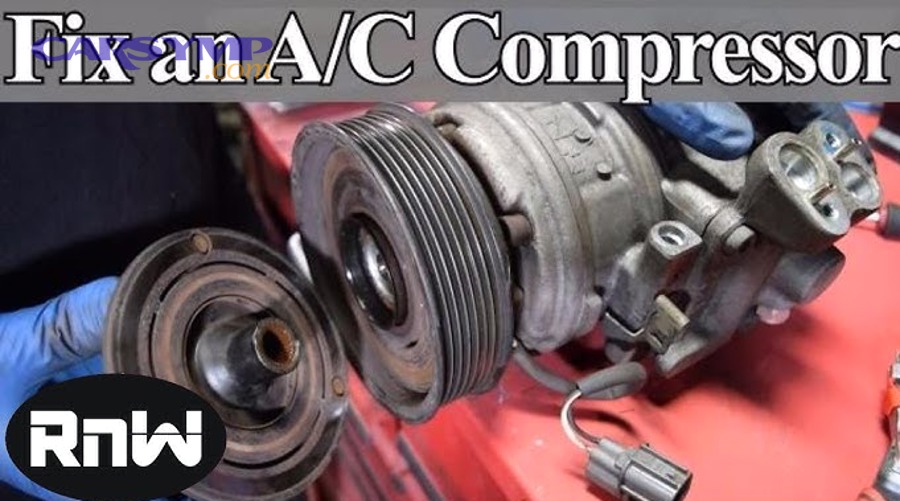
To start, look at the pulley face: the outer pulley always spins with the belt, but the center hub/drive plate should “snap” and spin with it when commanded. Next, listen for a clean click—then watch if it stays engaged or cycles rapidly.
Quick command checks you can do in 60 seconds
Yes: you can confirm command with three fast checks—A/C button status, blower speed, and whether engine idle changes—because most vehicles increase idle slightly when the compressor load is applied. Next, check that the radiator fans behave as expected when A/C is requested.
- A/C request: Button/indicator on, blower running, and temperature set to cold.
- Fan behavior: Many cars command at least one fan speed with A/C on; no fan can indicate a broader control issue.
- Idle/load cue: A mild idle dip then recovery often coincides with clutch engagement.
When “no engagement” points to the clutch circuit, not the compressor
No: if the hub never pulls in, you typically suspect clutch coil power/ground, relay/fuse, pressure switch logic, or an excessive clutch air gap preventing magnetic pull-in. Next, you’ll differentiate “no power to clutch” from “clutch has power but won’t pull in.”
- No voltage at clutch connector: upstream control/relay/pressure switch issue is likely.
- Voltage present but no pull-in: coil resistance/coil failure or air gap too wide becomes likely.
- Intermittent pull-in: heat-related coil failure or marginal air gap can appear.
The clutch air gap matters because a wider gap reduces magnetic force until the clutch can’t couple reliably; MACS specifically recommends checking clutch air gap rather than assuming it’s correct out of the box.
Does the clutch engage but slip, chatter, or cycle rapidly under load?
Yes: engagement with slipping or chatter often indicates a clutch friction or air-gap problem, while rapid cycling can indicate pressure/charge issues or protection logic. Next, you’ll separate “mechanical slip” from “system cycling.”
Start by observing the hub face: if it engages, spins, then slows or stops while the pulley keeps spinning, you’re seeing clutch slip. Next, watch for dust, glazing, or heat discoloration near the clutch face—classic signs of friction distress.
How to recognize clutch slip (and why it matters)
Yes: clutch slip usually shows up as squeal, burning smell, or a hub that can’t keep up at higher engine speed, because the clutch can’t transmit enough torque to drive the compressor. Next, focus on why torque demand is high—sometimes the compressor is binding, sometimes the clutch is weak.
- Slip symptom: Hub rotates inconsistently; you may see “strobing” motion at idle.
- Heat clue: Strong hot-metal smell near the compressor nose after A/C request.
- Noise clue: Chirp/squeal right at engagement that goes away when A/C is off.
The physics behind this matters: the clutch is a dry-friction device that must transmit a fairly stable operating torque once engaged. According to research from Zhejiang University and collaborators in Processes (dated 28 December 2023), AC electromagnetic clutch maximum torque was reported mainly in the 12–15 N·m range, with operating torque commonly around 10–13 N·m under tested conditions, highlighting why marginal friction surfaces can slip under real load.
How to interpret rapid cycling without overreacting
Yes: cycling every few seconds can be normal in some conditions, but “machine-gun cycling” is often a protection response to low refrigerant charge, airflow problems, or sensor issues. Next, you’ll verify pressures and temperature split to see whether cycling is system-driven.
- Very short cycles: can indicate low charge triggering low-pressure switch.
- Cycles with fan issues: can indicate high-side pressure spikes due to poor condenser airflow.
- Cycles after warm soak: can indicate coil overheating or marginal gap that worsens with heat.
What pressure behavior proves “clutch issue” versus “compressor issue”?
Comparison: a healthy compressor lowers low-side pressure and raises high-side pressure when driven, while a failing compressor may spin but barely move pressures; a failing clutch may not drive the compressor consistently at all. Next, you’ll use gauges to confirm the pump’s effect.
To avoid misreads, always pair gauge interpretation with vent temperature and condenser airflow. Next, use stable RPM (around 1,500), doors open, blower medium-high, and note ambient temperature.
This table helps you map what you see to likely root causes, so you can decide whether the problem is “drive not coupling” or “pump not pumping.”
| Observed Behavior | What It Usually Means | Most Likely Next Step |
|---|---|---|
| Clutch never engages; pressures remain static | Control/electrical/air-gap issue more likely than internal compressor | Check power/ground, relay/fuse, air gap; consider targeted clutch work |
| Clutch engages; low side drops and high side rises normally | Compressor pumping is likely OK | Investigate blend door, airflow, expansion device, or charge accuracy |
| Clutch engages; pressures barely change; vent stays warm | Internal compressor pumping loss or control valve issue (variable displacement) | Confirm command/control-valve behavior; deeper compressor evaluation |
| Clutch slips; pressures fluctuate; squeal/burn smell present | Clutch friction/air-gap weakness or excessive torque demand | Inspect clutch face, pulley bearing, gap; assess compressor drag |
| High side climbs fast; fans weak; cycling occurs | Condenser airflow restriction or overcharge risk | Fix airflow/fan issues; verify charge by weight |
Why “static pressures look fine” can still be misleading
Yes: static pressure alone can look normal even with a dead compressor, because static pressure mostly reflects refrigerant temperature equilibrium. Next, prioritize dynamic response: pressure split and vent temperature under a consistent test condition.
How to catch a weak compressor that still “spins”
Yes: a weak compressor can turn quietly while failing to create an effective pressure differential, especially if internal valves, scroll elements, or control mechanisms are damaged. Next, look for small pressure movement plus poor vent cooling that doesn’t improve with RPM.
When does AC clutch replacement make sense, and when is it a trap?
Comparison: AC clutch replacement is best when the compressor internals pump well but the clutch can’t reliably transmit torque; full compressor repair becomes smarter when the clutch is “symptom” and the compressor is the “cause.” Next, you’ll use evidence to avoid replacing the wrong layer.
Start with the core question: does the compressor rotate smoothly by hand (with belt removed) and does the system show a credible pressure split when driven? Next, if pumping is solid, clutch-side repair is rational; if pumping is weak or the compressor drags, clutch work becomes a temporary bandage.

Green-light indicators for clutch-only repair
Yes: clutch-only repair is justified when you have at least three signals—good pressure split, no internal noise, and a clear clutch fault like slip, bearing noise at the pulley, coil failure, or incorrect air gap. Next, confirm you can service the clutch without introducing contamination or belt alignment issues.
- Good pumping: pressures respond normally and vent gets cold under test.
- Clutch fault visible: glazed friction surface, wobble, burned smell, or coil open circuit.
- Compressor rotation smooth: no binding, grinding, or “notchy” feel by hand.
Red-flag indicators that point to internal compressor failure
Yes: if the compressor binds, makes internal knocking, sheds debris, or fails to create pressure differential despite engagement, the clutch is not the real fix. Next, plan for a deeper repair strategy that addresses system health, not just the coupling.
- Drag/seizure: belt squeal with clutch engaged, or hub stalls repeatedly.
- Metallic noise: grinding/knocking that tracks compressor speed, not pulley speed.
- Weak pressure split: little dynamic change even at steady RPM.
How do air gap, coil strength, and heat create “intermittent clutch failure”?
Definition: intermittent clutch failure is when engagement works cold but fails hot, typically due to marginal magnetic pull, widening air gap, or coil issues that worsen with temperature. Next, you’ll test for a heat-related pattern instead of assuming random electronics.
One common pattern is “works for 5–10 minutes, then quits until it cools.” Next, that points to coil resistance changes, thermal protection behavior, or an air gap that becomes too wide as components heat and expand.
Air-gap fundamentals (and why “factory set” isn’t always enough)
Yes: the air gap can shift due to handling, wear, or improper assembly, and an overly wide gap can prevent engagement or cause slip, while a gap that’s too tight can cause dragging. Next, treat air gap as a measurable specification, not a guess.
MACS highlights that clutch issues often trace back to air gap problems and recommends checking gap before installation because handling and manufacturing variation can leave the gap too wide or too tight.
Heat stress and on/off cycling can accelerate clutch wear
Yes: frequent cycling and high-speed engagement raise friction temperatures and can degrade the friction surface and coil over time. Next, treat rapid cycling as a symptom to fix—charge, airflow, or control issues—so the clutch isn’t forced into high-frequency stress.
The same Processes study (dated 28 December 2023) reports that higher rotational speeds and shorter on/off times increased friction-surface temperatures, supporting the real-world observation that high-frequency clutch engagement can shorten clutch life.
What noises and physical clues separate pulley bearing, clutch face, and compressor internals?
Grouping: there are three main noise sources—pulley bearing noise (even with A/C off), clutch-face noise (during engagement), and internal compressor noise (only when pumping). Next, you’ll isolate them with a simple on/off listening routine.
To start, listen with A/C off, then on, and note what changes. Next, if the sound exists with A/C off, suspect the pulley bearing; if it begins exactly at engagement, suspect the clutch face; if it only occurs while pumping, suspect internals.
Pulley bearing clues (often mistaken for a “bad compressor”)
Yes: a worn pulley bearing can growl whenever the belt spins, because the pulley rotates even when the clutch is disengaged. Next, confirm by toggling A/C—if noise doesn’t change, the pulley bearing becomes the prime suspect.
- Noise with A/C off: steady growl/whine that tracks engine RPM.
- Wobble: visible pulley wobble indicates bearing play or alignment issues.
- Heat at pulley: localized heat without A/C load can occur with failing bearing.
Internal compressor noise clues (the “don’t ignore this” category)
Yes: internal noise—knocking, grinding, or rattling that appears only when the clutch drives the compressor—often indicates internal wear or damage. Next, treat this as a system-level risk because internal failure can spread debris into the circuit.
- Knock on engagement: then rhythmic knocking while engaged can indicate internal damage.
- Grinding: often indicates severe wear and potential imminent seizure.
- Pressure instability: noise paired with unstable pressures increases suspicion.
How do you avoid replacing the clutch when the real issue is the refrigerant circuit?
Yes: you can avoid wrong parts by confirming the system conditions that force abnormal clutch behavior—low charge, airflow restriction, and sensor-driven shutoff—because a clutch can appear “bad” when it’s simply being protected. Next, verify system basics before parts decisions.
Start with airflow: condenser cleanliness, fan operation, and proper shrouding matter. Next, confirm charge accuracy by weight rather than “pressure guessing,” because incorrect charge can push pressures into protection thresholds and cause cycling.
Low charge can mimic a clutch problem
Yes: low charge often causes short cycling that looks like an intermittent clutch, but the clutch is obeying a low-pressure command. Next, look for telltales: cycles that improve slightly with higher RPM but never deliver consistent cold air.
Airflow problems can overload the system and stress the clutch
Yes: poor condenser airflow can spike high-side pressure, making the compressor harder to drive and forcing cycling, which increases thermal stress on the clutch. Next, fix airflow first—fans, condenser blockage, and bent fins—before assuming clutch weakness.
What should you check before any major A/C service for safety and compliance?
Yes: you should treat refrigerant handling as a compliance and safety issue, because improper venting and recovery can be illegal and environmentally harmful. Next, decide whether you’re diagnosing only or also performing service with proper equipment.
According to a U.S. EPA document on motor vehicle A/C regulatory requirements (Section 609), Section 608 prohibits intentionally releasing refrigerants and most alternatives (including HFCs and HFOs) during service, and technicians servicing MVACs must be trained/certified and use approved recovery equipment. Next, if you’re not equipped, use diagnosis to inform a professional repair plan.
Use diagnosis to communicate clearly with a shop
Yes: when you can describe engagement behavior, pressure response, and noise timing, you reduce misdiagnosis and speed up correct repair. Next, write down what you observed under a consistent test condition and share it with the technician.
- Engagement: never / intermittent / constant / slipping.
- Noise timing: A/C off vs on; at engagement vs while running.
- Cooling result: vent temperature trend and whether it changes with RPM.
Contextual Border: Up to this point, you’ve diagnosed “what failed” at the clutch-versus-compressor level. Next, we widen the context to “what else must be true” for the repair to last—parts compatibility, risk of repeat failure, and decision economics.
Supplementary: How to choose a lasting fix beyond the clutch-or-compressor decision
Grouping: a lasting fix usually depends on four factors—accessibility, contamination risk, correctness of the underlying system condition, and total ownership cost. Next, use these factors to pick the repair scope that matches your vehicle and your goals.
How repair access changes the “right” decision
Yes: if the compressor is buried, clutch-only repairs can still require major labor, and repeating that labor twice is expensive. Next, consider whether doing the deeper repair once is more rational than saving parts cost but risking a second teardown.
That’s where decision wording matters: you’re not choosing “cheap vs expensive,” you’re choosing “one-time labor vs repeat labor” under uncertainty.
How to think about contamination risk and repeat failures
Yes: if internal failure is suspected, debris and contamination can spread, and a clutch-only fix won’t remove that risk. Next, interpret warning signs—internal noise, binding, and weak pressure split—as system-risk signals, not just component symptoms.
In real-world service communications, manufacturers sometimes highlight clutch-related issues that can cause warm air without requiring a full compressor replacement. For example, an Acura notice to NHTSA dated July 2015 described an A/C compressor clutch driver bolt that could loosen or break, causing clutch malfunction and warm air—illustrating that clutch-side faults can exist independently of internal pumping failure.
How to compare total cost without getting trapped by “parts-only thinking”
Yes: total cost includes labor, refrigerant handling, potential rework, and downtime, not just the part price. Next, when you evaluate options, include the probability of a comeback if the root cause is misidentified.
In many estimates, you’ll see line items and narratives that sound like separate worlds; that’s why reading the fine print matters. For example, terms like AC compressor replacement might appear alongside service notes like Post-replacement vacuum and recharge steps, plus diagnostic conclusions such as AC compressor failure symptoms and line-by-line accounting like AC compressor replacement cost breakdown—and those details should match what your diagnosis suggests, not contradict it.
FAQ: Common questions people ask before buying a clutch or compressor
To keep decisions practical, here are the most common pre-purchase questions answered in a way that ties directly back to your diagnosis evidence. Next, use these answers as a final sanity check before approving parts.
- Can I replace only the clutch? Yes, if the compressor pumps well and the failure is clearly in the coil, bearing, friction surface, or air gap; otherwise it’s often a short-lived fix.
- What if the clutch engages but air is still warm? Then the circuit may have charge/airflow/expansion issues or the compressor may be weak despite turning; confirm pressure split and vent temperature behavior.
- Is intermittent cooling usually electrical? Often yes when heat-related, but it can also be low charge or airflow causing protective cycling; verify before assuming a bad coil.
- What’s the fastest “proof test”? Observe engagement plus gauge response under a consistent test condition; if pressures don’t move meaningfully while engaged, suspect internal pumping loss.