


A puncture can’t be repaired when the damage compromises the tire’s structure or sits in a zone where a repair won’t reliably hold pressure—meaning the safest choice is replacement, not a patch. The key is recognizing the red flags quickly (location, size, and hidden internal damage) so you don’t gamble with a sudden failure at speed.
Next, this guide explains exactly how shops decide whether a tire is repairable or unrepairable, using clear “repairable zone” rules and damage-type examples. You’ll be able to look at a nail or screw and predict—often within seconds—whether it’s worth attempting a professional repair.
Then, you’ll learn practical, low-risk checks you can do at home or on the roadside to confirm a leak, protect the wheel, and avoid unsafe DIY. This includes How to use a tire inflator and sealant safely when you’re stranded and need temporary mobility.
Introduce a new idea: once you’re sure the puncture can’t be repaired, the smart move is choosing the right replacement strategy (one tire vs pairs vs all four), especially if you drive AWD/4WD—because the “wrong” replacement decision can create handling problems or even drivetrain stress.
What does “a puncture can’t be repaired” mean for a tire (and why is it a safety issue)?
A puncture “can’t be repaired” when the injury is outside the safe repair zone or causes internal damage that a patch-plug can’t restore—making replacement the only reliable way to keep the tire safe, stable, and airtight.
To better understand why that matters, start with what actually fails when a damaged tire keeps rolling.
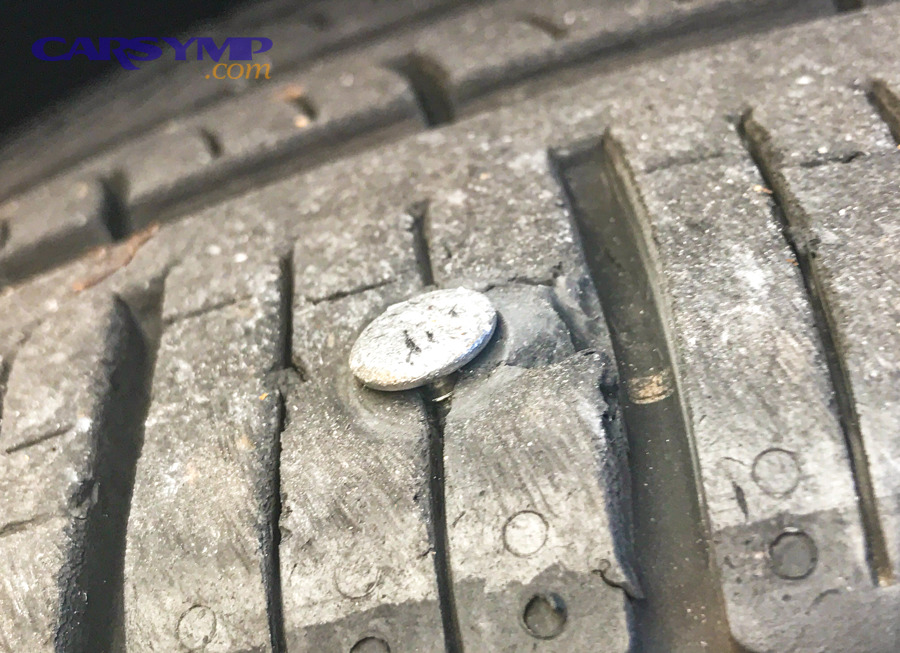
Is it safe to drive on a punctured tire until you reach a shop?
No—driving on a punctured tire is not safe in many real-world cases because (1) air loss can accelerate without warning, (2) heat and sidewall flex can destroy the tire internally, and (3) the tire can fail suddenly under braking, cornering, or highway speed.
More importantly, even a “slow leak” can turn into permanent, unrepairable damage if the tire is run underinflated long enough.
Specifically, here’s what makes “just a short drive” risky:
- Pressure loss is rarely linear. A screw can seal itself at rest, then leak faster when the tread blocks flex under load. Temperature swings can also change leak rate.
- Underinflation amplifies sidewall flex. The sidewall bends more each rotation, which builds heat and can cause internal separations you can’t see from the outside.
- Handling changes immediately. A low tire can pull the car, lengthen stopping distances, and reduce stability—especially in wet conditions.
If you must move the vehicle (for safety), the lowest-risk approach is: slow speed, shortest distance, hazards on, avoid hard turns/braking, and stop the moment the tire feels unstable or looks deformed.
What’s the real risk: air loss, heat buildup, or a blowout?
The real risk is a chain reaction: air loss → extra flex → heat buildup → internal damage → possible rapid deflation or failure.
In addition, the tire’s internal cords and belts can be damaged by driving even short distances while low, and that damage may not be visible until the tire is removed and inspected.
For example, when pressure drops, the tire does more “work” flexing as it rolls. That repeated flexing generates heat, and heat accelerates material fatigue. This is why a puncture that might have been repairable at first can become non-repairable after being driven on while underinflated.
Evidence: According to a study by Williams College from the Center for Environmental Studies, in 2010, vehicles with under-inflated tires overall experienced a fuel economy loss range from 0.225% to 8.325%, reflecting how common and impactful underinflation can be in everyday fleets. (sustainability.williams.edu)
Which punctures are repairable vs unrepairable (based on location, size, and damage type)?
There are 3 main ways a puncture becomes unrepairable—location, size/shape, and damage type—because these factors determine whether a repair can seal the inner liner and preserve the tire’s structure.
Next, use the same criteria professional tire organizations and manufacturers use, so your decision matches real shop policy.
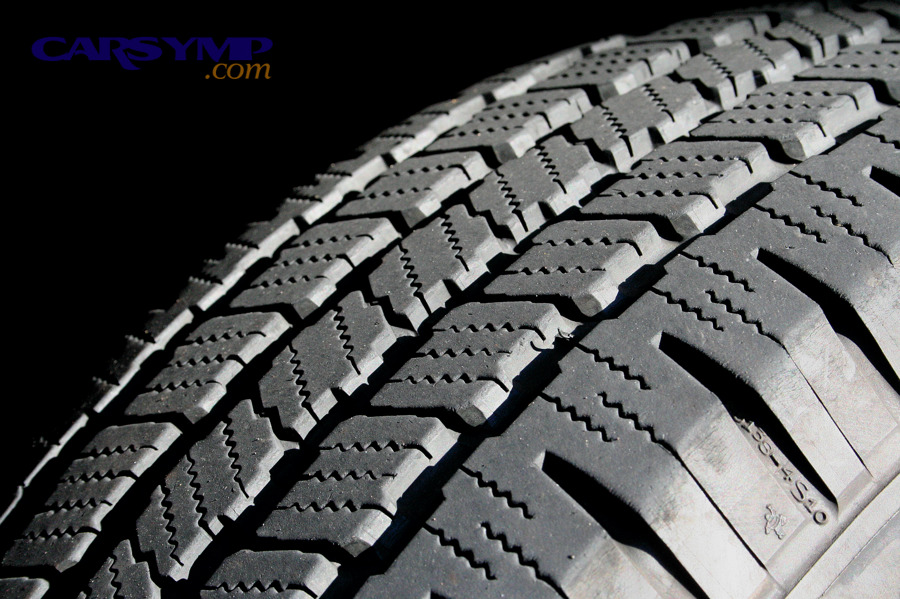
Before the details, here’s a quick reference table explaining what the repair rules mean in practice:
| Factor | Usually Repairable | Usually Not Repairable | Why it matters |
|---|---|---|---|
| Location | Center tread/crown area | Shoulder or sidewall | Sidewall/shoulder flex too much; repairs can’t reliably hold |
| Size | Small, round puncture (≤ 1/4 in / 6 mm) | Larger hole, tear, or elongated damage | Bigger injuries can’t be sealed and reinforced safely |
| Internal condition | No run-flat damage; liner intact | Driven flat/low, cords exposed, bulge, separation | Hidden internal damage makes failure more likely |
These thresholds are consistent with widely published tire repair guidance: repairs are limited to the center tread area and punctures larger than 1/4 inch (6 mm) should not be repaired. (tireindustry.org)
Which puncture locations are non-repairable (sidewall, shoulder, near edge)?
Punctures in the sidewall or shoulder are considered non-repairable because these areas flex the most and carry high stress, making repairs unreliable and unsafe.
To illustrate, imagine the tire as a bending spring: the sidewall is designed to flex constantly, so any injury there is under repeated strain.
Most repair policies limit repairs to the crown/center tread area and exclude shoulder/sidewall damage. (tireindustry.org)
Practical “at-a-glance” location cues:
- Center tread (good candidate): roughly the middle ribs/blocks, away from the outer shoulder.
- Shoulder (bad candidate): the curved transition where tread meets sidewall.
- Sidewall (non-repairable): any puncture on the vertical side area, even if it “looks small.”
How big is “too big” (diameter, tear, elongated hole)?
“Too big” generally means larger than 1/4 inch (6 mm) in the tread, or any injury that isn’t a clean puncture (like a tear, gash, or elongated hole).
More specifically, the shape matters as much as diameter: a bolt or jagged metal can “ream” the rubber, leaving an irregular channel that can’t be sealed properly.
Consumer and industry repair guidance commonly sets the 1/4 inch (6 mm) maximum for tread punctures and warns against repairing larger damage. (tireindustry.org)
What damage types make a tire non-repairable (run-flat damage, bulges, cord exposure, multiple injuries)?
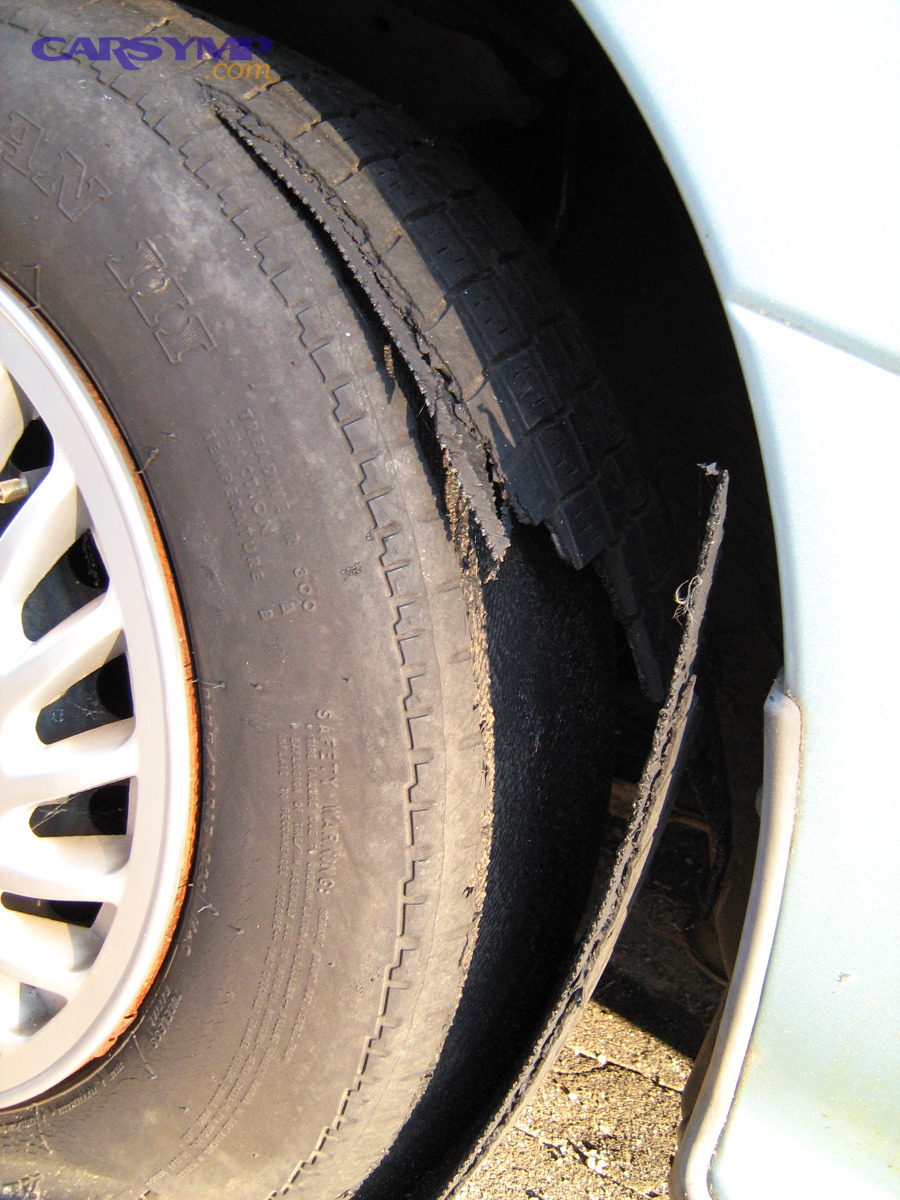
A tire becomes non-repairable if it has structural damage, not just an air leak—especially if it was driven on while flat/very low, shows a bulge, has cord exposure, or has multiple injuries that overlap.
Besides the puncture itself, the hidden danger is internal: the tire can look “fine” outside while the inner liner and body plies are compromised.
Common non-repairable damage types:
- Driven-flat damage: shredded inner liner, melted rubber dust inside, or sidewall creasing.
- Bulge / “hernia”: indicates damaged cords—replacement is the safe move.
- Cord or belt exposure: any visible cords mean the tire’s structure is compromised.
- Multiple punctures too close together: repairs that overlap are typically not permitted.
Plug vs patch vs plug-patch: which methods are considered safe?
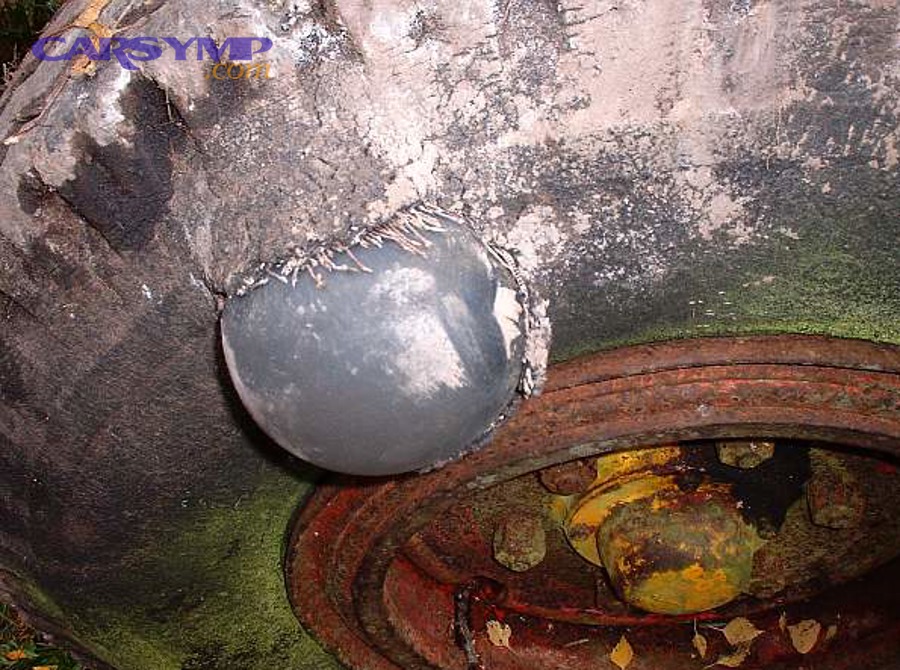
A plug-patch combination is widely considered the proper repair approach because it fills the injury channel (plug/stem) and seals the inner liner (patch). A plug alone is typically considered unacceptable for a permanent repair.
Meanwhile, a patch alone may not fill the puncture pathway fully, which can allow moisture intrusion and belt damage over time.
Repair guidance from tire industry organizations emphasizes that the tire should be removed and inspected internally, and that a plug plus patch method is used rather than a plug alone. (ustires.org)
What quick checks can drivers do before going to a shop (without unsafe DIY)?
You can do 4 quick checks—visual inspection, air-pressure check, leak confirmation, and damage red-flag scan—to decide whether to drive, tow, or use a temporary mobility option.
Then, you can communicate better with a tire shop and avoid “trial-and-error” fixes that make the tire unrepairable.
How do you find the puncture and confirm the leak without removing the tire?
You can confirm a leak by listening, looking, and using soapy water on the tread area—without removing the tire—then watching for bubbles that grow steadily.
Next, match what you see to risk: a nail in the center tread with a slow bubble stream is often a repair candidate; sidewall damage is not.
A safe, quick process:
- Check the valve stem and cap first. A loose core or cracked stem can mimic a puncture.
- Look for shiny metal in the tread. Rotate the wheel slightly if needed to see the full contact patch.
- Spray soapy water (dish soap + water) on the suspected spot and valve area.
- Watch the bubble pattern:
- Fast expanding bubbles = faster leak, higher risk to drive.
- Tiny, slow bubbles = slow leak, still needs prompt attention.
If the tire is already very low, inflate only enough to inspect safely—don’t keep inflating if the sidewall looks distorted or the tire won’t hold pressure.
Should you use a tire plug kit on the roadside?
No—using a roadside plug kit is often not the safest choice because (1) you can’t inspect the tire internally, (2) you may worsen an irregular injury, and (3) a plug-only repair may not meet accepted permanent repair methods.
However, a roadside plug may still be used by some drivers as a temporary measure in emergencies—but you should treat it as “get-me-home,” not a final fix.
More importantly, the safest plan is: spare tire → professional inspection → proper internal repair or replacement, depending on location/size/damage.
How to use a tire inflator and sealant safely
Using a tire inflator/sealant kit safely is a short method with 6 steps—secure the scene, verify eligible damage, connect, inject, inflate, and re-check—to restore temporary mobility without turning a small puncture into a bigger problem.
Then, you must treat the result as temporary and get the tire professionally inspected.
A practical safety-first walkthrough:
- Move to a safe area (flat, away from traffic), hazards on, parking brake set.
- Inspect the tire for obvious sidewall damage, a ripped tread, or a blown-out section—if you see those, don’t use sealant; call for help.
- Do not remove the foreign object in many cases unless your kit instructions tell you to—removing it can cause rapid deflation. (Many OEM instructions explicitly warn not to remove it.) (fordservicecontent.com)
- Connect the hose to the valve and follow your kit order (some inject sealant first, then inflate).
- Inflate to the vehicle placard PSI (door jamb spec), not the tire sidewall maximum.
- Drive a short distance slowly (often 5–10 minutes) to distribute sealant, then re-check pressure.
Important safety constraints commonly included in reputable guidance:
- Kits generally work only for small tread punctures, not sidewall damage. (ace.aaa.com)
- Treat sealant as a temporary solution and avoid high speeds/long distances until inspected. (michelin.co.uk)
You may also watch one clear demonstration video (example OEM guidance style):
What should you tell the tire shop if you used sealant (TPMS considerations)?
Tell the shop you used sealant because it affects cleanup, inspection, and sometimes sensor service—especially if your car uses in-wheel TPMS sensors.
In addition, be specific: tell them which wheel, what product, and how far you drove after injection, because those details help them decide whether a repair is still possible.
Key points to communicate:
- “I used sealant on the front-right tire and drove about X miles.”
- “The puncture was in the tread / near the shoulder” (if you know).
- “The tire lost pressure again / held pressure.”
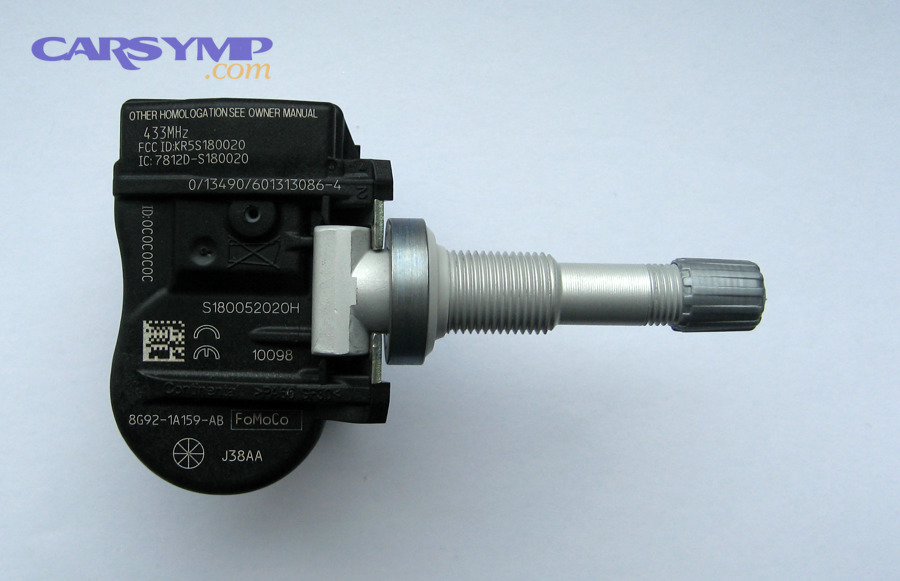
For TPMS: many products and OEM instructions emphasize that the technician should be informed because sealant may need to be cleaned from the wheel and sensor area. (fordservicecontent.com)
And if your dash light stays on afterward, you may need a TPMS reset after fixing a flat—but the correct procedure depends on your vehicle (some relearn automatically after driving, others require a menu reset, and some require a scan tool). The safest rule is: follow your owner’s manual and let the shop confirm pressures and sensor status after the tire is repaired or replaced.
When the puncture can’t be repaired, what should you do next (replace one tire or more)?
When a puncture can’t be repaired, the best next move is to replace the tire in a way that preserves balanced traction and matched rolling diameter—often one tire on 2WD, but frequently a pair or all four on AWD/4WD depending on tread depth differences.
Next, the goal is to restore predictable handling and avoid mechanical stress, not just “fix flat tire and move on.”
Should you replace one tire, two tires, or all four?
As a general rule: one tire can be acceptable when the remaining tires are close in tread depth and the replacement matches size/spec; two tires is common when the opposite tire on the same axle is noticeably worn; and all four is often recommended when tread differences are large or when the vehicle’s drivetrain demands matched rolling diameter.
Practical decision logic (driver-friendly):
- Replace 1 tire if the other three are still quite new (minimal tread difference) and you can match the exact size/spec and, ideally, the same model.
- Replace 2 tires (a pair) if the tire on the same axle is moderately worn compared to new.
- Replace all 4 if tread depths are far apart, the vehicle is AWD/4WD with strict matching requirements, or the remaining tires are near end-of-life.
For general safety, tire guidance often recommends keeping the best tread on the rear axle for stability when only two tires are replaced. (michelinman.com)
How do AWD/4WD systems change the answer (tread depth matching)?
AWD/4WD changes the answer because mismatched tires can create different rolling circumferences, forcing the drivetrain to compensate constantly—raising wear and heat in components designed for occasional differences, not permanent mismatch.
More importantly, many manufacturers specify a maximum allowable difference between tires (often expressed as tread depth or circumference), and exceeding it can cause problems.
A commonly cited guideline is that manufacturers may require all four tires remain within 2/32 to 4/32 inch of each other in remaining tread depth, and some (like Subaru examples) reference a tight rolling circumference tolerance. (tirerack.com)
Can tire shaving help you replace only one tire?
Yes—tire shaving can allow a single replacement tire to match the tread depth of the other tires, which can be a cost-effective alternative to replacing all four on AWD/4WD vehicles when the other tires still have meaningful life left.
However, this only works when the shop can source the exact tire and shave it precisely to the measured tread depth you need.
Tire shaving is specifically discussed as a solution to match tread depth and avoid driveline stress while replacing only one tire. (tirerack.com)
What to do if you don’t have a spare (temporary mobility options)?
If you don’t have a spare, your best temporary mobility options are inflator/sealant (if eligible), roadside assistance/tow, or a run-flat/self-sealing strategy if equipped—chosen based on the type and location of damage.
In addition, avoid “forcing it home” on a clearly failing tire, because that can destroy the casing and wheel and turn a manageable replacement into a bigger repair bill.
A simple decision tree:
- Small tread puncture, no sidewall damage: inflator/sealant kit may help temporarily. (ace.aaa.com)
- Sidewall/shoulder damage, bulge, shredded tread, or rapid deflation: tow/roadside assistance.
- Equipped with run-flat tires: follow the tire maker’s distance/speed limits and replace as needed. (michelinman.com)
Contextual border: At this point, you can reliably decide whether a puncture is unrepairable and what replacement strategy keeps your vehicle safe and stable; the remaining section expands into special cases that can change the rules.
What rare or special-case factors can change whether a puncture is repairable?
Rare or special-case factors—like run-flat constructions, self-sealing layers, motorcycle tire rules, commercial tire policies, and prior repairs—can override “normal” repairability guidelines and change what’s safe or allowed.
Next, use these exceptions to avoid surprises when a shop tells you “no” even though the puncture looks small.
Can run-flat or self-sealing tires still be “unrepairable”?
Yes—run-flat and self-sealing tires can still be unrepairable because the internal damage rules still apply, and driving on a deflated run-flat can permanently harm the tire even if it temporarily supports the vehicle.
For example, tire makers often describe run-flat capability as limited distance and speed, not as permission to keep using the tire indefinitely.
Some tire guidance notes that certain run-flat tires may allow driving up to about 50 miles at 50 mph (varies by model and conditions), after which the tire typically requires professional inspection and often replacement. (africa.michelin.com)
Self-sealing technologies may seal small tread penetrations, but repair limits and inspection still apply. (michelinman.com)
Does a puncture in a motorcycle tire follow different rules?
Yes—motorcycle tires often follow stricter rules because of higher sensitivity to imbalance, different constructions, and manufacturer-specific limits on puncture size, speed rating, and number of repairs allowed.
Meanwhile, some guidance distinguishes repairability based on the tire’s speed rating and limits the number of repairs allowed.
For example, Michelin’s motorcycle guidance references different maximum puncture diameters depending on speed rating categories. (michelin.co.uk)
What about commercial truck tires or LT tires?
Commercial truck and LT tires often have different repair policies based on casing value, load range, and service conditions—but they still require internal inspection and may be rejected for heat/run-flat damage, belt separations, or sidewall injuries.
In addition, fleets may follow stricter policy to reduce liability: “repairable” isn’t just engineering—it’s also risk management.
The practical takeaway: if it’s a work truck, high load range tire, or commercial casing, let a trained technician inspect it internally and follow the tire maker’s service manual/policy.
What if the tire was repaired before (overlap, improper repair)?
A prior repair can make a new puncture unrepairable if repairs would overlap, if the earlier repair was done incorrectly (for example, an outside-in plug-only fix), or if the tire shows internal damage around the repair area.
More specifically, repair guidance commonly states that repairs should not overlap and that the tire must be demounted for internal inspection—meaning a “mystery repair” in the casing can lead to a rejection.
Overlapping repairs and plug-only approaches are repeatedly flagged as unacceptable in mainstream tire repair guidance. (ustires.org)