


Most engine knock can be prevented with routine maintenance because maintenance directly controls the three things that trigger abnormal combustion: fuel resistance to detonation, combustion temperature, and ignition accuracy. When you keep those three stable, the engine stays out of the “pinging” zone even under load.
Next, you’ll learn what engine knock actually is (and what it isn’t), so you can stop guessing and start fixing the right system. That clarity matters because many “knocks” are not combustion knock at all—they’re mechanical rattles that maintenance won’t solve.
Then, you’ll get a prioritized maintenance checklist that targets the most common knock causes first, plus a DIY triage workflow to narrow down your likely culprit before you spend money. The goal is not to become a mechanic; it’s to make smart, low-risk decisions.
Introduce a new idea: below is a driver-friendly, step-by-step structure that starts with safety and certainty, then moves into prevention, diagnosis, and long-term routines—so every section builds naturally into the next.
Can routine maintenance prevent engine knock (yes/no)?
Yes—routine maintenance can prevent engine knock in most daily-driven engines because it (1) keeps fuel and air delivery consistent, (2) prevents overheating and hot spots, and (3) maintains correct ignition timing and spark quality.
To begin, engine knock prevention works best when you treat it like risk reduction: you lower the conditions that allow detonation to start, rather than hoping one “magic fix” will stop it.
Is it safe to keep driving when you hear knocking (yes/no)?
No—driving with active knocking is not “safe” because continued knock can damage pistons, rings, bearings, and spark plugs, and the risk rises sharply under heavy load, high heat, or sustained acceleration.
Next, safe decisions come from pattern recognition, not panic. Use Safe-to-drive guidance for knocking sounds by matching the sound to a scenario: light ping only during hard acceleration is less urgent than heavy knock at idle, and any knock that appears suddenly and gets worse quickly deserves immediate caution.
Use these quick rules before you keep driving:
- Stop driving (or drive only to a nearby safe place) if the knock is loud, constant, or present at idle; if the engine feels weak; if the temperature gauge rises; or if the check engine light flashes.
- Reduce load immediately if you hear pinging under acceleration: ease off throttle, avoid climbing in too high a gear, and avoid towing until you diagnose it.
- Treat it as urgent if you also hear metallic rattling plus misfire, smoke, or a burning smell.
This is where a simple truth helps: knock is often the engine telling you it is operating too close to its limit. Maintenance moves that limit farther away.
Do higher-octane fuel and additives stop knock permanently (yes/no)?
No—higher-octane fuel or additives rarely stop knock permanently because they may reduce symptoms while the underlying cause (heat, deposits, lean conditions, incorrect ignition parts, or cooling issues) keeps building pressure toward knock.
Then, octane becomes a tool rather than a crutch. Higher octane can help when:
- Your engine is designed for premium but you’ve been using regular
- You’re hearing light pinging under heavy load or high heat
- Carbon deposits have raised effective compression
However, octane usually will not solve:
- Overheating from cooling-system faults
- Incorrect spark plugs (wrong heat range, gap, or type)
- Vacuum leaks or sensor problems that create a lean mixture
- Injector problems causing uneven fueling
If the ping disappears with higher-octane fuel, that’s useful information—but treat it as a diagnostic clue, not the finish line.
What is engine knock (pinging/detonation) in simple terms?
Engine knock is an abnormal combustion event in a spark-ignition engine where part of the air-fuel mixture auto-ignites after the spark begins normal burning, creating pressure waves that sound like metallic pinging and stress the engine.
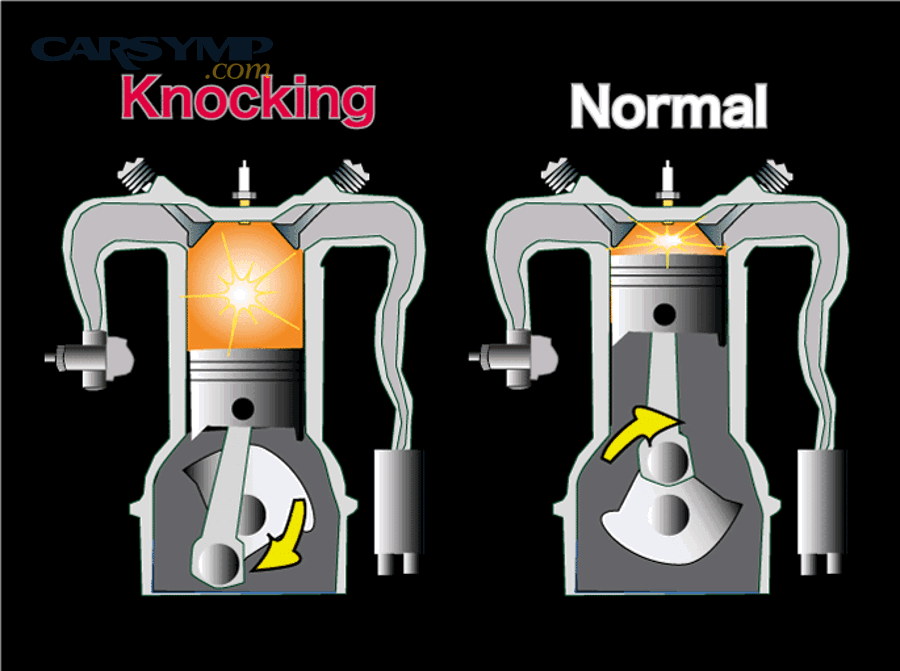
To better understand why maintenance prevents it, connect knock to conditions: knock is more likely when the cylinder is hot, pressure is high, the mixture is unstable, or ignition timing is too advanced for the fuel being used.
In plain language, normal combustion is a controlled “push” on the piston; knock is an uncontrolled “hammering” that happens when leftover mixture ignites at the wrong time. That’s why consistent terminology matters: engine knock = pinging/detonation (synonyms in everyday usage), while pre-ignition is a different event that can sometimes lead to severe knock.
What causes knock during acceleration or climbing hills?
Knock during acceleration usually happens because cylinder pressure and temperature spike under load, and the fuel or combustion conditions cannot resist auto-ignition, so detonation occurs at the worst moment—when the engine is working hardest.
Specifically, acceleration knock commonly points to one (or more) of these causes:
- Fuel mismatch: octane too low for your engine’s demands, especially in heat or at high load
- Carbon deposits: deposits raise compression and create hot spots that trigger knock
- Overheating or heat soak: cooling system weak, radiator airflow reduced, or high intake air temperature
- Lean mixture: vacuum leaks, dirty MAF/MAP, fuel delivery issues, or injector imbalance
- Ignition issues: wrong spark plugs, worn plugs, weak coils, or timing control problems
- EGR/PCV-related deposit pathways: in some engines, these systems increase deposit formation and raise knock tendency
The key is cause mapping: acceleration knock is often combustion-related, so maintenance that stabilizes fuel, spark, and temperature has the biggest payoff.
What causes knock at idle vs at speed?
Knock at speed is more often combustion knock, while knock at idle is more often mechanical noise; the best Knock at idle vs acceleration clues come from when the sound appears, whether it changes with engine load, and whether it sounds sharp (ping) or dull (thud).
However, don’t oversimplify. Use this comparison as a practical filter:
If it knocks mostly under acceleration (load):
- Likely combustion knock (pinging/detonation)
- More sensitive to octane, heat, deposits, lean conditions, and ignition timing
- Often improves when you reduce throttle
If it knocks at idle (no load):
- More likely mechanical or accessory-related (engine mounts, pulleys, heat shields, loose brackets)
- Could also be severe combustion issues (misfire, wrong plugs, very lean idle, injector faults)
- Often changes with RPM but not necessarily with road speed
A good knocking noise diagnosis starts by asking one question: Does the sound track engine load (combustion) or engine motion/vibration (mechanical)? That single distinction prevents a lot of wasted parts.
Which maintenance items prevent engine knock most effectively?
There are 5 main maintenance “levers” that prevent engine knock—fuel quality, ignition health, air/fuel control, cooling efficiency, and deposit control—because each lever reduces the temperature/pressure instability that triggers detonation.
More importantly, you should prioritize levers that remove risk quickly before you chase rare causes. A driver who changes oil but ignores coolant condition, spark plugs, and air leaks often stays stuck in the knock cycle.
Which fuel and intake maintenance steps reduce knock risk fastest?
There are 6 high-impact fuel and intake steps—use the correct octane, buy quality fuel, replace the air filter, check for vacuum leaks, clean key sensors when appropriate, and ensure the throttle path isn’t restricted—because stable airflow and correct fuel resistance reduce detonation tendency.
Then, treat “fuel and air” like a matched pair:
- Use the octane your engine requires
- If the manual says premium is required, regular fuel can cause persistent pinging under load.
- If premium is only recommended, you may still benefit from premium in heat, towing, or mountain driving.
- Choose consistent, detergent-rich fuel
- Good detergency helps slow deposit buildup and injector fouling over time.
- Replace the engine air filter on schedule
- A restricted filter can alter airflow patterns and contribute to poor combustion stability in some conditions.
- Check for vacuum leaks
- Vacuum leaks create a lean mixture that burns hotter and increases knock risk.
- Listen for hissing, inspect cracked hoses, and pay attention to idle changes.
- Clean MAF/MAP sensors only when appropriate
- A dirty airflow sensor can skew fueling, pushing mixtures lean under certain conditions.
- Use the correct sensor-safe cleaner and avoid touching the element.
- Address intake restriction and heat management
- A clogged air path or heat-soaked intake can raise intake air temperature, reducing knock margin.
When these basics are right, many “mystery pings” disappear without deeper repairs.
Which ignition maintenance steps prevent pinging and misfire-related knock?
There are 5 ignition steps that most directly prevent pinging—install the correct spark plugs, maintain correct plug gap, replace worn coils when failing, keep timing control healthy, and avoid mismatched aftermarket parts—because ignition consistency prevents abnormal pressure spikes and incomplete combustion.
Next, treat spark plugs as precision parts, not generic hardware:
- Use the exact plug type specified (material, heat range, and reach matter)
- Respect the service interval—worn plugs can misfire under load, increasing heat and knock tendency
- Check gap if your engine uses serviceable plugs; excessive gap stresses coils and can create weak spark events
- Replace coils when symptoms match (misfire codes, load misfires, intermittent stumble)
A simple best practice is to avoid “upgrades” that change heat range unless you have a tuning reason. The wrong heat range can either run too hot (raising knock risk) or foul and misfire (creating unstable combustion).

Which cooling-system maintenance steps prevent knock from overheating?
There are 6 cooling-system maintenance checks—coolant level/condition, pressure integrity, fan operation, thermostat behavior, radiator airflow, leak prevention—because temperature control directly increases knock resistance by lowering combustion-chamber hot spots and intake heat soak.
To better understand why this matters, remember: hot engines knock more easily. Cooling maintenance is not just about avoiding overheating; it’s about maintaining a stable thermal environment.
Practical steps:
- Check coolant level and concentration (low coolant reduces heat transfer and raises local hot spots)
- Inspect for leaks (hoses, radiator seams, water pump weep holes)
- Confirm radiator fans work (especially at idle and in traffic)
- Watch temperature behavior (rapid swings can indicate thermostat issues)
- Keep the radiator and condenser fins clear (blocked airflow increases temps, especially in summer)
- Replace the pressure cap when weak (low system pressure lowers boiling point and increases hot-spot risk)
If knock shows up primarily in traffic or after long climbs, cooling system health should be near the top of your list.
Which oil and engine-cleanliness steps reduce carbon-related knock?
There are 5 oil and cleanliness steps that reduce carbon-related knock—use the correct oil spec, keep change intervals consistent, maintain PCV function, address excessive oil consumption, and use deposit-control strategies for your engine type—because deposits raise compression and create hot spots that trigger detonation.
Besides, oil is not only lubrication; it’s part of combustion cleanliness. When oil quality degrades or consumption rises, deposits can accelerate.
A practical approach:
- Use the oil specification and viscosity your engine calls for (especially in turbo engines)
- Follow severe-service intervals if you do short trips, towing, or lots of idling
- Ensure the PCV system is functioning (a failing PCV can increase oil vapor in the intake and deposit formation)
- Address oil consumption early (burning oil can create deposits that increase knock risk)
- Target deposits intelligently
- For port-injected engines, injector cleanliness and combustion chamber deposits are common focus areas
- For direct-injection engines, intake valve deposits may require different strategies
According to a 2024 open-access dissertation by Michigan Technological University (Mechanical/Automotive engineering research), modern spark-ignition knock behavior is strongly influenced by operating conditions and factors that alter end-gas auto-ignition tendency, reinforcing why controlling heat, mixture stability, and deposits through maintenance improves knock resistance.
How do you diagnose knock using DIY checks before paying a shop?
There are 4 practical DIY stages to diagnose engine knock—pattern logging, quick safety checks, OBD scan and basic inspections, and targeted tests—because structured elimination prevents you from replacing parts blindly.
Next, DIY diagnosis is about safe certainty. You are not trying to “tune” the engine; you are trying to identify which system is most likely at fault so your maintenance choices become precise.
What DIY listening tests and inspection steps confirm it’s combustion knock?
There are 5 DIY listening and inspection steps that confirm combustion knock—identify the trigger condition, separate engine RPM from road speed, reduce load to see if the sound fades, eliminate common rattles, and check for heat-related patterns—because true detonation tracks load and heat more than vibration alone.
Then, run a safe checklist:
- Log when it happens
- Only under hard throttle? Only uphill? Only hot? Only with AC on?
- Does it disappear when you lift the throttle? That’s a strong combustion clue.
- Separate engine speed from vehicle speed
- If it happens in neutral with quick blips (carefully), it may be mechanical.
- If it mainly happens under load in gear, it’s more likely combustion-related.
- Perform a “load reduction” test
- Downshift instead of lugging the engine.
- If the knock reduces when RPM rises slightly (less load per combustion event), detonation becomes more likely.
- Eliminate common non-combustion noises
- Loose heat shields, worn mounts, exhaust contact points, accessory pulleys, and brackets can mimic knock.
- A mechanic’s stethoscope can help, but even careful listening around the engine bay (when safe) can narrow it down.
- Check heat patterns
- Knock that appears only after a long drive or in traffic often ties to heat soak or cooling weakness.
This is the “knocking noise diagnosis” step that saves money: you decide whether you’re chasing combustion control or chasing mechanical vibration.
What OBD2 clues (codes and data) point to knock-related causes?
There are 6 common OBD2 clues that point to knock-related causes—misfire codes, lean-condition codes, fuel trim extremes, high coolant temperature, abnormal intake air temperature behavior, and knock-related timing correction (when visible)—because the ECU logs the conditions that raise knock risk.
To better understand, think of OBD2 as a “trend recorder.” Even when you can’t see knock directly, you can see the environment that causes it.
Key clues:
- Misfire codes (P0300–P030X): can indicate ignition weakness or fueling imbalance that increases heat and instability
- Lean codes (often P0171/P0174): point to vacuum leaks, MAF issues, or fuel delivery problems
- Fuel trim extremes: long-term trims far positive suggest lean compensation; far negative can indicate rich correction or sensor issues
- Coolant temperature issues: overheating is a knock amplifier
- IAT trends: very high intake temperatures reduce knock margin
- Timing/knock correction visibility: some scan tools show timing advance and knock retard behavior (varies by vehicle)

If you see lean codes plus pinging under load, you have a strong direction: fix the lean condition before you chase exotic causes.
What are the top “maintenance-fixable” causes vs “repair-needed” causes?
Maintenance wins for fuel quality, ignition wear, minor air leaks, cooling service, and mild deposit control, while repair is often required for injector failures, compression problems, timing-component wear, severe deposits, and persistent overheating faults.
Meanwhile, this comparison prevents false optimism:
More often maintenance-fixable:
- Wrong octane for the engine’s demand
- Worn spark plugs or incorrect plug type
- Dirty air filter or skewed airflow sensing
- Minor vacuum leaks
- Early-stage cooling inefficiency (low coolant, weak cap, fan issues)
- Mild deposits that respond to proper routine and fuel quality
More often repair-needed:
- Failing injector(s) causing uneven fueling under load
- Compression or mechanical wear issues
- Persistent timing chain/belt timing problems
- Severe combustion chamber deposits or DI-related issues requiring deeper intervention
- Cooling system component failure (water pump, radiator internal blockage)
According to an SAE-reviewed research paper on knock deterioration due to accumulated carbon deposits (2019), deposit accumulation can measurably worsen knock tendency by altering combustion conditions—supporting why deposit prevention is a long-term maintenance strategy, not a one-time fix.
What is the step-by-step maintenance checklist to prevent knock long-term?
A practical knock-prevention plan uses 4 phases—today’s risk reduction, this week’s inspections, next-service replacements, and ongoing habits—to reduce knock frequency and protect the engine by improving fuel resistance, spark consistency, and temperature control.
More specifically, this checklist keeps you from doing everything at once while still making quick progress.
What should you do today if your engine knocks occasionally?
There are 6 “today” actions—reduce load, verify fuel choice, check oil and coolant, scan for codes, rule out obvious rattles, and avoid lugging—because they cut knock risk immediately while you gather the clues needed for an accurate fix.
Then, do the safest, highest-impact steps first:
- Ease off and reduce load immediately
- Knock under heavy throttle is the scenario most likely to cause harm.
- Confirm your last fuel fill
- If you used a lower octane than required, correct it on the next fill and avoid heavy load until then.
- Check oil level and coolant level
- Low oil can raise temps and stress components; low coolant can create hot spots fast.
- Scan for codes (even if the light is off)
- Pending codes can point to lean conditions, misfires, or sensor issues.
- Listen for non-combustion sources
- A loose heat shield or bracket can sound like knock and distract you from the real issue.
- Avoid lugging the engine
- Downshift rather than pushing hard at low RPM.
These steps align with safe-to-drive guidance for knocking sounds: the goal is to prevent a small problem from becoming a major repair while you move toward certainty.
What should be done at the next service interval to stop knock from returning?
There are 7 next-service items—install correct spark plugs, evaluate coils if misfire symptoms exist, replace air filter, inspect for vacuum leaks, confirm oil spec/interval, service cooling system as needed, and address deposit control—because long-term prevention requires stable combustion conditions, not just symptom suppression.
In addition, build your service plan around what your clues suggest:
- If knock is load-related: prioritize octane correctness, plugs, cooling margins, and lean-condition checks.
- If knock is heat-related (traffic/after long drive): prioritize coolant service, fan operation, radiator airflow, and thermostat behavior.
- If knock is intermittent plus roughness: prioritize ignition health and injector consistency.
A helpful maintenance order (for most drivers) looks like this:
- Spark plugs (correct spec, correct interval)
- Air filter + vacuum leak inspection
- Cooling check (levels, fans, leaks, temperature behavior)
- Oil spec verification + interval alignment to your driving style
- Fuel quality consistency + deposit-control strategy
- Injector assessment if symptoms persist
According to a 2015 research-focused technical study on LSPI in turbocharged GDI engines and its relationship to engine oil design, lubricant choice and operating conditions can influence abnormal combustion events, which supports why “correct oil spec and interval” is not optional in certain modern engines.
How can you prevent knock with driving habits and load management?
There are 5 driving habits that prevent knock—avoid lugging, manage heat soak, use the right gear on hills, reduce sustained high-load operation when hot, and address early symptoms quickly—because driving style changes cylinder pressure and temperature faster than any part can.
Especially, habits matter most in summer, towing, and stop-and-go conditions:
- Downshift on hills instead of wide-open throttle at low RPM
- Let the engine cool after heavy load (short idle or gentle driving) to reduce heat soak
- Avoid repeated full-throttle pulls when intake temps are high
- Keep up with maintenance intervals that match your use (short trips are severe service)
- Treat new knock as a signal—if it starts suddenly, investigate now rather than later
Driving habits do not replace maintenance, but they extend the benefits of maintenance by keeping the engine out of high-risk knock conditions.
Contextual border: At this point, you’ve covered the core maintenance checklist and DIY workflow. The next section expands into specialized cases—turbo GDI/LSPI and diesel “knock”—to deepen semantic coverage and prevent misdiagnosis.
How does knock prevention change for turbo GDI engines (LSPI) vs diesel engines?
Turbo GDI engines need stricter oil-spec discipline and lugging avoidance to reduce LSPI risk, while diesel engines require a different interpretation of “knock” because diesel combustion noise is not the same detonation mechanism as gasoline pinging/detonation.
However, this comparison is where many drivers get misled: the word “knock” describes multiple sounds, but the physics and prevention can differ.
What maintenance reduces LSPI risk in turbo GDI engines?
There are 5 LSPI-focused maintenance actions—use the exact oil specification, shorten intervals under severe use, keep spark plugs correct, maintain injector and intake cleanliness, and avoid low-RPM high-boost operation—because LSPI is tied to oil/fuel interactions and extreme pressure rise events in certain conditions.
Then, apply LSPI-specific discipline:
- Do not improvise oil viscosity or spec just because it “worked in another car.”
- Treat short trips as severe service—oil contamination and deposit formation rise.
- Avoid lugging in boost (high throttle at low RPM) because it increases LSPI exposure.
- Keep ignition parts exact—wrong plugs can shift heat and ignition stability.
According to a PhD thesis hosted by the University of Brighton on low-speed pre-ignition in turbocharged direct-injection engines, LSPI is a distinct abnormal combustion phenomenon with specific triggering conditions, which is why oil specification, severe-service intervals, and lugging avoidance matter more in some turbo GDI setups.
What’s the difference between diesel knock and gasoline knock (pinging/detonation)?
Gasoline knock is detonation of end-gas after spark initiation, while diesel “knock” is often the sharp combustion pressure rise associated with compression ignition timing and fuel injection characteristics, so prevention and diagnosis differ by fuel type and combustion method.
Meanwhile, here’s a practical way to avoid confusion:
- Gasoline detonation (pinging): more load-sensitive; often responds to octane, heat control, and ignition/fueling stability
- Diesel knock/clatter: often linked to injector spray/timing, cetane quality, and combustion noise characteristics—not octane
If you drive a diesel and hear a new, harsh clatter plus power loss or smoke, treat it as a diesel fuel/injection issue first, not a gasoline-style detonation problem.
When do carbon deposits become the dominant cause of knock, and what maintenance targets them?
Carbon deposits become a dominant knock cause when they raise effective compression, create hot spots, or disrupt airflow/fuel mixing, and the maintenance that targets them focuses on correct oil control, consistent quality fuel, and engine-specific deposit strategies rather than random “one-bottle fixes.”
To illustrate, deposits tend to become “dominant” when you notice:
- Knock appears more often over time under the same driving conditions
- Premium fuel temporarily reduces knock but it returns quickly
- The engine has lots of short-trip operation (deposit-friendly conditions)
Deposit-targeting maintenance is most effective when it is consistent:
- Correct oil spec + correct interval (reduces deposit precursors)
- Fuel quality consistency (detergent action over time)
- Engine-appropriate cleaning strategy (DI engines may need different approaches than port injection)
Can altitude, heat, and seasonal fuel blends increase knock even with good maintenance?
Yes—altitude, heat, and seasonal fuel blends can increase knock tendency even with good maintenance because they change air density, intake temperature, and fuel volatility, which shifts combustion conditions closer to detonation under load.
In short, good maintenance gives you margin, but weather and environment can still consume that margin:
- High heat raises intake temps and reduces knock resistance
- Heat soak after idling can make the first few accelerations knock-prone
- Seasonal blends can change volatility and behavior under certain conditions
- Altitude alters load behavior and can change how the engine reaches knock-limited operation depending on design
If your knock only appears during a summer heat wave or during towing in the mountains, your maintenance may be fine—your operating condition has simply become more demanding, so you adjust load management, fuel choice, and cooling margin accordingly.
Evidence (if any)
According to a 2024 dissertation by Michigan Technological University (automotive/engine research), knock behavior in modern spark-ignition engines is closely linked to conditions that influence end-gas auto-ignition, supporting the practical strategy of preventing knock by controlling heat, mixture stability, and deposits through maintenance.
According to an SAE technical paper (2019) on knock deterioration due to accumulated carbon deposits, deposit buildup can worsen knock tendency under certain loads, reinforcing why long-term deposit control is a maintenance priority rather than a one-time intervention.
According to a University-hosted PhD thesis from the University of Brighton on low-speed pre-ignition (LSPI) in turbocharged direct-injection engines, LSPI is a distinct abnormal combustion phenomenon with specific triggering conditions, which is why oil specification, severe-service intervals, and lugging avoidance matter more in some turbo GDI vehicles.