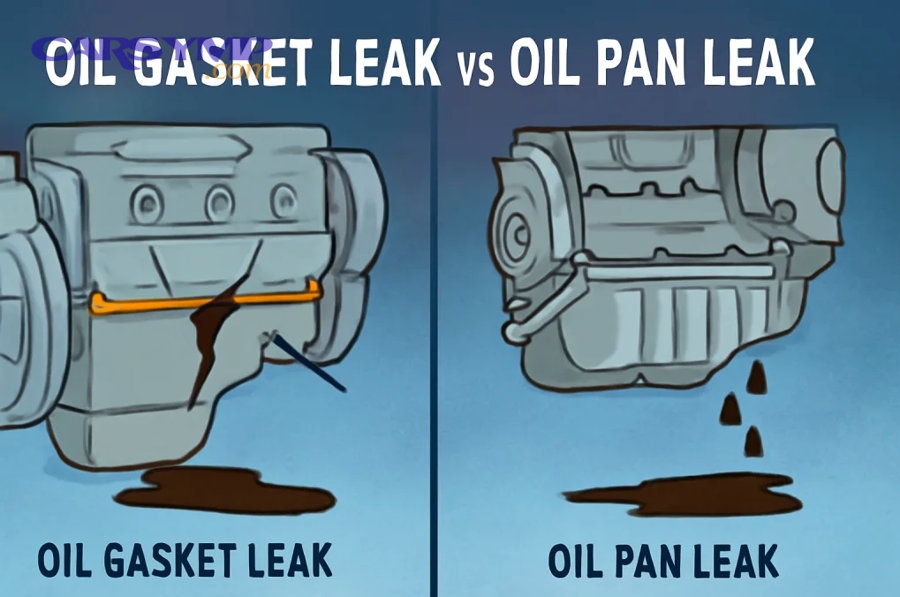
If you see oil collecting along the oil pan rail or dripping from the bottom of the engine, the safest assumption is not “the oil pan gasket is leaking,” but “oil is ending up at the pan.” In many cars, leaks from higher up (valve cover, timing cover, oil filter housing, drain plug) run downward and spread, making oil leaks mistaken for an oil pan gasket leak a common—and expensive—misdiagnosis.
Next, you’ll learn how to read leak clues like a mechanic: where the oil appears first, how gravity and airflow move it, and which “look-alike” leak sources most often fool car owners. That way, you can avoid jumping straight into an oil pan gasket replacement that doesn’t solve the problem.
Then, we’ll compare the biggest confusion pairs—valve cover vs oil pan gasket and rear main seal vs oil pan gasket—using simple location-based checks you can do with a flashlight, a mirror, and a clean engine surface. The goal is to pinpoint the highest wet point instead of the lowest drip.
Introduce a new idea: once you can identify the likely source, you’ll also know whether it’s safe to keep driving and what to do after any repair, including Post-repair leak check steps to confirm the leak is truly gone.
Definition — What does “oil leaks mistaken for an oil pan gasket leak” mean for car owners?
Oil leaks mistaken for an oil pan gasket leak are engine oil leaks whose true source is above or adjacent to the oil pan, but the oil migrates and collects at the pan, making the pan gasket look like the culprit even when it isn’t.
To better understand why this happens, you need to think like oil: it follows gravity, airflow, vibration, and surfaces that “wick” fluid.
Definition — What leak patterns make an oil pan gasket look guilty when it isn’t?
A true oil pan gasket leak usually creates fresh oil at the pan-to-block seam (the “rail”) and forms a consistent wet line that starts at that seam. The problem is that many other leaks create the same wet line—because oil runs down the engine block and spreads across the pan lip.
Here are the most common “false guilt” patterns that make the oil pan gasket look bad:
- Top-down wash: Oil begins high (valve cover gasket, cam seal, timing cover, oil filter housing) and forms a streak down the block. It eventually coats the pan rail and drips off the pan bolts or the lowest corner.
- Airflow smear: After driving, airflow under the car pushes oil backward. Oil that began at the front of the engine can end up dripping closer to the middle or rear, especially at highway speeds.
- Crossmember collection: Oil lands on the subframe/crossmember and drips from there. The drip point may be several inches away from the source.
- Undertray migration: Plastic splash shields and belly pans catch oil, then release it at the back edge. You may see drips that look “rearward” even if the leak is forward.
A quick mental rule helps: the drip point is rarely the origin point. The origin is usually the highest wet point you can find when inspecting from top to bottom.
Boolean — Is an oily oil pan always proof the oil pan gasket is leaking?
No—an oily oil pan is not proof the oil pan gasket is leaking, for three reasons: (1) gravity moves oil downward, (2) airflow spreads oil backward, and (3) surfaces like engine blocks and covers wick oil and hide the true starting point.
More importantly, the oil pan is the engine’s “collection bowl,” so it commonly gets coated even when the leak is above it.
To separate “oil collected on the pan” from “oil leaking at the pan gasket,” look for these stronger indicators of a true pan gasket leak:
- Fresh oil starting at the pan-to-block seam (not above it)
- A wet line that appears even after cleaning, returning first at the seam
- Oil beads forming along the seam while the engine is running (best seen with safe access and good lighting)
If those clues are missing, treat the oil pan gasket as suspect #2, not suspect #1.
Grouping — Which common leaks most often mimic an oil pan gasket leak?
There are three main groups of leaks that mimic an oil pan gasket leak: upper-engine runoff leaks, service-point leaks, and center/rear leaks, based on where oil starts and how it travels to the pan area.
Next, we’ll classify them by location so you can prioritize checks that are fast, cheap, and high-probability.
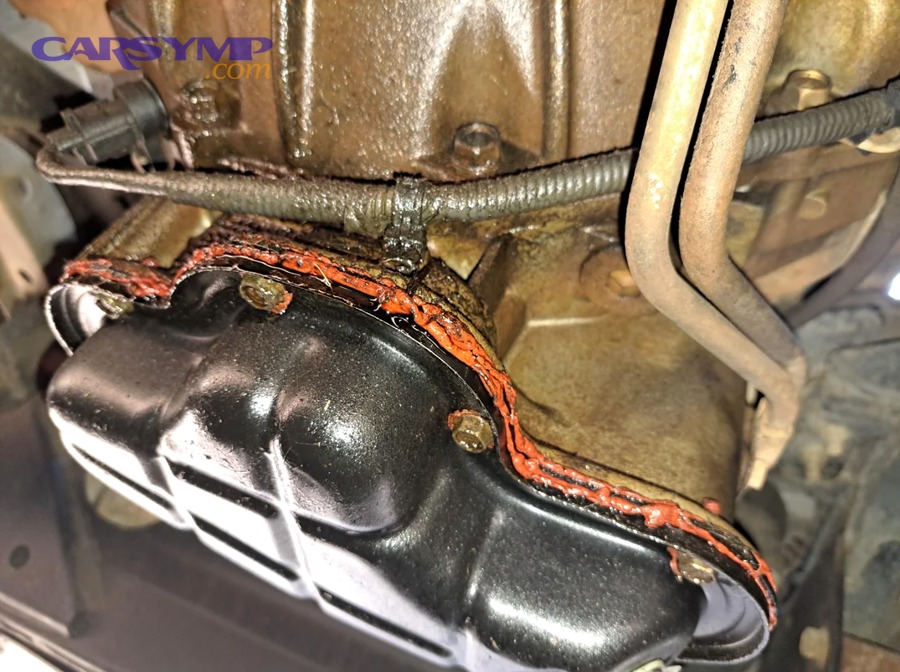
Grouping — Which upper-engine leaks drip down and imitate a pan leak (valve cover, timing cover, cam seals)?
Upper-engine leaks are the #1 reason people blame the oil pan gasket. These leaks start high, then “paint” the engine block with oil until the pan looks wet.
Common upper-engine sources:
- Valve cover gasket leak: Oil seeps from the top of the engine, often down the back of the head or along the sides. It can drip onto the exhaust manifold or down the block.
- Camshaft seal leak / cam cap seep: Often near the top front or top rear of the engine, sometimes hidden behind covers.
- Timing cover seep: Oil appears at the front of the engine and can run down to the front of the oil pan.
- Oil pressure switch/sender leak (engine-dependent): Can spray or seep and coat surrounding parts rapidly.
- PCV-related pressure push-out: Not a “leak point” itself, but excessive crankcase pressure can worsen gasket and seal leaks, making everything look like it’s leaking.
High-probability clue: if you see oil above the pan—especially on the block, head, or timing cover—assume runoff until proven otherwise.
Grouping — Which service-point leaks imitate a pan leak (drain plug, crush washer, oil filter, double gasket)?
Service-point leaks are common because they occur right after an oil change and create fresh drips that seem to come from “the pan area.”
Key service-point culprits:
- Drain plug leak: A worn crush washer, damaged gasket, or under/over-torqued plug can seep steadily.
- Stripped drain threads / damaged pan threads: Oil may leak around the plug area even with a new washer.
- Oil filter leak: A loose filter, a damaged filter gasket, or the infamous double-gasket (old gasket stuck to the housing) can dump oil quickly.
- Filter housing/oil cooler gasket leak: Many engines have an adapter or housing gasket above the pan line. It can mimic a pan gasket leak because oil runs down.
Simple timing clue: If the leak started right after service, check drain plug and filter before you suspect the pan gasket.
Grouping — Which “center/rear” leaks get blamed on the pan (rear main seal, oil separator plate, oil cooler housing)?
Center/rear leaks confuse people because oil spreads across the transmission case and the rear of the oil pan.
Common center/rear sources:
- Rear main seal leak: Oil appears at the engine-to-transmission junction (bellhousing seam). It may drip from a low point or inspection cover.
- Oil pan rear corner seep: A real pan gasket leak can occur at the rear corners, but it’s often confused with rear main seal.
- Oil separator plate / rear cover leak (engine-dependent): Some engines have a rear cover plate that can seep and look exactly like a rear main leak.
- Turbo oil feed/return lines (where equipped): Can leak and run down in deceptive ways.
Key concept: rear-area oil does not automatically equal rear main seal, and it does not automatically equal oil pan gasket. You need a pattern.
Comparison — How do valve cover vs oil pan gasket leaks differ by symptoms and oil trail location?
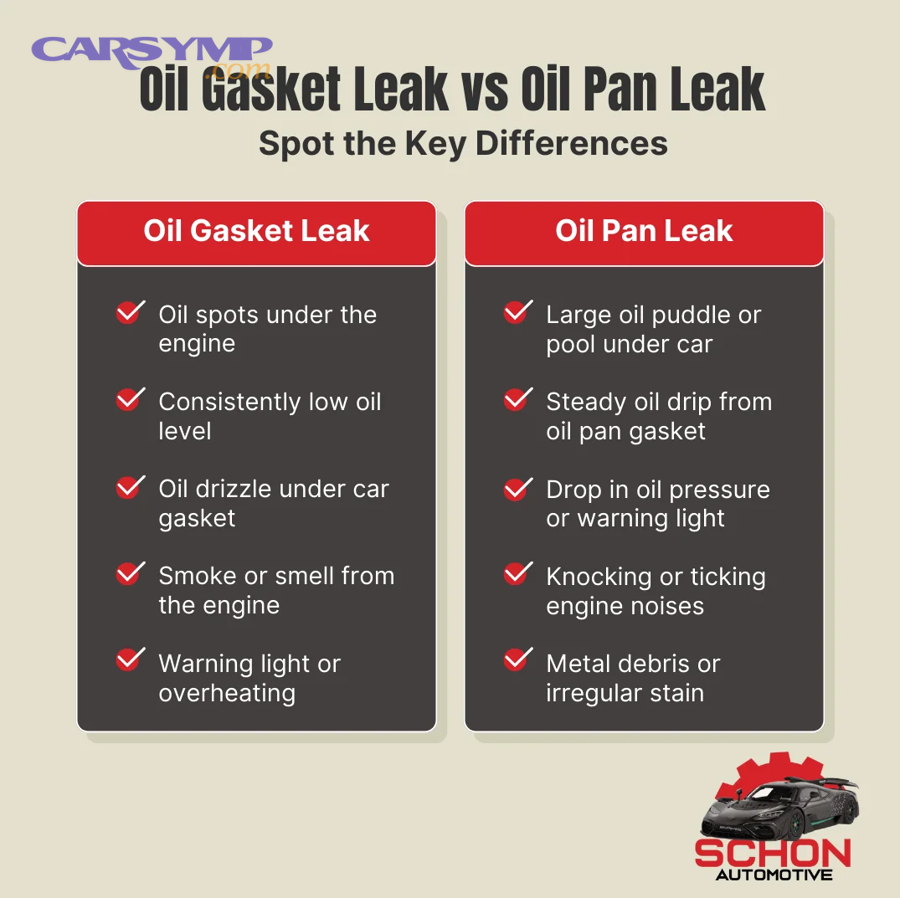
Valve cover leaks win in top-down runoff, oil pan gasket leaks win in seam-origin wetness, and drain/filter leaks are best identified by fresh oil around service points.
However, the confusion persists because oil from a valve cover leak can end up coating the pan, so you must compare where oil appears first, not where it ends up.
Comparison — Where does oil appear first with a valve cover leak vs a true oil pan gasket leak?
Valve cover gasket leak:
- Oil appears at the top perimeter of the engine, where the valve cover meets the cylinder head.
- You may see wetness around bolt grommets, corners, or along the rear edge.
- Oil then runs down the side of the head and block, eventually reaching the pan.
True oil pan gasket leak:
- Oil appears first at the pan rail seam (pan-to-block joint).
- The wet line starts at the seam and spreads along it, often with beads forming at the lowest points of the seam.
- Oil may collect on the pan bolts and drip from the pan edge.
A practical inspection sequence (fast and reliable):
- Open the hood and inspect the valve cover perimeter with a flashlight.
- Follow any oil trail downward on the block.
- Only after checking the top and mid-level areas should you judge the pan rail seam.
If the highest wet point is the valve cover area, a pan gasket replacement won’t fix it—even if the pan is soaked.
Comparison — What smells or smoke clues point to valve cover leaks rather than a pan gasket?
Valve cover leaks are more likely to create burning oil smells or smoke because oil can drip onto hot exhaust components near the cylinder head.
Common valve-cover-style clues:
- Burning oil smell after driving, especially when stopping at a light
- Whisps of smoke from the engine bay, often near the rear of the engine
- Oil residue on the exhaust manifold heat shield area (engine-dependent)
Why this matters: an oil pan gasket leak is often lower and may drip onto lower components or the ground without as much engine-bay smoke—though any oil hitting exhaust can be dangerous.
You should treat smoke and strong oil smell as urgency signals, because oil on hot exhaust can raise fire risk in extreme cases.
Comparison — How do rear main seal vs oil pan gasket leaks differ (and where do they overlap)?
Rear main seal leaks win in bellhousing seam evidence, oil pan gasket leaks are best confirmed by pan rail seam wetness, and both can overlap because oil can spread across the rear pan area and transmission case.
Next, you’ll learn the specific spots that separate a true rear main seal leak from a rear pan leak.
Comparison — Does oil at the bellhousing seam indicate a rear main seal or something else?
Oil at the bellhousing seam is a strong clue for a rear main seal leak, but it is not a guarantee. The bellhousing area is a meeting point where multiple leaks can converge.
More likely rear main seal indicators:
- Fresh oil at the engine-to-transmission mating seam
- Oil dripping from a small opening or inspection cover area
- Oil film inside the bellhousing area (sometimes visible with inspection)
Possible “something else” indicators:
- Oil trails coming from above (valve cover, rear of head) that run down to the bellhousing
- Oil cooler or housing leak that runs rearward
- Engine-specific rear cover/plate leaks (not the seal itself)
A smart approach is to clean the area, then re-check after a short drive. The leak source that shows fresh oil first is the one to trust.
Boolean — Can a rear main seal leak make it look like the oil pan gasket is leaking at the rear?
Yes—a rear main seal leak can make it look like the oil pan gasket is leaking at the rear for three reasons: (1) oil spreads across the rear pan flange, (2) the transmission case guides oil to lower edges, and (3) airflow after driving redistributes oil backward.
More importantly, both leaks often produce drips near the same undercar area, so you must rely on origin evidence, not drip location.
A quick decision cue:
- If the rear pan rail seam is the highest wet point: suspect pan gasket.
- If the bellhousing seam is the highest wet point: suspect rear main seal (or rear cover area).
If you cannot find a highest wet point because everything is coated, use a controlled diagnostic method (covered later) before choosing a repair.
Definition — What is the fastest step-by-step check to confirm the true leak source before replacing parts?
The fastest confirmation method is a clean–drive–reinspect workflow in three steps—degrease, short drive, and top-down inspection—so you identify the highest wet point and avoid replacing the wrong gasket.
Below, we’ll turn that into a repeatable routine you can do in a driveway without specialized tools.
Definition — How do you clean and re-check to find the “highest wet point”?
Step 1: Clean the suspected zones (safely). Focus on the top half of the engine first, then the mid-level, then the pan area. Use a degreaser that’s safe for automotive use, and avoid soaking electrical connectors. If you’re uncomfortable cleaning around hot parts, wait for the engine to cool.
Step 2: Dry and run a short, controlled drive. A 10–20 minute drive is often enough to reproduce a seep. Park on a level surface afterward and let the engine idle for a few minutes if it’s safe to do so.
Step 3: Inspect from top to bottom. This is the core technique: don’t look at the drip—look for the first place oil returned.
Inspection order:
- Valve cover perimeter and upper engine (flashlight + mirror helps)
- Timing cover area and front engine surfaces
- Oil filter housing, cooler lines, and filter seal area
- Drain plug and crush washer area
- Oil pan rail seam (only after checking above)
This method works because fresh oil is easier to spot than old grime, and the highest wet point appears before oil has time to travel far.
Definition — How do you map the leak using drip location, airflow, and parking position?
Once the engine is reasonably clean, you can map leak behavior using simple observation:
- Cardboard test: Place clean cardboard under the engine overnight. Note whether drips cluster at the front, middle, or rear.
- Hot vs cold clue: Some leaks worsen when hot (oil thins), while others show up after sitting (oil drains and pools).
- After-drive airflow smear: If drips appear farther back only after driving, airflow is moving oil rearward.
A helpful mini-table (what it contains: common “drip location” patterns and what they often suggest) makes the mapping clearer:
| Drip pattern | What it often suggests | Why it misleads |
|---|---|---|
| Drip near front after driving | Timing cover, filter housing, front seal area | Airflow spreads oil backward and downward |
| Drip near middle under pan | Could be pan rail or runoff | Oil collects at the lowest geometry |
| Drip near rear/bellhousing | Rear main seal or rear cover, or runoff from above | Transmission surfaces guide oil to edges |
Mapping doesn’t replace inspection, but it narrows your search so you don’t waste time on low-probability repairs.
Boolean — Should you replace the oil pan gasket before confirming other leaks?
No—you should not replace the oil pan gasket before confirming other leaks, for three reasons: (1) oil pan gasket replacement is labor-heavy, (2) many leaks originate above and will persist after the repair, and (3) misdiagnosis wastes money and may introduce new leaks if sealing surfaces aren’t perfect.
More importantly, some vehicles require subframe loosening or engine lifting for pan access, which raises cost and risk.
This is also where DIY risks and when to avoid matters. If your vehicle needs engine support, subframe shifts, or tight-angle fastener access, DIY pan removal can become a safety issue. In those cases, confirmation first isn’t just about saving money—it’s about avoiding a difficult job that doesn’t fix the leak.
If you do confirm the oil pan gasket is the source, you’ll likely face a sealing choice. On many engines, the debate is RTV vs gasket type differences: some designs use a formed gasket, while others specify RTV sealant. Using the wrong approach can cause repeat leaks, which is why following manufacturer guidance is critical.
Boolean — Is it safe to keep driving if you suspect an oil pan gasket leak but aren’t sure?
Yes, it can be safe to keep driving briefly while diagnosing, but only if (1) the oil level stays stable, (2) there is no oil-pressure warning, and (3) there is no smoke or oil burning on hot exhaust.
More importantly, your safety decision should be based on leak rate and warning signs—not the suspected gasket name.
Boolean — What signs mean “stop driving now” (low pressure light, heavy smoke, rapid oil loss)?
Stop driving now if any of these occur:
- Oil pressure warning light comes on (or oil pressure drops warning appears)
- Heavy smoke from the engine bay or under the car
- Strong burning smell that worsens quickly
- Rapid oil loss (dipstick drops noticeably after a short drive)
- Oil dripping onto exhaust (you may hear sizzling or see smoke near hot components)
The logic is simple: low oil pressure can destroy an engine quickly, and oil on hot exhaust can become a fire hazard. Even if the leak is “just a gasket,” the consequences can be severe when oil volume drops or ignition risk rises.
Definition — What should you monitor while diagnosing (dipstick intervals, leak rate, burning smell)?
Treat diagnosis like a controlled test:
- Check oil level on the dipstick at consistent intervals (for example: before a drive, after a 15–20 minute drive, and the next morning).
- Estimate leak rate: a few drops overnight is different from a puddle after a short trip.
- Track smell/smoke: a new burning smell is a strong clue of oil contacting hot parts.
- Watch for warning lights: oil pressure and engine temperature matter most.
If you must drive while diagnosing, keep trips short, avoid high RPM, and keep oil topped up to the safe range. This is not a long-term solution, but it can reduce risk while you confirm the source.
After any repair—whether it’s a valve cover gasket, a drain plug washer, or a confirmed oil pan gasket replacement—finish with Post-repair leak check steps: clean the area again, drive a short loop, re-inspect for the highest wet point, and confirm no new drips appear on clean cardboard overnight.
Definition — What advanced methods and edge cases help confirm stubborn oil leaks (when visual checks fail)?
Advanced confirmation methods include UV dye tracing, powder mapping, fluid identification, and undertray/airflow checks, and they work because they make the leak’s origin easier to see when oil has already coated everything.
Next, we’ll cover the tools and edge cases that typically solve “I cleaned it, but I still can’t tell.”
Definition — How does a UV dye test confirm the leak source when oil spreads everywhere?
A UV dye test works by adding a small amount of fluorescent dye to the engine oil, driving briefly, and then scanning with a UV light so the fresh oil path glows, making the origin point easier to locate.
Best practices for UV dye testing:
- Clean first. Dye works best when old oil residue is reduced.
- Drive long enough to reproduce the leak, but not so long that everything becomes coated again.
- Scan from top to bottom and look for the brightest, freshest glow at the origin.
- Pay attention to hidden spots: behind pulleys, under housings, and along gasket edges.
This method is especially helpful for slow leaks, intermittent leaks, or multiple leaks that overlap visually.
Definition — How can talcum powder/chalk reveal the exact seep line on the oil pan rail and seals?
Powder mapping is simple: after cleaning and drying the suspect area, you dust a light layer of talcum powder or chalk on seams and surfaces. Fresh oil creates clear tracks through the powder, showing direction and origin.
Where powder mapping shines:
- Oil pan rail seam: reveals whether oil is seeping from the gasket line or arriving from above
- Timing cover edge: shows whether seep starts at the cover seam
- Rear junction areas: helps separate a bellhousing seam origin from oil arriving via runoff
Key caution: powder mapping is a diagnostic tool, not a permanent fix. Clean thoroughly afterward to avoid residue buildup.
Comparison — How do you distinguish engine oil from transmission fluid to avoid a false rear main diagnosis?
Engine oil vs transmission fluid confusion is a classic “wrong repair” trap, especially near the bellhousing area.
General comparison cues (always verify with your vehicle’s fluid type):
- Engine oil: typically amber to dark brown/black, oily smell, matches dipstick level changes
- Transmission fluid (many automatics): often red/pink when fresh, can turn brown with age, distinct odor, level changes at transmission dipstick (if equipped)
Practical confirmation steps:
- Wipe the fluid onto a white paper towel and compare color and feel.
- Check which reservoir level is dropping (engine oil dipstick vs transmission level).
- Look for the highest wet point: engine oil leaks often show on engine surfaces above the transmission case; transmission fluid leaks may originate from transmission seals/lines.
This comparison matters because a rear main seal diagnosis is costly, and confusing fluids can send you toward the wrong major repair.
Definition — How can splash shields/undertrays and airflow move oil and create a false leak location?
Undertrays and splash shields can catch oil, spread it sideways, and release it far from the source, especially after a highway drive. Airflow can also move oil backward, making a front leak look like a mid or rear leak.
How to handle this edge case:
- Inspect the undertray for pooled oil and trace where it runs off.
- Look for a “cleaner” washed area that indicates oil flow direction.
- If safe and practical, temporarily remove or lower the undertray for inspection after cleaning.
This is one reason Post-repair leak check steps should include a re-inspection after driving: oil trapped in shields can drip later and falsely suggest the leak is still active.
Evidence (if any)
According to a study by the University of Bologna from the Department of Industrial Engineering, in 2022, researchers improved oil-leak visibility using UV illumination and fluorescent dye and reported 94% accuracy for classifying leak vs non-leak conditions in their system.