


Driving with a transmission fluid leak is technically possible for a very short distance, but it is not safe and should never be treated as a long-term solution. The answer depends critically on the severity of the leak — a slow seep from a worn gasket behaves very differently from a sudden rupture in a fluid line. As a general rule, most mechanics agree you should drive no more than 10 to 15 miles, and only to reach the nearest repair shop. Beyond that threshold, you risk causing irreversible mechanical damage that turns a minor repair into a major financial crisis.
Understanding how far you can safely drive requires knowing what transmission fluid actually does inside your vehicle. This fluid simultaneously lubricates moving metal components, generates hydraulic pressure to execute gear shifts, cools the transmission’s internal heat, and conditions the seals that keep everything contained. The moment fluid levels drop below the operating minimum, all four of those functions begin to degrade at once — and the damage compounds with every additional mile driven.
The risks of continuing to drive go well beyond sluggish gear shifts. Mechanical damage can escalate from simple gasket wear to full torque converter failure, and the repair costs rise steeply at each stage. A leak caught early may cost a few hundred dollars to fix; a transmission seized from fluid starvation can cost thousands to rebuild or replace. Recognizing the warning signs early is the single most effective way to protect both your vehicle and your wallet.
Knowing what to do the moment you spot a leak is just as important as understanding why the leak is dangerous. From confirming the fluid type, to topping off correctly, to deciding between driving slowly to a shop or calling a tow truck — every decision made in those first minutes matters. Next, this guide walks through each of those decisions in detail, giving you a clear, step-by-step framework for handling a transmission fluid leak safely and confidently.
Can You Drive With a Transmission Fluid Leak?
No, you should not drive with a transmission fluid leak beyond an absolute minimum distance, for three core reasons: the fluid loss directly disables lubrication, eliminates hydraulic shifting pressure, and accelerates heat buildup that destroys internal components.
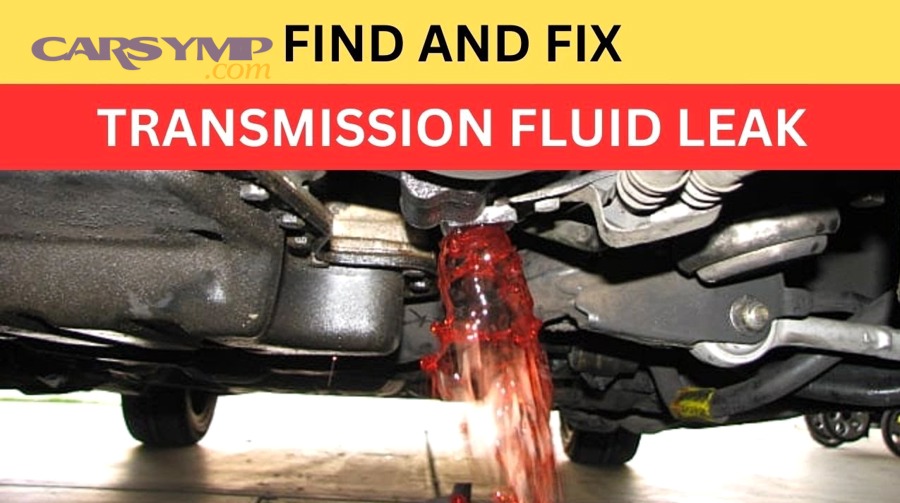
Specifically, the risk level is not uniform — it scales directly with how fast fluid is escaping and how much remains in the system. To better understand why this matters, it helps to first look at what transmission fluid is actually doing while the vehicle is in motion.
What Happens to Your Car When Transmission Fluid Is Low?
Transmission fluid is a multi-purpose fluid that performs four simultaneous jobs inside an automatic transmission: it lubricates hundreds of moving metal parts to prevent friction wear, it acts as a hydraulic medium to engage clutch packs and execute gear changes, it absorbs and transfers heat away from internal components, and it chemically conditions the rubber seals that prevent leaks from forming. When the fluid level drops, all four of these functions degrade at the same time.
The sequence of failure follows a predictable pattern. As lubrication drops, metal components begin grinding against each other, generating friction and heat. That additional heat accelerates fluid breakdown, which further reduces its protective properties. Gear shifts become hesitant or delayed as hydraulic pressure falls. Eventually, the transmission may enter “limp mode” — a self-protective state that locks the gearbox into a single gear to limit further damage. Left unaddressed, the end result is complete mechanical seizure.
The following table illustrates how quickly and systematically transmission function deteriorates once fluid levels fall below the minimum operating threshold.
| Stage | What Is Happening | Driver Symptom |
|---|---|---|
| Stage 1 | Lubrication drops, friction increases | Sluggish or rough gear shifts |
| Stage 2 | Hydraulic pressure falls | Delayed engagement, gear hunting |
| Stage 3 | Heat builds beyond safe threshold | Burning smell, transmission warning light |
| Stage 4 | Limp mode activates | Stuck in one gear, loss of power |
| Stage 5 | Component seizure | Vehicle unable to move |
Is It Ever Safe to Drive With a Transmission Fluid Leak?
The only scenario in which driving with a transmission fluid leak is arguably acceptable is a minor, slow seep — such as a weeping pan gasket — where fluid levels remain near normal and the destination is a repair shop within 10 to 15 miles. Even then, it is a calculated risk, not a safe situation.
A major leak changes the calculation entirely. If you can see a spreading puddle of red fluid beneath the vehicle before you have even started the engine, or if Transmission fluid leak signs and identification point to a cracked fluid line or damaged torque converter seal, the correct action is to call a tow truck rather than attempt to drive. The potential cost of driving — a full transmission replacement — will always exceed the cost of a tow.
- Minor leak (slow seep): Top off fluid to the correct level, drive directly and only to the nearest shop, monitor for symptoms continuously
- Major leak (large puddle, fast drip): Do not start the engine; call for a tow immediately
- Unknown severity: Check fluid level on the dipstick before deciding; if the level is already at or below the minimum mark, treat it as a major leak
How Far Can You Drive With a Transmission Fluid Leak?
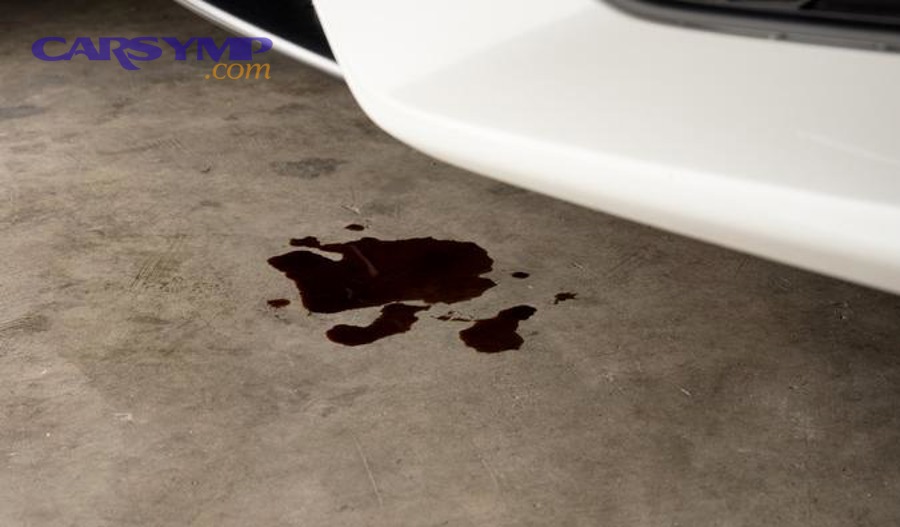
A transmission fluid leak limits safe driving to approximately 10 to 15 miles — only enough to reach the nearest repair facility — and even that distance assumes the leak is slow and fluid levels are still within the acceptable range.
However, this figure is a guideline, not a guarantee. More specifically, the actual safe distance shrinks dramatically as the leak rate increases or as the starting fluid level drops.
What Are the Warning Signs You Should Stop Driving Immediately?
There are six warning signs that indicate you must stop the vehicle immediately, regardless of how close you are to a repair shop:
- Burning smell — Overheated transmission fluid produces a sharp, acrid odor. This indicates fluid has already dropped low enough to cause heat damage.
- Grinding or clunking noises during gear changes — Metal-on-metal contact is occurring inside the gearbox due to insufficient lubrication.
- Gear slipping — The transmission shifts into a gear and then unexpectedly drops out of it, a direct symptom of lost hydraulic pressure.
- Delayed or refused engagement — A noticeable pause between selecting Drive or Reverse and the vehicle actually moving indicates critically low fluid.
- Jerking or shuddering while in motion — Gear teeth are not meshing smoothly; this signals both lubrication failure and potential clutch pack damage.
- Limp mode activation — The transmission control module locks the gearbox into a single gear. At this point, driving further risks permanent damage.
If any one of these symptoms appears while driving, pull over safely, turn off the engine, and contact a mechanic or roadside assistance service. Continuing to drive through these symptoms is the fastest way to convert a repairable leak into a full transmission replacement.
How Long Can You Drive Before the Transmission Is Permanently Damaged?
There is no fixed time limit — permanent damage begins the moment fluid falls below the minimum operating level, and the timeline to irreversible failure depends entirely on the rate of fluid loss. A fast leak from a ruptured cooler line can drain the transmission in minutes; a slow seep from a deteriorating pan gasket may take days to weeks to reach a critical level.
The key variable is not time but fluid volume. Transmission components require a continuous, pressurized supply of fluid to function. Once that supply is interrupted — even briefly — friction and heat spike immediately. According to data cited by transmission specialists at AAMCO, running an automatic transmission with depleted fluid even for a few minutes under load can cause damage that requires a full rebuild to correct.
What Are the Risks of Driving With a Transmission Fluid Leak?
Driving with a transmission fluid leak carries three categories of risk: mechanical damage to internal components, escalating repair costs, and active driving safety hazards — all of which worsen with every mile driven after the leak is detected.
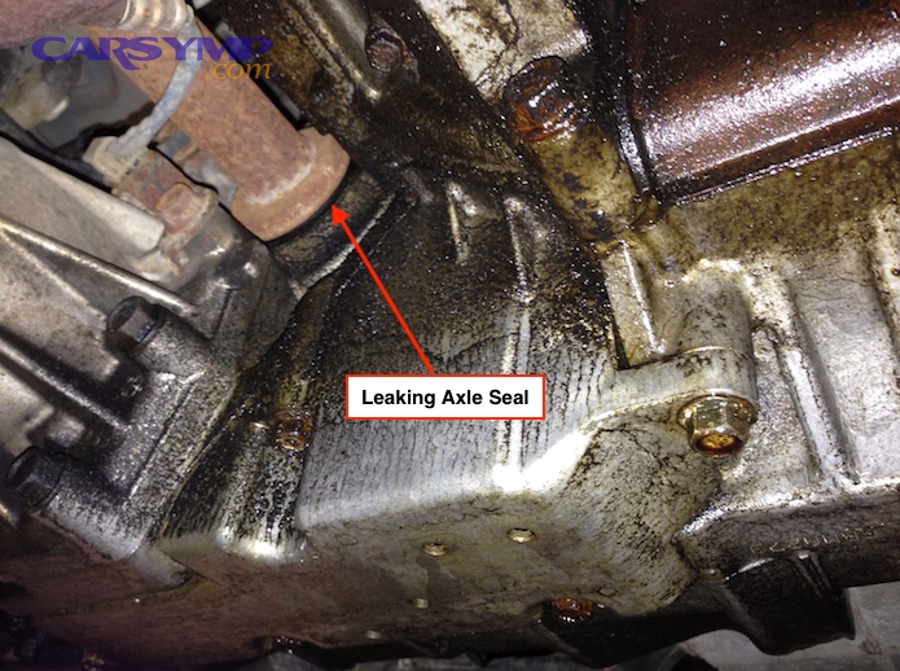
To better understand this, the risks can be grouped into mechanical, financial, and immediate safety consequences.
What Mechanical Damage Can a Transmission Fluid Leak Cause?
A transmission fluid leak can cause at least five distinct forms of internal mechanical damage, each compounding the next in a snowball effect:
- Torque converter failure — The torque converter relies on a steady supply of ATF both to transmit engine power and to cool its internal clutch. Without adequate fluid, it overheats and its needle bearings and clutch begin to fail.
- Gear and clutch pack wear — Clutch packs engage and disengage constantly during normal driving. Without lubrication, the friction material burns off rapidly, leading to slipping and then complete clutch failure.
- Seal deterioration — Transmission seals require fluid contact to stay pliable. Running dry causes them to harden, crack, and ultimately fail — which in turn creates additional new leak points, worsening the original problem.
- Valve body damage — The valve body controls hydraulic fluid routing throughout the transmission. Contaminated or absent fluid causes the precision-machined valves to stick, resulting in erratic shift behavior.
- Complete transmission seizure — In the most severe cases, metal components grind to a halt entirely. This is the end-stage failure state, and it renders the vehicle undrivable without a full transmission replacement.
According to Ralph’s Transmission, fluid leaks are the single most common cause of major internal transmission damage — a finding consistent with the snowball failure pattern described above.
How Much Does It Cost to Repair a Transmission Damaged by Low Fluid?
The financial consequence of driving with a transmission fluid leak scales sharply with how long the leak is ignored. The table below summarizes the typical repair cost tiers based on damage severity.
| Damage Level | Likely Cause | Estimated Repair Cost |
|---|---|---|
| Minor leak only (gasket/seal) | Worn pan gasket, loose drain plug | $150 – $400 |
| Fluid exchange + filter replacement | Degraded fluid from leak-related heat | $100 – $250 |
| Solenoid or valve body repair | Hydraulic pressure irregularities | $300 – $900 |
| Transmission rebuild | Extensive internal wear from low fluid | $1,500 – $3,500 |
| Full transmission replacement | Seized or catastrophically failed unit | $4,000 – $8,000+ |
This cost comparison illustrates a crucial point: the earlier a transmission fluid leak is addressed, the lower the financial damage. A $200 gasket repair ignored for weeks can escalate to an $8,000 replacement — making the decision to act immediately one of the most cost-effective choices a vehicle owner can make.
Can a Transmission Fluid Leak Cause a Safety Hazard While Driving?
Yes, a transmission fluid leak can create direct, active safety hazards while a vehicle is in motion — beyond just mechanical damage. The most immediate risk is a sudden, unexpected loss of propulsive power. If the transmission fails mid-drive, the vehicle loses the ability to accelerate or maintain speed, which is particularly dangerous on highways or in fast-moving traffic.
A second, less commonly discussed hazard is fire risk. Transmission fluid has a flash point — the temperature at which it can ignite — and if leaking fluid contacts a hot exhaust manifold or catalytic converter, it can produce smoke or, in severe cases, ignite. Additionally, fluid that drips onto road surfaces creates a slip hazard for motorcycles and cyclists behind the vehicle.
What Should You Do If Your Car Is Leaking Transmission Fluid?
The correct response to a transmission fluid leak follows four steps: confirm the fluid type, assess leak severity, add fluid safely if appropriate, and transport the vehicle to a qualified mechanic as quickly as possible — ideally the same day the leak is discovered.
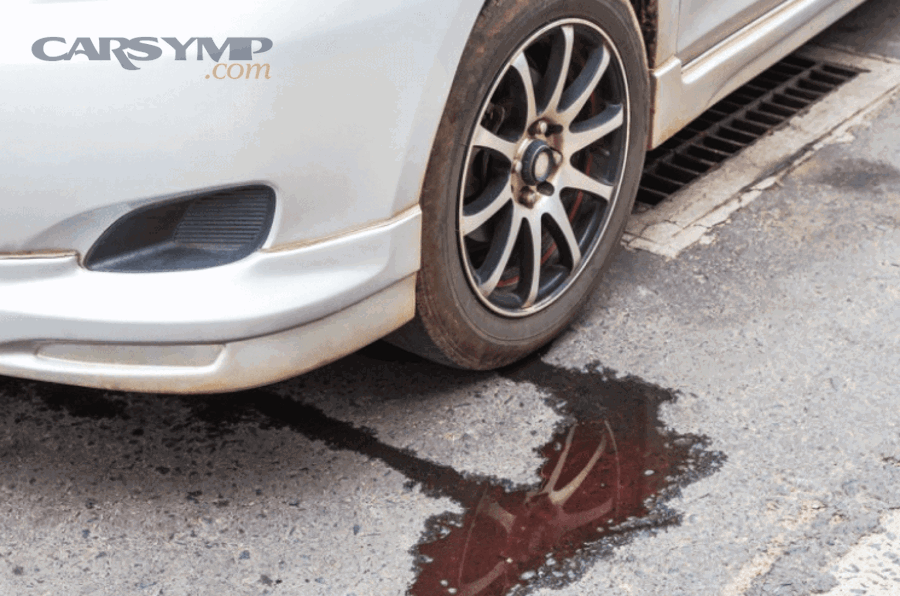
Below, each of these steps is broken down in detail to give you a practical action plan you can follow immediately.
How Do You Confirm It Is Transmission Fluid and Not Another Fluid?
Confirming a transmission fluid leak requires checking four identifying characteristics: color, consistency, location, and smell. Each of these distinguishes ATF from the other fluids that can leak from a vehicle. Transmission fluid leak signs and identification rely on these exact cues.
Color: Fresh transmission fluid is bright red or cherry red. As it ages and degrades, it darkens to a reddish-brown and eventually to a dark brown with a burnt odor — a sign the fluid itself needs replacing regardless of the leak. Note that some power steering fluids are also red, which is a common source of confusion.
Consistency: Transmission fluid is thinner than engine oil but slightly thicker than brake fluid. It has a slippery, almost oily feel between the fingers.
Location under the vehicle: For rear-wheel-drive vehicles, a puddle will appear near the center of the car, beneath the transmission. For front-wheel-drive vehicles, the fluid will typically appear on the side of the engine bay where the transaxle is located.
Smell: Fresh ATF has a mildly sweet, petroleum-like smell. Burnt ATF smells sharp and acrid — similar to overheated brake pads.
For cases where the leak source is not visible to the naked eye, a UV dye test for ATF leaks is one of the most reliable diagnostic methods available. A small amount of UV-reactive dye is added to the transmission fluid, the vehicle is driven briefly, and a UV lamp is then used to illuminate the exact location of the leak. This technique is widely used by transmission specialists to pinpoint micro-leaks in seals, cooler lines, and the torque converter that would otherwise be invisible during a standard visual inspection.
Should You Top Off Transmission Fluid Before Driving to the Shop?
Adding fluid safely and with the correct type is a legitimate short-term measure when the leak is minor and the destination is a nearby repair facility. However, it must be done correctly to avoid making the situation worse.
Steps for adding transmission fluid safely:
- Park the vehicle on a level surface and engage the parking brake
- Locate the transmission dipstick (typically a brightly colored handle near the back of the engine bay on rear-wheel-drive vehicles — note that many newer vehicles do not have a dipstick and require a lift-mounted check)
- With the engine warm and running (for most vehicles — check the owner’s manual), pull the dipstick, wipe it clean, reinsert it fully, and pull it again to read the fluid level
- If the level is below the “Min” or “Low” mark, add fluid in small increments (half a quart at a time), rechecking the level between additions
- Use only the fluid type specified in the owner’s manual — mixing incompatible ATF types can damage seals and clutch materials
Critical caution: Do not overfill. Excess transmission fluid foams under operating pressure, which destroys its ability to lubricate and creates its own set of internal damage. If the dipstick shows the fluid is already at or above the “Full” mark, do not add more — the issue is the leak, not the fluid volume.
Topping off is a bridge measure, not a repair. It buys you enough fluid volume to safely cover the short distance to a shop. It does not stop the leak, and the fluid level will continue to drop until the root cause is fixed.
When Should You Call a Tow Truck Instead of Driving?
You should call a tow truck instead of attempting to drive in any of the following five situations:
- A large puddle of red fluid is visible under the vehicle before the engine is started — this indicates a fast, significant leak that will deplete fluid within miles
- The transmission fluid level reads at or below the minimum on the dipstick — there is insufficient fluid to safely lubricate the system even for a short drive
- Any of the six critical warning symptoms are already present — gear slipping, grinding noises, limp mode, burning smell, delayed engagement, or shuddering
- The leak appears to be coming from a fluid line or cooler line — these leaks are often pressurized and can drain the transmission rapidly
- You are more than 15 miles from the nearest repair facility — the risk of component damage over that distance outweighs the cost of a tow
The cost of a tow truck typically ranges from $75 to $150 for a local tow. That investment is trivial compared to the $4,000 to $8,000 cost of a transmission replacement that a preventable drive might cause.
Transmission Fluid Leak vs. Other Vehicle Fluid Leaks — What’s the Difference?
Transmission fluid wins in terms of identification ease because of its distinctive red color; engine oil is the most familiar leak type for most drivers; coolant is most critical for immediate overheating risk — and each fluid requires a different response priority.
However, distinguishing between these fluids in a real-world situation is not always straightforward, particularly as fluids age and darken. The following comparison table provides a clear framework for telling them apart based on color, location, smell, and urgency level.
| Fluid Type | Color | Consistency | Location | Smell | Urgency |
|---|---|---|---|---|---|
| Transmission fluid (ATF) | Bright red → dark brown | Thin, slippery | Center or side (FWD) | Sweet, or burnt if degraded | High — stop driving |
| Engine oil | Amber → dark brown/black | Thick, viscous | Front to center | Petroleum, acrid if burning | High — address promptly |
| Power steering fluid | Clear to light red/pink | Thin | Front, driver’s side | Mild petroleum | Medium — monitor |
| Coolant/antifreeze | Green, orange, pink, or blue | Thin, watery | Front | Sweet, maple-like | Very high — stop immediately |
| Brake fluid | Clear to light yellow | Medium viscosity | Near wheels or firewall | Slightly chemical | Extremely high — do not drive |
| Differential fluid | Brown to dark brown | Thick, gear-oil smell | Rear axle | Strong sulfur odor | Medium-high |
Minor Transmission Leak vs. Major Transmission Leak — How Severe Is Yours?
A minor transmission leak and a major transmission leak are not simply different points on the same scale — they require completely different responses. Classifying which type you are dealing with is the most important first decision after discovering a leak.
Minor leak indicators:
- A few small drops or a light stain on the driveway after the car has been parked overnight
- Fluid level on the dipstick is still within the acceptable range
- No driving symptoms (shifts feel normal, no warning lights)
- Likely source: pan gasket seep, slightly loose drain plug, or aged output shaft seal
Major leak indicators:
- A spreading puddle or multiple large drops beneath the vehicle
- Fluid level is at or below the minimum mark
- Driving symptoms already present (slipping, hesitation, noise)
- Likely source: cracked transmission pan, ruptured cooler line, failed torque converter seal, or damaged front pump seal
The drip rate is a practical field test: if you can count individual drops per minute, it is likely a minor leak. If fluid is running rather than dripping, it is a major leak requiring immediate towing.
Do Stop-Leak Additives Actually Fix a Transmission Fluid Leak?
Stop-leak additives offer limited, temporary benefit for very specific types of minor transmission leaks — primarily those caused by dried-out or slightly shrunken rubber seals — and can cause active harm in most other situations. They work by causing rubber seal material to swell slightly, which can temporarily close a minor seep. They do not repair cracked metal, failed gaskets, damaged fluid lines, or mechanical seal failures.
The risks of using stop-leak products include:
- Clogging the transmission filter, which restricts fluid flow and creates the same symptoms as low fluid
- Interfering with clutch pack friction material, causing slipping that mimics — or accelerates — transmission failure
- Masking the actual problem, delaying a proper diagnosis while damage continues to develop
Stop-leak additives are not a substitute for diagnosis and repair. They are, at best, a very short-term tool to buy a day or two before a proper mechanic appointment — and even then, only for minor seep-type leaks. Using them on a major leak or a mechanical failure will not stop the leak and may worsen the underlying condition.
Does a Transmission Fluid Leak Affect Automatic and Manual Transmissions Differently?
Yes, automatic and manual transmissions handle fluid leaks differently in both severity and symptom presentation, because the two systems use different fluid types and rely on fluid for different functions.
Automatic transmissions (ATF):
- Rely on fluid for both lubrication and hydraulic pressure to shift gears
- A leak directly impacts gear-changing function, making symptoms rapid and obvious
- ATF is thinner and flows more freely, meaning leaks drain the system faster
- Fluid is typically checked via a dipstick (where available) or by a technician lift inspection
Manual transmissions (gear oil):
- Use a thicker gear oil (GL-4 or GL-5 rated) that lubricates mechanical synchros and gears
- Do not rely on fluid for hydraulic shifting, so early symptoms are more subtle
- Common early signs: difficulty engaging gears, especially when cold; grinding on gear changes; whining noise at speed
- Fluid level can only be checked with the vehicle raised on a lift, making DIY assessment more difficult
- Leaks are typically slower to create a crisis, but long-term low gear oil causes severe synchro and bearing wear
In practical terms, an automatic transmission leak demands faster action because the hydraulic function failure becomes immediately apparent and dangerous. A manual transmission leak may go unnoticed longer but will eventually cause equally serious mechanical damage.
Can You Prevent a Transmission Fluid Leak From Happening Again?
Preventing future transmission fluid leaks relies on four maintenance practices: following the manufacturer’s fluid change intervals, moderating driving behavior, managing vehicle load, and scheduling periodic seal and gasket inspections.
Fluid change intervals: Transmission fluid degrades with heat and time. Old, oxidized fluid loses its seal-conditioning properties, causing rubber seals and gaskets to dry out and crack — the primary cause of leak formation. Most manufacturers recommend changing automatic transmission fluid every 30,000 to 60,000 miles, though this varies by vehicle. Consult your owner’s manual for the specific interval.
Driving behavior: Aggressive acceleration, hard braking, and frequent towing all place elevated heat and mechanical stress on the transmission. Heat is the number-one enemy of transmission seals. Smooth, progressive driving significantly extends seal and fluid lifespan.
Load management: Consistently exceeding your vehicle’s rated towing or payload capacity forces the transmission to operate at higher temperatures. If you regularly tow heavy loads, consider a transmission cooler upgrade and more frequent fluid changes.
Periodic inspection: Ask your mechanic to visually inspect the transmission pan, gasket, cooler lines, and output shaft seals at every oil change. Catching a seeping seal before it becomes an active leak is the most cost-effective form of transmission maintenance available.
According to Jiffy Lube’s service guidelines, having transmission fluid level and condition checked at every oil change interval is one of the simplest and most effective preventive measures a driver can take to avoid both leaks and premature transmission wear — a recommendation echoed by most OEM maintenance schedules.