


A UV dye test for ATF leaks is the most reliable method to pinpoint exactly where your automatic transmission fluid is escaping — using a fluorescent dye that circulates through the transmission system and glows bright yellow-green under ultraviolet light. Unlike wiping down components and guessing, this method reveals even the smallest seep with precision, saving hours of diagnostic time. Whether you are dealing with a slow drip or an intermittent transmission fluid leak, the UV dye approach removes the guesswork entirely and gives you a confirmed location before you spend a dollar on parts.
To perform the test correctly, you need to understand what UV dye is, why it works specifically in ATF systems, and whether it is safe to introduce into your transmission. Many drivers and first-time DIYers hesitate because they worry the dye might affect fluid performance or void a warranty. Understanding the chemistry and compatibility of UV fluorescent dye with automatic transmission fluid resolves those concerns and builds confidence before you begin.
Choosing the right tools is equally important. Not every UV dye product works equally well in transmission systems, and not every UV inspection light delivers enough intensity to make leaks visible. Knowing the difference between application-specific ATF dyes, universal oil-based dyes, proper UV LED lights, and UV-enhancing glasses will determine whether your test succeeds or leaves you with an inconclusive result.
Finally, once you understand how the procedure works from start to finish, you will also want to know how this method stacks up against other ATF leak detection approaches — and where the most common transmission leak points actually show up. Next, this guide walks through every stage in a logical sequence so you can complete a professional-quality UV dye test on your own transmission system with confidence.
What Is a UV Dye Test for ATF Leaks?
A UV dye test for ATF leaks is a diagnostic method in which a fluorescent dye is introduced into the automatic transmission system, circulated through the fluid, and then inspected under ultraviolet light to reveal the precise origin of a transmission fluid leak.
To better understand why this method works so well, it helps to start with the underlying principle. Automatic transmission fluid flows continuously through a closed loop of components — the transmission pan, valve body, torque converter, cooler lines, and seals. When a gasket degrades or a seal fails, fluid escapes at that exact point. The UV dye, being fully dissolved in the ATF, exits the system at every leak site and leaves a glowing deposit that is invisible in normal light but immediately obvious under UV illumination.
How Does UV Dye Work in an Automatic Transmission System?
UV fluorescent dye works by bonding with the host fluid — in this case, ATF — and traveling with it through every passage, seal, and gasket in the transmission. As the fluid circulates during vehicle operation, the dye reaches all areas of the system simultaneously. Wherever fluid is escaping, the dye escapes with it and accumulates on the exterior surface of the component at the exact leak point.
When you then scan the underside of the vehicle with a UV inspection light, those accumulated deposits fluoresce in a bright yellow-green color that contrasts sharply against metal, rubber, and grime. Even a microscopic seep that would never produce a visible puddle on the ground will glow clearly under UV light. This makes the method especially powerful for diagnosing early-stage leaks before they become serious enough to require an emergency transmission fluid leak repair.
Importantly, once the dye enters the system, it does not need to be removed. Premium UV dyes from manufacturers like Tracer Products are specifically engineered to remain suspended in ATF indefinitely without affecting viscosity, friction modifiers, or any other transmission fluid properties. This means the dye stays available in your system for future rechecks as well.
Is UV Dye Safe to Use in ATF and Transmission Fluid Systems?
Yes, UV dye is safe to use in ATF and transmission fluid systems, for three key reasons: it is chemically compatible with petroleum-based and synthetic ATF, it does not alter the fluid’s performance properties, and it is approved for permanent residence in the system by leading OEM diagnostic programs.
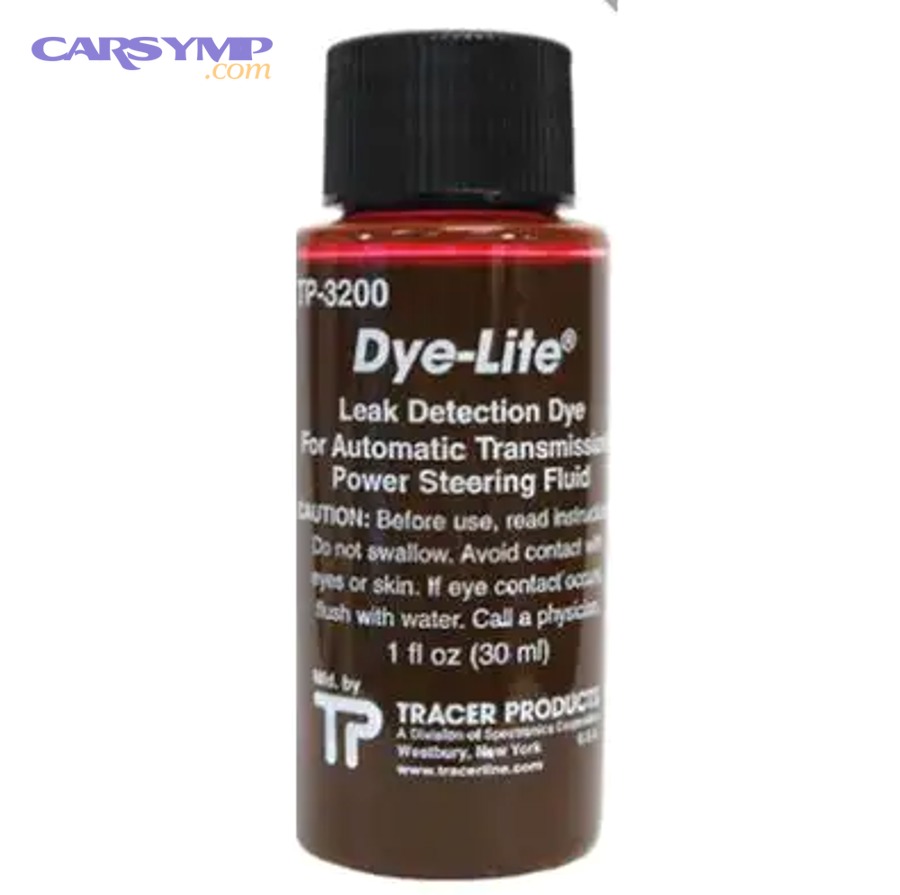
Specifically, application-specific UV dyes formulated for ATF — such as Tracer Products’ Dye-Lite TP-3200-0601 — are engineered to be fully miscible with both conventional and synthetic automatic transmission fluids as well as power steering fluid. They carry no risk of clogging valve body passages or affecting shift behavior. The standard dosage is 1 ounce (approximately 30 ml) of UV dye per 6 quarts (5.7 liters) of system fluid, a concentration low enough to be functionally invisible to the transmission but highly visible under UV inspection.
What Tools Do You Need for a UV Dye Test on ATF Leaks?
There are 3 essential tool categories needed for a UV dye test on ATF leaks: the UV fluorescent dye itself, a suitable UV inspection light, and UV-enhancing safety glasses — each chosen to match the specific demands of ATF system diagnostics.
Getting the right tools before you start is not optional — it is what separates a conclusive result from a frustrating, inconclusive inspection. Below is a detailed breakdown of each tool category.
What Type of UV Dye Should You Use for ATF Leak Detection?
The two main categories of UV dye for ATF leak detection are application-specific ATF dyes and universal oil-based dyes, differentiated by their formulation specificity and fluorescence concentration.
Application-specific ATF dyes are formulated exclusively for transmission and power steering fluid systems. They offer higher fluorescence intensity because they are optimized for the viscosity and chemistry of ATF. The best-known example is Tracer Products Dye-Lite TP-3200-0601, which produces a vivid yellow-green glow and is safe to remain in the system permanently.
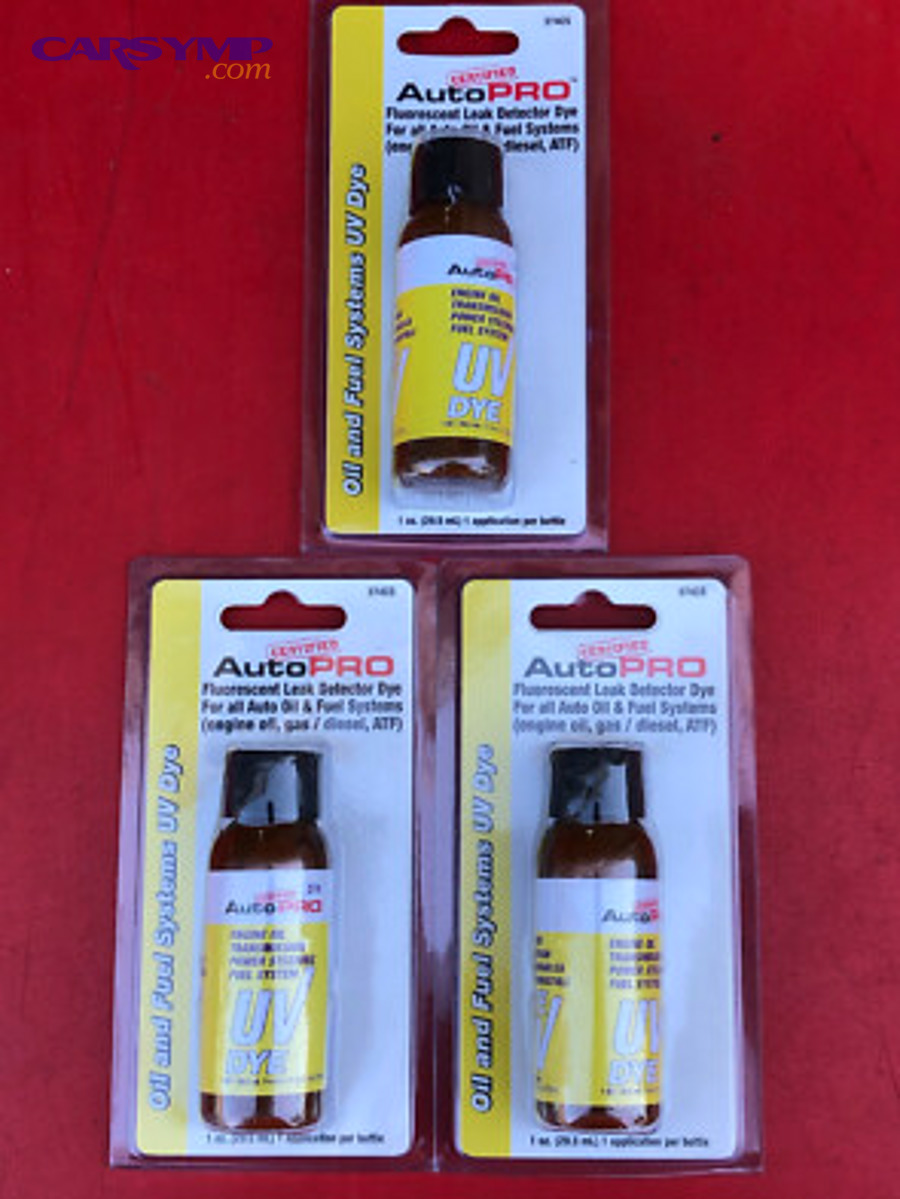
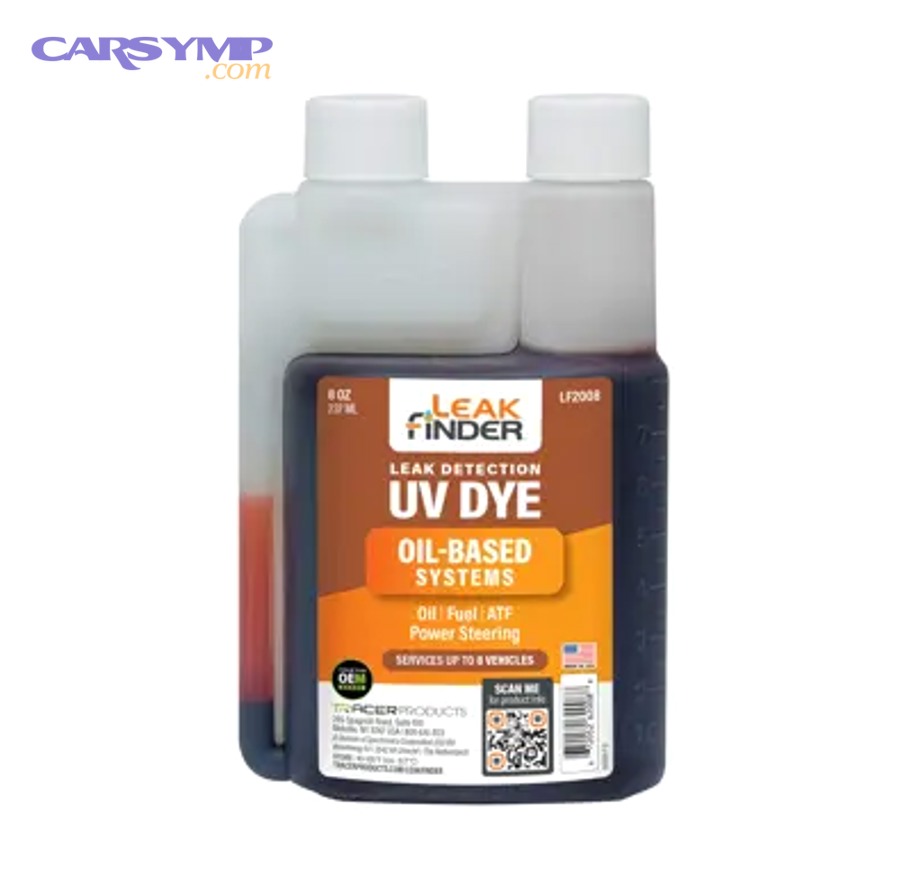
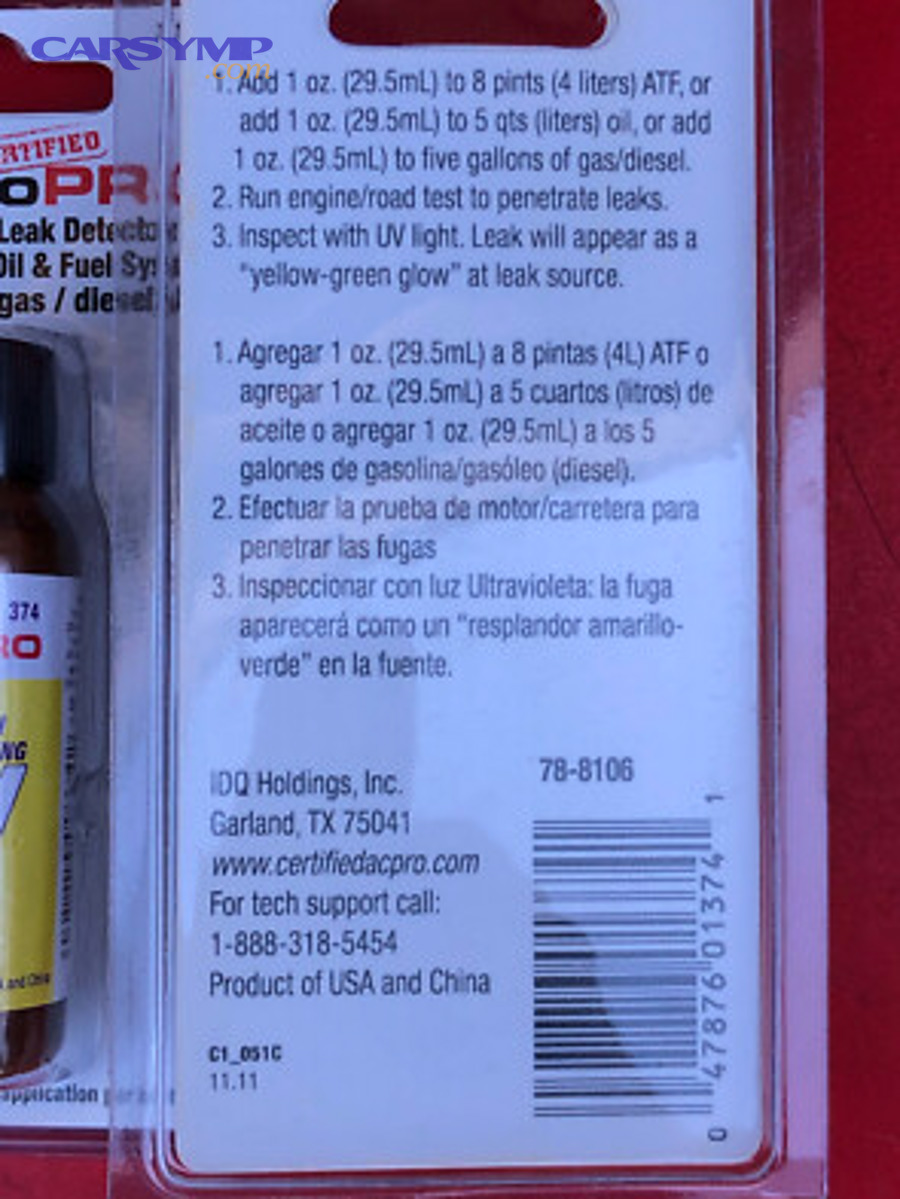
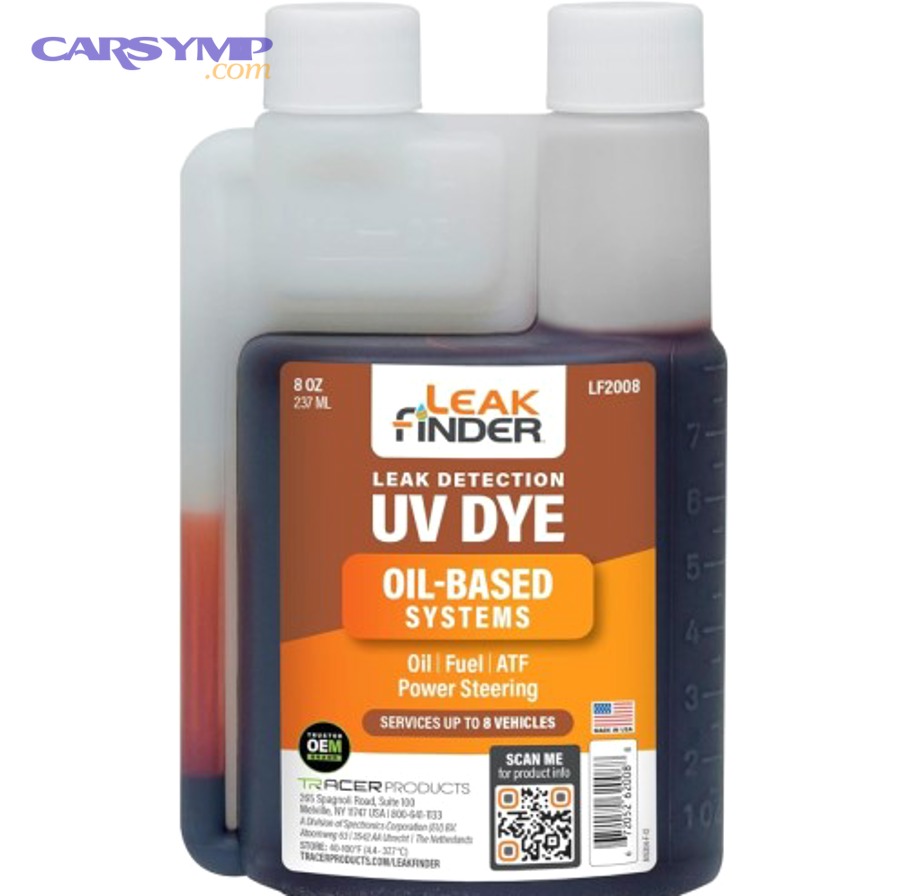
Universal oil-based dyes — such as the LeakFinder LF2008 or AutoPro’s multiple-use dye available at AutoZone — work across oil, fuel, ATF, and power steering systems. These are practical for DIYers who want a single product to cover multiple leak scenarios. However, some users report that universal dyes can appear similar in color to dirty ATF under low-quality UV lights, which is why the quality of your UV inspection light matters equally.
The table below summarizes the key differences to help you choose:
| Feature | Application-Specific ATF Dye | Universal Oil-Based Dye |
|---|---|---|
| Fluorescence intensity | Very high | Moderate to high |
| ATF compatibility | Optimized | Compatible |
| Multi-system use | No | Yes |
| Best for | Professional/OEM diagnostics | DIY multi-system inspection |
| Example product | Tracer Products TP-3200-0601 | LeakFinder LF2008 |
This comparison makes clear that if your only goal is diagnosing a transmission fluid leak, an application-specific dye will give you the most definitive result.
What Kind of UV Light Is Best for Inspecting ATF Leaks?
A true UV LED light operating at 365nm wavelength is the best option for inspecting ATF leaks, because it produces the specific ultraviolet frequency that causes fluorescent dye to glow at maximum intensity.
Not all UV lights are equal. Standard blacklights — particularly inexpensive pen-style lights — often emit at 395nm or higher, which produces a purple-visible glow that causes many surfaces to fluoresce weakly and makes it harder to distinguish dye deposits from background contamination. A dedicated 365nm true UV LED light, by contrast, produces very little visible light and makes the fluorescent dye deposits stand out in sharp contrast.
For practical use, there are two types of UV lights worth having:
- Rechargeable wide-area UV LED light — ideal for scanning large undercarriage areas quickly during a sweep inspection
- Battery-powered focused-beam UV light — essential for inspecting tight spaces like valve body passages, axle seal areas, and cooler line connections
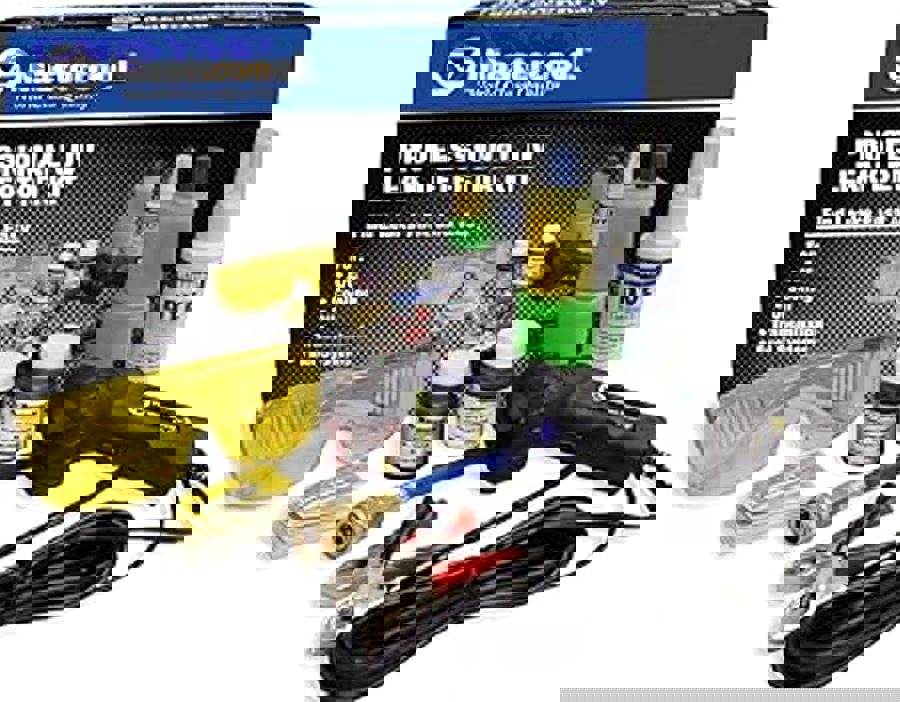
Both are included in professional-grade kits such as the Honda OEM ATF Leak Detection Kit (UVUATFDYEKT) and the Mastercool 53351 Professional UV Leak Detection Kit. Whichever light you choose, always pair it with UV-enhancing safety glasses, which filter out ambient light and intensify the fluorescence of the dye, making even micro-leaks clearly visible.
How Do You Perform a UV Dye Test to Find ATF Leaks? (Step-by-Step)
The UV dye test for ATF leaks involves 4 steps — adding dye to the transmission system, circulating it through normal vehicle operation, scanning with a UV inspection light, and confirming the leak location — with the expected outcome being a precise, visually confirmed leak point.
This is the core of the diagnostic process. Each step builds on the previous one, and skipping or rushing any stage reduces accuracy. The following sections cover each step in full detail.
Step 1 — How Do You Add UV Dye to the Transmission System?
Add UV dye to the transmission through the dipstick tube using a clean funnel or dye injector, with the engine off and the vehicle on level ground, at a dosage of 1 ounce per 6 quarts of ATF.
Begin by identifying the transmission fluid dipstick tube — on most rear-wheel-drive vehicles this is located toward the back of the engine bay; on front-wheel-drive vehicles it may be at the side of the transaxle. With the engine fully cooled and turned off, pour the correct measured amount of UV dye directly into the dipstick tube. Do not overpour — using significantly more dye than recommended does not improve detection and may slightly affect fluid color interpretation during future oil analysis.
Safety precautions to observe during this step:
- Wear nitrile gloves to avoid skin contact with ATF and dye
- Do not introduce the dye while the engine is running — splatter from a running transmission can prevent accurate leak site identification, as noted by multiple automotive technicians
- Cap the dipstick tube securely after adding the dye before starting the vehicle
Step 2 — How Long Should You Run the Vehicle to Circulate the Dye?
Run the vehicle for at least 15 to 20 minutes of active driving — including low-speed and moderate-speed operation — to ensure the UV dye fully circulates through all transmission passages, seals, and cooler lines before inspection.
Circulation time is critical and is one of the most frequently underestimated steps by DIYers. A transmission that has only been idled in the driveway for five minutes may not have cycled fluid through the torque converter lockup circuit, the cooler lines, or the valve body passages at full operating pressure. These are precisely the areas where many leaks originate.
For active or obvious leaks, 15 minutes of mixed city and light highway driving is usually sufficient. For slow-seep or intermittent leaks — the kind that only appear under thermal expansion or load — a longer drive cycle of 30 to 45 minutes at highway speed is recommended. This extended approach is especially useful when diagnosing an intermittent transmission fluid leak that leaves only occasional spots on the garage floor.
Step 3 — How Do You Scan for ATF Leaks Using a UV Light?
Scan the entire underside of the transmission systematically from front to rear using your UV inspection light in a darkened environment or at night, with UV-enhancing glasses on, looking for any yellow-green fluorescent deposits on components, gaskets, seals, and lines.
The scanning technique matters as much as the light quality. Work methodically:
- Start at the transmission pan and pan gasket — the most common ATF leak location on older transmissions
- Move to the front and rear output shaft seals
- Inspect the torque converter area between the transmission bellhousing and engine
- Check all cooler line fittings where lines attach to the transmission case and to the radiator
- Examine the valve body area (accessible through the pan area on many vehicles)
- On front-wheel-drive vehicles, inspect both axle seal areas at the transaxle
Positive results appear as vivid yellow-green glowing deposits that look almost wet or iridescent under the UV light. Even a deposit no larger than a thumbprint is a confirmed leak site. Inspect in low ambient light for best contrast — a darkened garage or nighttime inspection produces the clearest results.
Step 4 — How Do You Confirm and Document the ATF Leak Location?
Confirm the leak location by photographing the glowing deposit site with a smartphone camera under UV light, then mark the component with a grease pencil or technician’s label for repair reference.
Photographic documentation is particularly important if you are taking the vehicle to a shop for the actual Transmission fluid leak repair cost estimate — the photo gives the technician an unambiguous starting point and can reduce diagnostic labor charges. Most professional shops and OEM service programs include UV service information labels in their leak detection kits specifically for this recordkeeping purpose.
One significant advantage of UV dye testing over other methods is the built-in recheck capability. Because the dye remains in the ATF system permanently, once you have completed a repair — whether it is a pan gasket replacement, a new axle seal, or a cooler line fitting — you can re-scan the same area without adding any new dye. A clean scan under UV light after the repair confirms the fix was successful with zero additional material cost.
What Are the Most Common ATF Leak Locations Found with UV Dye?
There are 6 primary ATF leak locations commonly identified through UV dye testing: the transmission pan gasket, input/output shaft seals, cooler line fittings, torque converter seal, valve body, and axle seals on front-wheel-drive vehicles.
Understanding where leaks typically originate helps you prioritize your UV scan sequence and interpret results more confidently. The table below summarizes the most common leak points, their typical causes, and relative repair complexity to inform your transmission fluid leak repair cost estimate.
| Leak Location | Common Cause | Repair Complexity |
|---|---|---|
| Transmission pan gasket | Age, overtightening, corrosion | Low |
| Output shaft seal (rear) | Miles/wear, lack of lubrication | Moderate |
| Axle seal (FWD transaxle) | Age, debris damage | Moderate |
| Cooler line fittings | Vibration, corrosion | Low to moderate |
| Torque converter seal | High mileage, heat damage | High |
| Valve body gasket | Improper pan service | Moderate |
This breakdown is valuable context for anyone researching Leak at pan vs axle seal vs cooler line diagnosis, since the UV dye test removes the ambiguity entirely — you will know exactly which component is responsible before committing to any repair.
How Do You Tell If the Leak Is ATF and Not Engine Oil Using UV Dye?
The most reliable way to differentiate an ATF leak from an engine oil leak using UV dye is to add dye to only one system at a time — if you add dye exclusively to the transmission and the glow appears near the transmission pan or axle seal area, the source is confirmed as ATF.
This distinction matters significantly on vehicles where the engine oil pan and transmission pan are in close proximity, or where a leak has been tracking along a frame rail or crossmember and dripping at a point far from its actual origin. Engine oil leaks and ATF leaks can both produce reddish-brown stains on concrete that are nearly impossible to attribute visually.
The UV dye method solves this problem through sequential testing:
- First test: Add UV dye to the transmission only, drive, scan. Any glow confirms an ATF source.
- Second test (if needed): Add UV dye to the engine oil separately, drive, scan. Any new glow confirms an engine oil source.
Application-specific dyes enhance this further — some manufacturers offer dyes with slightly different fluorescence tones for different systems (e.g., yellow-green for ATF vs. orange for coolant), allowing simultaneous multi-system inspection when added together. This is the approach used in full professional UV leak detection kits like the Mastercool 53351.
Does a UV Dye Test Work Better Than Other ATF Leak Detection Methods?
Yes, a UV dye test works better than other ATF leak detection methods in three key areas: it pinpoints micro-leaks that visual inspection misses, it confirms the exact leak origin rather than just a general area, and it remains effective for detecting intermittent leaks that do not produce puddles consistently.
However, each method has its place, and understanding the comparison helps you decide when UV dye testing is the right tool and when it can be combined with other approaches for the best outcome.
| Detection Method | Micro-Leak Detection | Location Precision | Intermittent Leaks | Cost |
|---|---|---|---|---|
| UV Dye Test | Excellent | Exact | Yes (dye persists) | Low–Moderate |
| Visual Inspection | Poor | General area only | No | Free |
| Paper/Cardboard Test | Poor | Floor stain only | Sometimes | Free |
| Pressure Test | Good | Good | Moderate | Moderate–High |
| Blacklight (no dye) | None | N/A | No | Low |
The table above makes the comparison clear: UV dye testing consistently outperforms free visual methods and matches or exceeds pressure testing for practical diagnostic use.
What Are the Limitations of Using UV Dye for ATF Leak Detection?
UV dye for ATF leak detection has three main limitations: inadequate UV light quality can prevent the dye from glowing visibly, universal dyes can appear similar in color to dirty ATF under low-intensity lights, and the correct UV wavelength (365nm) is required for reliable fluorescence.
More specifically, the most common failure reported by DIYers is using a low-quality pen-style blacklight rather than a true 365nm UV LED light. At the wrong wavelength, the dye may fluoresce only dimly or not at all — leading users to incorrectly conclude the product did not work. This is not a dye failure; it is a tool mismatch. Investing in a proper 365nm UV LED light resolves this issue entirely.
A second practical limitation applies to vehicles with heavily contaminated undercarriages — thick layers of road grime, old oil residue, and undercoating can partially obscure UV dye deposits. In these cases, a preliminary cleaning of the transmission exterior with degreaser before adding the dye and running the vehicle significantly improves result clarity.
Advanced Tips for Getting More Out of Your UV Dye ATF Leak Test
Getting the most out of your UV dye ATF leak test depends on three advanced techniques: extending your drive cycle for intermittent leaks, verifying dye compatibility with synthetic ATF formulations, and leveraging the dye’s permanent residence in the system for post-repair verification.
These tips go beyond the basic procedure and address the scenarios that trip up even experienced technicians. They apply particularly to complex, hard-to-reproduce leaks and professional shop settings where diagnostic efficiency directly affects labor cost.
Can UV Dye Detect Intermittent or Slow-Seep ATF Leaks?
Yes, UV dye can detect intermittent or slow-seep ATF leaks because the dye remains suspended in the transmission fluid indefinitely, allowing it to accumulate at a leak site over multiple drive cycles until the deposit is large enough to identify visually under UV light.
Intermittent leaks are the most frustrating type of transmission fluid leak to diagnose because they often disappear during a cold inspection immediately after a short test drive. These leaks typically occur only when the transmission reaches full operating temperature, when the torque converter lockup engages at highway speed, or when thermal expansion opens a micro-gap in a deteriorating seal.
The recommended approach for intermittent leaks is to add UV dye and then conduct at least two to three extended drive cycles — including highway driving above 55 mph for at least 20 minutes per session — before performing the UV inspection. Because the dye has been accumulating at the leak site across multiple heat cycles, even a seep that produces only a drop per hour will leave a clearly visible fluorescent deposit.
Does UV Dye Behave Differently in Synthetic ATF vs. Conventional ATF?
UV dye behaves consistently in both synthetic and conventional ATF when the dye is specifically formulated for oil-based automotive fluids, but compatibility should always be confirmed on the product label before use in CVT fluid or specialty transmission fluids.
Standard petroleum-based UV dyes are fully compatible with the base oil carriers used in both conventional ATF (such as Dexron VI) and most full-synthetic ATF formulations. The dye molecules interact with the base oil regardless of whether it is mineral-derived or synthetically processed. The fluorescent compounds remain uniformly distributed throughout the fluid and glow equally well in both formulations.
However, one nuance applies to Continuously Variable Transmission (CVT) fluid and dual-clutch transmission (DCT) fluid. These specialized fluids use unique friction-modifier chemistry that differs significantly from traditional ATF. Some manufacturers specifically note on their dye packaging whether the product is tested for CVT compatibility. If you are working on a CVT-equipped vehicle, confirm compatibility before adding dye — or contact the dye manufacturer directly. Using an incompatible dye in a CVT could theoretically affect the friction coefficient of the fluid and cause shift quality issues.
How Can You Use UV Dye to Verify an ATF Leak Repair Was Successful?
You can verify a successful ATF leak repair by re-scanning the repaired component with a UV inspection light after the repair is complete and the vehicle has been driven for 15 to 20 minutes — no new dye is required because the original dye already present in the ATF will migrate to any remaining leak points and confirm either a clean result or a continuing leak.
This post-repair verification step is one of the most underappreciated features of UV dye leak testing. In a professional shop environment, it eliminates the need for a second paid diagnostic appointment. The technician simply re-scans the repaired area using the same UV light. A clean, non-glowing surface at the repair site confirms the fix. Any residual glow that persists after a fresh degreasing of the area indicates the leak has not been fully sealed.
This is also particularly useful when evaluating whether a transmission fluid leak repair cost was justified — if the repair was successful, the UV scan is conclusive evidence the leak origin has been eliminated, giving the vehicle owner confidence and the shop a verifiable quality control record.
What Is the Difference Between a UV Dye Test Kit and an OEM ATF Leak Detection Kit?
A UV dye test kit wins in cost-effectiveness and versatility for DIYers, while an OEM ATF leak detection kit is best for professional technicians requiring certified diagnostic accuracy, and a universal professional kit like the Mastercool 53351 is optimal for multi-system shop diagnostics.
The distinction matters because not all kits are created equal. The table below outlines the core differences across these three categories to help you decide what level of investment your situation requires:
| Feature | DIY UV Dye Kit | OEM ATF Leak Detection Kit | Universal Pro Kit (e.g., Mastercool 53351) |
|---|---|---|---|
| Dye type | Universal oil-based | Application-specific, OEM certified | Universal with multiple dye types |
| UV light included | Sometimes (low-intensity) | Yes (true UV LED, rechargeable + focused) | Yes (12V/50W high-intensity) |
| UV glasses included | Rarely | Yes | Yes |
| Carry case | No | No | Yes (molded case) |
| Best for | Homeowner/DIYer | Dealership service tech | Independent shop technician |
| Example | Harbor Freight 1oz kit | Honda UVUATFDYEKT | Mastercool 53351 |
| Approximate cost | $10–$25 | $150–$250 | $80–$130 |
For a DIYer conducting a one-time leak at pan vs axle seal vs cooler line diagnosis, a quality universal UV dye plus a 365nm UV LED light purchased separately represents the best value. For a professional technician performing daily transmission diagnostics, an OEM or professional-grade kit pays for itself quickly through reduced diagnostic time and more accurate results on the first inspection.
According to Tracer Products, over 275 million vehicles globally have used Tracerline UV fluorescent dye systems for leak detection and quality assurance — a figure that reflects the method’s reliability and widespread acceptance across both OEM manufacturing and aftermarket repair environments.