


Replacing the thermostat and belts during a water pump job is often the smart preventive move, but the right answer depends on how the pump is driven, how old the parts are, and how much labor overlaps. When the water pump runs behind the timing cover or shares access with major front-engine components, replacing related parts together can cut repeat labor, reduce comeback risk, and protect long-term cooling and drive-system reliability.
The first key issue is part selection. A water pump replacement does not create the same to-do list on every engine. Some engines make the timing belt part of the job, while others involve only the serpentine belt. In many cases, technicians also inspect or replace tensioners, idlers, coolant, seals, and sometimes the thermostat because the cooling system is already open.
The second key issue is timing. A thermostat that is old, original, or already linked to unstable temperature behavior deserves serious attention during the same repair. Likewise, belts near the end of their service interval are often better replaced during the same teardown than postponed to a second labor event.
The third key issue is decision-making for real owners, not theory. Cost, mileage, access, and risk all matter, and the best answer is usually the one that avoids doing the same labor twice. Introduce a new idea: the sections below break down exactly when bundled replacement makes sense, when it does not, and what Signs of incorrect installation you should watch for after the repair.
Should You Replace the Thermostat and Belts During a Water Pump Job?
Yes, you should often replace the thermostat and at least inspect or replace the relevant belts during a water pump job because labor overlaps, wear timelines can be similar, and delaying related parts can trigger a second teardown.
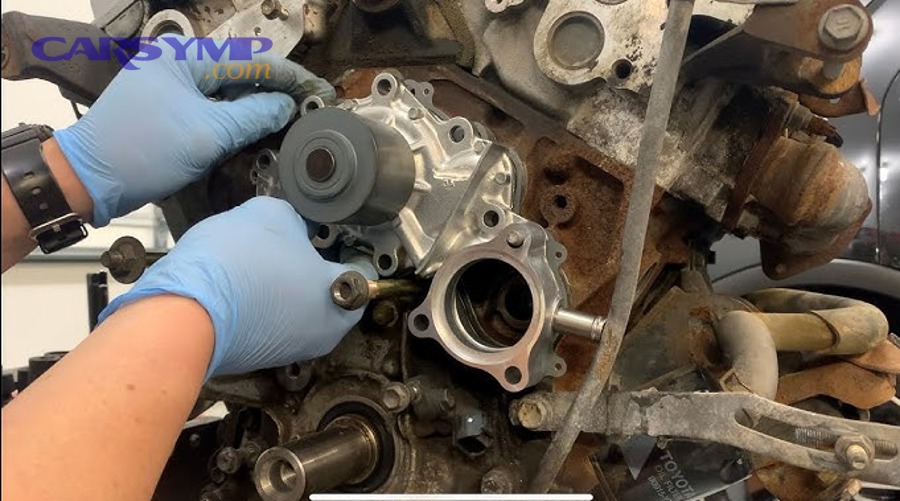
To better understand that decision, the important point is not replacing everything blindly; it is replacing the parts that share access, age, and failure risk with the pump. On engines where the water pump is timing-belt-driven, the case for bundled service becomes much stronger because the same disassembly exposes multiple wear items at once. Gates states that timing-belt-driven water pumps should always be replaced at the same time as the timing belt, and Dayco describes replacing both together as best practice because the parts often wear out on similar timelines.
Is replacing these parts together usually the smartest preventive maintenance choice?
Yes, replacing these parts together is usually the smartest preventive maintenance choice when the job already requires coolant draining, belt removal, or front-engine disassembly.
Specifically, the biggest benefit is labor efficiency. If a technician must remove the timing cover, loosen accessory components, drain coolant, and reassemble the front of the engine, much of the expensive work has already been paid for. Doing the thermostat or belt later often means paying for overlapping labor again. Dayco notes that when timing belt work is being done, the water pump is inexpensive relative to the labor overlap, and AutoZone similarly points out that if the pump sits behind the timing cover you may need to replace the timing belt as well.
A second reason is risk reduction. A fresh water pump paired with an old belt, weak tensioner, or aging thermostat can leave one old failure point beside one new part. That mismatch raises the chance that a neglected component will fail first and force the job to be reopened. AutoZone’s timing-belt-and-water-pump kit listings explicitly market the combination as a way to avoid future trouble with related timing components and save time and money by doing the work once.
A third reason is system performance. The cooling and belt-drive systems work as linked systems, not isolated parts. When coolant circulation, belt tension, pulley condition, and thermostat response all align, the engine is more likely to maintain stable temperature and dependable accessory drive performance. Dayco’s water-pump repair guidance emphasizes a systems approach because front-end drive components affect the longevity of the new pump installation.
What does “during a water pump job” actually mean for labor overlap and access?
“During a water pump job” means replacing related parts while the same disassembly, coolant service, and engine-access steps are already underway.
More specifically, overlap can include draining coolant, removing the serpentine belt, removing the timing belt if necessary, loosening accessories, removing covers, cleaning mating surfaces, and refilling and bleeding the system afterward. On some engines, the thermostat is easy to reach during a water pump replacement because the coolant is already drained and nearby housings are exposed. On others, the thermostat sits elsewhere, so the overlap is smaller and the case for simultaneous replacement is weaker. AutoZone’s repair guides show that both water pump and thermostat service begin with coolant draining and careful sealing-surface preparation, which is why these repairs are often evaluated together.
That overlap also explains why Water pump replacement labor time matters so much in the decision. The parts themselves are often cheaper than the labor needed to access them. If access is difficult, replacing a marginal thermostat or a near-due belt during the same job can be more rational than gambling on a later repair. Gates and Dayco both frame combined replacement as a way to reduce comebacks and preserve long-term system performance.
According to Dayco’s North America Tech Hub in March 2025, replacing the water pump at the same time as the timing belt is best practice because the parts wear at a similar pace and function as part of the same system.
What Parts Should Be Considered for Replacement Along With the Water Pump?
There are three main groups of parts to consider along with the water pump: directly linked cooling parts, directly linked belt-drive parts, and condition-based supporting parts.
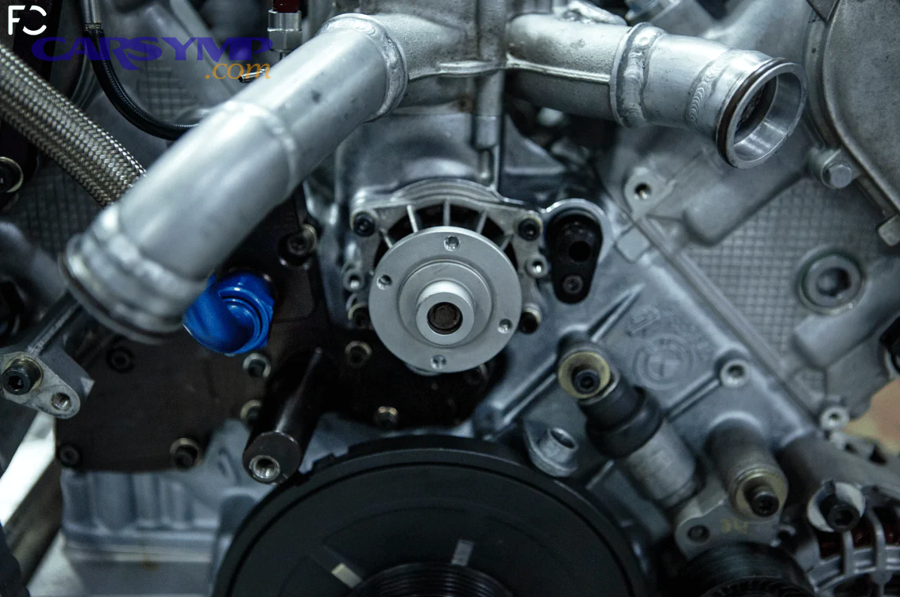
Next, grouping these parts helps owners avoid two common mistakes: replacing too little and replacing too much. The smartest list depends on the engine layout. If the water pump is behind the timing cover, the timing belt and often its supporting hardware move to the top of the list. If the pump is driven by an external accessory belt, the serpentine belt and its tension path deserve close inspection instead. AutoZone and Dayco both recommend viewing the job as a system, not a single-part swap.
Which companion parts are commonly replaced at the same time?
The most common companion parts are the thermostat, the relevant belt, tensioners, idler pulleys, coolant, seals or gaskets, and sometimes hoses or clamps.
For example, the thermostat is commonly considered because the cooling system is already open. The relevant belt depends on engine design: timing belt on one engine, serpentine belt on another. Tensioners and idlers matter because a worn pulley can shorten the life of a new belt or new pump installation. Coolant matters because draining the system is part of the repair, and reusing old or contaminated coolant can work against the value of the new components. AutoZone’s water pump category guidance recommends replacing the external belt or internal timing belt along with tensioners where applicable, and also recommends coolant, clamps, hoses, and thermostat inspection or replacement.
To make that easier to scan, the table below shows what each companion part contributes to the decision.
| Companion part | Why it is considered during a water pump job | Replace automatically or conditionally? |
|---|---|---|
| Thermostat | Cooling system is open; part is relatively inexpensive; age can justify renewal | Usually conditional, often recommended if old |
| Timing belt | Shares labor and access on timing-driven layouts | Often strongly recommended or interval-based |
| Serpentine belt | Removed or disturbed on many external-pump jobs | Conditional, based on wear and age |
| Tensioner / idler | Controls belt tracking and load | Conditional but highly important |
| Coolant | System must be drained and refilled | Usually essential |
| Gaskets / seals / O-rings | Needed for proper sealing | Essential |
| Hoses / clamps | Age-related leak risk | Conditional |
This grouping matters because owners frequently focus only on the pump itself. In practice, a clean and reliable repair depends on sealing surfaces, belt path integrity, and coolant quality as much as on the pump housing and impeller. Dayco’s best-practices article specifically stresses cooling-system cleanliness before installation, while AutoZone’s thermostat guide stresses a clean, flat sealing surface and correct gasket placement.
Which parts are mandatory to replace versus only worth considering?
The mandatory parts are the water pump itself, its required seals or gasket, and fresh coolant service steps; the parts worth considering are the thermostat, belts, and supporting drive hardware based on layout, interval, and condition.
However, “mandatory” is not the same on every engine. If the water pump is timing-belt-driven and the belt must be removed for access, the timing belt often becomes functionally mandatory because reinstalling an old, near-interval belt defeats the logic of the repair. On an engine where the pump is external and the serpentine belt is still relatively new and in good condition, belt replacement may remain optional. Gates is explicit that timing-belt-driven water pumps should be replaced with the timing belt, and AutoZone notes that some water pump procedures require timing belt removal depending on pump location.
The thermostat usually sits in the “worth considering” category, but it moves closer to mandatory when the part is original, access is convenient, or the engine already has overheating or warm-up complaints. A recent NHTSA-linked technical service bulletin shows thermostat failure as a direct cause of engine overheating in at least one manufacturer’s repair guidance, which reinforces that thermostat health is not a minor issue in cooling-system reliability.
According to Gates product guidance, timing-belt-driven water pumps should always be replaced with the timing belt to reduce comebacks and preserve long-term system performance.
How Do Timing Belt and Serpentine Belt Jobs Differ During Water Pump Replacement?
The timing belt wins in replacement priority when it directly drives the water pump, while the serpentine belt is more condition-based and layout-dependent during water pump replacement.
To better understand the difference, think in terms of access and consequence. A timing belt often sits deeper behind covers and may involve much more labor to reach. A serpentine belt usually sits at the front of the engine and is easier to replace later if needed. That difference changes both the economic logic and the risk calculation. Gates, Dayco, and AutoZone all distinguish between timing-belt-driven and external-belt-driven water pump layouts.
Is the timing belt more important to replace than the serpentine belt during a water pump job?
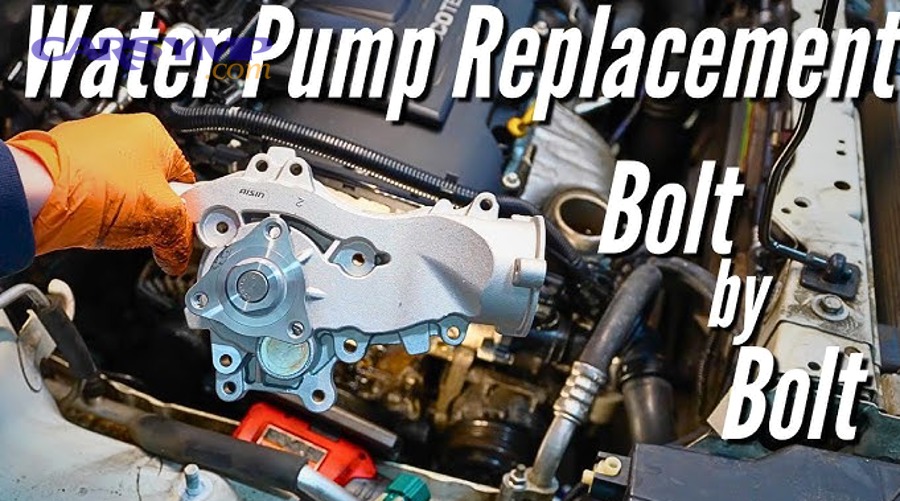
Yes, the timing belt is usually more important to replace than the serpentine belt when it directly drives the water pump because access overlap is greater, labor duplication is higher, and failure consequences can be more severe.
Specifically, the timing belt often shares the same service window as the pump on certain engines. Reusing an old timing belt after opening the timing side can erase much of the labor value of the repair. By contrast, a serpentine belt is frequently quicker to replace later unless it already shows cracking, glazing, contamination, edge wear, or age-related stiffness. Gates and Dayco both present the timing belt and water pump as a system-level service event, not merely two unrelated parts.
Another reason is consequence. On many engines, timing system integrity is critical to engine operation. Even when a serpentine belt failure can still cause overheating or loss of accessories, timing-system failure often carries a much higher repair risk. That is why the phrase water pump replacement labor time matters more on timing-side jobs than on simpler front-belt jobs: the teardown itself is where most of the cost lives.
What is the difference between a timing-belt-driven water pump and a serpentine-belt-driven water pump?
A timing-belt-driven water pump is mounted within the timing system and shares internal access, while a serpentine-belt-driven water pump sits on the accessory drive side and is usually easier to reach.
More specifically, the timing-belt-driven design forces the repair into a deeper service category. Covers come off, alignment matters more, and the pump, belt, pulleys, and tensioners form one service cluster. The serpentine-belt-driven design is usually simpler at the front of the engine, although exact access still varies by platform. AutoZone’s repair guide reflects this distinction directly by instructing technicians to remove the serpentine belt and, if necessary, the timing belt depending on the pump configuration.
That design difference also changes what “replace together” means. On a timing-side job, “together” may include belt, tensioner, idlers, and pump as one integrated service. On an external-belt job, “together” often means inspecting the serpentine belt, checking the tensioner, and deciding whether the thermostat and coolant service should be added while the system is open.
According to AutoZone’s water pump replacement guide, if the pump is driven by a serpentine belt, that belt is removed first, while pumps behind the timing cover require deeper disassembly and may require timing belt replacement as part of access.
When Should the Thermostat Be Replaced With the Water Pump?
You should replace the thermostat with the water pump when the thermostat is old, original, symptom-prone, conveniently accessible during the job, or when you want to avoid reopening the cooling system later.
Moreover, the thermostat decision is often where owners hesitate because the part is cheaper than the pump but not always obviously failed. The smarter question is not “Is it broken today?” but “Would delaying this part create avoidable repeat labor or cooling uncertainty?” AutoZone recommends careful thermostat installation with correct orientation and sealing, and NHTSA-linked manufacturer guidance shows that thermostat failure can directly trigger overheating conditions.
Should an old thermostat be replaced whenever the water pump is replaced?
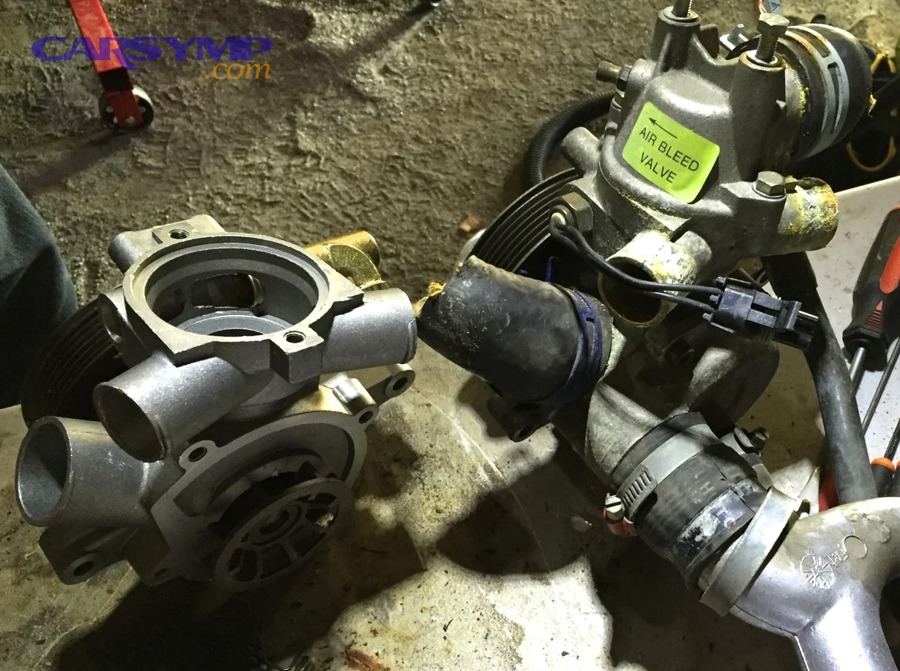
Yes, an old thermostat should usually be replaced whenever the water pump is replaced if it is original, high-mileage, or easy to reach during the repair.
Specifically, the thermostat is a classic low-cost, medium-risk part. It can stick, cycle poorly, or respond slowly long before a driver sees a dramatic failure. Because the cooling system must already be drained for many water pump jobs, replacing the thermostat at the same time can improve confidence in the entire cooling system rather than only one component. AutoZone’s thermostat replacement guide begins with coolant draining and stresses proper gasket seating and orientation, which shows how naturally this job pairs with cooling-system service.
That said, “whenever” should not mean blindly. If the thermostat was recently replaced, sits in a separate hard-to-reach location, and the engine has shown stable temperature behavior, keeping it may be reasonable. The best decision balances age, access, and symptoms instead of assuming every cooling-system part must be renewed at once.
What signs suggest the thermostat should be replaced at the same time?
The main signs are unstable temperature readings, slow warm-up, recurrent overheating, previous thermostat-related fault history, coolant service neglect, or an original high-mileage thermostat.
For example, a thermostat that opens late can contribute to overheating, while one stuck open can prevent the engine from warming up properly. In either case, the cooling system loses precision. Manufacturer service guidance linked through NHTSA includes overheating cases where thermostat replacement is the repair, and coolant service procedures also note verifying thermostat opening during warm-up. Those examples support treating the thermostat as a functional control point, not a trivial add-on.
This is also where Signs of incorrect installation matter. After a thermostat or water pump replacement, repeated overheating, trapped air, coolant seepage at a housing, erratic gauge movement, or poor cabin heat can indicate that the thermostat is installed backward, the system was not bled properly, or sealing surfaces were not prepared correctly. AutoZone specifically stresses correct thermostat orientation and proper torque on the housing, while Dayco stresses cooling-system cleanliness and installation best practices for the pump.
According to an NHTSA-linked technical service bulletin published in March 2025, thermostat failure can produce an “Engine Overheated” message and reduced vehicle performance, demonstrating the thermostat’s direct role in cooling-system reliability.
How Do Mileage, Age, and Service Intervals Affect the Decision?
Mileage, age, and service intervals often decide the job because belts are frequently interval-driven, thermostats age with heat cycles, and high-mileage parts are more likely to waste labor if left behind.
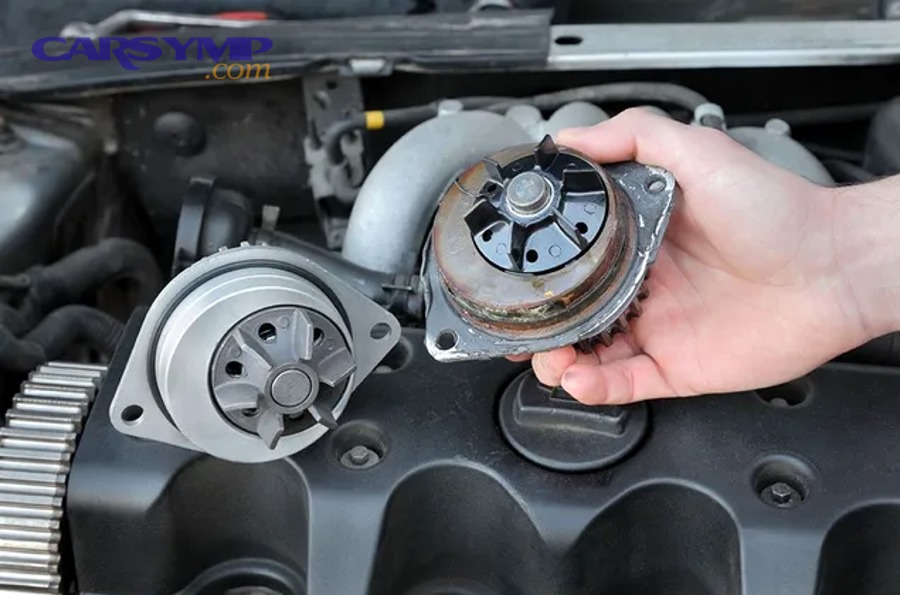
Then, once the engine layout is known, service timing becomes the next most important filter. A water pump job on a vehicle near a major belt interval is very different from the same job on a vehicle with recently documented belt and thermostat service. If the records show recent replacement, keeping those parts can be rational. If the records are missing and the parts are old, bundled service becomes more persuasive. Dayco says timing-belt and water-pump components commonly wear at the same pace, while Gates frames combined service as a way to avoid comebacks.
When is it better to replace parts based on service interval instead of visible wear?
It is better to replace parts based on service interval when the part can fail without obvious visible warning, when access is labor-intensive, and when the part sits inside an integrated system such as the timing drive.
Specifically, timing belts are the clearest example. A belt can look acceptable to an untrained eye and still be near the end of its reliable service life. The same logic can extend to tensioners and some thermostats, where heat cycling and age matter even without dramatic visible clues. This is why timing-belt-driven pump service is usually treated as an interval event rather than a cosmetic inspection event. Gates, Dayco, and kit manufacturers all promote bundled timing component replacement to prevent future work or damage caused by worn related parts.
For external belts, interval logic still matters but shares space with condition inspection. Cracks, glazing, frayed ribs, noise, contamination, or weak tension should raise the replacement priority. If the serpentine belt is comparatively new and the tensioner is strong, it may not need to be replaced solely because the pump is being serviced.
Which replacement scenarios make the most financial sense for car owners?
The most cost-effective scenarios are high-mileage vehicles, timing-belt-driven pumps, old thermostats, unclear service history, and repairs where most of the labor overlaps anyway.
More specifically, bundled service makes the most sense when:
- the pump is driven by the timing belt,
- the vehicle is already near its belt interval,
- the thermostat is original or symptom-prone,
- the coolant is old or contaminated,
- the owner plans to keep the vehicle,
- the front-of-engine teardown is extensive.
By contrast, limited replacement can make sense when the water pump is externally driven, the serpentine belt and thermostat were recently replaced, access overlap is small, and the owner has clear maintenance records. Dayco’s statement that roughly 90% of the labor for the pump can overlap with timing-belt work captures why timing-side jobs heavily favor the “do it once” approach.
According to Dayco’s automotive water pump repair guidance from March 2025, a technician should also replace the water pump during a timing belt change because the pump is inexpensive relative to the overlapping labor, with about 90% of the labor occurring during the same service window.
How Can Car Owners Decide What to Replace During a Water Pump Job?
Car owners can decide what to replace during a water pump job by checking five factors: pump drive type, maintenance records, part age, current symptoms, and how much labor would be repeated later.
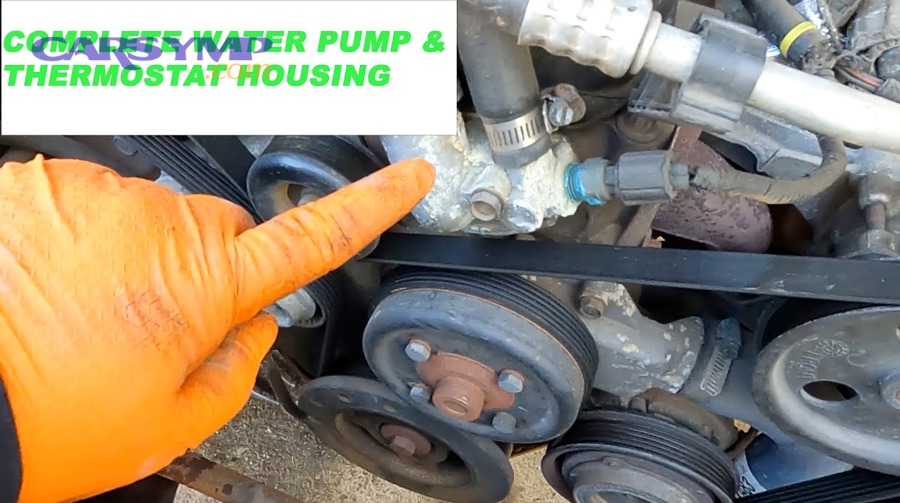
To better understand the choice, use a decision framework instead of guesswork. Start with the engine layout. If the water pump is behind the timing cover, think in systems. If it is external, think in inspection plus selective replacement. Then look at age and documentation. A recent documented thermostat and belt service changes the answer; missing records usually push the decision toward bundled renewal.
What questions should you ask before approving the repair?
The most useful questions are: What drives the pump, when were the thermostat and belts last replaced, what is the current mileage, are tensioners or idlers worn, and how much labor repeats if the parts are delayed?
Those questions matter because they force the repair discussion into specifics. Ask whether the pump is timing-belt-driven or serpentine-belt-driven. Ask whether the thermostat is original. Ask whether the shop sees signs of cracking, contamination, weak tension, leakage, or unstable temperature behavior. Ask whether coolant will be fully renewed. Ask whether there are visible Signs of incorrect installation risks, such as poor sealing surfaces, improper torque habits, or rushed bleeding procedures. AutoZone’s thermostat guide and Dayco’s best-practice guidance both emphasize correct installation details, which means workmanship matters as much as part choice.
A good repair conversation should also mention water pump replacement labor time in plain language. Owners should know whether the thermostat takes five extra minutes while the system is open or requires separate major labor. That answer often settles the decision immediately.
Is replacing more parts now cheaper than paying for another teardown later?
Yes, replacing more parts now is often cheaper than paying for another teardown later when the added parts share the same labor path and are already near the end of their useful service life.
However, “more parts” should mean relevant parts, not random parts. Replacing a timing belt, tensioner, and pump together on a timing-driven engine usually saves money over separate jobs. Replacing a recently renewed serpentine belt just because it was touched may not. The cost-saving logic depends on overlapping labor, not on part count alone. Gates, Dayco, and AutoZone all support system-based replacement where access and service timing justify it.
In short, the owner’s goal should be to buy reliability once, not labor twice. The more front-engine work the current job already requires, the stronger the case becomes for replacing the other age-sensitive parts that live in the same work zone.
According to Gates timing component guidance, replacing critical system components together helps avoid returns and comebacks, which is another way of saying it lowers the risk of paying twice for overlapping work.
What Related Repair Factors Can Change the Best Replacement Strategy?
The best replacement strategy can change because tensioners, idlers, engine design, interference risk, thermostat location, and installation quality all influence whether a bundled repair is necessary or merely helpful.

Besides the main decision, these related factors determine whether the job remains routine or becomes high-stakes. A simple external-pump replacement on a well-maintained engine does not carry the same risk profile as a timing-side service on a high-mileage interference engine with unknown history. That is why blanket rules often fail; the repair context matters.
How do tensioners and idler pulleys affect the value of replacing belts with the water pump?
Tensioners and idler pulleys increase the value of replacing belts with the water pump because they control belt alignment and load, and a worn pulley can shorten the life of both old and new components.
More specifically, a new belt running across a weak tensioner or noisy idler is not a complete repair. The belt may track poorly, wear unevenly, or place extra stress on the system. Gates kits and AutoZone timing-belt kits with water pumps highlight pulleys and tensioners as part of the complete repair solution, which reflects how these parts work together rather than separately.
Why does engine design make bundled replacement more important on some vehicles than others?
Engine design matters because some vehicles bury the water pump inside the timing system while others mount it on the outside, changing access, labor intensity, and the cost of postponing related parts.
For example, a compact engine bay with multiple covers and tight clearances raises the price of future re-entry. A thermostat integrated into a hard-to-reach housing also gains replacement value during a cooling-system service event. By contrast, on a more open layout with a simple external pump and recently serviced belt, separate replacement may be easier to justify. AutoZone’s distinction between serpentine-belt and timing-cover access illustrates this design-driven split clearly.
What is the risk of delaying timing component replacement on an interference engine?
The risk of delaying timing component replacement on an interference engine is high because a belt or timing-related failure can potentially cause severe internal engine damage, not just a roadside inconvenience.
More importantly, that risk changes the owner’s tolerance for postponing parts. On a non-critical accessory drive, waiting may create inconvenience and overheating risk. On an interference-engine timing system, waiting can escalate the stakes significantly. While the exact damage pattern varies by engine, the strategic lesson remains the same: when the timing side is open, ignoring age-sensitive timing parts is often the most expensive gamble on the vehicle. Gates and Dayco’s repeated emphasis on replacing timing-belt-driven water pumps with the belt reflects that higher-risk service philosophy.
When is it reasonable not to replace the thermostat or belts during a water pump job?
It is reasonable not to replace the thermostat or belts during a water pump job when those parts were recently replaced, show strong condition, have documented service history, and do not share enough labor overlap to justify renewal.
To sum up, selective replacement is reasonable when the owner has records, the parts are still within service life, and the risk of repeating labor is small. It is also reasonable when the thermostat is in a separate location and the engine shows no warm-up or overheating symptoms. What is not reasonable is making the decision without knowing the drive layout, service history, or installation details. Signs of incorrect installation such as coolant seepage, noisy belt tracking, misalignment, trapped air, overheating after repair, or poor heater performance should be investigated immediately because they can mimic “bad new parts” when the real issue is the installation process.
According to Dayco’s best-practices guidance from March 2025, correct installation and cooling-system cleanliness are essential to a successful water pump replacement, reinforcing that repair quality can matter just as much as deciding which companion parts to replace.