


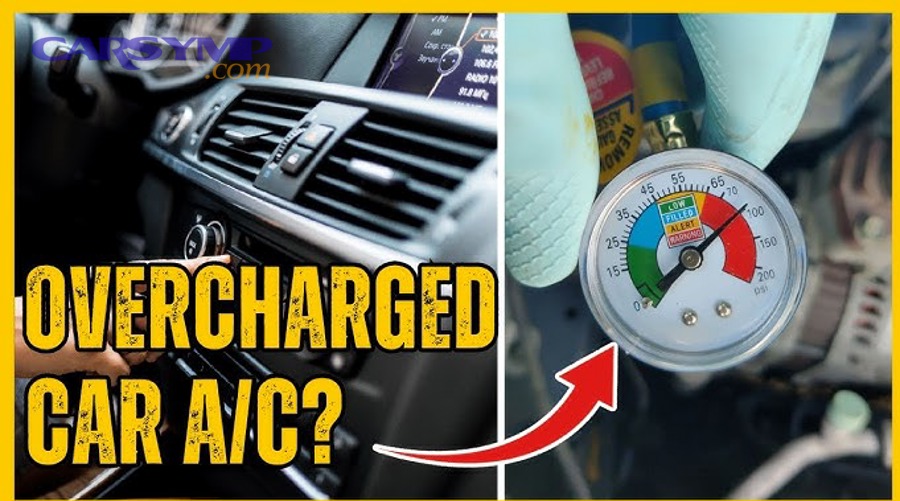
Overcharging your car’s air conditioner means the system contains more refrigerant than the factory specification, and yes—this can reduce cooling, spike pressures, and shorten component life.
To avoid it, the safest rule is simple: charge by weight with the exact spec, confirm airflow and condenser fan performance, and never “top off” blindly based on a single low-side gauge.
You’ll also learn how to verify what’s happening using pressure behavior, vent temperature patterns, and quick under-hood checks—so you don’t mistake a restriction or airflow problem for a charge issue.
Giới thiệu ý mới: below are the practical symptoms, the physics behind them, and the cleanest prevention steps you can use before any damage is done.
What does an overfilled refrigerant charge mean in a car A/C system?
An overfilled charge means the system is running with excess refrigerant mass, which pushes the high side toward abnormal pressures and reduces the “space” needed for proper heat rejection and stable expansion.
To connect the dots, it helps to remember the system is designed around a specific amount of refrigerant to balance condensing, metering, and evaporating across normal driving conditions.

Why “more refrigerant” is not “more cold”
No—adding extra refrigerant does not automatically improve cooling because the A/C loop needs stable phase change, not maximum quantity.
Next, the important mechanism is that too much refrigerant can reduce effective condenser volume for condensing, raise head pressure, and make the expansion device feed the evaporator inconsistently.
In practice, the result often looks like weak cooling at idle, “cold-then-warm” cycling, or high-pressure cutouts that mimic electrical faults.
What parts feel the pain first
The first parts to suffer are the condenser (heat rejection), compressor (load and discharge temperature), and pressure protection logic (switches/sensors that will shut the system down).
Additionally, seals and hoses can see higher stress when the system repeatedly hits elevated pressure peaks in hot ambient conditions.
The risk is not just comfort—it’s reliability, especially on high heat days or in stop-and-go traffic.
A research anchor you can trust
Overcharge changing system pressures and performance is not just a “shop myth.” Theo nghiên cứu của Purdue University từ International Refrigeration and Air Conditioning Conference, vào 07/2014, refrigerant charge deviation (including overcharge) measurably shifts suction/discharge conditions and system performance trends.
What are the most reliable symptoms of an overcharged car A/C?
The most reliable symptoms are high-side pressure running abnormally high, cooling that gets worse at idle or after a short drive, and frequent compressor cycling or shutdown triggered by pressure protection.
To move from guesswork to proof, you’ll want to combine cabin behavior with under-hood clues—because overcharge rarely shows up as just one symptom.
Symptom cluster 1: cooling feels inconsistent
Yes—overcharge often creates cooling that starts decent and then fades, especially when the car sits at a light or idles after a highway run.
Next, watch for “cooling plateaus” where turning the fan higher doesn’t improve comfort, or where the air feels only mildly cool unless the car is moving fast.
That pattern points to heat rejection stress and pressure management events rather than a simple low charge.
Symptom cluster 2: compressor cycles too often or abruptly stops
Yes—if head pressure rises fast, the system may shut the compressor off to protect hardware.
Then you’ll notice frequent clutch cycling (or rapid displacement control changes on variable compressors), sometimes paired with a warm blast, then cold again.
This is not “normal cycling”—it’s protective behavior that can hide the real cause if you only feel the vent air for a few seconds.
Symptom cluster 3: abnormal sounds and hot lines
Sometimes—an overcharged system can sound “loaded,” with subtle groans, whines, or gurgling as pressures fluctuate.
Next, under the hood you may find the discharge line and condenser area unusually hot compared to a healthy system under the same ambient temperature.
Hot lines alone are not diagnosis, but when paired with poor cooling and pressure cutouts, they strengthen the case.
Why can overcharge cool worse than a slightly low charge?
Overcharge can cool worse because it drives the system into high head pressure, reduces condenser effectiveness, and destabilizes the expansion process—so the evaporator cannot absorb cabin heat efficiently.
To understand why, it helps to follow the refrigerant’s “job” in each component and see where excess mass breaks the balance.
Condenser bottleneck: heat can’t leave fast enough
Yes—when the condenser can’t reject heat efficiently, discharge pressure rises and the system’s “temperature lift” becomes unfavorable.
Next, excess refrigerant can increase the likelihood that parts of the condenser remain filled with liquid in a way that reduces effective condensing area, especially with weak airflow.
In hot weather, this is why a car can feel okay on the highway but struggles at idle.
Expansion instability: the evaporator gets fed unevenly
Sometimes—overcharge can cause the metering device to see abnormal pressure relationships, leading to unstable feeding and evaporator performance swings.
Then the cabin symptom is familiar: cold bursts followed by mediocre cooling, rather than a steady low vent temperature.
This is also why a single low-side gauge reading can mislead you—stable cooling is about the whole loop, not one number.
Protection logic: the system may “save itself” by shutting down
Yes—modern cars use pressure transducers and module logic that will disengage the compressor if pressures are unsafe.
Next, that shutdown can look like an electrical or clutch issue, even though the root cause is pressure stress from charge error or airflow restriction.
Theo nghiên cứu của ESCO Institute từ Section 609 training materials, vào 2021, overcharged MVAC systems can create excessively high pressures that risk system failure and may lead to venting incidents if serviced improperly.
How do you confirm overcharge without guessing?
You confirm overcharge by combining high-side pressure behavior, vent temperature performance under controlled conditions, and airflow/heat-rejection checks—then comparing results to the vehicle’s specified charging method.
To do this safely, you need a repeatable test routine rather than “add a little and see.”

Step 1: run a controlled performance check
Yes—use a consistent setup: doors open, blower mid-high, recirculation on, engine at stable idle, and a thermometer at the center vent.
Next, note how fast vent temperature drops, whether it plateaus early, and whether it warms during idle even though the compressor is commanded on.
This is where you can incorporate an AC recharge outcome check, but only after verifying the charge method was correct and not based on low-side pressure alone.
Step 2: watch pressure trends, not just “a reading”
Yes—overcharge diagnosis is about how pressures respond as condenser airflow changes (fans on/off, idle vs light rev, shaded vs sun).
Then, if the high side climbs quickly and stays elevated while cooling deteriorates, that pattern is more consistent with overcharge or condenser airflow problems than with low refrigerant.
Use caution: many DIY kits show only low-side pressure, which is not enough to confirm the condition.
Step 3: rule out airflow and heat rejection problems
No—do not declare overcharge until you confirm the condenser is getting proper airflow and the fan(s) are working correctly.
Next, check for debris, bent fins, blocked grille areas, and fan operation at idle with A/C on; poor airflow can mimic the same high-pressure behavior you’d blame on refrigerant quantity.

Step 4: use the “vent temperature proof” correctly
Yes—the cabin test matters, but only if you run it the same way each time and record ambient temperature.
Next, document a Post-recharge vent temp test after any service so you can see whether performance is stable or drifting (which may indicate a leak, airflow issue, or charge error).
This is also where you should verify you didn’t ignore Signs you have a leak before recharging, because topping off a leaking system invites repeat mistakes—and overfilling becomes more likely over time.
What quick warning signs show you should stop adding refrigerant?
You should stop adding refrigerant immediately if cooling stops improving, pressures behave aggressively, or the compressor begins cycling abnormally—because continuing turns a “comfort fix” into a high-pressure risk.
To stay safe, treat these as red flags rather than “normal” behavior during a refill attempt.
Cooling plateaus or gets worse
Yes—if vent temperature stops dropping after small additions, that is a clear sign you may be past optimal charge or chasing the wrong problem.
Next, if vent air warms at idle after adding refrigerant, it strongly suggests rising head pressure or airflow limitation.
Continuing to add at this point is one of the most common ways DIY service creates overcharge.
Compressor starts short-cycling
Yes—if the compressor clicks on/off rapidly or the system appears to “give up” and blow warm intermittently, stop.
Next, short-cycling can be protective logic responding to pressure, and it can also be caused by fan failure or a restriction—both of which extra refrigerant will not fix.
At minimum, you need proper diagnostics before adding anything else.
Hoses feel dangerously hot and fans sound like they’re maxed out
Sometimes—very hot discharge lines and fans running hard can be normal on extreme days, but if this escalates after adding refrigerant, it’s a warning.
Next, rising thermal stress can push the system toward a cutout event, especially in traffic.
The smart move is to stop and verify charge by weight rather than “one more little squeeze.”
How do you avoid overcharging when doing DIY service?
You avoid overcharging by using the factory charge specification, charging by weight, and verifying the system is leak-free and airflow-healthy before adding anything—because “guess-and-fill” is the real cause of most overcharge cases.
To make this practical, use a prevention routine that removes the common traps.

Trap 1: charging based on low-side pressure only
No—low-side pressure alone cannot tell you the correct refrigerant mass, especially with variable displacement compressors and modern control logic.
Next, low-side pressure can look “normal” while high-side is excessive due to airflow restrictions, condenser issues, or overcharge.
So the safer method is to use the correct equipment and charge by weight whenever possible.
Trap 2: skipping leak verification and “topping off” repeatedly
No—if the system needed refrigerant once, it often needs a leak check before it needs more refrigerant again.
Next, repeated top-offs increase the chance you eventually exceed the system’s spec—especially if temperature and fan conditions differ each time you add.
This is where “I add a little every summer” turns into chronic performance issues and component wear.
Trap 3: confusing airflow problems with charge problems
Yes—dirty fins, blocked airflow, or a weak fan motor can mimic overcharge behavior.
Next, clean the condenser face, confirm fan operation, and ensure nothing is obstructing airflow before you touch refrigerant quantity.
If airflow is the true bottleneck, correct charge won’t rescue performance until airflow is restored.
Best-practice checklist you can follow
Below is a quick reference so you can reduce guesswork and prevent expensive mistakes.
This table contains the most common “looks like overcharge” symptoms, what they usually mean, and the safest next step so you can avoid chasing the wrong fix.
| What you notice | Most likely category | Quick check | Safest next step |
|---|---|---|---|
| Cooling weak at idle, improves while driving | Airflow/heat rejection stress | Condenser fan operation, debris, bent fins | Fix airflow first; don’t add refrigerant yet |
| Compressor cycles off, then on, with warm bursts | Pressure protection events | Monitor high-side behavior with proper gauges | Stop charging; verify by weight |
| Vent temp plateaus after adding refrigerant | Past optimal charge or wrong diagnosis | Repeat controlled vent test, compare ambient | Recover/charge correctly; check for restrictions |
| Oil/dye residue near fittings, slow performance decline | Leak likely | UV dye/soap bubbles/electronic leak check | Repair leak before adding refrigerant again |
What’s the safest way to correct an overcharged system?
The safest correction is to recover refrigerant with proper equipment and recharge the exact specified amount by weight—because venting is unsafe, illegal in many jurisdictions, and inaccurate.
To do it right, focus on precision rather than speed.
Why “bleeding a little” is the wrong move
No—releasing refrigerant to atmosphere is not a safe or acceptable adjustment method.
Next, from a practical standpoint, you cannot control how much refrigerant you remove by cracking a fitting, and you may also pull oil out of the system in the process.
The correct solution is recovery and measured recharge.
The legal angle matters too: Theo nghiên cứu của U.S. EPA từ Ozone Layer Protection program documents, vào 2015, intentional refrigerant release (venting) is prohibited for many refrigerants while servicing MVAC-related systems.
Correct correction workflow (professional standard)
Yes—use recovery equipment to remove the refrigerant charge, then pull a stable vacuum, verify vacuum hold, and recharge by weight to the under-hood specification.
Next, confirm performance using controlled vent temperature measurement and pressure behavior across idle and higher RPM.
This is how you turn an “unknown” charge into a known, factory-correct charge.
Where DIY tools commonly fall short
Sometimes—DIY kits can be fine for basic checks, but many lack high-side measurement, accurate weighing, and recovery capability.
Next, if you cannot charge by weight and cannot recover refrigerant, your best “avoid damage” choice is to stop and use a certified shop for correction.
That cost is often lower than replacing a compressor or condenser after repeated high-pressure stress.
When is overcharge the wrong diagnosis?
Overcharge is the wrong diagnosis when the real issue is restricted condenser airflow, a system restriction, or a control/door problem—because those can create the same “poor cooling + odd pressures” pattern.
To avoid chasing the wrong fix, use elimination logic before you blame refrigerant quantity.
Restriction scenarios that mimic overfill
Yes—restrictions (like a clogged condenser or a stuck metering device) can raise high-side pressure and reduce cooling even if the charge is correct.
Next, restrictions often show up as abnormal temperature drops across specific points in the loop and performance that changes sharply with RPM.
If you suspect restriction, the safe path is professional diagnosis because “adding refrigerant” will not remove a blockage.
Airflow failures that look like charge mistakes
Yes—a dead condenser fan, missing fan shroud, or packed debris can elevate head pressure quickly at idle.
Next, the clue is that the problem is worst at stoplights and improves with road speed, even without changing any refrigerant amount.
Cabin airflow and blend door issues
Sometimes—if the blend door is stuck or the cabin filter is severely restricted, the cabin can feel warm even while the evaporator is cold.
Next, this causes people to add refrigerant unnecessarily, increasing the risk of creating a true overcharge on top of the original cabin airflow problem.
So always confirm cabin airflow health before you touch the refrigerant side.
When should you stop DIY work and go to a certified shop?
You should stop DIY work if pressures are unknown, cooling triggers frequent shutdowns, you suspect a leak or restriction, or you cannot charge by weight—because the cost of getting it wrong is usually higher than the cost of proper service.
To decide quickly, use a risk-based threshold rather than pride.
Go to a shop if you can’t verify the charge method
Yes—if you don’t know the exact amount in the system, you’re operating blind.
Next, a shop can recover, weigh, and recharge to spec, which resets the system to a known baseline and prevents accidental overcharge.
This is especially important for newer refrigerants and vehicles with sensitive pressure control logic.
Go to a shop if you suspect a leak but can’t confirm it
Yes—leaks are the main reason people keep adding refrigerant until they overshoot.
Next, professional leak detection (dye, nitrogen pressure testing, electronic detectors) can find the source so you stop repeating the same cycle.
This is where an AC recharge cost estimate can look “high” at first, but it’s often cheaper than repeated refills plus compressor damage.
Go to a shop if the system is shutting down under heat load
Yes—rapid cutouts can indicate unsafe pressures, airflow failures, or restrictions.
Next, continued operation during cutouts can stress the compressor and push the system into failure, so professional diagnosis is the safer call.
Also, if you’re documenting Car Symptoms, note when the shutdown occurs (idle, highway, uphill, hot soak) because that pattern is diagnostic gold.
Contextual border: Up to this point, you’ve learned the core symptoms and prevention/correction logic. Next, we’ll expand into edge cases—modern refrigerants, compressor types, climate conditions, and oil balance—where overcharge behaves differently.
Edge cases that make overcharge harder to spot
Overcharge becomes harder to spot when the vehicle uses newer refrigerants, variable displacement compressors, or aggressive control strategies that mask pressure swings—so you must lean more on measured mass and controlled testing.
To keep your diagnosis accurate, treat these as “special contexts,” not exceptions you can ignore.
Newer refrigerants and tighter service tolerances
Yes—newer refrigerants and systems can be more sensitive to charge accuracy, and small deviations can produce noticeable performance changes.
Next, that sensitivity increases the importance of charging by weight and following the exact service procedure rather than relying on pressure-only heuristics.
If your vehicle uses a refrigerant with specific service constraints, treat DIY “top-off” as a high-risk move.
Variable displacement compressors can hide the problem
Yes—variable compressors can adjust capacity to maintain targets, which can make an overcharged system feel “almost okay” until heat load rises.
Next, once ambient temperatures climb or airflow drops, control range can run out and symptoms become obvious—often at the worst time (traffic in summer).
This is why you should validate with controlled tests, not just “it feels cold right now.”
Hot ambient, heat soak, and idle time amplify overcharge behavior
Yes—overcharge symptoms often get dramatically worse after a hot soak or long idle.
Next, high ambient reduces condenser temperature margin, so head pressure climbs faster and protection cutouts become more likely.
If your system fails mainly after parking in the sun, think heat rejection and charge accuracy first.
Oil quantity mistakes can compound charge mistakes
Sometimes—too much or too little compressor oil can distort pressures, reduce heat exchange, and mimic charge problems.
Next, oil is not “just lubrication”; it affects system volume and heat transfer, so incorrect oil management during repairs can make overcharge-like behavior more severe.
If major parts were replaced, confirm oil procedure and quantity in addition to refrigerant mass.
FAQs about refrigerant overfill problems
Can you damage the compressor by adding too much refrigerant?
Yes—overfill can create high pressures and elevated compressor load/temperature, which accelerates wear and can trigger protection shutdowns that feel like “random A/C failure.”
Is a low-side gauge kit enough to prevent overcharge?
No—low-side-only kits cannot see high-side pressure behavior and can mislead you on modern systems; charging by weight is the most reliable prevention method.
Why does the A/C get colder while driving but warmer at idle?
Often this points to condenser airflow/heat rejection stress; it can happen with overcharge, but also with weak fan operation or blocked condenser fins—so confirm airflow before adding refrigerant.
Do you need to remove refrigerant if you suspect overcharge?
Yes, but safely—recovery and measured recharge is the correct method; “bleeding” refrigerant is unsafe, inaccurate, and may violate regulations depending on refrigerant and location.
How do you know the correct refrigerant amount for your car?
Look for the under-hood A/C label or service manual specification; the correct value is a weight (mass), not a pressure target, and it’s tied to the exact refrigerant type.
What should you record to help diagnose recurring A/C problems?
Record ambient temperature, vent temperature behavior over time, when symptoms occur (idle/highway/hot soak), fan operation, and any visible signs of leaks—this history makes professional diagnosis faster and cheaper.