


Control arm bushing clunk symptoms usually show up as a dull knock from the suspension—most often during braking, acceleration, or when the wheel hits a bump—because the bushing can no longer hold the control arm firmly in its designed position.
Next, you’ll learn what a control arm bushing does and why it’s specifically capable of creating a clunk instead of just a squeak or vibration.
Then, you’ll get a symptom-by-symptom checklist (noise, handling, steering feel, tire wear, and visual clues) so you can connect what you feel in the driver’s seat to what’s happening under the car.
Introduce a new idea: you’ll finish with quick DIY tests and clear decision rules for safety and repairs—so you know what to inspect first, what’s “driveable for now,” and what needs immediate attention.
What is a control arm bushing, and what does it do in your suspension?
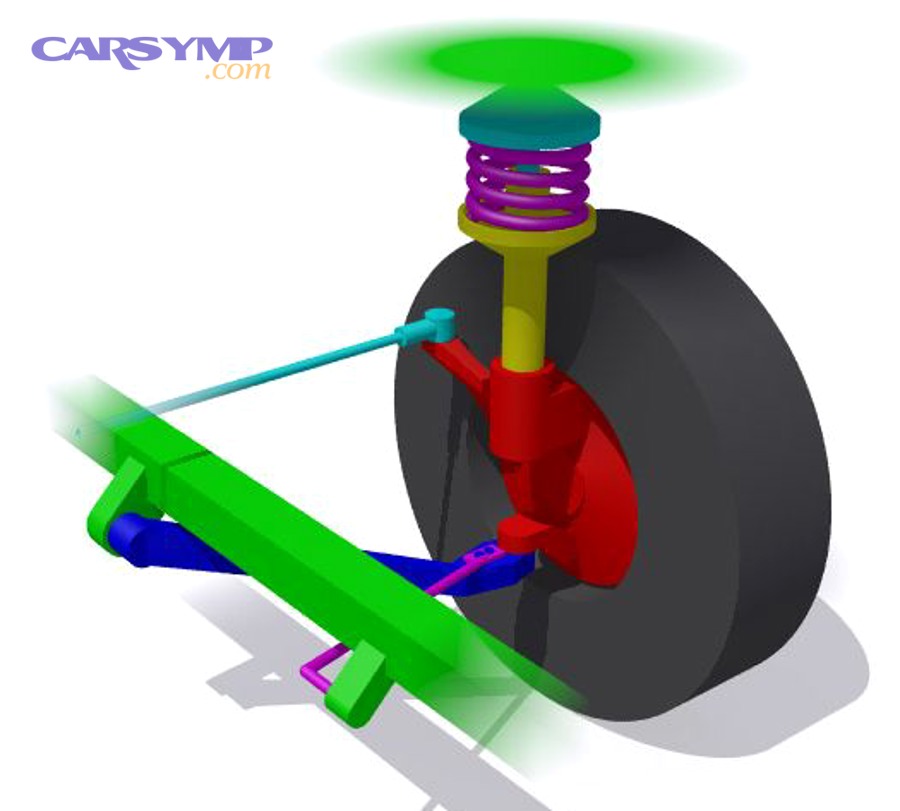
A control arm bushing is a rubber-or-polyurethane isolated joint that connects the control arm to the vehicle’s chassis/subframe, allowing controlled movement while damping vibration and keeping the wheel’s alignment geometry stable under load.
To better understand why clunks happen, it helps to visualize where the bushing sits and what forces it handles every time you brake, turn, or hit a pothole.
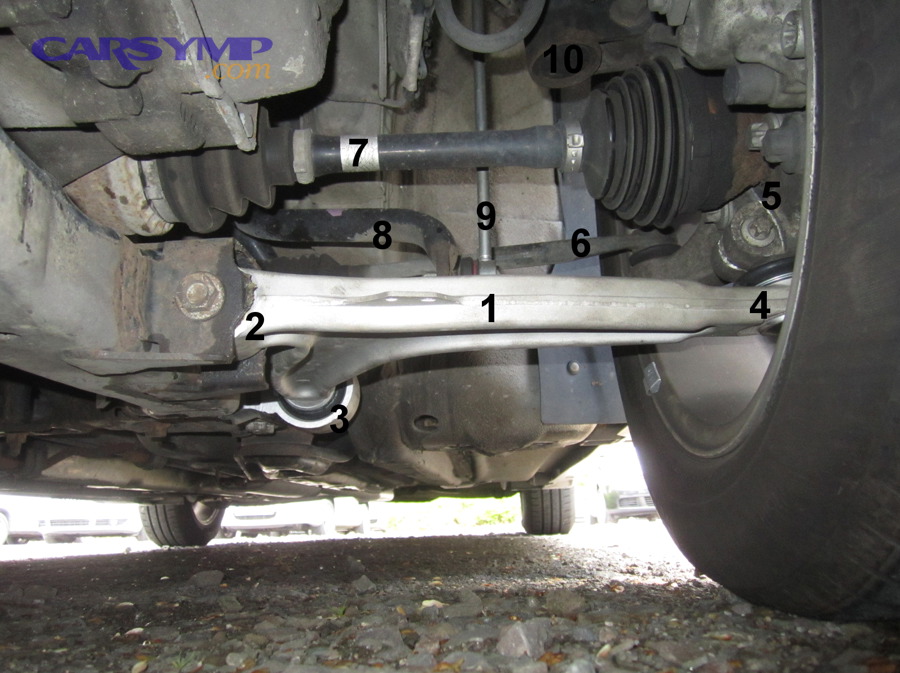
Where is the control arm bushing located (and why does location matter)?
The control arm bushing is typically pressed into the inner end(s) of the control arm—where the arm bolts to the chassis or a subframe. Many vehicles have:
- One front bushing + one rear bushing on a lower control arm (common on MacPherson strut front suspensions).
- Multiple bushings on multi-link setups (more pieces, more potential sources of play/noise).
Location matters because each bushing sees different loads:
- The rear bushing often takes heavy braking/acceleration loads (fore-aft forces).
- The front bushing often manages side-loads and stabilizes arm position during cornering.
When one bushing fails, the control arm can shift in the direction that bushing used to restrain—creating a repeatable “bump → shift → knock” pattern.
What does a bushing actually do when it’s healthy?
A healthy control arm bushing does three jobs at the same time:
- Allows motion: the suspension has to move up/down and articulate.
- Controls geometry: the bushing’s stiffness resists unwanted changes in toe/camber under load.
- Damps vibration: the rubber isolates road harshness so the cabin stays quiet.
That “controlled movement” part is the key: it’s normal for the bushing to flex a little—but it’s not normal for the arm to shift abruptly.
Rubber vs polyurethane bushings: do they change symptoms?
Yes—material changes can change how symptoms feel:
- Rubber (OEM-style): best isolation; tends to fail by cracking/tearing and allowing soft “thuds” or wandering.
- Polyurethane: stiffer; improves response but can transmit more noise; if dry or improperly greased (where applicable), it can squeak—yet it can still clunk if there’s play or hardware looseness.
What doesn’t change is the diagnostic principle: a clunk happens when something moves suddenly and hits a stop (metal-to-metal contact, sleeve shift, bolt movement, or arm repositioning).
Evidence (if any): According to a study by Chalmers University of Technology from the Department of Mechanics and Maritime Sciences, in 2022, a target-driven suspension method reported that suspension hardpoint and bushing compliance design work could reduce design lead time by half, highlighting how critical bushing compliance is to overall suspension behavior. (research.chalmers.se)
Are clunking/knocking noises a sign of worn control arm bushings?
Yes—control arm bushing clunk symptoms are a common cause of a knock because worn bushings create excess play, allow the control arm to shift under load, and can lead to metal-to-metal contact at the bushing sleeve, bracket, or mounting bolt interface.
More importantly, the timing of the noise tells you whether the bushing is a strong suspect.
Yes/No test: does the clunk match bushing load changes?
If the noise is tied to load transitions, bushings move up the suspect list:
- Brake application (especially light-to-medium braking): arm shifts rearward → knock.
- Accelerating from a stop: arm shifts forward → knock.
- Steering input + bumps: combined lateral + vertical load → knock.
This is why many drivers describe it as a clunking noise over bumps plus a second clunk during braking.
Why bushings clunk instead of just “feel loose”
A worn bushing can fail in two common ways:
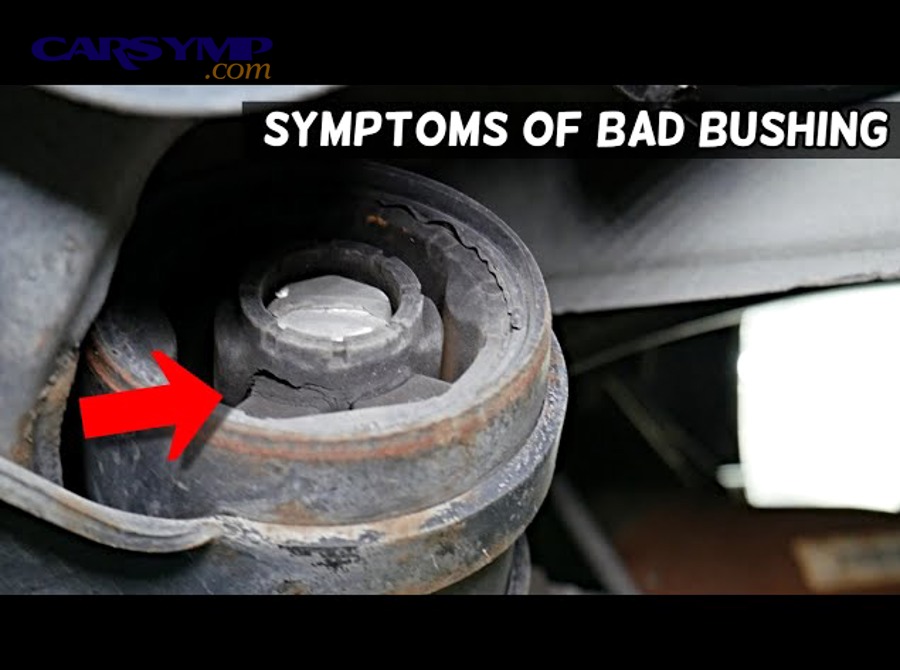
- Rubber separates from the sleeve: the inner sleeve can move independently of the outer shell.
- Rubber tears: the arm rotates farther than intended and then “snaps” back, hitting a limit.
In both cases, the sound you hear is usually not “rubber making noise”—it’s the arm or sleeve moving until something stops it.
When a clunk is less likely to be a control arm bushing
A bushing is not always the culprit if the clunk:
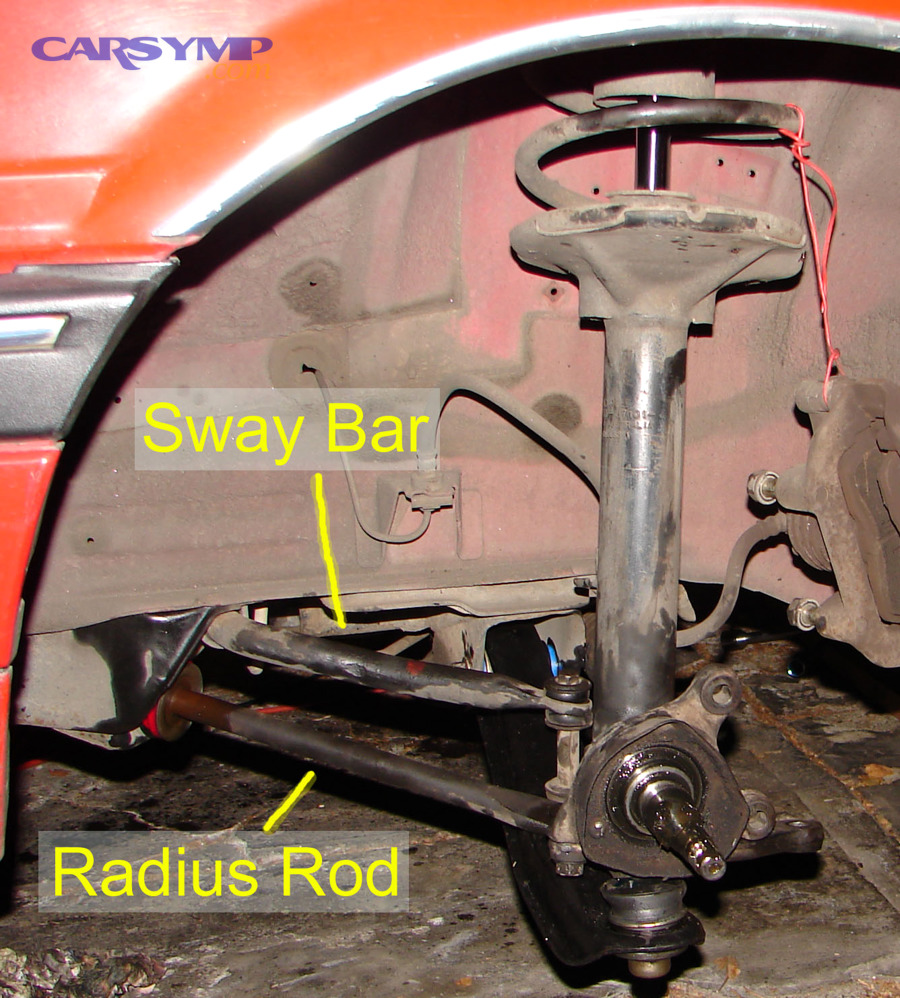
- Happens mostly on small rapid chatter (often sway bar links).
- Is accompanied by a sharp clicking on turns (often CV axle).
- Sounds like a top-of-strut pop during steering (often strut mount).
That’s why the next section focuses on symptoms you can pair with the noise to raise confidence.
What are the most common control arm bushing clunk symptoms?
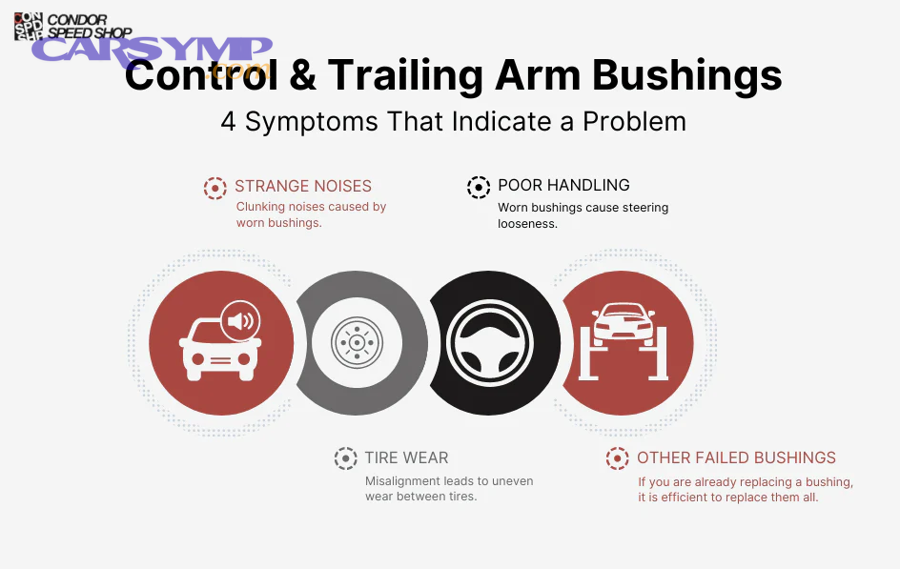
There are 5 main symptom groups of control arm bushing clunk symptoms: noise patterns, steering feel changes, handling stability issues, tire wear/alignment clues, and visible bushing damage.
Specifically, you’ll get the best diagnostic accuracy when you match at least two symptom groups—not just the sound.
What noise patterns point most strongly to control arm bushings?
Control arm bushing noise tends to be:
- Dull, heavy, single “thunk/knock” rather than a rapid rattle
- Most noticeable at low speed over speed bumps, driveway transitions, potholes
- Often worse when the suspension is loaded on one side (turning into a driveway)
Quick pattern checklist:
- Clunk on braking → rear bushing load shift
- Clunk on acceleration → fore-aft shift
- Clunk when reversing + braking → bushings or subframe/control arm mount movement
What steering and handling symptoms commonly appear with worn bushings?
When bushings can’t hold geometry, you may feel:
- Vague steering on-center
- Wandering or tramlining (car follows grooves)
- Pulling under braking
- Unstable lane changes (extra correction needed)
A simple way to describe it: the wheel alignment may be “correct on paper,” but it changes dynamically because the control arm is no longer held firmly.
What tire wear and alignment clues can support the diagnosis?
Bushings don’t “wear tires” directly—but they can let toe/camber shift, which does. Watch for:
- Inside edge wear (common with camber/toe issues)
- Feathering (toe changes)
- New tires wearing fast after an alignment (alignment can’t “hold” if parts move)
If you recently aligned the car and the steering wheel goes off-center again quickly, bushings (or other joints) become more suspicious.
What visual signs confirm bushing deterioration?
With the car safely lifted, a worn bushing often shows:
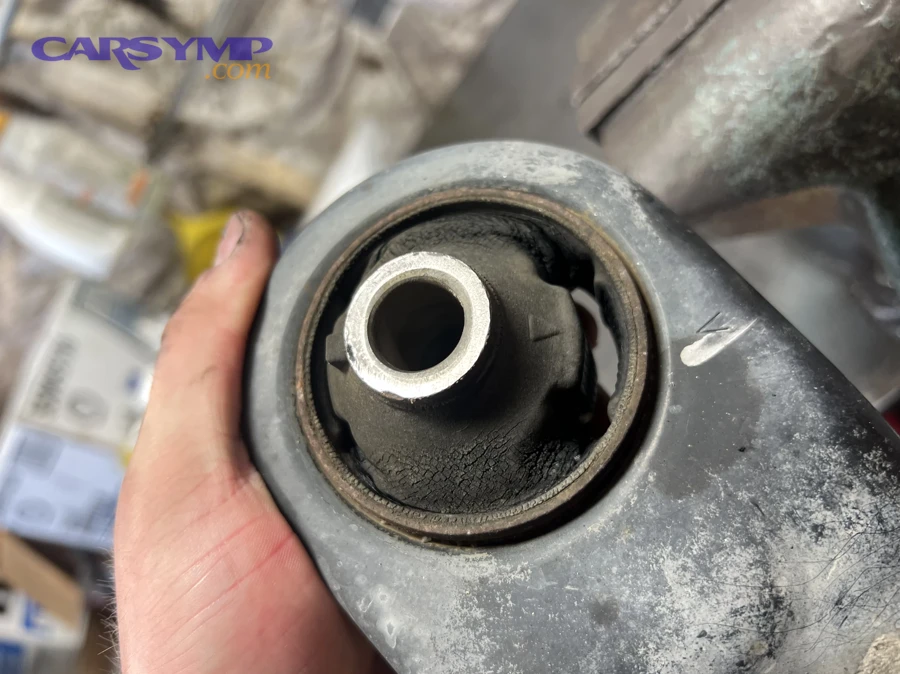
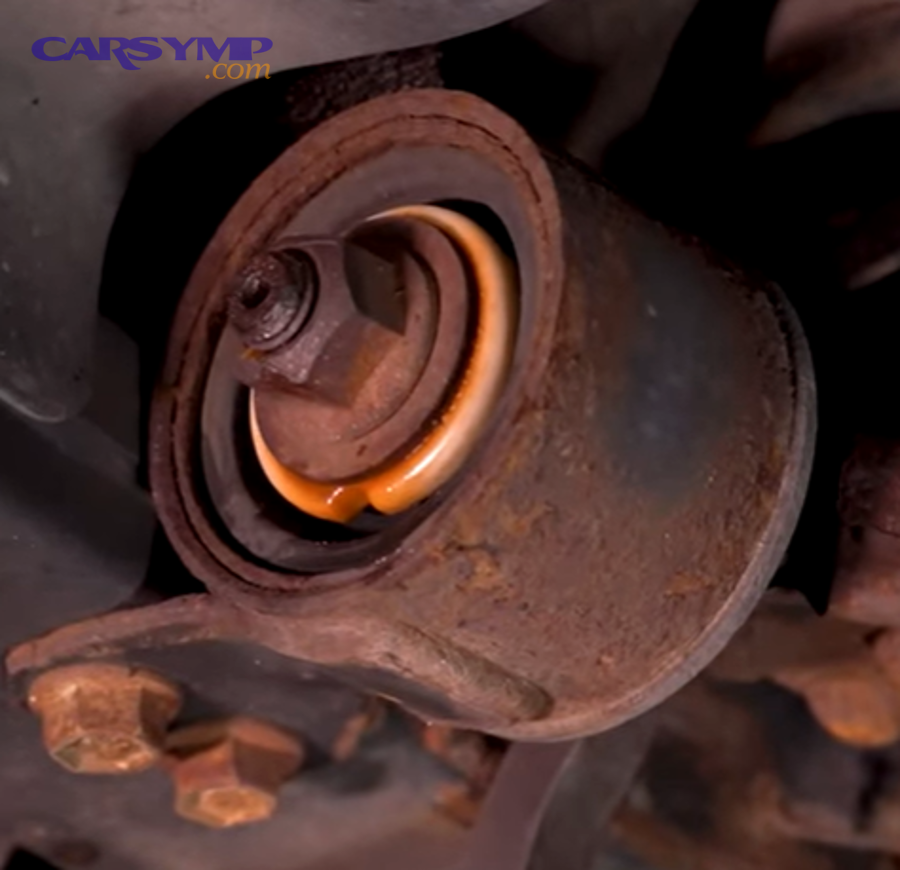
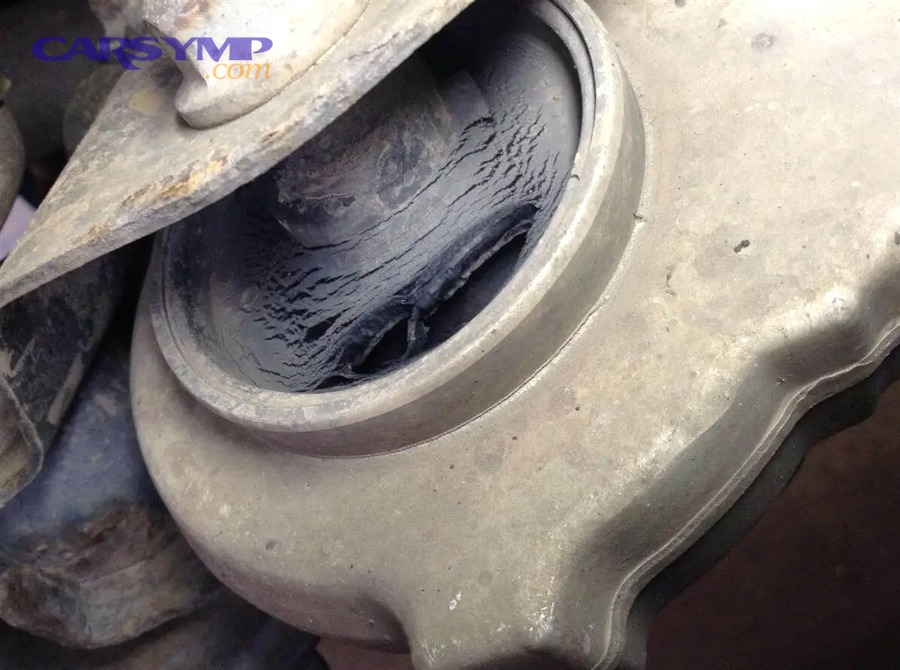
- Cracks or missing chunks of rubber
- Separation between rubber and sleeve
- Wet, swollen rubber (fluid-filled hydraulic bushings can leak and soften)
- Off-center sleeve or obvious deformation
If the bushing looks “shifted” in its housing, it’s often already past the point of quiet operation.
How can DIY car owners confirm a control arm bushing is causing the clunk?
You can confirm control arm bushing clunk symptoms with a 4-step method: repeatable road test, visual inspection, controlled pry-bar load test, and wheel/arm movement checks—which together reveal whether the control arm is shifting beyond normal bushing flex.
Next, you’ll connect what you hear while driving to what you can physically observe—so you’re not guessing.
Step 1: How do you road-test for bushing-specific clunks?
Use a low-speed test route:
- Drive over a single speed bump at 5–10 mph (listen for a single thunk).
- Repeat while lightly braking over the bump.
- Repeat while lightly accelerating after the bump.
If the clunk changes with braking/acceleration, it supports a fore-aft shift—classic bushing behavior.
Step 2: What should you look for during a visual inspection?
Safely lift and support the vehicle on jack stands. Then inspect:
- Rubber condition (cracks, tears, separation)
- Sleeve position (centered vs shifted)
- Missing or damaged washers/spacers
- Shiny rub marks near the mount (evidence of movement/contact)
If you have hydraulic bushings, look for leaking fluid or rubber that looks softened and distorted.
Step 3: How do you do a pry-bar test without damaging parts?
This is the most useful DIY confirmation if done carefully:
- Place a pry bar between the control arm and subframe in a way that applies force similar to braking/acceleration (fore-aft).
- Apply steady pressure—don’t stab or jerk.
- Watch the bushing: normal flex is smooth and limited; bad bushings show abrupt shifts, sleeve movement, or knocking.
A strong indicator is when you can recreate the sound while watching the bushing move.

Step 4: What wheel/arm checks help separate bushings from ball joints or tie rods?
Try these quick checks (with the wheel off the ground):
- 12 and 6 o’clock shake: often points to ball joint or bearing (not always, but useful).
- 3 and 9 o’clock shake: often points to tie rods/steering play.
- Observe the control arm mounts while a helper rocks the wheel: bushing movement at the chassis end is a red flag.
If the chassis end of the arm visibly shifts, bushings (or loose mounting bolts) are likely involved.
What else can cause clunking noises over bumps besides control arm bushings?
The main alternatives to control arm bushing clunk symptoms are sway bar end links, strut mounts, ball joints, tie rods, CV axles, and loose hardware—and each one has a slightly different trigger and sound signature.
However, you can narrow it down fast by matching the noise to when it happens and what changes it.
Which parts most often mimic a bushing clunk?
Here’s a practical “most common first” list:
- Sway bar end links: rapid rattle or knock over small bumps; often worse on uneven roads.
- Strut mount/top hat: pop or clunk during steering or when the strut rotates.
- Ball joint: clunk plus steering looseness; can be dangerous if severe.
- Tie rod ends: clunk with steering input; may feel like steering delay.
- Loose subframe/control arm bolts: heavier knock, often repeats under braking/accel.
- Brake hardware: caliper bracket or pad movement can create a clunk that sounds “suspension-like.”
How do you differentiate control arm bushing clunks from sway bar end link clunks?
Control arm bushings:
- Usually single heavier thunk
- Changes with braking/acceleration load
- May come with wandering/pulling
Sway bar end links:
- Often faster, lighter tapping
- Most obvious on small repetitive bumps
- Often quieter on smooth roads and louder on rough, chattery surfaces
To make it even simpler, use this comparison table (it summarizes what the clunk sounds like and what makes it change):
| Suspected part | Typical sound | Trigger that makes it worse | Quick DIY clue |
|---|---|---|---|
| Control arm bushings | Dull thunk/knock | Brake/accel transitions, big bumps | Pry bar causes visible mount movement |
| Sway bar end links | Rattle/tap/knock | Small repetitive bumps, uneven roads | Grab link; check for play at joints |
| Strut mount | Pop/clunk | Steering at low speed, turning into driveway | Noise at top of strut tower area |
| Ball joint | Clunk + looseness | Bumps + steering | 12/6 shake + visible joint play |
| Tie rod end | Clunk with steering | Turning/steering corrections | 3/9 shake + steering play |
| Loose hardware | Heavy knock | Brake/accel, bumps | Torque check reveals movement |
Can engine/trans mounts cause a front-end clunk that feels like suspension?
Yes—especially during:
- Shifting from drive to reverse
- Sudden throttle changes
- Hard braking to a stop
Mount clunks often feel like a “mass shift” rather than a wheel-specific knock. If the sound happens even on smooth ground during throttle blips, mounts rise on the suspect list.
Is it safe to drive with control arm bushing clunk symptoms?
No—driving with control arm bushing clunk symptoms is not reliably safe because worsening bushing play can change alignment under load, reduce steering stability, and accelerate failure in related joints; it becomes especially risky if the clunk is paired with wandering, braking instability, or visible bushing separation.
More importantly, you need a clear rule for When clunking is unsafe to drive—so you don’t rely on wishful thinking.
When is clunking unsafe to drive (clear stop-driving triggers)?
Stop driving (or drive only directly to a shop) if you have any of these:
- The car pulls hard under braking or feels unstable
- Steering feels loose, delayed, or “floating”
- The clunk is loud, frequent, and worsening quickly
- You can see torn/separated bushing rubber or a shifted sleeve
- The wheel appears to sit oddly in the fender well (geometry change)
- You suspect a ball joint (especially if the wheel can move vertically)
A bushing itself may not cause instant wheel collapse—but it can allow enough movement to stress ball joints, tie rods, and tires, which can lead to a more dangerous failure mode.
When can you cautiously drive short-term?
Cautious short-term driving is sometimes reasonable if:
- The clunk is mild and infrequent
- Steering remains tight and predictable
- No abnormal tire wear is present yet
- Visual inspection shows only minor cracking (no separation)
Even then, treat it as “limited miles until repair,” not “ignore it.” Bushings rarely heal; they degrade.
Why the risk increases over time
As the bushing opens up, the control arm changes where it sits during braking/turning. That means:
- The car can dart or pull unexpectedly
- Tires scrub more
- Other joints take impact loads they weren’t designed for
That’s why a small clunk today can become “the car feels sketchy” later—often without a dramatic single event.
What’s the best fix for a clunking control arm bushing?
The best fix is to replace the failed bushing (or the complete control arm if the bushing is not serviceable) in pairs on the same axle, torque hardware at ride height, and follow up with a wheel alignment—because this restores geometry control and eliminates the shift that causes the clunk.
Then, you can choose the repair path that matches your budget, tools, and how long you plan to keep the car.
Replace just the bushing or the entire control arm: which is smarter?
Replace the whole control arm when:
- Bushings are not easily serviceable
- The ball joint is integrated or worn
- Labor time is similar and you want fewer repeat repairs
Replace just the bushing when:
- You can press bushings safely
- The control arm is in good condition
- Aftermarket bushings are a known upgrade for your vehicle
Many DIYers choose full arms because it avoids pressing tools and reduces the chance of installation errors—especially when clunking has been present long enough to stress other joints.
OEM rubber vs polyurethane: what should a daily driver choose?
For most daily drivers:
- OEM-style rubber is the best balance of comfort + noise isolation + longevity.
- Polyurethane can sharpen handling but may transmit more noise/harshness.
If your main goal is “quiet and stable again,” rubber is usually the correct answer. If your goal is “tighter response and you accept more feedback,” polyurethane can fit—provided it’s installed correctly.
What installation details prevent the clunk from coming back?
Three details matter most:
- Torque at ride height (not drooping): prevents preloading and tearing rubber early.
- Replace one side? Do pairs. If one bushing failed, the other is often close behind.
- Alignment afterward: restoring geometry is part of the fix, not an optional extra.
Repair cost estimate for common clunks (what to budget)
Repair costs vary widely by vehicle and region, but your budget usually follows this pattern:
- Sway bar end links: typically lower parts cost and moderate labor time
- Control arm replacement: moderate-to-higher parts cost + alignment afterward
- Press-in bushing labor: can be higher if a shop must remove/press/reinstall
Use this phrase as your planning anchor: Repair cost estimate for common clunks should include parts, labor, and alignment (when suspension geometry parts are involved)—because skipping alignment can cause tire wear that costs more than the repair.
What less-common factors can mimic or worsen a control arm bushing clunk?
Less-common contributors include loose subframe bolts, steering rack mount play, aftermarket suspension pre-load issues, and temperature-related bushing stiffness changes—all of which can create a knock that feels like a bushing failure even when the bushing is only marginal.
In addition, these factors often explain why a clunk appears “after another repair” or comes and goes with seasons.
Can loose subframe/control arm bolts create a bushing-like knock?
Yes. If subframe bolts or control arm mounting bolts loosen, the entire assembly can shift under load, producing a heavy knock that looks like a bushing symptom. A shop will typically verify this by:
- Inspecting witness marks (metal movement lines)
- Checking torque specs and bolt stretch requirements
- Confirming alignment shift patterns
If you replaced suspension parts recently and a clunk started afterward, hardware torque and seating should be checked early.
Can steering rack mounts cause a clunk that sounds like suspension?
Yes—rack movement can create a knock during steering correction or bumps, and it can feel like “front end clunk” even though the control arm bushings are okay. A common clue is:
- The noise appears during small steering inputs, like lane-centering corrections.
Do temperature and road salt change symptom severity?
They can. Rubber stiffness changes with temperature:
- Cold weather can make rubber stiffer and noisier.
- Heat can soften degraded rubber and increase movement.
Road salt and age accelerate cracking and corrosion at mounting points, which can amplify noise.
Can aftermarket sway bars or lifts introduce clunking without bushing failure?
Yes. Aftermarket setups can:
- Change end link angles
- Add pre-load to sway bars
- Create contact points that knock on bumps
If your clunk started after modifications, inspect for interference marks and confirm the sway bar system is neutral at rest.
Notes on consistency and terminology
This article keeps the hook-chain consistent by tying the core concept—control arm shift due to bushing play—through symptoms, DIY confirmation, safety thresholds, and repair decisions, while distinguishing similar clunks from other suspension components.