


If you’re trying to pin down a front-end (or rear) suspension noise, the fastest path is to match the trigger to the component: sway bar end links usually clunk on sharp, one-wheel bumps, while strut mounts (and their bearings) more often creak/pop during steering input or when the spring loads and unloads near the top of the strut.
Next, you’ll get a practical way to interpret when the noise happens—over bumps, during turns, or at low speed—because those conditions load sway bars and top mounts differently, and the sound pattern is often more diagnostic than the volume.
Then, you’ll learn the sound signatures—metallic knock vs rubbery thud vs creak/pop—and how to separate them from other common suspension culprits (bushings, tie rods, brake hardware) so you don’t replace parts blindly.
Introduce a new idea: instead of “guess and swap,” you can do a short set of isolation tests that deliberately change suspension loading, so the noise either disappears or becomes repeatable—making your next repair the right one the first time.
What’s the difference between sway bar link noise and strut mount noise?
Sway bar link noise wins for bump-triggered clunks, strut mount noise is most likely during spring/top-mount load changes, and strut bearing-related noise is most obvious during steering rotation at low speed. However, the key is why the load changes: sway bar links react to left-right suspension difference, while strut mounts react to vertical spring/strut forces and rotation.
Is the noise louder on one side of the car?
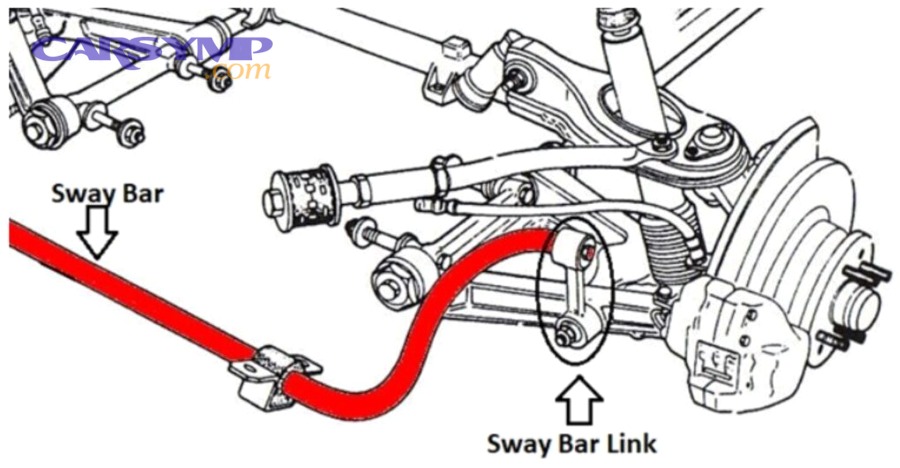
A sway bar end link problem is often louder on the side with the worn joint, but it can sound like it’s coming from the opposite side because the sway bar transmits force across the axle. More specifically, if you hit a bump with only the right wheel and hear a sharp clunk that repeats on similar one-sided bumps, you’re listening to a system that’s being twisted—and that points you toward the stabilizer bar links/bushings before you blame the strut tower.
Practical cues:
- Single-wheel bumps (manhole covers, small potholes) → stronger sway bar/end link suspicion.
- Both wheels together (smooth speed bumps taken square) → less sway bar twist, so link noise may reduce.
Where are sway bar links and strut mounts located in the suspension?
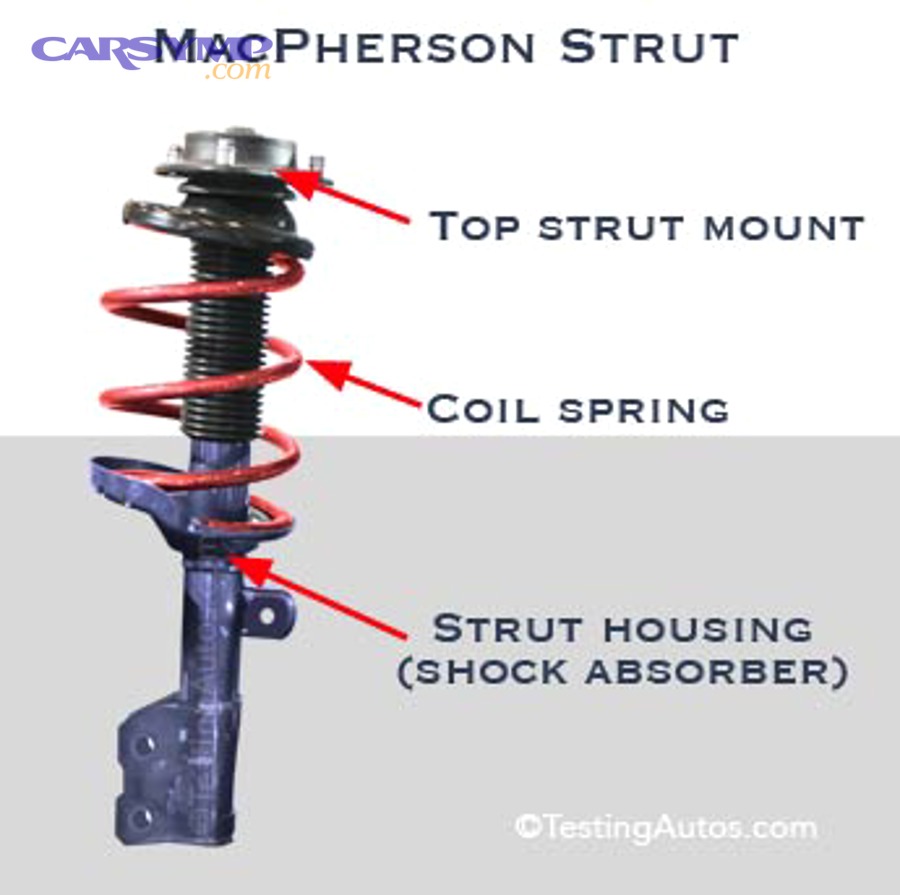
A sway bar end link is a short link (with ball joints or bushings) that connects the sway bar to the strut or control arm so the bar can transfer roll forces. A strut mount sits at the top of a MacPherson strut, bolting the strut to the body and isolating noise/vibration with rubber; many designs also include a strut bearing so the strut can rotate as you steer.
Which road inputs trigger each noise?
Sway bar link noise is most repeatable when the suspension sees unequal movement side-to-side; strut mount noise is most repeatable when the suspension sees vertical compression/rebound that loads the top mount, or when steering causes rotation through the mount bearing.
To make this actionable, here’s what the checklist below contains: it maps trigger → likely source → quick confirmation test so you can run one small test before buying parts.
| Trigger you notice | Most likely source | Why it points there | Quick confirmation idea |
|---|---|---|---|
| Sharp clunk on small, one-wheel bumps | Sway bar end link (or sway bar bushing) | Bar twists; a loose link “knocks” at joints | Repeat the bump at low speed; listen for “tap-tap” cadence |
| Pop/creak while steering at low speed | Strut bearing/mount | Bearing binds or mount rubber shifts under load | Turn wheel lock-to-lock while stationary; feel “jerk” in steering |
| Clunk when spring unloads (driveway dip) | Strut mount hardware/rubber | Top mount sees peak load change | Watch strut top while a helper bounces the corner |
Is the clunk happening over bumps, during turns, or at low speed—does that point to sway bar links or strut mounts?
Yes—when the clunk is tied to the condition, you can usually narrow it down to sway bar links or strut mounts for at least three reasons: (1) each condition loads different joints, (2) the sound cadence changes with wheel travel, and (3) steering input isolates top-mount rotation better than bump inputs do. Then, once you match the condition to the load path, you’ll stop chasing “mystery noises” and start testing one component at a time.
Does the noise show up as a clunking noise over bumps?
Yes—clunking noise over bumps strongly suggests sway bar links (or sway bar bushings) when it’s most obvious on short, choppy bumps and potholes. That’s because worn links develop excess play, allowing the stud/joint to knock as the suspension cycles quickly.
How it usually behaves:
- Loudest on rough neighborhood roads at 10–35 mph.
- Often quieter when you take a bump perfectly straight with both wheels.
- Can sound like a hammer tap: light, sharp, repetitive.
Does it happen when turning the steering wheel at a stop or slow roll?
Yes—if you hear popping/creaking when you turn at low speed (especially while stationary), a strut mount bearing is a prime suspect because it’s directly involved in strut rotation in many vehicles.
Typical pattern:
- Noise increases when steering load increases (full lock, parking maneuvers).
- Steering may feel notchy or “springy” if the bearing binds.
Does it disappear on smooth highway but return on broken pavement?
Yes—this is common with sway bar links because the highway produces fewer sharp, high-frequency suspension events, while broken pavement repeatedly twists the bar and “works” the looseness in the link. Meanwhile, strut mounts can still make noise on the highway, but it’s usually tied to big compressions (bridge joints, dips) rather than constant chatter.
What do sway bar link, strut mount, and strut bearing noises sound like (types of sounds)?
There are 3 main sound “types” to listen for—metallic clunk/knock (often links), rubbery thud or mount shift (often mounts), and pop/creak during steering rotation (often bearings)—based on how the joint moves and whether it has play, binding, or rubber separation. More specifically, your goal is to match sound texture + trigger rather than trying to guess by loudness alone.

What does a bad sway bar link sound like?
A bad sway bar link typically sounds like a metallic clunk or knocking over bumps because the joint has looseness that allows movement and impact at the mounting points. You’ll often notice it:
- Over small, sharp bumps more than slow, smooth undulations
- As a “tap” that repeats quickly when the road is choppy
- Sometimes more audible with windows down near a wall (sound reflection)
If your car uses ball-joint style links, the noise often has a hard edge; if it uses bushing-style links, the noise can be duller but still rhythmic.
What does a bad strut mount sound like?
A worn strut mount often produces a clunk or rattle when the top mount’s rubber or internal plate separates or shifts, especially when the suspension loads and unloads near the top of travel. It can show up:
- When entering driveways at an angle
- When the suspension “tops out” after a dip
- After pothole hits that compress the spring abruptly
Also, because the mount helps isolate vibration, a failing mount can transmit more “road feel” into the cabin even when it’s not loudly clunking.
What does a bad strut bearing sound like?
A bad strut bearing commonly makes popping or creaking during steering at low speed because the bearing binds, then releases, as the strut rotates. Signs that support the bearing hypothesis:
- The noise happens without a bump
- It gets worse at full lock
- The steering wheel feels jerky during rotation.
How do these noises differ from Control arm bushing clunk symptoms?
Control arm bushing clunk symptoms usually feel “heavier” and more directional: you may get a dull thud under braking/acceleration changes or when the wheel shifts fore/aft, because the control arm locates the wheel and reacts to longitudinal forces. On the other hand, sway bar link noises correlate more with rapid vertical wheel motion, and strut mount/bearing noises correlate more with top-of-strut load and rotation.
A simple discriminator:
- If the noise increases when you brake hard or accelerate hard (wheel “shifts”), suspect control arm bushings more than end links.
How can you diagnose sway bar link vs strut mount noise at home without special tools?
Use a simple isolation method with 4 steps—repeat the noise, change one load condition, re-test, and confirm with a hands-on play check—so you can separate sway bar link play from strut mount/bearing bind. To better understand what you’re hearing, each step below is designed to create a “yes/no” outcome rather than a vague impression.

How to do a quick bounce-and-listen test (ground test)
Do this first because it’s fast and safe:
- Park on level ground, engine off, parking brake on.
- Bounce one corner of the car (push down hard on fender/hood edge).
- Listen for a top-of-travel clunk (often mount) vs a lower, sharper knock (often link).
Tip: Put one hand lightly on the strut tower area (under hood) while a helper bounces—sometimes you can feel the mount “tap” as it shifts.
How to check sway bar link play safely (both wheels loaded)
Check links correctly because sway bars preload easily:
- Keep both front wheels either on the ground or both lifted evenly; a one-wheel lift can twist the bar and mask play.
- Grab the link and try to move it; any click/knock or visible looseness is suspicious.
What “bad” feels like:
- A ball-joint link may feel like a loose tie-rod end (free play, click).
- A bushing link may show cracked/missing rubber and metal-to-metal contact.
How to isolate strut mount/bearing noises under the hood
- Open the hood and locate the top strut mount nuts/studs.
- Have a helper turn the wheel slowly lock-to-lock while you watch the mount area.
- Listen for creak/pop and watch for spring wind-up (spring twists, then releases).
If the bearing binds, the spring can store torsion until it “snaps” free—often matching the exact moment you hear the pop.
When to stop DIY and use a chassis ear or shop inspection
Yes—stop DIY when (1) the noise only happens at speed and you can’t reproduce it safely, (2) there’s any sign of structural damage (cracked mount, missing fastener), or (3) you suspect multiple components. A shop can use tools like chassis microphones to pinpoint noise paths when symptoms overlap.
Which should you replace first: sway bar links or strut mounts?
Sway bar links win as the first replacement when the noise is bump-triggered and link play is confirmed, strut mounts/bearings are best to replace first when steering-triggered creaks/pops dominate, and replacing both together is optimal when mileage is high and multiple symptoms overlap. Meanwhile, your decision should prioritize (1) confirmation confidence, (2) labor overlap, and (3) alignment impact.
Replace sway bar links first when…
Replace sway bar links first when:
- The noise is repeatable on choppy bumps and you can recreate it easily.
- You can feel/see play in the link joint.
- The sound is a clear metallic knock that matches common worn-link symptoms.
Why this is often the “smart first move”:
- Links are usually quicker and cheaper than top-mount work.
- You avoid spring-compression labor that comes with mount replacement.
Replace strut mounts/bearings first when…
Replace strut mounts/bearings first when:
- The noise happens during steering input at low speed or at a stop.
- The steering feels notchy/jerky, suggesting bearing bind.
- You can reproduce the noise while watching/feeling the top mount area.
Practical caution:
- Many strut mount replacements require removing the strut and compressing the spring, which is a safety-critical procedure.
When to replace both together (and align afterwards)
Yes—replace both together when you’re already doing struts, the vehicle has high mileage, or both tests point to looseness at the link and noise/roughness at the top mount. That’s because labor overlaps: once the strut is out, mount/bearing replacement is already in the workflow.
Cost/maintenance reality check:
- Some repair guides note mount replacement can add substantial labor and may require alignment afterward, depending on the vehicle.
Evidence: According to a study by University of Pretoria from the Department of Mechanical and Aeronautical Engineering, in 2009, adding an active anti-roll bar improved body roll angle by 80% on a smooth road during a double-lane-change maneuver at 80 km/h (and 41% improvement on Belgian paving at 50 km/h).
What common mistakes cause people to misdiagnose suspension clunks?
There are 4 common misdiagnosis patterns—testing under the wrong load, ignoring adjacent rubber isolators, chasing the loudest (not the most repeatable) noise, and overlooking steering hardware—because suspension noises transmit through subframes and resonate in confusing ways. In addition, correcting these mistakes usually makes the culprit obvious within one or two re-tests.
Mistake 1: Checking end links with one wheel hanging
This is a classic trap: lifting only one side can preload the sway bar and make a loose link feel tight (or make a good link feel loaded). Always check links with both wheels equally loaded/unloaded so the bar isn’t twisting against you.
Better approach:
- Drive-on ramps (both wheels loaded), or
- Lift both wheels evenly (both unloaded), then check.
Mistake 2: Ignoring sway bar bushings and brackets
End links get blamed first, but sway bar frame bushings can also clunk or squeak, especially if rubber cracks or dries out and allows bar movement. If you replace links and the noise barely changes, check:
- Bushing condition (cracks, tears, shiny metal contact points)
- Bracket tightness and bushing fit to bar diameter
Mistake 3: Overlooking Steering rack and tie rod clunk signs
Steering rack and tie rod clunk signs often show up as a knock you can feel through the wheel, especially over small bumps while lightly holding steering input. On the other hand, sway bar link knocks often feel less “through the wheel” and more like a chassis tap near the corner—so if you feel it in your hands, don’t skip steering checks.
Quick steering-side checks:
- With wheels off the ground, gently rock tire at 3-and-9 o’clock and look for tie-rod play.
- Listen for a distinct knock when transitioning left-right quickly.
Mistake 4: Confusing brake hardware or loose fasteners for suspension noise
Loose pads, caliper bolts, worn slider pins, or even a loose lug nut can mimic a suspension clunk—often perfectly timed with bumps. If the noise changes when you lightly apply the brake over bumps, suspect brake hardware before you buy suspension parts.
What else can mimic sway bar link or strut mount noise?
There are 4 common “noise impostors”—sway bar bushings, brake hardware, CV/wheel bearing issues, and general squeak/rattle frequency effects—because the cabin amplifies impulsive sounds and makes location judgment unreliable. More importantly, a quick impostor check can save you from replacing the right part for the wrong reason.

Can sway bar bushings cause similar noise?
Yes—sway bar bushings can clunk or squeak when the rubber wears, dries, or allows the bar to shift inside the bracket, especially during cornering and repeated bumps. A tell:
- You may see polished/shiny areas on the bar where it’s been moving.
Can loose lug nuts, brake pads, or caliper bolts create a knock?
Yes—brake hardware and wheel fasteners can create a very convincing knock that matches bumps exactly. The simplest safety-first check is torque verification and a brake inspection before deeper suspension work.
Can CV joints or wheel bearings masquerade as suspension clunks?
CV joints more often click on turns under power, and wheel bearings more often hum/growl with speed, but failing parts can still create intermittent knocks if something is severely worn. However, if the noise tracks speed more than bumps or steering input, shift your suspicion away from links/mounts and toward rotating assemblies.
How do temperature and frequency affect what you hear?
Temperature changes rubber stiffness and lubrication behavior, and frequency content changes perceived “quality” of a noise—why some issues sound like a high creak while others sound like a low thud.
Evidence: According to a study by Chalmers University of Technology from the Department of Industrial and Materials Science, in 2020, squeak sounds are commonly classified in a mid- to high-frequency range of about 500–8000 Hz, while rattle sounds often have lower frequency content around 200–5000 Hz, with excitation sources commonly in 20–200 Hz.