


A stuck open thermostat prevents your engine from reaching optimal operating temperature, causing seven distinct warning signs: persistently low temperature gauge readings, extended engine warm-up times, insufficient cabin heat, reduced fuel economy, check engine light activation with code P0128, rough cold-start idling, and increased emissions during cold operation. These thermostat stuck symptoms occur because continuous coolant circulation through the radiator keeps the engine runs cold, disrupting the thermal management system designed to bring your vehicle to its ideal 195-210°F operating range within minutes of startup.
Understanding the mechanical failure behind these symptoms helps you differentiate a stuck open thermostat from other cooling system issues. When the thermostat valve remains permanently open instead of regulating coolant flow based on temperature, your engine never achieves the heat necessary for efficient combustion, proper lubrication viscosity, or effective emissions control. This fundamental disruption creates a cascade of performance problems that manifest as observable warning signs.
Diagnosing a stuck open thermostat requires combining symptom recognition with simple testing procedures that confirm abnormal coolant flow patterns. The touch test, scan tool data analysis, and warm-up time monitoring provide reliable confirmation methods that distinguish this specific failure from stuck closed thermostats, faulty temperature sensors, or air pocket issues in the cooling system.
Addressing a stuck open thermostat promptly prevents long-term engine damage from extended cold-running conditions while restoring fuel efficiency and cabin comfort. Below, we’ll explore each warning sign in detail, explain diagnostic procedures, examine root causes, and provide comprehensive repair guidance including cost estimates and DIY feasibility assessments.
What Does a Stuck Open Thermostat Mean?
A stuck open thermostat is a cooling system component failure where the temperature-regulating valve remains permanently in the open position, allowing unrestricted coolant circulation through the radiator even when the engine is cold. This condition prevents the engine from reaching its designed operating temperature because coolant continuously flows through the radiator’s heat-dissipating core instead of being restricted to warm up the engine block and cylinder head first.
To understand this failure, we must first examine how the thermostat functions in normal operation and what happens mechanically when it gets stuck open.
How Does a Car Thermostat Work Normally?
A car thermostat acts as a temperature-controlled valve positioned between the engine and radiator, regulating coolant flow to maintain optimal engine temperature. The device contains a wax pellet that expands when heated, pushing a piston that opens the valve at a predetermined temperature—typically between 180°F and 195°F depending on the vehicle specifications.
During cold starts, the thermostat remains closed, blocking coolant flow to the radiator. This restriction forces coolant to circulate only within the engine block through a bypass circuit, allowing rapid temperature increase. As the wax pellet heats and expands, the valve gradually opens around 180-195°F, permitting coolant to flow through the radiator where air passing through the cooling fins dissipates excess heat. The thermostat continuously modulates between partially and fully open positions, maintaining the engine within a narrow temperature band that optimizes combustion efficiency, reduces emissions, and prevents overheating.
Modern engines rely on precise thermal management for emission control systems, variable valve timing operation, and fuel injection calibration. The Engine Control Unit (ECU) monitors coolant temperature through dedicated sensors and adjusts fuel delivery, ignition timing, and transmission shift points based on this data. When the thermostat functions correctly, the engine reaches operating temperature within 5-10 minutes of cold start, enabling closed-loop fuel control and catalytic converter activation.
What Happens When a Thermostat Gets Stuck Open?
When a thermostat gets stuck open, the valve remains in the fully open position regardless of coolant temperature, creating a condition where coolant flows continuously through the radiator even during warm-up. The wax pellet mechanism fails to contract during cooling or breaks entirely, leaving the piston extended and the valve passage unobstructed.
This continuous circulation prevents normal engine warm-up because heat generated by combustion immediately transfers to the radiator where airflow—especially during highway driving—dissipates it faster than the engine produces it. The engine struggles to reach 195°F and often stabilizes at 140-160°F, well below the target operating range. At these reduced temperatures, fuel atomization deteriorates, oil viscosity remains too thick for optimal lubrication, and piston ring sealing becomes less effective.
The ECU recognizes this abnormal temperature pattern through the coolant temperature sensor. When the engine runs cold beyond the expected warm-up period, the computer stores diagnostic trouble code P0128 (Coolant Thermostat Temperature Below Regulating Temperature) and illuminates the check engine light. The ECU compensates by maintaining enriched fuel mixture—similar to cold-start fueling—which increases consumption by 15-25% and raises hydrocarbon emissions significantly.
Mechanical components experience accelerated wear under these cold-running conditions. Thicker oil creates higher friction in bearings and valve trains, while incomplete fuel vaporization washes lubricant from cylinder walls and dilutes the oil sump. Carbon deposits accumulate on intake valves and combustion chambers due to incomplete combustion. The catalytic converter operates below its light-off temperature, failing to convert pollutants effectively and potentially causing emissions test failures.
What Are the 7 Key Symptoms of a Stuck Open Thermostat?
There are 7 primary symptoms of a stuck open thermostat: the temperature gauge reads below normal range, the engine takes excessively long to warm up, the heater blows cold or lukewarm air, fuel economy decreases noticeably, the check engine light illuminates with code P0128, the engine runs rough during cold operation, and emissions levels increase during testing. These symptoms result from the engine’s inability to reach and maintain its designed operating temperature of 195-210°F.
Recognizing these warning signs early prevents extended cold-running damage and allows prompt repair. Let’s examine each symptom in detail to understand its causes and how it manifests during normal driving conditions.
Does the Temperature Gauge Stay Below Normal?
Yes, the temperature gauge stays below normal when a thermostat is stuck open, typically reading in the lower quarter of the gauge range or showing coolant temperatures between 140-170°F instead of the normal 195-210°F range. The gauge remains abnormally low even after 15-20 minutes of driving, and may drop further during highway speeds when increased airflow through the radiator enhances cooling beyond the engine’s heat generation capacity.
This symptom presents most obviously on vehicles with traditional analog temperature gauges that display a continuous range from Cold to Hot. The needle settles significantly below the center position where it normally operates, often hovering just above the cold mark. On digital displays showing actual temperature values, readings plateau at 150-165°F instead of progressing to the target 195-205°F range.
Highway driving intensifies this symptom because higher vehicle speeds force more air through the radiator, maximizing heat dissipation. Drivers notice the gauge dropping 10-20 degrees when cruising at 65+ mph compared to city driving, a pattern opposite to normal thermostat operation where highway temperatures stabilize at or slightly above city temperatures. This inverse relationship strongly indicates stuck-open failure rather than a faulty temperature sensor, which would show erratic or consistently incorrect readings regardless of driving conditions.
The temperature gauge provides the most immediate and continuous feedback about thermostat function. Drivers who monitor this gauge during their normal commute establish a baseline for typical operating temperature, making deviations immediately noticeable when thermostat failure occurs.
Does Your Engine Take Forever to Warm Up?
Yes, your engine takes excessively long to warm up when the thermostat is stuck open, often requiring 15-30 minutes instead of the normal 5-10 minutes to reach operating temperature in moderate ambient conditions. In cold weather below 40°F, the engine may never fully warm up during short trips, continuously running cold throughout the entire drive cycle.
This extended warm-up period occurs because unrestricted coolant flow through the radiator dissipates heat faster than the engine generates it, especially during low-load conditions like idling or gentle city driving. The engine must work considerably harder and longer to overcome this heat loss, and in severe cold weather with highway airflow, heat dissipation may exceed heat production entirely.
Drivers notice this symptom through delayed cabin heating, prolonged periods before the temperature gauge rises, and sluggish throttle response that persists much longer than normal after cold starts. Vehicles with remote starters experience particularly obvious symptoms—running the vehicle for 10-15 minutes before driving still results in insufficient engine and cabin warmth, whereas a properly functioning thermostat would achieve full operating temperature within this timeframe.
Cold weather exacerbates warm-up delays dramatically. While a stuck open thermostat might allow eventual warm-up to 170°F during summer driving, winter temperatures below freezing may prevent the engine from exceeding 140-150°F even after 30 minutes of operation. This temperature level proves insufficient for proper engine management system operation and drastically reduces cabin heating effectiveness.
Is Your Heater Blowing Cold or Lukewarm Air?
Yes, your heater blows cold or lukewarm air when the thermostat is stuck open because coolant circulating through the heater core never reaches the 180-200°F necessary to provide adequate cabin heating. The heater output feels barely warm at best, failing to defrost windows effectively or provide comfortable cabin temperatures even when the heater controls are set to maximum temperature and fan speed.
The automotive heating system operates by routing hot engine coolant through the heater core—a small radiator located inside the dashboard. Air blown by the heater fan passes through this core’s fins, transferring heat to the cabin. When coolant temperature remains at 140-160°F instead of the normal 195-210°F range, heat transfer becomes insufficient for effective cabin warming, particularly during cold ambient conditions when maximum heating capacity is required.
This symptom becomes most noticeable during winter months when drivers rely on heater performance. The air emerging from dashboard vents feels cool to the touch immediately after starting, and even after 15-20 minutes of driving, it barely reaches lukewarm temperatures that struggle to clear frost from the windshield. Drivers compensate by increasing fan speed, which paradoxically reduces air temperature further by forcing more air volume through the underheated heater core.
Defrosting problems create safety concerns beyond mere discomfort. Insufficient heat prevents effective windshield clearing, forcing drivers to manually scrape ice or drive with impaired visibility. Rear window defrosters may function electrically, but front windshield defrosting relies entirely on heated air from the heater core, making thermostat stuck symptoms particularly problematic during winter driving conditions.
This heater not working issue differs from other heating problems like stuck blend doors, clogged heater cores, or low coolant levels because the symptom correlates directly with low coolant temperature readings on the gauge. When the temperature gauge shows normal readings but heat remains insufficient, other heating system components require investigation. When both the gauge reads low and heat is inadequate, a stuck open thermostat emerges as the primary suspect.
Are You Experiencing Poor Fuel Economy?
Yes, you experience poor fuel economy with a stuck open thermostat, typically seeing a 10-20% reduction in miles per gallon due to the engine control unit maintaining enriched fuel mixture to compensate for below-normal operating temperatures. The ECU recognizes cold coolant temperatures and extends the warm-up fueling strategy, injecting additional fuel to ensure adequate combustion despite poor fuel atomization in the cold intake manifold and combustion chambers.
Modern fuel injection systems rely on precise coolant temperature data to optimize air-fuel ratios. During normal warm-up, the ECU gradually leans the mixture as temperature increases, transitioning from cold-start enrichment to closed-loop stoichiometric control (14.7:1 air-fuel ratio) once the engine reaches operating temperature. When the thermostat remains stuck open and coolant temperature stays at 150-160°F, the ECU never completes this transition, maintaining partial enrichment indefinitely to prevent lean misfires and hesitation.
This continuous enrichment wastes fuel in two ways. First, excess fuel enters the cylinders beyond what combustion requires, with unburned portions evacuating through the exhaust. Second, cold engine operation increases internal friction from thick oil and tight clearances, requiring more fuel to produce equivalent power output. Drivers notice this degradation most clearly on familiar routes where they’ve established baseline fuel economy expectations—a commute that previously yielded 30 MPG may drop to 24-26 MPG with no changes in driving behavior.
Highway fuel economy suffers more severely than city driving because sustained speeds allow greater airflow through the radiator, dropping coolant temperatures further and forcing the ECU into even richer fuel compensation. Winter driving compounds the problem, with near-freezing ambient temperatures preventing any meaningful engine warm-up during short trips, resulting in entire commutes conducted at cold-start fueling levels.
According to research from the U.S. Department of Energy, engines running 40°F below normal operating temperature consume approximately 12% more fuel during city driving and up to 22% more during highway cruising, translating to hundreds of dollars in wasted fuel annually for vehicles driven 12,000-15,000 miles per year.
Is the Check Engine Light On (P0128 Code)?
Yes, the check engine light illuminates when a thermostat is stuck open, typically storing diagnostic trouble code P0128 (Coolant Thermostat – Coolant Temperature Below Thermostat Regulating Temperature) after the engine control unit detects that coolant temperature fails to reach the expected threshold within the programmed time frame. This code specifically indicates that the engine does not warm up to specification, distinguishing it from overheating codes associated with stuck-closed thermostats.
The ECU monitors coolant temperature continuously through a dedicated sensor and compares actual warm-up rates against calibrated expectations based on ambient temperature, engine load, and elapsed time. Manufacturers program specific temperature targets—for example, the engine should reach 170°F within 5 minutes of cold start under normal ambient conditions. When multiple drive cycles pass without meeting these targets, the ECU concludes that the thermostat cannot properly regulate temperature and sets code P0128.
Code P0128 appears less immediately than temperature gauge symptoms because the ECU requires multiple failed warm-up cycles before setting the code and illuminating the light. Drivers may notice temperature gauge abnormalities for several days or weeks before the check engine light appears. Once illuminated, a diagnostic scan tool retrieves the stored code and displays the specific fault description, providing definitive confirmation of insufficient engine warming.
This code proves particularly valuable for diagnosing stuck-open thermostats in vehicles with simplified temperature gauge displays that show only “Cold-Normal-Hot” zones without precise temperature indication. When the gauge reads in the “Normal” zone but actually indicates 165°F instead of 195°F, drivers may not recognize the problem visually. The check engine light and P0128 code alert them to the underlying issue before symptoms become severe.
Some vehicles set additional codes alongside P0128, including fuel system richness codes when the ECU reaches maximum fuel trim trying to compensate for cold operation. The presence of P0128 combined with long-term fuel trim values exceeding +15% strongly indicates stuck-open thermostat rather than sensor failure or wiring issues.
Does Your Engine Run Rough When Cold?
Yes, your engine runs rough when cold with a stuck open thermostat because extended cold operation prevents fuel from vaporizing properly in the intake manifold and combustion chambers, resulting in incomplete combustion that manifests as rough idle, hesitation, and power loss during the warm-up period. The roughness persists much longer than the typical 30-60 seconds of normal cold-start operation, continuing for 10-15 minutes or throughout short trips.
Cold fuel atomization problems create uneven combustion across cylinders. Liquid fuel droplets striking cold intake ports and valve surfaces fail to vaporize completely before entering the cylinders. Some cylinders receive adequate fuel vapor for combustion while others receive excess liquid fuel or lean vapor mixtures, creating power imbalances that shake the engine and produce irregular idle speeds. The ECU attempts to smooth operation through individual cylinder fuel trim adjustments, but cold metal surfaces limit effectiveness.
Drivers experience this as noticeable vibration felt through the steering wheel and chassis during idle, uneven acceleration response with momentary hesitations when pressing the throttle, and occasional surge or hunt in idle speed as the ECU struggles to maintain target RPM. The symptoms resemble a misfiring engine, and in severe cases, actual misfires occur due to incomplete combustion in the coldest cylinders.
Automatic transmissions exhibit delayed or harsh engagement when shifted from Park to Drive during cold rough-idle conditions. The combination of irregular engine speed and cold transmission fluid creates perceptible shift shock. Manual transmission vehicles experience clutch shudder during cold-start launches due to the erratic power delivery from the rough-running engine.
This symptom distinguishes itself from ignition system misfires or mechanical problems because the roughness diminishes as the engine gradually warms toward its sub-optimal 160°F plateau. True ignition or mechanical issues produce roughness that persists or worsens regardless of temperature. The temperature-dependent nature of the roughness, combined with low gauge readings and extended warm-up times, points clearly toward thermostat failure.
Are You Noticing Increased Emissions?
Yes, you notice increased emissions with a stuck open thermostat because cold engine operation prevents complete fuel combustion and keeps the catalytic converter below its light-off temperature of 400-600°F, allowing elevated levels of hydrocarbons (HC), carbon monoxide (CO), and nitrogen oxides (NOx) to exit the tailpipe. Vehicles subject to emissions testing often fail inspection due to readings that exceed allowable limits by 50-200%.
The catalytic converter requires sustained exhaust temperatures above 400°F to initiate the chemical reactions that convert harmful pollutants into harmless compounds. When the engine runs cold continuously, exhaust temperatures remain at 250-350°F, well below the catalyst activation threshold. The converter essentially remains inactive during much of the drive cycle, allowing raw emissions to pass through untreated.
Hydrocarbon emissions increase most dramatically because incomplete fuel vaporization results in unburned fuel exiting through the exhaust. Cold combustion chambers and thick oil films on cylinder walls prevent thorough burning, while excess fuel from the ECU’s enrichment strategy further contributes to HC output. Emissions testing reveals HC levels of 200-400 ppm versus the normal 50-100 ppm from properly warmed engines.
Visible symptoms include increased exhaust odor—particularly a strong gasoline smell from the tailpipe during cold operation—and occasionally visible white or blue-tinted exhaust smoke during cold starts. The fuel smell persists longer than the brief period typical of normal cold starts, continuing for several minutes as the cold engine struggles with fuel atomization.
States with mandatory emissions testing programs reject vehicles with P0128 codes before conducting emissions measurements because the code indicates the vehicle cannot pass the functional check portion of the inspection. Even if the thermostat failure occurred recently and hasn’t yet caused emissions test failure, inspectors cannot certify the vehicle until the code clears and proper warm-up function is restored.
According to the Environmental Protection Agency’s emissions studies, vehicles operating 50°F below design temperature produce approximately 30% higher hydrocarbon emissions and 25% higher carbon monoxide compared to properly warmed engines, contributing significantly to urban air quality degradation during winter months when stuck-open thermostats affect thousands of vehicles simultaneously.
How Can You Diagnose a Stuck Open Thermostat?
You can diagnose a stuck open thermostat through three primary methods: performing the touch test by feeling radiator hoses during engine warm-up, using a scan tool to monitor real-time coolant temperature data, and evaluating warm-up time against normal specifications for your vehicle. These diagnostic procedures confirm that coolant flows continuously through the radiator when it should remain restricted, distinguishing stuck-open failure from sensor problems, air pockets, or other cooling system issues.
Accurate diagnosis prevents unnecessary parts replacement and ensures you address the actual problem. Let’s examine each diagnostic method to understand the procedures and what results indicate thermostat failure.
What Is the Touch Test Method?
The touch test method involves carefully feeling the upper radiator hose temperature during engine warm-up to determine if coolant flows to the radiator prematurely, indicating a stuck-open thermostat. With a properly functioning thermostat, the upper radiator hose remains cool for 5-10 minutes after cold start, then suddenly becomes hot as the thermostat opens. With a stuck-open thermostat, the upper hose warms gradually and simultaneously with the engine from the moment you start the vehicle.
To perform this test safely, start with a completely cold engine that hasn’t run for at least 2 hours. Start the engine and immediately locate the upper radiator hose—the larger diameter hose connecting the top of the radiator to the engine. Carefully touch the hose near the radiator every 60-90 seconds, monitoring temperature progression. Exercise extreme caution as the hose will eventually become hot enough to cause burns.
Normal thermostat operation produces a distinct temperature pattern: the upper hose remains cool or slightly warm for several minutes while the lower radiator hose (which carries coolant returning from the engine through the bypass circuit) becomes moderately warm. Suddenly, when coolant temperature reaches 180-195°F and the thermostat snaps open, the upper hose transitions from cool to hot within 30-60 seconds as heated coolant surges through the radiator.
A stuck-open thermostat creates a completely different pattern. Both radiator hoses begin warming simultaneously from the first minute of operation, indicating coolant circulates through both the bypass circuit and radiator immediately. The upper hose temperature increases gradually and steadily, never exhibiting the sudden temperature jump characteristic of thermostat opening. After 10 minutes of operation, the upper hose feels warm but not hot, reaching perhaps 130-150°F instead of the 195°F+ that indicates full engine operating temperature.
This test provides immediate, free diagnostic information without any tools beyond your hand. The technique works reliably because the thermostat’s physical location between the engine and radiator creates unmistakable differences in coolant flow patterns that translate directly to hose temperature progression. However, caution is essential—radiator hoses can reach 200°F+ temperatures that cause severe burns, so touch them briefly and carefully, never wrapping your hand around the hose.
How Do You Use a Scan Tool to Check Thermostat Function?
You use a scan tool to check thermostat function by connecting it to the vehicle’s OBD-II port and monitoring the Engine Coolant Temperature (ECT) sensor data in real-time during engine warm-up, comparing actual temperature progression against expected warm-up rates for your vehicle’s specifications. A properly functioning thermostat allows coolant temperature to rise steadily at 15-25°F per minute until reaching 195-210°F, while a stuck-open thermostat shows much slower temperature rise—often 5-10°F per minute—that plateaus at 140-170°F regardless of run time.
Modern scan tools display live ECT sensor data in degrees Fahrenheit or Celsius, updating every 1-2 seconds. After connecting the scan tool and starting with a cold engine, begin monitoring the coolant temperature value before starting the engine to establish the ambient baseline—typically 50-80°F matching ambient air temperature. Start the engine and observe the temperature climb.
Normal warm-up progression shows rapid, consistent temperature increase. The ECT reading should climb from 60°F to 180°F within 6-8 minutes at idle under normal ambient conditions. The rate of increase remains relatively constant until the thermostat opens, at which point the temperature may pause briefly as cool radiator coolant mixes with hot engine coolant, then continues climbing to the target 195-205°F range where it stabilizes.
Stuck-open thermostat data shows distinctly different patterns. Temperature rises very slowly—perhaps reaching only 120°F after 5 minutes and 150°F after 10 minutes. The rate of increase may accelerate slightly during this period as the engine works harder, but the temperature never reaches the 195°F+ target. During highway driving simulation (if safe to perform), the ECT reading actually drops 5-15 degrees as increased airflow through the radiator overcomes the engine’s heat production.
Professional-grade scan tools display additional helpful data including calculated thermostat position (on vehicles with electronically monitored thermostats), long-term fuel trim values showing enrichment compensation, and stored diagnostic trouble codes. The presence of P0128 alongside ECT readings that plateau at 160°F provides definitive confirmation of stuck-open thermostat failure.
This diagnostic method proves particularly valuable on vehicles with simplified temperature gauge displays that don’t show precise temperature values. The scan tool reveals the actual coolant temperature the ECU monitors, exposing problems that dash gauges might obscure. The numerical data also creates indisputable documentation useful for warranty claims or when communicating with mechanics about the specific failure mode.

When Should You Replace vs Just Monitor?
You should replace a stuck open thermostat immediately rather than monitoring because continued cold-running operation causes progressive engine damage including accelerated wear, oil contamination, carbon deposits, and catalytic converter degradation that costs far more to repair than thermostat replacement. Unlike some automotive issues where temporary monitoring makes sense while ordering parts or scheduling service, a stuck-open thermostat inflicts ongoing damage every minute the engine operates below design temperature.
The decision matrix is straightforward: if diagnostic testing confirms stuck-open operation with sustained coolant temperatures below 175°F and symptoms including poor fuel economy, insufficient heat, or check engine light P0128, replacement should occur within days, not weeks. The thermostat assembly typically costs $20-60 for parts and requires 30-90 minutes for replacement depending on vehicle design, making it among the least expensive major cooling system repairs.
Monitoring without replacement makes sense only in very limited scenarios: if symptoms appeared suddenly and you suspect possible air pockets from recent cooling system work, allowing 2-3 drive cycles for air to purge through the system before confirming thermostat failure represents reasonable caution. Similarly, if you’re unsure whether symptoms indicate stuck-open thermostat versus a faulty ECT sensor, performing the touch test and scan tool diagnosis to confirm the actual problem prevents misdiagnosis.
However, once you confirm stuck-open failure, continued operation accrues hidden costs. Fuel economy losses of 15-20% mean a vehicle averaging 25 MPG that consumes $150 in fuel monthly wastes $22-30 monthly with a failed thermostat—potentially exceeding the cost of thermostat replacement within 2-3 months. Engine wear from extended cold operation, while not immediately apparent, manifests as reduced engine life measurable in tens of thousands of miles of premature wear.
Certain driving conditions accelerate damage from delayed replacement. Highway-heavy commuters experience more severe temperature depression and fuel waste than city drivers. Cold climate operation below 40°F ambient can prevent the engine from reaching even 140°F, creating maximum wear conditions. Vehicles used for short trips never achieve any meaningful warm-up, essentially operating in perpetual cold-start mode that maximizes component stress.
The repair cost comparison favors immediate replacement overwhelmingly. A $100-200 thermostat replacement performed promptly prevents potential $500-1,500 repairs to address carbon cleaning, oxygen sensor replacement, catalytic converter damage, or oil contamination issues that develop from months of cold-running operation. From both immediate economic and long-term engine health perspectives, replacement proves the only logical choice once diagnosis confirms stuck-open failure.
What Causes a Thermostat to Stick Open?
A thermostat sticks open due to three primary causes: mechanical wear and aging that degrades the wax pellet actuator, contaminated coolant that causes corrosion and deposits, and manufacturing defects that result in premature failure. Understanding these root causes helps identify whether the failure resulted from normal wear requiring simple replacement or systemic cooling system problems that need additional attention to prevent repeat failures.
Identifying the specific cause informs your repair approach and determines whether simply replacing the thermostat suffices or whether coolant system cleaning and maintenance should accompany the repair.
How Does Age and Wear Affect Thermostats?
Age and wear affect thermostats by gradually degrading the wax pellet actuator mechanism, causing the pellet to lose its expansion properties or the spring to weaken, eventually resulting in stuck-open failure after 60,000-100,000 miles or 7-10 years of service. The wax compound experiences thousands of heating and cooling cycles throughout its service life, with each cycle causing microscopic material fatigue that eventually prevents the pellet from contracting fully when coolant cools, leaving the valve partially or fully open.
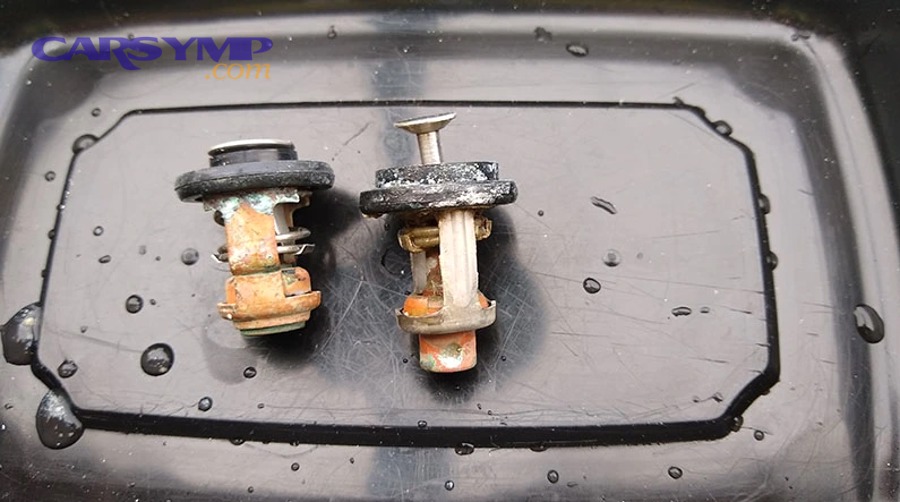
The thermostat’s wax pellet contains a specialized hydrocarbon compound engineered to expand precisely at the thermostat’s rated temperature—typically 180°F, 192°F, or 195°F depending on application. This compound sits in a copper or brass cylinder, surrounded by a rubber boot that seals against coolant intrusion. When heated, the wax melts and expands approximately 10-15%, pushing a piston that mechanically opens the valve against spring pressure. Upon cooling, the wax contracts, and spring force closes the valve.
Years of thermal cycling create material changes in the wax compound. The molecular structure degrades through repeated melting and solidification, reducing expansion coefficient and contraction completeness. The rubber boot deteriorates from constant heat exposure and coolant contact, potentially allowing coolant to contaminate the wax chamber. The return spring loses tension from metal fatigue, reducing the closing force. The piston and valve surfaces develop wear from friction during opening and closing movements.
Eventually, one or more degraded components fails to function properly. Most commonly, the wax loses sufficient contraction capability, preventing the valve from closing fully even with maximum spring force. Less frequently, the rubber boot ruptures, allowing coolant into the wax chamber where it prevents proper expansion and contraction. Occasionally, the spring breaks entirely, eliminating closing force and allowing the valve to float fully open regardless of wax pellet position.
Vehicle operating conditions influence failure timing significantly. Vehicles operating in extreme climates with wider temperature swings—such as cold-weather regions where coolant varies from -20°F overnight to 200°F operating temperature—experience faster wax degradation than moderate-climate vehicles. Engines that frequently experience overheating events subject the thermostat to temperatures beyond design specifications, accelerating wax breakdown. Vehicles with extended service intervals between coolant changes expose the thermostat to degraded coolant chemistry longer, promoting internal corrosion.
Manufacturer quality variations also affect longevity. Original Equipment Manufacturer (OEM) thermostats typically outlast economy aftermarket units because they use higher-grade wax compounds and more durable materials. However, even premium thermostats eventually succumb to wear-related failure given sufficient time and mileage. This predictable degradation explains why preventive thermostat replacement during major cooling system service—such as when replacing a water pump or radiator—represents sound maintenance practice.
Can Contaminated Coolant Cause Thermostat Failure?
Yes, contaminated coolant causes thermostat failure by depositing corrosion particles, rust scale, and degraded additive compounds on the valve surfaces and within the wax pellet chamber, preventing the valve from closing properly or interfering with the pellet’s expansion mechanism. Coolant that has exceeded its service life loses corrosion inhibitors and becomes acidic, actively attacking metal components including the thermostat housing, valve, and piston assembly.
Modern engine coolant contains a complex chemistry of additives including corrosion inhibitors, pH buffers, anti-foaming agents, and lubricants designed to protect all cooling system metals—aluminum, steel, copper, and brass—simultaneously. These additives deplete over time through chemical reactions with metal surfaces and exposure to combustion gases that enter the cooling system through head gasket seepage. Manufacturers specify coolant replacement intervals—typically 30,000-100,000 miles depending on coolant type—based on additive depletion rates.
When coolant exceeds its service life, several degradation processes occur. The pH shifts from neutral toward acidic, creating conditions that promote galvanic corrosion between dissimilar metals. Aluminum components throughout the cooling system—engine block, cylinder head, water pump housing, radiator tanks—begin oxidizing, releasing microscopic aluminum oxide particles into the coolant. Iron and steel components rust, contributing iron oxide particles. These suspended particles circulate through the system, settling in low-flow areas and accumulating on surfaces.
The thermostat’s precision valve mechanism proves particularly vulnerable to contamination. Particles accumulate along the valve seat where the valve disc must seal completely to block coolant flow. Even microscopic deposits prevent proper sealing, allowing small amounts of coolant to leak past the closed valve. This leakage may initially cause only slight temperature reduction, but as deposits build, flow increases until the valve effectively cannot close at all.
Severe contamination creates a different failure mode. Thick scale deposits accumulate on the valve stem and housing bore, mechanically jamming the valve in whatever position it occupies when the buildup becomes sufficient. If the valve happens to be open during heavy deposit formation, it physically cannot close due to scale binding the stem. This sudden stuck-open failure occurs without the gradual symptom progression typical of wear-related failures.
Electrolysis from mixed coolant types accelerates contamination dramatically. When different coolant formulations mix—such as adding traditional green ethylene glycol to a system designed for long-life orange Dex-Cool—chemical incompatibilities cause additive dropout, forming gel-like compounds that plug narrow passages. The thermostat’s bypass ports and valve clearances accumulate these gels, interfering with normal operation.
Preventing contamination-related failures requires adherence to manufacturer coolant specifications and replacement intervals. Using the correct coolant type prevents incompatibility issues. Replacing coolant on schedule maintains corrosion inhibitor effectiveness. Addressing cooling system leaks promptly prevents air ingestion that accelerates oxidation. Systems that receive proper maintenance rarely experience contamination-related thermostat failures, with most units lasting their full design life before age-related wear causes eventual failure.
According to research published by the Society of Automotive Engineers, thermostats operating in cooling systems with neglected coolant maintenance fail on average 40% earlier than units in properly maintained systems, with contamination-related failures often occurring at 40,000-60,000 miles versus the 80,000-120,000 mile range typical of wear-based failures in clean systems.
What Are the Consequences of Driving with a Stuck Open Thermostat?
Driving with a stuck open thermostat causes four major consequences: accelerated engine wear from operating below optimal temperature, fuel economy reduction of 10-25%, failed emissions testing due to incomplete combustion and cold catalytic converter operation, and compromised safety from inadequate window defrosting in cold weather. These consequences range from immediate operational problems to long-term mechanical damage that reduces engine lifespan and increases maintenance costs substantially.
Understanding the severity and progression of these consequences helps prioritize repair timing and appreciate why immediate thermostat replacement proves more economical than continued operation with known failure.
Will It Damage Your Engine?
Yes, it damages your engine by causing accelerated wear to bearings, piston rings, and valve train components that operate with inadequate lubrication from oil that remains too viscous at sustained low temperatures, and by allowing fuel dilution of engine oil from incomplete combustion that washes protective oil films from cylinder walls. Extended cold-running operation measurably reduces engine life, potentially sacrificing 50,000-100,000 miles of service compared to properly warmed operation.
Engine oil viscosity changes dramatically with temperature. Multi-grade oils like 5W-30 are engineered to flow adequately at both cold-start temperatures and normal operating temperatures, but they reach optimal viscosity and lubrication properties only within the 195-210°F operating range. At 150°F—the temperature where a stuck-open thermostat allows an engine to stabilize—the oil remains significantly thicker than design specifications, creating higher resistance to flow through narrow bearing clearances and reducing the protective oil film thickness between moving components.
This elevated viscosity increases friction throughout the engine. Crankshaft main bearings and connecting rod bearings experience higher loads as they shear through thicker oil films. Camshaft bearings and valve lifters work against increased resistance. Piston rings drag against cylinder walls with greater force. This additional friction converts to heat and wear, removing microscopic amounts of material from bearing surfaces with each revolution. Over thousands of miles, this accelerated wear accumulates, increasing clearances and reducing compression.
Incomplete fuel combustion creates a second damage mechanism. When fuel doesn’t vaporize completely in cold intake manifolds and combustion chambers, liquid fuel droplets contact cylinder walls during the intake and compression strokes. These droplets wash away the protective oil film that normally prevents metal-to-metal contact between piston rings and cylinder bores. The interrupted lubrication allows increased wear at the critical top ring position where combustion pressures peak.
Unburned fuel that escapes past the piston rings contaminates the oil sump, diluting the lubricant and degrading its protective properties. Oil analysis from engines with stuck-open thermostats often shows fuel dilution levels of 3-5% versus the <1% typical of properly warmed engines. This dilution reduces oil viscosity further, compounds the inadequate lubrication problem, and accelerates oil oxidation that forms sludge and varnish deposits.
Valve train components suffer particularly severe wear under cold operation. Hydraulic valve lifters rely on precise oil viscosity to maintain proper lash adjustment. Thick, cold oil prevents lifters from pumping up correctly, creating excessive valve clearance that allows hard impacts between rocker arms, valve stems, and camshaft lobes. Direct-acting overhead cam engines experience similar problems, with thick oil preventing proper lifter operation and creating noisy, wear-inducing operation until the engine finally warms.
Carbon deposit accumulation represents another long-term consequence. Cold combustion chambers promote incomplete fuel burning that leaves carbon residues on intake valves, piston tops, and combustion chamber surfaces. These deposits build gradually over thousands of miles, eventually causing performance problems including rough idle, reduced power, increased fuel consumption, and potential pre-ignition or detonation issues that can catastrophically damage pistons and rings.
The cumulative effect of these wear mechanisms measurably reduces engine longevity. While a single trip with cold-running operation causes negligible damage, sustained operation over months or years with a stuck-open thermostat inflicts the equivalent wear of tens of thousands of additional miles. Engines that accumulate 50,000 miles of stuck-open operation may exhibit bearing clearances, compression loss, and oil consumption typical of engines with 150,000+ miles under proper operating conditions.
How Much Does Poor Fuel Economy Cost You?
Poor fuel economy from a stuck open thermostat costs $150-400 annually for a typical commuter driving 12,000 miles per year, based on 15-20% fuel consumption increase that raises monthly fuel expenses by $12-35 depending on base fuel economy, fuel prices, and driving patterns. This ongoing expense accumulates quickly, potentially exceeding the cost of thermostat replacement within 2-4 months while providing no benefit beyond what proper repair would deliver immediately.
The financial impact calculation requires considering your specific driving profile. A vehicle that normally achieves 25 MPG and consumes $150 monthly in fuel experiences the following degradation with a stuck-open thermostat reducing efficiency to 21 MPG: monthly fuel costs increase to approximately $178, representing $28 monthly waste or $336 annually. Over two years, this amounts to $672 in unnecessary fuel expense—far exceeding the $100-200 typical thermostat replacement cost.
Highway-focused drivers suffer greater economic impact because sustained speeds create maximum airflow through the radiator, depressing coolant temperatures furthest below normal and forcing the ECU into maximum fuel enrichment. A highway commuter covering 15,000 annual miles who normally achieves 32 highway MPG may drop to 26 MPG with stuck-open failure, increasing annual fuel consumption from 469 gallons to 577 gallons. At $3.50 per gallon, this represents $378 annual waste—$31.50 monthly.
Conversely, short-trip city drivers face different economics. Their engines rarely achieve full operating temperature even with functioning thermostats, so the percentage degradation from stuck-open failure may be less severe—perhaps 12% versus 20%—but the base fuel economy is already lower, meaning absolute MPG reductions are smaller. A city vehicle averaging 18 MPG might drop to 16 MPG, increasing monthly fuel costs from $200 to $225, or $25 monthly waste.
Cold climate operation compounds fuel waste substantially. Winter temperatures below 30°F prevent engines with stuck-open thermostats from warming beyond 130-140°F, creating maximum fuel enrichment conditions. Drivers in northern states may experience 25-30% fuel economy degradation during December through February, with monthly waste reaching $40-50 during these peak months even if shoulder-season waste proves more moderate.
The calculation becomes even more unfavorable when considering opportunity cost. The money wasted monthly on excess fuel provides zero value—it produces no additional miles, no enhanced comfort, no improved performance. The identical $25-35 directed toward thermostat replacement eliminates the waste permanently after a single month’s accumulation. Each additional month of delayed repair essentially doubles down on the economic mistake, throwing good money after bad while the underlying problem persists unchanged.
Fuel economy monitoring through tank-to-tank calculations or vehicle computer displays reveals stuck-open impact clearly. Drivers who track their MPG notice sudden degradation coinciding with thermostat failure, making the financial impact concrete rather than theoretical. This awareness often motivates repair when abstract concepts of “engine wear” or “emissions” might not, because the wallet impact appears directly on every fuel receipt.
From a purely economic standpoint, operating any vehicle with confirmed stuck-open thermostat longer than the time required to acquire parts and schedule installation makes no financial sense. The ongoing waste exceeds repair costs rapidly, and unlike some automotive issues where “driving it until it fails completely” might save money, a stuck-open thermostat cannot fail “more completely”—it either regulates temperature or it doesn’t, and continued operation simply extends the duration of peak inefficiency.
How Do You Fix a Stuck Open Thermostat?
You fix a stuck open thermostat by replacing the failed unit with a new thermostat assembly rated for your vehicle’s specifications, a repair that involves draining coolant, removing the thermostat housing, installing the new thermostat with fresh gasket or O-ring, refilling the system with proper coolant, and bleeding air to ensure complete filling. The repair requires basic mechanical skills and tools for most vehicles, though some designs present access challenges that favor professional service, with total costs ranging from $100-400 depending on labor requirements.
Let’s examine the feasibility of DIY repair, cost expectations, and time requirements to help you plan the most appropriate repair approach for your situation.
Can You Fix It Yourself or Do You Need a Mechanic?
Yes, you can fix a stuck open thermostat yourself if you possess basic mechanical skills and your vehicle provides reasonable thermostat access, as the repair requires only common hand tools including wrenches or sockets, a drain pan, and fresh coolant. However, you need a mechanic if the thermostat location demands special tools, extensive component removal for access, or if you lack confidence properly bleeding the cooling system to prevent air pockets that cause overheating.
The DIY feasibility assessment begins with thermostat location. Many engines position the thermostat at the engine end of the upper radiator hose, accessible by removing 2-4 bolts securing a housing cover. These straightforward designs allow thermostat replacement in 30-60 minutes with minimal tool requirements. Other engines integrate the thermostat into complex housings beneath intake manifolds, behind timing covers, or in positions requiring removal of multiple accessory components, transforming a simple repair into a 3-4 hour project requiring extensive disassembly.
Research your specific vehicle’s thermostat location before committing to DIY repair. Online forums, repair manuals, and video tutorials reveal whether your model presents straightforward or complex access. Look for comments about difficulty level, special tools required, and common complications. A repair described as “two bolts and done” suits DIY approach; one requiring “remove intake manifold, throttle body, and coil packs” suggests professional service unless you have significant mechanical experience.
Basic DIY requirements include a complete socket set or wrench set matching your vehicle’s fastener sizes, a drain pan with 2+ gallon capacity, fresh coolant matching manufacturer specifications, replacement thermostat with gasket or O-ring, and optionally a coolant vacuum fill tool or air bleed kit. Total parts cost typically runs $30-70, with the thermostat itself costing $15-50 and coolant adding $15-25 per gallon (most repairs require 1-2 gallons).
The critical DIY challenge involves proper system bleeding after refilling. Air pockets trapped in the cooling system prevent proper coolant circulation, causing localized overheating despite adequate overall coolant level. Some vehicles feature bleeder valves that simplify air removal; others require specific filling procedures like running the engine with the radiator cap off while squeezing hoses to burp out air. Failure to bleed properly can result in overheating that causes serious engine damage—potentially far exceeding the cost of professional thermostat replacement.
Professional service makes sense when thermostat access requires extensive disassembly, when you lack appropriate workspace or tools, or when you cannot risk the potential complications of improper installation or bleeding. Many repair shops offer thermostat replacement at competitive labor rates—often $75-150 in labor charges—because the job is routine and well-defined. Mobile mechanics provide even greater convenience, performing the repair in your driveway and often charging less than shop rates.
The decision framework considers several factors: if your vehicle’s thermostat is readily accessible, you have a suitable workspace and basic tools, and you’re comfortable following detailed procedures, DIY saves significant money and provides valuable learning experience. If any of these conditions isn’t met, or if you value your time highly and prefer guaranteed correct completion, professional service provides peace of mind for a reasonable premium over DIY costs.
What Does Thermostat Replacement Cost?
Thermostat replacement costs $150-400 for most vehicles when performed professionally, consisting of $20-70 in parts for the thermostat assembly and gasket, $15-30 for coolant and supplies, and $75-300 in labor depending on accessibility and regional shop rates. Economy vehicles with simple thermostat access typically fall toward the lower end of this range, while luxury vehicles, SUVs, and models requiring extensive disassembly for access trend toward the upper range or beyond.
Parts costs vary based on thermostat type and vehicle requirements. Standard mechanical thermostats for domestic and Asian economy vehicles cost $15-35 for quality aftermarket units or $30-60 for Original Equipment Manufacturer (OEM) parts. European luxury vehicles often require OEM-specific thermostats costing $60-150 due to proprietary designs and tighter tolerances. Some modern vehicles use electronically-controlled thermostats with integrated heating elements and sensors, priced at $100-250 even for aftermarket versions.
The thermostat gasket or O-ring—essential for leak-free installation—adds $5-20 depending on design. Some thermostats include gaskets; others require separate purchase. Reusing old gaskets virtually guarantees leaks and should never be attempted. Fresh coolant contributes $15-30 to parts costs based on the quantity required to replace what drains during service and whether your vehicle specifies standard or premium coolant formulations.
Labor costs reflect access difficulty and regional rate variations. Simple thermostat locations allowing replacement in 0.5-1.0 hours of labor generate $40-100 in labor charges at typical shop rates of $80-100 per hour. Complex installations requiring 2-3 hours to remove intake components, accessory systems, or body panels produce $160-300 labor charges. Shops in high-cost-of-living metropolitan areas charge premium rates—$120-150 per hour—that increase labor portions substantially.
Vehicle examples illustrate the range. A 2015 Honda Civic with top-mounted thermostat accessible in 45 minutes might cost $180 total ($45 OEM thermostat, $25 coolant, $110 labor). A 2018 BMW X5 with thermostat buried beneath the intake manifold requiring 2.5 hours of labor could reach $550 ($180 OEM electronic thermostat, $35 premium coolant, $335 labor at $135/hour). A 2012 Toyota Camry with straightforward access typically runs $220 ($55 OEM thermostat, $20 coolant, $145 labor).
DIY repairs eliminate labor costs entirely, reducing total expense to parts only—typically $50-120 for thermostat, gasket, and coolant combined. This represents 60-75% savings compared to professional service, making DIY highly economical when feasible. However, the savings equation must account for your time value and the risk of complications from improper installation.
Some cost-reduction strategies maintain quality while minimizing expense. Requesting quotes from multiple shops reveals rate variations and identifies competitive pricing. Independent repair shops often charge 20-40% less than dealerships for identical work using equivalent parts. Providing your own OEM parts purchased online at discount prices while paying only for labor installation can save $30-80 on parts markup, though some shops refuse customer-supplied parts due to warranty concerns.
Timing repair to coincide with other cooling system service spreads fixed costs across multiple repairs. Replacing the thermostat when installing a new water pump or radiator adds minimal additional labor since coolant draining and filling would occur regardless. This bundled approach maximizes value from shop charges and minimizes vehicle downtime.
Extended warranties and vehicle service contracts sometimes cover thermostat replacement if the failure triggers a check engine light and affects drivability. Reviewing coverage before paying out-of-pocket could save substantial expense, though expect deductibles of $50-200 that reduce but don’t eliminate costs.
The repair cost comparison sheet below summarizes typical expense ranges by vehicle category and service type:
| Vehicle Category | DIY Parts Cost | Professional Total | Labor Time |
|---|---|---|---|
| Economy sedan (Civic, Corolla, Sentra) | $40-70 | $150-250 | 0.5-1.0 hr |
| Midsize sedan (Accord, Camry, Altima) | $50-85 | $180-300 | 0.8-1.5 hr |
| Domestic truck/SUV (F-150, Silverado, Explorer) | $45-80 | $200-350 | 1.0-2.0 hr |
| European luxury (BMW, Mercedes, Audi) | $90-200 | $350-600 | 1.5-3.0 hr |
| Japanese luxury (Lexus, Infiniti, Acura) | $75-150 | $280-450 | 1.0-2.5 hr |
These figures represent typical ranges; specific vehicles may vary based on engine configuration and model year peculiarities.
How Long Does the Repair Take?
The thermostat replacement repair takes 30 minutes to 3 hours depending on thermostat accessibility, with simple top-mounted units requiring 30-60 minutes, moderately accessible locations taking 1-2 hours, and complex buried installations demanding 2-3 hours when performed by experienced technicians. DIY repairs typically require 50-100% additional time compared to professional service due to unfamiliarity with procedures, pause for reference material consultation, and extra caution to avoid mistakes.
The time estimate begins with coolant draining, which requires 10-15 minutes for the system to empty adequately through a radiator petcock or lower hose removal. Some technicians partially drain only enough coolant to drop the level below the thermostat housing, saving 5-10 minutes versus complete draining. This partial drain works for simple accessible thermostats but risks spillage during removal of buried units where housing orientation allows coolant flow when disconnected.
Housing access and disassembly consumes the majority of repair time. Simple designs require removing only the housing bolts—a 2-5 minute task—to expose the thermostat. Moderately complex installations demand removal of air intake ducting, battery hold-downs, or accessory brackets, adding 15-30 minutes. Difficult access cases require substantial disassembly: removing intake manifolds (45-90 minutes), disconnecting multiple electrical connectors and vacuum lines (15-30 minutes), or removing timing covers (60-90 minutes).
Thermostat installation itself takes only 5-10 minutes: removing the old unit, cleaning gasket surfaces thoroughly, installing the new thermostat in the correct orientation, applying new gasket or O-ring, and torquing housing bolts to specification. This step proceeds quickly regardless of vehicle complexity; the time investment lies in access rather than actual thermostat handling.
System refilling and bleeding requires 15-45 minutes depending on methodology and vehicle design. Vehicles with bleeder valves and straightforward filling procedures complete this step in 15-20 minutes: add coolant to the radiator and overflow reservoir, open bleeder valves, run the engine until the thermostat opens and circulates coolant while air escapes through the bleeders, then close the bleeders and top off the coolant level. Complex systems without bleeder valves demand tedious manual bleeding involving repeated filling, running, cooling, and refilling cycles to evacuate all air pockets, potentially consuming 30-45 minutes.
Professional shops using vacuum fill equipment complete bleeding in 10-15 minutes regardless of system complexity. The vacuum pump evacuates all air before filling begins, ensuring complete filling without air pockets. This equipment represents significant investment ($500-2,000) justifiable for shops performing regular cooling system work but impractical for single DIY repairs.
Component reassembly reverses the disassembly process, requiring similar time. Simple jobs need only housing bolt tightening (2-3 minutes); complex repairs demand 30-90 minutes to reinstall intake components, reconnect sensors and hoses, and restore removed accessories.
Final verification adds 10-15 minutes: running the engine to operating temperature, checking for leaks, confirming proper temperature gauge operation, and verifying adequate heater output. This step proves essential to catch problems before the customer leaves or before you drive away from your DIY workspace.
DIY time estimates must account for learning curves and references. First-time DIYers typically require double the professional time estimate, allocating 1-6 hours for repairs that shops complete in 0.5-3 hours. This extra time covers research and reference material consultation, extra caution with unfamiliar procedures, and inevitable complications like stuck bolts, difficulty accessing components, or confusion about bleeding procedures.
Scheduling considerations affect the practical repair timeline beyond actual work time. Professional shops often cannot perform same-day service without appointment, requiring vehicle drop-off for 1-3 days. Some facilities offer while-you-wait service for simple thermostats, completing the repair in 1-2 hours including paperwork and payment processing. Mobile mechanics typically schedule within 1-3 days and complete on-site repairs within their time estimates, offering superior convenience for straightforward jobs.
DIY repairs proceed on your schedule, offering weekend project flexibility without appointment constraints. However, complications may extend simple repairs across multiple days if you encounter unexpected problems, lack necessary tools, or discover related issues requiring additional parts. Planning DIY repairs when alternative transportation is available prevents time pressure that leads to mistakes or incomplete repairs.
Stuck Open vs Stuck Closed: What’s the Difference?
Stuck open wins for preventing immediate catastrophic damage but causes gradual long-term wear, while stuck closed creates immediate overheating risk that can destroy an engine within minutes but produces obvious warning symptoms. Understanding these contrasting failure modes helps diagnose which problem affects your vehicle and determines appropriate response urgency—stuck closed demands immediate shutdown and towing to prevent severe damage, while stuck open allows continued driving to reach service facilities despite the performance degradation and ongoing wear.
This comparison reveals why differentiating between these failures proves essential for proper diagnosis and repair prioritization. Let’s examine the specific symptoms, danger levels, and failure patterns that distinguish these opposite thermostat malfunctions.
What Are the Symptoms of a Stuck Closed Thermostat?
The symptoms of a stuck closed thermostat include rapid temperature gauge climb into the red zone within 10-15 minutes of driving, coolant overflow from the reservoir due to excessive pressure, steam emerging from under the hood, rough running or power loss from overheating, and check engine light illumination with code P0217 (Engine Coolant Over Temperature). These symptoms present opposite characteristics from stuck open failure—high temperature readings versus low, coolant boiling versus inadequate warming, and immediate crisis versus gradual degradation.
The temperature gauge provides the clearest distinction. While stuck open thermostats cause the gauge to read abnormally low and drop during highway driving, stuck closed thermostats produce gauge readings that climb rapidly past the normal midpoint into the hot or red zone. The needle advances steadily upward, accelerating as coolant boils and pressure increases. Without intervention, the gauge pegs at maximum within 15-20 minutes of operation under moderate driving conditions.
Coolant system pressure builds excessively when the thermostat remains closed because heat generated by combustion cannot dissipate through the radiator. The coolant temperature exceeds its boiling point under pressure (typically 260-270°F with a 15 PSI radiator cap), creating steam that increases system pressure further. When pressure exceeds the radiator cap relief setting, hot coolant erupts into the overflow reservoir and potentially onto the ground, creating visible steam clouds under the hood.
Engine performance deteriorates rapidly under overheating conditions. Electronic control units detect excessive temperature through coolant sensors and enter protective mode, retarding ignition timing and richening fuel mixture to reduce combustion heat. This intervention reduces power output noticeably and may cause rough running or hesitation. Severe overheating triggers limp mode, limiting engine speed to 2,000-3,000 RPM to minimize heat generation, making normal driving impossible.
The check engine light illuminates with codes indicating excessive temperature (P0217) and potential sensor implausibility as temperatures reach levels beyond normal operating range. Modern vehicles may display warning messages like “ENGINE OVERHEATING” or “COOLANT TEMPERATURE HIGH” on information screens, providing explicit alerts that demand immediate attention.
Physical damage escalates rapidly with stuck closed operation. Aluminum cylinder heads and engine blocks warp when exposed to temperatures exceeding 260°F for extended periods. Head gaskets fail as thermal expansion creates clamping load beyond gasket capability, allowing combustion gases to enter the cooling system and coolant to leak into cylinders or oil passages. Continued operation risks complete engine seizure as overheating breaks down oil lubrication and thermal expansion closes bearing clearances.
These stuck closed symptoms present with immediate urgency absent from stuck open failures. While stuck open thermostats allow continued driving despite degraded performance, stuck closed thermostats demand immediate engine shutdown and vehicle towing to prevent catastrophic damage costing thousands in repairs versus the $150-400 thermostat replacement expense.
Which Failure Mode Is More Dangerous?
Stuck closed failure mode is more dangerous because it creates immediate catastrophic damage risk within 10-15 minutes of driving if not addressed, potentially destroying cylinder heads, head gaskets, and even complete engines at costs of $2,000-8,000+, while stuck open failure causes gradual wear over months that reduces engine life but rarely creates sudden failure. The urgency and damage potential differ by orders of magnitude—stuck closed represents an emergency requiring immediate shutdown, while stuck open constitutes a maintenance issue allowing continued operation while scheduling repair.
The danger assessment considers both immediate risk and long-term consequences. Stuck closed thermostats present extreme immediate danger because modern engines cannot tolerate sustained overheating. Aluminum components common in contemporary engine construction—cylinder heads, engine blocks, intake manifolds—lose structural strength above 250°F and warp permanently when overheated. These warpage issues typically manifest as head gasket failure, allowing coolant and oil mixing, combustion gas leakage, and compression loss that renders the engine inoperable.
Overheating damage progresses rapidly and irreversibly. A driver who ignores temperature warnings and continues operating an overheating engine for 20-30 minutes can transform a $200 thermostat problem into a $4,000+ head gasket replacement including machine shop resurfacing, or potentially into a $6,000-10,000 engine replacement if warpage proves severe enough to prevent successful head resurfacing. No economical repair pathway exists once thermal damage occurs—the affected components require replacement or extensive machining.
Conversely, stuck open thermostats create gradual, cumulative wear that rarely manifests as sudden failure. The accelerated wear from cold operation accumulates over tens of thousands of miles, shortening overall engine life but rarely causing immediate breakdowns. An engine that might achieve 250,000 miles with proper maintenance might reach only 180,000 miles when operated with a stuck-open thermostat for 50,000 of those miles, but it continues functioning throughout this period without catastrophic failure.
The practical danger implications differ substantially. Drivers experiencing stuck closed symptoms face immediate decisions: pull over safely, shut down the engine, and arrange towing or wait for the engine to cool completely before attempting further operation. Continuing to drive with visible temperature gauge overheating or steam from under the hood constitutes reckless damage amplification. The correct response requires abandoning the vehicle temporarily to prevent permanent destruction.
Stuck open symptoms allow more measured responses. Drivers can continue to work, home, or service facilities despite degraded performance, schedule repairs at convenient times, and generally maintain normal vehicle utility while planning thermostat replacement. The failure doesn’t create roadside emergency scenarios or demand immediate expensive interventions beyond the repair itself.
Modern engine management systems provide some protection against stuck closed damage through protective modes and shutdown protocols, but these safeguards prove imperfect. Some vehicles enter extreme temperature protection mode that prevents restart after detecting dangerous overheating, essentially stranding the vehicle but protecting against additional damage. Others maintain limited operation indefinitely, relying on driver awareness to recognize and respond to warning symptoms—an unreliable protection mechanism given driver tendency to continue operation despite warning lights.
The danger comparison ultimately reflects different failure philosophies: stuck closed creates immediate, severe, preventable damage that demands emergency response, while stuck open causes chronic, moderate, progressive wear that tolerates delayed response. Both failures require repair, but the urgency and consequence severity differ fundamentally, making stuck closed the definitively more dangerous condition despite stuck open’s measurable long-term engine life reduction.
Can a Thermostat Be Partially Stuck?
Yes, a thermostat can be partially stuck in a mid-range position where the valve neither fully closes during warm-up nor fully opens at operating temperature, creating erratic symptoms including fluctuating temperature gauge readings, intermittent heating performance, inconsistent fuel economy, and difficulty achieving stable operating temperature. This partial failure mode produces less predictable symptoms than complete stuck-open or stuck-closed failures, often confusing diagnosis because performance varies with driving conditions, ambient temperature, and engine load.
Partial sticking occurs through several mechanisms. Debris or scale deposits may partially jam the valve stem, allowing limited movement but preventing full travel. The wax pellet might degrade asymmetrically, providing sufficient expansion to open the valve partially but lacking complete range of motion. The return spring may lose some but not all tension, allowing partial closing without complete sealing. These conditions create valves that regulate temperature poorly rather than completely failing in one position.
The symptom presentation varies considerably from fully stuck thermostats. Temperature gauges show unstable readings that climb and fall unpredictably rather than remaining consistently low (stuck open) or high (stuck closed). During highway driving, the gauge might read normal, then drop to cool during city traffic—opposite the stuck-open pattern where highway driving depresses temperature furthest. The inconsistency reflects the valve’s inability to modulate coolant flow properly as heat load changes.
Heating performance fluctuates correspondingly. The heater might produce adequate warmth during sustained highway driving when heat accumulation compensates for partial coolant flow restriction, then blow lukewarm air during city operation when lower heat generation cannot overcome incomplete valve opening. This intermittent pattern frustrates drivers who cannot reproduce the problem consistently or predict when heating will prove inadequate.
Diagnostic trouble codes may or may not appear with partial sticking. If the engine eventually reaches 175-180°F—barely within acceptable range—the ECU might not set P0128 despite the warm-up taking twice as long as design specification. Alternatively, the code may set intermittently, appearing during some drive cycles but not others depending on ambient temperature and driving profile. This inconsistent code setting complicates professional diagnosis because technicians cannot reliably reproduce the fault condition.
The touch test reveals partial sticking through mixed results. The upper radiator hose warms gradually—indicating some coolant flow like full stuck-open failure—but also exhibits occasional temperature jumps suggesting intermittent opening and closing. Temperature progression lacks the smooth, predictable pattern of either normal operation or complete failure, instead showing irregular warming with plateaus and surges.
Partial sticking failures often progress toward complete failure over weeks or months as the underlying degradation continues. The debris causing partial jamming accumulates further until completely blocking valve travel. The degraded wax pellet loses additional functionality until expansion becomes negligible. The weakened spring eventually breaks entirely. This progression means partial sticking represents a transitional failure state between normal operation and complete stuck-open or stuck-closed failure.
Repair approaches mirror complete thermostat failure—replacement with new unit remains the only solution. Attempting to clean or free a partially stuck thermostat proves futile because the underlying wear or contamination cannot be reversed. The irregular symptoms simply indicate that failure hasn’t yet progressed to completion, but the same repair necessity exists whether failure is partial or total.
How Do Electronic Thermostats Fail Differently Than Mechanical Ones?
Electronic thermostats fail differently than mechanical ones by experiencing electrical component failures including open or shorted heating element circuits, failed temperature sensors, and control module communication errors that produce different symptom patterns than mechanical wax-pellet failures. Where mechanical thermostats physically stick in open or closed positions from wear or contamination, electronic units may fail in limp-home modes with the valve positioned at manufacturer-programmed default positions—typically partially open to prevent overheating while signaling fault codes that identify electronic rather than mechanical problems.
Modern electronic thermostats integrate electrically-heated wax pellet actuators controlled by the engine management computer. Unlike conventional thermostats that open passively at fixed temperatures determined by wax compound formulation, electronic units respond to computer commands that vary opening temperature based on operating conditions. The ECU signals the thermostat’s heating element to warm the wax pellet actively, triggering opening at temperatures ranging from 160°F during warm-up to 210°F under heavy load, optimizing thermal management for emissions, fuel economy, and performance across diverse conditions.
This electronic control creates new failure modes absent from mechanical thermostats. The heating element circuit can fail open, preventing electrical warming of the wax pellet and forcing purely passive temperature-based operation at the pellet’s base activation temperature. Alternatively, the circuit may short, causing continuous heating that opens the valve prematurely—functionally identical to mechanical stuck-open failure but resulting from electrical rather than mechanical problems.
The integrated temperature sensor—which provides feedback to the ECU about actual thermostat temperature—can fail, reporting incorrect data that causes inappropriate valve control. A sensor reading 200°F when actual temperature is 160°F might prevent the ECU from commanding valve opening, creating stuck-closed symptoms despite mechanical components functioning correctly. Conversely, sensors reporting artificially low temperatures cause premature opening, mimicking stuck-open mechanical failure.
Communication failures between the thermostat control module and main ECU produce distinctive symptoms. CAN bus errors, connector corrosion, or wiring damage interrupt command and feedback signals, typically forcing the thermostat into a programmed failsafe position—usually 30-50% open to prevent overheating risk while alerting the driver through check engine light illumination. This failsafe mode produces symptoms resembling partial mechanical sticking but with associated electrical fault codes (often P0597, P0598, or manufacturer-specific codes) that identify electronic system problems.
Diagnostic procedures differ substantially for electronic versus mechanical thermostats. Mechanical units require primarily physical testing—touch tests, visual inspection, temperature gauge observation. Electronic thermostats demand electrical testing including resistance checks of heating element circuits (typically 10-30 ohms across element terminals), voltage supply verification (usually 12V switched by the ECU), and scan tool monitoring of thermostat position commands versus actual temperature sensor feedback.
The fault code patterns provide clear differentiation. Mechanical thermostat failures generate temperature-related codes: P0128 (insufficient warm-up) for stuck-open or P0217 (overheating) for stuck-closed. Electronic failures produce circuit-specific codes: P0597 (Thermostat Heater Control Circuit Open), P0598 (Thermostat Heater Control Circuit Low), P0599 (Thermostat Heater Control Circuit High), plus manufacturer-specific codes identifying communication errors or sensor implausibility.
Repair costs reflect the complexity difference. Mechanical thermostats cost $15-60 for quality replacement units. Electronic thermostats with integrated heating elements, sensors, and control modules range from $80-250 even for aftermarket versions, with OEM units reaching $200-400 for premium European vehicles. Labor costs remain similar since physical replacement procedures differ minimally, but diagnostic time may increase for electronic units requiring electrical testing to confirm the specific failure mode before replacement.
According to studies by automotive electronics manufacturers, electronic thermostat failures split approximately 60% mechanical (wax pellet, valve, spring wear similar to conventional units) and 40% electronic (heating element, sensor, control circuit failures), with the electronic failure proportion increasing on vehicles exceeding 100,000 miles as electrical connections degrade and circuit components age. This mixed failure mode distribution means electronic thermostats require comprehensive diagnosis addressing both mechanical and electrical systems to ensure accurate problem identification and appropriate repair.