


If you’re confused about “cooling fans vs ram air,” here’s the clean truth: at steady road speeds, road-speed airflow (ram air) usually provides most of the radiator’s cooling, while fans matter most at low speed, idle, and heat-soak—and the confusion starts when airflow is blocked, recirculated, or your heat load spikes.
Next, this guide also explains why a vehicle can still show overheating on highway after a fan or shroud change, and how to recognize when the real problem is airflow restriction rather than “not enough fan.”
Then, you’ll get a practical framework for choosing and setting up fans, shrouds, and sealing so your system benefits from both fan pull and ram air—especially when Transmission overheating contribution and A/C condenser heat add to the load.
Introduce a new idea: the fastest way to stop guessing is to connect what you feel (idle vs cruise temps) to the physics (pressure and airflow path), then apply a short diagnostic checklist before you commit to Preventive fixes before long trips.
Is ram air enough to cool a car at speed—yes or no?
Yes—ram air is usually enough to cool a properly designed cooling system at speed because road-speed airflow increases through-core flow, reduces dependence on fan-driven pressure, and stabilizes coolant temperature under steady load.
Next, the confusion appears when the radiator cannot use that airflow due to restriction, recirculation, or an unusually high heat load.
At a cruising speed, the front of the car becomes a high-pressure zone and the area behind the radiator is comparatively lower pressure. That pressure difference is what “pushes” air through the condenser and radiator core. If the path is clean and sealed (air must go through the fins, not around them), the system behaves the way people expect: the temperature stops climbing and settles near thermostat-controlled range.
However, “usually” is not “always,” and that’s why the debate exists in forums. Ram air can be strong, but it’s also easy to waste. Air takes the path of least resistance. If your setup gives air an easier path around the radiator, or it traps high pressure behind the radiator, then the speed you think should help may do surprisingly little.
Does a radiator fan matter on the highway?
Yes—a radiator fan can still matter on the highway because it can (1) correct weak pressure differential behind the radiator, (2) help overcome added restriction from stacked coolers/condensers, and (3) prevent recirculation when the airflow path is imperfect.
Then, the key is understanding why it matters: not because the fan “makes cooling,” but because it helps the radiator get airflow through the core.
In many OEM passenger cars, fans reduce duty or cycle off at speed because ram air is doing the work. But the moment you add any of the following, a fan can remain relevant even at highway speeds:
- High heat load: towing, long grades, high ambient temperature, or sustained high RPM.
- Stacked heat exchangers: thick A/C condenser + transmission cooler + intercooler in front of the radiator.
- Airflow restriction: dense fins clogged with debris, bent fins, or poorly designed shroud that acts like a blockage plate.
- Low-pressure deficiency: poor exit path for hot air (no venting, poor underbody evacuation, missing air dam).
This is also where Lean fuel mixture and engine load overheating becomes an invisible multiplier. A lean condition or heavy load can increase combustion and exhaust heat. Even if coolant flow is fine, your radiator now has to reject more heat. Ram air may still be the primary cooling mechanism, but the fan can become the extra pressure “assist” that prevents a slow creep upward in temperature.
According to a study by The University of Western Ontario from the Faculty of Engineering, in 2010, downstream blockage was shown to measurably alter the performance of low-pressure automotive axial fans—meaning restrictions placed behind a fan (like poor shroud geometry or packaging) can change airflow behavior and reduce effective cooling. (eng.uwo.ca)
Can an electric fan or shroud make highway temps worse?
Yes—an electric fan or shroud can make highway temperatures worse because it can (1) block radiator face area, (2) trap pressure behind the radiator and stall through-core flow, and (3) encourage hot-air recirculation back to the radiator inlet.
Moreover, this pattern is one of the most common explanations for overheating on highway that begins after an “upgrade.”
Here’s how it happens in real vehicles:
- Blocked core area: Large fan motors, thick housings, or poorly placed brackets reduce the effective open area. At speed, the moving air hits a “wall” rather than flowing through fins.
- Sealing that’s too “perfect” in the wrong way: A full-coverage shroud without relief/bypass can create a high-pressure pocket behind the core at speed. The radiator wants a pressure drop (front high → back lower). If the back also becomes high pressure, flow slows.
- Recirculation: If the fan pulls from the sides rather than through the core (due to gaps or shroud placement), it can circulate warmed underhood air back through the radiator, especially when the car is moving and underhood pressure patterns shift.
This isn’t hypothetical. Davies Craig notes that encompassing the entire rear radiator core with a cowling can inhibit airflow at speed, and that pressure build-up can stall airflow across the radiator and raise engine temps. (daviescraig.com.au)
What do “cooling fans” and “ram air” actually mean in engine cooling?
Cooling fans are airflow devices that create a pressure difference to pull or push air through the radiator at low vehicle speed, while ram air (road-speed airflow) is the airflow generated by the car’s forward motion that naturally forces air through the heat exchangers.
To better understand why the two get confused, you need a simple “airflow job description” for each.
A radiator does not cool because it has coolant inside—it cools because heat transfers from hot coolant to metal tubes/fins, then from fins into moving air. If air is slow, turbulent, or bypassing the fins, the radiator is “big but ineffective.” Both fans and ram air are just ways to move air across fin surface area; they differ in when and how they can move that air.
What is “ram air” (road-speed airflow) in simple terms?
Ram air is road-speed airflow created by the vehicle’s motion, where forward movement increases air pressure at the front of the vehicle and drives air through the radiator stack when the exit path allows it.
Specifically, you can treat it as a free airflow source that becomes stronger as speed rises—provided the air can actually pass through and exit.
A helpful mental model: at speed, the car is constantly “scooping” air. The grille opening is the entry, and the area behind the radiator and under the vehicle is the exit. If the entry is large enough and the exit is unobstructed, air flows. If the exit is restricted (packed engine bay, poor underbody evacuation, missing ducting), the airflow you expect doesn’t happen.
In heavy-duty cooling system explanations, ram air is explicitly described as air produced by movement and working together with fan airflow to remove heat.
What does the cooling fan do differently than ram air?
A cooling fan creates airflow and pressure differential when road-speed airflow is weak, especially at idle and low speed, and it can “assist” through restrictions when heat load rises.
However, the fan’s biggest value is not raw airflow at 60 mph; it’s control—it gives you cooling when the vehicle isn’t moving fast enough for ram air to do the job.
That’s why you’ll see typical patterns:
- Stop-and-go: temp rises without a good fan strategy.
- Cruising: temp should stabilize because ram air increases.
- Heat soak after shutdown: fan strategy can reduce peak heat spikes (in some vehicles).
- A/C on: fans may run even at moderate speed because condenser heat increases inlet air temperature to the radiator.
This is also where the phrase “fans don’t matter above X mph” becomes misleading. What’s really true is: the fan’s relative contribution decreases as ram air increases, but its absolute usefulness can remain if the system is restrictive or overloaded by sustained heat generation.
What role do the fan shroud and sealing play in airflow?
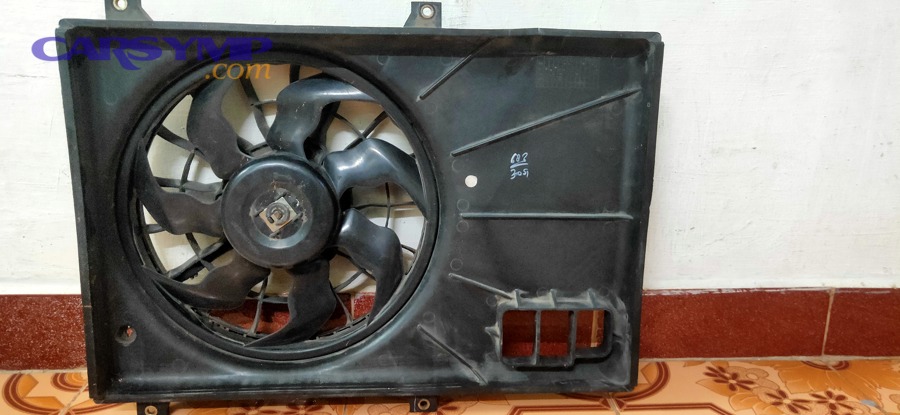
A fan shroud is an airflow management device that improves how the fan pulls air through the radiator by reducing bypass, increasing effective coverage, and limiting recirculation, but a poorly designed shroud can become a restriction at speed.
Next, the shroud isn’t optional “decoration”—it’s part of the airflow circuit.
A good shroud does three important things:
- Forces through-core flow: it blocks easy paths around the radiator so air must pass through fins.
- Improves radiator coverage: it lets the fan pull air from the entire core, not just a circle in front of the blades.
- Reduces recirculation: it prevents hot underhood air from being pulled back into the radiator inlet path.
But shrouds must be designed for the real world. Many performance cooling guides emphasize correct fan position relative to the shroud (often “half-in, half-out” for engine-driven fans) because it affects pull efficiency and can influence airflow behavior at speed. (flex-a-lite.com)
According to a study by Iowa State University from the Department of Mechanical Engineering, in 2015, fan shroud geometry was analyzed for its effect on suction airflow and performance, highlighting that shroud design meaningfully changes airflow behavior rather than acting as a neutral cover. (dr.lib.iastate.edu)
When does cooling come mostly from ram air vs mostly from fans?
There are 3 main operating “cooling modes” based on driving condition: fan-dominant (low speed), ram-air-dominant (steady speed), and blended/high-load (speed plus heavy heat load).
Then, once you classify your situation correctly, the confusion starts to disappear.
To make this practical, think in terms of what’s providing the pressure and flow:
- Fans provide pressure when vehicle speed doesn’t.
- Ram air provides pressure when vehicle speed does.
- Restrictions and heat load decide whether either source is “enough.”
Which driving scenarios are “fan-dominant”?
Fan-dominant scenarios are low-speed conditions where ram air is weak: idle, stop-and-go traffic, long drive-thru lines, slow off-roading, and heat soak after a hot shutdown.
Specifically, these are the conditions where you can have good coolant circulation but still overheat because airflow through the radiator is insufficient.
Common fan-dominant signs:
- Temperature rises at idle but drops once you start moving.
- A/C performance worsens at a stop because the condenser isn’t getting enough airflow.
- You hear fans ramp up, and temperature responds quickly when fans engage (if they’re working properly).
This is also where a mechanical fan clutch or an electric fan control strategy (PWM or staged) makes a dramatic difference. In fan-dominant conditions, the fan is the airflow source.
Which driving scenarios are “ram-air-dominant”?
Ram-air-dominant scenarios are steady cruising conditions where vehicle motion provides strong airflow through the radiator stack, such as highway cruising on flat roads with moderate ambient temperatures.
More specifically, if everything is healthy, the temperature should stabilize rather than continue climbing.
In this mode:
- The radiator relies on clean airflow entry (grille/ducting).
- The system relies on an exit path (hot air must leave the engine bay).
- The fan’s relative contribution drops because the pressure and flow are already present.
This is why many experienced tuners and cooling engineers focus as much on ducting, sealing, and exit pressure as they do on fan CFM numbers. If air doesn’t go through the fins, the radiator’s size doesn’t matter.
What conditions shift the balance back toward fans even at speed?
Three conditions can shift the balance back toward fans at speed: high heat load, increased restriction, and compromised airflow exit—so the system becomes “blended” rather than purely ram-air-dominant.
Moreover, these are the conditions that often produce overheating complaints even when the car is “moving fast.”
Key causes include:
- Towing and grades: engine load rises, heat generation increases.
- High ambient temperatures: the radiator has less temperature difference to work with, so it needs more airflow to reject the same heat.
- A/C on: the condenser heats the air before it reaches the radiator.
- Transmission overheating contribution: the transmission cooler dumps heat into the same airflow stream or into the radiator tank (depending on design). That extra heat load can push the system over the edge.
- Restriction: clogged fins, thick intercoolers, dense auxiliary coolers, or a fan/shroud assembly that blocks flow at speed.
If you want a quick rule: when you add heat exchangers in front of the radiator or increase load, you may need fan “assist” even while moving—because the radiator sees hotter inlet air and/or less effective through-core flow.
Cooling fans vs ram air: what are the most common misunderstandings?
Cooling fans “win” at low-speed airflow control, ram air “wins” at steady-speed airflow volume, and the best setups are designed so neither becomes a restriction to the other.
However, most misunderstandings come from treating airflow like a single number (CFM) rather than a path (entry → through core → exit).
Here are the misunderstandings that create the most confusion:
- “Fans don’t matter above 40 mph” (sometimes true, often oversimplified).
- “More CFM fixes everything” (often false if airflow bypasses fins).
- “Any shroud is better than no shroud” (false if it stalls flow at speed).
- “Push and pull are the same” (not in real packaging).
- “If it overheats on the highway, it needs bigger fans” (often points to restriction, not fan size).
Is “more fan CFM” always better than improving ducting and sealing?
No—more fan CFM is not always better because (1) airflow quality through the core matters more than airflow advertised, (2) ducting/sealing reduces bypass that fans cannot “fix” efficiently, and (3) high CFM often increases blockage and electrical load.
Then, the better strategy is to make the radiator “see” real pressure difference and real through-core flow.
Why CFM alone misleads:
- Fan ratings are often measured without the restriction of a radiator and condenser.
- Radiators create static pressure resistance; the fan must overcome that resistance.
- If air can go around the radiator, your fan may mostly circulate underhood air rather than pull fresh air through fins.
This is why a modest fan with excellent shrouding and sealing can outperform a huge fan mounted with gaps and no ducting. Ducting turns the front opening into a controlled inlet and forces air through the core—so ram air becomes powerful and fans become efficient.
Puller vs pusher fans: which works better and why?
A puller fan wins in efficiency and radiator coverage, while a pusher fan is best when packaging forces it, and a dual strategy is optimal only when it preserves through-core airflow at speed.
Meanwhile, the reason pullers often win is simple: they sit in a region that can be sealed and shrouded more effectively behind the radiator.
Key comparison points:
- Efficiency: pullers typically operate with better flow conditions and less turbulence at the radiator face.
- Obstruction: pushers block the front face of the radiator where ram air enters, and they can create a “dead zone” behind the motor hub.
- Shrouding: rear shrouds can cover the full core and reduce bypass more effectively.
A pusher can still work well if it’s properly sized and mounted, but it must be chosen carefully. If you install a pusher and notice higher temps at speed, suspect blocked core area or disturbed inlet flow rather than “not enough fan.”
Electric vs mechanical fans: which is better for car owners?
Electric fans are best for controllability and idle cooling, mechanical fans are best for simple reliability and high sustained airflow tied to engine speed, and the optimal choice depends on your driving pattern and packaging.
In addition, the “best” answer changes if your vehicle sees towing, long grades, or sustained high RPM.
Electric fans (pros):
- Control via temperature and A/C demand (PWM or staged).
- Reduced parasitic drag when they’re off.
- Helpful for idle/low-speed cooling and heat soak strategies.
Electric fans (cons):
- Electrical load (alternator burden), wiring complexity, relay failures.
- Packaging can create airflow blockage at speed if not designed well.
Mechanical fans (pros):
- Strong airflow potential proportional to engine speed (especially under load).
- Simple system architecture; fewer electrical failure points.
Mechanical fans (cons):
- Parasitic loss can be continuous depending on fan clutch behavior.
- Less precise control; noise can increase when engaged.
If you’re troubleshooting a car that runs hot during towing or long climbs, don’t dismiss mechanical fans as “old tech.” Their airflow can be very effective under sustained load, while a poorly implemented electric setup can struggle if the radiator stack is restrictive.
If your car runs hot at speed, is it really a “fan vs ram air” problem?
No—if your car runs hot at speed, it’s usually an airflow path or heat-load problem first, and a fan vs ram air problem only after you confirm the radiator can actually use road-speed airflow.
Especially, “overheating on highway” is a symptom pattern that points you toward restriction, exit pressure, heat exchanger stacking, ignition/fuel/load issues, or coolant-side limitations.
Before you buy parts, map the symptom. The table below summarizes what different temperature behaviors often indicate so you can aim your diagnosis.
This table shows common temperature patterns and the most likely causes, helping you separate airflow issues from coolant-side issues quickly.
| Symptom pattern | What it often suggests | Why it matters |
|---|---|---|
| Hot at idle, cooler when moving | Fan control, fan failure, shroud sealing | Ram air fixes it once speed provides airflow |
| Hot at speed, okay at idle | Airflow restriction/recirculation/exit pressure | Speed should help; if it doesn’t, airflow path is compromised |
| Hot only with A/C on | Condenser heat + airflow shortfall | Inlet air to radiator is hotter; airflow demand rises |
| Hot on long grades/towing | High heat load + limited radiator capacity or airflow | Load raises heat generation continuously |
| Hot after shutdown (heat soak) | Heat retention + poor airflow strategy | Fans and venting can reduce peak spikes |
According to a study by Iowa State University from the Department of Mechanical Engineering, in 2015, shroud geometry meaningfully affects airflow behavior—so packaging changes behind the radiator can create performance changes that look like “mystery overheating.” (dr.lib.iastate.edu)
What does it mean if temps rise at highway speed but are fine in traffic?
If temps rise at highway speed but are fine in traffic, it usually means the radiator is not benefiting from ram air due to restriction, pressure build-up, or recirculation—rather than a simple lack of fan power.
Then, treat it as an airflow-path investigation.
Highway-rise causes to prioritize:
- Blocked radiator/condenser fins (bugs, leaves, mud, bent fins).
- Fan/shroud assembly restriction (too much blockage of core area, no bypass relief).
- Hot air not exiting (undertray changes, missing air dam, poor venting).
- Stacked heat exchangers choking flow.
- Lean fuel mixture and engine load overheating (tune or fueling problem raises heat production under sustained load).
- Thermostat or radiator capacity issues (less common than airflow, but possible).
A key clue: if the temperature climbs gradually at speed and doesn’t respond to fan engagement, the system often lacks effective through-core airflow or is overloaded by sustained heat generation.
Davies Craig specifically warns that pressure build-up in the cowling or engine compartment can stall airflow across the radiator and raise temperatures—exactly the kind of behavior that shows up “at speed” when the airflow path is wrong. (daviescraig.com.au)
What does it mean if temps rise in traffic but drop on the highway?
If temps rise in traffic but drop on the highway, it almost always points to a fan-dominant weakness: inadequate fan airflow, incorrect fan direction, poor shroud sealing, or fan control strategy issues.
Moreover, this is the classic pattern that makes people think they need a bigger radiator when they really need better low-speed airflow.
Start with quick checks:
- Verify fans spin the correct direction (puller should pull through radiator).
- Confirm the fan turns on at the right temperature and at the right speed (staged/PWM).
- Check for gaps around the shroud and radiator support that allow bypass.
- Confirm the condenser isn’t heat-soaking the radiator at idle due to low airflow.
This is also where wiring and voltage drop matter. An electric fan can spin “fine” unloaded but lose performance under radiator restriction if it’s underpowered electrically.
How can you quickly diagnose airflow restriction vs coolant system issues?
You can diagnose airflow restriction vs coolant-side issues with 5 fast checks: (1) temperature behavior by speed, (2) radiator face condition, (3) pressure/exit path clues, (4) fan/shroud geometry, and (5) load-related heat multipliers like transmission and fueling.
Next, use the checklist below before replacing parts.
1) Speed behavior test (simple but powerful)
- Gets hotter with speed → suspect airflow path, exit pressure, restriction, or load heat.
- Gets cooler with speed → suspect fan control/low-speed airflow.
2) Radiator stack inspection
- Shine a light through the fins. If light doesn’t pass cleanly, airflow won’t either.
- Clean bugs and debris from condenser and radiator, front to back.
3) Underhood and exit path clues
- Missing air dam or damaged splash shields can change pressure distribution.
- Large gaps can let air spill around the radiator instead of through it.
4) Fan/shroud geometry sanity check
- Is the fan centered and properly spaced?
- Is the shroud full-coverage with no relief at speed? If so, it may need bypass flaps.
5) Heat multipliers
- Transmission overheating contribution: if the trans runs hot, that heat may be added to the cooling stack.
- Lean fuel mixture and engine load overheating: a lean condition or aggressive timing under load can increase engine heat output.
If you’re preparing Preventive fixes before long trips, do these checks first. They cost little and often prevent a “parts cannon” approach that doesn’t solve the root cause.
How can you optimize an electric fan system so it doesn’t block ram air?
You can optimize an electric fan system so it doesn’t block ram air by combining (1) a shroud that supports through-core flow, (2) relief/bypass features for high-speed airflow, and (3) fan control that matches real heat load rather than running full-time.
Then, the goal becomes clear: the fan should help when needed and “get out of the way” when ram air is dominant.
Do you need bypass flaps (relief doors) in a fan shroud?
Yes—you often need bypass flaps (relief doors) if your shroud covers most of the radiator because they (1) prevent the shroud from acting as a high-speed restriction, (2) reduce pressure build-up behind the core, and (3) allow ram air to pass through efficiently at speed.
Moreover, bypass flaps are a practical way to solve “it got worse on the highway after I added a full shroud.”
Relief doors work like check valves:
- At low speed, the fan creates suction and the flaps stay mostly closed, forcing air through the radiator.
- At high speed, ram air pressure opens the flaps, providing extra flow area and reducing restriction.
If your vehicle shows overheating on highway after a full-coverage fan/shroud install, relief doors are one of the first design features to consider—because they directly address the “blocked at speed” failure mode.
What fan control strategy (PWM vs on/off) best matches real driving?
PWM control wins for smooth temperature stability, on/off control is best for simplicity and cost, and staged multi-fan control is optimal for high-load vehicles that need predictable airflow steps.
Meanwhile, the right choice depends on how you drive and how much heat load changes over time.
PWM (Pulse Width Modulation):
- Pros: smooth temperature control, reduced cycling, potentially lower electrical spikes.
- Cons: requires compatible controller/fan, tuning complexity.
On/off (single threshold):
- Pros: simple wiring, reliable if done well.
- Cons: temperature swings, frequent cycling, audible fan “events.”
Staged (Fan 1 then Fan 2, or low/high):
- Pros: matches rising heat load; useful with A/C and towing.
- Cons: more relays and wiring.
A smart strategy also reduces alternator burden. Running fans at full power all the time can add electrical load and heat in the engine bay, and it can make airflow management worse if it encourages recirculation.
How do stacked coolers and the AC condenser change the fan vs ram-air equation?
Stacked coolers and the A/C condenser change the equation by raising inlet air temperature to the radiator and increasing airflow resistance, which makes both ram air and fan airflow less effective unless the system is ducted and sealed.
Especially, this is where Transmission overheating contribution becomes important: transmission heat can be dumped into the same airflow stream before the radiator ever sees it.
Common stacked scenarios:
- A/C condenser in front: heats the incoming air, reducing the radiator’s ability to reject heat.
- Transmission cooler: adds heat into airflow or into radiator tank, raising total cooling demand.
- Intercooler (turbo vehicles): increases restriction and competes for frontal airflow.
This is why a vehicle can run fine on a cool day but struggle in hot weather with A/C on, towing, or climbing grades. The system isn’t “bad”; it’s just operating at a higher heat load with reduced cooling headroom.
In underhood airflow literature, researchers repeatedly note the complexity of underhood flow and recirculation effects that can reduce cooling effectiveness—supporting why ducting and airflow path matter as much as fan selection. (sciencedirect.com)
Which advanced airflow mods help when everything else is correct?
There are 4 advanced airflow mods that help when the basics are correct: improving radiator inlet sealing, improving hot-air exit paths, managing underbody pressure, and reducing recirculation near the radiator inlet.
In short, these are “last 10%” fixes—valuable when you’ve already verified fans, shrouds, and coolant-side health.
Practical options (use only what fits your vehicle safely):
- Inlet sealing and ducting: close gaps so incoming air can’t bypass the radiator stack.
- Hot-air exit improvement: ensure air can leave behind the radiator (factory ducting intact, no blockages).
- Underbody management: restoring missing splash shields or air dams that help pressure distribution.
- Vent and recirculation control: on some builds, venting can reduce underhood pressure and improve through-core flow.
If your goal is Preventive fixes before long trips, prioritize the basics first (clean fins, correct coolant mix, proper cap pressure, verified fan operation, intact ducting). Advanced mods help most when the system is already healthy but operating near its limits (towing, desert heat, track sessions).
Evidence (key sources referenced)
- Davies Craig highlights that pressure build-up behind a radiator cowling can stall airflow across the radiator and raise engine temperatures. (daviescraig.com.au)
- Horton describes cooling as a combination of ram air (movement-produced airflow) and fan airflow supporting heat rejection.
- Flex-a-lite and PRI Tech emphasize correct fan-to-shroud positioning and airflow management principles. (flex-a-lite.com)
- Iowa State University research discusses how fan shroud geometry affects airflow behavior and performance. (dr.lib.iastate.edu)
- University of Western Ontario research examines how downstream blockage affects low-pressure automotive fan performance, supporting why restrictions and packaging matter. (eng.uwo.ca)