


A long road trip is safest and cheapest when you prevent breakdowns before you leave by running a pre-trip preventive maintenance checklist that catches tire, fluid, brake, battery, and cooling problems early—before they turn into roadside emergencies. (newsroom.aaa.com)
Next, you’ll learn what “pre-trip preventive maintenance” really means, so you don’t waste time on random tasks and you don’t skip the few checks that actually decide whether your trip is smooth or stranded.
Then, you’ll get a complete, system-by-system checklist plus a clear way to turn “checks” into “fixes,” including what you can safely DIY and what belongs in a shop—so you can prioritize with limited time or budget.
Introduce a new idea: you’ll also see the no-go warning signs (especially around cooling, tires, and brakes) and a short test-drive protocol that confirms road-trip readiness before you commit to hours on the highway.
What does “pre-trip preventive maintenance” mean for long road trips?
Pre-trip preventive maintenance is a road-trip-specific inspection and minor service routine you perform before departure to reduce safety risk and breakdown probability by verifying tires, fluids, brakes, battery, cooling, visibility, and leak conditions against “trip-ready” thresholds.
Next, because “maintenance” can mean everything from a full service to wiping the windshield, the key is to treat pre-trip preventive maintenance like a screening process: you’re looking for a small set of high-impact failures that commonly strand drivers—battery issues, flat tires, and other preventable problems. (newsroom.aaa.com)
Here’s what makes pre-trip preventive maintenance different from everyday upkeep:
- It is time-bound. You’re not planning the next 12 months; you’re verifying the car is stable for the next few hundred (or thousand) miles.
- It is risk-weighted. You prioritize items that cause roadside calls and highway safety problems: tires, battery/charging, cooling stability, and brakes. (newsroom.aaa.com)
- It ends with verification. A short test drive confirms the “fixes” actually solved the issue, because a repair that isn’t verified is just a guess.
In practical terms, pre-trip preventive maintenance has two outputs:
- A checklist you can confidently mark “pass/fail.”
- A prioritized fix list that tells you what to handle now, what can wait, and what means you should not start the trip yet.
According to a study by Mineta Transportation Institute (San José State University) from Project 2006 (February 2021), the literature review and case study reinforce that low tire pressures increase fuel consumption and contribute to increased emissions, supporting pre-trip tire checks as a high-impact preventive step. (transweb.sjsu.edu)
What are the must-check items on a pre-trip car maintenance checklist?
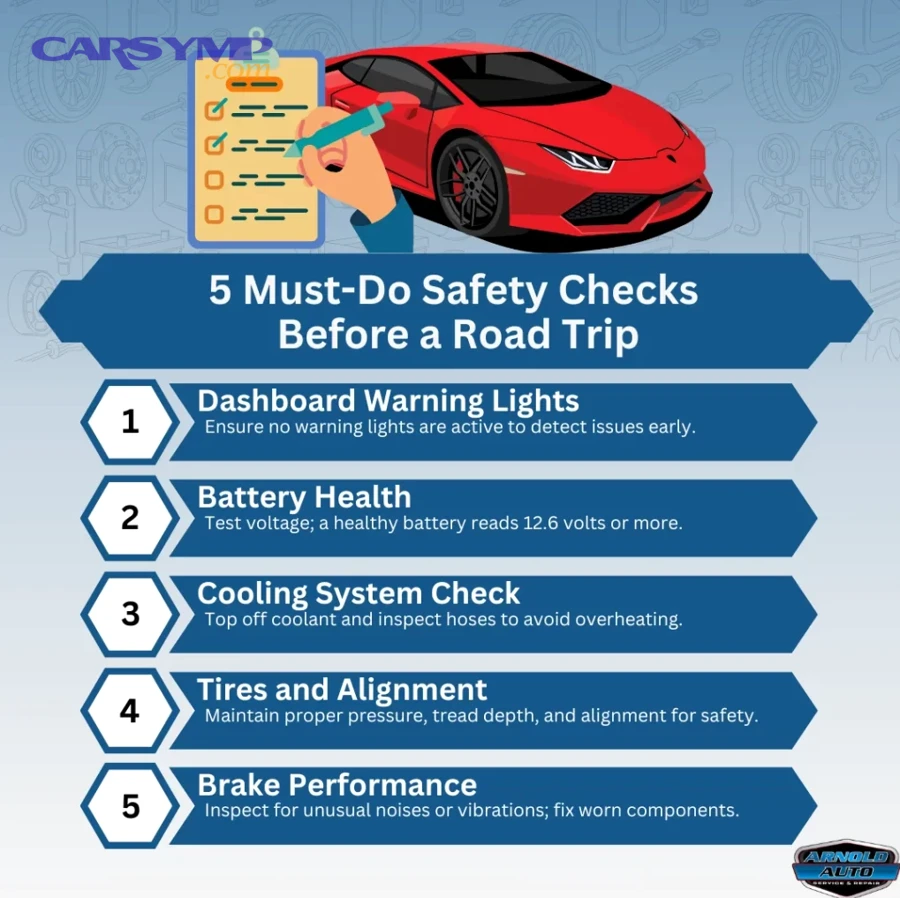
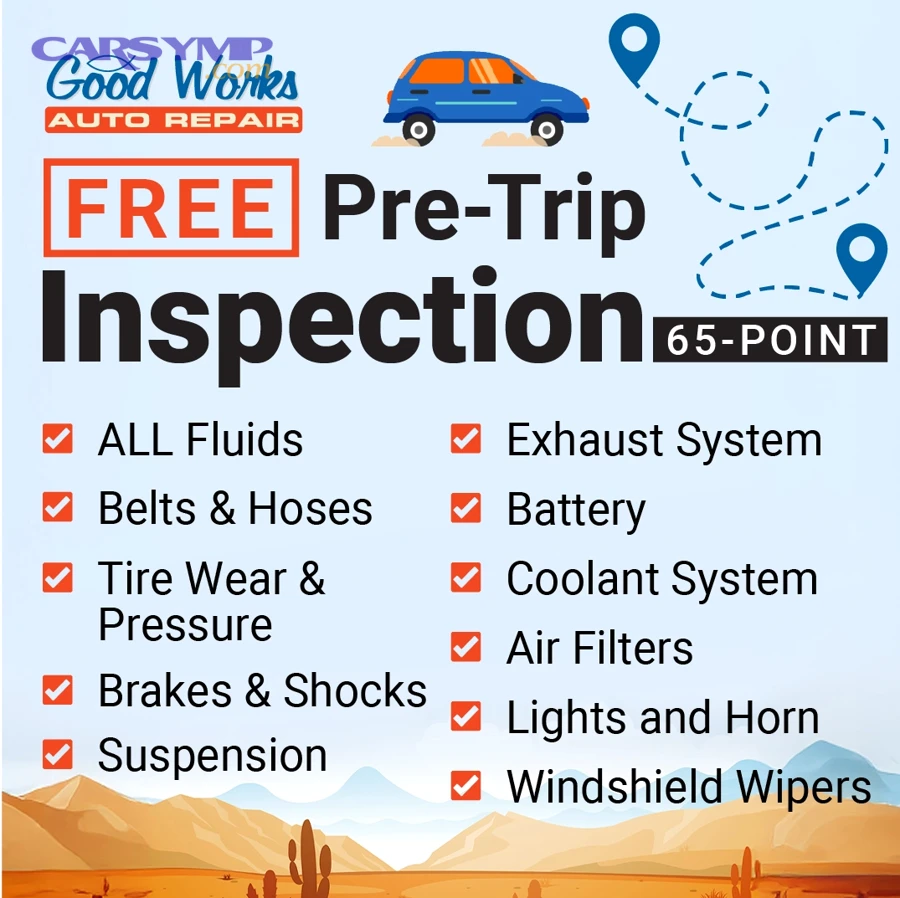
There are 8 main types of must-check items on a pre-trip car maintenance checklist: tires, fluids, brakes, battery/charging, cooling system basics, lights/visibility, belts/hoses, and safety essentials, based on the criterion of breakdown risk + safety impact.
Next, because a road trip magnifies small problems into big failures, the best checklist is organized by systems—so you can diagnose quickly and avoid “fixing the wrong thing.”

Is your tire setup road-trip ready (pressure, tread, age, spare)?
Yes—your tire setup is road-trip ready only if you confirm correct pressure, safe tread depth, acceptable age/condition, and a functional spare, because tires carry the entire load, they fail suddenly, and they directly control braking and stability.
Next, tires deserve first priority because they are both a safety system and a common cause of roadside trouble. (newsroom.aaa.com)
Check tire pressure (cold)
- Use the driver-door placard pressure, not the number on the tire sidewall.
- Check when tires are cold (parked for a few hours) because highway heat changes readings.
- If your TPMS light is on, treat it as a real problem: in the U.S., TPMS is designed to alert when pressure in one or more tires falls below 75% of the manufacturer’s recommended cold pressure. (crashstats.nhtsa.dot.gov)
Check tread depth and traction risk
- Look for uneven wear (alignment/suspension clues), and measure the shallowest grooves.
- As tread drops, wet-road traction decreases and tire-related pre-crash problems become more likely.
- In NHTSA’s crash-stats research, vehicles running on tires with 0–2/32" tread were observed to experience tire problems in the pre-crash phase 3× more than vehicles with 3–4/32" tread. (crashstats.nhtsa.dot.gov)
Check tire age and sidewall condition
- Look for sidewall bulges, cuts, or cracking.
- Check the tire’s DOT date code if you suspect the tires are old or the car sat for long periods (age can matter even if tread looks fine).
Check the spare and tools
- Confirm the spare is inflated and that you have the jack, lug wrench, and wheel-lock key (if applicable).
- If your vehicle has no spare, confirm your sealant/inflator kit is present and not expired, and consider what that means for remote routes.
According to a study by NHTSA’s National Center for Statistics and Analysis using NMVCCS 2005–2007 data (published in 2012), tires with 0–2/32" tread were associated with a markedly higher share of tire-related crash vehicles, reinforcing that tread checks are not cosmetic—they’re preventive safety screening. (crashstats.nhtsa.dot.gov)
Are your fluids at the right level and condition for a long drive?
Yes—your fluids are road-trip ready when they meet correct level and condition checks, because fluids prevent heat damage, maintain hydraulic pressure, and reveal leaks that worsen under sustained highway load.
Next, fluid checks are not about topping everything off blindly; they’re about catching two trip-ending patterns: leaks and overheating.
Engine oil
- Verify level on the dipstick (if equipped) and look for unusually dark, gritty oil or a burnt smell.
- If you’re close to your service interval and you’ll add hundreds of miles, schedule the oil change early enough to recheck for leaks afterward.
Coolant
- Check only when the engine is cold.
- Look for “MIN/MAX” marks on the reservoir and inspect for crusty residue, damp hoses, or sweet smell.
- Treat Low coolant and leaks under load as a serious pre-trip risk: a small seep that looks harmless in town can become a large loss at highway speed when pressure and temperature rise.
Brake fluid
- Check the reservoir level and look for signs of leakage around wheels or under the master cylinder.
- A low brake fluid level may indicate pad wear or a leak; either requires attention before a long trip.
Transmission fluid (if applicable/accessible)
- Many modern cars are sealed; if you have no dipstick, look for leaks and follow the manufacturer’s service schedule.
- If you’ve had shifting flare, harsh shifts, or overheating history, prioritize a pre-trip inspection.
Power steering fluid (if hydraulic)
- Check level and inspect for leaks.
- Don’t confuse noises: a whine during turns can be low power steering fluid noise confusion, but you still must confirm the source and not assume.
Washer fluid
- Fill it. On a long trip, visibility is safety.

According to a U.S. Department of Energy vehicle efficiency fact sheet (June 2017), proper tire pressure saves fuel, and underinflation wastes fuel and can pose safety risks—supporting fluid and tire checks as part of a pre-trip efficiency-and-safety routine. (energy.gov)
Are your brakes safe for highway speeds and hills?
Yes—your brakes are road-trip safe if they provide consistent stopping power, stable pedal feel, and no warning symptoms, because highway speeds and long descents amplify heat, increase stopping distance, and punish weak components.
Next, brake checks are both a safety requirement and a breakdown-prevention step, because a dragging brake or failing caliper can overheat, warp rotors, and create an emergency.
Do a fast, practical brake screen:
- Pedal feel: firm and consistent, not spongy or sinking.
- Straight-line braking: no pulling left/right.
- Noise: no grinding (metal-on-metal) and no sudden new scraping.
- Vibration: no steering shake or pulsing strong enough to suggest warped rotors or loose suspension.
If you’re driving mountains, consider brake heat management:
- Use engine braking when appropriate.
- Avoid riding the brakes.
- If you smell burning or feel fade, stop and cool down—then diagnose before continuing.
According to a study by NHTSA’s National Center for Statistics and Analysis (2012), tire problems and vehicle stability issues are linked with increased crash potential, which interacts with braking demands—supporting pre-trip braking and tire readiness as a combined safety strategy. (crashstats.nhtsa.dot.gov)
Is your battery and charging system likely to survive the trip?
Yes—your battery and charging system are trip-ready if the battery is healthy, connections are clean/tight, and there are no charging warning signs, because battery problems are a frequent reason drivers need roadside help and heat/cold accelerate battery weakness. (mwg.aaa.com)
Next, the mistake many drivers make is assuming the battery is “fine” because the car starts today; weak batteries often fail after short stops—exactly what road trips include (gas, food, viewpoints).
Practical checks:
- Age: if the battery is old or unknown, get it tested before the trip.
- Start behavior: slow crank or clicking is a warning.
- Terminals: look for corrosion (white/green crust) and ensure tight connections.
- Charging warnings: battery light on the dash or intermittent electrical glitches.
If you’re in extreme temperatures, expect battery weakness to show itself more easily, and build extra margin into your plan.
According to a report from AAA’s newsroom (July 2016), AAA rescued 32 million drivers in 2015, with more battery and flat tire problems than ever before, reinforcing that pre-trip battery and tire checks target common real-world failure modes. (newsroom.aaa.com)
Which preventive fixes should you do before a long trip (and when)?
There are 3 main types of preventive fixes you should do before a long trip—fix-now safety repairs, near-term reliability services, and simple DIY readiness tasks—based on the criterion of risk severity + how quickly the problem can escalate.
Next, this turns your checklist into an action plan: you stop “checking” and start “preventing.”
Here’s a simple timeline that works for most drivers:
- 7–14 days before: anything that could require parts, alignment, or re-check after repair.
- 2–3 days before: final fluid/tire verification, lights, wipers, and a short test drive.
- Day of departure: tire pressure confirmation and quick leak check.
What can you fix in 30 minutes at home vs what needs a shop visit?
DIY wins for basic readiness tasks, a shop is best for safety-critical mechanical work, and a hybrid approach is optimal for time—because some fixes require lifts, torque specs, bleeding systems, or diagnostics you can’t reliably do roadside.
Next, treat DIY as “low-risk, high-certainty” work.
DIY in 30 minutes (typical)
- Inflate tires to placard spec; check spare.
- Replace wiper blades; top washer fluid.
- Inspect visible leaks; check oil/coolant level (cold).
- Clean battery terminals (carefully) if corrosion is mild and you know the safe procedure.
- Verify lights and signals.
Shop visit (recommended)
- Brake pad/rotor work, brake fluid leak diagnosis.
- Tire repair for punctures near sidewalls; replacements; balancing/alignment.
- Cooling system pressure test when coolant loss is suspected.
- Charging system test when battery/alternator symptoms appear.
- Suspension issues causing irregular wear or steering instability.
According to a U.S. NHTSA tire safety resource, proper inflation can extend tire life by about 4,700 miles and improve efficiency—benefits that come from simple, repeatable checks that are often DIY-friendly. (nhtsa.gov)
What are “fix-now” issues that can turn into breakdowns on the highway?
There are 7 main fix-now issues that can turn into a highway breakdown: active fluid leaks, overheating history, low coolant warnings, bulging/damaged tires, brake warning symptoms, charging-system warnings, and severe vibration/steering pull, based on the criterion of rapid escalation at sustained speed.
Next, “fix-now” means you do not rationalize it away; you reduce risk before you leave.
Key examples:
- Active coolant leak or repeated top-offs
- This is how “overheating on highway” stories begin: the system pressurizes, a weak hose opens up, and temperature spikes.
- Water pump and thermostat highway behavior issues
- A thermostat that sticks can look “fine” in town but fail under continuous load.
- A water pump with a marginal bearing/seal can leak more when RPM and temperature rise.
- Low coolant warning + no visible puddle
- Treat it as Low coolant and leaks under load until proven otherwise: pressure tests exist for a reason.
- Bulges, sidewall cuts, or cords showing
- Replace; do not “chance it.”
- Grinding brakes or brake pedal fade
- Fix before travel, especially if you’ll drive hills or heavy traffic.
- Battery/charging warning light
- A failing alternator can leave you stranded after a stop.
- Violent steering vibration
- Can signal tire separation, bad wheel balance, or suspension issues—none are road-trip friendly.
According to a study by NHTSA’s National Center for Statistics and Analysis (2012), inadequate tread and improper inflation correlate with increased tire problems in the pre-crash phase, supporting a fix-now approach when tire condition is questionable. (crashstats.nhtsa.dot.gov)
What maintenance should be done 7–14 days before the trip (not the night before)?
There are 5 main maintenance items you should do 7–14 days before a trip—oil service if due soon, tire service/alignment if wear is uneven, brake inspection/service if symptoms exist, cooling system inspection if any coolant concerns exist, and battery/charging test if age/symptoms suggest weakness—based on the criterion of needing time for parts, repairs, and verification.
Next, the reason you don’t do these the night before is simple: you need time for a second check and a short shakedown drive.
A good “two-week window” routine:
- Schedule service early, then do a 20–30 minute test drive.
- Recheck fluid levels and look for fresh drips after the car cools.
- Confirm no new dashboard lights appear.
If your car has a history of running hot, this is when you investigate root causes that show up under long load, like Lean fuel mixture and engine load overheating—a condition that can increase combustion temperatures and stress the cooling system, especially at sustained speed.
According to a study by Mineta Transportation Institute (San José State University) from February 2021, the relationship between tire pressure and fuel consumption is well-established in the literature they reviewed, and the study frames tire inflation as a repeatable preventive action—making a post-service verification drive and recheck a practical way to confirm stability. (transweb.sjsu.edu)
How do you prioritize checks if you only have limited time or budget?
There are 3 main priority tiers for pre-trip checks—safety-critical, breakdown-likely, and comfort/efficiency—based on the criterion of severity of consequences if the item fails at highway speed.
Next, this tiering prevents the common mistake of spending money on low-impact tasks while ignoring the handful of issues that strand drivers.
Use this practical ranking:
- Safety-critical (do first)
- Tires (pressure, tread, damage, spare)
- Brakes (feel, noise, warning symptoms)
- Lights (headlights, brake lights, signals)
- Breakdown-likely (do next)
- Battery/charging health
- Cooling stability (coolant level, leaks, hose condition)
- Oil level/condition (especially if close to due)
- Comfort/efficiency (do last)
- Cabin air filter
- Wipers/washer fluid (still important)
- Minor rattles, interior issues
What are the top 5 high-impact checks that prevent the most roadside failures?
There are 5 high-impact checks that prevent the most common trip disruptions: tire condition, battery/charging readiness, cooling system leak screening, oil level verification, and brake safety screening, based on the criterion of frequency + severity.
Next, these five work because they target the problems that show up again and again in real roadside outcomes.
- Tires: pressure + tread + damage + spare readiness
- Battery: age/symptoms + test + clean terminals
- Cooling: coolant level cold + leak evidence + fan operation awareness
- Oil: correct level and service timing
- Brakes: pedal feel + noise + straight stopping
According to information published by AAA, dead batteries and flat tires are among the most common roadside emergencies, which aligns with prioritizing tires and battery checks first. (mwg.aaa.com)
Should you change oil before a road trip if you’re not due yet?
It depends—changing oil early is best when you’re close to the interval, driving in heat/load, or uncertain about oil level/consumption, but keeping current oil is fine when it’s well within interval, the level is stable, and there are no leaks.
Next, the decision is a comparison between risk margin and unnecessary service.
Change oil early when:
- You’ll cross the service interval during the trip.
- The engine consumes oil and you don’t want to monitor constantly.
- You’ll tow, drive mountains, or run long highway stretches in high heat.
Keep your current oil when:
- You’re far from the interval.
- The engine is not consuming oil and the level stays stable.
- You’ve had recent service with no leaks.
Even if you don’t change oil, still verify the level and carry the correct top-off oil if your vehicle is known to consume it.
According to an AAA maintenance resource emphasizing routine checks and preventive tasks, staying ahead on fluids reduces the risk of major repairs and trip-ending issues, supporting proactive—but not wasteful—fluid management. (aaa.com)
What warning signs mean you should not start a long trip yet?
No—you should not start a long trip if you see overheating symptoms, repeated low coolant warnings, unsafe tire or brake conditions, or severe vibration, because these issues can escalate quickly at highway speed, cause expensive damage, and create safety emergencies.
Next, a “no-go” rule sounds strict, but it is cheaper than gambling with tow bills, missed plans, and potential crash risk.
Use this no-go checklist:
- Temperature gauge rising abnormally or warning message appears
- Coolant level drops repeatedly or you find fresh coolant residue
- Tire bulge, exposed cords, severe cracking, or very low tread
- Brake grinding, strong pull, or warning light
- Battery/charging warning light or repeated no-start events
- Severe vibration that changes with speed or steering input
Is it safe to drive if your car recently overheated or has a low coolant warning?
No—it’s not safe to start a long trip if the car recently overheated or shows a low coolant warning without diagnosis, because overheating can damage the engine and a low-coolant condition can worsen rapidly under sustained highway load.
Next, this is where many drivers get trapped in a pattern: the car seems okay for short drives, then overheating on highway returns because highway load builds heat continuously.
What to do instead:
- If it overheated, diagnose before travel: look for leaks, fan operation issues, thermostat behavior, and pressure-test results.
- If you have a low coolant warning, treat it as a symptom, not a problem. You need the cause: leak, cap not holding pressure, hose weakness, radiator issue, water pump seep, or heater core loss.
This is also where Water pump and thermostat highway behavior matters: both parts can behave “borderline” until sustained RPM and heat reveal the failure.
According to a study by NHTSA’s National Center for Statistics and Analysis (2012), maintaining proper inflation and adequate tread reduces the emergence of tire problems under adverse conditions, reinforcing the general pre-trip rule: when a safety-critical system is compromised, you fix first and travel second. (crashstats.nhtsa.dot.gov)
What noises are red flags before travel (clicking, grinding, whining)?
There are 3 main red-flag noise categories before travel—clicking, grinding, and whining—based on the criterion of likelihood of mechanical failure or safety impact.
Next, noises aren’t just annoying; they are diagnostic clues.
- Clicking noise when turning
- Often points toward CV joint issues, especially if the clicking repeats rhythmically during turns.
- It may still drive, but long distances and highway exits can stress it further.
- Grinding
- Treat as urgent for brakes or wheel bearings. Grinding brakes can turn into metal-to-metal damage quickly.
- Whining
- Can be wheel bearing noise (speed-related) or power steering pump noise (steering-input-related).
- This is where low power steering fluid noise confusion happens—confirm by checking fluid level and observing when the noise occurs.
If you can’t confidently identify the noise, a pre-trip inspection is not optional—it’s preventive.
According to guidance from NHTSA on tire safety and maintenance, tire condition has major safety and savings implications, and abnormal noises plus irregular wear can be related to tire and wheel issues that affect control. (nhtsa.gov)
How do you confirm road-trip readiness with a short “test drive” protocol?
A road-trip readiness test drive is a 20–30 minute verification loop that checks temperature stability, braking behavior, steering tracking, vibration, and post-drive leaks so you confirm your preventive fixes worked before you commit to hours on the road.
Next, verification is the final link in the chain: checklist → fixes → proof.
Run this simple protocol:
- Warm-up and temperature stability
- Watch the temp gauge: it should rise to normal and stabilize.
- Any drift upward under mild driving is a warning.
- Braking checks
- Perform a few controlled stops in a safe area.
- Confirm no pull, no fade, no grinding, no major vibration.
- Steering and vibration
- Drive at neighborhood speeds, then at 50–65 mph if safe/legal.
- Note any shake, wobble, or pull.
- Stop and inspect
- Park on a clean surface.
- After cooling, look under the car for new drips.
- Recheck coolant and oil levels if you recently serviced or topped off.
If your car is prone to overheating, include a brief hill climb or highway segment to see if Lean fuel mixture and engine load overheating symptoms appear under load (hesitation, unusual temps, pinging, or a check engine light).
According to a study by Mineta Transportation Institute (San José State University) from February 2021, the relationship between tire pressure and fuel consumption is well-established in the literature they reviewed, and the study frames tire inflation as a repeatable preventive action—making a post-service verification drive and recheck a practical way to confirm stability. (transweb.sjsu.edu)
What specialized pre-trip checks apply to your specific trip conditions and vehicle type?
There are 4 main specialized pre-trip check types—hot vs cold weather adjustments, towing/fully loaded adjustments, rare tire-age screening, and hybrid/EV readiness—based on the criterion of conditions that change heat load, traction, and failure probability.

Next, this is the “micro” layer that makes your checklist smarter than generic advice, because opposite conditions (hot vs cold, loaded vs light) change what breaks first.
How should you adjust preventive checks for hot weather vs cold weather road trips?
Hot-weather trips demand stronger cooling and tire heat management, while cold-weather trips demand stronger battery and pressure management, because temperature shifts change system margins and reveal weak components.
Next, use an antonym lens: heat vs cold changes the checklist emphasis.
Hot weather focus
- Cooling system integrity: hoses, reservoir, fans, and leak evidence.
- Watch for overheating on highway and heat-soak restarts.
- Tire pressure: heat increases pressure after driving; set pressure cold.
Cold weather focus
- Battery testing becomes higher priority.
- Tire pressure drops with cold; recheck before departure and after overnight parking.
According to NHTSA, proper tire inflation provides safety and savings benefits and can extend tire life by about 4,700 miles, making pressure checks especially valuable when temperatures swing. (nhtsa.gov)
What changes when towing or traveling fully loaded (and why)?
Towing or heavy loading increases heat, braking demand, and tire stress, so you must prioritize tires, brakes, cooling, and transmission resilience because the vehicle operates closer to its limits for longer periods.
Next, think of towing as “the highway load turned up.”
Pre-trip upgrades in attention:
- Tires: confirm load rating and pressure for load; inspect sidewalls carefully.
- Brakes: ensure strong, consistent stopping; consider brake service if near end-of-life.
- Cooling: check coolant level and look harder for leaks.
- Transmission: if you have a history of heat or towing, use manufacturer guidance for service intervals and consider auxiliary cooling where appropriate.
This is where Water pump and thermostat highway behavior becomes more than theory: towing keeps the engine in higher load states, which exposes marginal cooling parts.
According to AAA roadside reporting, common breakdown reasons include mechanical and tire issues, and heavier-duty operating conditions logically raise the importance of preventive checks that reduce those failure risks. (newsroom.aaa.com)
What rare tire details matter most before long trips (DOT age, sidewall microcracks)?
Rare but high-impact tire details include DOT age, sidewall microcracks, and internal damage clues, because tires can look “fine” by tread alone yet still be vulnerable to heat, impact, and long-distance stress.
Next, this is the hidden failure category: low probability, high consequence.
Use this quick screen:
- If tires are old/unknown, check the DOT date code and inspect for fine cracking near the bead and sidewall.
- If you recently hit a pothole, inspect for bulges or localized deformation.
- If you feel a new vibration, don’t assume balance—inspect tire integrity.
According to NHTSA crash research, inadequate tread depth and improper inflation are associated with increased tire problems in pre-crash phases, reinforcing that tire condition is a legitimate safety variable, not a cosmetic one. (crashstats.nhtsa.dot.gov)
How do hybrids/EVs differ in “pre-trip readiness” (12V battery, tires, charging plan)?
Hybrids and EVs require extra focus on tire condition, the 12-volt battery system, and route/charging planning, because EV weight and torque can stress tires and a weak 12V system can still prevent normal operation even when the main battery has charge.
Next, don’t let “range anxiety” distract you from the most practical failure modes.
- Tires: EVs can be heavier and hard on tires; inspect more carefully, confirm pressure, and understand your spare/sealant situation.
- 12V system: EVs still use a conventional 12-volt battery for control systems; failure can strand you.
- Charging plan: confirm reliable charging stops and backups.
A report described by Time (Jan 2024), citing AAA’s findings, notes that tire issues are a leading reason EV drivers call for roadside help and that EV tire issue rates can be significantly higher than for internal combustion vehicles, underscoring the importance of tire-first readiness for EV trips. (time.com)
Evidence (if any)
According to a study by NHTSA’s National Center for Statistics and Analysis, using NMVCCS 2005–2007 data and published in 2012, vehicles running on tires with 0–2/32" tread were observed to experience tire problems in the pre-crash phase three times more than vehicles with 3–4/32" tread, highlighting why tread depth is a preventive, trip-critical check. (crashstats.nhtsa.dot.gov)
According to a study by Mineta Transportation Institute (San José State University) from Project 2006 (February 2021), prior findings referenced in their review indicate underinflation increases rolling resistance (including a cited estimate of roughly 1.1% rolling resistance increase per 1 psi underinflation) and their analysis reinforces that low tire pressure can increase fuel consumption, supporting tire inflation as a high-ROI preventive fix before long trips. (transweb.sjsu.edu)